Theme: Measurement

  • Not everyone will understand the math, but many can follow the procedures, and benefit from whatever is produced by them

    Oct 10, 2019, 12:28 PM

    —“Science explains and Mathematics describes the universe. However, engineers are necessary to produce calculations and write procedures and processes for the technician that produces the machines that the clerk, and laborer use to produce the goods services and information the individual consumes. Not everyone will understand the math, but many can follow the procedures, and benefit from whatever is produced by them.”— JWarren Warren

  • ‘Contrast Godel with P – Request from Kash Vikas

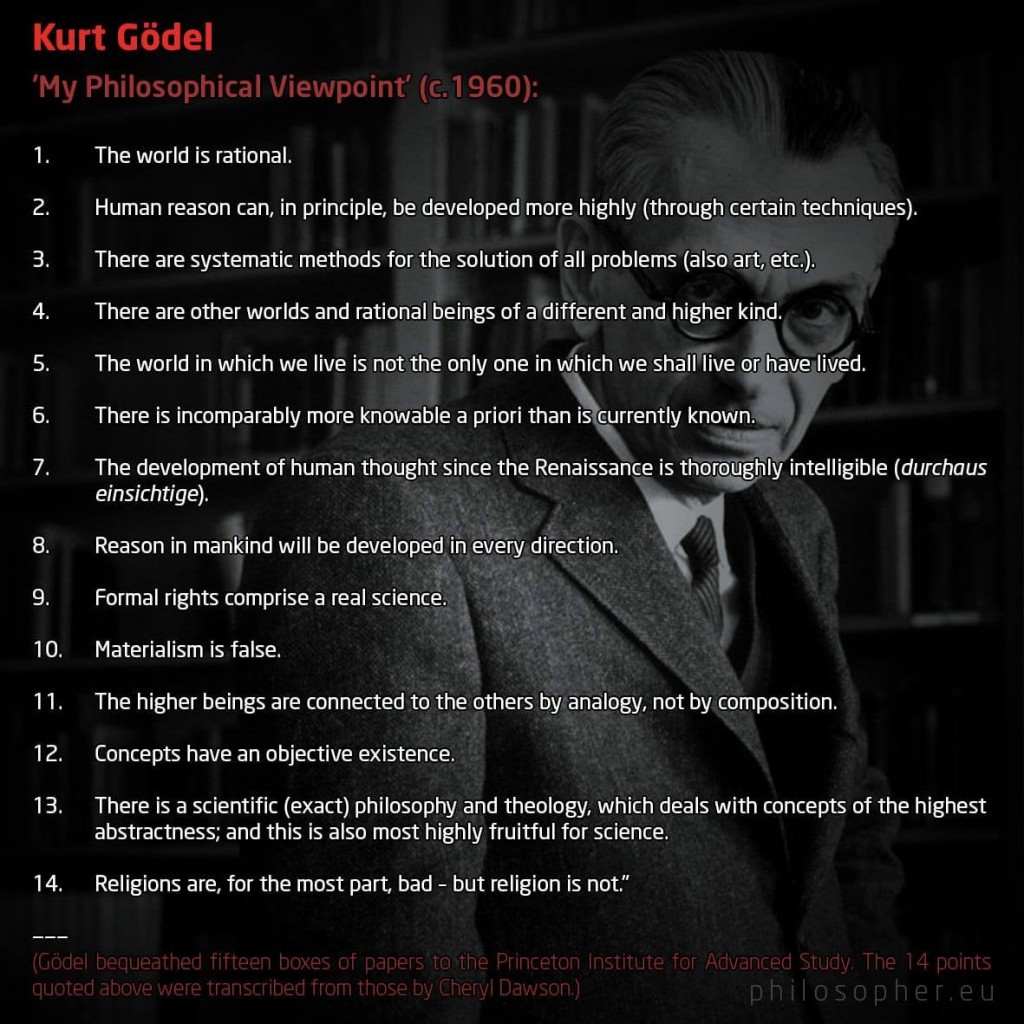
    Oct 16, 2019, 10:49 AM (Godel is a Platonist and I’m an Operationalist. This contrast is rather helpful in illustrating the operational vs platonist vs empirical.)

    1. Man acts rationally, and by rationally amorally. But given the disproportionate value of cooperation, and the disproportionate risk of retaliation, it’s just in his interest to act morally much more often than immorally.
      1a. We can incrementally reduce observations of the universe, using our senses, reason, and instrumentation to descriptions of invariant constant relations (paradigms)
      1b + 3. We can describe (explain) all of experience as constant relations (a single paradigm)
    2. While our ability to reason is constant, every increase convergence of our instruments and paradigms increases the explanatory power available to our reason.
    3. The capacity to reason is a deterministic product of entropy at convenient temperatures in convenient conditions, for sufficient periods of time. It is likely that given the vastness of the universe, other creatures have evolved reason, and that while the logic of constant relations will exist, and mathematics as a logic of constant positional relations will exist in some form, that the composition of experience that results from different body structures will result in different techniques for employing reason. (think octopi). And that the ability of these creatures may vastly outperform ours.
    4. Because we are able to use our powers of prediction using free association to construct a model of the world we exist in, and the worlds we might exist in, and the worlds we cannot exist in, we can experience, many candidate worlds.
      5b. The set of demands we evolved and express daily is largely invariant. The set of paradigms we use to imagine opportunities for fulfilling those demands evolves (and devolves) constantly. So while we largely increase the coherence of paradigms, and approach a single paradigm for describing the universe, we have experienced the world differently in the past than in the present, and will so again experience it differently in the future.
    5. If we can construct an operational grammar and paradigm for a given set of constant relations, we can produce an operational logic of that set of constant relations, and conduct experiments logically by trial and error as we do in mathematics. To do so we require convergence of paradigms to the point of marginal indifference of those logical constructions. But the Analytic program failed, and Godel and Frege et all were wrong – closure does not exist.
    6. Yes the development of thought since Aristotle expanded on Democritus, has been consistent and rational with the exception of the semitic abrahamic dark ages of supernatural ignorance.
    7. Reason is reason is reasoning and there is nothing to it. There are however endless permutations of reason especially as knowledge increases.
    8. The via-negativa of Natural Law can be restated in the via-positiva as Natural rights, and this logic and empirical combination produces a science of cooperation, and law the institutional enforcement of cooperation under that law, and economics the measure of it’s success, and economics the language of analysis and measurement within that science.
      10.The material(noun) and the Operational(verb) are true (exist, and are testifiable). The platonic (ideal) is false. All sets of constant relations are identified, retained, applied, reinforced, and revised by merging physical stimuli with physical organization of information in the brain, producing a hierarchy of changes in state over time we call ‘experience’. So while it is correct to say that the universe is deterministic (composed of constant relations), it is only correct to say that we can observe sets of constant relations, identify them (category), compare them, name them, and predict future states of of them, and in relation to them. These memories and predications like running consist of physical potential, that produce results in time. In other words, al of reality is constructed physically, from a hierarchy of changes in state over time we call experience.
    9. Concepts do not exist. the potential for Concepts exists. Running only exists when one is running. We have the potential to run. We have the potential to identify sets of constant relations (concepts), but experience of contexts only exist when we are acting to recall them in time.
    10. It appears we can know the most parsimonious paradigm, and host of parsimonious sub-paradigms of increasing complexity (permutations) allowing us to speak the truth using evidence – science; that we can know the same for choices using arguments – philosophy; and we can know the same for collective organization using stories – theology.
    11. Existing religions are bad to terrible to suicidal – but human psychological, social, political, and strategic demand for the products of ‘religion’ (order) are endless. So we need to educate one another in mindfulness, ethics(interpersonal), morality (extrapersonal), political, and strategic (competitive), by means gracefully increasing and decreasing in accessibility: parable, story, history, reason and general rules, science and outcomes.’
      CONTRAST WITH P – REQUEST FROM KASH VIKAS
      (Godel is a Platonist and I’m an Operationalist. This contrast is rather helpful in illustrating the operational vs platonist vs empirical.)

    12. Man acts rationally, and by rationally amorally. But given the disproportionate value of cooperation, and the disproportionate risk of retaliation, it’s just in his interest to act morally much more often than immorally.
      1a. We can incrementally reduce observations of the universe, using our senses, reason, and instrumentation to descriptions of invariant constant relations (paradigms)
      1b + 3. We can describe (explain) all of experience as constant relations (a single paradigm)

    13. While our ability to reason is constant, every increase convergence of our instruments and paradigms increases the explanatory power available to our reason.
    14. The capacity to reason is a deterministic product of entropy at convenient temperatures in convenient conditions, for sufficient periods of time. It is likely that given the vastness of the universe, other creatures have evolved reason, and that while the logic of constant relations will exist, and mathematics as a logic of constant positional relations will exist in some form, that the composition of experience that results from different body structures will result in different techniques for employing reason. (think octopi). And that the ability of these creatures may vastly outperform ours.
    15. Because we are able to use our powers of prediction using free association to construct a model of the world we exist in, and the worlds we might exist in, and the worlds we cannot exist in, we can experience, many candidate worlds.
      5b. The set of demands we evolved and express daily is largely invariant. The set of paradigms we use to imagine opportunities for fulfilling those demands evolves (and devolves) constantly. So while we largely increase the coherence of paradigms, and approach a single paradigm for describing the universe, we have experienced the world differently in the past than in the present, and will so again experience it differently in the future.
    16. If we can construct an operational grammar and paradigm for a given set of constant relations, we can produce an operational logic of that set of constant relations, and conduct experiments logically by trial and error as we do in mathematics. To do so we require convergence of paradigms to the point of marginal indifference of those logical constructions. But the Analytic program failed, and Godel and Frege et all were wrong – closure does not exist.
    17. Yes the development of thought since Aristotle expanded on Democritus, has been consistent and rational with the exception of the semitic abrahamic dark ages of supernatural ignorance.
    18. Reason is reason is reasoning and there is nothing to it. There are however endless permutations of reason especially as knowledge increases.
    19. The via-negativa of Natural Law can be restated in the via-positiva as Natural rights, and this logic and empirical combination produces a science of cooperation, and law the institutional enforcement of cooperation under that law, and economics the measure of it’s success, and economics the language of analysis and measurement within that science.
      10.The material(noun) and the Operational(verb) are true (exist, and are testifiable). The platonic (ideal) is false. All sets of constant relations are identified, retained, applied, reinforced, and revised by merging physical stimuli with physical organization of information in the brain, producing a hierarchy of changes in state over time we call ‘experience’. So while it is correct to say that the universe is deterministic (composed of constant relations), it is only correct to say that we can observe sets of constant relations, identify them (category), compare them, name them, and predict future states of of them, and in relation to them. These memories and predications like running consist of physical potential, that produce results in time. In other words, al of reality is constructed physically, from a hierarchy of changes in state over time we call experience.
    20. Concepts do not exist. the potential for Concepts exists. Running only exists when one is running. We have the potential to run. We have the potential to identify sets of constant relations (concepts), but experience of contexts only exist when we are acting to recall them in time.
    21. It appears we can know the most parsimonious paradigm, and host of parsimonious sub-paradigms of increasing complexity (permutations) allowing us to speak the truth using evidence – science; that we can know the same for choices using arguments – philosophy; and we can know the same for collective organization using stories – theology.
    22. Existing religions are bad to terrible to suicidal – but human psychological, social, political, and strategic demand for the products of ‘religion’ (order) are endless. So we need to educate one another in mindfulness, ethics(interpersonal), morality (extrapersonal), political, and strategic (competitive), by means gracefully increasing and decreasing in accessibility: parable, story, history, reason and general rules, science and outcomes.
  • Man is the measure

    Man is the measure https://propertarianism.com/2020/05/27/man-is-the-measure/


    Source date (UTC): 2020-05-27 16:46:30 UTC

    Original post: https://twitter.com/i/web/status/1265685823556669440

  • Man is the measure

    Oct 19, 2019, 6:43 PM I call it Vitruvianism in honor of Davinci’s Vitruivan Man.

    —“Man is the System of Weights and Measures for all things Human”—

    But the first man to say it:

    —“Man is the measure of all things.”— Protagoras

  • Man is the measure

    Oct 19, 2019, 6:43 PM I call it Vitruvianism in honor of Davinci’s Vitruivan Man.

    —“Man is the System of Weights and Measures for all things Human”—

    But the first man to say it:

    —“Man is the measure of all things.”— Protagoras

  • Intuition Is Understood, Sorry. Its Not Complicated

    Oct 30, 2019, 11:13 AM

    —“Any thoughts on empiricism ever incorporating intuition into its epistemology? It is, though not yet understood, a sensory experience.”—Jarrod Marma

    I don’t make errors. Operational simplification: Sensation(nerves), perception(cortex), integration (entorhinal cortex), experience(hippocampal region), auto-association( hippocampal subregion), attention (thalamus), projection(frontal cortex), retention (prefrontal cortex), recursion (repeat). intuition = auto association (involuntary), free association(voluntary focus of attention) If you read testimonialism you will find that I’ve repeated it for years now. sense(stimulation), perception (disambiguation), auto-association, free association, hypothesis(reason), theory(empiricism), law(survival), recursion(partial falsification). The brain (you) consists of a nervous system consisting almost entirely of variations on one cell type (neuron) of different compositions for different functions, the most numerous variation of which is (surprisingly) inhibition of information, the most influential of which are one type which calculate information. We cannot make computers do the same thing at the same cost because in exchange for perfect memory, computers use fixed wiring and dynamic routing, where your brain uses both dynamic wiring and with it dynamic routing. So we have vast adaptability, and storage in exchange for recreation of memories through associations, whereas computers have precise recollection, l limited adaptability, and require far more physical storage because they have to store all the underlying sensory data. Current computer neural networks learn and no longer need to retain the sensory data they were trained with but they cannot be adapted to additional functions without training and re-structuring (yet). There are very good at single things so the future will likely consist of many basic functions performed by artificial neural networks, combined by a ‘grammar’ into a hierarchy of neural networks. our ‘grammar’ is spatial – because we must act. That does not mean computers will need a spatial grammar as well, because we might design it to act by different means – but I can’t conceive yet of an alternative other than property transactions, which are then handed off too another AI to act upon.
  • Intuition Is Understood, Sorry. Its Not Complicated

    Oct 30, 2019, 11:13 AM

    —“Any thoughts on empiricism ever incorporating intuition into its epistemology? It is, though not yet understood, a sensory experience.”—Jarrod Marma

    I don’t make errors. Operational simplification: Sensation(nerves), perception(cortex), integration (entorhinal cortex), experience(hippocampal region), auto-association( hippocampal subregion), attention (thalamus), projection(frontal cortex), retention (prefrontal cortex), recursion (repeat). intuition = auto association (involuntary), free association(voluntary focus of attention) If you read testimonialism you will find that I’ve repeated it for years now. sense(stimulation), perception (disambiguation), auto-association, free association, hypothesis(reason), theory(empiricism), law(survival), recursion(partial falsification). The brain (you) consists of a nervous system consisting almost entirely of variations on one cell type (neuron) of different compositions for different functions, the most numerous variation of which is (surprisingly) inhibition of information, the most influential of which are one type which calculate information. We cannot make computers do the same thing at the same cost because in exchange for perfect memory, computers use fixed wiring and dynamic routing, where your brain uses both dynamic wiring and with it dynamic routing. So we have vast adaptability, and storage in exchange for recreation of memories through associations, whereas computers have precise recollection, l limited adaptability, and require far more physical storage because they have to store all the underlying sensory data. Current computer neural networks learn and no longer need to retain the sensory data they were trained with but they cannot be adapted to additional functions without training and re-structuring (yet). There are very good at single things so the future will likely consist of many basic functions performed by artificial neural networks, combined by a ‘grammar’ into a hierarchy of neural networks. our ‘grammar’ is spatial – because we must act. That does not mean computers will need a spatial grammar as well, because we might design it to act by different means – but I can’t conceive yet of an alternative other than property transactions, which are then handed off too another AI to act upon.

  • All Grammars Perform the Same Function

    Nov 1, 2019, 2:41 PM

    –“Logic is a type of math.”–

    Not quite true. all grammars perform the same function, providing a scope(dimensions) of permissible vocabulary, a set of comparison operators; and a grammar and syntax of continuous recursive disambiguation, all of which rely upon identity, similarity, and differences in constant relations, the simplest we know of which is arithmetic (positional names), and the next simplest of which are the first order logics, but all such grammars are simply variations on the human language facility: the use of a grammar, operators (vocabulary), and references(vocabulary) to produce transactions we call meaning.

  • Definition: Parsimony

    Nov 13, 2019, 9:21 AM DEFINITION: PARSIMONY “Lowest cost across all dimensions testable by man” EXPANSION – Given human faculties: sense, disambiguation (constant relations), perception(integration-prediction), auto-association-prediction, attention-prediction (will), recursion-prediction, and release of actions; – And dimensions of tests of constant relations: free associative, categorical, logical, empirical, operational, rational choice, reciprocal rational choice, completeness; Parsimony must refer to: “Lowest Cost”, expanded to:

    • the lowest cost (least information), description of a chain of causation
    • surviving tests of: entropy, realism, naturalism, operationalism,
    • and;

    • bounded rational self interest:

    • in the seizure of opportunity,
    • from the field of identified opportunities,
    • given the opportunity cost of the opportunity,
    • determined by competition for the greatest return in the shortest time for the least effort, with the greatest certainty at the lowest risk,
    • to the point of disequilibrium and subsequent re-equilibration,
    • eliminating the opportunity from the field of opportunities.

    • and

    • reciprocity (repeating the above) is the only productive rather than parasitic (costly) means of interaction.
      (- although parasitism and predation are profitable means of interaction, they are consumptive not productive.)

    The difference between: – Testimony (due diligence by self), – Coherence(consistency by audience), – Parsimony(competition by market), … is grammatical (point-of-view), and an application of and conformity to, – the law of epistemology (free association-idea-> hypothesis-surviving > theory-surviving > application-surviving) I can fuss with this a bit to make it as tight as reciprocity and testimony, or any of the other definitions, but ‘skeptical subjective testing against Occam’s Razor serves as the colloquial reduction.

  • Definition: Parsimony

    Nov 13, 2019, 9:21 AM DEFINITION: PARSIMONY “Lowest cost across all dimensions testable by man” EXPANSION – Given human faculties: sense, disambiguation (constant relations), perception(integration-prediction), auto-association-prediction, attention-prediction (will), recursion-prediction, and release of actions; – And dimensions of tests of constant relations: free associative, categorical, logical, empirical, operational, rational choice, reciprocal rational choice, completeness; Parsimony must refer to: “Lowest Cost”, expanded to:

    • the lowest cost (least information), description of a chain of causation
    • surviving tests of: entropy, realism, naturalism, operationalism,
    • and;

    • bounded rational self interest:

    • in the seizure of opportunity,
    • from the field of identified opportunities,
    • given the opportunity cost of the opportunity,
    • determined by competition for the greatest return in the shortest time for the least effort, with the greatest certainty at the lowest risk,
    • to the point of disequilibrium and subsequent re-equilibration,
    • eliminating the opportunity from the field of opportunities.

    • and

    • reciprocity (repeating the above) is the only productive rather than parasitic (costly) means of interaction.
      (- although parasitism and predation are profitable means of interaction, they are consumptive not productive.)

    The difference between: – Testimony (due diligence by self), – Coherence(consistency by audience), – Parsimony(competition by market), … is grammatical (point-of-view), and an application of and conformity to, – the law of epistemology (free association-idea-> hypothesis-surviving > theory-surviving > application-surviving) I can fuss with this a bit to make it as tight as reciprocity and testimony, or any of the other definitions, but ‘skeptical subjective testing against Occam’s Razor serves as the colloquial reduction.