THE SOLUTION TO THE GREAT PROBLEM OF PHILOSOPHY. YES, REALLY.
—“I’ve been spending a lot of time thinking about this post. It is an unedited hodgepodge of ideas, with typos, on Facebook, with 10 likes.
And yet, it claims to have solved a great problem spanning as far back as Aristotle.
I would really like to see this explained more. A formal essay, with references would be great. I’d like to see it part of the greater discussion of contemporary thinkers.
Can you share thoughts on more recent approaches to the demarcation problem? Pigliucci? Mahner? Hansson? Haack? Laudan? Etc. I’d love to see some of these people respond to your solution.Curt Doolittle,Eric Danelaw
I heard Haack saying that Bacon was an excellent Chancellor, but “no scientist”.
It looks like you’ve completely shifted the frame from a philosophical question to a legal question. I’d like to try to put it in my own words, but I’m still trying to wrap my head around all the different arguments.
If this is really a breakthrough in our understanding of science (which it looks like to me so far), I would want it to have a more formal presentation than a sloppy Facebook post with 10 likes.
Thanks for your consideration.”— Daniel T Johnson
RESPONSE:
First, why would humans avoid the legal frame? 😉
Why: Legal > Scientific > Philosophical > Theological > Fictional?
(accountability) (knowledge required) vs (evasion of liability) (pretense of knowledge)
So, yes, I can construct it from first principles – (I have) and it’s quite long, so this ‘sketch’ is an overview to synthesize the subject for (close) followers.
What I think you’re asking for is a bridge between the diversity of conventions (sects) and the grammars, and from the grammars to P-logic and from P-logic to p-law. When, frankly, sects in philosophy are as diverse as the sects of Christianity if not more so. Because they are all not-quite-right paradigms (incommensurable).
If I went through a bridge argument it would only be possible AFTER having taught enough of the grammars, p-logic, and p-law, without ending up in millions of rat-holes of trying to answer objections without common foundations.
Those ‘sects’ would now (in my understanding) be categorized as
pseudosciences or sophistries the same way we have recategorized theology as either mythology or supernatural sophistry.
The same would be said for formal logic, psychology, sociology, a good bit of economics, law, and politics. Just as we purged the sophistry and supernatural from those fields, we will (P does) purge sophistry and pseudoscience from those fields.
Now, if we take Haak, she’s attacking the postmodernists (especially rorty) on their terms. If we state his or her arguments in economics and law they are no longer complicated, but trivial. Mahner is doing what I think is the job of philosophers, which is taking scientific progress in a field, reorganizing the paradigm (ontology) dependent upon the evolutionary ideas in the discoveries, and integrating and adapting that paradigm into the broader paradigm we call testimony (truth) or science. (What the grammars do is put all paradigms into one commensurable paradigm).
And what we find in all but one or two thinkers per generation, is that philosophy (if you read papers) it has been reduced to commentary on commentary on error. It’s embarrassing to read philosophy. It’s no different from medievalists commenting on comments on nonsense-scripture.
So for example, if I said, that we use mathematical logic (measurements), and set logic (words), but we are missing operational logic (actions in time) between them – the interesting question is ‘why’? Law does it? Why don’t other fields?
So: human logical facility(measures of constant religions in
existence(observations)) > human action facility (human actions
(demonstrations)) > human grammatical facility(human speech
(suggestions)) > human hearing (synthesis of suggestion (imagination))
Same problem throughout all fields. Why does ‘is’ exist in our language and is it only implied in others?
So it’s not an essay. It’s the ‘dummies guide’ that supplies the foundations.
From that point one can go tot he book for the full workup.
Or we can have ‘bridge’ arguments with other philosophers.
But there are things you can’t discuss without the underlying logic.
So, what you will discover at the end of the journey is that humans seek to avoid costs at all costs and most human thought other than math, science, engineering are constructed primarily of lies because the thinkers have no other means of coercing others in order to obtain self-worth, attention, something to trade, and material advantage.
In other words, the pre-requisite is the dummies version. Right now I have so many projects going on and it’s probably the most important one that I SHOULD work on. Which depends on either trump winning and buying me another four years, or me just going back to Europe and ignoring it all from there.
THE FORMAL SCIENCES (LOGICS)
While we are nearly all familiar with
Mathematics: (Logic of Existence)
the logic of ordinal (positional) names (position in an order of names, not in space or time.) The beauty of mathematics is in that there is only one property: position in an order (base number system). It’s the dumbest language that’s possible. Just as binary is the dumbest mathematics we can invent. Mathematics is the dumbest language can invent. We use math to measure (sense and perceive) that which is beyond your natural sense perception retention.) We use it to measure what we don’t (or can’t) know.
And we are at least aware of:
Logic (the logic of sets)
The logic of sets. So while a positional name (say forty-two), … We use language to SUGGEST ( force ourselves, or others to rely on deduction, induction, abduction, guessing, and auto-association) extremely complex sets of relations with
Operations (Operationalism) The logic of Actions in Time
The Logic of Sentience (language)
(…)
So just as say, when counting can only increase or decrease in position or not, actions can only be executed in a sequence or not. Just as there are only so many operations in arithmetic (really, just adding and removing), but in combinations we can produce all of mathematics, human being sare only able to sense perceive (model by auto association), predict (auto association), imagine (auto association and attention), think (recurse by auto attention, association, and recursion), act (change body state), and speak. So the operations available to people are much more complex. In between mathematics and action is programming, which is a more constrained logic, limited to the sets of operations available to the software, which is limited to the sets of operations limited to the hardware.
RESULTS:
Mathematics
(Geometry constrained by three dimensions and time.)
(and not constrained by space, time, and optionally cost)
… Arithmetic: The Logic of Counting
… Geometry: The Logic of Lines (Constancy)
… Calculus: The Logic of Curves (Change)
… Statistics: The Logic of Variation (Commensurability)
… Probability: The Logic of Prediction (Time or non-time)
… ‘Economics’: The Logic of Equilibration
… Algebra: The logic of deduction with positional names (balance)
Operations:
(Actions constrained by available operations)
(and Constrained by space, time, cost, incentives)
… Programmatic operations (speed)
… Bayesian Operations (volume, precision)
… Sequences of actions in time (actions, procedures, processes)
Set Operations:
(ideals free of operational constraints and time.)
(and not constrained by space, time, cost or incentives)
… Propositional logic – reasoning about sentences and their logical connections (and, or, …).
… First-order predicate logic – reasoning about quantified quantities and domain-specific functions/predicates (like addition in arithmetic) that make up sentences.
… Higher-order predicate logics – extend first-order logic to quantify not just over variables, but also over sets, sets of sets, etc.
… Modal logics – reasoning about “modalities” of sentences. Common meanings are: possibility/necessity, always/eventually, obligation/permission, knowledge/belief.
ORIGINAL POST:
KARL POPPER’S DEMARCATION PROBLEM IS SOLVED, AND THE CRITICAL RATIONALIST PROGRAM OF FALSIFICATION IS COMPLETE: IT WAS LAW ALL ALONG. AND HAYEK WAS RIGHT.
As far as I know, western success in science, technology, medicine, and economics was due to the transfer of our legal tradition (including traditional european law to Aristotle to Bacon to Hume to Hayek) – and the failure of our philosophers to understand that transfer.
That legal tradition includes a Metaphysical Traditional Contract:
1 – A Universal Militia Regardless of Cost
2 – Excellence and Heroism Regardless of Cost
3 – Duty and Commons Regardless of Cost
4 – Truth and Oath Regardless of Cost
5 – Promise and Contract Regardless of Cost
6 – Sovereignty and Reciprocity Regardless of Cost
7 – The Natural Law and Jury Regardless of Cost
8 – Wherein every man a soldier, sheriff, judge, and his own legislator, of his own demonstrated interests.
9 – And as a result – the only possibility for social organization is Voluntary Markets in:
.. – association
.. .. – cooperation
.. .. .. – production
.. .. .. .. – reproduction
.. .. .. .. .. – commons
.. .. .. .. .. .. – polities
.. .. .. .. .. .. .. – war.
10 – Together producing the fastest possible means of human adaptation to circumstances;
11 – Including the continuous evolutionary production of Human Agency (human capital);
12 – By the domestication of man by market eugenics,
13 – And as a result, the direction of surpluses to the production of commons, and the multiples of returns produced therefrom;
14 – Including the unique high trust society;
15 – And the informational, scientific, technological, medical, economic, social, political, and military benefits therefrom.
16 – Yielding a genetic distribution free of the burden of underclass consumption, and the costs of their organization, administration, and care.
These are the organizing principles of western civilization, and what separates the west from the rest, and origin of that separation is in truth before face, cost to self-image, cost to the competence hierarchy, and cost to the dominance hierarchy, where truth refers to martial testimonial truth (what the military calls ‘reporting’, warrantied by the speaker, given the consequences that result from error, bias, and deceit in military contexts.
India is an extended family, china is a family bureaucracy, the west a military hierarchy, and semitia is feminine supernatural dependency: a civilization of and for women.
CRITICAL RATIONALISM
So, the demarcation in law between testifiability and fiction, is legal due diligence (falsification).
DUE DILIGENCE
Man can perform due diligence against every dimension perceivable by man:
1 – categorical consistency (identity),
2 – internal consistency (logical),
3 – operational consistency (existential possibility),
4 – external consistency (empirical),
5 – rational consistency (rational choice),
6 – reciprocal consistency (rational choice between parties in affected by any change in state),
7 – limites and completeness (full accounting within stated limits),
8 – sufficient to meet demand for infallibility of decidability by all parties affected directly or indirectly by the display word ord deed,
9 – and warrantied by possibility of the speaker’s restitution of all parties affected by display word or deed.
In other words, yes, one of the demarcations between science and non-science is falsificationary, and requires not only the test of falsifiability, but due diligence against falsehood in all dimensions perceivable by man, and warranty to falsify the incentive to escape due diligence.
EPISTEMOLOGY
Another is that the individual alone can perform that due diligence, or that the process of due diligence includes only:
… [ Problem -> Theory -> Test -> Repeat ] …
Instead of:
… [ Observation -> Question(problem) -> Free association -> hypothesis -> falsification by one’s reason -> falsification by the full set of dimensions falsifiable by man above -> Propositional Theory -> Falsification by Application in the Market for Solutions to Problems -> Settled (Surviving) Theory -> Presumption -> Metaphysical Presumption ] …
Which is a chain of iterations on:
… [ Problem(Question) -> Hypothesis -> Test(Falsify) -> Repeat ] ..
Under increasing scope of ‘markets’ (competitions) from the mind(imagination) demonstrated actions (due diligence), to the market for applications (applied).
… [ Mental-Imagination -> Physical-Action -> Market-Competition ] …
And this epistemological sequence applies for all knowledge claims regardless of the discipline, paradigms, and logic within that discipline.
CRITICAL PREFERENCE
And this brings us to where else Popper – like all literary (platonic) philosophers failed: costs. Costs of due diligence, costs of internal consistency, costs of operational possibility, Costs of empirical (external) correspondence, costs to others if one errs, implies, or deceives, and costs of liability for one’s displays words and deeds if one errs, suggests, implies, or deceives.
In other words, where philosophers are (like theologians) conventionally forgiven their use of suggestion and deceit, scientists, like testimony in court, are not. And this explains the causal relationship between the horrifying damage done by theology and philosophy while providing and questionable good, and the profound gains done by science and its unquestionable goods: raising mankind out of ignorance, superstition, tyranny, hard labor, poverty, starvation, disease, suffering, child mortality, early death, and the vicissitudes of a nature all but hostile to advanced life.
THE AGE OF VERBALISM AND THE AGE OF OPERATIONS
Philosophers generally work in sets (verbal associations), and ideals, while the law, engineering work in operations (sequences of actions) and the material. And while sets are largely verbal constructs free of cost, action, operations, engineering, science, law and economics include costs.
This is why there is a high correlation between moralizing and philosophy, and a high correlation between science and law. Because moralizing does seeks general rules regardless of cost, and sciences and law seek general rules including costs.
It also explains why the west developed geometry (engineering and technology) and the orient algebra (astrology and theology). And it explains the western restoration by Descartes’s restoration of mathematics from language to geometry. And the development of calculus because of our return to european geometry.
And that, in turn, explains western religion’s development of law, philosophy, epicureanism, and unfortunately stoicism, of the middle classes, and the middle east’s development of monotheistic (totalitarian) religion of the underclasses.
Why does this matter? Popper never performed a study of scientific research, he just used reason to state that choices in scientific investigation was undecidable.
But it’s demonstrably false. The problem in scientific exploration like any form of action (engineering), is that as distance from human scale increases. either smaller or larger, the costs of investigation increases, and as such we pursue the information we can afford to.
And this turns out to be the optimum means of investigation. And this corresponds to the physical and human world’s behavior: nature must take the least cost action possible, and humans do as well – as long as we make a full accounting of causes (incentives).
DEMARCATION IS SOLVED
So the demarcation problem is solved. The word for science is due diligence under the law of reciprocity, in pursuit of giving warrantable testimony about the world regardless of our ignorance, error, bias, wishful-thinking, suggestion, obscurantism, propaganda, fictionalisms, and deceits.
BUT ALSO, PHILOSOPHY IS SOLVED
Philosophy now, like the logics, is complete for truth and limited only to preference within the limits provided by physical laws of Nature, and the Natural law of cooperation: Reciprocity within the Limits of Proportionality.
Truth is, and always has been, a subject of testimony under the law of reciprocity, and that discipline we call science, is merely our means of due diligence in pursuit of falsifying our testimony so that we may warranty and accept liability for our truth claims.
WHERE WERE WE FIND:
DEFLATIONARY GRAMMARS (LOGICS)
1 – Mathematics for the measurement of constant relations.
.. 2 – Operations for the measurement of existential possibility.
.. .. 3 – Reciprocity for the measurement of ethics.
.. .. .. 4 – Science (falsification) for the measurement of due diligence against error, bias, and deceit.
AND DESCRIPTIVE GRAMMARS (LOGICS)
.. .. .. .. 5 – Testimony for the truth claims under the promise of due diligence.
.. .. .. .. .. 6 – Philosophy for choice within the testifiable.
.. .. .. .. .. .. 7 – History for what we have done, and literature for what we might do.
AND INFLATIONARY GRAMMARS (LOGICS)
.. .. .. .. .. .. .. 8 – Myths, Legends, Fairy Tales, Parables, and Rhymes for pedagogy of the young, and the most error-free preservation of the consistency of accumulated wisdom over time.
AND GRAMMARS OF DECEIT (LOGICS)
.. .. .. .. .. .. .. .. 9 – Suggestions: Loading, Framing, Overloading, Obscurantism, Propaganda, Social Construction, Religion.
.. .. .. .. .. .. .. .. .. 10 – Fictionalisms: idealism-surrealism, magic-pseudoscience, occult-supernaturalism(theology)
.. .. .. .. .. .. .. .. .. .. 11 – Deceits (Fictions)
.. .. .. .. .. .. .. .. .. .. .. 12 – Denial
All else is ignorance, error, bias, wishful-thinking, fictionalism, propaganda, and deceit. And baiting into hazard, using the fictionalisms of denialism, social-construction, idealism, pseudoscience, and the supernatural, is most advanced technology of deceiving other humans.
And philosophers have a long history of making false claims that bait our peoples into hazard, because they have failed to perform due diligence against the consequences of the harms that are the direct or indirect consequences of the falsehoods that they have advocated.
DEMARCATION IS SOLVED
Not only have we demarcated science from non-science, but we have demarcated math, operations, reciprocity, science, testimony, philosophy, history, literature, and myth.
Popper’s program is complete. We just don’t want to be accountable for paying the cost of due diligence, so we preserve philosophy like we preserve theology – to escape responsibility for our thoughts words and deeds.
GIVEN THESE DIMENSIONS POSSIBILITY
1 – Distinguishability (indistinguishable, distinguishably, meaningful(categorical), identifiable(memorable).
.. 2 – Possibility (unimaginable, imaginable, rational, empirical, operational, unavoidable )
.. .. 3 – Actionability (inactionable,contingently actionable, actionable)
.. .. .. 4 – Population (Self, Others, All, Universal)
AND THESE DIMENSIONS OF DECIDABILITY
Indistinguishable(perception) >
.. Distinguishable(cognition) >
.. .. Memorable(categorical-referrable) >
.. .. .. Possible(material) >
.. .. .. .. Actionable(physical) >
.. .. .. .. .. Choosable(for use) >
.. .. .. .. .. .. Preferable(Personal) >
.. .. .. .. .. .. .. Good(interpersonal) >
.. .. .. .. .. .. .. .. Decidable(juridical, political) >
.. .. .. .. .. .. .. .. .. True(most parsimonious descriptive name possible)(universal) >
.. .. .. .. .. .. .. .. .. .. Analytic >
.. .. .. .. .. .. .. .. .. .. .. Tautological.
WHERE THE DEMAND FOR INCREASING INFALLIBILITY OF DECIDABILITY YIELDS THE SERIES:
1 – Intelligible: Decidable enough to imagine a conceptual relationship
.. 2 – Reasonable: Decidable enough for me to feel confident that my decision will satisfy my needs, and is not a waste of time, energy, resources.
.. .. 3 – Actionable: Decidable enough for me to take actions given time, effort, knowledge, resources.
.. .. .. 4 – Ethical and Moral: Decidable enough for me to not impose risk or costs upon the interests of others, or cause others to retaliate against me, if they have knowledge of and transparency into my actions.
.. .. .. .. 5 – Normative: Decidable enough to resolve a conflict without subjective opinion among my fellow people with similar values.
.. .. .. .. .. 6 – Judicial: Decidable enough to resolve a conflict without subjective opinion across different peoples with different knowledge, comprehension and values.
.. .. .. .. .. .. 7 – Scientific: Decidable regardless of all opinions or perspectives “True”)
.. .. .. .. .. .. .. 8 – Logical: Decidable out of physical or logical necessity
.. .. .. .. .. .. .. .. 9 – Tautological: Decidedly identical in properties (referents) if not references (terms). So to borrow one of the many terms from Economics, we can see in this series (list) a market demand for increasingly infallible decidability.
AND WHERE WE CAN WARRANTY THE CONSEQUENCES OF THE PROMISE OF INFALLIBILITY OF DECIDABILITY:
1 – True enough to imagine a conceptual relationship
.. 2 – True enough for me to feel good about myself.
.. .. 3 – True enough for me to take actions that produce positive results.
.. .. .. 4 – True enough for me to not cause others to react negatively to me.
.. .. .. .. 5 – True enough to resolve a conflict without subjective opinion among my fellow people with similar values.
.. .. .. .. .. 6 – True enough to resolve a conflict without subjective opinion across different peoples with different values.
.. .. .. .. .. .. 7 – True regardless of all opinions or perspectives.
.. .. .. .. .. .. .. 8 – Tautologically true: in that the two things are equal.
WHERE DECIDABILITY CONSISTS IN
a) In the REVERSE: a question (statement) is DECIDABLE if an algorithm (set of operations) exists within the limits of the system (rules, axioms, theories) that can produce a decision (choice) absent discretion. In other words, if the sufficient information for the decision is present (ie: is decidable) within the system�(ie: grammar).
b) In the OBVERSE: Instead, we should determine if there is a means of choosing without the need for additional information supplied from outside the system (ie: not discretionary).
Or in simple terms, if DISCRETION is necessary the question is undecidable, and if discretion is unnecessary, a proposition is decidable. This separates reason (or calculation in the wider sense) from computation (algorithm).
WHERE GRAMMAR refers to the rules of continuous recursive disambiguation given the dimensions included in the paradigm(network of constant relations), and consequent limits on vocabulary and logic within those dimensions.
AND WHERE TRUTH CONSISTS IN THE SERIES
1 – Tautological Truth: That testimony you give when promising the equality of two statements using different terms: A circular definition, a statement of equality or a statement of identity.
2 – Analytic Truth: The testimony you give promising the internal consistency of one or more statements used in the construction of a proof in an axiomatic(declarative) system. (a Logical Truth).
3 – Ideal Truth: That testimony (description) you would give, if your knowledge (information) was complete, your language was sufficient, stated without error, cleansed of bias, and absent deceit, within the scope of precision limited to the context of the question you wish to answer; and the promise that another possessed of the same knowledge (information), performing the same due diligence, having the same experiences, would provide the same testimony. (Ideal Truth = Perfect Parsimony.)
4 – Truthfulness: that testimony (description) you give if your knowledge (information) is incomplete, your language is insufficient, you have performed due diligence in the elimination of error, imaginary content, wishful thinking, bias, fictionalism, and deceit; within the scope of precision limited to the question you wish to answer; and which you warranty to be so; and the promise that another possessed of the knowledge, performing the same due diligence, having the same experiences, would provide the same testimony.
5 – Honesty: that testimony (description) you give with full knowledge that knowledge is incomplete, your language is insufficient, but you have not performed due diligence in the elimination of error and bias, but which you warranty is free of deceit; within the scope of precision limited to the question you wish to answer; and the promise that another possess of the same knowledge (information), performing the same due diligence, having the same experiences, would provide the same testimony.
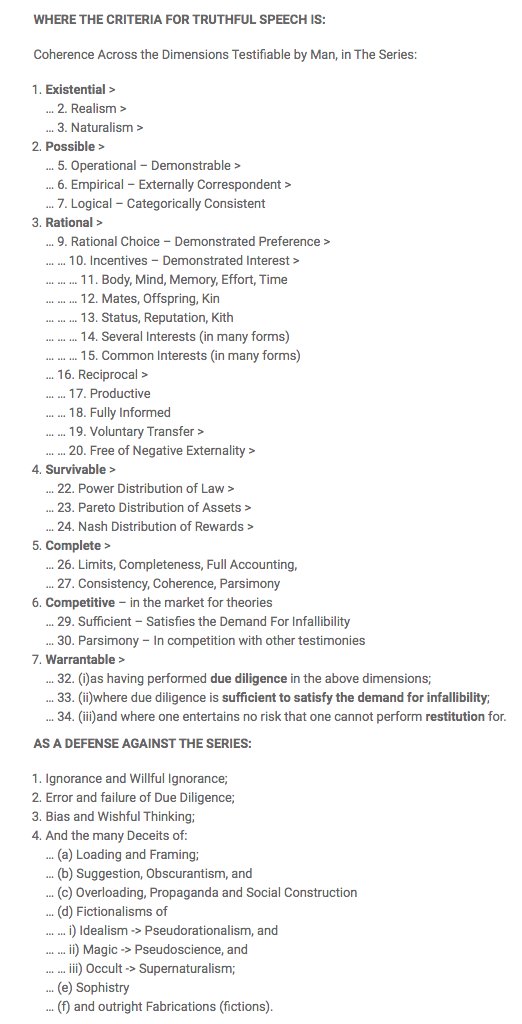
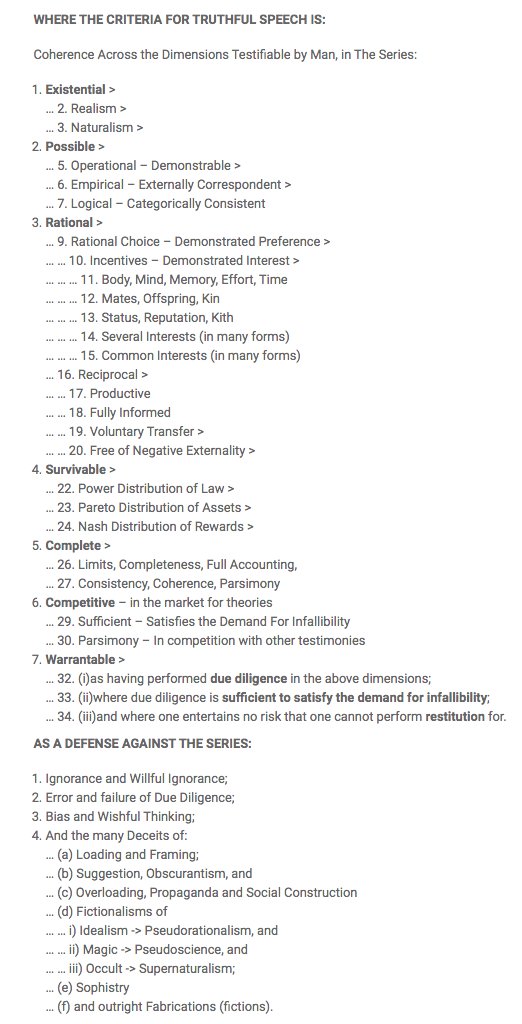
AND WHERE THE CRITERIA FOR TRUTHFUL SPEECH IS COHERENCE ACROSS THE DIMENSIONS TESTIFIABLE BY MAN, IN THE SERIES:
1 – Categorically Consistent (Non-conflationary, Differences)
2 – Internally Consistent (Logical)
3 – Externally Consistent (Empirical)
4 – Operationally Consistent (Consisting of Operational Terms that are Repeatable and Testable)
5 – Rationally Consistent (Consisting of Bounded Rational choice, in available time frame)
6 – Reciprocal (Consisting of Reciprocally Rational Choice)
7 – With Stated Limits and Fully Accounted (Defense against cherry-picking and inflation)
8 – Warrantied
… (i)as having performed due diligence in the above dimensions;
… (ii)where due diligence is sufficient to satisfy the demand for infallibility;
… (iii)and where one entertains no risk that one cannot perform restitution for.
AS A DEFENSE AGAINST THE SERIES:
1 – Ignorance and Willful Ignorance;
2 – Error and failure of Due Diligence;
3 – Bias and Wishful Thinking;
4 – And the many Deceits of:
… (a) Loading and Framing;
… (b) Suggestion, Obscurantism, and Overloading and Propaganda;
… (c) Fictionalisms of Sophisms, Pseudorationalisms, Pseudoscience, and Supernaturalism;
… (d) and outright Fabrications.
IN DEFENSE OR ADVOCACY OF:
1 – Any transfer of demonstrated interest that is not:
… (a) productive
… (b) fully informed
… (c) warrantied
… (d) voluntary transfer(harm, imposition of costs) upon demonstrated interests internal to the display word or deed;
… (e) and free of imposition upon the demonstrated interests of others by externality.
AND INCLUDING BUT NOT LIMITED TO THE SERIES OF THOSE CATEGORIES OF:
1 – Murder,
2 – Harm, Damage, Theft,
3 – Fraud, fraud by omission, fraud by indirection,
4 – Freeriding, socialization of losses, privatization of commons,
5 – Baiting into Hazard (The cause of 20th C pseudoscience)
6 – Rent-seeking, monopoly seeking, conspiracy, statism/corporatism,
7 – conversion(religion/sophism/pseudoscience),
8 – displacement(immigration/overbreeding),
9 – conquest (war).
Cheers
Curt Doolittle
The Propertarian Institute
Source date (UTC): 2020-09-07 14:25:00 UTC