September 5th, 2018 9:47 AM NIETZSCHE VS DOOLITTLE : Critique vs Science. Value vs Truth. Inspiration vs Institutions. I need to address this issue again for the little boys in the audience. What I take from Nietzsche is his attack on supernaturalism, and submission, and his attempt to restore classicism – which is also what I am also trying to do: discover our origins (I have), and solve the institutional problem (i think I have) of restoring them. Nietzsche created a Critique of semitic religion, and tried to articulate and express the ethic of the classical tradition (heroism, the dominance of man over nature) but was unable to solve the problem of how – just as many post-darwinist were. Unfortunately the abrahamists have nearly won again with marxism, feminism, and postmodernism. And they have won by continuing his technique: abrahamic critique. —“Nietzsche’s thought after Hegel was to incorporate Evolution and to reverse everything possible in prior thinkers. So he reverses Hegel by searching for a way for the Noble to have self-consciousness. He reverses Schopenhauer by attempting to be positive about life and its prospects. He reverses Wagner by rejecting the Christianization of the Pagan mythologies. Of course he then reverses many long held beliefs that were unquestioned within the western worldview such as the necessity to kow tow to Christianity as a religious belief system. … So basically Nietzsche went after as many Sacred Cows of the European tradition as he could”— Kent Palmer I systematically attack all our sacred cows and falsehoods – just as he did. Not for VALUE but for TRUTH. I look for everything FALSE not everything we VALUE. However, I attempt to restore classicism through formal INSTITUTIONS rather than the usual german sophomoric philosophy that is little other than a desperate attempt to restore the ‘woo’ of christian submission by rational sophistry rather than supernatural sophistry. As for ‘spirit’ I see nietzsche’s ‘spirit’ as a choice, and an individual choice, not a truth,or a political movement, or an institutional solution – and I see nietzsche as having failed to discover a solution. And worse, I find his silly german ‘suffering'(struggling) abhorrent – the voice of the weak. The strong do not struggle they just do. Nietzsche was prescient precisely because he FAILED. As did all german thinkers – desperate provincial romanticists appealing to the heartstrings of the pubescent. I see nietzsche as ‘weak’. A polemicist. Like say, Rand, he is a gateway that gives you permission to abandon traditional religion, just as rand is a gateway to abandon traditional political ethics. But they are … childish … works by childish people. Which is fine, because we all work at some level of sophistication available to us at our own stage of maturity. Nietzsche’s rant against his status who is nothing more than what all adolescent men do: express their identities and autonomy as unbound by parental debts, when they reach some level of agency. But in the end, he just was an insightful polemicists that failed to provide a solution other than infinite skepticism and a return to a celebration of life. A pair of sentiments otherwise politically inactionable. Nietzsche practiced critique: he remained an abrahamist. He offered us nothing to supplant the past. And understood the classical civilization only in silly germanic romantic and literary terms – rather than the tedious administration of half domesticated man by the use of military, law, bureaucracy, commerce, and education. Rome was the adult that athens matured into. We are only now, right now, restoring the state of development at which rome fell.
Theme: Institution
-
THE LAW (important) 1) Judges are forced to adjudicate between customary law, re
THE LAW
(important)
1) Judges are forced to adjudicate between customary law, regulation, and legislation during a period of rapid social, economic, and political upheaval. In science for… https://www.facebook.com/permalink.php?story_fbid=290190554911175&id=100017606988153
Source date (UTC): 2018-09-04 00:13:45 UTC
Original post: https://twitter.com/i/web/status/1036769247769387008
-
I’ll probably write an article in reply to this one, but here are a few points t
I’ll probably write an article in reply to this one, but here are a few points to “correct” the judiciary:
1) Judges are forced to adjudicate between customary judge discovered law, regulation, and legislation during a period of rapid social, economic, and political upheaval. In science for example, there is no temporal pressure to produce a decision. In conflict there is temporal pressure to produce a decision. The state has taken on the monopoly of the application of violence, and created a monopoly method of dispute resolution (courts), and created a monopoly body by which to adjudicate such conflicts (law, legislation, and regulation.)
2) There exists only one universal law of human cooperation. We call that law ‘natural law’. That natural law consists in reciprocity. Reciprocity requires satisfaction of the criteria (a) fully informed, (b) productive, (c) warrantied, (d) voluntary transfer, (d) free of imposition of costs upon the interests of others by externality. One can obtain an interest by bearing a cost (performing an improvement) for the purpose of obtaining an interest; and one can have no interest until one has born a cost to obtain such an interest.
3) This one law (reciprocity) provides decidability independent of opinion, preference, custom, or presumption of good, and is the reason international law is governed by reciprocity it is the only rule that provides reciprocal (equal) incentive against retaliation for the imposition of costs upon one another. Law evolved, from the first record, to the present, for the purpose of preserving the volume, velocity, and returns on cooperation, and preventing cooperation’s opposite: retaliation cycles that throughout history have produced the deleterious effects of feuds.
4) Customary Law (especially germanic, if not all european) consists of the discovery and accumulation of applications of this law of reciprocity that we call Tort law. Legislation (command) and regulation (prior constraint) have been given the FORCE of LAW by those whose profit interest – either the population (preservation of returns on cooperation) or the territorial rulers (returns from taxation).
5) The primary function of RULE has been the preservation of cooperation by use of organized violence to suppress impositions of costs upon the investments of others. This is the role of insurer of last resort of Personal Interests.
6) The primary function of GOVERNMENT has been the construction of commons and the extraordinary returns produced by commons, while insuring those commons from privatization of commons, socialization of losses into the commons, by the organized use of violence. This is the role of insurer of last resort of the Commons.
7) The primary function of the STATE, particularly with the advent of paper currency, and now fiat (unbacked) currency (our money consists of nothing but shares in the economy) has increasingly evolved to function as the insurer of last resort against the Hazards of the vicissitudes of nature (disasters, tragedies, accidents, disability, health, old age, and even war).
8) Rights can only exist (a) by reciprocal exchange of the same obligation, and (b) when insured by a third party with sufficient organized violence to insure and reinforce them. Otherwise they are not rights but impositions by means of command. It is correct to say we create a market ‘demand’ for natural rights, and we create a market demand for human rights, but those rights do not exist until we organize sufficient violence into roles and institutions to exchange and insure those rights: police, sheriffs, soldiery, and judges and the law.
9) Human rights consist of AMBITIONS that we demand from the Governments of States in order to tolerate their retention of a monopoly of control over a territory. They exist as a postwar attempt to constraint governments to improving their territory, people, and assets by market means, without imposition upon their neighbors. Such rights, likewise, do not exist. But are merely an ambition.
10) The universal declaration of human rights contains a few provisions that were necessary to obtain the signatures of the then-communist states, that asserted positive rights (obligations to provide for one another without constraint on the reproduction that exhausts the ability to provide for others, and therefore results in the gradual dysgenic decline as we reverse thousands of years of upward redistribution of reproduction back down to the underclasses who are not able to produce sufficient market goods and services to exist without harming the reproduction of the middle and upper classes.) [note: we have reversed the flynn effect and have, even in china, been losing a third of a point of intelligence over a fairly short number of years. The productivity of a people is reducible to the median of the population’s cost of education and training, such that every point below what is today’s 105 and tomorrow’s 110 places an intolerable burden upon the rest of the polity.]
8) Our American constitution persisted the anglo saxon, germanic, proto-germanic (and possibly proto-indo-european) law of sovereign men limited to acts of reciprocity, and licensed the government to act in their interests to preserve their sovereignty (the original text being ‘life, liberty, property’). Unfortunately at the time the techniques of formal logic, strict constriction from first principles, were not known. We are no longer limited, and there is no reason any and every law cannot be constructed formally from the natural law of reciprocity, producing a complete, consistent, and easily falsifiable body of adjudicatable law. There is no reason any and every act of legislation, and any and every act of regulation, cannot be so constructed. The principle difference under such formal construction is that the one law, discovered application of the one law, regulation to limit hazards of those actions not open to restitution, and CONTRACTS for the production of commons would be consistent, and as such the government could only issue contracts under law, not edicts above that law. (This would destroy the left’s ability to usurp power by democratic means).
9) The uniqueness of western civilization is reducible to (a) a militia that constitutes the shareholders, (b) individual sovereignty of shareholders, (c) the demand for truth, duty, and reciprocity from one another in mutual insurance of our sovereignty. (d) the dependence upon a jury of sovereign peers for the adjudication of differences, with a judge as referee, (e) And sovereignty results in the necessity of markets for association, cooperation, reproduction, production, commons, and polities. (f) such markets, adjudicated by the law of tort, adapt to change faster than all other methods of human organization. (g) it is this rapidity of adaptation and resulting insulation from corruption and rent seeking that made the west develop faster than the rest in both the ancient world and the modern, with the Abrahamic Dark Age of the Jewish, Christian, and Muslim attacks on the great civilizations, providing the only hindrance. Once north sea trade was reestablished, the saxon commercial order constructed in europe, and the atlantic opened to the age of sail, the west was finally, by the age of napoleon, able to return to Roman levels of institutional sophistication, and universal imposition of law. [note that the west had fertile lands and forests but no flood river valleys to concentrate production, concentrate people, and develop taxation. So while the ancient world could form armies by taxation, western people had to form militias that relied on advanced (at the time) technology that required whole families to pay for. These militias (cattle raiders, sea peoples, vikings, pirates, european explorers ) organized expeditions (raids) but did so voluntarily. There was no other means of organizing other than contract. It was this order that led to our law, our debate, our reason, and from there our science and technology. Western excellence is due to our law – which elsewhere is not contract but command.
10) The progressives lie to mask what is merely theft – they rely on postmodernism (lying by sophistry), and they rely on marxism (pseudoscience) as well as freudian and boazian pseudoscience. So yes, the Progressives (socialists) lie, but the Conservatives (aristocratics) cannot tell the truth: The truth is quite simple: the reason for the success of western and eastern civilization, and most obviously the ashkenazim, is the upward redistribution of reproduction, and the use of manorialism and taxation to limit the reproduction of the underclass until such point that surpluses are sufficient to continually increase the standard of living through continuous market competition and innovation. Man was not oppressed. The man self domesticated through the same process he used for plants and animals: breeding the best and culling the rest. This is the dirty secret of civilizations.
11) Sovereignty, Truth, Duty, and Reciprocity produce markets, and markets are eugenic. They are just a peaceful form of eugenics rather than war, enslavement, enserfment. By use of Sovereignty, Truth, Duty, Reciprocity, and Markets western man in the ancient world, and in the modern, dragged humanity kicking and screaming out of ignorance, superstition, hard labor, poverty, starvation, infant mortality, early death,
12) The chinese are not so inhibited as we are. they do not care about markets other than in their ability to preserve their racially homogenous polity, and return themselves to position of world power to do so. They are actively researching methods of direct improvement while event their one child policy did not help the ongoing decline in the distribution of intelligence. We are doing the opposite, which is undermining the very reason for our evolutionary success, ad the means by which we dragged mankind out of darkness, and we are doing it through immigration of those very peoples who we have spent thousands of years eliminating from our polities. As far as I know anglicans and ashkenazim remain at parity, but the anglos otherwise have lost a full standard deviation or more since the beginning of the industrial revolution. Even the Norwegians are in distributional decline.
13) The most profitable action any polity can take is to institutionalize benevolent eugenics, and that is to pay the underclasses not to reproduce, and to limit all immigration to skilled professionals, and to push the young and old into the labor force in the less demanding occupations. This is the lesson of our experiment with universal democracy and marxist-postmodernist globalism: dramatic reversal of centuries of civic improvement. At present only the east asians are willing to pay the costs of retaining their accumulated achievements. The eugenicists were right and in retrospect it appears that the Boas, Marx, Freud, Frankfurt, and French Postmodern movements were but reactions against Darwin, Maxwell, Menger, Spencer, and Nietzsche. And the entire postwar period has been nothing but a pseudoscientific and pseudorational attack on western civilization – an effort to repeat the destruction of the civilizations of the ancient world by the same means – false promises. This time with pseudoscience and pseudorational sophisms using the major media instead of supernatural sophisms using roman roads and greek writing.
Curt Doolittle
The Propertarian Institute
Kiev, Ukraine
IT’S SIMPLE: LIFE, LIBERTY, PROPERTY, RECIPROCITY
The Constitution defines how the government (production of commons) is organized.
The bill of rights defines the law that may not be discovered, legislation and regulation that may not be passed.
The constitution does try to implement natural law (life, liberty, property), but it does not state such concretely in the bill of rights, nor does it state the law of reciprocity despite the fact that reciprocity is the basis for germanic common law back into pre-history.
We could quite easily reorganize the constitution life(existence), liberty(action), property(thing), and reciprocity (volition), and then tie every one of the articles and amendments back to these (reciprocity and three dimensions of its demonstration).
This set of three rights (existence, action, possession) and the single law of reciprocity are very simple criteria by which any constitution can be strictly constructed.
ORIGINALISM AND TEXTUALISM
Originalism requires that the legislature alter the law and that the court not alter the law, only reject bad law.
The constitution was an attempt to codify natural law (reciprocity).
Our law is natural law and has been for 3500 years.
The weakness in our system of government is:
1) There is no requirement that a law pass the court before it’s enacted.
2) There is no way for the court to compel the state to repair a law other than to invalidate a provision or all of it.
3) Statement of natural law of reciprocity, Originalism, Textualism, and Strict Construction from natural law of reciprocity were not stated as part of the document.
Law can and must be algorithmic.
THE PROPER METHOD FOR THE SUPREME COURT’S DECISIONS
—” the constitutional doctrine of separation of powers mandates that judges anchor their analysis to the text as reasonably understood by the people of the time. If that leads to a violation of Reciprocity (Natural Law), then the proper avenue for redress is to amend the constitution so the text better and better codifies Reciprocity (Natural Law).”—
I assume, and the minority of strict jurists assume that the founding documents consist of The Declaration, The Constitution, and The Bill of Rights. And if clarity of original intent is required then we resort to The Federalist Papers, or notes on the proceeds of the debate. Once the bill of rights was ratified, then the founding documents were complete.
1 – The Declaration contains the appeal to Natural Law as justification for secession(independence).
2 – The Bill of Rights codifies the natural law as they enumerated those rights at the time.
3 – The Constitution describes the organization and processes of the government.
I tend to tell people to read them in that order: Declaration, Bill of Rights, and Constitution: from the reason for the secession: violation of natural law, to the articulation of the specific defenses of it, to the institutions that protect it yet still allow for the production of commons.
Unfortunately, first, reciprocity is not specifically stated as the first rule of natural law. Second, there is no requirement that the judiciary certify the constitutionality of legislation, and instead, all legislation ascends until falsified by the court. In other words, the market tests the legislation, and if conflicts arise the court corrects legislation.
This approach continues the no-prior-restraint of the Anglo Saxon (Germanic) law versus the prior-restraint of continental (french and roman) law. And this is yet another example of ‘markets in everything’.
Worse, without specifying Reciprocity, there is no means by which the initial rights can be limited, and therefore no means by which the court can limit the grant of rights rather than permissions and obligations.
Worse, there are no means by which the court can return the legislation to the legislature and demand correction. Nor are there means by which the court can suggest corrections or amendments to rectify the deficiency, and return to the legislature.
As such the court must, as the president must, choose ‘line item veto’ so to speak, or to veto the entire piece of legislation. So that is what the court does.
And the court members use different criteria for determining the power of the legislature:
1- Rule of Law (Substantive) in which the legislature and the people may only act in concert with natural law (reciprocity), or ;
2-Rule by Law (Formalist) in which the legislature can do what it wants;
3-Rule by Law (Majoritarian), in which the people can do whatever they want.
In other words, there are always at least THREE parties to a matter before the court: Plaintiff, Defendant, and Legislature. And the court cannot demand remedy of the legislature. And that is the oversight.
Curt Doolittle
The Propertarian Institute
Source date (UTC): 2018-09-03 21:43:00 UTC
-
THE LAW (important) 1) Judges are forced to adjudicate between customary law, re
THE LAW
(important)
1) Judges are forced to adjudicate between customary law, regulation, and legislation during a period of rapid social, economic, and political upheaval. In science for example, there is no temporal pressure to decide. In conflict there is temporal pressure to decide. The state has taken on the monopoly of the application of violence, and created a monopoly method of dispute resolution (courts), and created a monopoly body by which to adjudicate such conflicts (law, legislation, and regulation.)
2) There exists only one universal law of human cooperation. We call that law ‘natural law’. That natural law consists in reciprocity. Reciprocity requires satisfaction of the criteria (a) fully informed, (b) productive, (c) warrantied, (d) voluntary transfer, (d) free of imposition of costs upon the interests of others by externality. One can obtain an interest by bearing a cost (performing an improvement) for the purpose of obtaining an interest; and one can have no interest until one has born a cost to obtain such an interest.
3) This one law (reciprocity) provides decidability independent of opinion, preference, custom, or presumption of good, and is the reason international law is governed by reciprocity it is the only rule that provides reciprocal (equal) incentive against retaliation for the imposition of costs upon one another. Law evolved, from the first record, to the present, for the purpose of preserving the volume, velocity, and returns on cooperation, and preventing cooperation’s opposite: retaliation cycles that throughout history have produced the deleterious effects of feuds.
4) Customary Law (especially germanic, if not all european) consists of the discovery and accumulation of applications of this law of reciprocity that we call Tort law. Legislation (command) and regulation (prior constraint) have been given the FORCE of LAW by those whose profit interest – either the population (preservation of returns on cooperation) or the territorial rulers (returns from taxation).
5) The primary function of RULE has been the preservation of cooperation by use of organized violence to suppress impositions of costs upon the investments of others. This is the role of insurer of last resort of Personal Interests.
6) The primary function of GOVERNMENT has been the construction of commons and the extraordinary returns produced by commons, while insuring those commons from privatization of commons, socialization of losses into the commons, by the organized use of violence. This is the role of insurer of last resort of the Commons.
7) The primary function of the STATE, particularly with the advent of paper currency, and now fiat (unbacked) currency (our money consists of nothing but shares in the economy) has increasingly evolved to function as the insurer of last resort against the Hazards of the vicissitudes of nature (disasters, tragedies, accidents, disability, health, old age, and even war).
8) Rights can only exist (a) by reciprocal exchange of the same obligation, and (b) when insured by a third party with sufficient organized violence to insure and reinforce them. Otherwise they are not rights but impositions by means of command. It is correct to say we create a market ‘demand’ natural rights, and we create a market demand for human rights, but those rights do not exist until we organize sufficient violence into roles and institutions to insure those rights: police, sheriffs, soldiery, and judges.
9) Human rights consist of AMBITIONS that we demand from the Governments of States in order to tolerate their retention of a monopoly of control over a territory. They exist as a postwar attempt to constraint governments to improving their territory, people, and assets by market means, without imposition upon their neighbors. Such rights, likewise, do not exist. But are merely an ambition.
10) The universal declaration of human rights contains a few provisions that were necessary to obtain the signatures of the then-communist states, that asserted positive rights (obligations to provide for one another without constraint on the reproduction that exhausts the ability to provide for others, and therefore results in the gradual dysgenic decline as we reverse thousands of years of upward redistribution of reproduction back down to the underclasses who are not able to produce sufficient market goods and services to exist without harming the reproduction of the middle and upper classes.) [note: we have reversed the flynn effect and have, even in china, been losing a third of a point of intelligence over a fairly short number of years. The productivity of a people is reducible to the median of the population’s cost of education and training, such that every point below what is today’s 105 and tomorrow’s 110 places an intolerable burden upon the rest of the polity.]
8) Our American constitution persisted the anglo saxon, germanic, proto-germanic (and possibly proto-indo-european) law of sovereign men limited to acts of reciprocity, and licensed the government to act in their interests to preserve their sovereignty (the original text being ‘life, liberty, property’). Unfortunately at the time the techniques of formal logic, strict constriction from first principles, were not known. We are no longer limited, and there is no reason any and every law cannot be constructed formally from the natural law of reciprocity, producing a complete, consistent, and easily falsifiable body of adjudicatable law. There is no reason any and every act of legislation, and any and every act of regulation, cannot be so constructed. The principle difference under such formal construction is that the one law, discovered application of the one law, regulation to limit hazards of those actions not open to restitution, and CONTRACTS for the production of commons would be consistent, and as such the government could only issue contracts under law, not edicts above that law. (This would destroy the left’s ability to usurp power by democratic means).
9) The uniqueness of western civilization is reducible to (a) a militia that constitutes the shareholders, (b) individual sovereignty of shareholders, (c) the demand for truth, duty, and reciprocity from one another in mutual insurance of our sovereignty. (d) And sovereignty results in the necessity of markets for association, cooperation, reproduction, production, commons, and polities. (e) such markets, adjudicated by the law of tort, adapt to change faster than all other methods of human organization. (f) it is this rapidity of adaptation and resulting insulation from corruption and rent seeking that made the west develop faster than the rest in both the ancient world and the modern, with the Abrahamic Dark Age of the Jewish, Christian, and Muslim attacks on the great civilizations, providing the only hindrance. Once north sea trade was reestablished, the saxon commercial order constructed in europe, and the atlantic opened to the age of sail, the west was finally, by the age of napoleon, able to return to Roman levels of institutional sophistication, and universal imposition of law. [note that the west had fertile lands and forests but no flood river valleys to concentrate production, concentrate people, and develop taxation. So while the ancient world could form armies by taxation, western people had to form militias that relied on advanced (at the time) technology that required whole families to pay for. These militias (cattle raiders, sea peoples, vikings, pirates, european explorers ) organized expeditions (raids) but did so voluntarily. There was no other means of organizing other than contract. It was this order that led to our law, our debate, our reason, and from there our science and technology. Western excellence is due to our law – which elsewhere is not contract but command.
10) The progressives lie to masj what is merely theft – they rely on postmodernism (lying by sophistry), and they rely on marxism (pseudoscience) as well as freudian and boazian pseudoscience. So yes, the Progressives (socialists) lie, but the Conservatives (aristocratics) cannot tell the truth: The truth is quite simple: the reason for the success of western and eastern civilization, and most obviously the ashkenazim, is the upward redistribution of reproduction, and the use of manorialism and taxation to limit the reproduction of the underclass until such point that surpluses are sufficient to continually increase the standard of living through continuous market competition and innovation. Man was not oppressed. The man self domesticated through the same process he used for plants and animals: breeding the best and culling the rest. This is the dirty secret of civilizations.
11) Sovereignty, Truth, Duty, and Reciprocity produce markets, and markets are eugenic. They are just a peaceful form of eugenics rather than war, enslavement, enserfment. By use of Sovereignty, Truth, Duty, Reciprocity, and Markets western man in the ancient world, and in the modern, dragged humanity kicking and screaming out of ignorance, superstition, hard labor, poverty, starvation, infant mortality, early death,
12) The chinese are not so inhibited as we are. they do not care about markets other than in their ability to preserve their racially homogenous polity, and return themselves to position of world power to do so. They are actively researching methods of direct improvement while event their one child policy did not help the ongoing decline in the distribution of intelligence. We are doing the opposite, which is undermining the very reason for our evolutionary success, ad the means by which we dragged mankind out of darkness, and we are doing it through immigration of those very peoples who we have spent thousands of years eliminating from our polities. As far as I know anglicans and ashkenazim remain at parity, but the anglos otherwise have lost a full standard deviation or more since the beginning of the industrial revolution. Even the Norwegians are in distributional decline.
13) The most profitable action any polity can take is to institutionalize benevolent eugenics, and that is to pay the underclasses not to reproduce, and to limit all immigration to skilled professionals, and to push the young and old into the labor force in the less demanding occupations. This is the lesson of our experiment with universal democracy and marxist-postmodernist globalism: dramatic reversal of centuries of civic improvement. At present only the east asians are willing to pay the costs of retaining their accumulated achievements. The eugenicists were right and in retrospect it appears that the Boas, Marx, Freud, Frankfurt, and French Postmodern movements were but reactions against Darwin, Maxwell, Menger, Spencer, and Nietzsche. And the entire postwar period has been nothing but a pseudoscientific and pseudorational attack on western civilization – an effort to repeat the destruction of the civilizations of the ancient world by the same means – false promises. This time with pseudoscience and pseudorational sophisms using the major media instead of supernatural sophisms using roman roads and greek writing.
Curt Doolittle
The Propertarian Institute
Kiev, Ukraine
Source date (UTC): 2018-09-03 20:13:00 UTC
-
BREAK UP THE MONOPOLIES —“These companies have to be broken up just like Teddy
BREAK UP THE MONOPOLIES
—“These companies have to be broken up just like Teddy Roosevelt broke up the trusts. These [companies] are run by sociopaths,” he said. “These people are complete… https://www.facebook.com/permalink.php?story_fbid=289745271622370&id=100017606988153
Source date (UTC): 2018-09-02 15:59:32 UTC
Original post: https://twitter.com/i/web/status/1036282484835663873
-
BREAK UP THE MONOPOLIES —“These companies have to be broken up just like Teddy
BREAK UP THE MONOPOLIES
—“These companies have to be broken up just like Teddy Roosevelt broke up the trusts. These [companies] are run by sociopaths,” he said. “These people are complete narcissists. These people ought to be controlled, they ought to be regulated.” “These people are evil. There is no doubt about that.”— Steve Bannon
Source date (UTC): 2018-09-02 11:59:00 UTC
-
photos_and_videos/TimelinePhotos_dJ9jhts2Ng/40684683_289741528289411_69769092440
photos_and_videos/TimelinePhotos_dJ9jhts2Ng/40684683_289741528289411_6976909244020817920_n_289741524956078.jpg HAYEK WASN’T QUITE RIGHT
Hayek wasn’t quite right. Our civilization depends upon the rule of law by tort (natural law), the result of which CAN ONLY be ‘markets in everything’ – which he refers to as “Capitalism” by adopting the marxist criticism of financial cooperation at scale – but that I would call ‘Market-ism”: or the suppression of all involuntary parasitism and predation and forcing all peoples into the market in the service of others to survive. This zero-tolerance of non-market behavior is the result of the institutionalization of sovereignty and with sovereignty, of necessity, tort, and with tort and sovereignty we construct natural law and markets. So while, in the end, he did understand that it was Law that was the foundation of western civilization, he did not make the connection that it was law that LIMITED US to anything other than market cooperation.
I call this use of tort law (natural law) “incremental suppression of free riding, parasitism, and predation”.HAYEK WASN’T QUITE RIGHT
Hayek wasn’t quite right. Our civilization depends upon the rule of law by tort (natural law), the result of which CAN ONLY be ‘markets in everything’ – which he refers to as “Capitalism” by adopting the marxist criticism of financial cooperation at scale – but that I would call ‘Market-ism”: or the suppression of all involuntary parasitism and predation and forcing all peoples into the market in the service of others to survive. This zero-tolerance of non-market behavior is the result of the institutionalization of sovereignty and with sovereignty, of necessity, tort, and with tort and sovereignty we construct natural law and markets. So while, in the end, he did understand that it was Law that was the foundation of western civilization, he did not make the connection that it was law that LIMITED US to anything other than market cooperation.
I call this use of tort law (natural law) “incremental suppression of free riding, parasitism, and predation”.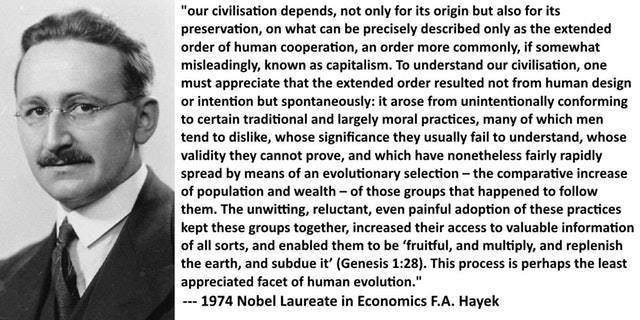
Source date (UTC): 2018-09-02 11:45:00 UTC
-
The Ideal Government? Depends upon The People
by Daniel Gurpide Voltaire‘s political outlook, for instance, was emphatically practical and flexible, embedded in and addressed to the specific circumstances of various European nations. He supported a mixed constitutional government in England, a more popular republic in Geneva and Holland, a strong monarchy in France, and an even stronger and more centralized one in Frederick‘s Prussia and Catherine‘s Russia. While he generally had kinder things to say about England and Geneva than France, Prussia, or Russia, he did not think that any of these regimes was simply the ‚best‘. On the contrary, he insisted that such judgments cannot properly be made in the abstract, that they can only be based on contextually sensitive empirical analysis.
-
The Ideal Government? Depends upon The People
by Daniel Gurpide Voltaire‘s political outlook, for instance, was emphatically practical and flexible, embedded in and addressed to the specific circumstances of various European nations. He supported a mixed constitutional government in England, a more popular republic in Geneva and Holland, a strong monarchy in France, and an even stronger and more centralized one in Frederick‘s Prussia and Catherine‘s Russia. While he generally had kinder things to say about England and Geneva than France, Prussia, or Russia, he did not think that any of these regimes was simply the ‚best‘. On the contrary, he insisted that such judgments cannot properly be made in the abstract, that they can only be based on contextually sensitive empirical analysis.
-
The Best Governors Are the Middle Class
The government you end up with is determined by what point on this scale your polity equilibrates. —Justin Allred x-axis: high trust<->low trust y-axis: distributed political agency<->concentrated political agency Monarchy – Tyranny Aristocracy – Oligarchy Polity – Democracy
—“Does Aristotle deem monarchy to be the best form of government?”— by Andy Mansfield, DPhil, former academic, teacher and author. Aristotle discussed the six forms of government, the correct form and its deviant counterpart: Monarchy – Tyranny Aristocracy – Oligarchy Polity – Democracy However, monarchy was not the best form. F. Miller provides the answer to your question in ‘Aristotle’s Political Theory’ taken from The Stanford Encyclopedia of Philosophy (2011): ‘Although his own political views were influenced by his teacher Plato, Aristotle is highly critical of the ideal constitution set forth in Plato’s Republic on the grounds that it overvalues political unity, it embraces a system of communism that is impractical and inimical to human nature, and it neglects the happiness of the individual citizens (Politics II.1–5). In contrast, in Aristotle’s “best constitution,” each and every citizen will possess moral virtue and the equipment to carry it out in practice, and thereby attain a life of excellence and complete happiness (see VII.13.1332a32–8). All of the citizens will hold political office and possess private property because “one should call the city-state happy not by looking at a part of it but at all the citizens.” (VII.9.1329a22–3). Moreover, there will be a common system of education for all the citizens, because they share the same end (Pol. VIII.1). If (as is the case with most existing city-states) the population lacks the capacities and resources for complete happiness, however, the lawgiver must be content with fashioning a suitable constitution (Politics IV.11). The second-best system typically takes the form of a polity (in which citizens possess an inferior, more common grade of virtue) or mixed constitution (combining features of democracy, oligarchy, and, where possible, aristocracy, so that no group of citizens is in a position to abuse its rights). Aristotle argues that for city-states that fall short of the ideal, the best constitution is one controlled by a numerous middle class which stands between the rich and the poor. For those who possess the goods of fortune in moderation find it “easiest to obey the rule of reason” (Politics IV.11.1295b4–6). They are accordingly less apt than the rich or poor to act unjustly toward their fellow citizens. A constitution based on the middle class is the mean between the extremes of oligarchy (rule by the rich) and democracy (rule by the poor). “That the middle [constitution] is best is evident, for it is the freest from faction: where the middle class is numerous, there least occur factions and divisions among citizens” (IV.11.1296a7–9). The middle constitution is therefore both more stable and more just than oligarchy and democracy.’ SUMMARY Matt Stewart, B.A. Literature, History, and Philosophy No- the best government was the one best suited to the people and culture that are to be governed and which allows its citizens to flourish. Aristotle understood that different nations with different values function differently; whatever system of government allows a particular nation to function correctly and flourish is the best form of government for that particular nation. The Persians flourished under a monarchy, and the Athenians flourished as a democracy. The two states had very different forms of government, yet each flourished in its own way. A properly functioning government is one which incorporates and reflects the values and interests of its people. That is the long and short of Aristotle’s view on government.