Theme: Institution

  • Not sure I’m following. AFAIK govt scales force (law) and procedure into institu

    Not sure I’m following. AFAIK govt scales force (law) and procedure into institutions. If we ask who inspires is it govt, media, entertainment, public intellectuals, or academy?


    Source date (UTC): 2021-05-28 20:42:25 UTC

    Original post: https://twitter.com/i/web/status/1398379152387067906

    Reply addressees: @RickyBobby_USA

    Replying to: https://twitter.com/i/web/status/1398378629332144131

  • And the order of institutions also impacts the rate of the ascent of the curve o

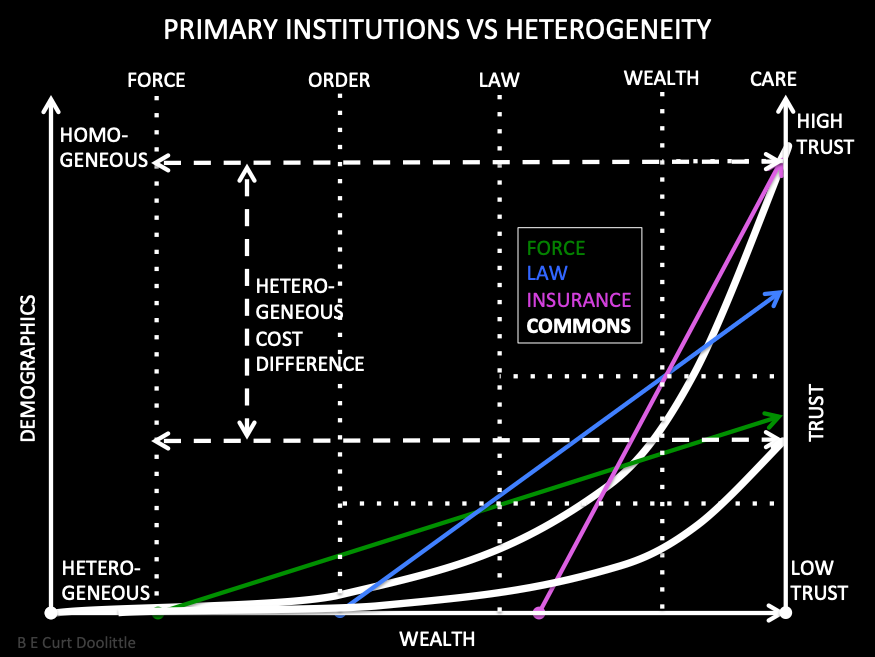
    And the order of institutions also impacts the rate of the ascent of the curve of commons production. Optimum is law, state, religion. Worst is religion, state, failure of law. Though most succeed at state alone, but never produce trust or economic velocity. https://twitter.com/curtdoolittle/status/1398375014966116356

  • Three possible and primary institutions (State(force), Law (reciprocity), Religi

    Three possible and primary institutions (State(force), Law (reciprocity), Religion (resistance)) vs homogeneity<>heterogeneity

    Essentially all diversity functions as a drag on the production of commons – where commons reduces universal cost of non-consumable goods. https://t.co/AdB8LoddWS


    Source date (UTC): 2021-05-28 20:25:58 UTC

    Original post: https://twitter.com/i/web/status/1398375014966116356

  • A society needs to expend resources on providing education in group strategy, mo

    A society needs to expend resources on providing education in group strategy, moral mythology, wisdom literature, logic of arguing it, ritual, oath, festival to provide mindfulness. We spent lost on education(skill) but not mindfulness(discipline): religion.

    Some people need religion as a framework for associations, some need only friends and family,and some need a sequence of allies on their life’s mission and some have the agency to compete at great scale by individual fortitude. It’s just your neural economy at work. Nothing else.

    “Some, some, some, some = Vast majority, significant minority, small minority, almost no one.”

    FWIW “almost no one” is the permanent .1%. Look at the families that have been wealthy for eight hundred years – there are plenty of them. Very selective marriage, very selective inheritance, very selective in all aspects of life.

    The people who are dependent upon others for SOCIAL insurance, security, information, validation, and status because they cannot compete in ECONOMIC POLITICAL & MILITARY markets need a means of mindfulness. Alienation increases with the division of knowledge labor and hierarchy.

    Mindfulness is necessary whether personal, interpersonal, social, economic, or political. In the sense that religion provides one or more of those demands for mindfulness, we merely need a true and evolution rather than false and regressive or devolutionary religion.

    Given the individual’s ability to perceive, learn, calculate choices with the brain, emotional fortitude (or lack of it), relationships, knowledge, resources at his disposal, what external ‘confirmation’ does he need?

    We’re all just bots. Some of us have better memory, CPUs and software and some less. You either have agency in yourself or dependency on others. If you are empathic, not bright, need opinion, information, confirmation, and to share calculation with others you’ll need religion.

    God is an analogy – a character serving as an anthropomorphic and therefore simplistic system of imitative, sympathetic, and empathic pre-rational means of decidability within a group class sex and age survival strategy. God = Laws of the universe. Science=testifying with them.

    Science=Testimony. Testimony requires identity, consistency, operational constructability from first principles, correspondence, rational choice, reciprocity, adversarial parsimony, limits, completeness, and warrantability. Since I know those things I can do that. That’s science.

    The LDS and Amish reproductive arguments are true but constitute are a repetition of the same fallacy of the libertarians: they require a host state or empire to provide the (masculine political) commons that their (feminine familial) social order cannot.

    INCREASE IN COST:
    Religion -> Intuition
    Philosophy -> Reason
    Testimony -> Evidence
    Science and Law -> Decidability
    First Principles -> Causality


    Source date (UTC): 2021-05-26 22:18:15 UTC

    Original post: https://gab.com/curtd/posts/106303815358298690

  • Natural demand whenever 1) the lower classes are lifted into market consumption,

    Natural demand whenever 1) the lower classes are lifted into market consumption, 2) women are lifted into market consumption 3) scale increases dramatically, 4) institutions are insufficient for indoctrination of women and lower classes
    Greece > Rome > France > Russia > America


    Source date (UTC): 2021-05-26 18:08:43 UTC

    Original post: https://twitter.com/i/web/status/1397615696327159811

    Reply addressees: @sergei_ivan @blamblamtheman @Ozpin_88

    Replying to: https://twitter.com/i/web/status/1397614202748026892

  • The Cause of Divergence in The Anglosphere

    britain diverged from germanic civilization in the 1830’s and american culture diverged far less so. So that while we speak english, and practice english institutions, we have retained germanic culture because germans were so influential in our settlement – such that the constitution was written in both english and german versions so all germanic americans whether english speaking or german speaking could read it. Today’s british commoners are closer to the french (peasants) and american commoners (whites) closer to germans (citizen soldiers). And this was amplified by the germanic protesant founders, and the spread of fundamentalism even among the american scots irish (south). This is the analysis that explains the american(germanic), australian (prewar english), postwar british (mixed english aristocracy-french peasantry), and canadian (french peasant) cultural differences in the anglosphere. Is whether we are baised toward the peasant french the martial german, or the mixed british.

  • The Cause of Divergence in The Anglosphere

    britain diverged from germanic civilization in the 1830’s and american culture diverged far less so. So that while we speak english, and practice english institutions, we have retained germanic culture because germans were so influential in our settlement – such that the constitution was written in both english and german versions so all germanic americans whether english speaking or german speaking could read it. Today’s british commoners are closer to the french (peasants) and american commoners (whites) closer to germans (citizen soldiers). And this was amplified by the germanic protesant founders, and the spread of fundamentalism even among the american scots irish (south). This is the analysis that explains the american(germanic), australian (prewar english), postwar british (mixed english aristocracy-french peasantry), and canadian (french peasant) cultural differences in the anglosphere. Is whether we are baised toward the peasant french the martial german, or the mixed british.

  • Conflict 12: Civilizational Strategies

    All Civilizations Evolved a Group Strategy And Means of Persisting It

    All civilizations evolved the following necessary information systems:

    (a) a Group evolutionary (competitive) strategy, (b) a Mythology to explain, justify, and lionize it in Emotions, (c) Wisdom literature to communicate it in Stories, (d) a System of Argument to persuade and defend it in Reason, and; (e) a set of Institutions to persist it across generations with limited modification.

    |Civilizational Strategy|: Group Strategy > Mythology >
    ... Wisdom Literature > 
    ... ... System of Argument > Institutions.

    (Note: We use “Wisdom Literature” in the more general sense above, rather than the narrower sense of a collection the sayings of sages developed as oral tradition but eventually written down.)

    The Geographic Origin of Group Strategies

    • HOSTILELANDS: African Ethics (pre-Christian). Africa is akin to the Desertlands because of the sheer number of competitors, the hostility of the disease gradient, the plethora of wildlife, combined with the primitiveness of the available technologies. This is the only possible strategy until one or more core states can evolve, and create sufficient stability in some regions. (this is occurring now).
    • DESERTLANDS: Muslim Ethics: (I am still working on this one because I don’t get that it’s causal, but opportunistic.) What can I justify now in order to make this minor advance now? And thereby accumulate wins by wearing down opponents over long periods. The ethics of opportunism. As far as i can tell Islam is just an excuse for justifying opportunism. We can consider this the combination of religion and justifying opportunism – a long term very successful strategy because it’s very low cost
    • STEPPELANDS: Russian(0rthodox) Ethics: What can I get away with now by negotiation and subterfuge, and hold by force later? (steppe raiders) The ethics of steppe people surrounded by competitors, always hostile and unpredictable. This is a difficult and expensive but only possible strategy, when one is surrounded by hostile opportunity seekers. While seemingly expansive, it’s actually a fearful one, aggression as the only possible means of controlling defensive positions across open territory.
    • BORDERLANDS: Cosmopolitanerish) Ethics: What will someone consent to Regardless of future resentment and retaliation? (borderland/subculture/ deontological ethics: rules) The ethics of diasporic, migrating traders, or herding peoples who can prey upon the locals who hold territory. This is a very low cost (parasitic) ethics that avoids all contribution to the host commons, but requires preserving the ability to exit (migrate). it is the raider strategy by systemic and verbal rather than physical means.
    • FORESTLANDS: Family, Clan Farms, Villages. Transportation expensive. Forests are dark and scary places full of brigands. Aristocratic Ethics: What will someone not retaliate against even if we agree to it?(rulers/teleological ethics: outcomes) The ethics of warriors who must hold territory. This is a very high-cost strategy because while professional warrior aristocracy is militarily superior, smaller numbers mean threats must be constantly suppressed when small, as soon as identified. (Profiting from the domestication of man)
    • RIVERLANDS: Riverlands strategy defends against Steppland and Desertland strategies. (Profiting from the domestication of man) Chinese Ethics: What can I get away with now, but over time make it impossible to change later? The ethics of long term ruling bureaucratic class. Sun Tzu strategy, and Confucian hyper familism. This is an exceptionally cost-effective strategy if one possesses a territorial resource (heartland), and can fortify that heartland.
    • FERTILE RIVER LAND: (Profit from the subjugation of man) (Cyrus was lost). Bias to Empire.
    • COASTAL-ISLAND LANDS – Athens, Scandinavia Bias to Trade
    • ISLAND LANDS – Cyprus, Crete, BRITAIN, Naval bias to Trade.
    • DIASPORIC PEOPLE – Gypsies, Travellers, Jews

    Rock Paper Scissors: Elites and the Three Methods of Coercion

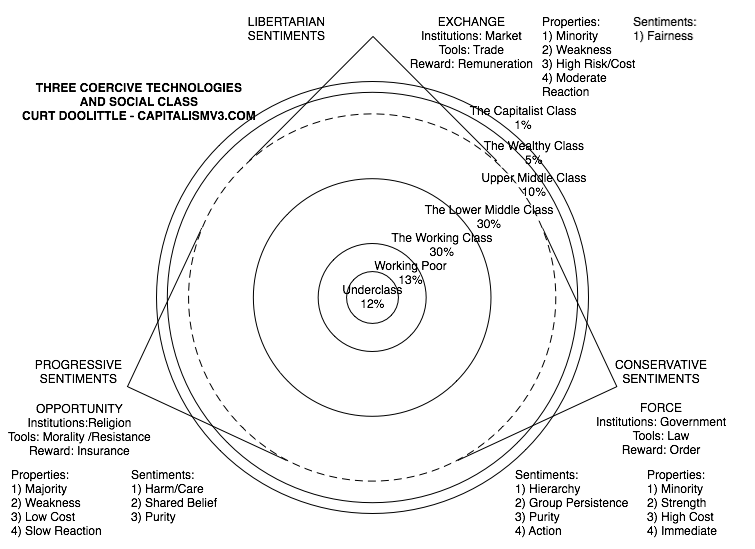
    There are three formal means of coercing groups of people with institutions. And we can use these three Archetypes to imagine the extremes:

    GHENGIS KHAN -- THOMAS JEFFERSON -- MOTHER THERESA
    VIOLENCE...........EXCHANGE............SUBSIDY 
    RIGHT...............CENTER..............LEFT 
    FATHER...............SON.............SISTER/MOTHER


    The three means of coercion are as follows:

    1) FORCE, or the threat of force A person has a VIOLENCE INCENTIVE to behave in a particular way when it has been made known to him that failure to do so will result in some form of physical aggression being directed at him by other members of the collectivity in the form of inflicting pain or physical harm on him or his loved ones, depriving him of his freedom of movement, or perhaps confiscating or destroying his treasured possessions.

    The Physical: Body and Movement Using Force or Violence The fear of harm or promise of defense. By the Dominant or Established Male

    Force: Tool: Physical Coercion Benefit: Avoidance Benefit Strategic use: Rapid but expensive. “Seize opportunities quickly with a concentrated effort.”

    LimitsVia-Negativa: Procedural Power: Political, Judicial, and Military Power (Soldiers, Judges, and Politicians)

    STATE(ORDER): Formal Limits. Violence(Harm) < -vs- > Defense (Protection) :  Defense, Taxation, Keeping the Peace

    2) REMUNERATION or payment A person has a REMUNERATIVE INCENTIVE to behave in a particular way if it has been made known to him that doing so will result in some form of material reward he will not otherwise receive. If he behaves as desired, he will receive some specified amount of a valuable good or service (or money with which he can purchase whatever he wishes) in exchange.

    The Material: Resources and Opportunity Using Bribe or Trade The fear of loss of gains, or promise of gains By the Brother, Ally, or Ascendant Male

    Exchange: Remunerative Coercion With Material Benefit – Strategic use: efficient in cost and time, only if you have the resources.

    PossibilitiesVia-Practica: Economic Power (people with wealth either earned or gained through tax appropriation).

    TRADE(LAW-COMMERCE): Formal Cooperation: Boycott (Deprivation) < -vs- > Trade (Gain)  :  Reciprocity, Property : Boycott:  Markets Laws.

    3) MORAL Claims (collective goods) A person has a MORAL INCENTIVE to behave in a particular way when he has been taught to believe that it is the “right” or “proper” or “admirable” thing to do. If he behaves as others expect him to, he may expect the approval or even the admiration of the other members of the collectivity and enjoy an enhanced sense of acceptance or self-esteem. If he behaves improperly, he may expect verbal expressions of condemnation, scorn, ridicule or even ostracism from the collectivity, and he may experience unpleasant feelings of guilt, shame or self-condemnation.

    The Social: Cooperation and Insurance Using Undermining or Advocacy The fear of ostracization or promise of inclusion By the female and especially dominant female

    Words: Tool: Verbal, Moral Coercion Benefit: Ostracization/Inclusion, and Insurance benefit Strategic Use: slow, but inexpensive. “Wait for opportunity by accumulating consensus.”

    WantsVia-Positiva: Populist Power (Religion, Entertainment, Public Intellectuals)

    RELIGION(SOCIETY): Formal Indoctrination Ostracization (Risk-Death) <–vs–> Inclusion (Safety-Life) : Conformity Obedience : Gossip, Undermining. And In addition, non-coercive informal institutions:

    4) The Informal Organic Norms

    THE PEOPLE: Organic Norms and Traditions: Pragmatic Habits

    Degrees Of Coercion

    We can scale each of the three-axis of coercion by degree of coercion:

    1) INFLUENCE – informing others in their interests … 2) COERCION – coercing others to follow your interests … … 3) POWER – organized coercion of others for your or collective interests

    |Coercion|: Neutral > Influence > Coercion > Power  And Scale each axis by dree of certainty:

    |Certainty|:Undecidability > Possibility > Potential > Probabilitye > Likelihood > Certainty

    Combinations of Methods of Coercion:  “Chords” of Coercion

    Influence, coercion and power can consist of one or more of these method, often in great complexity. Groups tend to give priority to one or more different weighted combinations, or perhaps ‘chordic’ representations of these strategies. They do so out of habit, and class inclination, just as they follow religious and class sentiments due to their upbringing. People who belong to institutions have different capacities for adopting these strategies. Force requires discipline and long Time Bias. Remuneration requires cunning and invention. Moral claims require loyalty to consensus, and absorption of, and therefore payment of, opportunity costs. Different social classes have different time biases and consist of people with different time preferences, requiring different types of discipline under different social and economic conditions. ie: it is easier to have a long time preference if one is genetically disposed to better impulse control, and lives in greater security. It is easier to have a short time preference if one is more persuaded by impulses, less disciplined, and in an environment of scarcity. There are different costs to these institutions: Force is extremely expensive. Creating non-corruption, and order (some network of property definitions and their means of transfer). Property is a term for a scarce good that must used, consumed or transformed in the process of production, even if that process is human sustenance. Remunerative institutions require the complex task of concentrating capital then maintaining it in a constantly changing kaleidic and competitive environment. Moral claims require constant advocacy, verbal skill, maintenance of numerous relationships, and constant payment of opportunity costs. The social classes are organized by intelligence expressed by empathy or dominance. Intelligence is the ability to absorb content in real-time, to learn abstractions in time, and to permute those abstractions in application to problems in real-time. Intelligence regresses toward the mean over generations. Therefore class membership is an indicator of the likelihood of class mobility, and upper-class position is difficult to maintain. While we use the word ‘middle class’, and most people in the west live middle-class lifestyles, the middle class means possessing disposable income and participating in the market. Therefore the majority of citizens are in the upper proletariat and lower-middle classes, which we call the working, white-collar working and craftsman classes. The Social classes have different access to each of these forms of coercion. Those in the institutional class, or upper class, have access to force in the form of policy and law. Those in the capitalist class, or middle, have access to capital: money, and market institutions. In each strategy peoples form elites, and organizations for utilizing those strategies. The elites create philosophical frameworks. Each of these frameworks consists of moral claims, and institutional means of perpetuating those claims, and the social benefits of adopting those claims. Each of these institutions is open to corruption, which is the privatization of opportunity and reward, for personal consumption at group expense. Corruption is fraud. Each of these strategies, their organizations, institutions, and elites compete against other strategies, organizations, and elites, and each attempts to use its organization for discounts against other organizations. This competition is analogous to the game of Rock, Paper, Scissors, if more complicated: each group can successfully compete against one another under most circumstances, but can defeat and be defeated by some other combination of forces. At its base, there are only three tools of social organization. These three forms can be combined, as they are in the majority of the population in some manner or another. Or they can be used as one of three specializations, each of which attempts to play rock, paper, scissors, with the other two.

    The Relation Between Elites and Classes

    ( … )

    theecoercivetechnologies

    The Three Orders: Kin, State, and Cult

    We make use of Authority and State, Law and Trade, and Education and Religion, but we choose a dominant bias with which to employ them in our social orders, yielding:

    (1) Kin and Law and Nation and Federation – Create Self Determination (2) State and Corporatism, and Empire – Limit Self Determination (3) Cult and Religion, and Globalism – Eradicate Self Determination … depending upon homogeneity or heterogeneity of the population; to overcome resistance to the creation and preservation of commons – so that why is it that one bias in the order is always better off than the others?

    The Order of Development of The Three Institutions

    Religion(Theology) -> State > Law ==> (Middle east) Religion(Mythology)  -> Law -> State ==> (India)

    Law > Religion > State  ==> (no one) Law > State > Religion(Philosophy) ==> (Europe)

    State -> Law -> Religion ==> (China) State-> Religion(Confucian) -> Law  ==> (China – Failed Law) Political power originates in the ability of humans to organize by individual influence, group coercion, and institutional power. It just so happens that we use gossip to rally and shame and ostracize people from production and opportunity for consumption. Religion. But then we scale. It just so happens that you need to use violence to suppress parasitism sufficiently for a market to form, at that scale: State But then we scale further. And then to use law to suppress cheating, fraud, and to impose performance, and restitution, and if necessary, punishment: Law. But then we scale further. And then we use wealth created by the application of violence and law and to force market participation rather than parasitism, to pay off those who cannot be forced. And then, we hit the novel inflection point, and scale further: And so we then use force, law and gossip to suppress the suppressors, and rely entirely upon rule of law, without a group that exercises power. So the sooner one develops rule of law, the sooner one starts suppressing the parasitism of the monopoly.

    Tools of Rule

    REPUTATION (Tribe, Band, Village) Individuals in small groups develop reputations and their survival depends on those reputations.We evolved for reputation. In fact. our consience serves to attempt to limit the damage we can do to our reputation. Because status (reputation) is the most infulential asset we have in survival after our health and natural ability. The reason is simple: the returns on coperation are not replacable by individual achievement. Weapon: Ostracization (death sentence) Records: Memory of Locals RELIGION (Polity) Religion evolved to provide an understanding of the word, virtues to imitate, and general prohibitions, across clans, tribes, and conquered nations, so that people could cooperate more easily and retaliate (feud) less frequently. Weapon: ostracization (deprivation from opportunity) Records: the memory of locals, religious registries and ceremonies. LAW  Law evolved to standardize punishments across clans, tribes, and conquered nations, to keep the peace, preserve productivity, preserve taxation, and legitimize (provide value by) rule. Weapon: violence, deprivation Records: written ledgers of crimes and punishments. CREDIT Credit rule evolved to increase productivity by the promise of consumption in the present, such that the primary form of social punishment was loss of consumption, status, and signaling. Weapon: deprivation of consumption, status, and signaling. Records: written and electronic records of creditworthiness. DIGITAL REPUTATION Social media is creating a digital reputation but so isall online activity. Weapon: deprivation of opportunity, consumption, status, and signaling. Records: Electronic Records of behavior in all walks of life DIGITAL PRIOR RESTRAINT State surveillance of all behavior private and public. Weapon: Deprivation of choice to behave according to ‘rules’. Records: Surveillance. Predicted behavior from records in all walks of life.

    The Result is the Ternary Logic of Political Science

    There are three states of logic, in order:

    1. False 2. Truth candidate (actionable) 3. Undecidable (In-actionable) There are three options to cooperation

    1. avoidance – to separation (ostracization) 2. exchange – to integration(cooperation) 3. parasitism– to predation (conflict) There are three means of coercion

    1. Remuneration (deprivation of trade, or benefit from trade) Middle class – Libertarian Meritocratic 2. Force (imposition of harm, defense from harm) Upper class – Conservative Eugenic 3. Undermining (ostracizing/inhibiting opportunity, including/generating opportunity) Under Class – Progressive Dysgenic So We Can Organize by Three Methods

    1. Kin – Law (Law, Economic)
    2. State – Force (Military, Political)
    3. Cult – Ostracizaton (Mythology, Social)

    So We Can Rule by three axis of decidability

    1. Reason and Command (China India) – Requires Justification 2. Empiricism(science) and Law (Europe) – Requires Truth 3. Sophistry and Propaganda (Semitia) – Requires Sophistry We can govern by three axis:

    … …  Military Elite (Unaccountable) 1. Bureaucracy (china) – Upper Class – Authority … …  Financial Elite (Unaccountable) 2. Markets, Law, Courts, (Europe) – Middle Class – Republic … … Academic Elite (unaccountable) 3. Priesthood (Semitia)  – Underclass – Theocracy – Byzantium, Islam Producing three axis of elites  

    1. Military, Militia, (external)

    2. Juridical Police, Sheriff (internal) 3. Priests, Politicians, Public Intellectuals (familial, social) and of late minor elites 4. Economic: Entrepreneurial, Financial, Treasury

    5. Scientific, Technical, Proucing Three Consequences

    1. Administration and Stagnation (strong:china, weak:india) 2. Production and Evolution (Europe) 3. Parasitism and Degeneration (semitia, gypsies)

    A Quick Note on Serialization

    And I hope you see the pattern we call Serialization that we use to produce Types:

    • Development: Sensory, Motor, Social, Rational, Skills
    • Aging: Youth (to 16), Ascendant Adult (to 35), Established Adult to death
    • Memory Adaptation: Right Now, Three Seconds, Three weeks, Three Months, Three years,
    • Mindfulness: personal, interpersonal, social, political, existential
    • Thought: Consiousness, Daydreaming, thinking, reasoning, ratioanalising (rationalism), calculating computing.
    • Institutions: In-Family Traditions. Class Traditions, Informal Institutions, Formal Institutions
    • Rules: Traditions, Norms, Laws
    • Ethics: Manners, Ethics, Morals
    • Ethical Methods: Imitative Ethics, Rule Ethics, Outcome Ethics
    • Stories: Mythology, Narrative(story), Literature, History
    • Paradigms: Theology (intuitive), Philosophy (Rational), Law(Evidentiary), Science(empirical), Logic(logical).
    • Sciences: Formal (Logics), Physical, Natural (Behavioral), and Evolutionary
    • Natural Sciences: Language, Psychology, Sociology, Economics, Law, Group Strategies
    • Physical Sciences: Physics, Chemistry, Biochemistry, Biology, Sentience
    • Mathematics: Counting: Numbers, Counting, Arithmetic, Accounting. Sets: Algebra, Computability, Combinatorics. Space: Trigonometry, Geometry, Differential Geometry, Algebraic Geometry, Topology. Time or Change: Calculus, Analysis)

    Or scalar both directions:

    • Moral: Evil, Immoral, Unethical, Bad <- Amoral -> Good, Ethical, Moral, Virtuous.
    • Extremes of Brain Structure: Female: Psychotic Solipsistic Sensitive Empathic <- Balanced -> Rational, Analytic, Aspie, Autistic :Male

    Or as we have seen above scalar in three directions:

    • 1 – Force: Coercion by Defense or Threat
    • … … … … … … … … 2 – Remuneration: Coercion by Bribery or Deprivation
    • 3 – Undermining: Coercion  by Inclusion or Ostracization

    Or say, the four dimensions of the Nolan chart of political biases:

    ……………………………………………1 – Libertarian (Individual)……………………………….. 3 – Socialist (Consumptive) ———–|——— 4 – Aristocracy (Conservative) …………………………………………2 – Authoritarian (Collective)………………………………… And we use all various combinations of these lists, spectra, hierarchies and graphs. Why? Because when we create these definitions we convert rules of thumb to systems of measurement. And on the one hand, by providing the context for any term, it turns out to be the best way to educate people because the world they learn about “fits together”. And on the other hand, it nearly eliminates the ability of ignorant, biased, or deceptive people to engage in the many techiques of conflation, so that they can perpetuate an error, advance a bias, or lie. So by using terms defined in a context of other terms, we disambiguate those terms and increase the precision of the speaker to use due dilligenc in speech, and the ability of the audience to insure they’re undersattnding and not being subject to a falsehood. The ranking assuming we eradicate the Semitic dark ages: Europe, China, India, Iran-Assyria-Babylon, Egypt Mesoamerica, Semitia (Jewish Muslim), S-Pacific, E africa, W africa Africa, S Africa, Austronesia The only hard choice being Iran vs India and that choice possible only because the Persians were not able to shake off Islam and reassert Persian civilization despite efforts just as the Germans can’t sake of Christianity despite their efforts and reassert germanic civilization.

    Human variation

    The Demand for Group Strategy (coherence, choice, calculation, coordination)

    The Demand for Mindfulness is Demand for Education

    The Neural Economy The Neural Economy, Uncertainty, and Worry (neuroticism) The Demand for “Meaning”The Demand For Agency (Will to Power, or control, or survival)The Demand for Mindfulness I mean the physical, cognitive and emotional discipline to control the subject of attention on the present intent, insulated from distractions whether personal, environmental, or interpersonal.

    —“People are not evolved for producing statements of secular epistemic purity but rather for survival through cooperation through language. “—

    Decidability and mindfulness are market goods. We require these goods to compensate for a complex unpredictable (kaleidic) world. Traits Agreeableness, Extraversion, and Neuroticism

    1. Personal: The market demand for personal mindfulness (Spiritualism) whether empathic-feminine (theological), moral-masculine(rational), or analytic-masculine(scientific) exists, and all three demands exist for most of us.
    2. Interpersonal: The Market Demand for interpersonal mindfulness by creating a standard dialog, set of signals, and manners that are costly to learn and practice, but that by practicing display to others you are worthy of honest cooperation on the same terms.
    3. Social: The market demand for social mindfulness (limitation of fear and comfort in the ethical, and moral. These are moral rules that serve the group’s competitive strategy – and all reflect the environmental challenges of the age of transformation in which men invented religions.,
    4. Political: The market demand for political mindfulness (limits on political action and on rulers actions). I won’t cover each of them here.
    5. Strategic: The Market Demand for a group strategy – gypsy parasitism, Jewish parasitism, Muslim parasitism, predation and conquest, Christian undermining of the truth, knowledge, reason, law, property, aristocracy by rallying the peasantry and women and slaves against all and being as expansionary as islam – to counter islam. Buddhist submission and obedience Hindu class duty and function in the ‘harmony’. Chinese hierarchical family (bureaucracy). Anglo aristocratic egalitarianism (entrepreneurship and corporation).

    +2 – Dominance (Real, Techne-Science, Materialism, Action) Statism Nationalism (Tribalism) Achieves mindfulness because of participation in state Soldiery Achieves mindfulness through military fraternity Agency Achieves Mindfulness because of achievement or success

    + 1 – Utility( Idealism, Philosophy, Reason, Choice, Mind) Aristotelian-Anglo Philosophy Continental and Platonic European Philosophy ConfucianDaoist Philosophy

    0 – Insulation (Accommodation, Ritualization, Thought, Intuition ) Stoicism achieves mindfulness through small daily task completion in a virtuous manner. Shinto achieves mindfulness through the precise repetition of ritual in a respectful manner. Buddhism achieves mindfulness through meditation and escape from reality.

    -1 – Submission (Supernatural, Theology, Empathy, Feeling) Christianity achieves mindfulness by personal and collective prayer (and song). Islam achieves mindfulness by many memorizations and ritual prayers during every single day. Judaism achieves mindfulness by separatism and deep indoctrination

    The question is, given how the various religions solved mindfulness (Stoicism-epicureanism, buddhism, hinduism, abrahamism) which produces agency (stoicism), which produces optimism (hinduism), which produces withdrawal from reality (buddhism) and which denies and escapes reality (abrahamism).

      ( … ) Male vs Female bias

    The Demand for and Difference in Moral Organization

    Openness, Conscientiousness, Extroversion, Agreeableness, and Neuroticism. morality personality Affinity

    The Difference in Religious Organization

    monoply 

    The Difference in Political Organization

    Indian Religion,  Chinese wisdom,  European ratio-scientific Literature, European Law, Prussian Monarchy and Bureaucracy, Chinese time horizon,

    The Differences in Legal Organization

    The Differences In Civilizational Time Horizons (Planning)

    (Chinese eternity), monarchical lifetimes, (democratic tomorrows), theological stagnation   Jewish (Undermined England, Germany, France, Ukraine, and Russia) The Jewish religion was the first to require literacy. While philosophy required literacy, religion came to literacy late and last. Literacy both prohibited a bottom class, and gave access to higher-paying administrative jobs. By the second century, nearly all jews had given up farming – or given up on the religion. The resulting diaspora, selection for ingroup bias, the exit of failures, upward redistribution of reproduction to Rabbis, and frequent retaliatory prosecutions and bottlenecks produced expected results.

    • Racism
    • Supremacy
    • Nepotism (Sustaining Judaism and Jewish People)
    • Serial Monogamy until Late.
    • Separatism (state within a state), (Buiding Support for Israel)
    • Poly Logicalism (Asymmetric) Ethics
    • Fictionalism Loading-Framing->Storytelling-> Fictionalism( occult->supernaturalism, magic->psueudoscience, Sophistry->idealsm, )
    • Parasitism (avoidance of braoder commons, privatizing comons)
    • Rebellion (Tikkun Olam – Repairing the world (making it safe for jews))
    • Globalism (making the world safe for rebellion, parasitism, separatism, nepotism, by eradicating other’s choice of self determination)
    • Federalism (Prevention of Authority, Aristocracy and Nationalism)
    • Hazarding
      • Physical Degeneracy ( avoiding integration )
      • Financialiaztion, Gabmgling, Usury, Baiting into Hazard, Unproductivity.
      • Marketing and Consumerism (Propaganda, False Promise, Hyperconsumption,)
      • Propagandism (social construction )
    • Undermining
    • Insurrection
    • Revolution
    • Retaliation (Murder)
    • Civilizational Destruction and Degeneracy

    The most racist of peoples, Jews can claim they aren’t because they aren’t responsible for the consequences. Latin American (Indo-European-Amerindian) (Curently Invading and colonizing North America) West European (Under Conquest by Latin American, Judaism, Islam) Organizations Japanese (preserving kinship) Buddhist (Under conquest by China: Mongolia, Tibet, Turkmenistan, Manchuria, Zungharia, and infringing on Laos, Thailand, Cambodia, and Vietnam. Indian (Indo Iranic (western Eurasian) – Ancestral North Indian(Western Eurasian) – Ancestral South Indian (African) (Under Conquest by Islam, partial by China) African (Under Conquest by Islam)

    The Costs of Differences in Civilizational Strategy

    The chinese strategy of delay and deceive until the battle is won comes at the cost of truth before face, corruption, and

    The Conflict of Civilizations and Incompatibility of Civilizations

    ( … )

    The Persistence of Group Strategies

    GIVEN; The disproportionate returns on increasing scales of cooperation in a division of sensation, perception, cognition, prediction, memory, wants, advocacy, negotiation, and labor.

    AND; The Competitive Value of Marginal Increases in the Rate of Adaptation by Physical and Caloric, Social and institutional, Cognitive and Technological means.

    AND; A Group’s Founding Relationships:

    To The Natural World, To Choices toward Others, By An Organizational Model, By Means of Mythology, and Paradigms By Means of Persuasion and Negotiation, and By Grammar of Communication

    AND; The Spectrum of Relationships with The Natural World

    Peers, Ascendants, Transformers, Conquerors of Nature (Europeans) – In Harmony with Nature – bias mankind (East Asians) – Interwoven Supernatural and Natural — bias supernatural (Hindu) – Subjects of the Supernatural (Semitic)

    AND; The Spectrum of Choices Toward Others:

    Predation, Parasitism, Rent Seeking, Free Riding, Undermining – Competition by the degree of Non-imposition, Cooperation, and Trade – Boycotting Avoidance of conflict or cooperation

    AND; The Spectrum of Means of Organizing Order and Elites Internally

    Force/Defense: Military/Judiciary — Authority (positive) – Remuneration/Deprivation: Finance/industry – Markets (exchange) – Undermining/Inclusion: Priesthood/intellectuals – Resistance (negative)

    AND; The Spectrum of Mythologies

    History (truth), Essay, Science – Literature (analogy), Mythology – Deceit (fraud), Scripture, Theology THEREFORE; All civilizations produce:

    (a) A Group Evolutionary (competitive) Strategy, (b) A Group Organizing Strategy to Pursue it (c)Mythology to explain and justify it, (d) A Wisdom Literature to communicate it, (e) A System of Argument to persuade and defend it, and; (f) A set of Institutions to persist it. (g) A Set of Traditions, Values, Norms, Habits to Act upon it.|STRATEGY|Strategy > Organizing Strategy > Mythology > Wisdom Literature > System of Argument > Institutions > Traditions, Values, Norms, Habits > Actions.

    Human Faculties

    Communication, Grammar, Epistemology, Suggestion, and Due Dilligence

    Spectrum of Speech

    • CRITICISM
      • Polemic: an individual’s expression of anger by criticism in political matters.
      • Diatribe: an individual’s expression of anger by criticism.
      • Criticism: opinion or factual objection to statements or actions.
    • PERSUASION
      • Prosecution: adversarial falsification (criticism) of one or more theories. Or what we call ‘science’.
      • Argument: adversarial competition between theories – or what we call reason.
      • Debate: competition between theories before an audience.
    • COLLABORATION
      • Discourse: an exchange between parties for the purpose of the exploration of competing ideas.
      • Dialog: exchange of information for the purpose of understanding ideas
    • COMMUNICATION
      • Testimony: Speech that communicates facts, warrantied to be free of wishful thinking, suggestion, obscurantism, bias, and deceit, under threat of perjury (harm).
      • Ordinary Language: negotiation of ordinary behavior in ordinary daily life.
      • Opinion, Essay or Narrative: Speech that communicates opinion.
    • STORYTELLING
      • Narration:
      • History:
      • Fiction (analogy, Parable)
    • DECEIT
      • Denying or Ignoraing
      • Obscuring, or Leaving Out
      • Suggesting,  Loading, Framing, Overloading:
      • Fiction (Deceit):
      • Fictionalism:
        • The Physical : Magic to Pseudoscience to Pseudomath (Pseudoscience)
        • The Verbal: sophistry to idealism, to platonism (Philosophy)
        • The Imaginary-Emotional Spirituality to occult to theology (Theology)
    • FRAUD
      • Avoid Liability  (Grey Lie)
      • Commit Fraud (Black Lie)
      • Bait into Hazard (Evil, or Purple Lie)

    Human Faculties, Suggestion and and Fictionalism

    (explain vulnerability)

    Methods of Argument

    • Expressive (emotional): a type of argument where a person expresses a positive or negative opinion based upon his emotional response to the subject.
    • Sentimental (biological): a type of argument that relies upon one of the five (or six) human sentiments, and their artifacts as captured in human traditions, morals, or other unarticulated, but nevertheless consistently and universally demonstrated preferences and behaviors.
    • Moral (normative) : a type of argument that relies upon a set of assumedly normative rules of whose origin is either (a)socially contractual, (b)biologically natural, (c) economically necessary, or even (d)divine. (Also: RELIGIOUS)
    • Reasonable (informal)
    • Rational (logical and formal) – Most philosophical arguments rely upon contradiction and internal consistency rather than external correspondence.
    • Analogical (HISTORICAL) A spectrum of analogical arguments – from Historical to Anecdotal — that rely upon a relationship between a historical sequence of events, and a present sequence events, in order to suggest that the current events will come to the same conclusion as did the past events, or can be used to invalidate or validate assumptions about the current period.
    • Scientific (directly empirical): The use of a set of measurements that produce data that can be used to prove or disprove an hypothesis, but which are subject to human cognitive biases and preferences. ie: ‘Bottom up analysis”
    • Economic: (indirectly empirical): The use of a set of measures consisting of uncontrolled variables, for the purpose of circumventing the problems of direct human inquiry into human preferences, by the process of capturing demonstrated preferences, as expressed by human exchanges, usually in the form of money. ie: “Top Down Analysis”. The weakness of economic arguments is caused by the elimination of properties and causes that are necessary for the process of aggregation.
    • Ratio-Empirical (Comprehensive: Using all above): A rationally articulated argument that makes use of economic, scientific, historical, normative and sentimental information to comprehensively prove that a position is defensible under all objections. NOTE: See “Styles of Argument” below.
    • Testimonial: (OPERATIONAL) categorically consistent, Internally consistent (logical), Externally Correspondent (Instrumentally observable), Operationally articulated (Possible), Fully Accounted, Moral (free of imposed costs).

    Mythology and Metaphysics

    consistency across dimensions

    Wisdom Literatures

    Tree of Group Wisdom Literatures

    Confucianism, Aristotelianism, Abrahamism, Hinduism->Buddhism

    Burial …
    … Animism ….
    … … Sun Tzu Realism ( Martial Realism)
    … … … Confucianism (harmony)
    … … … … Daoism (Tolerance)
    … … Proto IE Religion
    … … … Proto Vedic
    … … … … Hinduism
    … … … … Zoroastrianism
    … … … European Sky Father (martial realism)
    … … … … European Common Law (legal realism)
    … … … … … Platonism (idealism)
    … … … … … … Aristotelianism (realism naturalism)
    … … Proto Semitic (Animism)
    … … … Proto Judaism
    … … … … … Abrahamism <- Zoroastrianism (Authoritarianism)
    … … … … … … Rabbinical Judaism (Justificationism)
    … … … … … … Christianity (resistance)
    … … … … … … … The Augustinian Conflation (compromise)
    … … … … … … … … Orthodoxy – Catholicism, (settlement)
    … … … … … … … … … Protestantism, (reformation)
    … … … … … … … … … … Evangelicalism (folk-religion restoration)
    … … … … … … … Islam (7th c+)
    … … … … … … … … Fundamentalist Islam (11-12th c+)
    … … … … … … … … … Wahabi Fundamentalist Islam (20th c+)


    Grammars of Civilizations Tell Us Their Strategies

    1 – Aristotle Wrote Proto Empiricism: Reason, Naturalism, Proto-empiricism, Law, Calculation. (TRUTH, What is.), So the greeks and romans crossed from tradition into philosophy and then empiricism (science). Truth Regardless of Cost. 2 – Lao Tzu, Sun Tzu, and Confucius, all 6th-5th C BC wrote Philosophical WISDOM LIT. Lao Tzu crossed the line into the questionable. (WISDOM, What should be) Note that Buddhism was developed in India in the 5th Century BC, but did not succeed there. 3 – The Persians wrote supernormal and supernatural wisdom literature. Zoroastrianism 6th C BC. (UTOPIAN UNIVERSALISM) They did not make the full leap from religion to philosophy. 4 – The Indians wrote both mythology and wisdom literature, bordering on political science, from 1500 to 500 bc, then developed gods through 500AD, and continued to evolve through contributions of ‘saints’ through 1500AD despite Islamic conquest and interference. (WISDOM, RITUAL, PRAYER, What should be)  in the broadest sense, 5 – The Egyptians wrote no systemic text for their natural religion (mythology, animism, polytheism,  They practiced traditional trade: RITUAL AND SACRIFICE Supernatural (Animism, Anthropomorphism, heathenism ) Doctrine and Ritual. 6 – The Semitic Abrahamists , from 6th c BC, to 6th c AD, evolved traditional Semitic polytheistic religion into monolatry, then monotheism, then branched into Christianity, rabbinical Judaism, and islam (an others). (wrote Mythology, Resistance, Rebellion, Separatism, and Lie and Destruction of all of the above. (COMMAND, UTOPIAN LIE) They conflated theology, philosophy, and law into authoritarian religion.

    The Axial Age (Civilization Formation) Anchored Us All

    —“Axial Age (also Axis Age, from German: Achsenzeit) is a term coined by German philosopher Karl Jaspers in the sense of a “pivotal age”, characterizing the period of ancient history from about the 8th to the 3rd century BCE. During this period, according to Jaspers’ concept, new ways of thinking appeared in Persia, India, China and the Greco-Roman world in religion and philosophy, in a striking parallel development, without any obvious direct cultural contact between all of the participating Eurasian cultures.”— Wiki

    [I]t’s just a fact that the ‘wisdom literature’ of each civilization (a) relies upon the grammar, (b) relies upon the argumentative methodology of the law, (c) relies upon the mythos. It’s inescapable. There is a reason Jews appropriated Babylonian history, and integrated Greek idealism to create Pilpul (justificationism in theology that relies upon the same techniques as justification in astrology and numerology) … and predictably enough, the same argument you are making (critique – the via-negativa of pilpul’s via-positiva). There is a reason the Jews appropriated European sciences to create the pseudosciences of Freudianism, boazianism, marxism, neo-marxism, feminism, and HBD-denialism, and European rationalism to create postmodernism, and European math to create with the outliers being Keynes and Foucault – both homosexuals. Just as there is a reason Confucius couldn’t solve the problem of politics and the Chinese speak in contrasts (riddles). Just as there is a reason westerners speak in law, evidence, and testimony. The ‘Axial Age’ anchored us all.

    We Don’t Know Our Group Strategies

    We call these  ‘metaphysics’ or values as if they are arbitrary – and they aren’t. Within each strategy, classes develop sub-strategies There are

    There are a limited Number of Strategies – and we can Enumerate Them

    There are only so many human strategies – and we discovered and exploited all of them. It Takes Three to Maintain Equilibrium The ABC of strategy, and the necessity of trinaries to produce equilibria  Personality, Morality,  Class, Political System, Strategy The Conflict of Civilizations

    All Surviving Strategies Succeed, Some are Moral or Immoral, and advance man, hinder, or regress man

    ( … )

    Evolution, Path Dependency and Group Strategy

    Path dependence is when the decisions presented to people are dependent on prior decisions or experiences made in the past. So whether the information is genetic and invisible to us, metaphysical (a paradigmatic interpretation of the universe, world, man and our societies, presumptive habit

    We Can Reform Our Group Strategies

    The Indo European Revolution as Instigator of Strategies – the formation of organized religion The Greco-Roman Rational Revolution as the instigator of strategies – the formation of Abrahamic religions The British Empirical Restoration of Aistotielaims reuniting our law and custom with our theory and academic Cause of Most Strategies french division of functions made an operational error – but not a natural error. Violation of physical natural or evolutionary laws. The german search for secular theology – spread natural errors The jews, however, took it again, to extremes – jews MAN Sigmund Freud (Psychology) Franz Boaz (anthropology Stephen J Gould (Evolution) NEO MARXISM (Critique = Undermining, Straw Manning vs Heaping Undue Praise -> “Lying”) (Critical Theory, Undermine, Abandon Revolution) Antonio Gramsci FRANKFURT SCHOOL Critical Theorists Jürgen Habermas (philosopher) Axel Honneth (philosopher) Oskar Negt (philosopher) Alfred Schmidt (philosopher) Albrecht Wellmer (philosopher) Claus Offe (philosopher) Theorists Herbert Marcuse (philosopher) Max Horkheimer (philosopher) Theodor W. Adorno (philosopher) Erich Fromm (psychoanalyst), Friedrich Pollock (philosopher) Otto Kirchheimer (jurist) Leo Löwenthal (philosopher) Franz Leopold Neumann (Activist) Henryk Grossman (economist) Siegfried Kracauer (critic) Alfred Sohn-Rethel (economist) Walter Benjamin (philosopher) Ernst Bloch (philosopher) POSTMODERNISM (Relativism, No Truth, No Explanation, Just Power. Using Social Construction of falsehoods, and social deconstruction of Truths) Jacques Derrida (philosopher) Michel Foucault (philosopher) Jean-François Lyotard (philosopher) Richard Rorty (philosopher) Jean Baudrillard (philosopher) Fredric Jameson (philosopher) Douglas Kellner (philosopher) FEMININSM LIBERTARIAISM Rand-Rothbard CULTURE POLITICS ECONOMICS Karl Marx (Economics, Sociology) Ludwig von Mises (Economics) Paul Krugman and Joseph Stiglitz (Economics) MATHEMATICS Georg Cantor (mathematics) Niels Bohr (less so einstien) The Myth of Oppression The Myth of Oppression And The Demand for Adaptation to Physical, Natural, and Evolutionary Laws within the limits of the group’s strategy. Throughout history the myth of oppression is just that a myth. Instead, just as we contained Christianity and then failed, just as we contained Islam for 1400 years, just as we contained bolshevism, just as we contained fascism to resist bolshevism, and just as we contained the communist movement, just as we contained the soviets,  just as we have tried to contain the Islamist movement, just as we are trying to contain the Chinese Imperial movement, just as we are now trying to contain the Turkish Muslim and Iranian Muslim movements, we contained the Jewish movement throughout history. And the bolsheviks and the soviets were the only time the jews gained access to power to implement their culture at scale.  Most of our history consists of trying to contain authoritarian, non-market, anti-rational, anti-scientific and much larger populations to self-determination, markets, reason, and science. Despite the women and underclasses within, and the hordes without. And the simple reason is that we, the Japanese-Koreans, alone can trust one another, because of our defeat of tribalism, because of our homogeneity, and because of our empirical monarchies.  The three outliers today are (a) the gypsies that practice organized petty crimes, (b) the jews that practice organized social and political crimes of undermining, ( c) the Muslims that practice organized cromes of psychological undermining.  With the rest of the world practicing traditional warfare.

  • Conflict 12: Civilizational Strategies

    All Civilizations Evolved a Group Strategy And Means of Persisting It

    All civilizations evolved the following necessary information systems:

    (a) a Group evolutionary (competitive) strategy, (b) a Mythology to explain, justify, and lionize it in Emotions, (c) Wisdom literature to communicate it in Stories, (d) a System of Argument to persuade and defend it in Reason, and; (e) a set of Institutions to persist it across generations with limited modification.

    |Civilizational Strategy|: Group Strategy > Mythology >
    ... Wisdom Literature > 
    ... ... System of Argument > Institutions.

    (Note: We use “Wisdom Literature” in the more general sense above, rather than the narrower sense of a collection the sayings of sages developed as oral tradition but eventually written down.)

    The Geographic Origin of Group Strategies

    • HOSTILELANDS: African Ethics (pre-Christian). Africa is akin to the Desertlands because of the sheer number of competitors, the hostility of the disease gradient, the plethora of wildlife, combined with the primitiveness of the available technologies. This is the only possible strategy until one or more core states can evolve, and create sufficient stability in some regions. (this is occurring now).
    • DESERTLANDS: Muslim Ethics: (I am still working on this one because I don’t get that it’s causal, but opportunistic.) What can I justify now in order to make this minor advance now? And thereby accumulate wins by wearing down opponents over long periods. The ethics of opportunism. As far as i can tell Islam is just an excuse for justifying opportunism. We can consider this the combination of religion and justifying opportunism – a long term very successful strategy because it’s very low cost
    • STEPPELANDS: Russian(0rthodox) Ethics: What can I get away with now by negotiation and subterfuge, and hold by force later? (steppe raiders) The ethics of steppe people surrounded by competitors, always hostile and unpredictable. This is a difficult and expensive but only possible strategy, when one is surrounded by hostile opportunity seekers. While seemingly expansive, it’s actually a fearful one, aggression as the only possible means of controlling defensive positions across open territory.
    • BORDERLANDS: Cosmopolitanerish) Ethics: What will someone consent to Regardless of future resentment and retaliation? (borderland/subculture/ deontological ethics: rules) The ethics of diasporic, migrating traders, or herding peoples who can prey upon the locals who hold territory. This is a very low cost (parasitic) ethics that avoids all contribution to the host commons, but requires preserving the ability to exit (migrate). it is the raider strategy by systemic and verbal rather than physical means.
    • FORESTLANDS: Family, Clan Farms, Villages. Transportation expensive. Forests are dark and scary places full of brigands. Aristocratic Ethics: What will someone not retaliate against even if we agree to it?(rulers/teleological ethics: outcomes) The ethics of warriors who must hold territory. This is a very high-cost strategy because while professional warrior aristocracy is militarily superior, smaller numbers mean threats must be constantly suppressed when small, as soon as identified. (Profiting from the domestication of man)
    • RIVERLANDS: Riverlands strategy defends against Steppland and Desertland strategies. (Profiting from the domestication of man) Chinese Ethics: What can I get away with now, but over time make it impossible to change later? The ethics of long term ruling bureaucratic class. Sun Tzu strategy, and Confucian hyper familism. This is an exceptionally cost-effective strategy if one possesses a territorial resource (heartland), and can fortify that heartland.
    • FERTILE RIVER LAND: (Profit from the subjugation of man) (Cyrus was lost). Bias to Empire.
    • COASTAL-ISLAND LANDS – Athens, Scandinavia Bias to Trade
    • ISLAND LANDS – Cyprus, Crete, BRITAIN, Naval bias to Trade.
    • DIASPORIC PEOPLE – Gypsies, Travellers, Jews

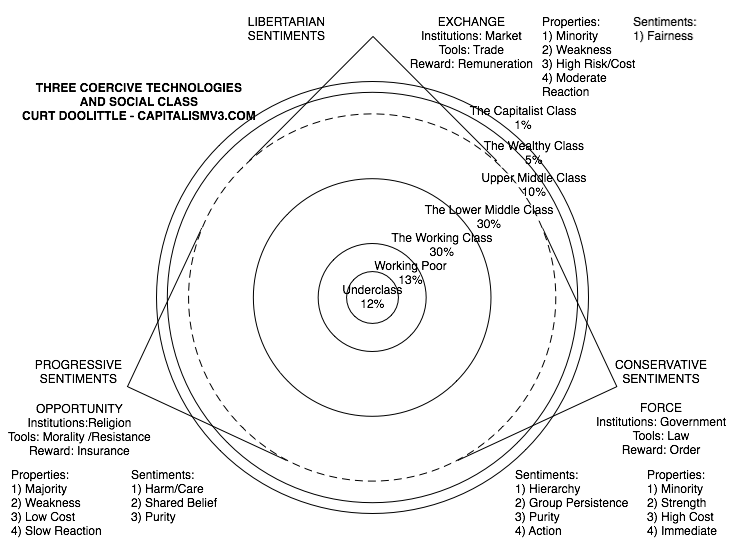
    Rock Paper Scissors: Elites and the Three Methods of Coercion

    There are three formal means of coercing groups of people with institutions. And we can use these three Archetypes to imagine the extremes:

    GHENGIS KHAN -- THOMAS JEFFERSON -- MOTHER THERESA
    VIOLENCE...........EXCHANGE............SUBSIDY 
    RIGHT...............CENTER..............LEFT 
    FATHER...............SON.............SISTER/MOTHER


    The three means of coercion are as follows:

    1) FORCE, or the threat of force A person has a VIOLENCE INCENTIVE to behave in a particular way when it has been made known to him that failure to do so will result in some form of physical aggression being directed at him by other members of the collectivity in the form of inflicting pain or physical harm on him or his loved ones, depriving him of his freedom of movement, or perhaps confiscating or destroying his treasured possessions.

    The Physical: Body and Movement Using Force or Violence The fear of harm or promise of defense. By the Dominant or Established Male

    Force: Tool: Physical Coercion Benefit: Avoidance Benefit Strategic use: Rapid but expensive. “Seize opportunities quickly with a concentrated effort.”

    LimitsVia-Negativa: Procedural Power: Political, Judicial, and Military Power (Soldiers, Judges, and Politicians)

    STATE(ORDER): Formal Limits. Violence(Harm) < -vs- > Defense (Protection) :  Defense, Taxation, Keeping the Peace

    2) REMUNERATION or payment A person has a REMUNERATIVE INCENTIVE to behave in a particular way if it has been made known to him that doing so will result in some form of material reward he will not otherwise receive. If he behaves as desired, he will receive some specified amount of a valuable good or service (or money with which he can purchase whatever he wishes) in exchange.

    The Material: Resources and Opportunity Using Bribe or Trade The fear of loss of gains, or promise of gains By the Brother, Ally, or Ascendant Male

    Exchange: Remunerative Coercion With Material Benefit – Strategic use: efficient in cost and time, only if you have the resources.

    PossibilitiesVia-Practica: Economic Power (people with wealth either earned or gained through tax appropriation).

    TRADE(LAW-COMMERCE): Formal Cooperation: Boycott (Deprivation) < -vs- > Trade (Gain)  :  Reciprocity, Property : Boycott:  Markets Laws.

    3) MORAL Claims (collective goods) A person has a MORAL INCENTIVE to behave in a particular way when he has been taught to believe that it is the “right” or “proper” or “admirable” thing to do. If he behaves as others expect him to, he may expect the approval or even the admiration of the other members of the collectivity and enjoy an enhanced sense of acceptance or self-esteem. If he behaves improperly, he may expect verbal expressions of condemnation, scorn, ridicule or even ostracism from the collectivity, and he may experience unpleasant feelings of guilt, shame or self-condemnation.

    The Social: Cooperation and Insurance Using Undermining or Advocacy The fear of ostracization or promise of inclusion By the female and especially dominant female

    Words: Tool: Verbal, Moral Coercion Benefit: Ostracization/Inclusion, and Insurance benefit Strategic Use: slow, but inexpensive. “Wait for opportunity by accumulating consensus.”

    WantsVia-Positiva: Populist Power (Religion, Entertainment, Public Intellectuals)

    RELIGION(SOCIETY): Formal Indoctrination Ostracization (Risk-Death) <–vs–> Inclusion (Safety-Life) : Conformity Obedience : Gossip, Undermining. And In addition, non-coercive informal institutions:

    4) The Informal Organic Norms

    THE PEOPLE: Organic Norms and Traditions: Pragmatic Habits

    Degrees Of Coercion

    We can scale each of the three-axis of coercion by degree of coercion:

    1) INFLUENCE – informing others in their interests … 2) COERCION – coercing others to follow your interests … … 3) POWER – organized coercion of others for your or collective interests

    |Coercion|: Neutral > Influence > Coercion > Power  And Scale each axis by dree of certainty:

    |Certainty|:Undecidability > Possibility > Potential > Probabilitye > Likelihood > Certainty

    Combinations of Methods of Coercion:  “Chords” of Coercion

    Influence, coercion and power can consist of one or more of these method, often in great complexity. Groups tend to give priority to one or more different weighted combinations, or perhaps ‘chordic’ representations of these strategies. They do so out of habit, and class inclination, just as they follow religious and class sentiments due to their upbringing. People who belong to institutions have different capacities for adopting these strategies. Force requires discipline and long Time Bias. Remuneration requires cunning and invention. Moral claims require loyalty to consensus, and absorption of, and therefore payment of, opportunity costs. Different social classes have different time biases and consist of people with different time preferences, requiring different types of discipline under different social and economic conditions. ie: it is easier to have a long time preference if one is genetically disposed to better impulse control, and lives in greater security. It is easier to have a short time preference if one is more persuaded by impulses, less disciplined, and in an environment of scarcity. There are different costs to these institutions: Force is extremely expensive. Creating non-corruption, and order (some network of property definitions and their means of transfer). Property is a term for a scarce good that must used, consumed or transformed in the process of production, even if that process is human sustenance. Remunerative institutions require the complex task of concentrating capital then maintaining it in a constantly changing kaleidic and competitive environment. Moral claims require constant advocacy, verbal skill, maintenance of numerous relationships, and constant payment of opportunity costs. The social classes are organized by intelligence expressed by empathy or dominance. Intelligence is the ability to absorb content in real-time, to learn abstractions in time, and to permute those abstractions in application to problems in real-time. Intelligence regresses toward the mean over generations. Therefore class membership is an indicator of the likelihood of class mobility, and upper-class position is difficult to maintain. While we use the word ‘middle class’, and most people in the west live middle-class lifestyles, the middle class means possessing disposable income and participating in the market. Therefore the majority of citizens are in the upper proletariat and lower-middle classes, which we call the working, white-collar working and craftsman classes. The Social classes have different access to each of these forms of coercion. Those in the institutional class, or upper class, have access to force in the form of policy and law. Those in the capitalist class, or middle, have access to capital: money, and market institutions. In each strategy peoples form elites, and organizations for utilizing those strategies. The elites create philosophical frameworks. Each of these frameworks consists of moral claims, and institutional means of perpetuating those claims, and the social benefits of adopting those claims. Each of these institutions is open to corruption, which is the privatization of opportunity and reward, for personal consumption at group expense. Corruption is fraud. Each of these strategies, their organizations, institutions, and elites compete against other strategies, organizations, and elites, and each attempts to use its organization for discounts against other organizations. This competition is analogous to the game of Rock, Paper, Scissors, if more complicated: each group can successfully compete against one another under most circumstances, but can defeat and be defeated by some other combination of forces. At its base, there are only three tools of social organization. These three forms can be combined, as they are in the majority of the population in some manner or another. Or they can be used as one of three specializations, each of which attempts to play rock, paper, scissors, with the other two.

    The Relation Between Elites and Classes

    ( … )

    theecoercivetechnologies

    The Three Orders: Kin, State, and Cult

    We make use of Authority and State, Law and Trade, and Education and Religion, but we choose a dominant bias with which to employ them in our social orders, yielding:

    (1) Kin and Law and Nation and Federation – Create Self Determination (2) State and Corporatism, and Empire – Limit Self Determination (3) Cult and Religion, and Globalism – Eradicate Self Determination … depending upon homogeneity or heterogeneity of the population; to overcome resistance to the creation and preservation of commons – so that why is it that one bias in the order is always better off than the others?

    The Order of Development of The Three Institutions

    Religion(Theology) -> State > Law ==> (Middle east) Religion(Mythology)  -> Law -> State ==> (India)

    Law > Religion > State  ==> (no one) Law > State > Religion(Philosophy) ==> (Europe)

    State -> Law -> Religion ==> (China) State-> Religion(Confucian) -> Law  ==> (China – Failed Law) Political power originates in the ability of humans to organize by individual influence, group coercion, and institutional power. It just so happens that we use gossip to rally and shame and ostracize people from production and opportunity for consumption. Religion. But then we scale. It just so happens that you need to use violence to suppress parasitism sufficiently for a market to form, at that scale: State But then we scale further. And then to use law to suppress cheating, fraud, and to impose performance, and restitution, and if necessary, punishment: Law. But then we scale further. And then we use wealth created by the application of violence and law and to force market participation rather than parasitism, to pay off those who cannot be forced. And then, we hit the novel inflection point, and scale further: And so we then use force, law and gossip to suppress the suppressors, and rely entirely upon rule of law, without a group that exercises power. So the sooner one develops rule of law, the sooner one starts suppressing the parasitism of the monopoly.

    Tools of Rule

    REPUTATION (Tribe, Band, Village) Individuals in small groups develop reputations and their survival depends on those reputations.We evolved for reputation. In fact. our consience serves to attempt to limit the damage we can do to our reputation. Because status (reputation) is the most infulential asset we have in survival after our health and natural ability. The reason is simple: the returns on coperation are not replacable by individual achievement. Weapon: Ostracization (death sentence) Records: Memory of Locals RELIGION (Polity) Religion evolved to provide an understanding of the word, virtues to imitate, and general prohibitions, across clans, tribes, and conquered nations, so that people could cooperate more easily and retaliate (feud) less frequently. Weapon: ostracization (deprivation from opportunity) Records: the memory of locals, religious registries and ceremonies. LAW  Law evolved to standardize punishments across clans, tribes, and conquered nations, to keep the peace, preserve productivity, preserve taxation, and legitimize (provide value by) rule. Weapon: violence, deprivation Records: written ledgers of crimes and punishments. CREDIT Credit rule evolved to increase productivity by the promise of consumption in the present, such that the primary form of social punishment was loss of consumption, status, and signaling. Weapon: deprivation of consumption, status, and signaling. Records: written and electronic records of creditworthiness. DIGITAL REPUTATION Social media is creating a digital reputation but so isall online activity. Weapon: deprivation of opportunity, consumption, status, and signaling. Records: Electronic Records of behavior in all walks of life DIGITAL PRIOR RESTRAINT State surveillance of all behavior private and public. Weapon: Deprivation of choice to behave according to ‘rules’. Records: Surveillance. Predicted behavior from records in all walks of life.

    The Result is the Ternary Logic of Political Science

    There are three states of logic, in order:

    1. False 2. Truth candidate (actionable) 3. Undecidable (In-actionable) There are three options to cooperation

    1. avoidance – to separation (ostracization) 2. exchange – to integration(cooperation) 3. parasitism– to predation (conflict) There are three means of coercion

    1. Remuneration (deprivation of trade, or benefit from trade) Middle class – Libertarian Meritocratic 2. Force (imposition of harm, defense from harm) Upper class – Conservative Eugenic 3. Undermining (ostracizing/inhibiting opportunity, including/generating opportunity) Under Class – Progressive Dysgenic So We Can Organize by Three Methods

    1. Kin – Law (Law, Economic)
    2. State – Force (Military, Political)
    3. Cult – Ostracizaton (Mythology, Social)

    So We Can Rule by three axis of decidability

    1. Reason and Command (China India) – Requires Justification 2. Empiricism(science) and Law (Europe) – Requires Truth 3. Sophistry and Propaganda (Semitia) – Requires Sophistry We can govern by three axis:

    … …  Military Elite (Unaccountable) 1. Bureaucracy (china) – Upper Class – Authority … …  Financial Elite (Unaccountable) 2. Markets, Law, Courts, (Europe) – Middle Class – Republic … … Academic Elite (unaccountable) 3. Priesthood (Semitia)  – Underclass – Theocracy – Byzantium, Islam Producing three axis of elites  

    1. Military, Militia, (external)

    2. Juridical Police, Sheriff (internal) 3. Priests, Politicians, Public Intellectuals (familial, social) and of late minor elites 4. Economic: Entrepreneurial, Financial, Treasury

    5. Scientific, Technical, Proucing Three Consequences

    1. Administration and Stagnation (strong:china, weak:india) 2. Production and Evolution (Europe) 3. Parasitism and Degeneration (semitia, gypsies)

    A Quick Note on Serialization

    And I hope you see the pattern we call Serialization that we use to produce Types:

    • Development: Sensory, Motor, Social, Rational, Skills
    • Aging: Youth (to 16), Ascendant Adult (to 35), Established Adult to death
    • Memory Adaptation: Right Now, Three Seconds, Three weeks, Three Months, Three years,
    • Mindfulness: personal, interpersonal, social, political, existential
    • Thought: Consiousness, Daydreaming, thinking, reasoning, ratioanalising (rationalism), calculating computing.
    • Institutions: In-Family Traditions. Class Traditions, Informal Institutions, Formal Institutions
    • Rules: Traditions, Norms, Laws
    • Ethics: Manners, Ethics, Morals
    • Ethical Methods: Imitative Ethics, Rule Ethics, Outcome Ethics
    • Stories: Mythology, Narrative(story), Literature, History
    • Paradigms: Theology (intuitive), Philosophy (Rational), Law(Evidentiary), Science(empirical), Logic(logical).
    • Sciences: Formal (Logics), Physical, Natural (Behavioral), and Evolutionary
    • Natural Sciences: Language, Psychology, Sociology, Economics, Law, Group Strategies
    • Physical Sciences: Physics, Chemistry, Biochemistry, Biology, Sentience
    • Mathematics: Counting: Numbers, Counting, Arithmetic, Accounting. Sets: Algebra, Computability, Combinatorics. Space: Trigonometry, Geometry, Differential Geometry, Algebraic Geometry, Topology. Time or Change: Calculus, Analysis)

    Or scalar both directions:

    • Moral: Evil, Immoral, Unethical, Bad <- Amoral -> Good, Ethical, Moral, Virtuous.
    • Extremes of Brain Structure: Female: Psychotic Solipsistic Sensitive Empathic <- Balanced -> Rational, Analytic, Aspie, Autistic :Male

    Or as we have seen above scalar in three directions:

    • 1 – Force: Coercion by Defense or Threat
    • … … … … … … … … 2 – Remuneration: Coercion by Bribery or Deprivation
    • 3 – Undermining: Coercion  by Inclusion or Ostracization

    Or say, the four dimensions of the Nolan chart of political biases:

    ……………………………………………1 – Libertarian (Individual)……………………………….. 3 – Socialist (Consumptive) ———–|——— 4 – Aristocracy (Conservative) …………………………………………2 – Authoritarian (Collective)………………………………… And we use all various combinations of these lists, spectra, hierarchies and graphs. Why? Because when we create these definitions we convert rules of thumb to systems of measurement. And on the one hand, by providing the context for any term, it turns out to be the best way to educate people because the world they learn about “fits together”. And on the other hand, it nearly eliminates the ability of ignorant, biased, or deceptive people to engage in the many techiques of conflation, so that they can perpetuate an error, advance a bias, or lie. So by using terms defined in a context of other terms, we disambiguate those terms and increase the precision of the speaker to use due dilligenc in speech, and the ability of the audience to insure they’re undersattnding and not being subject to a falsehood. The ranking assuming we eradicate the Semitic dark ages: Europe, China, India, Iran-Assyria-Babylon, Egypt Mesoamerica, Semitia (Jewish Muslim), S-Pacific, E africa, W africa Africa, S Africa, Austronesia The only hard choice being Iran vs India and that choice possible only because the Persians were not able to shake off Islam and reassert Persian civilization despite efforts just as the Germans can’t sake of Christianity despite their efforts and reassert germanic civilization.

    Human variation

    The Demand for Group Strategy (coherence, choice, calculation, coordination)

    The Demand for Mindfulness is Demand for Education

    The Neural Economy The Neural Economy, Uncertainty, and Worry (neuroticism) The Demand for “Meaning”The Demand For Agency (Will to Power, or control, or survival)The Demand for Mindfulness I mean the physical, cognitive and emotional discipline to control the subject of attention on the present intent, insulated from distractions whether personal, environmental, or interpersonal.

    —“People are not evolved for producing statements of secular epistemic purity but rather for survival through cooperation through language. “—

    Decidability and mindfulness are market goods. We require these goods to compensate for a complex unpredictable (kaleidic) world. Traits Agreeableness, Extraversion, and Neuroticism

    1. Personal: The market demand for personal mindfulness (Spiritualism) whether empathic-feminine (theological), moral-masculine(rational), or analytic-masculine(scientific) exists, and all three demands exist for most of us.
    2. Interpersonal: The Market Demand for interpersonal mindfulness by creating a standard dialog, set of signals, and manners that are costly to learn and practice, but that by practicing display to others you are worthy of honest cooperation on the same terms.
    3. Social: The market demand for social mindfulness (limitation of fear and comfort in the ethical, and moral. These are moral rules that serve the group’s competitive strategy – and all reflect the environmental challenges of the age of transformation in which men invented religions.,
    4. Political: The market demand for political mindfulness (limits on political action and on rulers actions). I won’t cover each of them here.
    5. Strategic: The Market Demand for a group strategy – gypsy parasitism, Jewish parasitism, Muslim parasitism, predation and conquest, Christian undermining of the truth, knowledge, reason, law, property, aristocracy by rallying the peasantry and women and slaves against all and being as expansionary as islam – to counter islam. Buddhist submission and obedience Hindu class duty and function in the ‘harmony’. Chinese hierarchical family (bureaucracy). Anglo aristocratic egalitarianism (entrepreneurship and corporation).

    +2 – Dominance (Real, Techne-Science, Materialism, Action) Statism Nationalism (Tribalism) Achieves mindfulness because of participation in state Soldiery Achieves mindfulness through military fraternity Agency Achieves Mindfulness because of achievement or success

    + 1 – Utility( Idealism, Philosophy, Reason, Choice, Mind) Aristotelian-Anglo Philosophy Continental and Platonic European Philosophy ConfucianDaoist Philosophy

    0 – Insulation (Accommodation, Ritualization, Thought, Intuition ) Stoicism achieves mindfulness through small daily task completion in a virtuous manner. Shinto achieves mindfulness through the precise repetition of ritual in a respectful manner. Buddhism achieves mindfulness through meditation and escape from reality.

    -1 – Submission (Supernatural, Theology, Empathy, Feeling) Christianity achieves mindfulness by personal and collective prayer (and song). Islam achieves mindfulness by many memorizations and ritual prayers during every single day. Judaism achieves mindfulness by separatism and deep indoctrination

    The question is, given how the various religions solved mindfulness (Stoicism-epicureanism, buddhism, hinduism, abrahamism) which produces agency (stoicism), which produces optimism (hinduism), which produces withdrawal from reality (buddhism) and which denies and escapes reality (abrahamism).

      ( … ) Male vs Female bias

    The Demand for and Difference in Moral Organization

    Openness, Conscientiousness, Extroversion, Agreeableness, and Neuroticism. morality personality Affinity

    The Difference in Religious Organization

    monoply 

    The Difference in Political Organization

    Indian Religion,  Chinese wisdom,  European ratio-scientific Literature, European Law, Prussian Monarchy and Bureaucracy, Chinese time horizon,

    The Differences in Legal Organization

    The Differences In Civilizational Time Horizons (Planning)

    (Chinese eternity), monarchical lifetimes, (democratic tomorrows), theological stagnation   Jewish (Undermined England, Germany, France, Ukraine, and Russia) The Jewish religion was the first to require literacy. While philosophy required literacy, religion came to literacy late and last. Literacy both prohibited a bottom class, and gave access to higher-paying administrative jobs. By the second century, nearly all jews had given up farming – or given up on the religion. The resulting diaspora, selection for ingroup bias, the exit of failures, upward redistribution of reproduction to Rabbis, and frequent retaliatory prosecutions and bottlenecks produced expected results.

    • Racism
    • Supremacy
    • Nepotism (Sustaining Judaism and Jewish People)
    • Serial Monogamy until Late.
    • Separatism (state within a state), (Buiding Support for Israel)
    • Poly Logicalism (Asymmetric) Ethics
    • Fictionalism Loading-Framing->Storytelling-> Fictionalism( occult->supernaturalism, magic->psueudoscience, Sophistry->idealsm, )
    • Parasitism (avoidance of braoder commons, privatizing comons)
    • Rebellion (Tikkun Olam – Repairing the world (making it safe for jews))
    • Globalism (making the world safe for rebellion, parasitism, separatism, nepotism, by eradicating other’s choice of self determination)
    • Federalism (Prevention of Authority, Aristocracy and Nationalism)
    • Hazarding
      • Physical Degeneracy ( avoiding integration )
      • Financialiaztion, Gabmgling, Usury, Baiting into Hazard, Unproductivity.
      • Marketing and Consumerism (Propaganda, False Promise, Hyperconsumption,)
      • Propagandism (social construction )
    • Undermining
    • Insurrection
    • Revolution
    • Retaliation (Murder)
    • Civilizational Destruction and Degeneracy

    The most racist of peoples, Jews can claim they aren’t because they aren’t responsible for the consequences. Latin American (Indo-European-Amerindian) (Curently Invading and colonizing North America) West European (Under Conquest by Latin American, Judaism, Islam) Organizations Japanese (preserving kinship) Buddhist (Under conquest by China: Mongolia, Tibet, Turkmenistan, Manchuria, Zungharia, and infringing on Laos, Thailand, Cambodia, and Vietnam. Indian (Indo Iranic (western Eurasian) – Ancestral North Indian(Western Eurasian) – Ancestral South Indian (African) (Under Conquest by Islam, partial by China) African (Under Conquest by Islam)

    The Costs of Differences in Civilizational Strategy

    The chinese strategy of delay and deceive until the battle is won comes at the cost of truth before face, corruption, and

    The Conflict of Civilizations and Incompatibility of Civilizations

    ( … )

    The Persistence of Group Strategies

    GIVEN; The disproportionate returns on increasing scales of cooperation in a division of sensation, perception, cognition, prediction, memory, wants, advocacy, negotiation, and labor.

    AND; The Competitive Value of Marginal Increases in the Rate of Adaptation by Physical and Caloric, Social and institutional, Cognitive and Technological means.

    AND; A Group’s Founding Relationships:

    To The Natural World, To Choices toward Others, By An Organizational Model, By Means of Mythology, and Paradigms By Means of Persuasion and Negotiation, and By Grammar of Communication

    AND; The Spectrum of Relationships with The Natural World

    Peers, Ascendants, Transformers, Conquerors of Nature (Europeans) – In Harmony with Nature – bias mankind (East Asians) – Interwoven Supernatural and Natural — bias supernatural (Hindu) – Subjects of the Supernatural (Semitic)

    AND; The Spectrum of Choices Toward Others:

    Predation, Parasitism, Rent Seeking, Free Riding, Undermining – Competition by the degree of Non-imposition, Cooperation, and Trade – Boycotting Avoidance of conflict or cooperation

    AND; The Spectrum of Means of Organizing Order and Elites Internally

    Force/Defense: Military/Judiciary — Authority (positive) – Remuneration/Deprivation: Finance/industry – Markets (exchange) – Undermining/Inclusion: Priesthood/intellectuals – Resistance (negative)

    AND; The Spectrum of Mythologies

    History (truth), Essay, Science – Literature (analogy), Mythology – Deceit (fraud), Scripture, Theology THEREFORE; All civilizations produce:

    (a) A Group Evolutionary (competitive) Strategy, (b) A Group Organizing Strategy to Pursue it (c)Mythology to explain and justify it, (d) A Wisdom Literature to communicate it, (e) A System of Argument to persuade and defend it, and; (f) A set of Institutions to persist it. (g) A Set of Traditions, Values, Norms, Habits to Act upon it.|STRATEGY|Strategy > Organizing Strategy > Mythology > Wisdom Literature > System of Argument > Institutions > Traditions, Values, Norms, Habits > Actions.

    Human Faculties

    Communication, Grammar, Epistemology, Suggestion, and Due Dilligence

    Spectrum of Speech

    • CRITICISM
      • Polemic: an individual’s expression of anger by criticism in political matters.
      • Diatribe: an individual’s expression of anger by criticism.
      • Criticism: opinion or factual objection to statements or actions.
    • PERSUASION
      • Prosecution: adversarial falsification (criticism) of one or more theories. Or what we call ‘science’.
      • Argument: adversarial competition between theories – or what we call reason.
      • Debate: competition between theories before an audience.
    • COLLABORATION
      • Discourse: an exchange between parties for the purpose of the exploration of competing ideas.
      • Dialog: exchange of information for the purpose of understanding ideas
    • COMMUNICATION
      • Testimony: Speech that communicates facts, warrantied to be free of wishful thinking, suggestion, obscurantism, bias, and deceit, under threat of perjury (harm).
      • Ordinary Language: negotiation of ordinary behavior in ordinary daily life.
      • Opinion, Essay or Narrative: Speech that communicates opinion.
    • STORYTELLING
      • Narration:
      • History:
      • Fiction (analogy, Parable)
    • DECEIT
      • Denying or Ignoraing
      • Obscuring, or Leaving Out
      • Suggesting,  Loading, Framing, Overloading:
      • Fiction (Deceit):
      • Fictionalism:
        • The Physical : Magic to Pseudoscience to Pseudomath (Pseudoscience)
        • The Verbal: sophistry to idealism, to platonism (Philosophy)
        • The Imaginary-Emotional Spirituality to occult to theology (Theology)
    • FRAUD
      • Avoid Liability  (Grey Lie)
      • Commit Fraud (Black Lie)
      • Bait into Hazard (Evil, or Purple Lie)

    Human Faculties, Suggestion and and Fictionalism

    (explain vulnerability)

    Methods of Argument

    • Expressive (emotional): a type of argument where a person expresses a positive or negative opinion based upon his emotional response to the subject.
    • Sentimental (biological): a type of argument that relies upon one of the five (or six) human sentiments, and their artifacts as captured in human traditions, morals, or other unarticulated, but nevertheless consistently and universally demonstrated preferences and behaviors.
    • Moral (normative) : a type of argument that relies upon a set of assumedly normative rules of whose origin is either (a)socially contractual, (b)biologically natural, (c) economically necessary, or even (d)divine. (Also: RELIGIOUS)
    • Reasonable (informal)
    • Rational (logical and formal) – Most philosophical arguments rely upon contradiction and internal consistency rather than external correspondence.
    • Analogical (HISTORICAL) A spectrum of analogical arguments – from Historical to Anecdotal — that rely upon a relationship between a historical sequence of events, and a present sequence events, in order to suggest that the current events will come to the same conclusion as did the past events, or can be used to invalidate or validate assumptions about the current period.
    • Scientific (directly empirical): The use of a set of measurements that produce data that can be used to prove or disprove an hypothesis, but which are subject to human cognitive biases and preferences. ie: ‘Bottom up analysis”
    • Economic: (indirectly empirical): The use of a set of measures consisting of uncontrolled variables, for the purpose of circumventing the problems of direct human inquiry into human preferences, by the process of capturing demonstrated preferences, as expressed by human exchanges, usually in the form of money. ie: “Top Down Analysis”. The weakness of economic arguments is caused by the elimination of properties and causes that are necessary for the process of aggregation.
    • Ratio-Empirical (Comprehensive: Using all above): A rationally articulated argument that makes use of economic, scientific, historical, normative and sentimental information to comprehensively prove that a position is defensible under all objections. NOTE: See “Styles of Argument” below.
    • Testimonial: (OPERATIONAL) categorically consistent, Internally consistent (logical), Externally Correspondent (Instrumentally observable), Operationally articulated (Possible), Fully Accounted, Moral (free of imposed costs).

    Mythology and Metaphysics

    consistency across dimensions

    Wisdom Literatures

    Tree of Group Wisdom Literatures

    Confucianism, Aristotelianism, Abrahamism, Hinduism->Buddhism

    Burial …
    … Animism ….
    … … Sun Tzu Realism ( Martial Realism)
    … … … Confucianism (harmony)
    … … … … Daoism (Tolerance)
    … … Proto IE Religion
    … … … Proto Vedic
    … … … … Hinduism
    … … … … Zoroastrianism
    … … … European Sky Father (martial realism)
    … … … … European Common Law (legal realism)
    … … … … … Platonism (idealism)
    … … … … … … Aristotelianism (realism naturalism)
    … … Proto Semitic (Animism)
    … … … Proto Judaism
    … … … … … Abrahamism <- Zoroastrianism (Authoritarianism)
    … … … … … … Rabbinical Judaism (Justificationism)
    … … … … … … Christianity (resistance)
    … … … … … … … The Augustinian Conflation (compromise)
    … … … … … … … … Orthodoxy – Catholicism, (settlement)
    … … … … … … … … … Protestantism, (reformation)
    … … … … … … … … … … Evangelicalism (folk-religion restoration)
    … … … … … … … Islam (7th c+)
    … … … … … … … … Fundamentalist Islam (11-12th c+)
    … … … … … … … … … Wahabi Fundamentalist Islam (20th c+)


    Grammars of Civilizations Tell Us Their Strategies

    1 – Aristotle Wrote Proto Empiricism: Reason, Naturalism, Proto-empiricism, Law, Calculation. (TRUTH, What is.), So the greeks and romans crossed from tradition into philosophy and then empiricism (science). Truth Regardless of Cost. 2 – Lao Tzu, Sun Tzu, and Confucius, all 6th-5th C BC wrote Philosophical WISDOM LIT. Lao Tzu crossed the line into the questionable. (WISDOM, What should be) Note that Buddhism was developed in India in the 5th Century BC, but did not succeed there. 3 – The Persians wrote supernormal and supernatural wisdom literature. Zoroastrianism 6th C BC. (UTOPIAN UNIVERSALISM) They did not make the full leap from religion to philosophy. 4 – The Indians wrote both mythology and wisdom literature, bordering on political science, from 1500 to 500 bc, then developed gods through 500AD, and continued to evolve through contributions of ‘saints’ through 1500AD despite Islamic conquest and interference. (WISDOM, RITUAL, PRAYER, What should be)  in the broadest sense, 5 – The Egyptians wrote no systemic text for their natural religion (mythology, animism, polytheism,  They practiced traditional trade: RITUAL AND SACRIFICE Supernatural (Animism, Anthropomorphism, heathenism ) Doctrine and Ritual. 6 – The Semitic Abrahamists , from 6th c BC, to 6th c AD, evolved traditional Semitic polytheistic religion into monolatry, then monotheism, then branched into Christianity, rabbinical Judaism, and islam (an others). (wrote Mythology, Resistance, Rebellion, Separatism, and Lie and Destruction of all of the above. (COMMAND, UTOPIAN LIE) They conflated theology, philosophy, and law into authoritarian religion.

    The Axial Age (Civilization Formation) Anchored Us All

    —“Axial Age (also Axis Age, from German: Achsenzeit) is a term coined by German philosopher Karl Jaspers in the sense of a “pivotal age”, characterizing the period of ancient history from about the 8th to the 3rd century BCE. During this period, according to Jaspers’ concept, new ways of thinking appeared in Persia, India, China and the Greco-Roman world in religion and philosophy, in a striking parallel development, without any obvious direct cultural contact between all of the participating Eurasian cultures.”— Wiki

    [I]t’s just a fact that the ‘wisdom literature’ of each civilization (a) relies upon the grammar, (b) relies upon the argumentative methodology of the law, (c) relies upon the mythos. It’s inescapable. There is a reason Jews appropriated Babylonian history, and integrated Greek idealism to create Pilpul (justificationism in theology that relies upon the same techniques as justification in astrology and numerology) … and predictably enough, the same argument you are making (critique – the via-negativa of pilpul’s via-positiva). There is a reason the Jews appropriated European sciences to create the pseudosciences of Freudianism, boazianism, marxism, neo-marxism, feminism, and HBD-denialism, and European rationalism to create postmodernism, and European math to create with the outliers being Keynes and Foucault – both homosexuals. Just as there is a reason Confucius couldn’t solve the problem of politics and the Chinese speak in contrasts (riddles). Just as there is a reason westerners speak in law, evidence, and testimony. The ‘Axial Age’ anchored us all.

    We Don’t Know Our Group Strategies

    We call these  ‘metaphysics’ or values as if they are arbitrary – and they aren’t. Within each strategy, classes develop sub-strategies There are

    There are a limited Number of Strategies – and we can Enumerate Them

    There are only so many human strategies – and we discovered and exploited all of them. It Takes Three to Maintain Equilibrium The ABC of strategy, and the necessity of trinaries to produce equilibria  Personality, Morality,  Class, Political System, Strategy The Conflict of Civilizations

    All Surviving Strategies Succeed, Some are Moral or Immoral, and advance man, hinder, or regress man

    ( … )

    Evolution, Path Dependency and Group Strategy

    Path dependence is when the decisions presented to people are dependent on prior decisions or experiences made in the past. So whether the information is genetic and invisible to us, metaphysical (a paradigmatic interpretation of the universe, world, man and our societies, presumptive habit

    We Can Reform Our Group Strategies

    The Indo European Revolution as Instigator of Strategies – the formation of organized religion The Greco-Roman Rational Revolution as the instigator of strategies – the formation of Abrahamic religions The British Empirical Restoration of Aistotielaims reuniting our law and custom with our theory and academic Cause of Most Strategies french division of functions made an operational error – but not a natural error. Violation of physical natural or evolutionary laws. The german search for secular theology – spread natural errors The jews, however, took it again, to extremes – jews MAN Sigmund Freud (Psychology) Franz Boaz (anthropology Stephen J Gould (Evolution) NEO MARXISM (Critique = Undermining, Straw Manning vs Heaping Undue Praise -> “Lying”) (Critical Theory, Undermine, Abandon Revolution) Antonio Gramsci FRANKFURT SCHOOL Critical Theorists Jürgen Habermas (philosopher) Axel Honneth (philosopher) Oskar Negt (philosopher) Alfred Schmidt (philosopher) Albrecht Wellmer (philosopher) Claus Offe (philosopher) Theorists Herbert Marcuse (philosopher) Max Horkheimer (philosopher) Theodor W. Adorno (philosopher) Erich Fromm (psychoanalyst), Friedrich Pollock (philosopher) Otto Kirchheimer (jurist) Leo Löwenthal (philosopher) Franz Leopold Neumann (Activist) Henryk Grossman (economist) Siegfried Kracauer (critic) Alfred Sohn-Rethel (economist) Walter Benjamin (philosopher) Ernst Bloch (philosopher) POSTMODERNISM (Relativism, No Truth, No Explanation, Just Power. Using Social Construction of falsehoods, and social deconstruction of Truths) Jacques Derrida (philosopher) Michel Foucault (philosopher) Jean-François Lyotard (philosopher) Richard Rorty (philosopher) Jean Baudrillard (philosopher) Fredric Jameson (philosopher) Douglas Kellner (philosopher) FEMININSM LIBERTARIAISM Rand-Rothbard CULTURE POLITICS ECONOMICS Karl Marx (Economics, Sociology) Ludwig von Mises (Economics) Paul Krugman and Joseph Stiglitz (Economics) MATHEMATICS Georg Cantor (mathematics) Niels Bohr (less so einstien) The Myth of Oppression The Myth of Oppression And The Demand for Adaptation to Physical, Natural, and Evolutionary Laws within the limits of the group’s strategy. Throughout history the myth of oppression is just that a myth. Instead, just as we contained Christianity and then failed, just as we contained Islam for 1400 years, just as we contained bolshevism, just as we contained fascism to resist bolshevism, and just as we contained the communist movement, just as we contained the soviets,  just as we have tried to contain the Islamist movement, just as we are trying to contain the Chinese Imperial movement, just as we are now trying to contain the Turkish Muslim and Iranian Muslim movements, we contained the Jewish movement throughout history. And the bolsheviks and the soviets were the only time the jews gained access to power to implement their culture at scale.  Most of our history consists of trying to contain authoritarian, non-market, anti-rational, anti-scientific and much larger populations to self-determination, markets, reason, and science. Despite the women and underclasses within, and the hordes without. And the simple reason is that we, the Japanese-Koreans, alone can trust one another, because of our defeat of tribalism, because of our homogeneity, and because of our empirical monarchies.  The three outliers today are (a) the gypsies that practice organized petty crimes, (b) the jews that practice organized social and political crimes of undermining, ( c) the Muslims that practice organized cromes of psychological undermining.  With the rest of the world practicing traditional warfare.

  • Conflict 1: Thesis

    The Solution To the Problem of Our Age Requires We Address A Taboo.

    THE PROBLEM All institutions lag. Of law (market), state (commons), and religion (tradition), law evolves fastest. But even so, law that is dependent upon tradition, even an empirical tradition, and lacking formal logical foundation, cannot reform without crisis – any more than familes, social organizations, commerical organiztins, the sciences, governments, or religions reform without crisis And we are in civilizational Crisis for just this reason: our law is lagging in reform. The failure of the law of tort to keep pace with inventions in parasitism and predation generates demand for the state to via-positiva impose rules of conduct instead of the law’s via-negativa prohibitions on conduct. The objective of my work the reformation of our traditional, empirical, evolutionary, common law and its foundation in the law of tort, and dependence upon the test of reciprocity into a strictly constructed, formal, operational logic like that of programming. Computers cannot choose and have no instincts of their own, so we program them with what they must do given the operations it is possible for them to perform. Conversely, man can choose and has instincts of his own, we must program man with what they must not do, given the operations it is possible for mankind to perform. If we are successful in evolving norms, we program man by training and environmental exposure with the positive alternatives to those actions we wish to program him not to perform. It is always better to reward the man for doing a good than threaten a man with consequences for doing a bad.  And while we adapt our norms to encourage different alternatives to the bad, we have evolved the habit of expressly prohibiting the bad, and codifying those prohibitions in law, and using institutions to enforce those prohibitions.  These laws convert social norms by which one can be ostracized to institutional ways by which one can be punished for doing bads. Where that law of Tort (or Trespass, or Property), is dependent upon the logical necessity and empirical evidence of the universal human demand for Reciprocity, and that tests of reciprocity provide man with universal decidability in matters of conflict. And where that demand for Reciprocity includes every action or inaction, and all display, word and deed. That means reciprocity in everything we can pay any cost for, directly or indirectly, by action or inaction, whether private, shared, or commons. And While reciprocity-in-deed is ancient and obvious, the novelty in my work is  ( …. scope and speech and display ) in demanding Reciprocity in word, that requires testifiable, warrantable claims for which one is liable. This requirement causes us to pay an even greater self-monitoring cost (what we call agency) than does reciprocity-in-deed. And this has been a problem. We have tolerated free speech when we meant truthful, reciprocal, moral, and constructive speech. science invent techniques of observation (measurement) and logic (measurement), that exhaust our … So when I say that my work in Propertarianism’s P-Logic, and P-Law complete the scientific method, I mean, that the scientific method evolved from, and is an application of, our law of evidentiary testimony, by extending the logic of tort from claims over property disputes, to all claims about the universe,  ( … suppressing all false claims not just false claims over  …) And that P-Logic and P-Law extend the prohibition on the spectrum of techniques of deception: of Laziness in failure of due diligence against error and bias; undue influence by loading and framing, suggestion and obscurantism,; deception by the three fictionalisms of verbal sophistry-to-idealism, physical magic-to pseudoscience, and imaginary occult to supernaturalism; and outright deceit by false promise, fraud, baiting into hazard. THOUGHT LEADERSHIP As strange as it might seem, there are only two groups of thought leaders in this present world, the Europeans and the Half European Jews we call Ashkenazi. And the Europeans and the Askenazi have polar opposite genetic intuitions, cultural strategies, civilizational ambitions, and designs for man. And to not surprisingly these strategies are as opposite as the male and female reproductive strategies that these civilizations institutionalized as their group strategies – because that is the underlying difference between these group strategies: European Masculine superpredation by military, political, and economic construction, and Semitic Feminine superpredation by social and moral construction to resist it. Why? The difference between male meritocracy producing eugenics, and female equalitarianism producing dysgenics. That’s the underlying conflict between male and female strategies, that is only mitigated by parenthood and monogamy with enough children to unite sex differences in cognition. Or to put in more common terms, the instinct for men to join in a loyal hierarchy, and the instinct of women to preserve ease of manipulation by words and emotions (infantilism) – both instincts are demonstrated as overwhelmingly in the literature as they are by common experience. ( … TITLE … ) While the Aristotelian restoration caused the middle class to re-harmonized common law and rule of law in opposition to (corrupt) church thought and resulted in the anglo empirical restoration, beginning with the “enlightenment”: the French, then German, then Jewish, now Islamic and Chinese counter-revolutions against the anglo empirical, agrarian, financial, commercial, industrial, Darwinian, Scientific, and german second-scientific revolutions, only the Jewish revolution has been successful in surviving:  Boaz-Freud-Marx-Lenin-Stalin, Cantor-Bohr, Gramsci-Frankfurt-Neomarxism, and Derrida-Friedan and the postmodernists, Mises-Rand-Rothbard and the libertarians, and the neoconservatives. This Almost exclusively Jewish counter-revolution is reducible to a revolt against Darwin, and Darwin’s implied explanatin for the success of western civilization, Nietzche’s restoration of european ethics, and the opportunity created by the failure of the church to either follow the orthodoxy into ritual, nationalism, and morals of the family, or modernize by completing the natural law project thus retaining the church’s position as a judicial authority over european civilization. Instead they tried to maintain the Augustine and Aquinas attempt to keep the church’s superstition out of direct competition with Aristotelian reason. Ths counter revolution repeats the same technique as the destruction of Roman civlization, it’s arts, letters, philosophy, wisdome, and technology from within by jewish insurrectionists that today we call Christians. But instead of a false promises of life after death, extension of familial love to non-kin, pretense of moral high ground, status from pretense of moral high ground, and freedom from social stimatism of inferiority to the aristocratic classes, in the modern world, the Marxists, Neo Marxists, Postmodernists, anti-male feminists, and human biodiversity science deniers, offer freedom from physical lawas of scarcity, natural laws of self interest and reciprocity, and evolutionary laws of the amorality of man, the domesticatin of man, and regression to the mean, if the evil european males are overthrown and another equalitarian age replaces it – which of course, will require additional false promises until the people have forgotten the meaning of truth itself. In the face of this predominantly jewish counter-revolution against wesetern civlization, the aristocracy, and the nobility, and the classes of the able, have held to their christian faith that the common folk would continue to suppress their wants and impulses, and retain their piety and civility and adherence to tradition despite the new plenty that gave them license. But this project we call democracy and mass consumption in order to defeat communism, failed. Worse, western man’s canon is distributed across hundreds of tomes across hundreds of decades, and as such was practiced as a tradition but not written down in consolidated form accessible to the masses until quite possibly the American constitution – for reasons I’ll explain further in this work.  Yet we are faced with the rather obvious evidence of the superiority of western civilization at least since the Romans and Greeks, if not yet sure about the Aryans, but we have failed to preserve it with religion, we have failed to preserve it with philosophy, and we seem to have only preserved it with the military, juridical government, the family, and our juridical law: traditions rather than persuasions or religions.  Although all four, in addition to our knowledge of history, have been under attack by the Jewish left, and that third of our population who are willing accomplices, for fourscore and ten years – to borrow a phrase. And the Jewish left and their willing accomplices, in particular, single women, less developed immigrants, and now Islamists – the same people who brought Christianity to Roman civilization and gave us the dark ages rather than roman restoration, and destroyed the great civilizations of the ancient world, So over the past decades as our civilization crumbles from insurrection within, despite postwar suppression by the Jewish left, we’ve seen scientists attempt to rescue our civilization by providing the answers that we ourselves have failed to write down as canon: why did Europeans outperform all other peoples in this world combined, in just a few centuries in the Aryan expansion, a few centuries in the ancient world, and a few centuries in the modern world – and why were the dark ages dark, and why didn’t we have the industrial revolution by within a few hundred years after Aristotle? Thanks to the combination of computers, science, cognitive science – meaning neurology,  and genetics, we know some of the answers, but I’m going to try to provide the rest, as well as how to restore our civilization despite the repeated counter-revolutions against it which seek to destroy our civilization once again.

    —“Western cultural uniqueness originates from two powerful currents—aristocratic individualism resulting from the Indo-European settlement beginning around 2500 BC, and egalitarian individualism originating from the primordial Northern hunter-gatherers that populated Europe since before the Ice Ages. This article describes the origins and culture of the Indo-Europeans.”– Kevin Macdonald

    A look at the literature contains two major arguments: Genetic, cultural, and philosophical. I’m going to do what behavioral economists do, and examine the incentives given the genetic, geographic, demographic, adversarial, institutional, scientific, and technological, differences between peoples and cultures – and treat literature, including philosophy, as largely post-hoc justification. It’s justification for the seizure of incentives that already exist. It’s the incentives that are causal – and not open to the various loadings, framings, obscurantisms and deceits humans so commonly commit to prose. My only substantive improvement on Macdonald and Duchesne will be an explanation of the incentives and resulting institutions and a minor improvement on genetics and cognitive science that have evolved over the past few years. And in doing so we’ll create a coherent and complete story of the evolution of western civilization and why it’s unique, produces excellence, is unrepeatable, and irreplaceable whether genetic, conceptual or institutional – because it’s all three. All intellectuals work from a primary frame. My frame is cognitive science, behavioral economics, methods of argument (language), institutions, and group strategy. This is a ‘constructivist’, ‘operational’, ‘causal’ frame.

    Thesis:

    The Physics of Mankind: The Most Important Lesson You Can Understand Today

    There is no ‘point’ to evolution other than profiting from entropy, and therefore persisting in the defeat of entropy. There is however opportunity in evolution for any that chooses to discover and use it. The framework we’re all looking for is this: 1) human evolution, incrementally exhausted opportunity for adaptability (physical morphological, (distribution of energy in our organs), metabolic, cooperative, social, cognitive, conceptual). The mammalian organism and the primate shape provide a platform for greater exhaustion of opportunity physical opportunity for adaptation. The cortex and braincase for sensation, integration, perception, prediction (imagination), cognition, neural density; exhausting cooperative opportunity through memory, prediction, and intuition for reciprocity; neoteny exhausting the opportunity for the development of agency, and biochemistry is very close to maximizing velocity; and systems of measurement (sciences) exhausting the possibilities for cognitive coherence. Upon solving the remaining sciences what remains is the exhaustion of cellular repairability internally, the opportunities for direct enhancement of physical form through manipulation internally, and the available sources of energy externally. 2) Evolutionary computation by trial and error achieved this adaptation, and adaptation through a distribution (distributed variation) of traits producing a division of reproductive, sensory, perceptual, cognitive, and physical labor, imitation(physical), empathy(emotional), sympathy(mental), and language to serialize information transfer by continuous recursive disambiguation. 3) We have incrementally exhausted physical, social, cognitive, and soon, conceptual methods of adaptability – primarily through the extension of the period of developmental adaptability (neoteny), and through the evolution (development) of variation in languages and paradigms as systems of measurement (all language consists of measurements, and the paradigm we call science (testimony by realism, naturalism, operationalism, rational choice, reciprocity, completeness, and parsimony) is incrementally providing commensurability and coherence across those languages and paradigms, producing a  universally commensurable language.) 4) This evolution of cooperation, gated by demand for volition, reciprocity, and proportionality, maintained (physical equilibrium), capitalization, and permitted the evolution of a Pareto distribution of abilities and influences (hierarchy of voluntary cooperation: a market), governed (regulated, computed) by the test of reciprocity within the limits of proportionality. 5) An adversarial (competitive) market is the fastest means of computation of possibility (opportunity for adaptability). An army is the fastest means of implementing changes. A religion is the least adaptive means of computation and implementation. 6) For this reason armies(states), laws(economies), and religions(education) each serve a LIMITED function in producing an INTERTEMPORAL DIVISION OF KNOWLEDGE AND LABOR. Armies when known and urgent, Markets when Unknown and not urgent, and Education to prepare for adaptability to the known and unknown. As such; 7) The european order is the maximum possible method yet known for adaptability at the cost of eugenic suppression of the unproductive, uncooperative, decapitalizing, and destructive. 8) And what we call IQ or intelligence is a measure of adaptability in time. It is the most rapid means of biological adaptability available to life forms. 9) With truth (scientific knowledge) as the most rapid tool of adaptability for applied intelligence. 10) However, given the distribution of the spectrum of cognitive adaptability (intelligence), to utilize the full spectrum of intelligence (maximize capitalization and adaptability) in the resulting division of labor (Pareto, or power law, hierarchy, of voluntary cooperation), conscientiousness is equally important at every point along the curve of adaptability (intelligence, IQ).  For this reason, wealth at any point under the adaptability (IQ) curve will be available by the measure of conscientiousness (merit in the voluntary organization of an area under the curve). As such, the variation in intelligence, non-variation in conscientiousness,  both serve the reproductive and intertemporal division of labor. While variation in conscientiousness – which we will call self-control, agency, or mindfulness depending on the context, provides utility along the spectrum, intelligence (the rate of adaptation) provides utility as the spectrum of complexity increases. However, the value of intelligence to the polity is not well understood. It conveys certain utilities: (a) greater detection of error, bias, and deceit as complexity increases, (b) greater incentive to profit from the detection of error, bias, and deceit, (c) the economic, social, and political value of those who profit from detection and suppression of error, bias, and deceit. In this sense, while there is certainly via-positiva value to intelligence, there is also via-negativa value to intelligence. And while via-positiva value may create innovation and opportunity, the value of suppressing error, bias, and deceit, appears to be more influential in a population than innovation. This is one of the fundamental lessons to take from western civilization. Because the greater the suppression of error, bias, and deceit, the more the collective population is limited to exploiting opportunities for truth and reciprocity, producing returns along the ENTIRE intellectual, socioal, political spectrum. As such truth provides a multiplier – and while it is the most counter-intuitive, difficult to produce, and expensive norm to create in a population, it is also the norm that provides the highest returns. For this reason, european civilization gravitated to the production of truth while others to harmony (china) or deception and ignorance (semitia).

    Human Organization

    7) There are three means of human coercion (organizing): … a) force (established male, k, capitalizing, conservative, armies, states), … b) remuneration (ascendant male, productive, libertarian, markets), … c) undermining, advocating (female/r/dysgenic, religion). The order in which discovers implements these institutions of coercion, then evolves and exhausts the opportunity for organizing societies by coercion, like any other evolutionary system, binds (limits) subsequent institutions. 8) Western civilization discovered rule of law (libertarian, markets) as the first institution. This discovery resulted in western tri-functionalism: a balance of power between army-state, law-commerce, and religion-family. All other civilizations discovered religion or state first, not law. As such they are not only different but they FAILED. They failed because by that first adaptation they established barriers to future adaptation.  This we see the european militia-law and high-trust, the Chinese army-state and low trust, the Hindu religion and state and limited trust and the Semitic religion-vs-state and lowest trust.  In effect, we have produced civilizations that specialized in the means of coercion while all other civilizations have failed even worse. 9) This institution of law the organizing foundation of european peoples. It provides the least resistance of a social organization to adaptation, and the most incentive to adapt both preventing negatives, and encouraging positives, by creating an adversarial market for the suppression of injustice (irreciprocity) and an adversarial market for consumption (reciprocity). And it’s the reason we evolved (adapted) FASTER than the rest even if we were not always first.  So, Europeans (steppe herders) bypassed the agrarian age and like any leap in technology, one is not anchored by the prior technology (religion, agrarianism). It is this advantage that the world hates and wants to draw us backward.

    Religion

    Most conservatives and I differ on Christianity for this reason. Christianity was a useful means of extending the pagan pantheon such that peasants, women, children, serfs, and slaves had access to social status as material life improved under Roman commercial rule, especially since they were the one’s being domesticated through suppression of their reproduction. And especially for Semites who were familial, tribal, and practiced deceit as honorable (cunning) despite its consequences for the commons. However, as monotheistic, and constructed of the Abrahamic method of lying, Christianity sought to produce that status by dragging western civilization down into the ignorance and superstition of the middle east’s early religion and farmers and to reverse the european revolution in social organization, economic organization, political organization and thought (intellectual adaptation). There is zero difference in technique between the ‘bolshevik‘ Christianization of Rome, the bolshevik undermining of Spain, the bolshevik undermining of the Ukrainian Peoples (Pale), the bolshevik undermining of Germany, the bolshevik revolution in Russia, the postwar bolshevik revolution in America and Europe today, and the ‘safe haven’ for bolshevism provided by France (Paris), New York, Los Angeles, an London. There is no difference whatsoever between the supernatural deceits of Judaism, Christianity and Islam, and the pseudoscientific deceits of anti-science by Boaz, Freud, Marx, anti-markets by communism, socialism, and Keynesianism,  anti culturalism by Gramsci-Adorno-Fromm’s neo-marxism, Friedan’s anti-male Jewish feminism, Derrida and Foucault’s sophistry with anti-scientific anti-truth Postmodernism and HBD Denialism, and anti-state and anti-commons rand-Rothbardian libertarianism, or anti-self-determination by Strauss, Kristol, and yes, Soros. The origins of organized religion on the steppe of the east Aryans, the Jewish, Christian, and Muslim revolts in the deserts, and the Jewish and Islamic revolts in the industrial age, are all variations on the same strategy: reversing adversarial( competitive-cooperative) evolution (adaptability) by continuous improvement of human adaptability, in physical, cognitive, informational, personal, interpersonal, social, economic, political, educational, and military spheres of opportunity for adaptation. This continuous ‘Bolshevik revolution’ (generalizing the specific term to apply to the historical strategy) seeks to reverse human evolution and produce yet another Jewish-Islamic-Christian dark age, as part of its thousands of years of revolt against the european (indo european) revolution in human evolution that produced markets in every aspect of life, producing rule of law, producing, reason, science, medicine, technology, and most importantly continuous eugenic evolution by the upward redistribution of reproduction that prevents regression to the mean (70’s). Why, because just as females seek to maintain infantilization of their offspring in order to maintain ease of control, the Semitic group strategy is to undermine host populations by the Abrahamic technique, weaponizing the strategy of females (seduction).

    Neotenic Self Domestication

    1-There are three human (H.Sapiens) races (subspecies). These subspecies adapted geographically. Their direction of adaptation is neotenic. Neoteny allows agency (cognitive adaptability), permitting the sequential social, linguistic (cognitive), and technical revolutions. 1 – The primary difference between human groups is the degree of neoteny. Neoteny preserves opportunity for developmental growth allowing for the development of the increasing agency. Neoteny is the product of selection for cooperation. intelligence is a byproduct of selecting for cooperation producing neoteny. 2-The climate in Africa and the population distribution resisted neotenic evolution. The climate in west Eurasia and distribution accelerated neotenic evolution. The climate in east Asian and limited distribution acclerated neotenic evolution. Groups speciated further. 3-The Agrarian revolution was a significant caloric advantage but homogenized populations. The cline in Asia was southward and beneficial, but in Eurasia was north and regressive. The Steppe revolution was a significant cultural advantage and homogenized populations(IE). 4-The manorial revolutions in northern Europe and northern China were a significant political revolution, restoring natural selection under agrarianism. The industrial revolution provided expansion but reversed natural (Neotenic) selection and was regressive. 5-The evolution of man is the story of the neotenic self-domestication of man, and the subsequent domestication of territories, plants, animals, metals, chemistry and now physical properties.

    Human Groups

    2 – Some groups have been the victim of circumstance that favored neotenic evolution. Some groups institutionalized neotenic evolution (eugenics) by accident. Some groups institutionalize neotenic evolution by design (eugenics). 3 – Class structures are the natural result of the competition between neotenic development, genetic load, health, and environment, with measurable consequences we call biological symmetry, absence of neuroticism(calm), conscientiousness, and intelligence. Class is the term we use for the spectrum of sexual, social, economic, political, military, and strategic market value. 4 – Any group that institutionalizes neotenic evolution (eugenics) will benefit from the fact that eugenics are the single most influential and desirable factor determining group quality of material life. Dysgenics are the single most desirable factor opposing material life in exchange for psychological life. Markets are naturally eugenic. Religion is the opposite.  And serves largely to sedate us against evolutionary pressures as populations increase and with it, anonymity, irrelevance, and alienation. 5 – The second most influential difference between groups is the order of institutions. Europeans, for entirely environmental reasons, were the only people to develop Law – meaning the natural law(under our control) of tort (consisting of self-determination, sovereignty, property, and reciprocity) as their first social and political institution, instead of religion (out of our control) or state (under their control). And law is a purely empirical means of social organization. As we shall see, the order of institutional development like any evolutionary process creates evolutionary dependencies, that determine the future of civilizations.  (See: Path Dependence) Law is the least evolutionarily contradictory political institution. Just as commerce is the least evolutionarily contradictory social order. Just as the Military is the least evolutionarily contradictory extra-political order. Just as science (Testimony) is the least evolutionarily contradictory intellectual order. 6 – The third most influential difference between groups is their ‘metaphysics’ or set of ‘paradigms’. Europeans, and specifically European aristocratic (Ruling) classes, for those entirely environmental reasons, and having developed empirical law as their first institution were alone the only people to discover, adapt to, and apply the physical, natural, and evolutionary laws of the universe. Despite the extraordinary high psychological cost of doing so. And the one cost East Asians alone would bear as well: the suppression of the reproduction of the underclasses and the direction of the surpluses to the production of commons. And in doing so dragged mankind kicking and screaming out of ignorance, superstition, hard labor, poverty, starvation, disease, suffering, early mortality, in just a few centuries in the early bronze age, a few centuries in the ancient world, and a few centuries in the modern world – while the middle east stagnated then declined in dysgenia, the Indians were unable to transform the continent, the Chinese, luckily isolated from the middle east succeeded then stagnated, leaving Europeans as the only people to succeed in the transition out of victimization by nature, and the universe, and instead to domesticate it. 7 – The fourth most influential difference between groups is their evolutionary strategy. ( … ) group strategies 6-The standard of living of civilizations is (was until 1950) a measure of the DENIAL of the physical, natural, and evolutionary laws of the universe, with the Europeans practicing the LEAST denial. 7 – If people have not passed thru sufficient neotenic domestication to survive by natural selection in markets(in the absence of immigration) then they are unfit for western civilization the entire structure of which is evolutionary.

    Hostilities

    8-The Left-Jewish-Islamist counter-revolution is DEVOLUTIONARY resistance to market domestication. Judaism to undermine, Christianity to weaken, Islam to reverse evolution. At present only China and the Slavs have the political system and will to resist devolution. 7 – Devolutionary Revolt: Both the Abrahamic Counter Revolutions of Christianity, Rabbinical Judaism, and Islam in the ancient world, and the Abrahamic counter-revolutions of Marxism, Bolshevism, Socialism, Postmodernism, Anti-Male Feminism, Human Difference Science Denialism, Political Correctness, and Anti-Westernism in the modern world, are revolts against the natural eugenics of the Aristocratic (European, Persian) peoples. The Abrahamic counter-revolution against the physical, natural, and evolutionary laws, proposes the opposite circumstance: the expansion of the underclasses, and the deprivation of the commons, and a parasitic elite that benefits from capturing mankind in stagnation and decline. 8 – Just as Judaism, Christianity, and Islam brought about the first Abrahamic dark age of ignorance superstition, dysgenia, destruction, and eventual decline, the second Abrahamic dark age is in progress using the false promise of freedom from physical, natural, and evolutionary laws, and with the same results as every other civilization affected by Judaism, Christianity, and Islam: devolution by dysgenia and decline. 9 – Every group develops a strategy, mythology, paradigm (metaphysics), methodology of persuasion, and perpetuates it across generations. We are unconscious of these differences. But just as we can be universally taught logic, mathematics, physics, chemistry, biology, and economics, we can be taught how to speak truthfully, how to identify lies and frauds, and how to find mindfulness in truth and community rather than falsehood and deceits. 10 – It is possible to use common law of tort to prevent false promises in psychological, social, economic, and political fraud( informational) just as we prevent it in commercial (advertising, marketing, sales). And it is possible to institutionalize the suppression of that specific kind of fraud (baiting into hazard) just as we institutionalize the suppression of other kinds of baiting into hazard at the interpersonal scale (drugs, prostitution, crime, etc. 11 – It is possible to prevent another dark age, and possible to prevent the civil war that many of us are determined to wage to prevent that dark age if we cannot prevent it by more agreeable political means: peaceful separation, and restoration of the process of speciation.

    The European Method of Truth

    ( … )

    The Abrahamic Method of Deceit

    The Institutionalization of Abrahamic Method of Deceit Militarizes the Female Means of Undermining as a Competitive Strategy. The false, unwarrantable, promise of freedom from the laws of the universe: … physical (scarcity) laws, … natural (reciprocity) laws, … evolutionary (regression to the mean) laws, thus: … baiting less able peoples into hazard (harm), … A harm advocated by Pilpul (sophistry, pseudoscience, supernaturalism), … Defended by Critique (undermining, not refuting, not providing competitive solution), … Evading Warranty, Escaping Liability and … By Deliberate Avoidance of Due Diligence,  … by Pretense of Plausible Deniability, Given: … the Asymmetry of Knowledge, … the Presence of Malincentives by both Agent(s) and Victim(s); … And Pursued for the Purpose of Attention, Reward (profit), Influence(power), Undermining (Power), of the Trust and Cooperation, of: … a Host Population in Normal Distribution, Thereby Generating: … Accelerating Cycles of Internal Conflict, … Generating Demand for Authority to Control by the Hazard Maker. The Semites, led by the Jews and their Abrahamic method of deception, which is as advanced a method of deceit as Aristotelianism is of truth, have spent thousands of years institutionalizing deception, fraud, organized crime, and in particular, organized crime against THE COMMONS (physical assets, formal and informal institutions) of host peoples. The purpose of their undermining is to reverse the high trust, and competitive advantage of superior peoples who developed eugenic civilization, that continues the adaptive progress of mankind. The Semites are not just different, they are not just worse, they are the and greatest cancer among the human populations. They are devolutionary. And their method of infection of the cognitively weak is as successful as the viruses we cannot defeat either. They are the origin of, and agents of, the Great Filter: the end of mankind.

    Solutions

    My goal is not, like the over 100 other countries in history, to expunge Abrahamists from politics (Christians) or from the market, society, and polity, (Jews, Muslims), or to kill them off, but instead to increase the scope of our laws to suppress the Abrahamic method of deceit by articulating the Aristotelian method of truth, such that all speech in public to the public in matters public must be truthful. If this is accomplished then it will be impossible for the jews, Christians, and Muslims using supernaturalism, or platonists with idealism, or Marxists, neo-Marxists, postmodernists, and difference, denialists to spread the Abrahamic false promises by the Abrahamic method of deceit. If instead of just grammar, logic, and rhetoric, we teach grammar, logic, testimony, and rhetoric, and we add basic economics and basic logic of the natural law of reciprocity, then within two generations we will achieve in psychological and social science what we have in physical sciences: the incremental eradication of the three primary methods of lying, the fictionalisms: supernaturalism (imaginary occult), super-normalism (verbal idealism and sophistry), and super-physicalism (physical magic and pseudoscience). This is an opportunity to bring the revolution in greek empiricism, in British science, German-American technology, and American biology, into a reformation of the linguistic, psychological, and social sciences, and to return western civilization to its continuous leadership of mankind out of ignorance, superstition, poverty, diseased, and yes… DYSGENIA. We can continue to drag mankind kicking and screaming out of ignorance, superstition, despotism, hard labor, poverty, starvation, disease, suffering, disability, child mortality, early death, and the victimhood of a nature all but hostile to human life, at the geological, solar, galactic, and universal levels. And from there continue our ascent into the gods we imagine. Or we can have another dark age because that is what Judaism, Christianity, and Islam and their revisions in marxism, socialism, neo-marxism, postmodernism, anti-male feminism, and human difference denial seek to bring about through the restoration of ignorance, sophistry, superstition, pseudoscience, and dysgenia that destroy the information system that man depends upon to pass the Great Filter.

    Understanding

    —“ A wisdom literature provides advice for decisions and choices within the limits of a group’s evolutionary strategy within a group using that evolutionary strategy. A Theology provides an authoritarian wisdom literature, by false promise and false threat, conflating wisdom and law between competing group evolutionary strategies. An ideology serves to inspire individuals to action under democracy. A philosophy provides methods of choice in order to achieve a desired state of affairs. A formal logic provides language and grammar for the testing (falsification) of the internal consistency of verbal relations. A science provides a formal process(logical and physical instrumentation) decidability for the elimination of ignorance, error, bias, and deceit from our claims. Strictly constructed Natural Law unite formal logic and formal science to provide decidability in matters of dispute. ”— Curt Doolittle, The Propertarian Institute, Kyiv, Ukraine.

    Sciences:

    1. Formal(Logics: logic, mathematics, algorithmic, operational). 2. Physical (the laws of nature). 3. Psychological (cognitive science), and; 4. Social (Social science: economics, law, politics, group strategy). P-law is a formal, operational, and algorithmic logic using a universally commensurable grammar (paradigm, vocabulary, logic grammar syntax), that tests (falsifies) every possible dimension of thought: coherent (consistent, correspondent, existentially and operationally possible). Now, you might arbitrarily define ‘science’, but by any present definition P-law is scientific. It is logical, empirical, operational, and under realism, naturalism, rational choice, and reciprocity. Human Faculties (physical process) > Epistemology > Grammar > Vocabulary > Speech > Due Diligence > including Ethics. Faculties:

    1. Sense, Integration by prediction 2. Space-Time Modeling prediction, 3. Auto Association prediction (intuition), Auto Evaluation (emotion), 4. Attention-Recursion, 5. Reason, Planning, Calculation, Computation, 6. Action-Release > Repeat.Epistemology: Observation > Free Association > Hypothesis (reason tested) > Theory (operationally tested), > Surviving Theory (market tested) > Limitation > Falsification > Repeat. In P we use a ‘grammar’ to refer to the Paradigm and Vocabulary, grammar, logic, and syntax of a paradigm. And when we use the term “the Grammars’ we mean the spectrum of those grammars. A Grammar: refers to the Paradigm (permissible dimensions of perception, cognition, and action), the Names, Operations, and Rules of Continuous Recursive Disambiguation (morpheme, word, phrase, sentence, story organization) and the LOGIC (constant relations) that limit consistency, correspondence, coherence, and completeness. Vocabulary: Deflation and disambiguation by competition, operationalization, and serialization, ex: Moral: Evil < Bad < Immoral < Unethical < Amoral > Ethical > Moral > Good > Righteous. or Truth: Tautological < Analytic < Idea < Testifiable < Honest < Untested. Speech: Deflation (constraint upon) ordinary language grammar, limited to a single point of view, absent the verb to be, using complete promissory sentences, describing a series of operations (human actions), resulting in testable transactions (sentence),and sets of transactions. Due Diligence: realism, naturalism, sensory, identity (categorical), internal (logical), operational (actions in time), external (empirical), rational (bounded rationality), reciprocal (moral – reciprocal rationality), limited, fully accounted, warranteed, restitutable. Ethics (Morality): Productive, Fully informed, Voluntary Transfer of Demonstrated Interests, free of imposition of costs upon the demonstrated interests of others by externality, and warrantied, by due diligence against error bias and deceit, within the limits of restitution. No more sophistry. Philosophy is closed. Science has fully replaced it. P-law is complete. Including Metaphysics, Epistemology, Psychology, Ethics, Sociology, Economics, Politics, Law, Group Strategy, and Aesthetics.