Theme: Incentives

  • 0) Current innovators talk in group evolutionary strategies 1) Intelligent peopl

    0) Current innovators talk in group evolutionary strategies

    1) Intelligent people talk in institutions and incentives.

    2) Educated idiots talk in laws and rights.

    3) Well meaning fools talk in shoulds and morals

    4) Idiots talk in meanings and contradictions

    5) animals express emotions of acceptance and rejection.

    Or like David said the other day, 2500 years after Aristotle we still have idiots arguing the meaning of terms like medieval theologians pondering the words of god.

    It is more frequent on the left since their objective is to invoke feeling not to construct a rational argument


    Source date (UTC): 2016-08-08 07:52:00 UTC

  • ACCUSATION: “DOOLITTLE DOESN’T UNDERSTAND ECONOMICS” (???) That’s a pretty stran

    ACCUSATION: “DOOLITTLE DOESN’T UNDERSTAND ECONOMICS” (???)

    That’s a pretty strange criticism. Well, so, let me clarify a bit.

    I know a great deal about the philosophy of science, and what is required of us to make truthful statements in the social and physical sciences. I suspect I know more about this subject than anyone living today. That is not a good thing. It’s a bad thing that more people are not working on the problem of truthfulness – which Kant would have told us was the categorical imperative.

    So I work at attacking mathematical platonism, pseudo-rationalism and pseudoscience. I don’t say that what mainstream macro economists claim is false. I state that they’re researching the limits of monetary deception (enabling discretionary rule, and the consumption of accumulated genetic and cultural capital) rather than researching rule of law (in the Chicago school, allowing correction – but not allowing consumption of accumulated capital), and rather than Natural Law (the Austrian school, disallowing any activity other than improvement of information available to each of us in the market). This is the correct framing of the goals of the different branches of economic investigation: discretionary rule (hubris/progressivism), rule of law(pragmatism/liberarianism), natural law(empiricism/conservatism).

    So if people don’t know WHY I’m arguing my position they might think I don’t understand economics. But I understand what ends economics can be put to and the reasons to pursue those ends.

    Ergo, it’s not that mainstream or Chicago econ is false, so much as it’s immoral and violates natural law, and therefore, violates our incentives to refrain from violence to restore natural law (non imposition of costs).

    Now, again, any economist will say (they do) “but that is not what economists do”, in the same way that mathematical platonists will say “truth is a matter for philosophers – as mathematicians we write proofs”.

    But both of these statements are kind of absurd when we ask instead ‘but what is the consequence of your following your method rather than changing your method so that you act morally – refraining from negative externalities, instead of immorally ignoring the externalities?

    And if your methodology in your discipline does nothing more than justify the spending of accumulated genetic, cultural, and physical capital, then is it in fact a science? Or is it a secular version of religion – obscuring the real intention: fraud.

    All of western history is comprised of the use of common judge made law to incrementally suppress direct and external imposition of costs. We civilized man through our law. We domesticated him through incremental suppression.

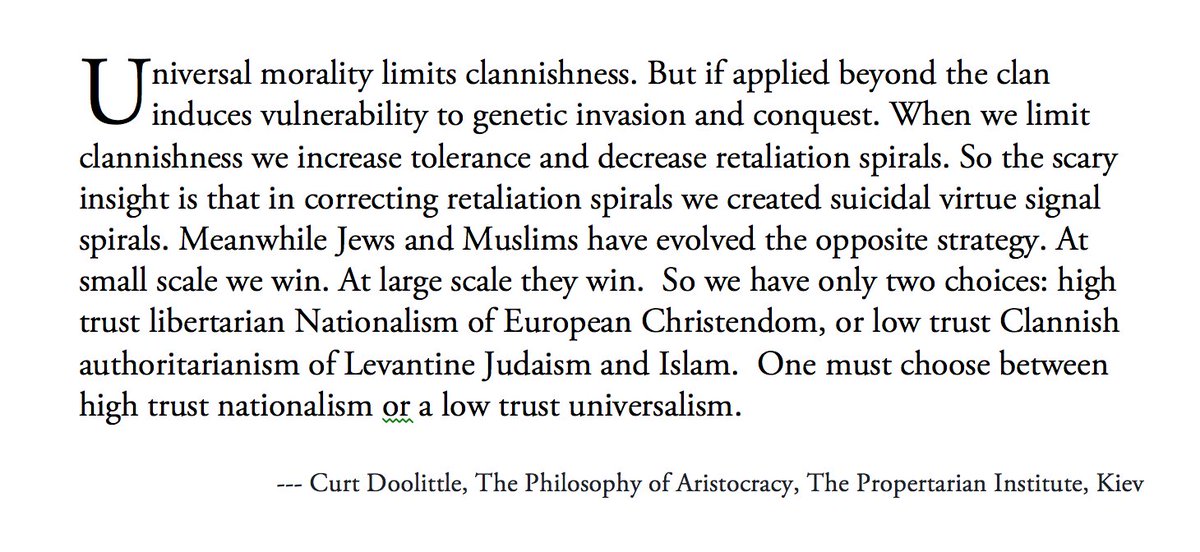
    Not like the Jews and Muslims who created a static law, but as aristocratic egalitarians that separate constantly evolving empirical law from the celebration of myth and ritual and feast that creates trust between us. We evolved fast for a reason. There is nothing fixed in western civilization.

    The 19th century, primarily due to the cosmopolitans, attempted to create a new secular religion to replace Judeo-Christianity: to replace magical mysticism with secular pseudoscience.

    This is what my work attempts to correct: the restoration of the empirical civilization. just as the English rescued us from the first great deceit: middle eastern mysticism using science. attempt to rescue us from the second great deceit: secular pseudoscience.

    The first lie cost us a thousand years of ignorance. We have no need of another dark age brought about by the same technique: a vast lie wrapped in promises of utopia, and sold to us through propagandism. The first time by preacher, pulpit, and parchment, and the second time by Academy and Media using books, radio, and video bringing the pulpit all the way to our living rooms.

    Curt Doolittle

    The Propertarian Institute

    Kiev, Ukraine.


    Source date (UTC): 2016-08-07 05:52:00 UTC
  • I’m writing. (As usual.) Business plan. Been my task for the past week. Probably

    I’m writing. (As usual.) Business plan. Been my task for the past week. Probably too much detail but then that’s my thing. I like to understand market mechanisms and convey them in both business plans and strategy documents. It creates a common model and language for management teams. I find I stick with my strategy documents a long time after I write them.

    I’m sitting under a canopy at a pub, drinking a cappuccino and water with lemon.

    I’m surrounded by two bunches of Ukrainan and Russian men drinking beer, smoking, and trash-talking. And loud. Louder than Americans. They’re Indistinguishable from Italians by other than accent, (bad) haircuts, and dress. And different in my knowledge that the amount of verbal nonsense tolerated before a fight in Italy, and the amount of verbal nonsense tolerated before a fight in Ukraine and Russia are inversely related.

    So you don’t act irritated in these circumstances. You just roll with the noise, bravado. And in my case, I’m thankful I can’t understand them very well, or my autism would force me to leave rather than endure the idiocy.

    There are a LOT fewer fights in Kiev now that the Russians don’t visit. There are more Turks on sex tourism adventures. (It’s no wonder. have you seen their women? ) But in general, I feel much safer here than I do in any American city. I usually carry in the states. I don’t even feel the need to here.

    I just make sure I have a bottle or coffee cup nearby.

    Just in case.

    🙂


    Source date (UTC): 2016-08-07 05:26:00 UTC

  • #tlot #tcot #conservative #nrx #altright Choose between retaliation spirals or v

    #tlot #tcot #conservative #nrx #altright Choose between retaliation spirals or virtue signal spirals. https://t.co/z4HREE8rvX


    Source date (UTC): 2016-08-04 07:02:04 UTC

    Original post: https://twitter.com/i/web/status/761094839010074625

  • LABOR vs CALCULATING, ORGANIZING, NEGOTIATING, RISKING. (important) Labor itself

    LABOR vs CALCULATING, ORGANIZING, NEGOTIATING, RISKING.

    (important)

    Labor itself is trivial in its contribution to value compared with the organization of production, and the organization of the institutions that make possible the organization of production at scale. We get more paid for calculating than laboring, more for organizing than calculating, more for negotiating than organizing, more for risking the accumulated results of laboring, calculating, organizing, negotiating, and risking more than for negotiating. Man does not need to persuade the physical world to choose from a multitude of options according to preference. The physical world cannot choose. Man can. And it is convincing large numbers of people to chose to produce some set of various goods and services in an enormous complex web versus choose to work toward producing some other set that is the difficult job that individuals in each layer of our hierarchy are paid more for, than the labor to force the world to change, versus the calculating, organizing, negotating, and risking that it takes man to change.

    Curt Doolittle

    The Propertarian Institute

    Kiev, Ukraine


    Source date (UTC): 2016-08-01 15:40:00 UTC

  • Expand the incentive to cooperate. Eliminate disincentive to cooperate. Eliminat

    Expand the incentive to cooperate. Eliminate disincentive to cooperate. Eliminate incentive to retaliate. Eliminate demand for the state.

    A market for association

    A market for reproduction

    A market for production of private goods and services

    A market for the production of commons.

    A market for the resolution of disputes under natural law.

    Natural Law. Common law. Rule of law. Universal standing.


    Source date (UTC): 2016-07-31 12:22:00 UTC

  • Andy Curzon Just had a thought in response to you question the other day. And I

    Andy Curzon

    Just had a thought in response to you question the other day. And I think it’s this: (as a vast overgeneralization )

    Women are less willing to pay rational behavioral adaptation costs, and more willing to pay social adaptation costs. The former requires they monitor their thinking and change it, the second means they feel the circumstance and adapt to it without rational demand.

    Men however must constantly outwit the hunted, and so readily adapt to facts, regardless of social constraints.

    (My ex-wife Allora was one of the few women (and there are quite a few) that are intellectually attached, and sufficiently emotionally detatched such that they can adapt their thinking in response to pure ideas. It’s probably why we were such a devastating team.)


    Source date (UTC): 2016-07-23 06:07:00 UTC

  • Children speak of morals and beliefs. Adults speak of incentives and institution

    Children speak of morals and beliefs. Adults speak of incentives and institutions. It’s not hard to separate argumentative boys from men.


    Source date (UTC): 2016-07-23 05:55:34 UTC

    Original post: https://twitter.com/i/web/status/756729450427998208

  • Children speak of morals and beliefs. Adults speak of incentives and institution

    Children speak of morals and beliefs. Adults speak of incentives and institutions. It’s not hard to separate argumentative boys from men.


    Source date (UTC): 2016-07-23 01:55:00 UTC

  • IT”S NOT CAPITALISM THAT’S THE PROBLEM —capitalism is a failure. It’s like the

    IT”S NOT CAPITALISM THAT’S THE PROBLEM

    —capitalism is a failure. It’s like the game monopoly. —

    Except monopoly is nothing at all like real life. And capitalism is responsible for raising the world out of endemic violence ignorance disease and poverty.

    The problem isn’t capitalism ( the voluntary organization of production ).

    It’s that the richer we become the more talented you need to be to earn a living.

    When we had unused talent most people could move up.

    Now we have passed the period where there is *unused* talent and entered the period where we have *unusable* talent.

    Societies progress just as evolution progresses: by eliminating the failures to produce from the gene pool.

    So has capitalism failed?

    Or have we failed to continue to constrain the reproduction of the unproductive?


    Source date (UTC): 2016-07-22 14:30:00 UTC