May 6, 2020, 11:02 AM So, by disambiguation by inventorying, operationalizing, serializing into sequences we create unambiguous measurements for language that prohibit conflation and ambiguity and therefore errors of inference and deduction, effectively turning language – especially language like english with so many terms – into a system of measurement. By combining this technique of very specific terms (measurements), using operational language that is testable, in promissory form (I Promise that…), absent verb-to-be (meaning “I dunno the condition of existence”) in complete sentences, of complete transactions of changes in state, we convert language to a via-negativa equivalent of a via-positiva programming language with the same test of possibility (compilability) since the ability to compile is a test of disambiguity (yes that’s the secret sauce). By using supply demand tests of statements rather than ideals we end up with the formal economics of human behavior.
Theme: Grammar
-
Updated Style Guide for P
Updated Style Guide for P https://propertarianism.com/2020/05/28/updated-style-guide-for-p/
Source date (UTC): 2020-05-28 03:51:09 UTC
Original post: https://twitter.com/i/web/status/1265853087987773440
-
Updated Style Guide for P
NOT JUST FOR NEWBS
Due to popular demand (actually a specific recommendation), I’ve updated the Style Guide to P which explains the following:
- The formatting of posts
- Styling
- Parentheticals
- Use of “Disambiguation, Operationalization, Serialization”
- Use of Testing by Testimony, Reciprocity, Property-In-Toto
- Use of Arrows < > -> <- etc
- Use of Lists, Hierarchies, Graphs
- Use of Sequential Declarative Statements
- Use of Pseudocode
-
Updated Style Guide for P
NOT JUST FOR NEWBS
Due to popular demand (actually a specific recommendation), I’ve updated the Style Guide to P which explains the following:
- The formatting of posts
- Styling
- Parentheticals
- Use of “Disambiguation, Operationalization, Serialization”
- Use of Testing by Testimony, Reciprocity, Property-In-Toto
- Use of Arrows < > -> <- etc
- Use of Lists, Hierarchies, Graphs
- Use of Sequential Declarative Statements
- Use of Pseudocode
-
Archetypes vs Stereotypes
May 9, 2020, 7:55 PM ARCHETYPES VS STEREOTYPES
—“Reals vs. ideals”—Martin Štěpán —“The Map (archetype) vs The Territory (stereotype).”—Günther Shroomacher —“Accurately validated and operationalized reals for the purpose of prediction vs. Mythologically articulated ideals for edifying instruction”—Predmetsky Rosenborg —“Stereotypes are generalizations about groups/ individuals that are true, vs Archetype is more psychological and possibly metaphysical.”— Donald Kent —“Deviation from your group VS composition of your group.”—Vengefül Bobmoran —“Commodity(stereotypt) vs Scarcity(archetype)”—Dave Germaniuk
by JWarren Prescott: ARCHETYPES Archetypes are merely an ‘a priori’ to the posteriori stereotype. This follows the 4 main Jungian archetypes. We have a sense of the core elements of what things ‘should’ be. For example, Jung’s wise old man is an archetype of guidance or wisdom. STEREOTYPES The word, stereotype, tends to have a negative connotation in the vernacular and ironically, the word has hence become its own stereotype in that regard. There are similar words that have similar meanings but without the social baggage attached. Archetype and prototype are similar words but have less negativity in the mind. Ever since childhood, we are instructed not to judge others and then later, the word judge became stereotype and were admonished that stereotyping was also not acceptable behavior. Apart from the common parental cognitive dissonance that most of us are subjugated to, the word stereotype simply means an empirical generalization or group tendency of some trait or behavior. The negative connotations of the word from common usage has done a disservice to an incredibly useful term by basically changing its meaning to include pejoratives like, oversimplified, exaggerated, offensive, distorted, simplistic, unfairly and many other terms that connote and/or elicit social disapproval of an argument. These pejoratives are not valid arguments. An argument is a set of reasons (a premise) to support a conclusion and is such that merely holding a contrary viewpoint is not an argument. Emotions such as outrage or anger are never a support for an argument. The stated premise of an argument must logically follow to prove or show that the conclusion is valid. If it does not follow, then the argument is invalid. To employ such tactics is a form of sophistry and social conditioning that has its own consequences in cognitive dissonance. Common stereotypes should never be rejected out-of-hand due to social pressures but should be evaluated for judgment errors. Facts, data, logic and reason are merely tools of cognition and are neither racist, sexist nor bigoted.
-
Archetypes vs Stereotypes
May 9, 2020, 7:55 PM ARCHETYPES VS STEREOTYPES
—“Reals vs. ideals”—Martin Štěpán —“The Map (archetype) vs The Territory (stereotype).”—Günther Shroomacher —“Accurately validated and operationalized reals for the purpose of prediction vs. Mythologically articulated ideals for edifying instruction”—Predmetsky Rosenborg —“Stereotypes are generalizations about groups/ individuals that are true, vs Archetype is more psychological and possibly metaphysical.”— Donald Kent —“Deviation from your group VS composition of your group.”—Vengefül Bobmoran —“Commodity(stereotypt) vs Scarcity(archetype)”—Dave Germaniuk
by JWarren Prescott: ARCHETYPES Archetypes are merely an ‘a priori’ to the posteriori stereotype. This follows the 4 main Jungian archetypes. We have a sense of the core elements of what things ‘should’ be. For example, Jung’s wise old man is an archetype of guidance or wisdom. STEREOTYPES The word, stereotype, tends to have a negative connotation in the vernacular and ironically, the word has hence become its own stereotype in that regard. There are similar words that have similar meanings but without the social baggage attached. Archetype and prototype are similar words but have less negativity in the mind. Ever since childhood, we are instructed not to judge others and then later, the word judge became stereotype and were admonished that stereotyping was also not acceptable behavior. Apart from the common parental cognitive dissonance that most of us are subjugated to, the word stereotype simply means an empirical generalization or group tendency of some trait or behavior. The negative connotations of the word from common usage has done a disservice to an incredibly useful term by basically changing its meaning to include pejoratives like, oversimplified, exaggerated, offensive, distorted, simplistic, unfairly and many other terms that connote and/or elicit social disapproval of an argument. These pejoratives are not valid arguments. An argument is a set of reasons (a premise) to support a conclusion and is such that merely holding a contrary viewpoint is not an argument. Emotions such as outrage or anger are never a support for an argument. The stated premise of an argument must logically follow to prove or show that the conclusion is valid. If it does not follow, then the argument is invalid. To employ such tactics is a form of sophistry and social conditioning that has its own consequences in cognitive dissonance. Common stereotypes should never be rejected out-of-hand due to social pressures but should be evaluated for judgment errors. Facts, data, logic and reason are merely tools of cognition and are neither racist, sexist nor bigoted.
-
Psychology – Everything Is Here.
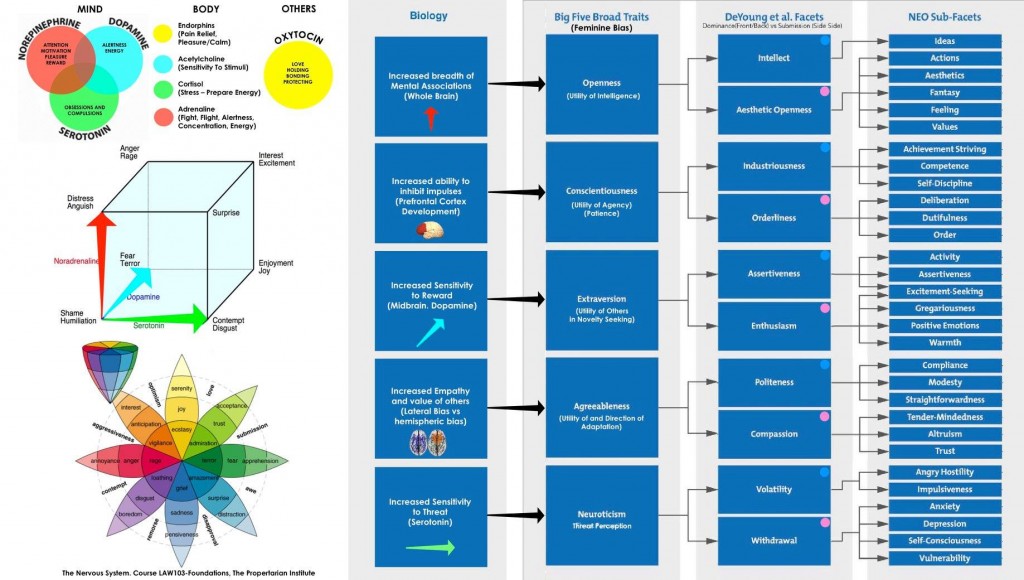
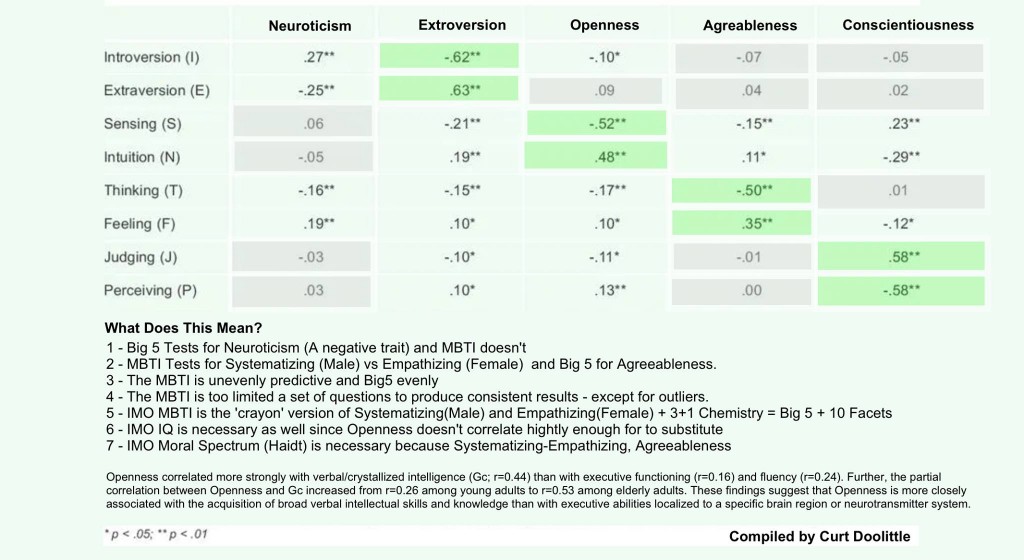
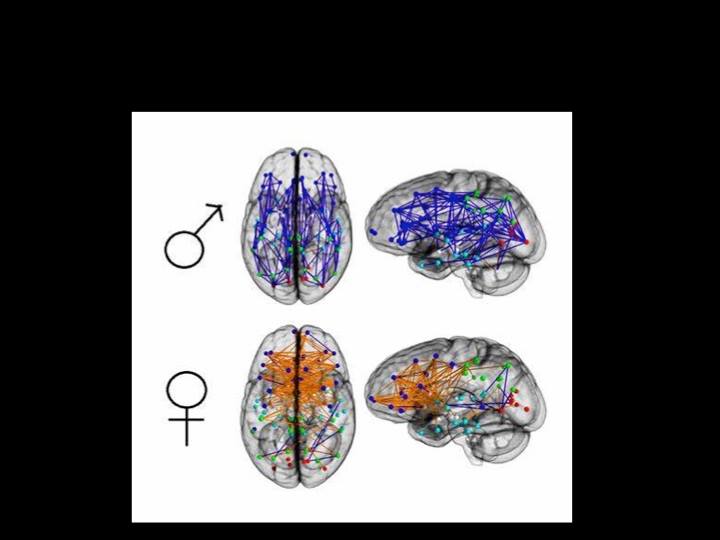
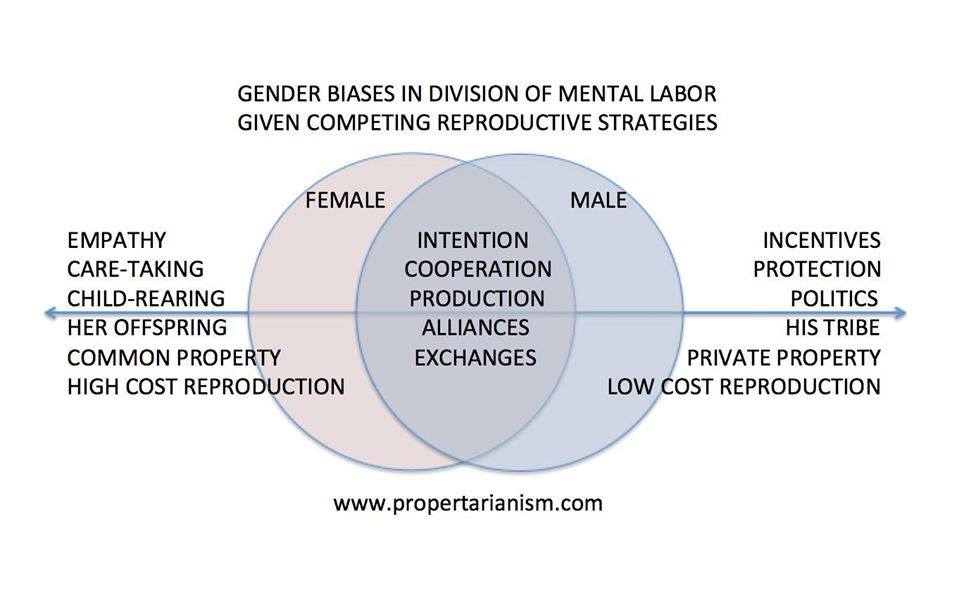
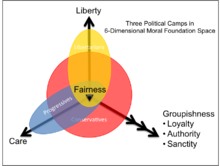
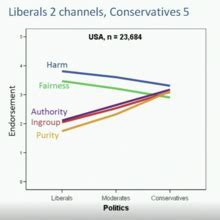
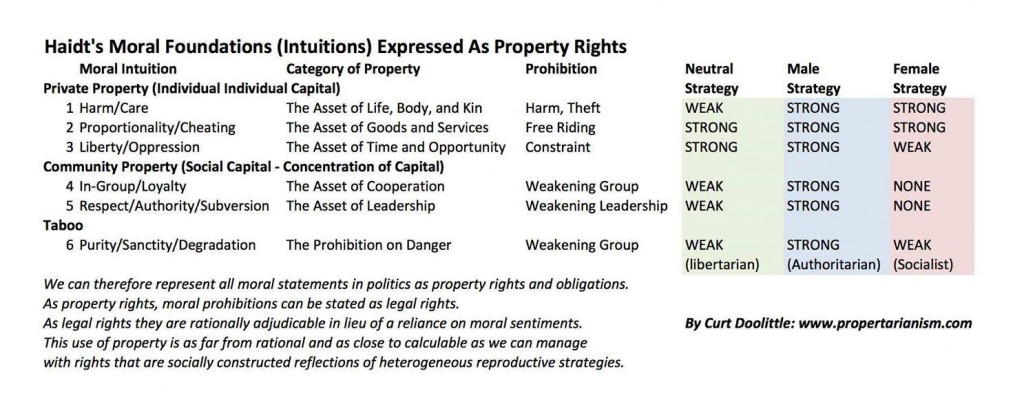
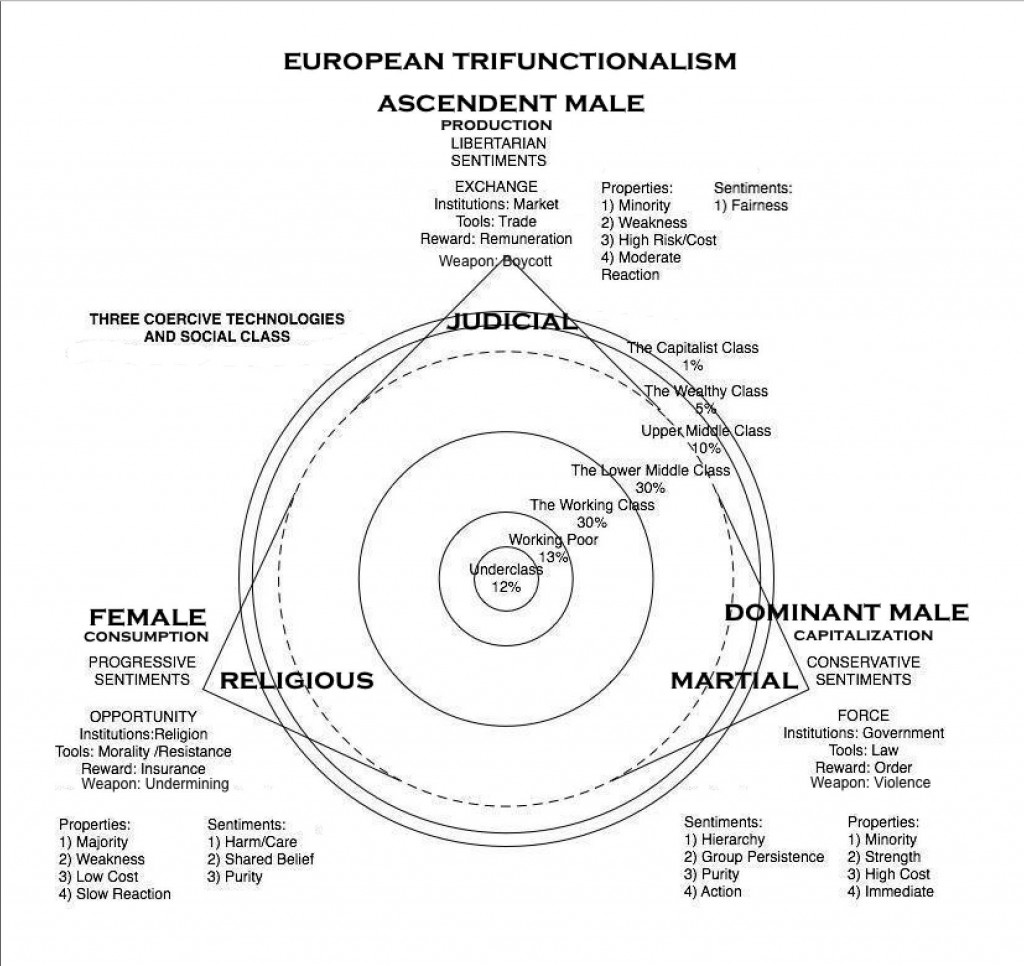
18 OCT, 2018 Archetypes(Myth), MBTI (Literature), BIG5 (Philosophy), Propertarianism (logic) SCALE: ARCHETYPES(Myth), MBTI (Literature), BIG5 (Philosophy), PROPERTARIANISM (logic) Think of MBTI as literature, and BIG5 as Philosophy, and Propertarianism as Logic: Graceful increase and decrease in precision according to the ability of the individual: SATISFACTION OF THE MARKETS FOR COMPREHENSION. AGAIN: MBTI vs BIG5/6 vs MORAL FOUNDATIONS vs GENDER In other words, the principle difference between MBTI and Big 5 are (a) the weight it gives to trait expression, and (b) the principle difference in value is that with 100 Questions we can test your IQ within a half a standard deviation, because all components scale evenly, but we cannot test the rest of your personality traits with so few questions because they do NOT scale evenly. Moreover, MBTI is a WORKPLACE and social weighting of traits, while BIG5 is a THERAPEUTIC weighting of traits. These are differences in value rather than differences in measurement. I was not the first person to make this distinction, but I have written extensively on the fact that while MBTI is imprecise, it is the maximum complexity of a model that individuals can work with in the workplace. We can measure all sorts of trait expression, and even the big 5 FACTORS must be broken down into TRAITS in order to accommodate the difference in factor expression between the GENDERS. DIFFERENCES In this sense MBTI is a better judge of the GENDER biases inherent in cognitive and emotional biases because its fairly obvious that the gender distributions are inverted. Whereas this transparency was only visible in BIG5 after division from Factors into Trait Expressions – and that occurred fairly recently (post 2000), as psychology attempted to reform from a pseudoscience to a science when confronted with imaging, genetic, and pharmaceutical science. [See attached MBTI > Big5 Mapping and P-Physical Maps] MALE RECIPROCITY(OPPORTUNITY) VS FEMALE PROPORTIONALITY (CONSUMPTION) -The Moral Foundations by Gender Bias (M vs F)- SELF (ACTION) – ASCENDENT BIAS 1) (M) Negative Freedom (Liberty) vs (F) Positive Freedom OTHERS FEMALE BIAS – THE HERD 2) (M) Reciprocity (Fairness) vs (F) Proportionality(Equality): rendering justice according to shared rules; opposite of cheating 3) (M) Defense (Negative) vs (F) Care (Positive): cherishing and protecting others; opposite of harm COMMON – ESTABLISHED MALE BIAS – THE PACK 4) (M) Loyalty vs (F) Devotion(Ingroup): standing with your family, group, nation; opposite of betrayal. 5) (M) Authority vs (F) Respect: submitting to tradition and legitimate authority; opposite of subversion 6) (M) Sanctity vs (F) Purity: abhorrence for disgusting things, foods, actions; opposite of degradation. (M) Absorb Cellular Damage. (F) Limit Cellular Damage MORAL FOUNDATIONS BY PROPERTY RIGHT BIAS (POLITICAL BIAS) Of Haidt’s evolutionary origins of moral intuitions, three can be expressed as individual property rights:
- Care/harm for others, protecting them from harm. (The asset of life and body.)
- Proportionality/cheating, Justice, treating others in proportion to their actions. (The asset of goods.)
- Liberty/Oppression, characterizes judgments in terms of whether subjects are tyrannized. (The asset of time, opportunity.)
And three others can be expressed as community property rights covering social capital. Which obviously enough, have been, and continue to be, mirrored in corporate shareholder agreements.
- In-Group Loyalty/In-Group Betrayal to/of your group, family, nation, polity.
- Respect/Authority/Subversion for tradition and legitimate authority.
- Purity/Sanctity/Degradation/Disgust, avoiding disgusting things, foods, actions.
It should be noted that the male reproductive strategy among chimpanzees as well as humans evolved to kill off males in opposing groups and collect females. And that females evolved to place greater emphasis on children and females than the (fungible) tribe. As such the distribution of moral intuitions varies in intensity between the feminine (1-3) and the masculine (4-6). This difference in moral intuitions roughly reflects the voting pattern we have seen since the enfranchisement of women into the electorate: an increase in the use of political violence to produce an increase in the female reproductive strategy (individual dysgenic reproduction) and a decrease in the male reproductive strategy (tribal eugenic reproduction). When I first read a paper by Jonathan Haidt, years ago now, I immediately understood the implication. Just as the ten commandments are reducible to “There is but one law: property, and thou shalt not steal”, all our moral rules can be reduced to one: “thou shalt not steal directly or indirectly, by action or inaction.” These rules are genetic in origin. They are necessary and immutable. THREE MEANS OF COERCION Three means of human coercion or more gently, weapons of influence. One more time. Three means of human coercion or more gently, weapons of influence. The Physical: Body and Movement Using Force or Violence The fear of harm or promise of defense. By the Dominant or Established Male The Material: Resources and Opportunity Using Bribe or Trade The fear of loss of gains, or promise of gains By the Brother, Ally, or Ascendant Male The Social: Cooperation and Insurance Using Undermining or Advocacy The fear of ostracization or promise of inclusion By the female and especially dominant female Personality: Big5/6 Personality Traits with 10/12 Personality facets. Where One Traits differs Dominance Expression. Where all Facets differ by Gender Bias. Where all personalities cluster by three types: Dominant or Established Male. Ascendant Male. Female. Gender: Where sex is genetically determined and either male or female. Where the brain evolves a dominant lateral, female, associative (wide association in the present) and longitudinal male a narrow, association over time and space). Where the resulting brain structure favors temporal interpersonal emotion in the female necessary for child rearing, and intertemporal political analytic in the male necessary for holding territory, resources, females, and children from capture by competing males. Where sexual preference is for the opposite sex, either male, female, but a small percentage of the population is subject to developmental defect in utero and can express almost any gender distribution. Conflict: Where developmental defect can cause failure to produce sufficient agency for self control. Where genders demonstrate differences in self control by antisocial, disruptive or hostile behavior. Where females demonstrate sexual, psychological(interpersonal), social(group), antisocial behavior, by continuous undermining and manipulation. Where males demonstrate sexual and physical antisocial behavior by continuous harm to self, others, and property. LEVELS OF ADAPTATION But we have this wonderful adaptive hierarchy available to us. 1) LEVEL ONE (gender bias) {Paternal, Sovereign, Meritocratic, Eugenic, Packs (K)} +
{Maternal, Collective, Equalitarian, Dysgenic, Herds (R)}
Adaptive flexibility. 2) LEVEL TWO (dimorphism) {Increased sexual dimorphism, Decreased sexual Dimorphism} + {Increased sexual maturity, Decreased Sexual Maturity} = Adaptive Flexibility 3) LEVEL THREE (redistribution) Normative and Institutional Redistribution of reproduction (shift) + Normative and Institutional Suppression of class reproduction (shift) = Adaptive Flexibility 4) LEVEL FOUR (mating) Assortative mating and Late Marriage vs Arranged Mating and early marriage. = Adaptive Flexibility 5) LEVEL FIVE (signals) Status Signals => Behavioral Expression of Gene Expression = Adaptive Flexibility 6) LEVEL SIX (design) Education, Training, and Genetic Manipulation. = Adaptive Flexibility With these various methods we can produce a population for almost any purpose within a generation or two. ATTACHED: 1. Propertarian Physical Mapping 2. MBTI > BI5 Map and explanation 3. Male Female Brain Diffs 4. Result of male female brain diffs 5. Moral Triangle 6. Moral Foundations 7. Moral Strategies 8. Resulting class strategies 9. Jung Archetypes
-
“All Language Consists of Measurements”
“All Language Consists of Measurements” https://propertarianism.com/2020/05/28/all-language-consists-of-measurements/
Source date (UTC): 2020-05-28 03:25:17 UTC
Original post: https://twitter.com/i/web/status/1265846578721456129
-
“All Language Consists of Measurements”
May 10, 2020, 10:14 AM We don’t think of it geometrically but that’s the best frame for representing it’s organization. Our senses (nervous system) register pulses, which vary only in on-off, and frequency – a measurement – and we combine those measurements, because our body is a system of commensurability, into a world-model useful for our actions. Then we describe the world in combinations of sense-perceptions. The second fundamental problem with AI so far (aside from our hardware is architected inversely) is that it has no system of commensurability like we have – the body – and so it cannot develop consciousness: a model with predictive differences given our possible actions (physical, logical, verbal). Archetypes – prototype measurements of combinations of instincts Stereotypes – consistent predictions from measurements. In the Foundations Course, I frame our consciousness geometrically from the start. Unfortunately constitution and revolution is more pressing than continuing work on consciousness and behaviour but I will get there….
-
“All Language Consists of Measurements”
May 10, 2020, 10:14 AM We don’t think of it geometrically but that’s the best frame for representing it’s organization. Our senses (nervous system) register pulses, which vary only in on-off, and frequency – a measurement – and we combine those measurements, because our body is a system of commensurability, into a world-model useful for our actions. Then we describe the world in combinations of sense-perceptions. The second fundamental problem with AI so far (aside from our hardware is architected inversely) is that it has no system of commensurability like we have – the body – and so it cannot develop consciousness: a model with predictive differences given our possible actions (physical, logical, verbal). Archetypes – prototype measurements of combinations of instincts Stereotypes – consistent predictions from measurements. In the Foundations Course, I frame our consciousness geometrically from the start. Unfortunately constitution and revolution is more pressing than continuing work on consciousness and behaviour but I will get there….