(important)(core)(learning opportunity) —“So, [propertarianism uses] a fixed grammar which diagrams or “measures,” as you say, how far a use of a particular word is from the precise meaning of the term in propertarian parlance. I’m guessing there has to be a reason to do this rather than give a straightforward definition like all non-initial words in a good math textbook. I’m guessing it has to do with the fact the same term takes on slightly different meaning, in essence less proximity to the initial described point on the grammar number line, as it ventures through different layers of the analytical process of operationalization. Rather than outright avoid some multiplicity of meaning, this schema just keeps track of it. To me, in my set theoretic way of thinking, this makes a word a set of definitions, and context indexes on it to determines the cardinality of the set, with each element being mapped to the number line used.”— Duke Newcomb We have a set of common P-definitions, all in series, and a glossary of individual terms as well as series – and there aren’t that many of the core definitions. (i was surprised) But that doesn’t mean we don’t need to explain how to do it to ANY term in order to FALSIFY others errors, biases, and deceits. So in keeping with the migration from verbalisms (associations), to mathematics (sets), to operations (actions), P is written like a PROGRAMMING LANGUAGE not like mathematics (sets). And so we produce functions in operational prose, not scale independent logic in symbolic prose – and I do it for a very good reason: the catastrophic failure of mathematics in economics, and in particular the divergence of mathematics and economics, rather than convergence. And that is because economics of consumption has replace morality in politics, and because it is possible to restore consumption with tests of changes in the state of capital vs consumption, thereby ending hyperconsumption, including of genetic, social, institutional, cultural and civilizational capital. I think you are trying to generalize into symbolics (sets) and I’m trying to reverse that ‘error’ by return to geometry similarly to how descartes restored aristotelian thought to europe by restoring mathematics to ‘geometry’ from ‘sets’ and scriptural and textual interpretation. For example, in cantor(sets) there are multiple infinities (impossible). However under babbage(gears) there are only different rates of production of positional names (operations). Why did mathematicians choose cantor over babbage? Why do we call the square root of two a number, when it is but the name of a function? And to take that forward, I think you are still trying prove (construct, justify) an argument under law, and my emphasis is falsification of the platonic sophisms in all fields, including mathematics, as well as more importantly, the abrahamic deceits of judaism, christianity, islam, Boasian, Freudian, Marxism, feminism, postmodernism, and the general feminine and semitic technique of disempowerment of those with agency by the continuous toppling of apple carts for no other reason than undermining the production of order (meaning any form of judgement by measurement) that would deny them the use of interpersonal persuasion and sexual temptation, and false promise to obtain good, services, information, opportunity, and status, without engaging in reciprocity. As such I know you’re deep into these subjects and you’re (omg thank you) smart, but it is far harder to move from construction with clay to make an argument, to sculpting of stone to reveal what’s inside it than you’d think. It is very hard. If it wasn’t very hard – because justification using appeal to moral intuition and habit, norm, tradition, and metaphysical presumption is natural, ancient, and saturated in the environment – someone would have done it earlier. I just spend a lot of time on both programming, artificial intelligence, economics, and law. And I (correctly as did Minsky) saw programming as an evolutionary leap in logics for that reason, moving logics out of language and restoring them to actions. The reality is that justification is cheap. Falsification is expensive. And not only have we only had a few centuries to adapt to our development of instrumentation and record keeping that is beyond human scale, So P Isn’t just an improved means of doing what we do today in more strictly constructed form, it allows us to take the common law system and to extended it to ALL false and irreciprocal speech made in public, to the public, in matters public. In other words, P allows us to outlaw every single aspect of leftism because it is all dependent upon fraud in order to obscure their thefts, necessitated by their moral envy, of higher status (sexual, social, economic, political military market value), and the cost of suppressing their impulses in order to develop agency in order to raise those market values that can be raised by one’s development of agency thru training. In other words, they must engage in fraud to obscure thefts, and prevent order, which creates measurement and accountability, so that they can compensate for their bad luck in the genetic lottery whose possibilities were created by the rather poor judgement of their ancestors – at least over no less than the past six generations. P allows us to convert from free speech to free truthful and reciprocal speech, where truthful means ‘what I can testify to’. This cuts the industrialization of lying made possible by the industrial revolution’s discount on production of information, and the mass distribution of false promise, undermining, and deceit by sophistry and pseudoscience by the marxists, postmodernists, and feminists. So while you are correct that there is temporally complete vocabulary available it is only temporally complete. And while we can adhere to that, we cannot operationalize and expose the thefts of the enemy, without the tools of doing so. So it’s more like mathematics, in that we continuously evolve new means of proof (tests of the possibility of measurement given scale independence (generalization of rules of measurement), limits (to compensate for undecidability of precision in scale independence) and the ‘presumption’ of the excluded middle necessary under scale independence – yet we keep discovering patterns and new means of deduction, so that we can never state mathematics is ‘complete’ (other than at some primitive dimensional scale). Math is just a very simple language of only one constant relation (position). All other languages from the first order logic on up contain more than one constant relation. But all languages are the same – the construction of a set of constant relations that another understands (agrees to, contracts to) and due diligence removing the possible associations, inferences, and deductions that the contracting party might be misled by. I mean in similar vernacular, we contract with our intuition which must, like another person, be trained by our reason. (God I hope people can learn from this discussion because I haven’t found anyone else knowledgeable enough to have it with, where I have the opportunity to discuss it in discursive terms. You are making it possible to discuss the big ideas rather than how to lay individual bricks. Thank you. ) DEVELOPMENT OF RELEVANT GRAMMARS Platonic Mathematics = Sets and Ideals independent of time and cost. Written in balanced symbols. Operational Mathematics = Demonstrable Operations in time at cost. Written in programmatic language, where the verbs are some variation of addition. Operational Prose = writing programmatic algorithms where the verbs are human actions (additions to reality).
Theme: Grammar
-
The Grammar people use tells you everything about their argument
The Grammar people use tells you everything about their argument https://propertarianism.com/2020/06/01/the-grammar-people-use-tells-you-everything-about-their-argument/
Source date (UTC): 2020-06-01 13:40:11 UTC
Original post: https://twitter.com/i/web/status/1267450876752539648
-
The Grammar people use tells you everything about their argument
The Grammar people use tells you everything about their argument https://t.co/kY5xPsKb1r
-
The Grammar people use tells you everything about their argument
I’ve noticed over time, that what grammar people use almost always tells you everything about their argument. And that if they’re using GSRRM, it’s collectivist,and if it’s scientific it’s cooperativist. And I think it might be better to say GSRRM=Parasitism, and Cooperativist=Balanced, and Fascist-Elmination of all parasitism
-
The Grammar people use tells you everything about their argument
I’ve noticed over time, that what grammar people use almost always tells you everything about their argument. And that if they’re using GSRRM, it’s collectivist,and if it’s scientific it’s cooperativist. And I think it might be better to say GSRRM=Parasitism, and Cooperativist=Balanced, and Fascist-Elmination of all parasitism
-
Which of Your Cognitive Markets Are You Serving?
The verb to be circumvents existence, which is what you are trying to cirumvent testifying for, just as Heiddeger was trying to cirvument and reverse the verb and noun – because both of you are tyint go make speech conform to experience rather than speech test experience – which is it’s only POSSIBLE function unless you’re trying to lie. All imagination is produced by association and introspective causes justificationary but all speech like all action is falsificationary – whether or not we wish it to be. So you can describe your predictions, imaginations and fantasies (meaning) in an effort to deceive yourself and others, or you can speak your predictions, imaginations and fantasies (meaning) and have others falsify them or not, or you can act on your predications, imaginations, and fantasies (meaning) and physical reality will falsify them or not. We are capable of free association, imagination (prediction), and fiction (relations between predictions), just as we capable of our own falsification of our fictions (reason, calculation, computation). But this requires agency, and to prefer the rewards of knowledge (truth) over masturbation( sedation by daydreaming) . So we physically demonstrate the series: sense(collection), perception(disambiguation), auto-association (free association), prediction (imagination), fictions (compositions) produce hypotheses, and THEN we falsify (test) them (detect risk and losses) using Reason, Calculation (transformation of inputs into outputs) and computation (using assistants-to-memory to overcome limits – something a we cannot do without external instrumentation, especially symbols that preserve correspondence-name, and other properties of the name-noun expressed as measurements of varying degrees of precision.) So the question is which market are you serving when you speak? Purely psychological (psychotic), purely personal interpretation of interpersonal (solipsistic), interpersonal (empathic), practical action (evidentiary), generalization (analytic), generalization without empathy (aspergers), failure to generalize or empathize (autism). And this is the underlying question. Are you preventing your learning and continuous adaptation to reality by the incremental development of agency, or are you trying to do the opposite which is the primary function of all religions, and most philosophies, and most pseudoscience, and that is to justify not paying the psychological, emotional, physical, and material costs of adapting to reality such that you develop agency? And always and everywhere with very little effort we can ask any individual a few questions, and discover the economics of his or her system of decidability, given costs and returns. (my favorite being christians, muslims, and hindus, as we do not see this other than ‘nationalism’ in the far east and the non-superstitious right, and the upper classes who have and have demonstrated agency. We don’t think of language as a system of measurement (but measurement of what?) but a cursory disambiguation and operationalization of english vocabulary (names of references, whether person, place, thing, action, change etc – reduced to scales that are open to human perception. As an example, Time in english includes always – sometimes – just a bit ago – now – not just a bit ago – sometimes not, and never. Most english vocabulary follows this 3 to 5 to 7 example range, which is about the maximum of human means of disambiguation into scopes of untidily; matches human short term memory; matches the number of points necessary to falsify a line (reduce most errors). I find when I disambiguate a concept that is not well understood because of insufficient operationalization, I end up with twelve or more points. I find that when I serialize existing terms I end up with five or seven. And this difference illustrates the function of operationalization – to improve precision in human speech.
-
Which of Your Cognitive Markets Are You Serving?
The verb to be circumvents existence, which is what you are trying to cirumvent testifying for, just as Heiddeger was trying to cirvument and reverse the verb and noun – because both of you are tyint go make speech conform to experience rather than speech test experience – which is it’s only POSSIBLE function unless you’re trying to lie. All imagination is produced by association and introspective causes justificationary but all speech like all action is falsificationary – whether or not we wish it to be. So you can describe your predictions, imaginations and fantasies (meaning) in an effort to deceive yourself and others, or you can speak your predictions, imaginations and fantasies (meaning) and have others falsify them or not, or you can act on your predications, imaginations, and fantasies (meaning) and physical reality will falsify them or not. We are capable of free association, imagination (prediction), and fiction (relations between predictions), just as we capable of our own falsification of our fictions (reason, calculation, computation). But this requires agency, and to prefer the rewards of knowledge (truth) over masturbation( sedation by daydreaming) . So we physically demonstrate the series: sense(collection), perception(disambiguation), auto-association (free association), prediction (imagination), fictions (compositions) produce hypotheses, and THEN we falsify (test) them (detect risk and losses) using Reason, Calculation (transformation of inputs into outputs) and computation (using assistants-to-memory to overcome limits – something a we cannot do without external instrumentation, especially symbols that preserve correspondence-name, and other properties of the name-noun expressed as measurements of varying degrees of precision.) So the question is which market are you serving when you speak? Purely psychological (psychotic), purely personal interpretation of interpersonal (solipsistic), interpersonal (empathic), practical action (evidentiary), generalization (analytic), generalization without empathy (aspergers), failure to generalize or empathize (autism). And this is the underlying question. Are you preventing your learning and continuous adaptation to reality by the incremental development of agency, or are you trying to do the opposite which is the primary function of all religions, and most philosophies, and most pseudoscience, and that is to justify not paying the psychological, emotional, physical, and material costs of adapting to reality such that you develop agency? And always and everywhere with very little effort we can ask any individual a few questions, and discover the economics of his or her system of decidability, given costs and returns. (my favorite being christians, muslims, and hindus, as we do not see this other than ‘nationalism’ in the far east and the non-superstitious right, and the upper classes who have and have demonstrated agency. We don’t think of language as a system of measurement (but measurement of what?) but a cursory disambiguation and operationalization of english vocabulary (names of references, whether person, place, thing, action, change etc – reduced to scales that are open to human perception. As an example, Time in english includes always – sometimes – just a bit ago – now – not just a bit ago – sometimes not, and never. Most english vocabulary follows this 3 to 5 to 7 example range, which is about the maximum of human means of disambiguation into scopes of untidily; matches human short term memory; matches the number of points necessary to falsify a line (reduce most errors). I find when I disambiguate a concept that is not well understood because of insufficient operationalization, I end up with twelve or more points. I find that when I serialize existing terms I end up with five or seven. And this difference illustrates the function of operationalization – to improve precision in human speech.
-
Tying the Universe Together in One Chart
TYING THE UNIVERSE TOGETHER IN ONE CHART (example of using the grammars)
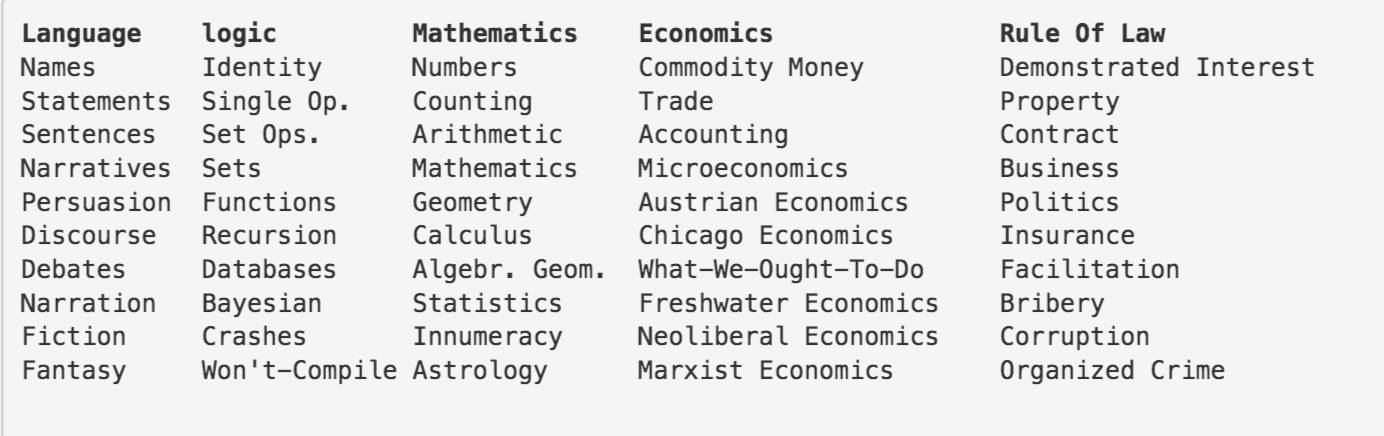
I made this to illustrate that austrian economics is simply the lowest level of economic study, using operationalism (a sequence of rational incentives) in order to circumvent the problem of a full accounting. For this reason I equate austrian economics with rule of law as the foundations of social science. So, full accounting economics under rule of law,. The purpose of which is to improve our information and understanding without interfering. Chicago Economics sought to remain within the rule of law and provide solutions to insure us from exceptions. Most macro economics is concerned largely with monetary, banking, and financial system and it has very little to do with anything other than how broken this archaic treasury, financial, banking and credit system is. Most political economics (mainstream) is an exercise in the use of maximum disinformation for the purpose of maximizing commercial, financial, and political extraction from the productive classes using the false promise of employment as a measure.
-
“It never gets easier, you just get better” is how I’d approach your work. Like
—“It never gets easier, you just get better” is how I’d approach your work. Like learning a programming language. Generally it’s as much about learning the syntax/grammar as the principles.”—Todd E. Magnusson
-
“It never gets easier, you just get better” is how I’d approach your work. Like
—“It never gets easier, you just get better” is how I’d approach your work. Like learning a programming language. Generally it’s as much about learning the syntax/grammar as the principles.”—Todd E. Magnusson