Theme: Decidability

  • photos_and_videos/TimelinePhotos_dJ9jhts2Ng/72688499_485728855357343_70954696429

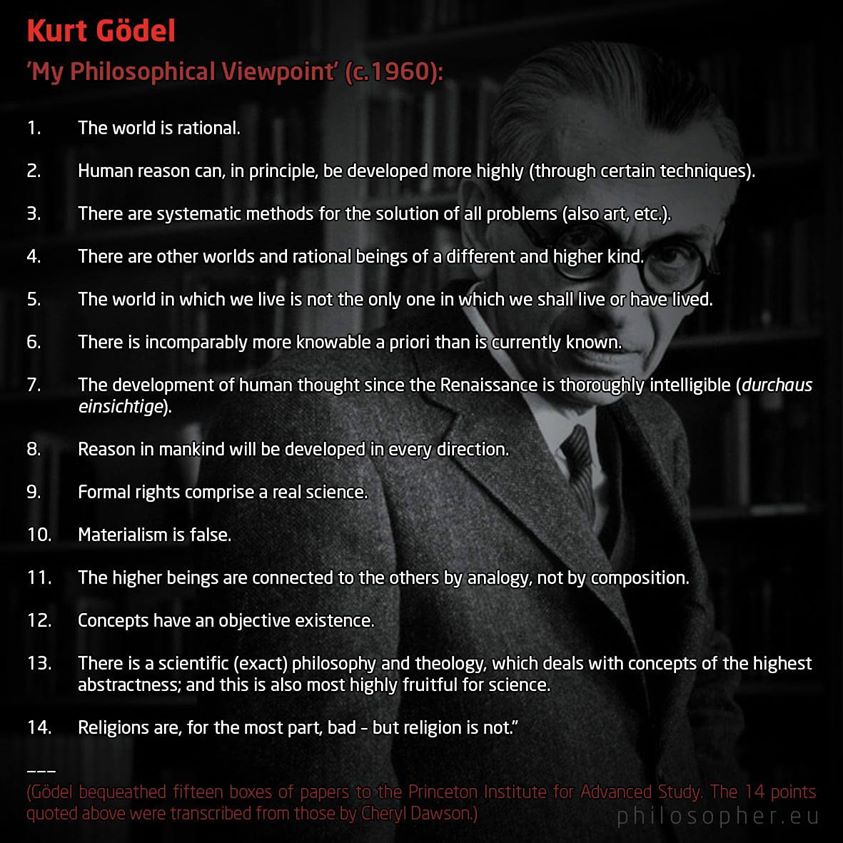
    photos_and_videos/TimelinePhotos_dJ9jhts2Ng/72688499_485728855357343_7095469642973446144_o_485728848690677.jpg CONTRAST GOEDEL WITH P – REQUEST FROM KASH V.

    (Godel is a Platonist, I’m an operationalist)

    1. Man acts rationally, and by rationally amorally. But given the disproportionate value of cooperation, and the disproportionate risk of retaliation, it’s just in his interest to act morally much more often than immorally.

    1a. We can incrementally reduce observations of the universe, using our senses, reason, and instrumentation to descriptions of invariant constant relations (paradigms)

    1b + 3. We can describe (explain) all of experience as constant relations (a single paradigm)

    2. While our ability to reason is constant, every increase convergence of our instruments and paradigms increases the explanatory power available to our reason.

    4. The capacity to reason is a deterministic product of entropy at convenient temperatures in convenient conditions, for sufficient periods of time. It is likely that given the vastness of the universe, other creatures have evolved reason, and that while the logic of constant relations will exist, and mathematics as a logic of constant positional relations will exist in some form, that the composition of experience that results from different body structures will result in different techniques for employing reason. (think octopi). And that the ability of these creatures may vastly outperform ours.

    5. Because we are able to use our powers of prediction using free association to construct a model of the world we exist in, and the worlds we might exist in, and the worlds we cannot exist in, we can experience, many candidate worlds.

    5b. The set of demands we evolved and express daily is largely invariant. The set of paradigms we use to imagine opportunities for fulfilling those demands evolves (and devolves) constantly. So while we largely increase the coherence of paradigms, and approach a single paradigm for describing the universe, we have experienced the world differently in the past than in the present, and will so again experience it differently in the future.

    6. If we can construct an operational grammar and paradigm for a given set of constant relations, we can produce an operational logic of that set of constant relations, and conduct experiments logically by trial and error as we do in mathematics. To do so we require convergence of paradigms to the point of marginal indifference of those logical constructions. But the Analytic program failed, and Godel and Frege et all were wrong – closure does not exist.

    7. Yes the development of thought since Aristotle expanded on Democritus, has been consistent and rational with the exception of the semitic abrahamic dark ages of supernatural ignorance.

    8. Reason is reason is reasoning and there is nothing to it. There are however endless permutations of reason especially as knowledge increases.

    9. The via-negativa of Natural Law can be restated in the via-positiva as Natural rights, and this logic and empirical combination produces a science of cooperation, and law the institutional enforcement of cooperation under that law, and economics the measure of it’s success, and economics the language of analysis and measurement within that science.

    10.The material(noun) and the Operational(verb) are true (exist, and are testifiable). The platonic (ideal) is false. All sets of constant relations are identified, retained, applied, reinforced, and revised by merging physical stimuli with physical organization of information in the brain, producing a hierarchy of changes in state over time we call ‘experience’. So while it is correct to say that the universe is deterministic (composed of constant relations), it is only correct to say that we can observe sets of constant relations, identify them (category), compare them, name them, and predict future states of of them, and in relation to them. These memories and predications like running consist of physical potential, that produce results in time. In other words, al of reality is constructed physically, from a hierarchy of changes in state over time we call experience.

    12. Concepts do not exist. the potential for Concepts exists. Running only exists when one is running. We have the potential to run. We have the potential to identify sets of constant relations (concepts), but experience of contexts only exist when we are acting to recall them in time.

    13. It appears we can know the most parsimonious paradigm, and host of parsimonious sub-paradigms of increasing complexity (permutations) allowing us to speak the truth using evidence – science; that we can know the same for choices using arguments – philosophy; and we can know the same for collective organization using stories – theology.

    14. Existing religions are bad to terrible to suicidal – but human psychological, social, political, and strategic demand for the products of ‘religion’ (order) are endless. So we need to educate one another in mindfulness, ethics(interpersonal), morality (extrapersonal), political, and strategic (competitive), by means gracefully increasing and decreasing in accessibility: parable, story, history, reason and general rules, science and outcomes.CONTRAST GOEDEL WITH P – REQUEST FROM KASH V.

    (Godel is a Platonist, I’m an operationalist)

    1. Man acts rationally, and by rationally amorally. But given the disproportionate value of cooperation, and the disproportionate risk of retaliation, it’s just in his interest to act morally much more often than immorally.

    1a. We can incrementally reduce observations of the universe, using our senses, reason, and instrumentation to descriptions of invariant constant relations (paradigms)

    1b + 3. We can describe (explain) all of experience as constant relations (a single paradigm)

    2. While our ability to reason is constant, every increase convergence of our instruments and paradigms increases the explanatory power available to our reason.

    4. The capacity to reason is a deterministic product of entropy at convenient temperatures in convenient conditions, for sufficient periods of time. It is likely that given the vastness of the universe, other creatures have evolved reason, and that while the logic of constant relations will exist, and mathematics as a logic of constant positional relations will exist in some form, that the composition of experience that results from different body structures will result in different techniques for employing reason. (think octopi). And that the ability of these creatures may vastly outperform ours.

    5. Because we are able to use our powers of prediction using free association to construct a model of the world we exist in, and the worlds we might exist in, and the worlds we cannot exist in, we can experience, many candidate worlds.

    5b. The set of demands we evolved and express daily is largely invariant. The set of paradigms we use to imagine opportunities for fulfilling those demands evolves (and devolves) constantly. So while we largely increase the coherence of paradigms, and approach a single paradigm for describing the universe, we have experienced the world differently in the past than in the present, and will so again experience it differently in the future.

    6. If we can construct an operational grammar and paradigm for a given set of constant relations, we can produce an operational logic of that set of constant relations, and conduct experiments logically by trial and error as we do in mathematics. To do so we require convergence of paradigms to the point of marginal indifference of those logical constructions. But the Analytic program failed, and Godel and Frege et all were wrong – closure does not exist.

    7. Yes the development of thought since Aristotle expanded on Democritus, has been consistent and rational with the exception of the semitic abrahamic dark ages of supernatural ignorance.

    8. Reason is reason is reasoning and there is nothing to it. There are however endless permutations of reason especially as knowledge increases.

    9. The via-negativa of Natural Law can be restated in the via-positiva as Natural rights, and this logic and empirical combination produces a science of cooperation, and law the institutional enforcement of cooperation under that law, and economics the measure of it’s success, and economics the language of analysis and measurement within that science.

    10.The material(noun) and the Operational(verb) are true (exist, and are testifiable). The platonic (ideal) is false. All sets of constant relations are identified, retained, applied, reinforced, and revised by merging physical stimuli with physical organization of information in the brain, producing a hierarchy of changes in state over time we call ‘experience’. So while it is correct to say that the universe is deterministic (composed of constant relations), it is only correct to say that we can observe sets of constant relations, identify them (category), compare them, name them, and predict future states of of them, and in relation to them. These memories and predications like running consist of physical potential, that produce results in time. In other words, al of reality is constructed physically, from a hierarchy of changes in state over time we call experience.

    12. Concepts do not exist. the potential for Concepts exists. Running only exists when one is running. We have the potential to run. We have the potential to identify sets of constant relations (concepts), but experience of contexts only exist when we are acting to recall them in time.

    13. It appears we can know the most parsimonious paradigm, and host of parsimonious sub-paradigms of increasing complexity (permutations) allowing us to speak the truth using evidence – science; that we can know the same for choices using arguments – philosophy; and we can know the same for collective organization using stories – theology.

    14. Existing religions are bad to terrible to suicidal – but human psychological, social, political, and strategic demand for the products of ‘religion’ (order) are endless. So we need to educate one another in mindfulness, ethics(interpersonal), morality (extrapersonal), political, and strategic (competitive), by means gracefully increasing and decreasing in accessibility: parable, story, history, reason and general rules, science and outcomes.

    Source date (UTC): 2019-10-16 10:51:00 UTC

  • CORPORATISM AS A VEHICLE FOR UNDERSTANDING ALL POLITICAL HISTORY I want to disam

    CORPORATISM AS A VEHICLE FOR UNDERSTANDING ALL POLITICAL HISTORY

    I want to disambiguate corporatism into a spectrum so that the criticisms is decidable by definition rather than by… https://www.facebook.com/permalink.php?story_fbid=485019662094929&id=100017606988153


    Source date (UTC): 2019-10-15 13:43:56 UTC

    Original post: https://twitter.com/i/web/status/1184102610695081984

  • CORPORATISM AS A VEHICLE FOR UNDERSTANDING ALL POLITICAL HISTORY I want to disam

    CORPORATISM AS A VEHICLE FOR UNDERSTANDING ALL POLITICAL HISTORY

    I want to disambiguate corporatism into a spectrum so that the criticisms are decidable by definition rather than by free-association. In other words, corporatism vs what?

    1. Corporatism. Bottom up: control of the state by economic common-interest groups vs Top down: the state’s organization of and control of the polity into economic common-interest groups.

    Corporatism arose from indo-european economic tripartism in the cooperative division of labor between military, administrative(educated), and laboring classes. The reason why it evolved in a militial order is obvious.

    The current “neo-corporatist” condition consists of negotiations between state(homogenous) labour (homogenous), and business (heterogeneous) to establish policy.

    This is the origin of social democracy. However, social democracy with forcible redistribution violates the ancestral paternalism, by putting control of common sproduction in the hands of the majority, and thereby taking away business’ necessity of care taking of labor as extension of family, and treating labor as resource rather than family members. (See pre-unification german industry, esp. Krupp).

    Heterogeneity of polity increases incentive to defect from this model, thereby producing the problems of the middle east and steppe, and the low trust of the far east (china) – all of which practice clan(kinship)-corporatism instead of economic interest corporatism.

    So I’ll cast social corporatism as rule of law, paternalism, and kinship, vs kinship by clan interests – vertical and hostile – rather than economic interests (esp class) – horizontal and interdependent. ie: economic produces economic trust, kinship produces clan trust. And the results are rather obvious.

    And so once again I’ll cast communism as monopoly underclass rule, libertarianism as monopoly middle class rule, and neoconservativsm as monopoly upper class rule, and cast tripartism as a division of labor between the classes for collective good.

    Socialism was a french invention largely a continuation of the extermination of the protestants (middle class) and the aristocracy (upper class). With new leadership merely rotating in to those positions and forcing out the economic middle that emerged in the anglo civilization (and which increased insecurity while increasing opportunity.)

    Fascism in Spain, Italy, and Germany was an attempt to Resist both communism (underclass monopoly) and french socialism (constraint of the middle class by the upper class for labor’s benefit), but not russian-jewish socialism (eradication of the middle class, and the upper class).

    And I’ll cast the term corporatism as an obscurant that relies upon suggestion by free association conveying no information other than “something bad”.

    So we have at least the pair of traditional axis: (a) rule for profit by individual or oligarchy(dictatorship, kinship, oligarchy), rule by collective classes(market), rule by monopoly classes (communism, russian-socialism, chinese socialism) and (b) clan corporatism (nationalism) vs economic corporatism (state), vs military corporatism (empire).

    So rule of law will result in market (economic corporatism) and nationalism (clan corporatism) or statism (state corporatism), with the possibility of paternalism (voluntary caretaking between the classes requiring nationalism.

    That is probably a distillation of everything meaningful that can be debated in the question of the organization of polities by criteria of decidability.

    And everything else is some form of bias coercion or deceit.

    I don’t think the above can be falsified. And it prevents our interpretation of history by eliminating contrary proposition (and definitions).


    Source date (UTC): 2019-10-15 09:43:00 UTC

  • “Sometimes I wonder about mathematics. Why is there deeper structure?”— 1 – Th

    —“Sometimes I wonder about mathematics. Why is there deeper structure?”—

    1 – The opposite. Mathematics is trivial. It consists entirely of positional names, and nothing else. Positional naming provides scale independence b/c positions are all ratios; arbitrary naming (correspondence), and invariable constant relations because of that single dimension.

    2 – Just as the nautilus produce patterns because of ratios or previous ratios, all other ratios of ratios (mathematics) produce patterns. So mathematics consist of a language (grammar and semantics) of constant relation using positional names.

    3 -The physical universe makes use of a more complex grammar we call the fundamental forces. Those fundamental forces consist of constant relations to one another, and are expressible in the language of constant relations using unique names by positional naming.

    4 – So we see patterns in the universe (forces, particles, elements, molecules, biological molecules, proteins, cell walls etc because the available ratios of those fundamental forces are limited in permutation. However, the permutations of each level of permutation increase.

    5 – So the fundamental patterns of the universe are simply the consequence of different ratios of the constant relations between different fundamental forces, which we can name with positional names, that we call numbers, and describe by changes in position in or across time.

    6 – Math isn’t complicated, it’s trivial. More trivial than the foundations of the universe, which is why we can measure the foundations of the universe and all that results from it until we approach sentience at which point the purpose of memory is to outwit those constant relations …

    … and to capture the difference to defeat entropy, in a process we call ‘life’.


    Source date (UTC): 2019-10-10 11:19:00 UTC

  • Yes, this argument has been around a while, because, as mandelbrot demonstrated

    Yes, this argument has been around a while, because, as mandelbrot demonstrated with his fractals by surpassing human ability (time), the mathematical questions, and the proofs (tests of falsification) are beyond human ability (time). So I assume we’ll see API’s for proofs.


    Source date (UTC): 2019-10-10 00:29:18 UTC

    Original post: https://twitter.com/i/web/status/1182090694665658368

    Reply addressees: @BrianTakita

    Replying to: https://twitter.com/i/web/status/1182089572773171201


    IN REPLY TO:

    @BrianTakita

    @curtdoolittle I figure you may be interested in his work.

    Original post: https://twitter.com/i/web/status/1182089572773171201

  • because we continually shift techniques such that we need only raise the cost of

    …because we continually shift techniques such that we need only raise the cost of truth discovery by creating ambiguity such that lie is indistinguishable from ignorance, error, or natural limitations in judgement and prediction.


    Source date (UTC): 2019-10-05 17:12:00 UTC

    Original post: https://twitter.com/i/web/status/1180531091465220096

    Reply addressees: @Gyeff @MartianHoplite

    Replying to: https://twitter.com/i/web/status/1180530585619632128


    IN REPLY TO:

    Unknown author

    @Gyeff @MartianHoplite People are amoral, and immoral or moral as suits their interests. People conspire ie, cheat, steal, harm and murder as suits their interests.We have just worked very hard to create institutions such that it doesn’t suit their interests. Lying is one of the hardest crimes to limit

    Original post: https://x.com/i/web/status/1180530585619632128


    IN REPLY TO:

    @curtdoolittle

    @Gyeff @MartianHoplite People are amoral, and immoral or moral as suits their interests. People conspire ie, cheat, steal, harm and murder as suits their interests.We have just worked very hard to create institutions such that it doesn’t suit their interests. Lying is one of the hardest crimes to limit

    Original post: https://x.com/i/web/status/1180530585619632128

  • USEFUL IDIOTS FOR THE ENEMY: NAP-ADDICTS The NAP? Really? 1. Define aggression,

    USEFUL IDIOTS FOR THE ENEMY: NAP-ADDICTS

    The NAP?
    Really?

    1. Define aggression, and aggression against what? How do you know what aggression means, and how do you know what constitutes… https://www.facebook.com/permalink.php?story_fbid=478058066124422&id=100017606988153


    Source date (UTC): 2019-10-04 16:40:34 UTC

    Original post: https://twitter.com/i/web/status/1180160793251328000

  • USEFUL IDIOTS FOR THE ENEMY: NAP-ADDICTS The NAP? Really? 1. Define aggression,

    USEFUL IDIOTS FOR THE ENEMY: NAP-ADDICTS

    The NAP?

    Really?

    1. Define aggression, and aggression against what? How do you know what aggression means, and how do you know what constitutes aggression against what?

    a) define aggression?

    b) against what?

    c) who determines it’s aggression and how?

    2. The litmus test is blackmail. Is blackmail aggression?

    3. What is the minimum scope of property necessary for a polity to survive competition for territory and people? How do you know that?

    4. What is the minimum scope of contributions to the production of commons (defense, common goods and services) sufficient for a polity to survive competition for territory, population, and political control? How do you know that?

    5. Why can’t I proactively defend myself on my terms rather than wait until an opposition individual, group, organization, or state conducts violence, harm, theft, fraud, socialization of losses, free riding, rent seeking, corruption, immigration, conversion, undermining, warfare, conquest?

    Once you realize you’re a useful idiot it will probably make you angry that you were a useful idiot and then you will go thru a period of hating the enemy for baiting you in to useful idiocy, but the fact remains – you are a useful idiot if you bought the NAP instead of rule of law by sovereignty and reciprocity where property consists of demonstrated interests.

    You and your opinion don’t matter. The market determines all of these – not you.


    Source date (UTC): 2019-10-04 12:40:00 UTC

  • Nope. It’s not testifiable. Can you submit it in court as evidence? Nope. Then i

    Nope. It’s not testifiable. Can you submit it in court as evidence? Nope. Then it is indistinguishable from lie.


    Source date (UTC): 2019-10-03 23:45:02 UTC

    Original post: https://twitter.com/i/web/status/1179905226263937024

    Reply addressees: @freedomismoral

    Replying to: https://twitter.com/i/web/status/1179904833949585409


    IN REPLY TO:

    Original post on X

    Original tweet unavailable — we could not load the text of the post this reply is addressing on X. That usually means the tweet was deleted, the account is protected, or X does not expose it to the account used for archiving. The Original post link below may still open if you view it in X while signed in.

    Original post: https://twitter.com/i/web/status/1179904833949585409

  • Does P Epistemology Stack Up?

    by Curt Doolittle, for philosophy supernerds. (Q via Joel Davis ) [W]ell, all of these examples are correct criticisms of justificationism. But P is ONLY falsificationary. Ideal truth and promises of ideal proof are all fallacies in P. All we can know is what we can testify to, and if we exhaust all possible dimensions that we can testify to, we can claim that our statements propositions theories promises are not false, and whether they are sufficient to solve the demand for infallibility for the question proposed. In other words, all truth in P is the result of competition between opposing forces. Because like Reason (hypothesis), Action (operation), and Consequence (empiricism) all knowledge is the product of the same series: hypothesis, the set of which eliminates opportunities for falsehood from the field of possibilities. Proof originated in the mathematics of geometry, under which ‘proof’ refers to the possibility of composing a measurement. So a proof refers to a proof of possibility. Now, the problem here is rather simple. Mathematics (alone) consists of ratios. So all numbers are some ratio of 1. Ratios are scale independent. Or stated with a different term: limit independent – which is why we can talk about existential impossibilities like infinity. Infinity CAN only mean ‘unknown limit’ given the scale demands of the question at hand. But there are no non tautological unlimited statements. Information expressed in language is always less than that in the universe that the language corresponds to (is consistent with, not incommensurable with). There is no premise in mathematics beyond the identity 1 and it’s universal possibility of assignment of correspondence to any category we choose. Math is simply the most simple possible language we can speak in: it has only one dimension: position, and all positions are just names of ratios to the identity 1 of the category. That’s not true of other language: all other non tautological human statements depend upon a premise and limits. Were Aristotle, Newton, and Einstein in error? Clearly, they were in error beyond the limit of that which they propose to describe. But they each met the demand for infallibility at the scale they described. Likewise, we do not use ‘proof’ in court, we use evidence sufficient to persuade the jury beyond reasonable doubt given the demand for infallibility in the matter in question (standards are higher with the death penalty than a small claims issue – which is why murder trials are expensive.) So, P uses exhaustive (complete) falsification (due diligence), warranty of that due diligence, and demand for infallibility given the question at hand – all via negativa – rather than some nonsensical idealism called “truth”. We can speak truthfully, but we can never – or at least in any non trivial question – know if we speak “the most parsimonious operational name possible”: Truth. So for example, empirical evidence can be used to falsify a criticism, but it does not promise ideal truth. Operational possibility, even repeatability, doesn’t tell us much, only the failure of all alternatives. We know the problem of repeatability of error. Falsification (process of elimination) is a very ‘expensive’ epistemology which is why it’s been avoided throughout history. People want to work with what’s in their heads whenever possible – because it’s cheap – but it’s also not warrantable as having survived due diligence. In other words, man must be able to identify a dimension he is able to testify to other than the logical, operational, empirical, rational, and it’s the COMPETITION between those testimonies under limits, completeness (full accounting within limits), parsimony, and coherence that reduce the opportunity for ignorance, error, bias, wishful thinking, suggestion, obscurantism, fictionalism, and deceit. So I do not use a trivial ideal truth (sophistry) nor justification nor proof. I use a competition by attempted falsification of every dimensions open to human perception that humans can perform due diligence against, and can warranty, hopefully to the point of restitution, if they err. And determine the standard of truth by the demand for infallibility for the given question. Why is this unappealing? You can’t use witty words to overload common people with sophomoric ‘proofs’ and accusations of insufficiency or contradiction. Where did this emphasis on ‘proof’ come from? It came from scriptural interpretation in the religious world, and legal interpretation in the secular world, mathematics in the intellectual world, and moral license in the vulgar world. If you can falsify Testimonialism (I don’t think it can be done) then I wold like to know but I have been working on this problem for ten years now and I’m pretty certain that it’s invulnerable, and it is probably the end of the european testimonial (scientific) program. I think metaphysics, epistemology, psychology, sociology, law, and politics are solved, at least at the scales and limits I am able to perceive given human abilities within the physical universe at this time.