Theme: Decidability

  • The Method – Decidability

    The Method – Decidability

    DECIDABILITY

    Precision, Completeness, and Decidability

    “Well, my take is that the brain evolved for graceful improvement and graceful failure of decidability.” [N]ow that we understand our journey, we can begin with the methodology. There are three parts to it:

    • Decidability via Disambiguation, Deflation, Operationalization, Serialization, and Competition. (Terms)
    • Strict Construction of Transactions, in a Contract for Meaning (Statements) and;
    • Due Diligence Against Ignorance, Error, Bias, and Deceit ( where due diligence requires tests of correspondence, consistency, possibility, rationality, reciprocity, completeness and coherence).

    These chapters will contain lots of definitions. You won’t have to retain them the first time. We’ll repeat them over and over again. And we will summarize them at the end of each chapter. And then repeat summaries at the end of chapters until you see how everything fits together neatly. So think of our work together as building familiarity with terms, series, checklists, and processes, until we produce a complete outline of the methodology, that you can refer back to until you have internalized it. In this chapter we will cover Decidability, Disambiguation, Deflation, Operational-ization, Serialization and Competition. The rest of the methodology will follow in subsequent chapters.

    Decidability (action)

    The Satisfaction of Demand For Infallibility

    A question (or statement) is Decidable (true or false: consistent, correspondent, possible; good or bad, and sufficient) if (a) an algorithm (argument, or set of operations) exists within the limits of the system (domain: set of axioms, rules, theories) that one can use to produce a decision and (b) if sufficient information for the decision is present within the system such that, (c) one need not appeal to either information outside of the system, or DISCRETION (INTUITION, VALUES) to supply information necessary to DECIDE. Ergo, if DISCRETION (choice) is unnecessary, a proposition is DECIDABLE. If Discretion is necessary then the question may be DISCRETIONARY (subjective choice) but it is not DECIDABLE (objective). Or for the most reductive version: the subjective requires appeal to intuition (judgment) and the objective requires only appeal to present information.

    |Choice| Decidable > Discretionary(opinion) > Choice(preference, presumed good) > Random Selection (undecidable) > In-actionable The purpose of our method is to produce decidability as a means of circumventing the dependence on discretion and choice. By our diligent production of decidability we produce a value independent universal language of testimony in all subjects; but particularly in the subjects most vulnerable to discretionary impulse: cooperation, ethics, morality, and politics.

    Note: This emphasis on decidability explains the difference between rule of law (decidable) and rule by discretion (undecidable, and therefore subjective discretion or choice are required). If discretion is required, then it is rule by discretion (choice) if not, then rule of law.

    Demand For Increasingly Infallible Decidability In an effort to avoid the mistake of relying upon an Ideal Type, we will describe a spectrum, or ordered hierarchy of Demand for DECIDABILITY. That way we do not ask the universe to fit our definition, but that we provide a definition that corresponds to decidability in all cases we can perceive in the universe. Spectrum of Decidability:

    1. Intelligible: Decidable enough to imagine a conceptual relationship
    2. Reasonable: Decidable enough for me to feel confident about my decision (that it will satisfy my needs, and is not a waste of time, energy, resource )
    3. Actionable: Decidable enough for me to take actions that produce positive results.
    4. Moral: Decidable enough for me to not cause others to react negatively to me, if they have knowledge of my actions.
    5. Normative: Decidable enough to resolve a conflict without subjective opinion among my fellow people with similar values.
    6. Judicial: Decidable enough to resolve a conflict without subjective opinion across different peoples with different values.
    7. Scientific: Decidable regardless of all opinions or perspectives (‘True’)
    8. Logical: Decidable out of physical or logical necessity
    9. Tautological: Decidably identical in properties (referents) if not references (terms).

    So to borrow the one of many terms from Economics, we can see in this series (list) a market demand for increasingly infallible decidability.
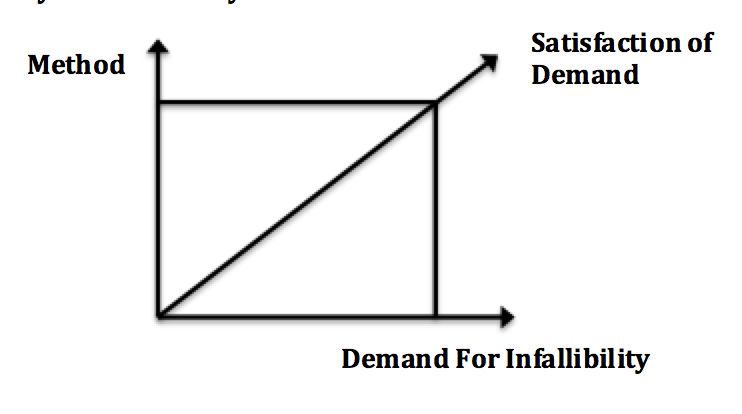
    The Methods of Decidability We can also separate the actions of intuiting (intuition), from reasoning (all processes of the mind), from rationalism (justification), from calculation (in the wider sense – transformation of inputs into outputs) from computation (algorithm).

    |DECIDABLE| Unintelligible(Incomprehensible) > Intelligible(Comprehensible) > Possible (actionable) > Preferable > Good (Normative, Moral) > Decidable(Judicial) > True (scientific) > Analytically True (logical) > Tautologically True (Tautological)

    and    

    |COGNITION| Comprehensible > Imaginable > Reasonable > Rational > Calculable > Computational > Identical

    and

    |METHOD| Experiential(emotional) > Rational (law : Social or Contractual) Theoretic (science: existential) > Axiomatic(logic: mental) > Each of these methods of reasoning depends upon a different degree of demand for the infallibility of decidability. So when we say we can decide a question, we mean it satisfies the demand for the infallibility of decidability.

    Note: This technique, where we test the satisfaction of demand for infallibility, will frame most of our thinking, and it is the principle difference between logical, philosophical, scientific, and legal thought. That is because it is the most complete of logical, philosophical, scientific, and legal thought.

    Producing Decidability

    The Deflationary Method

    Deflation And Disambiguation The technique we will use is Deflation and Disambiguation, where we use the term deflation as in conflation, and “de-conflation”, and where we use disambiguation as in ambiguous and unambiguous. These terms function as an evolution of the terms ‘analytic’ or ‘analytical’; meaning “to break into constituent parts”. However, instead of breaking into constituent parts, we break terms into Series, Spectra, Tables, Hierarchies, or Graphs of one or more Constant Relations through a process of (a) competition and (b) reduction to commensurable measurements (terms) we call operational language (or grammar). The purpose of deflation is to both limit the constant relations in our definitions to those that are decidable, and eliminate constant relations that are unnecessary for decidability. As a consequence of deflation we will produce multiple opportunities for comparison and decidability. And as such we will increase our chances of both confirmation and falsification.   Although, as we will discover later, it is falsification, not confirmation that provide us with greater decidability.   

    How We Deflate Language

    Dimensions, Dimensions, and Dimensions

    |DEFLATING| Constant Relations > Operational Terms > Competition in Series > Competition between SeriesThe Problem of Continuous Recursive Disambiguation We seek to satisfy the Demand for the infallibility of decidability. For historical reasons we tend to think in terms of creating meaning, but the process we use when speaking is the use of symbols to produce continuously recursive disambiguation. This ‘success by the negative’ or ‘via-negativa’ will be another of the central themes of our work. So to produce a stream of language AND to understand a stream of language we accumulate names of some set of constant relations(words) and helpers (words) that assist in the relations between those words, and by the accumulation of names and relations we reduce by speaking and restore by listening, a model (network of constant relations) that satisfies the demand for infallibility of decidability.

    |Understanding| Free Association -> Hypothesis -> (repeat) -> (Demand for Infallibility Satisfied. OR Not Satisfied)Continuous Recursive Disambiguation At Scale We make use of this same process at scale, in what we call ‘epistemology’ or ‘the continuous recursive falsification and therefore survival of demand for infallibility of decidability. The Process of Satisfying Demand for Infallibility of a Statement (Knowledge):

    • Free Association -> Test of Survivability of Inquiry (way-finding).
    • Hypothesis -> Test of survivability of Fitness, in personal falsification.
    • Theory -> Test survivability of Possibility in Applied
    • Law -> Test of Survivability of Application in the Market
    • Convention -> Test of Survivability of Habituation in the Market
    • Metaphysical Value Judgment -> Test of Survivability of Integration in the Market for application

    So whether as individual thinking through a problem in our minds, or as speaker and audience, as groups, as markets, as societies, as mankind, we test our ideas by a process of continuous competition for infallibility in the market for ideas that survive increasing scope of application. The Problem of Suggestion: Substitution, Conflation, and Ambiguity Every word (symbol) we speak in every stream of words, produces free association in the audience. We ‘suggest’ meaning with our expressions, sounds, words, phrases, sentences, narratives, and arguments. Then we continuously strive to disambiguate these suggestions until the other party demonstrates we have satisfied (at present) the demand for infallibility sufficiently to convey meaning (a contract for meaning. An agreement on experiences.) When someone says ‘I understand’ they convey acceptance of your offer (contract) for meaning within the limits of the demand for infallibility, in the given context. Unfortunately, in our optimism, we fail to perform due diligence with one another, and often let the conversation evolve until we confirm (justify) or disconfirm (falsify) our network of meaning and break the prior contract for meaning. More, unfortunately, even without our optimism, we may simply lack the vocabulary, grammars, and paradigms, to convey what we imagine we understand despite our inability to articulate it. And most unfortunately, it is quite easy to use the process of suggestion to force the audience to substitute a falsehood, conflate one circumstance with another, or inflate the scope, intensity, or values. In other words – it’s very easy to lie. And the only way of circumventing the problem of suggestion is due diligence: trying to falsify what we’ve understood. The positive solution to this problem is ‘seek to understand’ rather than agree. This is relatively expensive and puts the burden on the audience. The negative is ‘skepticism’ – which is cheaper and requires less knowledge, and puts the burden on the speaker. One way, the other, or both, are often required to produce a contract for meaning. The practical reality is, that this job falls always to the person better informed. The unfortunate problem is that the person most informed may have malincentives. If that is the case then no matter what due diligence we make use of, only warranty sufficient to cover the costs of failing to satisfy the demand for infallibility will provide us with decidability, to agree on a contingent contract for meaning. Note: As we continue this journey together the use of the language of law, contract, and economics will eliminate most of the weaknesses of moral and philosophical language, and provide you with a much superior model for analysis at the cost of more ‘steps’. Starting with Terms: Comparisons are costly. The more complex the comparison the more costly. We have a natural tendency to reduce the cost of composing speech and accumulating understanding. Some cultures use languages with a very large number of terms. Some languages use a very small number of terms. Large numbers of terms limit the need for suggestion. Small numbers of terms increase the need for suggestion. We describe this difference between High Context, Low Precision language of fewer terms and loose grammar, with Low Context, High Precision language with many terms and strict grammar. English is a low context, high precision language with strict grammar. Asian languages are high context, low precision. To westerners they are poetic. To Asians, western languages are burdensome. Same for our writing. Asian languages require more context and interpretation. Germanic languages little context. In effect, high context languages are stories, while low context languages are recipes. Germanic languages are military, engineering, and scientific languages. Whereas east Asian languages are moral, literary, and poetic languages. That said, it only takes about 300 words to satisfy travel demands in nearly any language. And in English around 1000 words are all that is necessary for interpersonal non-technical communication. However, even in our low context high precision language we tend to seek words with wide general meaning on one hand, or ideal meaning on the other, and rely on suggestion and context to relieve the burden of composing continuously recursive disambiguating prose. That leads us to the problem of general and ideal types. The Problem of Ideal Types Ideal types are constructs or concepts which create a paradigm by which to compare phenomenon and ideas. However, it turns out that a single stereotype, or paradigm encourages us to try to ‘fit’ data to model, and in doing so engage in various forms of conflation and inflation, that introduces error and bias. The Use of Series for Precision We will use series (spectra) of related words or phrases to describe a concept consisting of one or more constant relations from beginning to end. A series (spectrum) puts terms in competition with one another and forces us to choose which term refers to which properties. This competition prevents us from the ‘fitting’, conflating, and inflating we use with ideal types. Note: If you habituate the practice of converting ideals into one or more series (spectra) your reasoning will dramatically improve. Disambiguation of our Consciousness: Our Faculties We possess at least these faculties: Our physical senses (perceptions), our intuitionistic and emotional faculties (emotions, intuitions, imagination), and our conscious and cognitive faculties (thought, reason, calculation), and we can put them to use (test them) by producing action (movement) and that subset of actions we call speech (communication). We have no control over our senses. We have intuitions that are outside our control, though can train our intuitions a bit, but intuition is not open to introspection. We can train our reason and much of our reason is open to introspection. We can act, even if not introspectively decompose how we cause our body to act. We can speak and introspect our use of language, and even think in language. This difference between involuntary sensation, |Faculties| Perception (physical) > Intuition (emotion, impulse, intuition) > Cognition (thought, imagination, reason) > Action(testing) > Speech (testing – communication(via others)). Experiences: We will define our Experience as consisting of the combined results of Perception, Intuition, and Cognition as they change or remain constant over time. 1 – Our Perceptions with our Five Senses: sight, sound, touch, taste, and smell. 2 – Our Intuitions: Emotion, Intuition (including prediction), Imagination. 3 – Our Cognitions: Free Association (daydreaming), Thought, Reason, Calculation

    |Experience| Perception > Intuition > Cognition > Action -> (repeat)

    CORRESPONDENCE AND CONSISTENCY

    THE TESTS OF CONSISTENCY, INCONSISTENCY, AND CONTRADICTION The problem of Correspondence, Consistency, and Coherence Correspondence in language, more complex relations to name.

    • Numbers are very simple, despite the ‘magic’ (technically ‘idealism’) mathematicians attribute to them. Numbers refer to names of positions. When we create numbers of any size we are using ‘positional naming’. That’s it. Number means name for a position. That’s all. If you have ten children in your family, all born in some order, and all having different names, if you memorize that order then you can use the children’s names as positions in order, and build your decimal numbering system with those positional names instead of the ones we use. (Yes, people do such things).
    • When we ‘count’ we use the names of positions to refer to that count. Three refers to the third position. One hundred to the one hundredth position. We us the term Ordinal when we refer to positions. We use the term Cardinal when we refer to
    • We can count anything we choose to, that can be counted. Some things are countable and some are not. For example, trees are countable, but we resort to stand, grove and forest when counting is impractical. It’s possible to count grains of wheat, but impractical. It’s not possible to count water other than perhaps drops. Instead we use weight or volume to count that which is impractical or impossible to count.
    • When we count something countable, we say the positional name refers to some set of that something. And that relationship between number(name) and referent(what we’re counting) is correspondence. The beauty of numbers is that because they are so simple (meaning nothing but position) we can use them to correspond to almost anything we can imagine that is countable or countable by some measure.
    • Now the problem is, what if we say ‘men? Well, that’s a very broadly correspondent. It’s all humans that are not female or children. If we say “this apple”, “my older brother Thomas”, or “The Moon” those are very precise names that are narrowly correspondent with some set of constant relations.
    • When we say “a horse” we refer to a category of relations that we have learned to association with the term ‘horse’ from experience, testimony and fiction. When we say “unicorn” we refer to a set of constant relations we have learned partly from experience (horse, wings, horn, flying), or testimony, but when combined from only from fiction. In this case a horse is meaningful and correspondent with reality. And a unicorn is internally consistent with a fiction, but not externally correspondent with reality. This is the difference between internal consistency of ideas and words (such that no contradiction or falsehood exists), and words and ideas externally correspondent with existence (such that no non-correspondence exists). This distinction assists us in clarifying the relationship between consistent (internally: between words and imagination that can imagined) and correspondent (between words and reality that can be perceived.).

    |Speech| Incoherent (no contract for meaning possible) > Coherent (contract for meaning possible) > Verbally Consistent (words or symbols and their constant relations are non contradictory) > Perceivably Correspondent (words and symbols correspond with the constant relations

    | Coherent | … sufficient for meaning | Internally Consistent | … sufficient for demand | Externally Correspondent | … sufficient for demand So the problem with correspondence is satisfaction of the demand for infallibility in the given context, in the current contract for meaning (coherence, consistency, correspondence). When we use a name (referrer) does it satisfy the demand for disambiguity we imply infallible by the term ‘identity’? Or does it leave open the possibility of suggestion, conflation, or inflation? If we cannot satisfy the demand for infallibility of decidability, we can only perform by due diligence (present) or demand warranty (future).  

    COMMENSURABILITY

    PRODUCING CONSISTENCY, CORRESPONDENCE, AND COHERENCE The Problem of Commensurability Then we have the problem of the differences between apples and oranges. Both our countable, but they are not identical. Two things are commensurable when they are measurable using the same standard of measurement. 1) Numbers render countable objects commensurable 2) Units of Measure render weights and volumes commensurable. 3) Measurements render spatial commensurable 4) Physics renders physical actions commensurable. 5) Money and prices render goods and services commensurable 6) Property renders cooperation (ethics, morals, politics) commensurable 7) Names render categories of properties commensurable. 8) Categories render sets of properties commensurable. 9) Properties render sets of constant relations commensurable. The The Commensurability of Observability The Commensurability of Actions The Commensurability of Sensations The Incommensurability of Values Commensurability of terms vs referents No longer measure a third   Calculable (Calculability) (once commensurable then calculable) Man As The Measure Of All Things To Man …Faculties Produce Measurements ( …. )  Actions Create Commensurability….. Everything can be described by the actions required to describe it. (stories, recipes). If a thing can be described by the senses, intuitions, or reason, it can be explained in terms of senses. If a thing cannot be described by the senses intuitions or reason, it can be explained by the means of reducing it to an analogy to experience: measurements. Language Consists of Measurements All language consists of a series of measurements the purpose of which is to produce continuously recursive disambiguation in the audience, sufficient to satisfy the demand for infallibility given the context of the promise made. Man is the measure of all things to man, and language consists of parsimonious (true), accurate (sufficient), poetic(analogical but sufficient), inaccurate (insufficient) or deceitful measurements, that produce a stream of experiences of continuous recursive disambiguation (precision) in the audience such that their demand for infallibility of correspondence in the context is met – or not.   Testimony (Speech) consisting of Measurements can be Tested. ( … ) Producing Terms Producing Terms That Are Measurements Production of Unambiguous Terms and Operational Definitions that are Testable     Deflation (Deconflation and Disambiguation) We deflate into the identical, comparable (differential), measurable, and commensurable, and separate the observable and testifiable (Senses), from the arguable and testable (Cognitions), from the arbitrary, preferential, and opined (Intuitions).   Differentiation (Identity) Producing Comparability, Measurability, Commensurability, and Identity.   Comparability Measurability Commensurability Identity   Which is a verbose way of asking “Which one of these things is not like the others” about the Sensory, Intuitionistic, and Cognitive differences, until no conflation remains. Something vs. Nothing: We can perceive the change between Something and Nothing.   Something, Nothing, Everything ( … )  

    |Existence| (Nothing = Everything) > Something (subset)Time (change in time: story): To Perceive either State or Change in State we perceive the passage of Time. Without Time, we cannot speak of constant relations, because we cannot perceive either constant relations or changes in state that would falsify those freely associated relations. Change in Time ( … ) State (A story of Continuity): We can Perceive and generate an experience only over changes in time. Constant relations in time when those relations might differ. State depends upon time, time depends upon some utility. Change in State ( … ) Change (A Story of Change): We perceive Change (differences) our senses and intuitions. We exert some degree of guidance of our cognitions. Change ( … ) difference in perception. Constant, Inconstant, and Contingent Relations: We perceive constant relations and changes in constant relations over time.   Constant Relations 1 : properties constant within a referent 2 : properties shared between two or more referents. 3 : properties remaining constant between two or more states.   Inconstant Relations 1 : properties not constant within a referent 2 : properties not shared between two or more referents. 3 : properties not constant between two or more states.   Contingent Relations 1 : properties contingent within a referent 2 : properties contingently shared between two or more referents. 3 : properties contingently between two or more states.   Continuous Accumulation: We accumulate the indistinquishable (emotions, intuitions) that are not open to introspection,   Continuous Recursion (Comparison and Competition): we recursively     Competition for Excitement: (of neurons)    Limits Limits to Comprehension   accumulation of association vs falsification of associations   Computational efficiency.   State Persistence vs breadth search, vs depth search   Continuous Recursive Disambiguation vs Scale of Set of Constant Relations(density)       Names Properties, Categories, and their Names     Properties (A Story of Constant Relations) ( … ) analogy to experience – A construction of a combination of experiences. (sense(physical), intuition, and mind (reason, will)     Categories (a Story of Properties, Relations, and Values) ( … )    

    |Collections| Senses collect in > Experiences (sets) collect in> Properties (names of sets) collect in > Categories (names of sets) Name, Noun, Referrer vs. Referent (social, contract, index, efficiency)   Identity (uniqueness) Identity consists of some set of marginally indifferent properties in constant relations that persists over some period of time.   PropertyCategory (Types) Marginal differences in state of collection (set or subset) of constant relations in Time sufficient to satisfy the demand for disambiguation in the context at hand.   Name Noun Referrer Referent   Names refer to categories, identities, or properties consisting either of what we operationally define them to mean, or what we negotiate them to mean, or what the market for terms has determined that they mean. Time Time is our only Resource Our first resource is time. Our evolution of action, sentience, intelligence, cooperation, division of labor, and development writing, narrative, numbers, money, accounting, reason, law and science serve to produce increasing returns on time. When we increase our numbers in physical space we decrease opportunity costs (time). When we increase incremental suppression of parasitism and free riding, we decrease transaction costs (time). trades, money, savings, store time – time to trade with others. 1 — Time is limited and the only infinite scarcity2 — Man is a costly form of life in an unpredictable universe.

    “We are not wealthier than cavemen, we have merely made everything infinitely cheaper.”

    Defeating Time( … ) Subtraction of the Time Dimension   For example, numbers consist of names of positions, which by virtue or order maintain constant relations. We then manipulate accounts (balances, expressions, variables) by maintaining ratios (constant relations) and call that process ‘mathematics’. We generally perform this set of ratio-transformations in a particular sequence, always trying to simplify or rearrange. But what we rarely consider is that unless we specifically account for it most mathematics ignores time – which is its principle benefit to us outside of commensurability: time. Time and Production Cycles from the Trivial to the Grand. ( … ) “Harmonies or disharmonies” between short, medium, and long We cannot know the intelligence of distant ancestors. Planning a series of steps in sequence must emerge – which requires recursion. Consciousness must emerge, meaning, the ability to compare states. Cooperation must emerge, meaning, the ability to empathize with intent. At some point we must develop sufficient computational ability to manipulate our bodies in some way that allows for unambiguous communication, or a means of continuous disambiguation, that is fast enough for one another to make use of in real time, and easy enough for one another to retain. And at some point, given sufficient computational ability, memory, and state persistence independent of recursion, language must emerge. At some point the value of such communication much be such that the cost of it is offset by the rewards of it. And we should see a cliff in history where there is a dramatic change when we did develop those abilities. And we do see it – rather recently. But language requires a system of measurement. The system of measurement is limited by our senses. And as such meaning refers to a set of measurements, eventually reducible to analogies to human experience. So while semantic content (measurements) must vary from species to species, grammar (continuous recursive disambiguation) should be universal in the sense that it varies predictably with computational abilities. We can understand a child, a person with 60IQ, 70IQ and so on, up to 200+ IQ. But as far as I can tell the set of measurements (basis of semantics) remain the same, and all that changes is the scope of the state persisted, the depth of recursion, and the density and distance of relations, and the ability to model (forecast). In other words, simple people are in fact simply ‘more simple’ in the density of content of their semantics, use of grammar, and models (Stories) that they can construct with them. So universal grammar as a set of computational minimums and efficiencies, should always exist, and human universal grammar as universal grammar limited to human measurements (semantics), does exist. And any organism with sufficient computational (neural) capacity, should develop some means of communication using some variation of universal grammar, and some sense-perception – action dependent semantics. The Problem of Constant Relations All human thought consists of the physical production of constant yet contingent relations in neurons. That is all neurons can store: constant yet contingent relations. Relations between stimuli. Those relations begin with stimuli and through sequential layers, accumulate in increasingly combinatory relations, and through iterations, in real time, create a ‘persistence of vision’ (a model or models) that we experience as the culmination of continuous stimulation of our senses, and the admixture of those senses with upward associations, and downward models. When we refer to consciousness, we refer our ability to judge continuous differences between changes in state produced by the iterations of stimuli, memory, and synthesis into models. Neurons can fire two hundred times a second. It takes about one hundred milliseconds to cause your body to physically act (depending upon the distance). It takes about a half a second to react to a scare. It takes approximately one half to three seconds of continuous stimulation to construct a new model (waking up, experiencing a surprise, or walking into a new room). And the persistence of vision effect (on memory) has a half life of something on the order of half a second. Although variation in short term memory is one of the abilities that vastly differentiates us. When someone uses the term logical they mean (whether they understand it or not), that the network of constant relations between the universe, the perception of stimuli, their neural memory (relations), memory (categories) and models (networks of categories), remains consistent (internally), correspondent (externally), and coherent (free of conflict or contradiction). Identity Consists of a set of Constant Relations (Properties) – all the way up and all the way down from the senses to our ideas. Identity is discovered by free association, followed by elimination of non-constant relations. (falsification) Commensurability can be produced by use of a third reference that renders more than one referent measurable by another. (money, length, space, volume, current). Numbers consist of nothing more than names of positions and as such can refer to any constant positional relation, and as such we achieve scale independence. And as such numbers allow us to produce commensurability of most if not all phenomenon. All complex phenomenon consists of multiple, and often very dense causal relations and produce semi-constant intermediary relations. And we put our primary effort into determining which of those relations both direct and intermediary contribute to the production of changes in state and which of them do not.   Constant Perceptions, Constant Actions, Constant Incentives, and Inconstant Values Humans possess marginally indifferent senses, emotions, and physical capabilities – at least in the sense that we differ in amplitude rather than existence. And for this reason we can imitate (act), sympathize (think), and empathize (feel) one another’s actions, thoughts, and emotions sufficiently to cooperate on means and ends. But it rarely occurs to us that while we cannot equate our valuations and therefore emotions that reflect those valuations, and we cannot equate our understanding unless reduced to a series of simple decidable propositions, we CAN equate actions, the five senses, and simple logical vs. illogical relations. And as such, we CAN equate any statements represented as a series of actions that change state. In other words, just as prices consist of money and numbers, and those prices create commensurability between goods, so can our perceptions and actions produce statements that provide commensurability regardless of our knowledge, understanding, and ability. The Problem of (permanent) Contingency of Relations   Differences: Competition vs. Comparison, vs. Commensurability

    1. a) Competition: Without competition (comparison, differences) we have no means of distinction and without distinction we cannot make a choice.
    2. b) Constant Relations: Referrers, Properties, relations, and values are determined by marginally indifferent, comparable, or commensurable Constant Relations vs Inconstant Relations between states.

    Forms of competition:

    |Comparable|: Identical > Indifferent(in context/limits) > Marginally Indifferent > comparable > commensurable(via intermediary measure) > incommensurable (different) The problem of selection (withholding) The problem of suggestion The Problem of Inflation, The Problem of ConflationThe Utility of DeflationThe Problem of Ambiguity and Utility of Disambiguation Disambiguation by Context Disambiguation by Association Disambiguation by Disassociation  

    SERIALIZATION OF TERMS

     Organizing into Series, Spectra, Tables, Trees. Get Many Synonyms of shared relations.Starting and Ending with Limits (…)  

    OPERATIONAL DEFINITIONS OF TERMS

      (constant relations)(subjectively testable)(changes in state in time)(sequentially testable)   Example: Given the series:

    |Impositions| Criminal > Ethical > Moral > Evil 

    Competition

    (d) Equilibrating forces between series. (e) The evolutionary result of competition between sets of equilibrating forces. The Market Competition for Meaning (Positiva) (epistemic process)

    |Meaning| Utterances > Construction > Falsification > Agreement > Warranty.   DEFINITION OF MEANING MEANING (dimensional definition) (a) normative content (relations) (market) (b) habitual content (relations) (personal) (c) intentional content (relations) (d) extended (externalities) content (relations) (e) important (value) content (relations)   A network of relations(associations) reducible to a network of analogies to experience. Where experience can refer to any combination of physical, emotional, and mental experiences.   ETYMOLOGY: “INTEND” “intend, have in mind,” Old English mænan “to mean, intend, signify; tell, say; complain, lament,” from West Germanic *mainijan (source also of Old Frisian mena “to signify,” Old Saxon menian “to intend, signify, make known,” Dutch menen, German meinen “think, suppose, be of the opinion”), from PIE *meino- “opinion, intent” (source also of Old Church Slavonic meniti “to think, have an opinion,” Old Irish mian “wish, desire,” Welsh mwyn “enjoyment”), perhaps from root *men- (1) “to think.” Conversational question you know what I mean? attested by 1834. ( …. ) consisting of relations.   Stimulation by the Physical, Emotional, Intellectual (Christmas Tree Lights) (variances by agency) (agency as ‘distance’) Competition between via-Positiva and via-NegativaMarket Competition Provides Survival Market Competition Between HemispheresThe Two Faces of Suggestion (necessary for meaning)(vulnerability to deceit) Triangulation (estimation)Iterative Triangulation (estimation) “Market Competition”  

    Dimensions

      (THESE SERIES SERVE AS DIMENSIONS) Dimension: a series of terms (states) consisting of constant relations, organized in a scale – preferably from lower to upper limit. In computer science a Dimension Table refers to a range of possible values, usually in some order, sharing constant relations: a table of values. (Between sets of constant relations) Paradigm (Network, Frame)(Networks of commensurability) ( internally consistent networks of commensurability) (may not be consistent with other paradigms) (correspondent or non-correspondent) Convergence: Language of Testimony, the language of Science: Operationalism Truth: The Most Parsimonious Paradigm (…) Story: Continuous Recursive Disambiguation ( … ) Generative Grammar, Universal Grammar ( … ) In the 1950s Chomsky used |computability| Babbage > Boole > Turing > Chomsky to produce ‘generative’ or algorithmic grammar. Note that it is irrelevant in generative grammar whether or not a grammar is closed. Note that in what we will do here in Testimonialism is not rely on self-closure as in logic , but on transactional sentences as in programming, accounting, and if we are lucky, one day soon – law. Neural Economy / Computational Efficiency ( … ) Story as Transaction (exchange) (all the way up and down)A Grammar: A grammar is….
  • The Method – Decidability

    The Method – Decidability

    DECIDABILITY

    Precision, Completeness, and Decidability

    “Well, my take is that the brain evolved for graceful improvement and graceful failure of decidability.” [N]ow that we understand our journey, we can begin with the methodology. There are three parts to it:

    • Decidability via Disambiguation, Deflation, Operationalization, Serialization, and Competition. (Terms)
    • Strict Construction of Transactions, in a Contract for Meaning (Statements) and;
    • Due Diligence Against Ignorance, Error, Bias, and Deceit ( where due diligence requires tests of correspondence, consistency, possibility, rationality, reciprocity, completeness and coherence).

    These chapters will contain lots of definitions. You won’t have to retain them the first time. We’ll repeat them over and over again. And we will summarize them at the end of each chapter. And then repeat summaries at the end of chapters until you see how everything fits together neatly. So think of our work together as building familiarity with terms, series, checklists, and processes, until we produce a complete outline of the methodology, that you can refer back to until you have internalized it. In this chapter we will cover Decidability, Disambiguation, Deflation, Operational-ization, Serialization and Competition. The rest of the methodology will follow in subsequent chapters.

    Decidability (action)

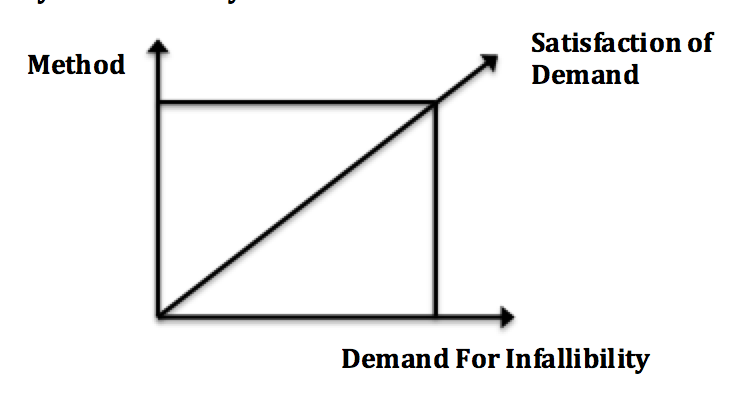
    The Satisfaction of Demand For Infallibility

    A question (or statement) is Decidable (true or false: consistent, correspondent, possible; good or bad, and sufficient) if (a) an algorithm (argument, or set of operations) exists within the limits of the system (domain: set of axioms, rules, theories) that one can use to produce a decision and (b) if sufficient information for the decision is present within the system such that, (c) one need not appeal to either information outside of the system, or DISCRETION (INTUITION, VALUES) to supply information necessary to DECIDE. Ergo, if DISCRETION (choice) is unnecessary, a proposition is DECIDABLE. If Discretion is necessary then the question may be DISCRETIONARY (subjective choice) but it is not DECIDABLE (objective). Or for the most reductive version: the subjective requires appeal to intuition (judgment) and the objective requires only appeal to present information.

    |Choice| Decidable > Discretionary(opinion) > Choice(preference, presumed good) > Random Selection (undecidable) > In-actionable The purpose of our method is to produce decidability as a means of circumventing the dependence on discretion and choice. By our diligent production of decidability we produce a value independent universal language of testimony in all subjects; but particularly in the subjects most vulnerable to discretionary impulse: cooperation, ethics, morality, and politics.

    Note: This emphasis on decidability explains the difference between rule of law (decidable) and rule by discretion (undecidable, and therefore subjective discretion or choice are required). If discretion is required, then it is rule by discretion (choice) if not, then rule of law.

    Demand For Increasingly Infallible Decidability In an effort to avoid the mistake of relying upon an Ideal Type, we will describe a spectrum, or ordered hierarchy of Demand for DECIDABILITY. That way we do not ask the universe to fit our definition, but that we provide a definition that corresponds to decidability in all cases we can perceive in the universe. Spectrum of Decidability:

    1. Intelligible: Decidable enough to imagine a conceptual relationship
    2. Reasonable: Decidable enough for me to feel confident about my decision (that it will satisfy my needs, and is not a waste of time, energy, resource )
    3. Actionable: Decidable enough for me to take actions that produce positive results.
    4. Moral: Decidable enough for me to not cause others to react negatively to me, if they have knowledge of my actions.
    5. Normative: Decidable enough to resolve a conflict without subjective opinion among my fellow people with similar values.
    6. Judicial: Decidable enough to resolve a conflict without subjective opinion across different peoples with different values.
    7. Scientific: Decidable regardless of all opinions or perspectives (‘True’)
    8. Logical: Decidable out of physical or logical necessity
    9. Tautological: Decidably identical in properties (referents) if not references (terms).

    So to borrow the one of many terms from Economics, we can see in this series (list) a market demand for increasingly infallible decidability.

    The Methods of Decidability We can also separate the actions of intuiting (intuition), from reasoning (all processes of the mind), from rationalism (justification), from calculation (in the wider sense – transformation of inputs into outputs) from computation (algorithm).

    |DECIDABLE| Unintelligible(Incomprehensible) > Intelligible(Comprehensible) > Possible (actionable) > Preferable > Good (Normative, Moral) > Decidable(Judicial) > True (scientific) > Analytically True (logical) > Tautologically True (Tautological)

    and    

    |COGNITION| Comprehensible > Imaginable > Reasonable > Rational > Calculable > Computational > Identical

    and

    |METHOD| Experiential(emotional) > Rational (law : Social or Contractual) Theoretic (science: existential) > Axiomatic(logic: mental) > Each of these methods of reasoning depends upon a different degree of demand for the infallibility of decidability. So when we say we can decide a question, we mean it satisfies the demand for the infallibility of decidability.

    Note: This technique, where we test the satisfaction of demand for infallibility, will frame most of our thinking, and it is the principle difference between logical, philosophical, scientific, and legal thought. That is because it is the most complete of logical, philosophical, scientific, and legal thought.

    Producing Decidability

    The Deflationary Method

    Deflation And Disambiguation The technique we will use is Deflation and Disambiguation, where we use the term deflation as in conflation, and “de-conflation”, and where we use disambiguation as in ambiguous and unambiguous. These terms function as an evolution of the terms ‘analytic’ or ‘analytical’; meaning “to break into constituent parts”. However, instead of breaking into constituent parts, we break terms into Series, Spectra, Tables, Hierarchies, or Graphs of one or more Constant Relations through a process of (a) competition and (b) reduction to commensurable measurements (terms) we call operational language (or grammar). The purpose of deflation is to both limit the constant relations in our definitions to those that are decidable, and eliminate constant relations that are unnecessary for decidability. As a consequence of deflation we will produce multiple opportunities for comparison and decidability. And as such we will increase our chances of both confirmation and falsification.   Although, as we will discover later, it is falsification, not confirmation that provide us with greater decidability.   

    How We Deflate Language

    Dimensions, Dimensions, and Dimensions

    |DEFLATING| Constant Relations > Operational Terms > Competition in Series > Competition between SeriesThe Problem of Continuous Recursive Disambiguation We seek to satisfy the Demand for the infallibility of decidability. For historical reasons we tend to think in terms of creating meaning, but the process we use when speaking is the use of symbols to produce continuously recursive disambiguation. This ‘success by the negative’ or ‘via-negativa’ will be another of the central themes of our work. So to produce a stream of language AND to understand a stream of language we accumulate names of some set of constant relations(words) and helpers (words) that assist in the relations between those words, and by the accumulation of names and relations we reduce by speaking and restore by listening, a model (network of constant relations) that satisfies the demand for infallibility of decidability.

    |Understanding| Free Association -> Hypothesis -> (repeat) -> (Demand for Infallibility Satisfied. OR Not Satisfied)Continuous Recursive Disambiguation At Scale We make use of this same process at scale, in what we call ‘epistemology’ or ‘the continuous recursive falsification and therefore survival of demand for infallibility of decidability. The Process of Satisfying Demand for Infallibility of a Statement (Knowledge):

    • Free Association -> Test of Survivability of Inquiry (way-finding).
    • Hypothesis -> Test of survivability of Fitness, in personal falsification.
    • Theory -> Test survivability of Possibility in Applied
    • Law -> Test of Survivability of Application in the Market
    • Convention -> Test of Survivability of Habituation in the Market
    • Metaphysical Value Judgment -> Test of Survivability of Integration in the Market for application

    So whether as individual thinking through a problem in our minds, or as speaker and audience, as groups, as markets, as societies, as mankind, we test our ideas by a process of continuous competition for infallibility in the market for ideas that survive increasing scope of application. The Problem of Suggestion: Substitution, Conflation, and Ambiguity Every word (symbol) we speak in every stream of words, produces free association in the audience. We ‘suggest’ meaning with our expressions, sounds, words, phrases, sentences, narratives, and arguments. Then we continuously strive to disambiguate these suggestions until the other party demonstrates we have satisfied (at present) the demand for infallibility sufficiently to convey meaning (a contract for meaning. An agreement on experiences.) When someone says ‘I understand’ they convey acceptance of your offer (contract) for meaning within the limits of the demand for infallibility, in the given context. Unfortunately, in our optimism, we fail to perform due diligence with one another, and often let the conversation evolve until we confirm (justify) or disconfirm (falsify) our network of meaning and break the prior contract for meaning. More, unfortunately, even without our optimism, we may simply lack the vocabulary, grammars, and paradigms, to convey what we imagine we understand despite our inability to articulate it. And most unfortunately, it is quite easy to use the process of suggestion to force the audience to substitute a falsehood, conflate one circumstance with another, or inflate the scope, intensity, or values. In other words – it’s very easy to lie. And the only way of circumventing the problem of suggestion is due diligence: trying to falsify what we’ve understood. The positive solution to this problem is ‘seek to understand’ rather than agree. This is relatively expensive and puts the burden on the audience. The negative is ‘skepticism’ – which is cheaper and requires less knowledge, and puts the burden on the speaker. One way, the other, or both, are often required to produce a contract for meaning. The practical reality is, that this job falls always to the person better informed. The unfortunate problem is that the person most informed may have malincentives. If that is the case then no matter what due diligence we make use of, only warranty sufficient to cover the costs of failing to satisfy the demand for infallibility will provide us with decidability, to agree on a contingent contract for meaning. Note: As we continue this journey together the use of the language of law, contract, and economics will eliminate most of the weaknesses of moral and philosophical language, and provide you with a much superior model for analysis at the cost of more ‘steps’. Starting with Terms: Comparisons are costly. The more complex the comparison the more costly. We have a natural tendency to reduce the cost of composing speech and accumulating understanding. Some cultures use languages with a very large number of terms. Some languages use a very small number of terms. Large numbers of terms limit the need for suggestion. Small numbers of terms increase the need for suggestion. We describe this difference between High Context, Low Precision language of fewer terms and loose grammar, with Low Context, High Precision language with many terms and strict grammar. English is a low context, high precision language with strict grammar. Asian languages are high context, low precision. To westerners they are poetic. To Asians, western languages are burdensome. Same for our writing. Asian languages require more context and interpretation. Germanic languages little context. In effect, high context languages are stories, while low context languages are recipes. Germanic languages are military, engineering, and scientific languages. Whereas east Asian languages are moral, literary, and poetic languages. That said, it only takes about 300 words to satisfy travel demands in nearly any language. And in English around 1000 words are all that is necessary for interpersonal non-technical communication. However, even in our low context high precision language we tend to seek words with wide general meaning on one hand, or ideal meaning on the other, and rely on suggestion and context to relieve the burden of composing continuously recursive disambiguating prose. That leads us to the problem of general and ideal types. The Problem of Ideal Types Ideal types are constructs or concepts which create a paradigm by which to compare phenomenon and ideas. However, it turns out that a single stereotype, or paradigm encourages us to try to ‘fit’ data to model, and in doing so engage in various forms of conflation and inflation, that introduces error and bias. The Use of Series for Precision We will use series (spectra) of related words or phrases to describe a concept consisting of one or more constant relations from beginning to end. A series (spectrum) puts terms in competition with one another and forces us to choose which term refers to which properties. This competition prevents us from the ‘fitting’, conflating, and inflating we use with ideal types. Note: If you habituate the practice of converting ideals into one or more series (spectra) your reasoning will dramatically improve. Disambiguation of our Consciousness: Our Faculties We possess at least these faculties: Our physical senses (perceptions), our intuitionistic and emotional faculties (emotions, intuitions, imagination), and our conscious and cognitive faculties (thought, reason, calculation), and we can put them to use (test them) by producing action (movement) and that subset of actions we call speech (communication). We have no control over our senses. We have intuitions that are outside our control, though can train our intuitions a bit, but intuition is not open to introspection. We can train our reason and much of our reason is open to introspection. We can act, even if not introspectively decompose how we cause our body to act. We can speak and introspect our use of language, and even think in language. This difference between involuntary sensation, |Faculties| Perception (physical) > Intuition (emotion, impulse, intuition) > Cognition (thought, imagination, reason) > Action(testing) > Speech (testing – communication(via others)). Experiences: We will define our Experience as consisting of the combined results of Perception, Intuition, and Cognition as they change or remain constant over time. 1 – Our Perceptions with our Five Senses: sight, sound, touch, taste, and smell. 2 – Our Intuitions: Emotion, Intuition (including prediction), Imagination. 3 – Our Cognitions: Free Association (daydreaming), Thought, Reason, Calculation

    |Experience| Perception > Intuition > Cognition > Action -> (repeat)

    CORRESPONDENCE AND CONSISTENCY

    THE TESTS OF CONSISTENCY, INCONSISTENCY, AND CONTRADICTION The problem of Correspondence, Consistency, and Coherence Correspondence in language, more complex relations to name.

    • Numbers are very simple, despite the ‘magic’ (technically ‘idealism’) mathematicians attribute to them. Numbers refer to names of positions. When we create numbers of any size we are using ‘positional naming’. That’s it. Number means name for a position. That’s all. If you have ten children in your family, all born in some order, and all having different names, if you memorize that order then you can use the children’s names as positions in order, and build your decimal numbering system with those positional names instead of the ones we use. (Yes, people do such things).
    • When we ‘count’ we use the names of positions to refer to that count. Three refers to the third position. One hundred to the one hundredth position. We us the term Ordinal when we refer to positions. We use the term Cardinal when we refer to
    • We can count anything we choose to, that can be counted. Some things are countable and some are not. For example, trees are countable, but we resort to stand, grove and forest when counting is impractical. It’s possible to count grains of wheat, but impractical. It’s not possible to count water other than perhaps drops. Instead we use weight or volume to count that which is impractical or impossible to count.
    • When we count something countable, we say the positional name refers to some set of that something. And that relationship between number(name) and referent(what we’re counting) is correspondence. The beauty of numbers is that because they are so simple (meaning nothing but position) we can use them to correspond to almost anything we can imagine that is countable or countable by some measure.
    • Now the problem is, what if we say ‘men? Well, that’s a very broadly correspondent. It’s all humans that are not female or children. If we say “this apple”, “my older brother Thomas”, or “The Moon” those are very precise names that are narrowly correspondent with some set of constant relations.
    • When we say “a horse” we refer to a category of relations that we have learned to association with the term ‘horse’ from experience, testimony and fiction. When we say “unicorn” we refer to a set of constant relations we have learned partly from experience (horse, wings, horn, flying), or testimony, but when combined from only from fiction. In this case a horse is meaningful and correspondent with reality. And a unicorn is internally consistent with a fiction, but not externally correspondent with reality. This is the difference between internal consistency of ideas and words (such that no contradiction or falsehood exists), and words and ideas externally correspondent with existence (such that no non-correspondence exists). This distinction assists us in clarifying the relationship between consistent (internally: between words and imagination that can imagined) and correspondent (between words and reality that can be perceived.).

    |Speech| Incoherent (no contract for meaning possible) > Coherent (contract for meaning possible) > Verbally Consistent (words or symbols and their constant relations are non contradictory) > Perceivably Correspondent (words and symbols correspond with the constant relations

    | Coherent | … sufficient for meaning | Internally Consistent | … sufficient for demand | Externally Correspondent | … sufficient for demand So the problem with correspondence is satisfaction of the demand for infallibility in the given context, in the current contract for meaning (coherence, consistency, correspondence). When we use a name (referrer) does it satisfy the demand for disambiguity we imply infallible by the term ‘identity’? Or does it leave open the possibility of suggestion, conflation, or inflation? If we cannot satisfy the demand for infallibility of decidability, we can only perform by due diligence (present) or demand warranty (future).  

    COMMENSURABILITY

    PRODUCING CONSISTENCY, CORRESPONDENCE, AND COHERENCE The Problem of Commensurability Then we have the problem of the differences between apples and oranges. Both our countable, but they are not identical. Two things are commensurable when they are measurable using the same standard of measurement. 1) Numbers render countable objects commensurable 2) Units of Measure render weights and volumes commensurable. 3) Measurements render spatial commensurable 4) Physics renders physical actions commensurable. 5) Money and prices render goods and services commensurable 6) Property renders cooperation (ethics, morals, politics) commensurable 7) Names render categories of properties commensurable. 8) Categories render sets of properties commensurable. 9) Properties render sets of constant relations commensurable. The The Commensurability of Observability The Commensurability of Actions The Commensurability of Sensations The Incommensurability of Values Commensurability of terms vs referents No longer measure a third   Calculable (Calculability) (once commensurable then calculable) Man As The Measure Of All Things To Man …Faculties Produce Measurements ( …. )  Actions Create Commensurability….. Everything can be described by the actions required to describe it. (stories, recipes). If a thing can be described by the senses, intuitions, or reason, it can be explained in terms of senses. If a thing cannot be described by the senses intuitions or reason, it can be explained by the means of reducing it to an analogy to experience: measurements. Language Consists of Measurements All language consists of a series of measurements the purpose of which is to produce continuously recursive disambiguation in the audience, sufficient to satisfy the demand for infallibility given the context of the promise made. Man is the measure of all things to man, and language consists of parsimonious (true), accurate (sufficient), poetic(analogical but sufficient), inaccurate (insufficient) or deceitful measurements, that produce a stream of experiences of continuous recursive disambiguation (precision) in the audience such that their demand for infallibility of correspondence in the context is met – or not.   Testimony (Speech) consisting of Measurements can be Tested. ( … ) Producing Terms Producing Terms That Are Measurements Production of Unambiguous Terms and Operational Definitions that are Testable     Deflation (Deconflation and Disambiguation) We deflate into the identical, comparable (differential), measurable, and commensurable, and separate the observable and testifiable (Senses), from the arguable and testable (Cognitions), from the arbitrary, preferential, and opined (Intuitions).   Differentiation (Identity) Producing Comparability, Measurability, Commensurability, and Identity.   Comparability Measurability Commensurability Identity   Which is a verbose way of asking “Which one of these things is not like the others” about the Sensory, Intuitionistic, and Cognitive differences, until no conflation remains. Something vs. Nothing: We can perceive the change between Something and Nothing.   Something, Nothing, Everything ( … )  

    |Existence| (Nothing = Everything) > Something (subset)Time (change in time: story): To Perceive either State or Change in State we perceive the passage of Time. Without Time, we cannot speak of constant relations, because we cannot perceive either constant relations or changes in state that would falsify those freely associated relations. Change in Time ( … ) State (A story of Continuity): We can Perceive and generate an experience only over changes in time. Constant relations in time when those relations might differ. State depends upon time, time depends upon some utility. Change in State ( … ) Change (A Story of Change): We perceive Change (differences) our senses and intuitions. We exert some degree of guidance of our cognitions. Change ( … ) difference in perception. Constant, Inconstant, and Contingent Relations: We perceive constant relations and changes in constant relations over time.   Constant Relations 1 : properties constant within a referent 2 : properties shared between two or more referents. 3 : properties remaining constant between two or more states.   Inconstant Relations 1 : properties not constant within a referent 2 : properties not shared between two or more referents. 3 : properties not constant between two or more states.   Contingent Relations 1 : properties contingent within a referent 2 : properties contingently shared between two or more referents. 3 : properties contingently between two or more states.   Continuous Accumulation: We accumulate the indistinquishable (emotions, intuitions) that are not open to introspection,   Continuous Recursion (Comparison and Competition): we recursively     Competition for Excitement: (of neurons)    Limits Limits to Comprehension   accumulation of association vs falsification of associations   Computational efficiency.   State Persistence vs breadth search, vs depth search   Continuous Recursive Disambiguation vs Scale of Set of Constant Relations(density)       Names Properties, Categories, and their Names     Properties (A Story of Constant Relations) ( … ) analogy to experience – A construction of a combination of experiences. (sense(physical), intuition, and mind (reason, will)     Categories (a Story of Properties, Relations, and Values) ( … )    

    |Collections| Senses collect in > Experiences (sets) collect in> Properties (names of sets) collect in > Categories (names of sets) Name, Noun, Referrer vs. Referent (social, contract, index, efficiency)   Identity (uniqueness) Identity consists of some set of marginally indifferent properties in constant relations that persists over some period of time.   PropertyCategory (Types) Marginal differences in state of collection (set or subset) of constant relations in Time sufficient to satisfy the demand for disambiguation in the context at hand.   Name Noun Referrer Referent   Names refer to categories, identities, or properties consisting either of what we operationally define them to mean, or what we negotiate them to mean, or what the market for terms has determined that they mean. Time Time is our only Resource Our first resource is time. Our evolution of action, sentience, intelligence, cooperation, division of labor, and development writing, narrative, numbers, money, accounting, reason, law and science serve to produce increasing returns on time. When we increase our numbers in physical space we decrease opportunity costs (time). When we increase incremental suppression of parasitism and free riding, we decrease transaction costs (time). trades, money, savings, store time – time to trade with others. 1 — Time is limited and the only infinite scarcity2 — Man is a costly form of life in an unpredictable universe.

    “We are not wealthier than cavemen, we have merely made everything infinitely cheaper.”

    Defeating Time( … ) Subtraction of the Time Dimension   For example, numbers consist of names of positions, which by virtue or order maintain constant relations. We then manipulate accounts (balances, expressions, variables) by maintaining ratios (constant relations) and call that process ‘mathematics’. We generally perform this set of ratio-transformations in a particular sequence, always trying to simplify or rearrange. But what we rarely consider is that unless we specifically account for it most mathematics ignores time – which is its principle benefit to us outside of commensurability: time. Time and Production Cycles from the Trivial to the Grand. ( … ) “Harmonies or disharmonies” between short, medium, and long We cannot know the intelligence of distant ancestors. Planning a series of steps in sequence must emerge – which requires recursion. Consciousness must emerge, meaning, the ability to compare states. Cooperation must emerge, meaning, the ability to empathize with intent. At some point we must develop sufficient computational ability to manipulate our bodies in some way that allows for unambiguous communication, or a means of continuous disambiguation, that is fast enough for one another to make use of in real time, and easy enough for one another to retain. And at some point, given sufficient computational ability, memory, and state persistence independent of recursion, language must emerge. At some point the value of such communication much be such that the cost of it is offset by the rewards of it. And we should see a cliff in history where there is a dramatic change when we did develop those abilities. And we do see it – rather recently. But language requires a system of measurement. The system of measurement is limited by our senses. And as such meaning refers to a set of measurements, eventually reducible to analogies to human experience. So while semantic content (measurements) must vary from species to species, grammar (continuous recursive disambiguation) should be universal in the sense that it varies predictably with computational abilities. We can understand a child, a person with 60IQ, 70IQ and so on, up to 200+ IQ. But as far as I can tell the set of measurements (basis of semantics) remain the same, and all that changes is the scope of the state persisted, the depth of recursion, and the density and distance of relations, and the ability to model (forecast). In other words, simple people are in fact simply ‘more simple’ in the density of content of their semantics, use of grammar, and models (Stories) that they can construct with them. So universal grammar as a set of computational minimums and efficiencies, should always exist, and human universal grammar as universal grammar limited to human measurements (semantics), does exist. And any organism with sufficient computational (neural) capacity, should develop some means of communication using some variation of universal grammar, and some sense-perception – action dependent semantics. The Problem of Constant Relations All human thought consists of the physical production of constant yet contingent relations in neurons. That is all neurons can store: constant yet contingent relations. Relations between stimuli. Those relations begin with stimuli and through sequential layers, accumulate in increasingly combinatory relations, and through iterations, in real time, create a ‘persistence of vision’ (a model or models) that we experience as the culmination of continuous stimulation of our senses, and the admixture of those senses with upward associations, and downward models. When we refer to consciousness, we refer our ability to judge continuous differences between changes in state produced by the iterations of stimuli, memory, and synthesis into models. Neurons can fire two hundred times a second. It takes about one hundred milliseconds to cause your body to physically act (depending upon the distance). It takes about a half a second to react to a scare. It takes approximately one half to three seconds of continuous stimulation to construct a new model (waking up, experiencing a surprise, or walking into a new room). And the persistence of vision effect (on memory) has a half life of something on the order of half a second. Although variation in short term memory is one of the abilities that vastly differentiates us. When someone uses the term logical they mean (whether they understand it or not), that the network of constant relations between the universe, the perception of stimuli, their neural memory (relations), memory (categories) and models (networks of categories), remains consistent (internally), correspondent (externally), and coherent (free of conflict or contradiction). Identity Consists of a set of Constant Relations (Properties) – all the way up and all the way down from the senses to our ideas. Identity is discovered by free association, followed by elimination of non-constant relations. (falsification) Commensurability can be produced by use of a third reference that renders more than one referent measurable by another. (money, length, space, volume, current). Numbers consist of nothing more than names of positions and as such can refer to any constant positional relation, and as such we achieve scale independence. And as such numbers allow us to produce commensurability of most if not all phenomenon. All complex phenomenon consists of multiple, and often very dense causal relations and produce semi-constant intermediary relations. And we put our primary effort into determining which of those relations both direct and intermediary contribute to the production of changes in state and which of them do not.   Constant Perceptions, Constant Actions, Constant Incentives, and Inconstant Values Humans possess marginally indifferent senses, emotions, and physical capabilities – at least in the sense that we differ in amplitude rather than existence. And for this reason we can imitate (act), sympathize (think), and empathize (feel) one another’s actions, thoughts, and emotions sufficiently to cooperate on means and ends. But it rarely occurs to us that while we cannot equate our valuations and therefore emotions that reflect those valuations, and we cannot equate our understanding unless reduced to a series of simple decidable propositions, we CAN equate actions, the five senses, and simple logical vs. illogical relations. And as such, we CAN equate any statements represented as a series of actions that change state. In other words, just as prices consist of money and numbers, and those prices create commensurability between goods, so can our perceptions and actions produce statements that provide commensurability regardless of our knowledge, understanding, and ability. The Problem of (permanent) Contingency of Relations   Differences: Competition vs. Comparison, vs. Commensurability

    1. a) Competition: Without competition (comparison, differences) we have no means of distinction and without distinction we cannot make a choice.
    2. b) Constant Relations: Referrers, Properties, relations, and values are determined by marginally indifferent, comparable, or commensurable Constant Relations vs Inconstant Relations between states.

    Forms of competition:

    |Comparable|: Identical > Indifferent(in context/limits) > Marginally Indifferent > comparable > commensurable(via intermediary measure) > incommensurable (different) The problem of selection (withholding) The problem of suggestion The Problem of Inflation, The Problem of ConflationThe Utility of DeflationThe Problem of Ambiguity and Utility of Disambiguation Disambiguation by Context Disambiguation by Association Disambiguation by Disassociation  

    SERIALIZATION OF TERMS

     Organizing into Series, Spectra, Tables, Trees. Get Many Synonyms of shared relations.Starting and Ending with Limits (…)  

    OPERATIONAL DEFINITIONS OF TERMS

      (constant relations)(subjectively testable)(changes in state in time)(sequentially testable)   Example: Given the series:

    |Impositions| Criminal > Ethical > Moral > Evil 

    Competition

    (d) Equilibrating forces between series. (e) The evolutionary result of competition between sets of equilibrating forces. The Market Competition for Meaning (Positiva) (epistemic process)

    |Meaning| Utterances > Construction > Falsification > Agreement > Warranty.   DEFINITION OF MEANING MEANING (dimensional definition) (a) normative content (relations) (market) (b) habitual content (relations) (personal) (c) intentional content (relations) (d) extended (externalities) content (relations) (e) important (value) content (relations)   A network of relations(associations) reducible to a network of analogies to experience. Where experience can refer to any combination of physical, emotional, and mental experiences.   ETYMOLOGY: “INTEND” “intend, have in mind,” Old English mænan “to mean, intend, signify; tell, say; complain, lament,” from West Germanic *mainijan (source also of Old Frisian mena “to signify,” Old Saxon menian “to intend, signify, make known,” Dutch menen, German meinen “think, suppose, be of the opinion”), from PIE *meino- “opinion, intent” (source also of Old Church Slavonic meniti “to think, have an opinion,” Old Irish mian “wish, desire,” Welsh mwyn “enjoyment”), perhaps from root *men- (1) “to think.” Conversational question you know what I mean? attested by 1834. ( …. ) consisting of relations.   Stimulation by the Physical, Emotional, Intellectual (Christmas Tree Lights) (variances by agency) (agency as ‘distance’) Competition between via-Positiva and via-NegativaMarket Competition Provides Survival Market Competition Between HemispheresThe Two Faces of Suggestion (necessary for meaning)(vulnerability to deceit) Triangulation (estimation)Iterative Triangulation (estimation) “Market Competition”  

    Dimensions

      (THESE SERIES SERVE AS DIMENSIONS) Dimension: a series of terms (states) consisting of constant relations, organized in a scale – preferably from lower to upper limit. In computer science a Dimension Table refers to a range of possible values, usually in some order, sharing constant relations: a table of values. (Between sets of constant relations) Paradigm (Network, Frame)(Networks of commensurability) ( internally consistent networks of commensurability) (may not be consistent with other paradigms) (correspondent or non-correspondent) Convergence: Language of Testimony, the language of Science: Operationalism Truth: The Most Parsimonious Paradigm (…) Story: Continuous Recursive Disambiguation ( … ) Generative Grammar, Universal Grammar ( … ) In the 1950s Chomsky used |computability| Babbage > Boole > Turing > Chomsky to produce ‘generative’ or algorithmic grammar. Note that it is irrelevant in generative grammar whether or not a grammar is closed. Note that in what we will do here in Testimonialism is not rely on self-closure as in logic , but on transactional sentences as in programming, accounting, and if we are lucky, one day soon – law. Neural Economy / Computational Efficiency ( … ) Story as Transaction (exchange) (all the way up and down)A Grammar: A grammar is….

  • Yes,well ten our differences is in a trade off for pragmatic speech (you) and le

    Yes,well ten our differences is in a trade off for pragmatic speech (you) and legally decidable speech (me) 😉


    Source date (UTC): 2019-11-08 20:28:24 UTC

    Original post: https://twitter.com/i/web/status/1192901706671153154

    Reply addressees: @Nalo_Nei @FreePeterBiarM

    Replying to: https://twitter.com/i/web/status/1192896807451250688


    IN REPLY TO:

    @Nalo_Nei

    @curtdoolittle @FreePeterBiarM Interesting idea, that falsehood doesn’t exist “out there” but only w/in one’s self.

    In my opinion Beings of Untruthfulness Do exist.
    They are our adversaries.

    Truth also exists. ‘Truth-Brings’ (totally clunky materialistic language but what else is there) are our allies

    Original post: https://twitter.com/i/web/status/1192896807451250688

  • PART 3 – The Method

    Part 999 – The Method

    The Methodology:

    Via-Negativa: In The Negative

    ( … )

    Disambiguation by Enumeration, Serialization and Operationalization.

    Serialization provides empirical evidence of the spectrum in a given language, even if some terms must be disambiguated. We operationalize the constant relations expressed in the SERIES, not the elements. So if I list the truth spectrum, identify its constant relations, and state them operationally, I have completed the method. (It’s just like geometry, three points make a line, lines are unambiguous). Which is why you see me using geometry in everything. It’s a higher (less ambiguous) standard of measurement. Or said differently, geometry constitutes the most complete grammar we have, and sets are a means of producing ideals and sophism. Or better: all language is measurement. The question is only the precision of the measures. P is the most precise n-dimensional language we have. COUNSEL: PHILOSOPHY VS SOPHISM Given any term, always use a series of at least 3 to 5 when analyzing propositions. I prefer 8 to 12 whenever I can get them, and english because it has so vast a vocabulary of working, governing, intellectual, logical, and scientific origins is extremely useful for creating constellations of constant relations whether in one series, or a competition between series we call ‘supply and demand curves’. Using series – which is what I teach – disambiguates and prevents errors of conflation when using ideal types and fallacies of construction such as ‘principles’. Example: Good < Moral < Ethical < Amoral > Unethical > Immoral > Evil constant relations: 1… change in capital whether positive, neutral, or negative 2… degree of intent, accidental, self interest, other interest 3… degree of informational distance between actors and victims (ethical interpersonal, moral inter social, evil both.) Most sophistry in philosophy consists of: 1… using ideal rather than serialized (enumerated) definitions; 2… using the verb to be (is are was were, be, being) rather than the means of existence; 3… conflating points of view between the observer, actor, and acted upon; 4… and failing to construct complete sentences in testimonial (promissory) grammar, using operational terms. You will find that this is one of the points of demarcation between pseudoscience, theology, philosophy, moralizing, and testimony (what we call science): disambiguation and operationalization into complete promissory sentences will rapidly demonstrate that almost all philosophical questions are sophisms. Witticisms. Nonsense. Puzzles. Riddles. But nothing more. ORIGINS Mathematics has only one constant relation (position) consisting of a single ratio, which provides scale independence, and cost independence which produces fully deterministic and testable descriptions. Yet philosophers since the time of the greeks have be trying to imitate it’s utility to no avail, and instead, have created textual and verbal interpretation under the premise the triviality of one-dimensional positional logic can provide the same utility in deduction and prediction (induction) as the constant relations of mathematics. Animism > Readings (Divination) > Astrology > Scriptural interpretation > Textual interpretation > legal interpretation > numerology > postmodern linguistic divination all constitute the same: finding what is not there as an appeal to an non-existent authority. The only peer to mathematics in language is serialization: lines that test the constant relations between points (terms), and supply-demand curves that test the relationship between lines ( propositions.). Dimensions Perceivable By Humans

    1. Logic = Constant relations of sense perceptions.
    2. Identity =(NAMES)
    3. Sets = (LANGUAGE)
    4. Science = (OBSERVATIONS)
    5. Operational = (ACTIONS)

    – Internally consistent, not inconsistent, sets of properties – Constant Relations between collections of properties. – Internally consistent (constant, consistent relations), Relations, , .) – Constant relations between collections of references – Empirical, externally correspondent, correlative – Constant Relations between collections of references and reality – Operationally consistent or operationally possible Causation – Constant Relations between collections of references, actions, and reality in time.

    1. Rational (reasonable) = (RATIONAL INCENTIVE)
      (choice)
    2. Reciprocity = (RECIPROCAL INCENTIVES)
      (cooperation)

    This is the full set of dimensions of causality that humans can perceive and compare in order to decide. Each depends upon the one before it.

    The Grammars

    LANGUAGE IS CALCULATING WITH INCREASING DIMENSIONSWe tend to think of mathematics as calculation (it is) but language is also a form of calculation, and we have just (or I have just) begun to understand that language is a means of calculating (transforming inputs and outputs) in a market (competition) for signaling and influence, that produces continuous improvements in knowledge IF not impeded by error (supernatural, magical, ideal) all of which prohibit precision and increase error counter to the natural, scientific, and operational descriptions.

    The Grammars of Truth and Deceit

    Grammar (rules) or A Grammar (book) consists of:

    • Rules of continuous recursive disambiguation (speech transactions)
    • governing the composition(organization) of words, phases, and clauses,
    • traditionally divided into:
      • Phonology (systems sounds),
      • Morphology (structure of words, parts of words, relations between words, and intonation, stress, influence of context),
      • Syntax ( the structure – especially meaning word order – of sentences),
      • Punctuation using Symbols to separate and clarify the meaning of a text, or, to speak with the Annunciation, Inflection, Tone, Volume, and Pause to separate and clarify the meaning of speech.
      • Semantics (meaning) and
      • Pragmatics (context),
    • often complemented by linguistics:
      • Phonetics (the human production of sounds),

    “Grammar” In Testimony

    However, “Grammar” in Testimony, also includes the transformation of different Speech Paradigms into a set of Operational Logics. Formal Operational Logic  vs Formal Set Logics So we refer to Formal Logic or Formal Set Logic from the interpretation of algebra, text, and scripture (and tea leaves, astrology, and entrails), versus Formal Operational Logic of a sequence of objectively testable human operations, either physical (body), rational(incentive), or logical (cognitive). That Formal Operational Logic includes:

    • The Scope (Dimensions) of Pragmatics.
    • The Scope (Dimensions) of Semantics.
    • The scope of Syntax (demands requirements for a sentence – meaning transaction) within the scope of those Pragmatics and Semantics
    • The Scope (set) of the Operators possible within those Pragmatic and Semantic limitations.
    • The Necessary Function of that set of Pragmatics, Semantics, Syntax, and Operators as:
      • disambiguation (eliminate ambiguity to falsify and warranty)
        –vs–
        ambiguation ( increase opportunity for meaning to assist in communication )
    • The relationship between:
      • The Necessary Function in the given Pragmatics, Semantics and Operators APPLIED,
        –vs–
        The Pragmatics, Semantics and Operators sufficient for due diligence against error, bias, and deceit that those subject DEMANDS.

    So a Traditional Grammar is a ‘Weak’ or “Loose” logic of speech across all Paradigms of Speech, and a Propertarian Grammar is a ‘Strong’ logic of speech for each of those Paradigms of Speech. We provide a Periodic Table of Speech (Poster really) listing all of the Grammars.

    NOTE: Find our Periodic Table of Speech Here <— (Add Link)

    … Deceits … … … Fictionalism … … … …. Pseudoscience -> Magic… … … …. Idealism-> Surrealism, and… … … …. Supernaturalism->Occult

    METHODS OF ARGUMENT

    1) Expressive (emotional): a type of argument where a person expresses a positive or negative opinion based upon his emotional response to the subject. 2) Sentimental (biological): a type of argument that relies upon one of the five (or six) human sentiments, and their artifacts as captured in human traditions, morals, or other unarticulated, but nevertheless consistently and universally demonstrated preferences and behaviors. 3) Moral (normative) : a type of argument that relies upon a set of assumedly normative rules of whose origin is either (a)socially contractual, (b)biologically natural, (c) economically necessary, or even (d)divine. (Also: RELIGIOUS) 4) Reasonable (informal) 5) Rational (logical and formal) – Most philosophical arguments rely upon contradiction and internal consistency rather than external correspondence. 10) Analogical (HISTORICAL) A spectrum of analogical arguments – from Historical to Anecdotal — that rely upon a relationship between a historical sequence of events, and a present sequence events, in order to suggest that the current events will come to the same conclusion as did the past events, or can be used to invalidate or validate assumptions about the current period. 6) Scientific (directly empirical): The use of a set of measurements that produce data that can be used to prove or disprove an hypothesis, but which are subject to human cognitive biases and preferences. ie: ‘Bottom up analysis” 7) Economic: (indirectly empirical): The use of a set of measures consisting of uncontrolled variables, for the purpose of circumventing the problems of direct human inquiry into human preferences, by the process of capturing demonstrated preferences, as expressed by human exchanges, usually in the form of money. ie: “Top Down Analysis”. The weakness of economic arguments is caused by the elimination of properties and causes that are necessary for the process of aggregation. 8) Ratio-Empirical (Comprehensive: Using all above): A rationally articulated argument that makes use of economic, scientific, historical, normative and sentimental information to comprehensively prove that a position is defensible under all objections. NOTE: See “Styles of Argument” below. 9) Testimonial: (OPERATIONAL) categorically consistent, Internally consistent (logical), Externally Correspondent (Instrumentally observable), Operationally articulated (Possible), Fully Accounted, Moral (free of imposed costs). 10 – Idea – Surreal 11 – Pseudoscicnce-magic 12 – Fictional-Parable 13 – Theology-occult 14 – Lying      

    Part 999 – Testimony: Truth and Lying

    “Truth is the hard problem of both philosophy and science. And Religion is the hard problem of social science. Both were hare to solve largely because we so desperately want to find what isn’t there, and so habituated that preoccupation, that we did not know how to look at the questions without it presuming it was there.”

    Truth, Truthful SpeechDemand for Infallibility in Decidability enough for? Where Given These Dimensions:

    1. Distinguishability (indistinguishable, distinguishably, meaningful(categorical), identifiable(memorable).
    2. Possibility (unimaginable, imaginable, rational, empirical, operational, unavoidable)
    3. Actionability (inactionable,contingently actionable, actionable)
    4. Population (Self, Others, All, Universal)

    Yields the Series:

    1. Indistinguishable(perception) >
    2. Distinguishable(cognition) >
    3. Memorable(categorical-referrable) >
    4. Possible(material) >
    5. Actionable(physical) >
    6. Choosable(for use) >
    7. Preferable(Personal) >
    8. Good(interpersonal) >
    9. Decidable(political) >
    10. True(most parsimonious descriptive name possible)(universal) >
    11. Analytically True >
    12. Tautologically True.

    Where Truthful Speech that Satisfies the Demand for Increasing Infallibility of Decidability Yields the Series:

    1. Intelligible: Decidable enough to imagine a conceptual relationship
    2. Reasonable: Decidable enough for me to feel confident that my decision will satisfy my needs, and is not a waste of time, energy, resources.
    3. Actionable: Decidable enough for me to take actions given time, effort, knowledge, resources.
    4. Ethical and Moral: Decidable enough for me to not impose risk or costs upon the interests of others, or cause others to retaliate against me if they have knowledge of and transparency into my actions.
    5. Normative: Decidable enough to resolve a conflict without subjective opinion among my fellow people with similar values.
    6. Judicial: Decidable enough to resolve a conflict without subjective opinion across different peoples with different knowledge, comprehension, and values.
    7. Scientific: Decidable regardless of all opinions or perspectives (‘True’)
    8. Logical: Decidable out of physical (Theoretical) or logical (Axiomatic) or rational (Bounded Rationality) necessity
    9. Tautological: Decidedly identical in properties (referents) if not references (terms). So to borrow one of many terms from Economics, we can see in this series (list) the market demand for increasingly infallible decidability.

    Where Truth Consists in The Series of Definitions

    1. Tautological Truth: That testimony you give when promising the equality of two statements using different terms: A circular definition, a statement of equality or a statement of identity.
    2. Analytic Truth: The testimony you give promising the internal consistency of one or more statements used in the construction of a proof in an axiomatic(declarative) system. (a Logical Truth).
    3. Ideal Truth: That testimony (description) you would give, if your knowledge (information) was complete, your language was sufficient, stated without error, cleansed of bias, and absent deceit, within the scope of precision limited to the context of the question you wish to answer; and the promise that another possessed of the same knowledge (information), performing the same due diligence, having the same experiences, would provide the same testimony. (Ideal Truth = Perfect Parsimony.)
    4. Truthfulness: that testimony (description) you give if your knowledge (information) is incomplete, your language is insufficient, you have performed due diligence in the elimination of error, imaginary content, wishful thinking, bias, fictionalism, and deceit; within the scope of precision limited to the question you wish to answer; and which you warranty to be so; and the promise that another possessed of the knowledge, performing the same due diligence, having the same experiences, would provide the same testimony.
    5. Honesty: that testimony (description) you give with full knowledge that knowledge is incomplete, your language is insufficient, but you have not performed due diligence in the elimination of error and bias, but which you warranty is free of deceit; within the scope of precision limited to the question you wish to answer; and the promise that another possess of the same knowledge (information), performing the same due diligence, having the same experiences, would provide the same testimony.
    6. Demonstrated Preference:
      (…)

    Where the Criteria for Truthful Speech Is Coherence Across the Dimensions Testifiable by Man, in The Series:

    1. Categorically Consistent (Non-conflationary, Differences)
    2. Internally Consistent (Logical)
    3. Externally Correspondent (Empirical)
    4. Operationally Consistent (Consisting of Operational Terms that are Repeatable and Testable)
    5. Rational Choice (Consisting of Rational choice, in available time frame)
    6. Reciprocal (Consisting of Reciprocally Rational Choice)
    7. With Stated Limits and Fully Accounted (Defense against cherry-picking and inflation)
    8. Warrantied
      … (i)as having performed due diligence in the above dimensions;
      … (ii)where due diligence is sufficient to satisfy the demand for infallibility;
      … (iii)and where one entertains no risk that one cannot perform restitution for.

    As a Defense Against the Series:

    1. Ignorance and Willful Ignorance;
    2. Error and failure of Due Diligence;
    3. Bias and Wishful Thinking;
    4. And the many Deceits of:
      … (a) Loading and Framing;
      … (b) Suggestion, Obscurantism, and Overloading(direct) and Propaganda (environmental);
      … (c) Fictionalisms of SophismsPseudorationalismsPseudoscience, and Supernaturalism;
      … (d) and outright Fabrications (Deceits)

    In Defense or Advocacy Of:

    1. Any transfer that is not:
      … (a) productive
      … (b) fully informed
      … (c) warrantied
      … (d) voluntary
      … (e) free of imposition of costs upon the demonstrated interests of others by any externality.

    Including but Not Limited to The Series of Those Categories Of:

    1. murder,
    2. harm, damage, theft,
    3. fraud, fraud by omission, fraud by indirection,
    4. free riding, socialization of losses, privatization of commons,
    5. rent-seeking, corruption, monopoly seeking, conspiracy, statism/corporatism,
    6. conversion(Religion, Ideology, Sophism,Pseudoscience),
    7. displacement(immigration/overbreeding),
    8. conquest (war).

    Lying and Deceit

    And Whereas People lie:

    1. To advance an interest
    2. To obtain an interest
    3. To preserve an interest

    And where the Spectrum of Lying consists of:

    1. Intent to deceive.
    2. Failure of due diligence against lying
    3. Carrier of and distributor of lies
    4. Carrier of tradition and culture of lies.
    5. A genetic predisposition to lie.

    Where

    1. White Lie: Preservation or construction of an emotional (status, relationship) debt or credit.
    2. Grey Lie: Protecting interests from liability due to accidental harm to others’ interests.
    3. Black Lie: Gaining an interest by intentional destruction or transfer of another’s interests.
    4. Evil Lie: Causing harm to others’ interest for the purpose of causing harm rather than gaining interest for one’s self.

    Where; Lying consists in the Failure of due diligence against:

    1. ignorance, error, bias, and wishful thinking,

    And making use of:

    1. Loading, Framing, Obscuring, Suggestion;
    2. Ridiculing, Shaming, Moralizing, Psychologizing, Gossiping, Propagandizing Reputation Destruction;
    3. Sophisms (Overloading), (Appealing to cognitive biases);
    4. Straw Manning via Negativa, and Heaping of Undue Praise via Positiva;
    5. Fictionalisms of Idealism, Innumeracy, Pseudoscience, Supernaturalism;
    6. Fictions (Deceit)
    7. Denialism
    8. Truthful Speech

    Instead of:

    Free and Truthful Speech

    Where Free and Truthful Speech consists in (a) what you can testify to in court. And (b) What you can defend or claim as reciprocal in court. What do you have the knowledge to testify to? We hold people accountable for their testimony, for their commercial speech, but not their political, academic, and scientific speech (matters of the commons). So when engaged in Public Speech TO the Public (not talking with friends or family where signaling is a necessary contribution to the internal trust economy ), especially for personal, commercial, political gain you can’t make false or ir-reciprocal statements in matters of the commons (economics, politics, law, science). This law will criminalize political correctness and the pseudosciences the way we have criminalized related kinds of commercial, medical, and legal speech. Politicians, academics, public intellectuals, reporters – the entire gossip profession, would have to warranty the truthfulness (scientific), operationality, and reciprocity of their speech, and could not advocate for ir-reciprocity (theft) using falsehoods (fraud), especially as a group (conspiracy). Only Trades. The reason is that the government can only apply violence. The only non-violent means of cooperation is TRADE. Now, what does this mean in practice? It means that there are three common-sense tests:

    1. Are you making a truth claim (“is”), advocating for political coercion (“good”), expressing an opinion (should), or venting in frustration(nonsense)?
      .
    2. Are you advocating for reciprocity (exchange), an investment (returns), a restitution (proportionality), or a coercion (redistribution), a corruption (rents and rent-seeking), a taking (theft), or a harm (war, injury, or death)?
      .
    3. Are you speaking in operational language – a sequence of actions stating the HOW and accounting for the COSTS to all involved – demonstrating you possess the knowledge to make the claim, or using GSRRM (shaming, psychologizing moralizing)SophismIdealismPseudoscience, or Supernaturalism to obscure the fact that you either lack the knowledge and understanding you claim or are engaging in deceit?

    In scientific terms that means is what you’re saying Logical, Empirical, Possible, Rational, Reciprocal, Fully Accounted, and Transparent?  (Operational language provides both possibility and transparency). In legal terms it’s just a tiny bit more precise, and not really necessary for ordinary people to understand: Have you performed due diligence against ignorance, error, bias, wishful thinking, suggestion, obscurantism, fictionalism, and deceit by testes of identity, internal consistency, external correspondence, operational possibility, rational choice, reciprocity in rational choice, fully accounted for cause and consequence in within stated limits,  and reversibility and capacity for restitution if you’re wrong? It didn’t matter when all we could do is write letters and conduct arguments, or when books were costly, but the industrialization of information by mass media has made it possible to conduct organized lying on a massive scale not possible since the invention of the monotheistic religions, distributed by Roman roads. Marxism was pseudoscience sophism and wishful thinking.  Feminism is an experiment in irreciprocity, and postmodernism is simply lying on a civilizational scale. it is as disastrous to modernity as Christianity and Islam were to antiquity. In this sense, we have freedom of speech to speak the truth. We do not have freedom of speech to engage in criminal activity under the cover of freedom of speech. And that is exactly how the Enemy operates as organized crime:  Proportionality without Reciprocity,  under the industrialization of lying, using the false promise of the possibility of equality. Equality or life after death. No difference. False promise after death. False promise prior to death. False promise either way.  

    PHILOSOPHY IS CLOSED / HIERARCHY 

    The demarcation between truth(decidability) and choice (preference) is complete. Philosophy only tells us choice now, while law (reciprocity), science(consistency correspondence, and coherence), and mathematics(measurement) provide decidability regardless of choice. The top of the pyramid is not philosophy but testimony, law, science, mathematics, and the logic faculty in a consistent coherent ontology. While philosophy (arbitrary ontology) has nothing to say but choice. In other words, Law (cooperation) science (evidence) are merely an extension of testimony. Which is why the west developed them. We are the only people that base our law entirely on sovereignty and therefore we have no other choice but testimony, law, science and math for decidability. The Continuation of The European Civilizational Arc The Western Indo Europeans were fighting submission to nature in every aspect of the social order: nature(technology), family, polity, and religion. They invented the Agency of Man. The application of mastery of metallurgy, the horse, the wheel and war to all aspects of human experience. Aristotle was fighting ignorance in all the disciplines – including religion, custom, and politics. He invented Empiricism: the transfer of testimony in a court of peers to all aspects of human experience. Galileo was fighting supernaturalism and denial in the physical sciences: physics, chemistry, biology. He was the principle advocate of Science: The restoration of testimony using mathematics in court a court of peers to all aspects of life. Darwin was fighting supernaturalism in the biological sciences. He was the principle advocate of realism and naturalism in biology: the restoration of naturalism in biological and social sciences. We are fighting pseudoscience and sophism and denial in the human sciences: language, psychology, sociology, politics, and group strategy: The completion of social science: The application of testimony using the measurement of reciprocity.        

  • PART 3 – The Method

    Part 999 – The Method

    The Methodology:

    Via-Negativa: In The Negative

    ( … )

    Disambiguation by Enumeration, Serialization and Operationalization.

    Serialization provides empirical evidence of the spectrum in a given language, even if some terms must be disambiguated. We operationalize the constant relations expressed in the SERIES, not the elements. So if I list the truth spectrum, identify its constant relations, and state them operationally, I have completed the method. (It’s just like geometry, three points make a line, lines are unambiguous). Which is why you see me using geometry in everything. It’s a higher (less ambiguous) standard of measurement. Or said differently, geometry constitutes the most complete grammar we have, and sets are a means of producing ideals and sophism. Or better: all language is measurement. The question is only the precision of the measures. P is the most precise n-dimensional language we have. COUNSEL: PHILOSOPHY VS SOPHISM Given any term, always use a series of at least 3 to 5 when analyzing propositions. I prefer 8 to 12 whenever I can get them, and english because it has so vast a vocabulary of working, governing, intellectual, logical, and scientific origins is extremely useful for creating constellations of constant relations whether in one series, or a competition between series we call ‘supply and demand curves’. Using series – which is what I teach – disambiguates and prevents errors of conflation when using ideal types and fallacies of construction such as ‘principles’. Example: Good < Moral < Ethical < Amoral > Unethical > Immoral > Evil constant relations: 1… change in capital whether positive, neutral, or negative 2… degree of intent, accidental, self interest, other interest 3… degree of informational distance between actors and victims (ethical interpersonal, moral inter social, evil both.) Most sophistry in philosophy consists of: 1… using ideal rather than serialized (enumerated) definitions; 2… using the verb to be (is are was were, be, being) rather than the means of existence; 3… conflating points of view between the observer, actor, and acted upon; 4… and failing to construct complete sentences in testimonial (promissory) grammar, using operational terms. You will find that this is one of the points of demarcation between pseudoscience, theology, philosophy, moralizing, and testimony (what we call science): disambiguation and operationalization into complete promissory sentences will rapidly demonstrate that almost all philosophical questions are sophisms. Witticisms. Nonsense. Puzzles. Riddles. But nothing more. ORIGINS Mathematics has only one constant relation (position) consisting of a single ratio, which provides scale independence, and cost independence which produces fully deterministic and testable descriptions. Yet philosophers since the time of the greeks have be trying to imitate it’s utility to no avail, and instead, have created textual and verbal interpretation under the premise the triviality of one-dimensional positional logic can provide the same utility in deduction and prediction (induction) as the constant relations of mathematics. Animism > Readings (Divination) > Astrology > Scriptural interpretation > Textual interpretation > legal interpretation > numerology > postmodern linguistic divination all constitute the same: finding what is not there as an appeal to an non-existent authority. The only peer to mathematics in language is serialization: lines that test the constant relations between points (terms), and supply-demand curves that test the relationship between lines ( propositions.). Dimensions Perceivable By Humans

    1. Logic = Constant relations of sense perceptions.
    2. Identity =(NAMES)
    3. Sets = (LANGUAGE)
    4. Science = (OBSERVATIONS)
    5. Operational = (ACTIONS)

    – Internally consistent, not inconsistent, sets of properties – Constant Relations between collections of properties. – Internally consistent (constant, consistent relations), Relations, , .) – Constant relations between collections of references – Empirical, externally correspondent, correlative – Constant Relations between collections of references and reality – Operationally consistent or operationally possible Causation – Constant Relations between collections of references, actions, and reality in time.

    1. Rational (reasonable) = (RATIONAL INCENTIVE)
      (choice)
    2. Reciprocity = (RECIPROCAL INCENTIVES)
      (cooperation)

    This is the full set of dimensions of causality that humans can perceive and compare in order to decide. Each depends upon the one before it.

    The Grammars

    LANGUAGE IS CALCULATING WITH INCREASING DIMENSIONSWe tend to think of mathematics as calculation (it is) but language is also a form of calculation, and we have just (or I have just) begun to understand that language is a means of calculating (transforming inputs and outputs) in a market (competition) for signaling and influence, that produces continuous improvements in knowledge IF not impeded by error (supernatural, magical, ideal) all of which prohibit precision and increase error counter to the natural, scientific, and operational descriptions.

    The Grammars of Truth and Deceit

    Grammar (rules) or A Grammar (book) consists of:

    • Rules of continuous recursive disambiguation (speech transactions)
    • governing the composition(organization) of words, phases, and clauses,
    • traditionally divided into:
      • Phonology (systems sounds),
      • Morphology (structure of words, parts of words, relations between words, and intonation, stress, influence of context),
      • Syntax ( the structure – especially meaning word order – of sentences),
      • Punctuation using Symbols to separate and clarify the meaning of a text, or, to speak with the Annunciation, Inflection, Tone, Volume, and Pause to separate and clarify the meaning of speech.
      • Semantics (meaning) and
      • Pragmatics (context),
    • often complemented by linguistics:
      • Phonetics (the human production of sounds),

    “Grammar” In Testimony

    However, “Grammar” in Testimony, also includes the transformation of different Speech Paradigms into a set of Operational Logics. Formal Operational Logic  vs Formal Set Logics So we refer to Formal Logic or Formal Set Logic from the interpretation of algebra, text, and scripture (and tea leaves, astrology, and entrails), versus Formal Operational Logic of a sequence of objectively testable human operations, either physical (body), rational(incentive), or logical (cognitive). That Formal Operational Logic includes:

    • The Scope (Dimensions) of Pragmatics.
    • The Scope (Dimensions) of Semantics.
    • The scope of Syntax (demands requirements for a sentence – meaning transaction) within the scope of those Pragmatics and Semantics
    • The Scope (set) of the Operators possible within those Pragmatic and Semantic limitations.
    • The Necessary Function of that set of Pragmatics, Semantics, Syntax, and Operators as:
      • disambiguation (eliminate ambiguity to falsify and warranty)
        –vs–
        ambiguation ( increase opportunity for meaning to assist in communication )
    • The relationship between:
      • The Necessary Function in the given Pragmatics, Semantics and Operators APPLIED,
        –vs–
        The Pragmatics, Semantics and Operators sufficient for due diligence against error, bias, and deceit that those subject DEMANDS.

    So a Traditional Grammar is a ‘Weak’ or “Loose” logic of speech across all Paradigms of Speech, and a Propertarian Grammar is a ‘Strong’ logic of speech for each of those Paradigms of Speech. We provide a Periodic Table of Speech (Poster really) listing all of the Grammars.

    NOTE: Find our Periodic Table of Speech Here <— (Add Link)

    … Deceits … … … Fictionalism … … … …. Pseudoscience -> Magic… … … …. Idealism-> Surrealism, and… … … …. Supernaturalism->Occult

    METHODS OF ARGUMENT

    1) Expressive (emotional): a type of argument where a person expresses a positive or negative opinion based upon his emotional response to the subject. 2) Sentimental (biological): a type of argument that relies upon one of the five (or six) human sentiments, and their artifacts as captured in human traditions, morals, or other unarticulated, but nevertheless consistently and universally demonstrated preferences and behaviors. 3) Moral (normative) : a type of argument that relies upon a set of assumedly normative rules of whose origin is either (a)socially contractual, (b)biologically natural, (c) economically necessary, or even (d)divine. (Also: RELIGIOUS) 4) Reasonable (informal) 5) Rational (logical and formal) – Most philosophical arguments rely upon contradiction and internal consistency rather than external correspondence. 10) Analogical (HISTORICAL) A spectrum of analogical arguments – from Historical to Anecdotal — that rely upon a relationship between a historical sequence of events, and a present sequence events, in order to suggest that the current events will come to the same conclusion as did the past events, or can be used to invalidate or validate assumptions about the current period. 6) Scientific (directly empirical): The use of a set of measurements that produce data that can be used to prove or disprove an hypothesis, but which are subject to human cognitive biases and preferences. ie: ‘Bottom up analysis” 7) Economic: (indirectly empirical): The use of a set of measures consisting of uncontrolled variables, for the purpose of circumventing the problems of direct human inquiry into human preferences, by the process of capturing demonstrated preferences, as expressed by human exchanges, usually in the form of money. ie: “Top Down Analysis”. The weakness of economic arguments is caused by the elimination of properties and causes that are necessary for the process of aggregation. 8) Ratio-Empirical (Comprehensive: Using all above): A rationally articulated argument that makes use of economic, scientific, historical, normative and sentimental information to comprehensively prove that a position is defensible under all objections. NOTE: See “Styles of Argument” below. 9) Testimonial: (OPERATIONAL) categorically consistent, Internally consistent (logical), Externally Correspondent (Instrumentally observable), Operationally articulated (Possible), Fully Accounted, Moral (free of imposed costs). 10 – Idea – Surreal 11 – Pseudoscicnce-magic 12 – Fictional-Parable 13 – Theology-occult 14 – Lying      

    Part 999 – Testimony: Truth and Lying

    “Truth is the hard problem of both philosophy and science. And Religion is the hard problem of social science. Both were hare to solve largely because we so desperately want to find what isn’t there, and so habituated that preoccupation, that we did not know how to look at the questions without it presuming it was there.”

    Truth, Truthful SpeechDemand for Infallibility in Decidability enough for? Where Given These Dimensions:

    1. Distinguishability (indistinguishable, distinguishably, meaningful(categorical), identifiable(memorable).
    2. Possibility (unimaginable, imaginable, rational, empirical, operational, unavoidable)
    3. Actionability (inactionable,contingently actionable, actionable)
    4. Population (Self, Others, All, Universal)

    Yields the Series:

    1. Indistinguishable(perception) >
    2. Distinguishable(cognition) >
    3. Memorable(categorical-referrable) >
    4. Possible(material) >
    5. Actionable(physical) >
    6. Choosable(for use) >
    7. Preferable(Personal) >
    8. Good(interpersonal) >
    9. Decidable(political) >
    10. True(most parsimonious descriptive name possible)(universal) >
    11. Analytically True >
    12. Tautologically True.

    Where Truthful Speech that Satisfies the Demand for Increasing Infallibility of Decidability Yields the Series:

    1. Intelligible: Decidable enough to imagine a conceptual relationship
    2. Reasonable: Decidable enough for me to feel confident that my decision will satisfy my needs, and is not a waste of time, energy, resources.
    3. Actionable: Decidable enough for me to take actions given time, effort, knowledge, resources.
    4. Ethical and Moral: Decidable enough for me to not impose risk or costs upon the interests of others, or cause others to retaliate against me if they have knowledge of and transparency into my actions.
    5. Normative: Decidable enough to resolve a conflict without subjective opinion among my fellow people with similar values.
    6. Judicial: Decidable enough to resolve a conflict without subjective opinion across different peoples with different knowledge, comprehension, and values.
    7. Scientific: Decidable regardless of all opinions or perspectives (‘True’)
    8. Logical: Decidable out of physical (Theoretical) or logical (Axiomatic) or rational (Bounded Rationality) necessity
    9. Tautological: Decidedly identical in properties (referents) if not references (terms). So to borrow one of many terms from Economics, we can see in this series (list) the market demand for increasingly infallible decidability.

    Where Truth Consists in The Series of Definitions

    1. Tautological Truth: That testimony you give when promising the equality of two statements using different terms: A circular definition, a statement of equality or a statement of identity.
    2. Analytic Truth: The testimony you give promising the internal consistency of one or more statements used in the construction of a proof in an axiomatic(declarative) system. (a Logical Truth).
    3. Ideal Truth: That testimony (description) you would give, if your knowledge (information) was complete, your language was sufficient, stated without error, cleansed of bias, and absent deceit, within the scope of precision limited to the context of the question you wish to answer; and the promise that another possessed of the same knowledge (information), performing the same due diligence, having the same experiences, would provide the same testimony. (Ideal Truth = Perfect Parsimony.)
    4. Truthfulness: that testimony (description) you give if your knowledge (information) is incomplete, your language is insufficient, you have performed due diligence in the elimination of error, imaginary content, wishful thinking, bias, fictionalism, and deceit; within the scope of precision limited to the question you wish to answer; and which you warranty to be so; and the promise that another possessed of the knowledge, performing the same due diligence, having the same experiences, would provide the same testimony.
    5. Honesty: that testimony (description) you give with full knowledge that knowledge is incomplete, your language is insufficient, but you have not performed due diligence in the elimination of error and bias, but which you warranty is free of deceit; within the scope of precision limited to the question you wish to answer; and the promise that another possess of the same knowledge (information), performing the same due diligence, having the same experiences, would provide the same testimony.
    6. Demonstrated Preference:
      (…)

    Where the Criteria for Truthful Speech Is Coherence Across the Dimensions Testifiable by Man, in The Series:

    1. Categorically Consistent (Non-conflationary, Differences)
    2. Internally Consistent (Logical)
    3. Externally Correspondent (Empirical)
    4. Operationally Consistent (Consisting of Operational Terms that are Repeatable and Testable)
    5. Rational Choice (Consisting of Rational choice, in available time frame)
    6. Reciprocal (Consisting of Reciprocally Rational Choice)
    7. With Stated Limits and Fully Accounted (Defense against cherry-picking and inflation)
    8. Warrantied
      … (i)as having performed due diligence in the above dimensions;
      … (ii)where due diligence is sufficient to satisfy the demand for infallibility;
      … (iii)and where one entertains no risk that one cannot perform restitution for.

    As a Defense Against the Series:

    1. Ignorance and Willful Ignorance;
    2. Error and failure of Due Diligence;
    3. Bias and Wishful Thinking;
    4. And the many Deceits of:
      … (a) Loading and Framing;
      … (b) Suggestion, Obscurantism, and Overloading(direct) and Propaganda (environmental);
      … (c) Fictionalisms of SophismsPseudorationalismsPseudoscience, and Supernaturalism;
      … (d) and outright Fabrications (Deceits)

    In Defense or Advocacy Of:

    1. Any transfer that is not:
      … (a) productive
      … (b) fully informed
      … (c) warrantied
      … (d) voluntary
      … (e) free of imposition of costs upon the demonstrated interests of others by any externality.

    Including but Not Limited to The Series of Those Categories Of:

    1. murder,
    2. harm, damage, theft,
    3. fraud, fraud by omission, fraud by indirection,
    4. free riding, socialization of losses, privatization of commons,
    5. rent-seeking, corruption, monopoly seeking, conspiracy, statism/corporatism,
    6. conversion(Religion, Ideology, Sophism,Pseudoscience),
    7. displacement(immigration/overbreeding),
    8. conquest (war).

    Lying and Deceit

    And Whereas People lie:

    1. To advance an interest
    2. To obtain an interest
    3. To preserve an interest

    And where the Spectrum of Lying consists of:

    1. Intent to deceive.
    2. Failure of due diligence against lying
    3. Carrier of and distributor of lies
    4. Carrier of tradition and culture of lies.
    5. A genetic predisposition to lie.

    Where

    1. White Lie: Preservation or construction of an emotional (status, relationship) debt or credit.
    2. Grey Lie: Protecting interests from liability due to accidental harm to others’ interests.
    3. Black Lie: Gaining an interest by intentional destruction or transfer of another’s interests.
    4. Evil Lie: Causing harm to others’ interest for the purpose of causing harm rather than gaining interest for one’s self.

    Where; Lying consists in the Failure of due diligence against:

    1. ignorance, error, bias, and wishful thinking,

    And making use of:

    1. Loading, Framing, Obscuring, Suggestion;
    2. Ridiculing, Shaming, Moralizing, Psychologizing, Gossiping, Propagandizing Reputation Destruction;
    3. Sophisms (Overloading), (Appealing to cognitive biases);
    4. Straw Manning via Negativa, and Heaping of Undue Praise via Positiva;
    5. Fictionalisms of Idealism, Innumeracy, Pseudoscience, Supernaturalism;
    6. Fictions (Deceit)
    7. Denialism
    8. Truthful Speech

    Instead of:

    Free and Truthful Speech

    Where Free and Truthful Speech consists in (a) what you can testify to in court. And (b) What you can defend or claim as reciprocal in court. What do you have the knowledge to testify to? We hold people accountable for their testimony, for their commercial speech, but not their political, academic, and scientific speech (matters of the commons). So when engaged in Public Speech TO the Public (not talking with friends or family where signaling is a necessary contribution to the internal trust economy ), especially for personal, commercial, political gain you can’t make false or ir-reciprocal statements in matters of the commons (economics, politics, law, science). This law will criminalize political correctness and the pseudosciences the way we have criminalized related kinds of commercial, medical, and legal speech. Politicians, academics, public intellectuals, reporters – the entire gossip profession, would have to warranty the truthfulness (scientific), operationality, and reciprocity of their speech, and could not advocate for ir-reciprocity (theft) using falsehoods (fraud), especially as a group (conspiracy). Only Trades. The reason is that the government can only apply violence. The only non-violent means of cooperation is TRADE. Now, what does this mean in practice? It means that there are three common-sense tests:

    1. Are you making a truth claim (“is”), advocating for political coercion (“good”), expressing an opinion (should), or venting in frustration(nonsense)?
      .
    2. Are you advocating for reciprocity (exchange), an investment (returns), a restitution (proportionality), or a coercion (redistribution), a corruption (rents and rent-seeking), a taking (theft), or a harm (war, injury, or death)?
      .
    3. Are you speaking in operational language – a sequence of actions stating the HOW and accounting for the COSTS to all involved – demonstrating you possess the knowledge to make the claim, or using GSRRM (shaming, psychologizing moralizing)SophismIdealismPseudoscience, or Supernaturalism to obscure the fact that you either lack the knowledge and understanding you claim or are engaging in deceit?

    In scientific terms that means is what you’re saying Logical, Empirical, Possible, Rational, Reciprocal, Fully Accounted, and Transparent?  (Operational language provides both possibility and transparency). In legal terms it’s just a tiny bit more precise, and not really necessary for ordinary people to understand: Have you performed due diligence against ignorance, error, bias, wishful thinking, suggestion, obscurantism, fictionalism, and deceit by testes of identity, internal consistency, external correspondence, operational possibility, rational choice, reciprocity in rational choice, fully accounted for cause and consequence in within stated limits,  and reversibility and capacity for restitution if you’re wrong? It didn’t matter when all we could do is write letters and conduct arguments, or when books were costly, but the industrialization of information by mass media has made it possible to conduct organized lying on a massive scale not possible since the invention of the monotheistic religions, distributed by Roman roads. Marxism was pseudoscience sophism and wishful thinking.  Feminism is an experiment in irreciprocity, and postmodernism is simply lying on a civilizational scale. it is as disastrous to modernity as Christianity and Islam were to antiquity. In this sense, we have freedom of speech to speak the truth. We do not have freedom of speech to engage in criminal activity under the cover of freedom of speech. And that is exactly how the Enemy operates as organized crime:  Proportionality without Reciprocity,  under the industrialization of lying, using the false promise of the possibility of equality. Equality or life after death. No difference. False promise after death. False promise prior to death. False promise either way.  

    PHILOSOPHY IS CLOSED / HIERARCHY 

    The demarcation between truth(decidability) and choice (preference) is complete. Philosophy only tells us choice now, while law (reciprocity), science(consistency correspondence, and coherence), and mathematics(measurement) provide decidability regardless of choice. The top of the pyramid is not philosophy but testimony, law, science, mathematics, and the logic faculty in a consistent coherent ontology. While philosophy (arbitrary ontology) has nothing to say but choice. In other words, Law (cooperation) science (evidence) are merely an extension of testimony. Which is why the west developed them. We are the only people that base our law entirely on sovereignty and therefore we have no other choice but testimony, law, science and math for decidability. The Continuation of The European Civilizational Arc The Western Indo Europeans were fighting submission to nature in every aspect of the social order: nature(technology), family, polity, and religion. They invented the Agency of Man. The application of mastery of metallurgy, the horse, the wheel and war to all aspects of human experience. Aristotle was fighting ignorance in all the disciplines – including religion, custom, and politics. He invented Empiricism: the transfer of testimony in a court of peers to all aspects of human experience. Galileo was fighting supernaturalism and denial in the physical sciences: physics, chemistry, biology. He was the principle advocate of Science: The restoration of testimony using mathematics in court a court of peers to all aspects of life. Darwin was fighting supernaturalism in the biological sciences. He was the principle advocate of realism and naturalism in biology: the restoration of naturalism in biological and social sciences. We are fighting pseudoscience and sophism and denial in the human sciences: language, psychology, sociology, politics, and group strategy: The completion of social science: The application of testimony using the measurement of reciprocity.        

  • I write in Technical Language on a technical subject, of Testifiability, Recipro

    I write in Technical Language on a technical subject, of Testifiability, Reciprocity, Decidability, and Law. Calculus, physics, economics, and algorithmic operations are not false or unclear just because they’re HARD. If you need children’s books, teen, or pop lit, follow others.


    Source date (UTC): 2019-11-06 12:17:12 UTC

    Original post: https://twitter.com/i/web/status/1192053315527417856

    Reply addressees: @Slackhurst

    Replying to: https://twitter.com/i/web/status/1191378002648666112


    IN REPLY TO:

    @Slackhurst

    @curtdoolittle Vox Day is not a very nice person, but he writes in clear language and makes projects happen. This guy’s writing has all the clarity of a puddle of vomit and most of the “courses” on his website don’t exist.

    Original post: https://twitter.com/i/web/status/1191378002648666112

  • It’s only hard to imagine for people who haven’t been to court over contract cla

    It’s only hard to imagine for people who haven’t been to court over contract claims in biz. You either have the knowledge to make a claim you do – or you don’t. You are either offering an exchange of consideration (reciprocity) or you are not. Courts need a checklist. I gave one.


    Source date (UTC): 2019-10-30 01:19:46 UTC

    Original post: https://twitter.com/i/web/status/1189351151663226880

    Reply addressees: @natrolleon

    Replying to: https://twitter.com/i/web/status/1189324864236204032


    IN REPLY TO:

    Original post on X

    Original tweet unavailable — we could not load the text of the post this reply is addressing on X. That usually means the tweet was deleted, the account is protected, or X does not expose it to the account used for archiving. The Original post link below may still open if you view it in X while signed in.

    Original post: https://twitter.com/i/web/status/1189324864236204032

  • such that one need not possess domain knowledge to determine what we may not do

    .. such that one need not possess domain knowledge to determine what we may not do because it violates reciprocity. We can create via positiva privileges if we so desire, and the right to sue for claims to that privilege as well. But we only have right to suit over that …


    Source date (UTC): 2019-10-28 16:46:41 UTC

    Original post: https://twitter.com/i/web/status/1188859641796714496

    Reply addressees: @natrolleon

    Replying to: https://twitter.com/i/web/status/1188858866781638656


    IN REPLY TO:

    Unknown author

    @natrolleon No natural rights exist. Natural law exists as a means of decidability. Under natural law we can CREATE via-negativa rights to suit before the court, as the insurer of reciprocity between those who have created that commons. We can articulate ‘natural rights’ within courts …

    Original post: https://x.com/i/web/status/1188858866781638656


    IN REPLY TO:

    @curtdoolittle

    @natrolleon No natural rights exist. Natural law exists as a means of decidability. Under natural law we can CREATE via-negativa rights to suit before the court, as the insurer of reciprocity between those who have created that commons. We can articulate ‘natural rights’ within courts …

    Original post: https://x.com/i/web/status/1188858866781638656

  • No natural rights exist. Natural law exists as a means of decidability. Under na

    No natural rights exist. Natural law exists as a means of decidability. Under natural law we can CREATE via-negativa rights to suit before the court, as the insurer of reciprocity between those who have created that commons. We can articulate ‘natural rights’ within courts …


    Source date (UTC): 2019-10-28 16:43:36 UTC

    Original post: https://twitter.com/i/web/status/1188858866781638656

    Reply addressees: @natrolleon

    Replying to: https://twitter.com/i/web/status/1188858280543752194


    IN REPLY TO:

    Unknown author

    @natrolleon In other words, if you want the benefit of the commons, then you may not impose costs upon those who produce and depend on those commons, where the institution of property is itself a commons produced by reciprocal exchange of defense of that commons.

    Original post: https://x.com/i/web/status/1188858280543752194


    IN REPLY TO:

    @curtdoolittle

    @natrolleon In other words, if you want the benefit of the commons, then you may not impose costs upon those who produce and depend on those commons, where the institution of property is itself a commons produced by reciprocal exchange of defense of that commons.

    Original post: https://x.com/i/web/status/1188858280543752194

  • Can you restate that? Multiple axis of conflation here. We don’t do via positiva

    Can you restate that? Multiple axis of conflation here. We don’t do via positiva and that’s what you’re doing. We do via-negativa. This is the evolution of thought in P-Law. One must not conform to a good, but conform to a prohibition on bads. Any not-bad is a good. ie: Markets.


    Source date (UTC): 2019-10-28 14:41:02 UTC

    Original post: https://twitter.com/i/web/status/1188828022935359489

    Reply addressees: @Gyeff

    Replying to: https://twitter.com/i/web/status/1188826153206931456


    IN REPLY TO:

    Original post on X

    Original tweet unavailable — we could not load the text of the post this reply is addressing on X. That usually means the tweet was deleted, the account is protected, or X does not expose it to the account used for archiving. The Original post link below may still open if you view it in X while signed in.

    Original post: https://twitter.com/i/web/status/1188826153206931456