Theme: Deception

  • photos_and_videos/your_posts/35922789_10156440940077264_1331565811675955200_o_10

    photos_and_videos/your_posts/35922789_10156440940077264_1331565811675955200_o_10

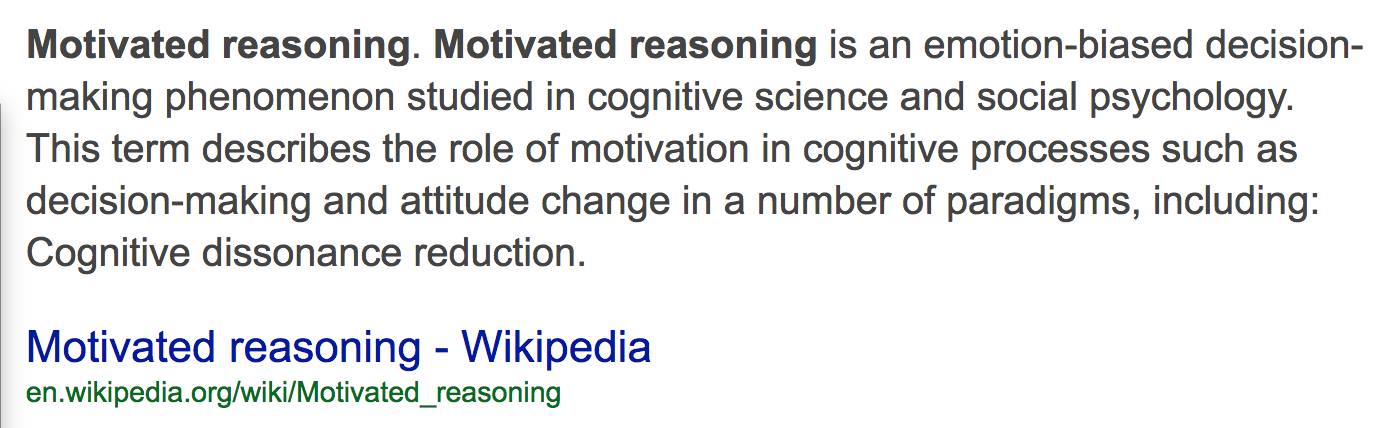
    photos_and_videos/your_posts/35922789_10156440940077264_1331565811675955200_o_10156440940067264.jpg MOTIVATED REASONING

    Young men are often weak, and will seek self medication in narratives.

    Aristocracy = Agency = Action (Dominance)

    -vs-

    Priesthood = Justification = Inaction (Submission)

    –Cognitive strategy–

    The processes of motivated reasoning are a type of inferred justification strategy which is used to mitigate cognitive dissonance. When people form and cling to false beliefs despite overwhelming evidence, the phenomenon is labeled “motivated reasoning”. In other words, “rather than search rationally for information that either confirms or disconfirms a particular belief, people actually seek out information that confirms what they already believe”.[2] This is “a form of implicit emotion regulation in which the brain converges on judgments that minimize negative and maximize positive affect states associated with threat to or attainment of motives”.[3]

    –Mechanisms–

    Early research on the evaluation and integration of information supported a cognitive approach consistent with Bayesian probability, in which individuals weighted new information using rational calculations.[4] More recent theories endorse cognitive processes as partial explanations of motivated reasoning but have also introduced motivational[5] or affective processes[6] to further illuminate the mechanisms of the bias inherent in cases of motivated reasoning. To further complicate the issue, the first neuro-imaging study designed to test the neural circuitry of individuals engaged in motivated reasoning found that motivated reasoning “was not associated with neural activity in regions previously linked with cold reasoning tasks [Bayesian reasoning] and conscious (explicit) emotion regulation”.[3] This section focuses on two theories that elucidate the mechanisms involved in motivated reasoning. Both theories distinguish between mechanisms present when the individual is trying to reach an accurate conclusion, and those present when the individual has a directional goal.

    –Goal-oriented motivated reasoning–

    One review of the research develops the following theoretical model to explain the mechanism by which motivated reasoning results in bias.[7] The model is summarized as follows:

    Motivation to arrive at a desired conclusion provides a level of arousal, which acts as an initial trigger for the operation of cognitive processes. Historically, motivated reasoning theory identifies that directional goals enhance the accessibility of knowledge structures (memories, information, knowledge) that are consistent with desired conclusions. This theory endorses previous research on accessing information, but adds a procedural component in specifying that the motivation to achieve directional goals will also influence which rules (procedural structures such as inferential rules) and which beliefs are accessed to guide the search for information. In this model the beliefs and rule structures are instrumental in directing which information will be obtained to support the desired conclusion.

    In comparison, Milton Lodge and Charles Taber (2000) introduce an empirically supported model in which affect is intricately tied to cognition, and information processing is biased toward support for positions that the individual already holds.

    This model has three components:

    On-line processing in which when called on to make an evaluation, people instantly draw on stored information which is marked with affect;

    Affect is automatically activated along with the cognitive node to which it is tied;[8]

    A “heuristic mechanism” for evaluating new information triggers a reflection on “How do I feel?” about this topic. The result of this process results in a bias towards maintaining existing affect, even in the face of other, disconfirming information.

    This theory of motivated reasoning is fully developed and tested in Lodge and Taber’s The Rationalizing Voter (2013).[9] Interestingly, David Redlawsk (2002) found that the timing of when disconfirming information was introduced played a role in determining bias. When subjects encountered incongruity during an information search, the automatic assimilation and update process was interrupted. This results in one of two outcomes: subjects may enhance attitude strength in a desire to support existing affect (resulting in degradation in decision quality and potential bias) or, subjects may counter-argue existing beliefs in an attempt to integrate the new data.[10] This second outcome is consistent with the research on how processing occurs when one is tasked with accuracy goals.Paul FranklinKurt, and all of you (us – me) forgive my panic and erratic thought, which seems unthought of by anyone else probably only for being asleep, but this is… important?

    There is a dangerous inversion of black and white, in a popular old wives’ tale repeated by men, that if you take the ‘red pill’ things get worse for being real, as a result of your being honest, sincere? The truth -aggravatingly universal in this example – our (common) reality is both beautiful and fulfilling, not by virtue of any perversion, inversion, lens, distortion, divorce or separation, but straightforwardly.

    Things are there for the taking when you wake up. And I think reality has been switched, substituted, and become a property of the subjective interpretation of the thing instead of the exact same thing.

    The ‘sacrifice’ we are expected to make (heros), enjoining hardship, suffering, deprivation, and gaining brotherhood, appears only flattering to (male?) egos while selling them (us) a false ‘Zion’ (of austerity)?

    Heroes will be egged on by this popular culture to turn their bullets against themselves – though perhaps, in these circumstances you can’t miss?

    The main trick is to come as close to telling the whole ‘truth’ as we can, and omitting the least; or turning something’s completely upside down while pointing out how every detail is in its place, then turning the lights out… .

    Btw. Only the fates of others look black to me now. And did I tell you, it’s been a great pleasure (and that goes for the rest of you)! For which and much else I must thank Mea Culba! May I wish you (and all of us) the best!

    btw If I seem unfriendly it’s partly because Blue=cuddly disarmed fraternity … but you can take things too far.

    Cheers!Jun 20, 2018 7:19pmPaul FranklinI was surprised to see this, I’d only thought about posting it!Jun 20, 2018 10:05pmMOTIVATED REASONING

    Young men are often weak, and will seek self medication in narratives.

    Aristocracy = Agency = Action (Dominance)

    -vs-

    Priesthood = Justification = Inaction (Submission)

    –Cognitive strategy–

    The processes of motivated reasoning are a type of inferred justification strategy which is used to mitigate cognitive dissonance. When people form and cling to false beliefs despite overwhelming evidence, the phenomenon is labeled “motivated reasoning”. In other words, “rather than search rationally for information that either confirms or disconfirms a particular belief, people actually seek out information that confirms what they already believe”.[2] This is “a form of implicit emotion regulation in which the brain converges on judgments that minimize negative and maximize positive affect states associated with threat to or attainment of motives”.[3]

    –Mechanisms–

    Early research on the evaluation and integration of information supported a cognitive approach consistent with Bayesian probability, in which individuals weighted new information using rational calculations.[4] More recent theories endorse cognitive processes as partial explanations of motivated reasoning but have also introduced motivational[5] or affective processes[6] to further illuminate the mechanisms of the bias inherent in cases of motivated reasoning. To further complicate the issue, the first neuro-imaging study designed to test the neural circuitry of individuals engaged in motivated reasoning found that motivated reasoning “was not associated with neural activity in regions previously linked with cold reasoning tasks [Bayesian reasoning] and conscious (explicit) emotion regulation”.[3] This section focuses on two theories that elucidate the mechanisms involved in motivated reasoning. Both theories distinguish between mechanisms present when the individual is trying to reach an accurate conclusion, and those present when the individual has a directional goal.

    –Goal-oriented motivated reasoning–

    One review of the research develops the following theoretical model to explain the mechanism by which motivated reasoning results in bias.[7] The model is summarized as follows:

    Motivation to arrive at a desired conclusion provides a level of arousal, which acts as an initial trigger for the operation of cognitive processes. Historically, motivated reasoning theory identifies that directional goals enhance the accessibility of knowledge structures (memories, information, knowledge) that are consistent with desired conclusions. This theory endorses previous research on accessing information, but adds a procedural component in specifying that the motivation to achieve directional goals will also influence which rules (procedural structures such as inferential rules) and which beliefs are accessed to guide the search for information. In this model the beliefs and rule structures are instrumental in directing which information will be obtained to support the desired conclusion.

    In comparison, Milton Lodge and Charles Taber (2000) introduce an empirically supported model in which affect is intricately tied to cognition, and information processing is biased toward support for positions that the individual already holds.

    This model has three components:

    On-line processing in which when called on to make an evaluation, people instantly draw on stored information which is marked with affect;

    Affect is automatically activated along with the cognitive node to which it is tied;[8]

    A “heuristic mechanism” for evaluating new information triggers a reflection on “How do I feel?” about this topic. The result of this process results in a bias towards maintaining existing affect, even in the face of other, disconfirming information.

    This theory of motivated reasoning is fully developed and tested in Lodge and Taber’s The Rationalizing Voter (2013).[9] Interestingly, David Redlawsk (2002) found that the timing of when disconfirming information was introduced played a role in determining bias. When subjects encountered incongruity during an information search, the automatic assimilation and update process was interrupted. This results in one of two outcomes: subjects may enhance attitude strength in a desire to support existing affect (resulting in degradation in decision quality and potential bias) or, subjects may counter-argue existing beliefs in an attempt to integrate the new data.[10] This second outcome is consistent with the research on how processing occurs when one is tasked with accuracy goals.

    Source date (UTC): 2018-06-20 18:43:00 UTC
  • photos_and_videos/TimelinePhotos_43196237263/35922789_10156440940077264_13315658

    photos_and_videos/TimelinePhotos_43196237263/35922789_10156440940077264_13315658

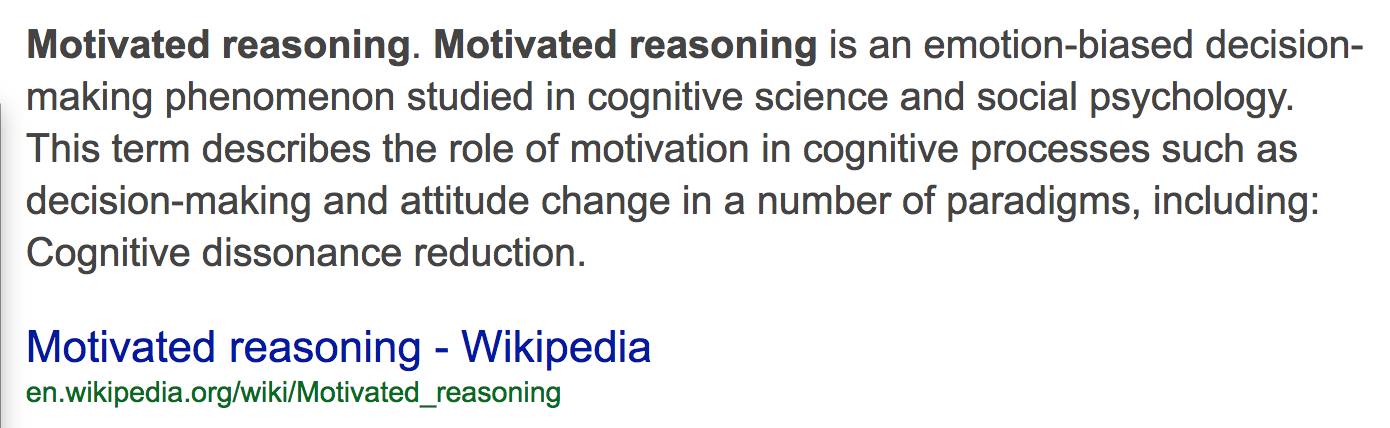
    photos_and_videos/TimelinePhotos_43196237263/35922789_10156440940077264_1331565811675955200_o_10156440940067264.jpg MOTIVATED REASONING

    Young men are often weak, and will seek self medication in narratives.

    Aristocracy = Agency = Action (Dominance)

    -vs-

    Priesthood = Justification = Inaction (Submission)

    –Cognitive strategy–

    The processes of motivated reasoning are a type of inferred justification strategy which is used to mitigate cognitive dissonance. When people form and cling to false beliefs despite overwhelming evidence, the phenomenon is labeled “motivated reasoning”. In other words, “rather than search rationally for information that either confirms or disconfirms a particular belief, people actually seek out information that confirms what they already believe”.[2] This is “a form of implicit emotion regulation in which the brain converges on judgments that minimize negative and maximize positive affect states associated with threat to or attainment of motives”.[3]

    –Mechanisms–

    Early research on the evaluation and integration of information supported a cognitive approach consistent with Bayesian probability, in which individuals weighted new information using rational calculations.[4] More recent theories endorse cognitive processes as partial explanations of motivated reasoning but have also introduced motivational[5] or affective processes[6] to further illuminate the mechanisms of the bias inherent in cases of motivated reasoning. To further complicate the issue, the first neuro-imaging study designed to test the neural circuitry of individuals engaged in motivated reasoning found that motivated reasoning “was not associated with neural activity in regions previously linked with cold reasoning tasks [Bayesian reasoning] and conscious (explicit) emotion regulation”.[3] This section focuses on two theories that elucidate the mechanisms involved in motivated reasoning. Both theories distinguish between mechanisms present when the individual is trying to reach an accurate conclusion, and those present when the individual has a directional goal.

    –Goal-oriented motivated reasoning–

    One review of the research develops the following theoretical model to explain the mechanism by which motivated reasoning results in bias.[7] The model is summarized as follows:

    Motivation to arrive at a desired conclusion provides a level of arousal, which acts as an initial trigger for the operation of cognitive processes. Historically, motivated reasoning theory identifies that directional goals enhance the accessibility of knowledge structures (memories, information, knowledge) that are consistent with desired conclusions. This theory endorses previous research on accessing information, but adds a procedural component in specifying that the motivation to achieve directional goals will also influence which rules (procedural structures such as inferential rules) and which beliefs are accessed to guide the search for information. In this model the beliefs and rule structures are instrumental in directing which information will be obtained to support the desired conclusion.

    In comparison, Milton Lodge and Charles Taber (2000) introduce an empirically supported model in which affect is intricately tied to cognition, and information processing is biased toward support for positions that the individual already holds.

    This model has three components:

    On-line processing in which when called on to make an evaluation, people instantly draw on stored information which is marked with affect;

    Affect is automatically activated along with the cognitive node to which it is tied;[8]

    A “heuristic mechanism” for evaluating new information triggers a reflection on “How do I feel?” about this topic. The result of this process results in a bias towards maintaining existing affect, even in the face of other, disconfirming information.

    This theory of motivated reasoning is fully developed and tested in Lodge and Taber’s The Rationalizing Voter (2013).[9] Interestingly, David Redlawsk (2002) found that the timing of when disconfirming information was introduced played a role in determining bias. When subjects encountered incongruity during an information search, the automatic assimilation and update process was interrupted. This results in one of two outcomes: subjects may enhance attitude strength in a desire to support existing affect (resulting in degradation in decision quality and potential bias) or, subjects may counter-argue existing beliefs in an attempt to integrate the new data.[10] This second outcome is consistent with the research on how processing occurs when one is tasked with accuracy goals.Paul FranklinKurt, and all of you (us – me) forgive my panic and erratic thought, which seems unthought of by anyone else probably only for being asleep, but this is… important?

    There is a dangerous inversion of black and white, in a popular old wives’ tale repeated by men, that if you take the ‘red pill’ things get worse for being real, as a result of your being honest, sincere? The truth -aggravatingly universal in this example – our (common) reality is both beautiful and fulfilling, not by virtue of any perversion, inversion, lens, distortion, divorce or separation, but straightforwardly.

    Things are there for the taking when you wake up. And I think reality has been switched, substituted, and become a property of the subjective interpretation of the thing instead of the exact same thing.

    The ‘sacrifice’ we are expected to make (heros), enjoining hardship, suffering, deprivation, and gaining brotherhood, appears only flattering to (male?) egos while selling them (us) a false ‘Zion’ (of austerity)?

    Heroes will be egged on by this popular culture to turn their bullets against themselves – though perhaps, in these circumstances you can’t miss?

    The main trick is to come as close to telling the whole ‘truth’ as we can, and omitting the least; or turning something’s completely upside down while pointing out how every detail is in its place, then turning the lights out… .

    Btw. Only the fates of others look black to me now. And did I tell you, it’s been a great pleasure (and that goes for the rest of you)! For which and much else I must thank Mea Culba! May I wish you (and all of us) the best!

    btw If I seem unfriendly it’s partly because Blue=cuddly disarmed fraternity … but you can take things too far.

    Cheers!Jun 20, 2018 7:19pmPaul FranklinI was surprised to see this, I’d only thought about posting it!Jun 20, 2018 10:05pmMOTIVATED REASONING

    Young men are often weak, and will seek self medication in narratives.

    Aristocracy = Agency = Action (Dominance)

    -vs-

    Priesthood = Justification = Inaction (Submission)

    –Cognitive strategy–

    The processes of motivated reasoning are a type of inferred justification strategy which is used to mitigate cognitive dissonance. When people form and cling to false beliefs despite overwhelming evidence, the phenomenon is labeled “motivated reasoning”. In other words, “rather than search rationally for information that either confirms or disconfirms a particular belief, people actually seek out information that confirms what they already believe”.[2] This is “a form of implicit emotion regulation in which the brain converges on judgments that minimize negative and maximize positive affect states associated with threat to or attainment of motives”.[3]

    –Mechanisms–

    Early research on the evaluation and integration of information supported a cognitive approach consistent with Bayesian probability, in which individuals weighted new information using rational calculations.[4] More recent theories endorse cognitive processes as partial explanations of motivated reasoning but have also introduced motivational[5] or affective processes[6] to further illuminate the mechanisms of the bias inherent in cases of motivated reasoning. To further complicate the issue, the first neuro-imaging study designed to test the neural circuitry of individuals engaged in motivated reasoning found that motivated reasoning “was not associated with neural activity in regions previously linked with cold reasoning tasks [Bayesian reasoning] and conscious (explicit) emotion regulation”.[3] This section focuses on two theories that elucidate the mechanisms involved in motivated reasoning. Both theories distinguish between mechanisms present when the individual is trying to reach an accurate conclusion, and those present when the individual has a directional goal.

    –Goal-oriented motivated reasoning–

    One review of the research develops the following theoretical model to explain the mechanism by which motivated reasoning results in bias.[7] The model is summarized as follows:

    Motivation to arrive at a desired conclusion provides a level of arousal, which acts as an initial trigger for the operation of cognitive processes. Historically, motivated reasoning theory identifies that directional goals enhance the accessibility of knowledge structures (memories, information, knowledge) that are consistent with desired conclusions. This theory endorses previous research on accessing information, but adds a procedural component in specifying that the motivation to achieve directional goals will also influence which rules (procedural structures such as inferential rules) and which beliefs are accessed to guide the search for information. In this model the beliefs and rule structures are instrumental in directing which information will be obtained to support the desired conclusion.

    In comparison, Milton Lodge and Charles Taber (2000) introduce an empirically supported model in which affect is intricately tied to cognition, and information processing is biased toward support for positions that the individual already holds.

    This model has three components:

    On-line processing in which when called on to make an evaluation, people instantly draw on stored information which is marked with affect;

    Affect is automatically activated along with the cognitive node to which it is tied;[8]

    A “heuristic mechanism” for evaluating new information triggers a reflection on “How do I feel?” about this topic. The result of this process results in a bias towards maintaining existing affect, even in the face of other, disconfirming information.

    This theory of motivated reasoning is fully developed and tested in Lodge and Taber’s The Rationalizing Voter (2013).[9] Interestingly, David Redlawsk (2002) found that the timing of when disconfirming information was introduced played a role in determining bias. When subjects encountered incongruity during an information search, the automatic assimilation and update process was interrupted. This results in one of two outcomes: subjects may enhance attitude strength in a desire to support existing affect (resulting in degradation in decision quality and potential bias) or, subjects may counter-argue existing beliefs in an attempt to integrate the new data.[10] This second outcome is consistent with the research on how processing occurs when one is tasked with accuracy goals.


    Source date (UTC): 2018-06-20 18:43:00 UTC

  • Answering a Presumptuous Critic

    (From Original Post: https://www.facebook.com/curt.doolittle/posts/10156430444672264) Lets get posturing out of the way first: I can judge from your argument and sentence structure I have somewhere in the vicinity of 15-30 IQ points on you (at a minimum), from your activity stream, far greater agency, have built multiple technology companies of scale, and am in the process of making a more than marginal contribution to human thought. That’s said, if we’re both done with appeals to achievement, let’s go through what non-argument you’re making and see if there is anything to it or not. Now onto discussion. 1. Original criticism makes two accusations: (a) pseudoscience, and (b) poor or lazy writing. The second (c) mentions something about scientific laws. As for (b), I don’t ‘dumb down’ my sentences in the postwar model. I’m perfectly happy with Jefferson, Lincoln, and Seneca’s prose. Writing for publication is different from sketching for followers. Dumbing it down is work I avoid. In fact, the higher on the Flesch Kincaid scale my writing lands, the more natural it is for me. (You clearly haven’t read Menger or Kant.) Although followers do say that experience with latin grammar is helpful. But yes, the accusation of laziness is correct. Although I consider it economically. It’s not worth my time to invest the extra effort. As for (a) Pseudoscience, well, I think we can address that with a little effort below. As for (c) “scientific laws”, I said “science and law” meaning that both the hard sciences and law require operational prose. This is logical because in large part, western civilization has always relied upon tort (empirical law) into prehistory, and our discourse, debate, law, reason, and science, all developed out of that prior influence. However, to put a sharper point on it. In the sequence: free association > hypothesis > theory > law > convention, each interstitial consists of a method of falsification. And whether a law consists of a mathematical expression of constant relations in deterministic (physical) or a verbal expression of constant relations in semi-deterministic (behavioral), is merely dependent upon the determinism of the discipline. Most economic laws can only be expressed symbolically because the categories change. Most physical laws can, in addition, be expressed mathematically for the simple reason that the categories do not change. “The universe can’t choose to outwit itself. Humans choose to outwit the universe and capture the difference in calories.” 2. Regarding: —“Also, no matter what language scientists write in, the rules of grammar of that language apply, as do the majority of the terms used therein.”— This statement depends on whether you use the definition of grammar of (a) the 19th and early 20th century (normatively) that was developed for mass education, or (b) the definition of grammar of the enlightenment prior to the revolutionary wars, and definition of grammar of the post-Turing (postwar) period (Operationally) (Chomsky). I use the latter: Universal Grammar > Generative Grammar > Rules of continuous, recursive disambiguation. Secondly, once one defines grammar “operationally” not “normatively”, as Continuous Recursive Disambiguation, one is forced to reorganize Semantics(dimensions of reference) as limited by grammar (rules of continuous disambiguation). Thirdly, once we do so, we discover that we have produced many, many ‘grammars’ (rules of continuous disambiguation, each limiting or expanding semantic dimensions), including Mathematical (positional), Logical (dimensional), Operational (actions), Procedural(programming), Contracts(property), Testimony(observability), Ordinary Language, Narrative, fictional, and the Fictionalisms. Fourth; once we account for the influence that the work of Popper Kuhn thru Kripke, and the work of Brouwer(physics), Bridgman(Math), Mises (economics), and the Operational, Operationalist, Intuitionistic, movements have had on the sciences, we see that the current language of at least the physical sciences is limited to Operational Grammar (and semantics). And that this difference in grammars separates the sciences (hard) from the pseudosciences (soft): psychology, sociology, literature, pseudo-history, theology, philosophy. Fifth, Operational grammar contains the most observable (empirical), least inflationary and conflationary (most deflationary) and most correspondent description (Testimony) that is possible – and therefore the most parsimonious in information EVEN IF FAR MORE PEDANTIC IN PROSE. Although we can, at some point, reduce SOME phenomenon to mathematical descriptions (constant relations) as long as the relations (categories, relations and values) are constant (physical world). Even if we cannot always do so because the relations are inconstant (economics, sentience). Although we have discovered that all economic phenomenon produce some set of symmetries (lie groups etc) which show that even in economics the hierarchy of the physical word (subatomic, atomic, chemical, biochemical, biological, ecological) also applies to a lesser degree to the discretionary (less deterministic) phenomenon that includes human memory, forecasting, and choice. CLOSING As far as I know I have no peers in these matters. As far as I know you have just stumbled onto one of my sketches, made for my followers, and either presumed you understood, or counter-signaled against prose you couldn’t understand. I don’t know. I just know it is in the nature of men to police the commons and you think that is what you are doing. Well done. But with this ‘crime’ brought before the judge so to speak, you merely err in your accusation. -Cheers

  • Abrahamism Is a Grammar of Devolutionary Deceit

    The Revolt Against The Invention of Truth Duty Aristocracy Meritocracy And Eugenic Evolution. Abrahamism = …. Pilpul(positiva) + Critique(negativa) = (undermining, loading, framing, overloading, suggestion, obscurantism, propagandism, fictionalisms) = ….. …. Gossip (undermining) = …. …. …. Female Group Strategy of Undermining Alphas = …. …. …. …. Female reproductive strategy of advancing her high-investment offspring regardless of merit = …. …. …. …. …. Dysgenic Parasitism.

  • Abrahamism Is a Grammar of Devolutionary Deceit

    The Revolt Against The Invention of Truth Duty Aristocracy Meritocracy And Eugenic Evolution. Abrahamism = …. Pilpul(positiva) + Critique(negativa) = (undermining, loading, framing, overloading, suggestion, obscurantism, propagandism, fictionalisms) = ….. …. Gossip (undermining) = …. …. …. Female Group Strategy of Undermining Alphas = …. …. …. …. Female reproductive strategy of advancing her high-investment offspring regardless of merit = …. …. …. …. …. Dysgenic Parasitism.

  • THE TRUTH IS FOR OURSELVES – NOT YOU. We don’t use the Truth to convince you. Yo

    THE TRUTH IS FOR OURSELVES – NOT YOU.

    We don’t use the Truth to convince you. You are immoral, dishonest, dysgenic and lack the agency to use the Truth. We use the Truth to convince ourselves, who are moral, honest, eugenic, and possess of agency, that it is right, just and moral, to separate from you – and if not, then conquer, kill, enslave, en-serf, and subjugate you in self defense – not only of ourselves, but of all we have made, and the future of mankind yet unmade.


    Source date (UTC): 2018-06-19 11:15:00 UTC

  • ABRAHAMISM IS A GRAMMAR OF DEVOLUTIONARY DECEIT The Revolt Against The Invention

    ABRAHAMISM IS A GRAMMAR OF DEVOLUTIONARY DECEIT

    The Revolt Against The Invention of Truth Duty Aristocracy Meritocracy And Eugenic Evolution.

    Abrahamism =

    …. Pilpul(positiva) + Critique(negativa) =

    (undermining, loading, framing, overloading, suggestion, obscurantism, propagandism, fictionalisms) =

    ….. …. Gossip (undermining) =

    …. …. …. Female Group Strategy of Undermining Alphas =

    …. …. …. …. Female reproductive strategy of advancing her high-investment offspring regardless of merit =

    …. …. …. …. …. Dysgenic Parasitism.


    Source date (UTC): 2018-06-19 09:39:00 UTC

  • The King of The Hill Method of Teaching Online

    —“…. largest problem is your obnoxious temperament 😉”— I bitch slap ignorance. yes. It’s so I can bait man-ginas. lol But listen….. You want my job? Do you have any idea how many overconfident, ignorant, sophomoric, posturing young single male ass-wipes there are on the internet? I have developed the “King of the Hill” strategy of discourse (teaching) because it is actually THE BEST method of teaching (masculine) men. I’ve been doing this since we used 300 baud dial up modems and 80 character monochrome screens. And I learned it early. Men can attack me and my ideas, without acting vulnerable, or submissive, or begging for attention, but by exercising their dominance. And they can fail and no one cares. This is actually the optimum method of reaching men: we create a dominance game of low risk. We learn from playing this dominance game. The secret is to reward dominance expression if it’s backed by insight, argument, or wit. And to stop on effeminate, abrahamic, and non-argument. I make serious arguments to teach. I make half arguments to encourage debate. And I push controversial ideas to encourage them to refute them. My role in this ‘game’ is to play king of the hill, and say ‘come get me’. I provide symbolic rewards (sharing quotes), and meaningful rewards (investing time in those with potential), and lifetime rewards (skill development). That is why this game works. Not everyone can play this game. But if they can play this game, and get good at it they will master a very special skill. And it’s that collection of talent I’m interested in creating. The internet does change. Men don’t change. The number of stupid men with access to digital discourse simply increases. The internet of such men requires street fighting, and I try to create a locker room for street fighters. In that locker room we play king of the hill. WE PUT DOMINANCE PLAY TO CONSTRUCTIVE USE. If you want beta-and-chick-friendly theatre watch TED videos. It’s a cult of pseudoscience. I teach argument.. I teach men. (And the occasional woman with character, intellectual honesty, and brains.) You might not realize I know this is a game, and that we are playing a game until you meet me in person or talk to me in an interview – because I’m not very much like my online persona. This is educational entertainment and theatre. 😉

  • The King of The Hill Method of Teaching Online

    —“…. largest problem is your obnoxious temperament 😉”— I bitch slap ignorance. yes. It’s so I can bait man-ginas. lol But listen….. You want my job? Do you have any idea how many overconfident, ignorant, sophomoric, posturing young single male ass-wipes there are on the internet? I have developed the “King of the Hill” strategy of discourse (teaching) because it is actually THE BEST method of teaching (masculine) men. I’ve been doing this since we used 300 baud dial up modems and 80 character monochrome screens. And I learned it early. Men can attack me and my ideas, without acting vulnerable, or submissive, or begging for attention, but by exercising their dominance. And they can fail and no one cares. This is actually the optimum method of reaching men: we create a dominance game of low risk. We learn from playing this dominance game. The secret is to reward dominance expression if it’s backed by insight, argument, or wit. And to stop on effeminate, abrahamic, and non-argument. I make serious arguments to teach. I make half arguments to encourage debate. And I push controversial ideas to encourage them to refute them. My role in this ‘game’ is to play king of the hill, and say ‘come get me’. I provide symbolic rewards (sharing quotes), and meaningful rewards (investing time in those with potential), and lifetime rewards (skill development). That is why this game works. Not everyone can play this game. But if they can play this game, and get good at it they will master a very special skill. And it’s that collection of talent I’m interested in creating. The internet does change. Men don’t change. The number of stupid men with access to digital discourse simply increases. The internet of such men requires street fighting, and I try to create a locker room for street fighters. In that locker room we play king of the hill. WE PUT DOMINANCE PLAY TO CONSTRUCTIVE USE. If you want beta-and-chick-friendly theatre watch TED videos. It’s a cult of pseudoscience. I teach argument.. I teach men. (And the occasional woman with character, intellectual honesty, and brains.) You might not realize I know this is a game, and that we are playing a game until you meet me in person or talk to me in an interview – because I’m not very much like my online persona. This is educational entertainment and theatre. 😉