Theme: Cooperation

  • photos_and_videos/TimelinePhotos_dJ9jhts2Ng/40684683_289741528289411_69769092440

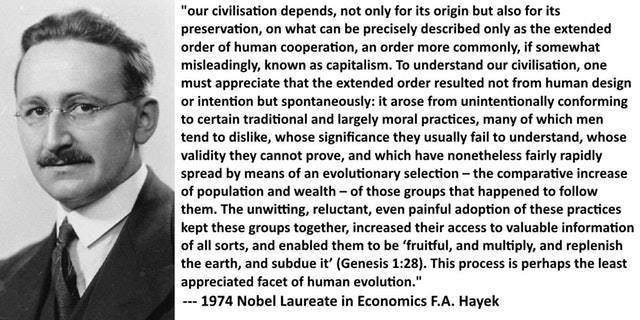
    photos_and_videos/TimelinePhotos_dJ9jhts2Ng/40684683_289741528289411_6976909244020817920_n_289741524956078.jpg HAYEK WASN’T QUITE RIGHT

    Hayek wasn’t quite right. Our civilization depends upon the rule of law by tort (natural law), the result of which CAN ONLY be ‘markets in everything’ – which he refers to as “Capitalism” by adopting the marxist criticism of financial cooperation at scale – but that I would call ‘Market-ism”: or the suppression of all involuntary parasitism and predation and forcing all peoples into the market in the service of others to survive. This zero-tolerance of non-market behavior is the result of the institutionalization of sovereignty and with sovereignty, of necessity, tort, and with tort and sovereignty we construct natural law and markets. So while, in the end, he did understand that it was Law that was the foundation of western civilization, he did not make the connection that it was law that LIMITED US to anything other than market cooperation.

    I call this use of tort law (natural law) “incremental suppression of free riding, parasitism, and predation”.HAYEK WASN’T QUITE RIGHT

    Hayek wasn’t quite right. Our civilization depends upon the rule of law by tort (natural law), the result of which CAN ONLY be ‘markets in everything’ – which he refers to as “Capitalism” by adopting the marxist criticism of financial cooperation at scale – but that I would call ‘Market-ism”: or the suppression of all involuntary parasitism and predation and forcing all peoples into the market in the service of others to survive. This zero-tolerance of non-market behavior is the result of the institutionalization of sovereignty and with sovereignty, of necessity, tort, and with tort and sovereignty we construct natural law and markets. So while, in the end, he did understand that it was Law that was the foundation of western civilization, he did not make the connection that it was law that LIMITED US to anything other than market cooperation.

    I call this use of tort law (natural law) “incremental suppression of free riding, parasitism, and predation”.

    Source date (UTC): 2018-09-02 11:45:00 UTC

  • The Best Governors Are the Middle Class

    The government you end up with is determined by what point on this scale your polity equilibrates. —Justin Allred  x-axis: high trust<->low trust y-axis: distributed political agency<->concentrated political agency Monarchy – Tyranny Aristocracy – Oligarchy Polity – Democracy


    —“Does Aristotle deem monarchy to be the best form of government?”— by Andy Mansfield, DPhil, former academic, teacher and author. Aristotle discussed the six forms of government, the correct form and its deviant counterpart: Monarchy – Tyranny Aristocracy – Oligarchy Polity – Democracy However, monarchy was not the best form. F. Miller provides the answer to your question in ‘Aristotle’s Political Theory’ taken from The Stanford Encyclopedia of Philosophy (2011): ‘Although his own political views were influenced by his teacher Plato, Aristotle is highly critical of the ideal constitution set forth in Plato’s Republic on the grounds that it overvalues political unity, it embraces a system of communism that is impractical and inimical to human nature, and it neglects the happiness of the individual citizens (Politics II.1–5). In contrast, in Aristotle’s “best constitution,” each and every citizen will possess moral virtue and the equipment to carry it out in practice, and thereby attain a life of excellence and complete happiness (see VII.13.1332a32–8). All of the citizens will hold political office and possess private property because “one should call the city-state happy not by looking at a part of it but at all the citizens.” (VII.9.1329a22–3). Moreover, there will be a common system of education for all the citizens, because they share the same end (Pol. VIII.1). If (as is the case with most existing city-states) the population lacks the capacities and resources for complete happiness, however, the lawgiver must be content with fashioning a suitable constitution (Politics IV.11). The second-best system typically takes the form of a polity (in which citizens possess an inferior, more common grade of virtue) or mixed constitution (combining features of democracy, oligarchy, and, where possible, aristocracy, so that no group of citizens is in a position to abuse its rights). Aristotle argues that for city-states that fall short of the ideal, the best constitution is one controlled by a numerous middle class which stands between the rich and the poor. For those who possess the goods of fortune in moderation find it “easiest to obey the rule of reason” (Politics IV.11.1295b4–6). They are accordingly less apt than the rich or poor to act unjustly toward their fellow citizens. A constitution based on the middle class is the mean between the extremes of oligarchy (rule by the rich) and democracy (rule by the poor). “That the middle [constitution] is best is evident, for it is the freest from faction: where the middle class is numerous, there least occur factions and divisions among citizens” (IV.11.1296a7–9). The middle constitution is therefore both more stable and more just than oligarchy and democracy.’ SUMMARY Matt Stewart, B.A. Literature, History, and Philosophy No- the best government was the one best suited to the people and culture that are to be governed and which allows its citizens to flourish. Aristotle understood that different nations with different values function differently; whatever system of government allows a particular nation to function correctly and flourish is the best form of government for that particular nation. The Persians flourished under a monarchy, and the Athenians flourished as a democracy. The two states had very different forms of government, yet each flourished in its own way. A properly functioning government is one which incorporates and reflects the values and interests of its people. That is the long and short of Aristotle’s view on government.

  • ON MANNERBUND I agree with the ‘sentiment’ of the Mannerbund narrative, but I ex

    ON MANNERBUND

    I agree with the ‘sentiment’ of the Mannerbund narrative, but I express it as ‘it all begins with the militia’, and the militia functions on the brotherhood of warriors. I… https://www.facebook.com/permalink.php?story_fbid=289130305017200&id=100017606988153


    Source date (UTC): 2018-08-31 23:16:17 UTC

    Original post: https://twitter.com/i/web/status/1035667622082293761

  • ( I hate conflict. I hate gender conflict. I fk–ing hate race conflict. And mos

    ( I hate conflict. I hate gender conflict. I fk–ing hate race conflict. And most of all I hate religious conflict. Competition, particularly signal competition creates conflict. the only solutions are nation states or regression to the bottom. empires are self destructive. They give opportunity to the worst of everything. )

  • ( I hate conflict. I hate gender conflict. I fk–ing hate race conflict. And mos

    ( I hate conflict. I hate gender conflict. I fk–ing hate race conflict. And most of all I hate religious conflict. Competition, particularly signal competition creates conflict. the only solutions are nation states or regression to the bottom. empires are self destructive. They give opportunity to the worst of everything. )

  • As I said elsewhere, the market for leadership will supply leaders. We must lead

    As I said elsewhere, the market for leadership will supply leaders. We must lead one another to sufficient numbers that leadership in that market can emerge.

  • As I said elsewhere, the market for leadership will supply leaders. We must lead

    As I said elsewhere, the market for leadership will supply leaders. We must lead one another to sufficient numbers that leadership in that market can emerge.

  • On Mannerbund

    I agree with the ‘sentiment’ of the Mannerbund narrative, but I express it as ‘it all begins with the militia’, and the militia functions on the brotherhood of warriors. I disagree with the Social Matters / Mannerbund in that the fact that our civilization begins there, does not mean it is SUFFICIENT to defeat enemies, or that much can be made of that ‘feeling’ alone. What binds people are incentive to bind with one another. Many of you are seeking the sense of safety and power in the pack and the restoration of our institutions of brotherhood throughout society due to the intentional destruction of them by the deconstructionists in marxism, femininsm, postmodernism, who exploit a ready willingness in our female population to defect by sh-t testing us. But you are making the mistake of an intuitionistic bias that is VERY RARE, instead of providing MAJOR incentives (military, political, economic, personal wealth, agency, status, and a plan to get there you are searching in the dark for emotional support, rallying without resources to do so. Those institutions of brotherhood are the last good we will achieve, not the first. They are a premium achieved for having worked to obtain military, political, economic, wealth, status benefits. Men will REPORT affiliation for sentiments. Men will DEMONSTRATE conviction for material rewards. The feeling of safety of the pack comes only from the shared experience of working as a pack to produce an outcome which provides an alternative to the present, yet promises only chaos because of an ABSENCE OF VISION. I do not operate from your perspective but work backward to achieve that emotion through demonstrated action together by the use of incentives to achieve material success. The answer to our problem is to provide an actionable plan the end result is mannerbund. That actionable plan is a means of altering the status quo such that POSSIBLE demands are met. One does not defeat a fortress by direct attack, but by starving it. One does not threaten potential allies but pays them off. One does not create incentives for defenders of the fortress by promises of suffering, but promising them returns. Once the fortress is won, the holdouts must be flayed and salted and hung from the walls for their crimes. All revolutions are suspect in prospect but deterministic in retrospect. It’s time to win.

  • On Mannerbund

    I agree with the ‘sentiment’ of the Mannerbund narrative, but I express it as ‘it all begins with the militia’, and the militia functions on the brotherhood of warriors. I disagree with the Social Matters / Mannerbund in that the fact that our civilization begins there, does not mean it is SUFFICIENT to defeat enemies, or that much can be made of that ‘feeling’ alone. What binds people are incentive to bind with one another. Many of you are seeking the sense of safety and power in the pack and the restoration of our institutions of brotherhood throughout society due to the intentional destruction of them by the deconstructionists in marxism, femininsm, postmodernism, who exploit a ready willingness in our female population to defect by sh-t testing us. But you are making the mistake of an intuitionistic bias that is VERY RARE, instead of providing MAJOR incentives (military, political, economic, personal wealth, agency, status, and a plan to get there you are searching in the dark for emotional support, rallying without resources to do so. Those institutions of brotherhood are the last good we will achieve, not the first. They are a premium achieved for having worked to obtain military, political, economic, wealth, status benefits. Men will REPORT affiliation for sentiments. Men will DEMONSTRATE conviction for material rewards. The feeling of safety of the pack comes only from the shared experience of working as a pack to produce an outcome which provides an alternative to the present, yet promises only chaos because of an ABSENCE OF VISION. I do not operate from your perspective but work backward to achieve that emotion through demonstrated action together by the use of incentives to achieve material success. The answer to our problem is to provide an actionable plan the end result is mannerbund. That actionable plan is a means of altering the status quo such that POSSIBLE demands are met. One does not defeat a fortress by direct attack, but by starving it. One does not threaten potential allies but pays them off. One does not create incentives for defenders of the fortress by promises of suffering, but promising them returns. Once the fortress is won, the holdouts must be flayed and salted and hung from the walls for their crimes. All revolutions are suspect in prospect but deterministic in retrospect. It’s time to win.

  • Collective Rituals Invoke the Pack Response

    If I teach you to stand at attention, put your hand over your heart, and speak the pledge of allegiance to our flag, or teach you to speak the lords prayer (a pledge of allegiance) while kneeling, hands clasped, and both actions, once habituated, fill us with ‘a sense of peace’ when performed as a group, what is the difference? The central issue is this: we need those collective rituals to invoke the pack response which generates intuitionistic trust among superpredators who do not necessarily trust one another, and who compete in all other walks of life OTHER than the ritual. Those oaths to a proxy of each other are useful to associate with that response.