Whence comes Property? The answer is a strong army and navy, a strong diplomatic corps, a strong currency free of debasement Trade rests on trade routes. Trade routes rest on the military. THe purpose of militarily established order is to create teh institution of property, and the market for trading it. It’s purpose iis to deny corruption of the market to others. The purpose of government is to determine which form of corruption wins. the puprpose of an ancient repubic, which means, property holders, is to disallow corrutpion of trade and trade routes. a republic of shareholders was the first and remains the only means of preserving trade. It is a private government.
Theme: Coercion
-
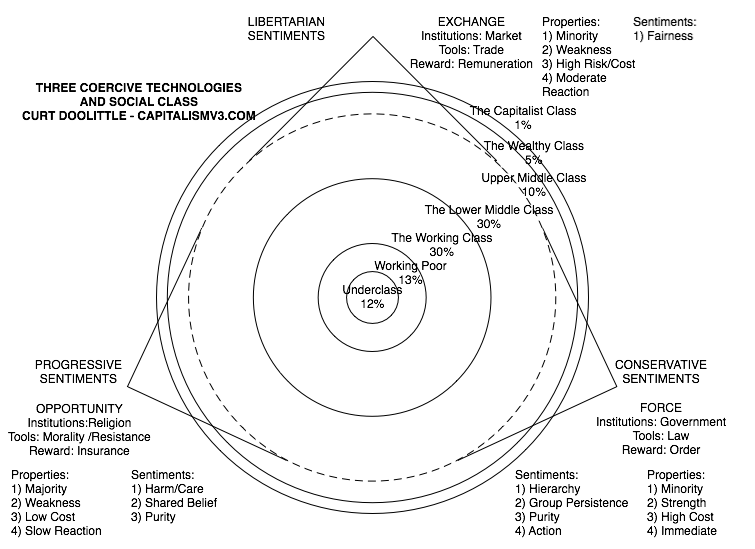
Rock, Paper, Scissors: Three Coercive Technologies, and Three Social Classes
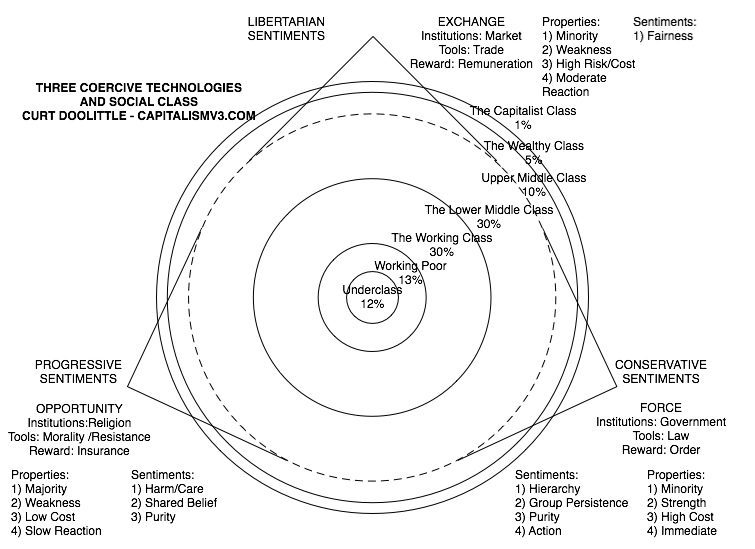
There are three means of coercing groups of people with institutions 1) Force, or the threat of force A person has a VIOLENCE INCENTIVE to behave in a particular way when it has been made known to him that failure to do so will result in some form of physical aggression being directed at him by other members of the collectivity in the form of inflicting pain or physical harm on him or his loved ones, depriving him of his freedom of movement, or perhaps confiscating or destroying his treasured possessions. 2) Remuneration or payment A person has a REMUNERATIVE INCENTIVE to behave in a particular way if it has been made known to him that doing so will result in some form of material reward he will not otherwise receive. If he behaves as desired, he will receive some specified amount of a valuable good or service (or money with which he can purchase whatever he wishes) in exchange. 3) Moral claims (collective goods) A person has a MORAL INCENTIVE to behave in a particular way when he has been taught to believe that it is the “right” or “proper” or “admirable” thing to do. If he behaves as others expect him to, he may expect the approval or even the admiration of the other members of the collectivity and enjoy an enhanced sense of acceptance or self-esteem. If he behaves improperly, he may expect verbal expressions of condemnation, scorn, ridicule or even ostracism from the collectivity, and he may experience unpleasant feelings of guilt, shame or self-condemnation. And a persuasive argument can consist of one or more of these strategies, often in great complexity. People give priority one or more different weighted combinations, or perhaps ‘chordic’ representations of these strategies. They do so out of habit, and class inclination, just as they follow religious and class sentiments due to their upbringing. People who belong to institutions have different capacities for adopting these strategies. Force requires discipline and long Time Bias. Remuneration requires cunning and invention. Moral claims require loyalty to consensus, and absorption of, and therefore payment of, opportunity costs. Different social classes have different time biases and consist of people with different time preferences, requiring different types of discipline under different social and economic conditions. ie: it is easier to have a long time preference if one is genetically disposed to better impulse control, and lives in greater security. It is easier to have a short time preference if one is more persuaded by impulses, less disciplined, and in an environment of scarcity. The social classes are organized by intelligence. Intelligence is the ability to absorb content in real time, to learn abstractions in time, and to permute those abstractions in application to problems in real time. Intelligence regresses toward the mean over generations. THerefore class membership is an indicator of the likelihood of class mobility, and upper class position is difficult to maintain. While we use the word ‘middle class’, and most people in the west live middle class lifestyles, the middle class means possessing disposable income and participating in the market. Therefore the majority of citizens are in the upper proletariat and lower middle classes, which we call the working, white collar working and craftsman classes. There are different costs to these institutions: Force is extremely expensive. Creating non-corruption, and order (some network of property definitions and their means of transfer). Property is a term for a scarce good that must used, consumed or transformed in the process of production, even if that process is human sustenance. Remunerative institutions require the complex task of concentrating capital then maintaining it in a constantly changing kaleidic and competitive environment. Moral claims require constant advocacy, verbal skill, maintenance of numerous relationships, and constant payment of opportunity costs. The Social classes have different access to each of these forms of coercion. Those in the institutional class, or upper class, have access to force in the form of policy and law. Those in the capitalist class, or middle, have access to capital : money, and market institutions. In each strategy people form elites, and organizations for utilizing those strategies. The elites create philosophical frameworks. Each of these frameworks consists of moral claims, and institutional means of perpetuating those claims, and the social benefits of adopting those claims. Each of these institutions is open to corruption, which is the privatization of opportunity and reward, for personal consumption at group expense. Corruption is fraud. Each of these strategies, their organizations, institutionas and elites compete against other strategies, organizations and elites, and each attempts to use it’s organization for discounts against other organizations. This competition is analogous to the game of Rock, Paper, Scissors, if more complicated: each group can sucessfully compete against one another under most circumstances, but can defeat and be defeated by some other combination of forces. The human mind is comfortable with identity and causality. It can with practice, understand a one dimensional causal spectrum. It can, with effort, understand two dimensions of cuasality. It can with more effort understand three dimensions of a causal spectrum. Human emotions for example, consist of probably no more than three stimuli: dominance, pleasure and activiation. And that all human emotions, in their seemingly infinite varieity can be described as using these three axis of stimuli. Likewise, human social behavior consists of three different forms of coercion, in some combination, and this leads set of axis leads to seemingly infinite variety. But it only seems infinite. At it’s base, there are only three forms of social organization.These three forms can be combined, as they are in the majority of the population in some manner or another. Or they can be used as one of three specializtions, each of which attempts to play rock, paper, scissors, with the other two.
-
Every philosophy is a little bit right and a whole lot wrong
The left is wrong on it’s face, because of the problems of incentives and economic calculation. The left is wrong on it’s perceptions: the pie isn’t fixed and people are not even closely equal in ability. The left is wrong on it’s sentiments: they are universalist and familial rather than group and political. They are wrong in their anti-sentiments: Care and Fair are only possible if first there is Order, and Group Persistence. The left is wrong on it’s logic: value is subjective, value is marginal, value is not determined by labor in, but by value out – and factor prices are determined by market prices of the end good. THe left is wrong on very purpose of society: it is a market first, and a society second. A society is it’s market and it’s market principles – everything else is an artifact of that market. THe left is wrong on diversity: people are demonstrably more charitable in the absence of diversity. The left is wrong in everything but it’s ambition – individual happiness in the absence of stress for the purpose of a happy family, rather than individual success for the purpose of group competition. The left is right that people at the bottom most likely have a claim on some amount of the profits of the market in which they participate, and that declining prices and increasing standard of living, and public services, and freedom from consumption taxes are to some degree justifiable.
[callout:More Right Than Wrong]Everyone is a little bit right.Everyone is a whole lot wrong. But libertarians are more right and less wrong than everyone else — assuming that is, that we seek prosperity, safety, health and choice for the maximum number of people at the minimum cost, at the lowest risk.[/callout]
But the right is wrong on rhetorical debate – the republican model breaks at scale – instead we would need economic democracy. It is wrong on monetary policy. The right is right on all of those things that the left is wrong on. Most importantly it’s right on group persistence, obligatory group identity. They are right on military dominance of the seas and trade, and the trade system, and of the expansion of a monetary empire. They are right on intolerance of extra-market orders. They are right on meritocratic rotation of the elites through market or military acts. The libertarians (the middle) are wrong on many of their principles. They are wrong on immigration. Immigration of an underclass that speaks a different language, and observes a different cult is demonstrably detrimental to a civilization. THey are wrong on free trade. They are wrong on intellectual property. They are wrong on the origins of society and market. They are wrong on forgone opportunity costs. They are wrong on equality – libertarianism is as beneficial to the intelligent, and totalitarianism is to the strong, and communism is to the weak. They are wrong on redistribution – precisely because they are wrong on the origin of markets. THey are wrong on empire and military. They are wrong on private courts. THey are wrong on private police. But the libertarians are right on monetary policy, on economic calculation and incentives, on rule of law, on small government, on privatization, on economic democracy. Everyone is a little bit right. Everyone is a whole lot wrong. But libertarians are more right and less wrong than everyone else — assuming that is, that we seek prosperity, safety, health and choice for the maximum number of people at the minimum cost, at the lowest risk.
-
Is There A War On Police?
There have been a large number of police deaths lately.
“It’s not a fluke,” Richard Roberts, a spokesman for the International Union of Police Associations, told MSNBC.com. “There’s a perception among officers in the field that there’s a war on cops going on.”
This is not rocket science, but it cannot be attributed to one thing alone. Instead:
It is not one issue on it’s own. It is the cumulative effect of the changes in american society due to a century and a half of policy. That policy was enacted during a period in which the USA had a strategic economic advantage. Because of that advantage, the class, race and cultural factors were suppressed by a period of extraordinary temporary wealth. But now that the circumstances have been reversed, and the consequential renormalization of human behavior has emerged as that economic advantage has been removed by the spread of capitalism’s economic institutions – particularly to Asia. The result is that the west is being destabilized again, just as it was when the american west opened up to development and caused shocks and price recessions in Europe. Add to that, that white folks are now starting to act like a diasporic minority, and less willing to support their system politically or fund it economically. In western literature, holding together a stable political system is an advantage. But it is also a high cost to the holders and comes at great sacrifice and discipline. The west (england and germany) has the most stable political system ever developed by man. But it comes at high cost. And people are no longer willing to pay that cost. Thorsten Veblen and Joseph Schumpater were correct. The political class will inevitably destroy the civilization under democracy.
-
Arresting Assange For What? Say Again?
OK. I just dont get arresting Assange for getting women to sleep with him, and not using a condom. We’d need an awful lot of additional jails. Either arrest the guy for the real reason that you want him, or you’re abusing the justice system. I’m not a fan of this guy, and I think public opinion will crowsdsource his guilt or innocence correctly. But this kind of legalism is simply abusive. I don’t let the state use my violence on my behalf for injustice. I give my violence to the state to use on my behalf in order to prevent and resolve disputes between my fellow citizens over theft, fraud and violence. I do not give my violence to the state to use on my behalf to trump up bad manners into illegal actions for the purpose of political nonsense. It’s just proving his position that our governments are corrupt. Arrest him for distributing state secrets (even if they are meaningless so far). Make an example of him if you want. But we’re going to have to legalize prostitution, universally license all women, and men are going to have to ask for receipts in order to have sex and prove it was voluntary. Ridiculous. Brits should be ashamed.
-
Tyler Re-Reads Road To Serfdom And Misses The Point
I don’t particularly like criticizing Tyler Cowen, but this is a bit ridiculous, and I”m going to have to chalk it up to excess holiday tryptophan. Last time I read Road To Serfdom was this fall, driving cross country. Actually, I listened to it on tape. And I cautiously pulled aside whenever I needed to take notes. I took ten pages of notes. But that’s OK. It helped with fatigue. Tyler recently re-read Road To Serfdom. Here are his comments.
Rereading *The Road to Serfdom* Given all the recent fuss, I picked it up again and found: 1. It was more boring and less analytic on matters of public choice than I had been expecting. 2. Although some of Hayek’s major predictions have been proven wrong, they are more defensible than I had been expecting. 3. The most important sentence in the book is “This book, written in my spare time from 1940 to 1943…” In those years, how many decent democracies were in the world? How clear was it that the Western powers, even if they won the war, would dismantle wartime economic planning? How many other peoples’ predictions from those years have panned out? At that time, Hayek’s worries were perfectly justified. 4. If current trends do turn out very badly, this is not the best guide for understanding exactly why. It’s fine to downgrade the book, relative to some of the claims made on its behalf, but the book doesn’t give us reason to downgrade Hayek.
Straw man. Self serving at that. No direct criticisms. Obtuse criticisms are illogical. a) The book contributed to the current state of affairs. b) The book was written for the masses, and that is why it has been widely read., and why it contributed to the current state of affairs. (more so than Braudel – although no discredit to him – and others.) c) The book’s criticism of central planning is not the same as the current criticism of the welfare state. And I do not understand, nor does it appear others here do, why you grant particular grace to current democracies – the merit of which is still in play, until we observe how we fare now that the rest of the world has adopted capitalist instituions, and erased our prior advantage. It certainly appears, that instead of Democracy, the award goes to capitalist institutions, calculation and incentives. Democracy is irrelevant. Other than, under democracy, it appears, it is far more common to vote one’s self into tyranny, than is possible under parliamentary monarchy, or oligarchy. I believe the three points above refute all four of your observations. In fact, I’m having trouble understanding why you even view it through your empirical framework. It is a narrative pedagogical work. And as a narrative pedagogical work it will very likely be as durable as most innovative narrative works are, versus the very perishable empirical works of political economy that are fashionable flashes of the moment. AFWIW: Whether one lives under tyranny or not is a matter of perspective determined by one’s definition of property. Cheers
-
Is There A Cartel Effect Under Minimum Wage?
From: SMALL TRUTHS ABOUT THE MINIMUM WAGE http://stumblingandmumbling.typepad.com/stumbling_and_mumbling/2010/11/small-truths-about-the-minimum-wage.html Something troubles me about this debate on the minimum wage. How do we know that employers in at least some sectors, artificially reduce wages by forming a wage-price cartel using state-sponsored price fixing of minimum wages? Wages are, aside from compensation, also a form of data, and employees can rate a company’s status or viability, or ‘greediness’ based on it’s wage rates. Fixing minimum wages distorts this information, and allows owners and managers to exhibit ‘bad behavior’ under the guise of minimum wage laws. Also, in many sectors, ‘labor’ in the sense of physical expenditure, is irrelevant, and other skills are not (literacy, attractiveness, manners). But those valuable skills are not paid for in the form of wages because all related businesses can claim minimum wage barriers, and if they compete at all, do so by trading entirely on environment rather than wages? Doesn’t this subsidize bad businesses? There are plenty of people who will work at certain companies simply in exchange for the environment (at a discount) rather than in sectors where the cartel effect drives down wages (less comfortable environments). In other words, they’re compensated partly with education, partly with environment, partly with lifestyle. Retail clerks, ie: jobs with comfortable social, clean environments that require unskilled, easy labor, seem vulnerable to low wages. But thats the discount the employee accepts for the ability to work in such an environment. Mexican “illegal” construction day labor on the west coast generally costs no less than $14 per hour. And if the buyer wants people who know concrete, it’s as much as $20. Waitresses in popular restaurants can, and often do, earn hundreds of dollars per day – often more than in their ‘day jobs’. Janitorial labor in office buildings costs well above minimum wage, even in our current economy. It appears that a cartel effect is in place, at least in the upper two quintiles. Has anyone studied that distortion? I don’t have a stake in this argument, it’s not my area of expertise, but I’m not entirely confident that the cartel-effect created by the minimum wage (at least in some sectors) is not driving down wages in at least some areas of the economy. And I don’t see any literature that grasps that much of the minimum wage economy is indeed the ‘on-the-job-training in exchange for rate discount’ ecosystem. Or ‘I’m husband shopping with this job”. Or “every other job is real work, and this makes my parents happy”. Or “I’m doing this job that’s easy while I”m in college.” All of these are not meaningful if considered on wages as compensation alone. What might be more interesting is experimenting with minimum wages in certain sectors in order to drive talent and ‘social status’ into them. I don’t think its important for us to subsidize retail and fast food clerks. It’s more important to drive more people back into skilled and semi-skilled labor. For example, (to be a bit crass) if we’re talking about single moms flipping burgers and waiting tables, or performing office work, (and we’re accepting the fact that we aren’t educating men and women on mate selection, and we’re saying that it’s acceptable for women to have children that they can’t support, and therefore that it’s acceptable for them to export their preference for childbearing, and poor choice of husband onto others) then why don’t we simply wage-match people with such problems rather than distort the entire pricing structure? I’m not advocating this but just wondering if there is any work in that field that isn’t riddled with the typical errors so endemic in quantitative probabilism (rather than evidence) preferred in the field. I’m sure there is quite a bit of data out there. I just am not sure that any paper that I’ve read on this topic relies on anything other than errors-of-aggregation, unsupportable probabilism, or questionable a priori logic, all of which run counter to observation. Again, this isn’t my field, but I don’t see the cartel-effect or these other issues addressed in the literature that I’ve spent time on.
-
Why Not Change Our Tax Structure To Punish Extra-Market Coercion?
Paul Krugman writes:
Soros, Obama, And Me What do we have in common? We’re all small business owners, according to Mitch McConnell. Obama and I make our business income off books — he sells the audacity of hope, Robin and I sell the misery of Econ 101; Soros makes his money off
financial destructiondirecting funds to their most productive use; but we’re all in the same category as the owner of a small factory.Small business people? Hardly. That writing provides a limited return is not a measure of its level of consumption by a large number of customers, but a measure of how little people are willing to pay for it. The term Mitch is looking for is not “entrepreneur” it is “[glossary:Schumpeterian Intellectuals]”: people who bring about the destruction of capitalism, the market, and the prosperity of national competitiveness by undermining both the sentiment of, and capital structure of entrepreneurship.
[callout]Then, perhaps some of us should put our capital stock of violence to better use, if in our restraint, we are disabused by men who simply take advantage of our creation – the market. It would be the optimum use of our asset.[/callout]
Unfortunately, we don’t have special taxes for Shumpeterian market destroyers like we have special taxes on entrepreneurial market creators. But we can fix that. Perhaps we should level the playing field by heavily taxing political, extra-market goods and services, and lowering taxes on apolitical intra-market goods and services? Wouldn’t that be a switch? I mean, why should the amount of income be the axis of measurement, rather than the service provided to the market? Under that measure we could confiscate all of Soros’ money, recover our losses from the bloated financial sector, and reduce the media to non-profit status, and make political writing an unprofitable exercise. As for putting capital to a better purpose, that’s not yet proven. Soros was not participating in the market for goods and services by creating unemployment and reorganizing that capital for his use. He’s just using remunerative coercion under state protections. And extra-market remunerative coercion at that. A form of coercion made possible only by the restraint of violence by others in order to create the somewhat free market – a restraint he does not himself employ. And while that asymmetry of restraint may not be apparent to your cult of those who are incapable of holding territory and trade routes, or building an durable government, or durable institutions of calculation and cooperation, it is not lost on those of us whose ancestors have done so for a millennia or more. It seems odd to me that so many people fail to grasp just how entertaining and enjoyable civil war is for those people who practice militial restraint – often at high personal [glossary:forgone opportunity cost]. Modern war is a ‘hell’ only for people who fight in the western model. It’s not for warriors, terrorists and raiders. We forget that the reason we cannot conquer the Afghans is in no small part because raiding and killing are actually enjoyable, entertaining, status-enhancing pass times among practitioners. And creating markets and property rights, and philosophy and econometrics, is a poor substitute. Then, perhaps some of us should put our capital stock of violence to better use, if in our restraint, we are disabused by men who simply take advantage of our creation – the market. It would be the optimum use of our asset. Or those who put their financial capital stock, or political capital stock to such extra-market or Schumpeterian Intellectual purposes, could pay the opportunity cost of restraint, so that we do not have put our stock of violence to extra-market uses. So that we can continue to devote our energies to the proxy of entrepreneurship instead of the more enjoyable and rewarding uses of our capital stock of violence. Why should we simply transfer our capital at a discount from a stock of market making violence to a stock of market destroying verbal and political coercive uses, or remunerative extra-market coercive uses. After all, violence is far more coercive. And much more rewarding. 🙂 Cheers See [glossary:three coercive technologies].
The depth of this insult is probalby accessible to only a few people. But I have to say this is one of my favorite little essays of late. – Curt
-
Anarchists and Elitism?
From The Liberty Defense League, an exceptionally intelligent posting on the weaknesses of anarchism.
Some libertarian friends call for anarchy to prevail. While such a state of affairs may be offering momentary delights, we need to remember that if we stand for nothing, we will fall for anything. Anarchy is government of nothing, and is only a transitional period between different states of order. Order always arises from chaos, and anarchy is often a tool of leftists. I am sure true libertarians are well meaning in upholding individuals’ self-rule in looking to a utopian anarchy, but I believe they are being used, even misled, to merely be creating conditions for another tyranny to prevail. The libertarian anarchists are correct in stating why the current Federal Union of Criminals Unlimited gives us ample reason to secede. But to what goals do we truly aspire?
(My comment posted from the site, copied below for recording purposes.) Exceptionally intelligent article. Thank you. A couple of insights for context.
[callout]The Anarchist movement, and the Rothbardian Libertarian Philosophy, are reactions to the failure of the conservative movement as well as the traditional classical liberal movement that is the jeffersonian model under which our nation has been founded, to provide an intellectual framework that can compete with the combination of marxist philosophy, socialist sentiments, and political tools that derive from the combination of Keynesian monetary philosophy with the rise of the dynamic stochastic equilibrium model. [/callout]
The Anarchist movement, and the Rothbardian Libertarian Philosophy, are reactions to the failure of the conservative movement as well as the traditional classical liberal movement that is the jeffersonian model under which our nation has been founded, to provide an intellectual framework that can compete with the combination of marxist philosophy, socialist sentiments, and political tools that derive from the combination of keynesian monetary philosophy with the rise of the dynamic stochastic equilibrium model. (I realize that this is a mouthful, but it is the correct analysis.) Mises, Hayek, Parsons, Popper, Rothbard, Nozick, fall failed despite great minds, to provide a solution to the semi-rational tools provided by the above listed models. The conservatives from Kirk onward produced sentimental historical references, but no rational philosophical framework. Especially that could compete with the heady religious scripture, rational philosophy, and volume of production of marxism and marxists. They failed because government consist of both the associations you refer to, as well as the institutions that limit the use of free associations to become governments themselves, and therefore have the ability to project their will by edict, rather than the ability to advocate their will upon the desirous. From this viewpoint, the anarchic research program, when approached as a program of research in limiting government (as largely done by Hoppe), has accomplished more than all other freedom-driven intellectual programs. But as a practical political movement it will fail. It wil fail for the reasons you have stated. However, it has contributed greatly to the philosophical debate. We just do not yet know how to change our institutions to make use of the libertarian anarchist framework of privatization in order to balance the use of monetary policy and redistributive sentiments, with freedom. Libertarians figured it out. Most of it. And we should thank them for it. The primary change in the nature of government was that western government ceased attempting to increase economic productivity after the great war, and instead, emphasized expansion and redistribution. And this treat to our freedom was started by the Louisiana Purchase and our fate sealed with the civil war. Liberty is for small homogenous states. And as Federalist 10 states, any time you have a government over people with dissimilar economic and cultural interests, it’s not a government, it’s an empire, and as an empire, it’s oppressive. – a member of the anarcho capitalist research program.
-
An Analysis Of Freedom #2: The Economy Of Freedom
A Little History For Context
The term ‘Freedom’, and its near relation ‘Liberty’, have a long heritage. The babylonian words “ama-gi”, meaning “Return To The Mother”, written in cuneiform, are often cited by Libertarians as the first written use of ‘freedom’. That usage literally refers to giving a slave back to his mother — an analogy to the more precisely stated ‘freeing him from slavery’ – owners gave a slave back to his mother when freeing him. In practice, the word “ama-gi” was used to grant exceptions from the dictator’s obligations or taxes. So the term meant freedom from obligations to the government. These special dispensations were used as a reward – freedom from requirements. The most simplistic use of Freedom described the opposite of slavery. It was not an abstraction, but a direct analogy to the deprivation of one’s choices under the threat of violence. Slavery to contemporary ears is a horrid system, but under barbarism it was universal. ( Barbarism refers to those people not members of one’s market system ) (( DEFINITION of “BARBARIAN”: Those persons who do not pay the set of costs of forgone opportunity, employed within a social order that cooperatively manages a market and territory. )) Most farm labor required a great deal of physical effort — hard work easily avoided with slaves. People often sold themselves into slavery simply because it was a reliable way to be fed and sheltered in a world where starvation and hunger were common. Wars and raids were conducted to obtain slaves – forced laborers. And escape was dangerous in that ancient world – without a tribe to take care of you, starvation was almost guaranteed. Later, ‘Freedom’ was the term used to describe a Free Man. A ‘Citizen’. A ‘non-barbarian’. This means quite literally, in a world consisting largely of either barbarians, competing warrior states, or eastern dictatorships, ‘an investor in the city and market’. As an investor, or rather It is hard for us to to imagine a world of barbarians. It is not so hard to imagine a world filled with conquerors. Today’s barbarians are immigrants who do not conform. And nation states that seek power in order to obtain resources and trade routes. Liberty by contrast, refers, not to constraint of, and control of, individual actions under threat of violence such as under the institution of slavery, but to the more general absence of coercion by a government, of those people who are not slaves, and not barbarians, and therefore citizens. In particular, in the west, it implies and egalitarian relationship between all those who are responsible for society: refraining from imposing conditions other than those one places on one’s self, or are required in order to maintain the property definitions (( DEFINITION of “PROPERTY DEFINITIONS”: A set of forgone opportunities that require one refrain from using objects of utility, or refrain from seizing or creating opportunities for gain – ie: self enforced self deprivations – usually described as property both individual and shareholder, manners, ethics, morals )) that constitute the social order. ((DEFINITION of “SOCIAL ORDER”: A social order is a collection of property definitions, and the required forgone opportunities required of members of the society in order to allow non-violent cooperation, and the establishment of a division of labor, and peaceful trade and exchange. And if a landed culture, also including the visible material contributions needed to maintain the physical viability of the territory, its built capital, its resources, and most importantly its market – without which escape from poverty is impossible. )) But in response to increases in the complexity of social order due to increases in population and the resulting increases in the division of knowledge and labor, both of the terms of “Freedom” and “Liberty” have been subject to political framing by public intellectuals and politicians, and their followers in the pragmatic public who use the extraordinary and uncommon freedom of speech ‘discount’ under democratic government to redefine these terms. This redefinition of the Social Order’s Property Definitions, and restatement of the material costs and the forgone opportunity costs of that system, has effectively constituted a legitimization of fraud, theft and redistribution. This restatement consequently led to a gradual usurpation of the social accounting system of opportunity costs, material costs, that make the market society possible. This distortion and confusion of meaning begs analysis, so that we, as members of a society under a democratic government, can tell the difference between those commonly held properties of freedom and liberty that are necessary and possible, from those that are either forms logically and physically impossible, from those that are intentionally obscure or distorted for the purpose of committing fraud and theft — or both. While frequent increases or decreases in redistribution of the PROFITS from the market are not only justifiable and beneficial, but warranted as a return on on the investment to shareholders (( DEFINITION of “SHAREHOLDER”: Synonym to “CITIZEN”: individuals who contribute forgone opportunity costs expressed as property definitions and thereby pay for the social order. )) (“Citizens”) as the division of knowledge and labor increases, the redefinition of the accounting system of property definitions, and forgone opportunity costs is simply a complex form of corruption, theft and fraud. Corruption theft and fraud made possible by the obscurity of the causal processes employed to create the Social Order, due to the fact that they are evolutionary in origin, unarticulated, expressed almost entirely as sentiments, and understood only as habits, superstitions, traditions, or exploitations, rather than as a system of precise and material accounting and costs, that materially effect economic calculation and human cooperation as the size of the population and the resultant division of knowledge and labor increases.
A Society Is Its Market : The Agrarian Society, Built Capital, Trade, And The Division Of Knowledge And Labor
(UNDONE)
The West And The Fraternal Order Of Market Making Soldiers
The Great Transformations: In Europe, Asia, The Middle East, and Africa Converting From Barbarism To City And Market – Europe Converting From Barbarism To Irrigating The Alluvial Plain – Middle East Converting From Barbarism By Combat – Asia Remaining in Barbarism – Sub Saharan Africa
The Behavioral Properties Of Freedom
The Desire For Freedom Versus Security.
Endless Want And Acquisitiveness, and The Role Of Imitation, Envy Status, And The Status Economy.
(UNDONE)
Property Is Defined Universally, But Shareholder Rights Are Open To Corruption
(UNDONE) The Oddity Of The Cognitive Bias In The Consensus And Equality Sentiments (UNDONE) Consensus Is Limited, On Means, and On Ends To Small Numbers Of People With Similar Objectives, Abilities, and Resources (UNDONE)
Freedom And The Status Economy
Almost Universally, Humans Don’t Like Status That Is Not Given as a reward for redistribution. All cultures, all humans, sense and express resentment at ‘excessive returns’ on any type of investment. Under heroic cultural systems, the hero is granted status and access to opportunity in exchange for his efforts on behalf of the group. As population increases, classes form because enough people exist in each class that they form group status hierarchies, and trade opportunities, and contribute to sustaining the group’s advantages. In effect, a class becomes an organization or bureaucracy whose members attempt to preserve it’s network of opportunities – it’s binding principles. At this point, exchange between classes must form some sort of trade network, and as this happens, classes, as organizations, compete against other classes for status.
The Freedom Seeking Minority Versus The Equality Seeking Majority
The Vast Majority of people to not want freedom, because freedom requires responsibility and risk. When people come to free societies, they either desire the standard of living, or access to opportunity. But they rarely, if ever, desire to contribute to the maintenence of the market order by forgoing opportunities, . In fact, they desire to gain the most using the least contribution. Likewise, (equality) So the contemporary use of the word freedom is the opposite of the contemporary use of the word equality
Property Is The Human Accounting System And Money And Numbers Increase Our Capacity for Perception, Comparison and Calculation Of Property
(UNDONE) The Economic Function Of Freedom In a division of labor, freedom increases consumption, decreases cost of maintaining the behavior of paying opportunity costs to create the market and contribute to property definitions, but most importantly, increases the process of trial and error – the process of entrepreneurship. Increases in trial and error lead to increases in the division of knowledge and labor, and increases in consumer choice, and decreases in prices.
The Limited Use Of Freedom As A Competitive Strategy Between Groups
If we define freedom as freedom from coercion, then there are only so many strategies that work for different groups with different abilities and resources. Total freedom, which means barbarism, Religion (resistance), Trade, and Force.
Freedom As Return On Investment In The Market, And The Market Is The Social Order
Freedom obtained in exchange for one’s return on one’s investment of forgone opportunities in the property definitions that constitute the local market. This contribution of forgone opportunity costs, is the cost of entry into the market, and the means by which one has access to the market. One can only be as free as the granularity of the property definitions. Profits are signals that convey rewards from the market participants that you have been rewarded for fulfilling their wants and desires. Redistribution is a form of return on the market, but only so long as (only so long as what?) Freedom is only relevant in a market society. Market societies are superior to alternative societies.
The Economy Of Freedom
We are all born free, so to speak, and able to use perception, memory, thought, action, force and violence to get whatever we want, if we choose to. Cooperation is not a necessity, at least for the strong. It is a compromise. It is a trade off. So lets look at the scope of actions human beings can take, and start from there, so that we can understand cooperation and freedom, and the compromises, costs and benefits that cooperation requires of us. Scope Of Individual Human Action If we eliminate the nearly infinite complexity that comes along with cooperation, we are left with only this scope of human actions.
-
- A.0) Thought
- A.1) Motion
- A.2) Consumption
- A.3) Transformation
- A.4) Violence
- A.5) Mating
The Five Freedoms
Given the possible scope of human actions listed above, there are only five possible non-contradictory freedoms available to human beings. Non-contradictory means that they can be granted to others equally without coercing them.
To grant these rights we only need to refrain from violence. In libertarian philosophy this is the principle of non-violence.
By refraining from violence we enforce cooperation. In other words, we coerce cooperation by depriving people of their natural ability to use violence. Furthermore, by depriving people of violence we make them more equal, by redistributing opportunities from the strong to the weak.
All other freedoms or rights, are derivatives of those five listed above. The remaining freedoms people commonly refer to are technologies of coercion for the purpose of cooperation, or of opposition for the purpose of competing with or avoiding the coercion.
To say that they are forms of coercion, is not to demean them. Many coercions are a proxy for violence. Property itself is a coercion.
We defend property. (talk about property and memory here)
there is a limit to cooperatino because of a limit to perception. Imagine for a moment that you could know the wants and desires of all people on the planet at once, and you could also know, all the resources that could be put to use by each person, all the skills that could be put to use by each person, all the tools available to each person, all the relationships that each person has, and the geography that each person has access to. Imagine trying to organize it all. Now, imagine that each person is trying to at least maintain his or her respect, or status. And that all these people are of different ages, and of differentI. Cooperative Organization – The Production Economy
Cooperative freedoms permit the division of knowledge and labor, which decrease everyone’s costs, or the concentration of effort to increase both the likelihood of success, and decrease the individual costs. Many people use subjective analysis, expressing these cost reductions as emotions. But our emotions exist to assist us in identifying cost reductions. Emotions describe changes in state. They inform us. They inform us in particular about changes in the state of our costs. Human aesthetics may be wounded by this fact, but all group emotional sensitivities are to costs and discounts.
- Coercion: Norms under threat of violence.
Opposition: Violence, Fraud, Theft, Coercion, Physical Restraint, Enslavement
Cost: Forgone Opportunity costs of Coercion, Fraud, Theft and Violence. The cost of not stealing.
Perception and Calculation: Property and prices allow us to percieve beyond our senses. To cooperate in large numbers. Property IS calculation.-
- Key Concept:
-
-
- P.1) Life, Movement and Action:
- P.2) Property (Exclusive Use. Inventory)
- P.3) Exchange (Trade)
- P.4) Freedom of Cooperation:
- P.5) Freedom Of Assertion
II. Cultural Organization: Manners, Ethics, Morals, Religion – The Conformity Economy (Inclusion / Ostracization)
Ethics: The Invisible Cost Economy Freedom to attempt to establish a network of norms: restraints on action enforced by inclusion or exclusion in the group. Inclusion in the group reduces risk and increases opportunity.
Manners, Ethics and Morals are terms for different segments of a spectrum for controlling costs of a group. Manners reduce friction and demonstrate predictability, class and quality. Display of good manners means access to more people who may grant one more opportunities. Each use of good manners requires some form of discipline. Each act of discipline is a cost to the individual, and a contribution to the cultural institutions. Each abuse of manners is a lack of discipline and a withdrawal from the cultural institutions. Manners must have a witness who can observe the demonstration of one’s discipline. In a demonstration of manners, there is no asymmetry of information. Each equally can observe the other.
Ethics on the other hand is a study in asymmetry. An action is ethical or not, because of shared lack of knowledge of the future, and asymmetry of knowledge between individuals. If one person has deep knowledge and the other shallow of the same exchange, ethical treatment requires that the person with greater knowledge act as if the other person is possessed of the same knowledge, and each is responsible for protecting the other from harm.
Ethical systems generally occupy some portion of a spectrum from the criminal to the charitable. a) The Criminal Ethic: I take what I can, without consent. a) The Bazaar Ethic: whatever I can get away with in voluntary exchange. b) The Warrior Ethic: whatever will not make the other or unhappy. c) The Christian Ethic: What is equally beneficial for both parties. d) The Charitable Ethic: As long as the other person prospers, I do not care what my outcome is. Then most ethical systems generally consist of intra-group and extra-group criteria, that might not be the same. Within and across family, clan, tribe, culture, religion, race, each culture varies in its adherence to its ethical standards. Furthermore,
Moral systems imply total asymmetry of knowledge. Actions fall under moral criteria whenever the cost of seizing an opportunity for one’s benefit either risks, or places an external cost, and a high cost, on others, and in particular, others with no recourse.
- Coercion:
Opposition:
Cost:
Perception and Calculation:- C.1) Cultural Freedom: (Choice and Opposition)
- C.2) Freedom of Norms (Competition and Choice) Participate in sets of norms, to select norms.
- C.3)
- Religion (Cultural Law And Institutionalized Conformity)
R.1) Religious Freedom: Freedom to create institutions, rituals, and codes for the purpose of establishing the criteria of inclusion and exclusion (ostracization). Including Freedom to choose to participate in religious factions, and freedom to evade participation in factions. Religions create opportunity monopolies and attempt to disallow competition of forgone opportunity costs. Competing religions are competitions of opportunities and opportunity costs. Evading participation is an attempt to obtain opportunities at a discount.
III. Regulatory Organization: Law(organized violence and coercion)
P.1) Political Freedom (Choice and Opposition): speech, assembly, leadership, concentration of wealth. (The right to cooperate against others who have a similar right) The right of opposition. Political freedom is the freedom to cooperate for GROUP ends, by pooling resources, and establishing an organization, or association for the purpose of advancing those ends.
- L.1) Legislative Freedom:
- L.2) Institutional Freedom:
- L.3) National freedom:
IIII. Credit Organization (Anonymous, Non-Territorial Law)
- CL.1)
VI. Capitalist Freedom
(organizatoins to concentrate real capital) (abstract property definitions)
V. Redistributive Organization
- R.1) Redistributive Freedom
-