I got a lot of heat for this so I pulled it and sat on it for a week. And this morning I’ve added some notes to it for clarity. And sorry if it pisses people off, but it’s right. It is what it is.
I got a lot of heat for this so I pulled it and sat on it for a week. And this morning I’ve added some notes to it for clarity. And sorry if it pisses people off, but it’s right. It is what it is.
I got a lot of heat for this so I pulled it and sat on it for a week. And this morning I’ve added some notes to it for clarity. And sorry if it pisses people off, but it’s right. It is what it is.
I want every people to compete for dominance.
I just want our people to never be defeated.
What are you, cowards? Women?
Source date (UTC): 2016-09-23 03:23:00 UTC
http://www.counter-currents.com/2016/09/the-caste-system-of-the-alt-right/I’M NOT INCLUDED IN THE LIST OF ALT RIGHT-ERS? I THINK THAT”S A GOOD THING. 🙂
( http://www.counter-currents.com/2016/09/the-caste-system-of-the-alt-right/ )
1) I don’t know whether to be thrilled or hurt by not being included in this list. 🙂 I think… I think maybe … that I like it. 🙂
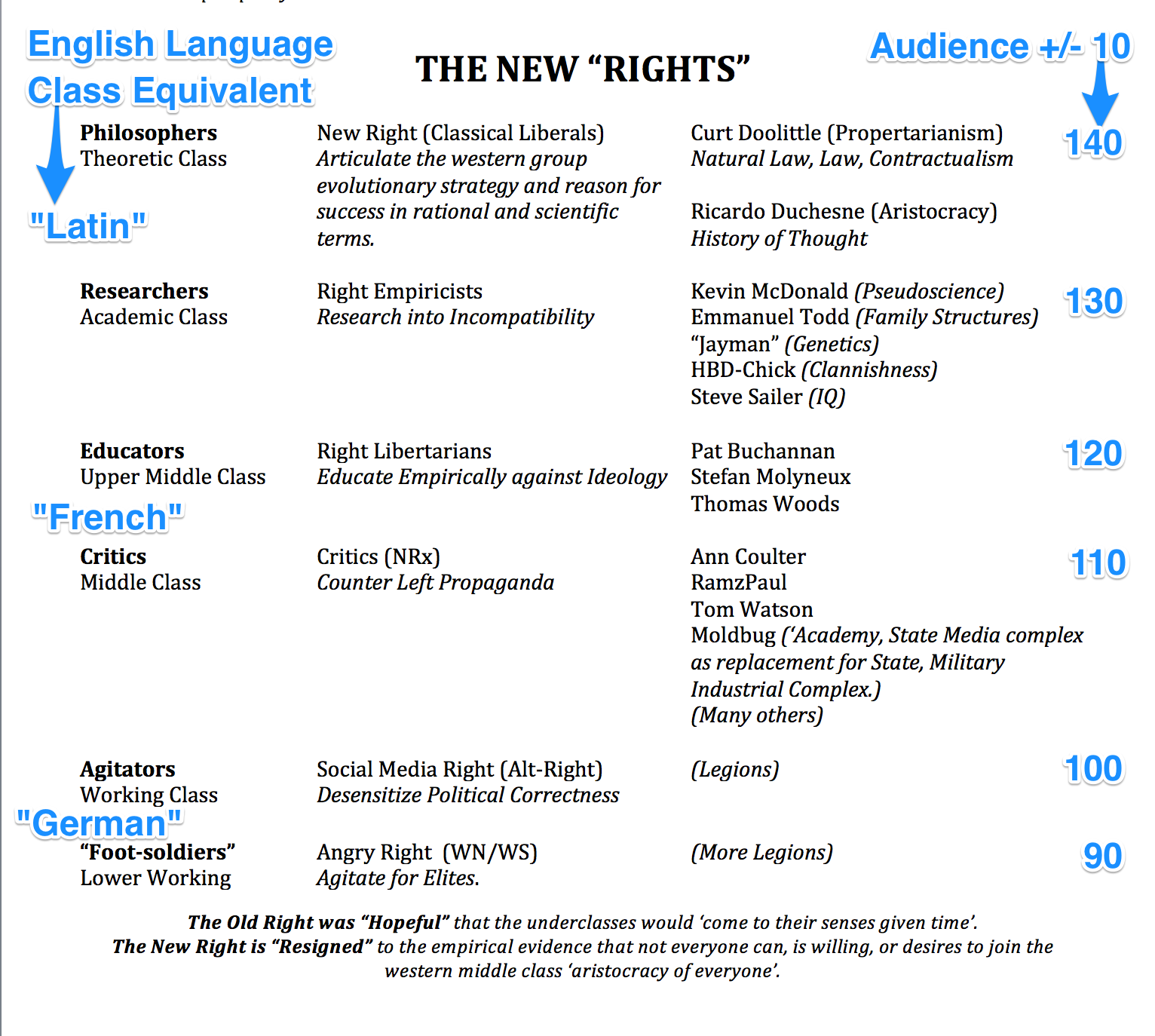
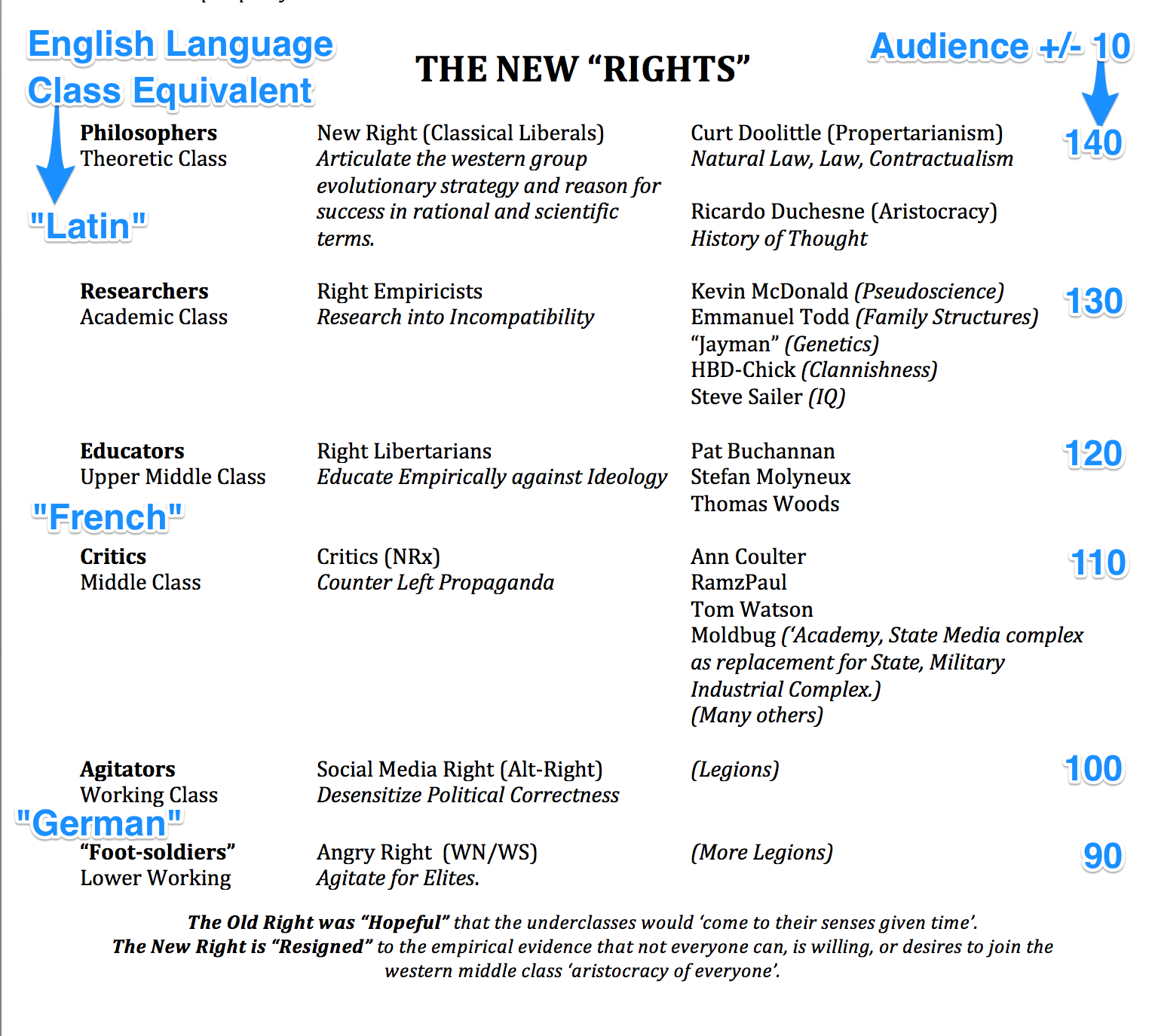
2) I wrote a similar list a few weeks ago. <a href=”https://propertarianism.wordpress.com/2016/09/23/the-new-right-class-structures/”>The New “Right” Class Structures</a> But I organized it by argumentative structure. Given our differences in abilities, we tend to argue differently at about every 10 points of IQ (with significant overlap). This division corresponds to both social and occupational classes as well as IQ. And I placed people in the alt-right given their method of argument. Which of course some people found insulting. But just as the English language contains three sets of terms: german for the lower class, french for the ruling class, and latin for the intellectual class, all political movements use a different language and argumentative method for every caste or class. (expressive, ridicule, moral justification, rational/historical justification, ratio-empirical-correspondence, and institutional. (And I consider myself in the NEW RIGHT rather than ALT RIGHT – for this reason: class argument method.) So view the world as the outgoing ‘hopeful’ old right(political). The resigned alt right(cultural). The traditional right in transition(religio-familial). The New Right (scientific-institutional).
3) And, I do understand why I am not included in this post’s list:
(a) I view the world as abandoning the 20th century battle between feminine universalism(socialism) and its paternal opponent masculine particularism(fascism), and that worldwide all groups are returning to Nationalism and Tribalism – in recognition of the failure of the anglo-contractual-commercial-universalism, and Jewish socialism-libertarian-neo-conservatism (ie: puritans and jews). And that we are just like everyone else – trying to reassert our traditional history now that the ‘market’ has been maximized by the universal adoption of consumer credit capitalism worldwide.
(b) I blame us (whites) for not manning the fortress Europa , not those who have succeeded in breaching our walls – it is after all, the purpose of competition, and we are losing because we are lazy and unwilling to fight.
(c) I spend my time worrying about institutional solutions, not trying to appease my bruised ego by ridiculing the wildlife for merely being wildlife. The scorpion DOES kill the frog before they get to the other side of the stream. Only a fool trusts the scorpion to act against its nature.
So:
i) Nationalism is for everyone, not just us. And anyone that it’s not for, is someone to be exterminated as a threat to the rest, not just us – to mankind.
ii) We must fight, and stop talking as if we will win a democratic election. Hillary is just the Left’s Dole: the next anointed apparatchik available in a weak field of options.
iii) We need a solution to fight for that restores our walls, and a process of transition, and a process of disrupting the economy and government such that surrender is obtained rather than ongoing hardship.
CLOSING
The alt-right is still a working-class and lower middle-class movement. because that’s where all the disenfranchised males are. And disenfranchised males are the only people who matter in creating a revolution. Unfortunately, the alt right has no answers to offer and is just a resistance movement.
But Resistance is insufficient for revolution. Rebellion is insufficient for Rule. Criticism is insufficient for proposing a solution. And a solution is necessary to coordinate action. Instead we must have a solution to demand, a plan of transition, and a plan by which to demand our solution.
The alt right is succeeding by adopting the methods of the Marxist/Socialist/Feminist/cultural-Marxists: poison the virtue signals of the opponents and make their status signals a worthless commodity. It’s working. And all we had to do was give up our ‘honor’ to do it. But once that’s done – “What’ch ya’ got there sonny?” Nothin’.
Necessary does not mean sufficient. The Alt right is necessary but insufficient. That’s where others come in. And that combination of ALT-RIGHT(Culture/aesthetics), TRAD-RIGHT(Ethics and Family), and NEW-RIGHT(institutions), will be what provides the full compliment of classes necessary to change the power structures.
But, in the end. “We gotta’ fight.”
Curt Doolittle
The Propertarian Institute
L’viv Ukraine
Source date (UTC): 2016-09-23 03:06:00 UTC
https://propertarianism.wordpress.com/2016/09/23/the-new-right-class-structures/THE NEW “RIGHTS” BY CLASS STRUCTURE
Source date (UTC): 2016-09-23 03:03:00 UTC
—“What is wrong with capitalism? Can it be solved by economic theories alone, or is it a leadership problem as well?”— Well, let’s take a ‘meaningful’ name: “capitalism”, and restated it operationally, using a ‘true’ name: What problems arise from the voluntary organization of production distribution and trade(capitalism) with individual distribution of property rights providing individual discretion using information provided by the pricing system, compared to the involuntary organization of production, distribution, and trade (socialism) with the discretionary distribution of property rights, in the absence of a pricing system, and compared to a mixed economy, where we use the voluntary organization of production, distribution, and trade, with the individual allocation of property rights, and with individual discretion provided by the pricing system, yet representative decision over the amount and use of the proceeds from the voluntary organization of production? And why has no one really succeded at producing a mixed property economy (other than the fascists), whereby the majority of consumption goods are produced by the voluntary market, and the commons are produced by the involuntary organization of production? In other words, we use armies for building defense, why don’t we use the industrial equivalent of armies to build and maintain infrastructure, and maintain the beauty, and civility of the commons. That’s a very long way of describing the problem, but it still obscures the next layer of complexity: discretion (decidability). The market provides superior decidability for those things that will benefit from competition. In many cases, competition for ideas(architecture and engineering) is beneficial but competition for labor is not (construction and maintenance). The answer is that we cannot choose pure capitalism because too many people are of too little value in many markets, because of immigration, asymmetric class reproduction, or simply overpopulation in relation to the trustworthiness of the people and their institutions. Likewise we cannot choose pure socialism, because there are too few incentives for people to engage in value-creating production, and too many incentives for people to engage in corruption. When we try a mixed appropriation economy (what we call a mixed economy today), we seem to produce rapidly decreasing birth rates in our productive people, and extraordinary rents in the public sector. We considered trying a mixed production economy, but the problem is the statists and rent seekers in the productive sector compete using the government to deprive the private sector. So the problem is not capitalism or socialism. The problem is demographic mix, the mixture of voluntary and involuntary organiztaion of production to suit the demographics and institutions available, and the elimination of discretion from the people in what we call government so that even if they exist they cannot (easily) engage in corruption. The problem is: 1) That we lack rule of law rather rule of legislation. Majority rule, representative democracy, is perhaps the worst government everyone ever produced. If we could vote to oust the entire government every 90 days, and rescind all acts of that government upon successful ouster, then that might be helpful. If we could sue government participants if they tried to construct or did construct immoral contracts, then that would be an a solutoin. And if we were still required to pay a progressive income tax, but we chould choose how it was allocated, right down to the paperclip, I think that would solve the problem. 2) But then we get to the answer: That we lack a market for the production of commons (like we had under english houses of parliament). We rely on assent (majority rule) creating opportunity for corruption, instead of relying on dissent (violation of natural, judge discovered, common law) to prevent immoral and illegal contracts for the production of commons. We could allocate funds evenly and let areas negotiate exchanges. And that would produce a moral and naturally legal market for the production of commons. 3) We rely on fiat money (which is an advantage) but we distribute liquidity and dividends through the financial system rather than directly to consumers. In other words, we cause consumers and businesses to fight for credit, rather than businesses and finance to fight for consumer spending. So as humans we tend to like to break ideas down into too simple a set of comparisons, becuase really, it’s hard to work with anything other than ideal types. Humans… well, we just aren’t that smart. (Try algebraic geometry, which in principle should’nt be too complicated, but our minds are just not often made for it.) Instead we must often thing in supply demand curves, becuase whether the thing we are discussing is persona, social, international, or physical concept, we deal with equilibrial forces. In this case we have a series of problems we must deal with: 1) demographic distributions: the differnce between races is largely one of sexual maturity and asymmetric sexual dimorphism producing differences in abilities. This is magnified by geography that cuases various selection pressures. As such poor places just were worse at killing off the lower classes and suppressing their reproduction, and the wealthier places better at upward redistribution of resources and constant culling of the underclasses through sanction (killing), war, starvation, and the difficulty of surviving in cold climates. 2) Information and incentives: the pricing system provides opportunity to FORM both information and incentives. 3) Discretion versus rule of law: Discretion and corruption versus rule of law and non-corruption. 4) The distribution of the organizaiton of production from authoritarian (originating in the fertile crescent and other flood plains) raider ethics (originating in steppe and desert), and libertarian (originating in the forest and sea peoples), and equalitarian, (preserved among hunter-gatherers). The solution is to solve all these problems with (a) rule of law (non discretion) (b) market production of commons limited by legal dissent. (c) extension of involuntary production for the construction and maintenance of commons, and reduction of the voluntary organization of production to those capable of surviving within it. (d) the restoration of the family as the central object of policy (e) the restoration of the process of intergenrational lending to preserve knowldge and calculability. (f) the direct and equal distribution of liquidity under fiat money (shares in the commons) to consumers in the case of the necessity to reorder the sustainable patterns of specialization and trade (the market) when it incurrs shocks or exhaustions (of opportunities). I could go on but I think you get the general idea. We got it wrong when we tried to steal the commons from the aristocracy by imposing majoritarianism, rather than constructing additional houses and continuing the tradition of using government as a market for the production of commons by negotiation between the classes. The middle class was nowhere near as good at governing as the aristocracy. Curt Doolittle The Propertarian Institute Kiev, Ukraine
—“What is wrong with capitalism? Can it be solved by economic theories alone, or is it a leadership problem as well?”— Well, let’s take a ‘meaningful’ name: “capitalism”, and restated it operationally, using a ‘true’ name: What problems arise from the voluntary organization of production distribution and trade(capitalism) with individual distribution of property rights providing individual discretion using information provided by the pricing system, compared to the involuntary organization of production, distribution, and trade (socialism) with the discretionary distribution of property rights, in the absence of a pricing system, and compared to a mixed economy, where we use the voluntary organization of production, distribution, and trade, with the individual allocation of property rights, and with individual discretion provided by the pricing system, yet representative decision over the amount and use of the proceeds from the voluntary organization of production? And why has no one really succeded at producing a mixed property economy (other than the fascists), whereby the majority of consumption goods are produced by the voluntary market, and the commons are produced by the involuntary organization of production? In other words, we use armies for building defense, why don’t we use the industrial equivalent of armies to build and maintain infrastructure, and maintain the beauty, and civility of the commons. That’s a very long way of describing the problem, but it still obscures the next layer of complexity: discretion (decidability). The market provides superior decidability for those things that will benefit from competition. In many cases, competition for ideas(architecture and engineering) is beneficial but competition for labor is not (construction and maintenance). The answer is that we cannot choose pure capitalism because too many people are of too little value in many markets, because of immigration, asymmetric class reproduction, or simply overpopulation in relation to the trustworthiness of the people and their institutions. Likewise we cannot choose pure socialism, because there are too few incentives for people to engage in value-creating production, and too many incentives for people to engage in corruption. When we try a mixed appropriation economy (what we call a mixed economy today), we seem to produce rapidly decreasing birth rates in our productive people, and extraordinary rents in the public sector. We considered trying a mixed production economy, but the problem is the statists and rent seekers in the productive sector compete using the government to deprive the private sector. So the problem is not capitalism or socialism. The problem is demographic mix, the mixture of voluntary and involuntary organiztaion of production to suit the demographics and institutions available, and the elimination of discretion from the people in what we call government so that even if they exist they cannot (easily) engage in corruption. The problem is: 1) That we lack rule of law rather rule of legislation. Majority rule, representative democracy, is perhaps the worst government everyone ever produced. If we could vote to oust the entire government every 90 days, and rescind all acts of that government upon successful ouster, then that might be helpful. If we could sue government participants if they tried to construct or did construct immoral contracts, then that would be an a solutoin. And if we were still required to pay a progressive income tax, but we chould choose how it was allocated, right down to the paperclip, I think that would solve the problem. 2) But then we get to the answer: That we lack a market for the production of commons (like we had under english houses of parliament). We rely on assent (majority rule) creating opportunity for corruption, instead of relying on dissent (violation of natural, judge discovered, common law) to prevent immoral and illegal contracts for the production of commons. We could allocate funds evenly and let areas negotiate exchanges. And that would produce a moral and naturally legal market for the production of commons. 3) We rely on fiat money (which is an advantage) but we distribute liquidity and dividends through the financial system rather than directly to consumers. In other words, we cause consumers and businesses to fight for credit, rather than businesses and finance to fight for consumer spending. So as humans we tend to like to break ideas down into too simple a set of comparisons, becuase really, it’s hard to work with anything other than ideal types. Humans… well, we just aren’t that smart. (Try algebraic geometry, which in principle should’nt be too complicated, but our minds are just not often made for it.) Instead we must often thing in supply demand curves, becuase whether the thing we are discussing is persona, social, international, or physical concept, we deal with equilibrial forces. In this case we have a series of problems we must deal with: 1) demographic distributions: the differnce between races is largely one of sexual maturity and asymmetric sexual dimorphism producing differences in abilities. This is magnified by geography that cuases various selection pressures. As such poor places just were worse at killing off the lower classes and suppressing their reproduction, and the wealthier places better at upward redistribution of resources and constant culling of the underclasses through sanction (killing), war, starvation, and the difficulty of surviving in cold climates. 2) Information and incentives: the pricing system provides opportunity to FORM both information and incentives. 3) Discretion versus rule of law: Discretion and corruption versus rule of law and non-corruption. 4) The distribution of the organizaiton of production from authoritarian (originating in the fertile crescent and other flood plains) raider ethics (originating in steppe and desert), and libertarian (originating in the forest and sea peoples), and equalitarian, (preserved among hunter-gatherers). The solution is to solve all these problems with (a) rule of law (non discretion) (b) market production of commons limited by legal dissent. (c) extension of involuntary production for the construction and maintenance of commons, and reduction of the voluntary organization of production to those capable of surviving within it. (d) the restoration of the family as the central object of policy (e) the restoration of the process of intergenrational lending to preserve knowldge and calculability. (f) the direct and equal distribution of liquidity under fiat money (shares in the commons) to consumers in the case of the necessity to reorder the sustainable patterns of specialization and trade (the market) when it incurrs shocks or exhaustions (of opportunities). I could go on but I think you get the general idea. We got it wrong when we tried to steal the commons from the aristocracy by imposing majoritarianism, rather than constructing additional houses and continuing the tradition of using government as a market for the production of commons by negotiation between the classes. The middle class was nowhere near as good at governing as the aristocracy. Curt Doolittle The Propertarian Institute Kiev, Ukraine
–What is the gentlest way to restrain underclass reproduction?– The gentlest way to restrain underclass reproduction is to be honest about it, transfer from services to direct redistribution, and to make redistribution contingent on single child reproduction, and offer free sterilization after the fist birth, and require sterilization of those with severe histories in the family (we have studies on this it’s pretty obvious stuff). And secondly to limit immigration to those with IQ’s 125 and above.
–What is the gentlest way to restrain underclass reproduction?– The gentlest way to restrain underclass reproduction is to be honest about it, transfer from services to direct redistribution, and to make redistribution contingent on single child reproduction, and offer free sterilization after the fist birth, and require sterilization of those with severe histories in the family (we have studies on this it’s pretty obvious stuff). And secondly to limit immigration to those with IQ’s 125 and above.
Aug 15, 2016 2:07pm—You wrote earlier about the differences in races being, in part, a difficulty for certain peoples to cull the lower classes. Would you be in favour of an organized plan of eugenics in order to correct this?— I advocate that we are not conducting a trade with the lower classes, and harming our civilization and mankind. They have nothing to trade in the market, and we do not permit or assist them in exit, yet we make the pay the high behavioral costs of observing private and public property rights. So I advocate we pay them rather than demand payment for nothing in return. I have no problem paying people for demonstrating normative behaviors, and perhaps participating in the maintenance of the commons. And restricting to one child and no immigration below graduate level education is sufficient within just a few generations to hollow out the lower classes. Especially if we literally pay educated women in above 106 to have children. Demographics produce deterministic results. We aren’t equal. And worse, the people at the bottom are ‘worse’ or all of us than the people at the top are ‘good’ for all of us. This is just true. Enough lies. We’ve not completely domesticated the planet. In fact, we’ve only domesticated a small piece of it, and we’re reducing that three-thousand year effort every day. But we will have to use direct violence, rather than indirect reproductive violence to negotiate that exchange. Curt Doolittle The Philosophy of Aristocracy The Propertarian Institute