Theme: Civilization

  • Graham Hancock

    Apr 10, 2020, 3:23 PM

    —“Curt, What do you think of Graham Hancock?”—

    If I’m sympathetic: I think he is honest about what he does. He makes up, or promotes, myths to inspire and entertain people – to restore wonder to their lives. yes some of what he harps about has a grain of truth in it. I’m charitable because it’s good for us to look back into the past with wonder, the same way we teach children fairy tales so that they will eventually mature into reading history. If I’m charitable, the world needs a few of these people so that we make sure wacky stuff doesn’t get overlooked, and the wrong story entrenched (geology in the past and mathematical physics in the present are the best examples). If I’m doing my job: he’s using pseudoarchaeology (pseudoscience) to get attention, and it’s been a profitable career for him. and given that his stuff is pretty hard to believe I suspect he’s helping us find suckers, catch them, and reeducate them before they do something harmful to themselves or others. Of all the kind of sucker-magnets in the world he’s the least harmful. If I want to correct him, and the audience, it is all but certain that Doggerland, isn’t alone, and the black sea the persian gulf, the red sea, the mediterranean, and the lost lakes and marshes of the south of africa, and various other coastal areas, now obscure much of our long, early, glacial and pre-glacial development with flooding. We may be living in a period of extraordinary technology, but the first five thousand years of chasing the glaciers back north, in doggerland, on the shorts of the black sea has to be about as close to paradise as hunter-gatherers can discover. That said, there is no evidence whatsoever of anything pre-glacial but animals, and nothing obscured by post glacial flooding that gave hints to what is necessary for the evolution of man: fire, metal, and pottery. Yes, people do lose technology (austronesians). Yes people do mature into depth rather than neoteny (equatorial africans). But in general, the long graudal line of history up until the 80-40k, and 40k-10k, and 10k incremental explosions, and the past 400 years of european explosion of knowledge, is so regular in retrospect it looks ordinary.
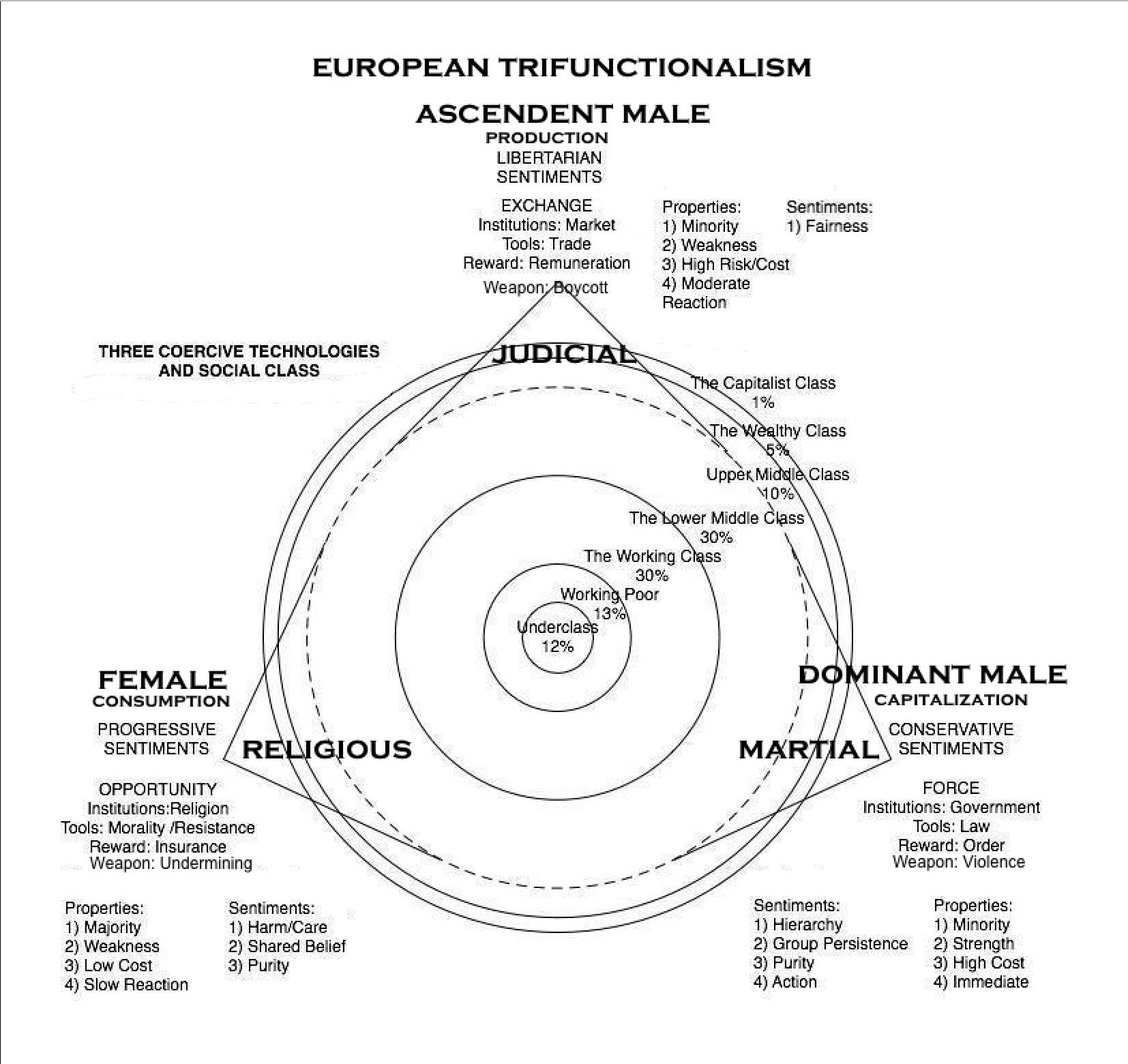

  • The Lesson of Comparative Civilizations

    Apr 15, 2020, 2:54 PM So, what is the lesson we learn from our study of history? That european peoples are able to evolve genetically, culturally, economically, technologically, faster than all other peoples because of our traditions of sovereignty, reciprocity, truth, duty, excellence, heroism, rule of law and jury, and markets in all aspects of life, where the market for suppression of parasitism we call the law, and the market for reciprocity in the production of goods, services, and information, evolve as rapidly as possible, thereby advancing productive innovations in each others interests, and suppression innovations in parasitism against others interests, in exchange for softly suppresses the rates of reproduction of the underclasses, thereby allowing us to divert proceeds of our production to the commons and the higher returns for all from those commons, the most important of which are truth before face, trust, economic and innovative velocity, and the prosperity, joy, and peace of mind that results from it.

  • The Lesson of Comparative Civilizations

    Apr 15, 2020, 2:54 PM So, what is the lesson we learn from our study of history? That european peoples are able to evolve genetically, culturally, economically, technologically, faster than all other peoples because of our traditions of sovereignty, reciprocity, truth, duty, excellence, heroism, rule of law and jury, and markets in all aspects of life, where the market for suppression of parasitism we call the law, and the market for reciprocity in the production of goods, services, and information, evolve as rapidly as possible, thereby advancing productive innovations in each others interests, and suppression innovations in parasitism against others interests, in exchange for softly suppresses the rates of reproduction of the underclasses, thereby allowing us to divert proceeds of our production to the commons and the higher returns for all from those commons, the most important of which are truth before face, trust, economic and innovative velocity, and the prosperity, joy, and peace of mind that results from it.

  • I remember when I was first struck by what was going wrong

    Apr 16, 2020, 7:42 PM I remember when I was first struck by what was going wrong. It was in the early 80’s. Long enough for the false promises of the sixties and seventies to become presumptions, long enough for people to intuit something wasn’t right, but not long enough for them to be falsified. … It’s early summer. A woman was pushing a stroller across the street on Farmington avenue. I don’t know why but I understood from her body language something wasn’t right. And then I started seeing it everywhere. That nagging feeling that we should be happy but we aren’t.

  • I remember when I was first struck by what was going wrong

    Apr 16, 2020, 7:42 PM I remember when I was first struck by what was going wrong. It was in the early 80’s. Long enough for the false promises of the sixties and seventies to become presumptions, long enough for people to intuit something wasn’t right, but not long enough for them to be falsified. … It’s early summer. A woman was pushing a stroller across the street on Farmington avenue. I don’t know why but I understood from her body language something wasn’t right. And then I started seeing it everywhere. That nagging feeling that we should be happy but we aren’t.

  • Apr 18, 2020, 6:25 PM —“I actually think Johannesburg represents the future. M

    Apr 18, 2020, 6:25 PM

    —“I actually think Johannesburg represents the future. My version of what I think the world is going to become looks like Johannesburg.”— Neil Blomkamp

    Exactly.

  • Apr 18, 2020, 6:25 PM —“I actually think Johannesburg represents the future. M

    Apr 18, 2020, 6:25 PM

    —“I actually think Johannesburg represents the future. My version of what I think the world is going to become looks like Johannesburg.”— Neil Blomkamp

    Exactly.

  • I’m a Practitioner of Cycles

    Apr 19, 2020, 8:17 AM

    —“Curt, What do you think of Peter Turchin’s Work”—

    Well I’m a practitioner, right? So I don’t know how to make a higher endorsement than that. Turchin, Kondratiev, Strauss and Howe, Caroll, Toynbee, Spenger, Durant … I mean, my model is a little lower level, meaning military, economic, and demographic, rather than statistical, so I tend to think in supply demand curves rather than statistical correlations, but I’m not just a follower but a practitioner.’

  • I’m a Practitioner of Cycles

    Apr 19, 2020, 8:17 AM

    —“Curt, What do you think of Peter Turchin’s Work”—

    Well I’m a practitioner, right? So I don’t know how to make a higher endorsement than that. Turchin, Kondratiev, Strauss and Howe, Caroll, Toynbee, Spenger, Durant … I mean, my model is a little lower level, meaning military, economic, and demographic, rather than statistical, so I tend to think in supply demand curves rather than statistical correlations, but I’m not just a follower but a practitioner.’