Source: Original Site Post

  • Conflict 5: The Rebirth of Man

    The Mesolithic – The First Dark Age

    (Human)
    Paleolithic >
    Mesolithic (“middle stone age”) (Europe 13,000 BC to 3,000 BC) 
    or Epipaleolithic (outside of europe) (18,000 BC to 6,000BC). 

    Generation Seven: Adapting to the Exhaustion of Megafauna, and a difficult time for humans.
    Status: Climate Crisis: Out of Africa > Dependence on the Sea > Nomadic Hunting Megafauna Herds  > Ice Age  Retreat > Semi Sedentary Small Game and Fishing, dependent on rivers > Domestication of animals and plants > rise of settlements (cities) > bronze revolution and rule > rise of trade, states, and empires.

    The Mesolithic refers to the final period of hunter-gatherer cultures in Europe and Western Asia, between the end of the Last Glacial Maximum and the Neolithic Revolution. The change in behavior occurred at different times in different regions, so the Mesolithic refers to different time spans in different parts of Eurasia, and the term is used less when referring to areas further east, and not at all beyond Eurasia and North Africa. China didn’t experience the same phase (decline), and similar time frames are considered Early Neolithic instead.

    Transitional from hunter gatherers to sedentary if only seasonal.
    Using many different resources (secondary food sources) 
    Increased use of boats and oars
    Gradual semi-sedantism 
    Homes
    Clearing of Forests
    Selective Burnings 
    Small Dams and Ponds
    Some Pottery 
    Traps, Nets
    Bows and Arrows
    Microliths mounted on a shaft to produce serrated edges.
    Burials remain the same, cremation, inhumation, and remain personal, coated with red ochre.
    Ranked society
    Evidence of violence 

    Our Mesolithic Stage 
     

    The Mesolithic Dark Age

    Overkill – the exhaustion of a food source – appears consistently on our journey through history, and the Mesolithic is one result.  Seventy-five percent of the larger animals (those of more than 40 kilograms live weight) that became extinct during the late Pleistocene did so by about 10,800 to 10,000 years ago. Whether the primary cause of this decimation was climatic or cultural is still debated, the pattern of history in eurasia and the americas, and in the modern age, in the absence of an extinction level event – other than humans, is hard to blame on other than humans – even if other hypotheses for the late Pleistocene extinctions, such as those involving climatic changes or disease outbreaks, have emerged. 

    Northern European Continuity: In northern Europe, the hunter gatherers were able to live well on rich food supplies from the marshlands created by the warmer climate, limiting their need to adapt to changes in food supplies – and as a consequence they delayed the coming of (need for) the Neolithic (farming) until 3,500 BC.  And the most interesting bit of evidence is the sophistication of their cooking recipes, which would make any contemporary chef proud.

    Elsewhere, the pressure to innovate: Necessity is the mother of invention, or rather, scarcity provides incentive to innovate, so while soutwest asia (levant, Mesopotamia) exhausted local hunting, and had to resort to additional food sources, europe – with lower population density, better climate, better terrain, better rivers – could maintain a primarily meat diet much longer.  The period saw such successful human predation of animals, and increase in population, that it caused a decline in the group-hunting of large animals in favour of a broader hunter-gatherer way of life, and the development of more sophisticated and typically smaller lithic tools and weapons than the heavy-chipped equivalents typical of the Paleolithic. Art declines.  The sites are now mostly cliff faces in the open air, and the subjects are now mostly human rather than animal, with large groups of small figures; there are 45 figures at Roca dels Moros. Clothing is shown, and scenes of dancing, fighting, hunting and food-gathering. The figures are much smaller than the animals of Paleolithic art, and depicted much more schematically, though often in energetic poses. The more permanent settlements tend to be close to the sea or inland waters offering a good supply of food. Mesolithic societies are not seen as very complex, and burials are fairly simple; in contrast, grandiose burial mounds are a mark of the Neolithic.
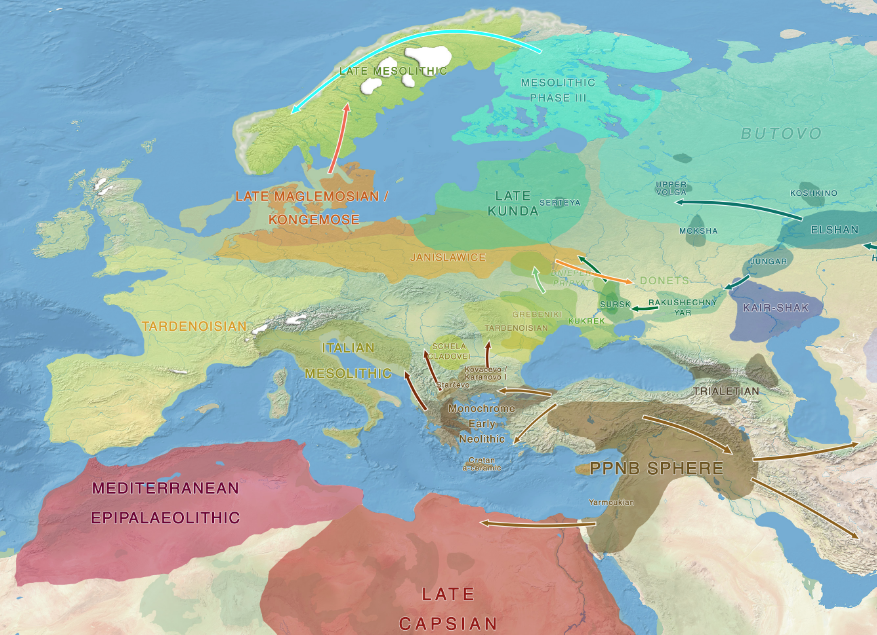
    Europe

    There is little of interest to say about the european mesolithic other than the necessary improvement in the precision of stone tools for the shift to dependence upon fishing and hunting smaller game, rather than their ancestral emphasis on hunting of megafauna.

    Western Europe: Tardennosian Culture: (Belgium, France, Britain, Spain, Central Europe. Questionable time span, poor documentation, and artifacts differ little from earlier cultures only by the presence of geometric microliths, microburin, scalene triangles, trapezoids and chisel-ended arrowheads and small flint blades made by the pressure-technique. 

    Northern Europe: Fosna, Hensbacka, and Komsa Cultures, Norway-Sweden (10,000/8300 BC to 7300 BC).  On area, central Bohuslän, may well have had the largest seasonal population in northern Europe during the Late Palaeolithic/early Mesolithic transition. The settlements were located close to the contemporary seashore but, due to constant land uplift after deglaciation, they are now well above present-day sea level. Sites indicate fishing and seal hunting were important for the economy likely that hide covered wooden framed boats were used in because the majority of sites are located on islands in the outer archipelago. The culture relied purely on hunting and gathering, and archaeologists have only found stone tools, especially  flake axes, lanceolates and tanged arrowheads. Again, these are less sophisticated tools than the preceeding era. The Komsa Culture was almost exclusively sea-oriented, living mainly off seal hunting, fishing, and boat-building, and their stone tools and other implements appear relatively crude. 

    Baltics: Swiderian-Kundra Culture  (11,000 to 8,200 BC), Baltic Forest: Poland-Latvia-Estonia-Russia-Urals,  (Soultrean> Swiderian > Kundra -> to Neolithic: Narva -> Pit Comb -> Corded Ware). Genetics were Western Hunter-Gatherers (WHGs) 70% Eastern Hunter-Gatherers (EHGs) 30%, with a substntial contribution of Ancient North Eurasians (ANE). ANE ancestry was lower than that of Scandinavian Hunter-Gatherers, indicating that ANE ancestry entered Scandinavia without traversing the Baltic.


    Ahrensburg located to the northwest of Europe.

    Asturian located Iberian Peninsula.

    Italian Mesolithic

    Old Europe – The Balkans

    The relative climatic stability in the Balkans, compared to northern and western Europe, enabled continuous settlement. So the area may have effectively functioned as an ice-age refuge from which much of Europe, especially eastern Europe, was re-populated.  And that begs the question whether or not there was a period which could be described as Mesolithic in southeastern Europe, rather than an extended Upper Palaeolithic or Epipalaeolithic Balkans, which might describe better its gradual changes and poorly defined development.

    Balkans: “Iron Gates” Culture (11,000 BC to 3500 BC) Danube, Balkans, between Romania and Servia. (“Old Europe”).  The archaeological complex that consists of one large settlement with around 10 satellite villages dated from 6300BC – 6000 BC,  called Lepenski Vir, and due to its permanency, organisation, as well as the sophistication of its architecture and construction techniques may constitute the first “City” in europe. These people were most closely related to Western European hunter-gatherers, but with some additional contribution from Eastern European hunter-gatherers and Anatolian Neolithic farmers. 

    Skin Painting
    War
    Ceramics 
    The Sledge
    Wood Canoes

    Caucuses:

    Trialetian Culture

    South Asia

    (Human)
    Paleolithic >
    Late Epipaleolithic (Southwest Asia) >
    Natufian (“Settlements”) (12,000 to 9,500 BC or 13,050 to 7,550 BC). The Natufian culture is a Late Epipaleolithic or “proto-Neolithic” archaeological culture that existed in the Levant. The culture was unusual in that it supported a sedentary or semi-sedentary population even before the introduction of agriculture. They lived in small round houses, dug into the earth, with stone foundations, posts, brush roofs, and a central hearth. Settlements were semi-temporary and they moved often. The Natufian communities may be the ancestors of the builders of the first Neolithic settlements of the region, which may have been the earliest in the world. Natufians founded a settlement where Jericho is today, which may be the longest continuously inhabited urban area on Earth. Natufians were hunters and gatherers and gazelles were the main prey, but they also hunted deer, aurochs and wild boar in the steppe zone, as well as onagers an ibex. Water fowl and freshwater fish formed part of the diet in the Jordan River valley. And there is evidence of communal hunts with nets, And most interestingly, the wooded terrain was ideal for wild grains, and exploited wild cereals – and some evidence suggests the oldest known evidence of deliberate cultivation of cereals -specifically rye, bread-making, and beer.


    The Holocene

    (Climate)
    Quaternary > Upper Pleistocine > Pleistocine End >
    The Holocene (“Entirely New”,”Civilizational Age”),
    (9,700 BC to Present) The Period of Post Glacial formation of fully modern humans and the post glacial evolution of agrarianism. It can be subdivided into five time intervals, or chronozones, based on climatic fluctuations:

    Preboreal (8,000 BC – 7,000 BC),
    Boreal (7,000 BC – 6,000 BC),
    Atlantic (6,000 BC – 3,000 BC),
    Subboreal 3,000 BC – .5 BC) and
    Subatlantic (.5 BC – present).

    The Holocene includes the period of:
    … Settlement
    … Institutions
      (or Formal Institutions) (organization, strategy, resources, cultures)
    … States (control, organization, strategy, resources, culture)
    … Empires (civilizations, core states, core institutions)
    … Civilizations (Balances of Power between civilizations.)
    Mass Extinctions

    The present Interglacial (9700 BC to Present) The earth is currently in an interglacial (warm) period, and the last glacial period ended about 10,000 years ago. All that remains of the previous continental ice sheets are the Greenland and Antarctic ice sheets and a few minor glaciers.

    The back breaking work of women under agrarianism, and the suppression of underclass reproduction of such women produced the predictable results.


    The Neolithic – Agrarian Revolution – Resurrection

    Generation Eight

    [ THE THIRD GREAT LEAP FORWARD ]

    [ HERE : 50-24000 years to create fully contemporary humans]

    (Human)
    Neolithic (“New Stone Age”) The Period of Settlement, Pottery, Agriculture, and polished stone tools.
    … SW Asia: (10,200 BC to 4500 BC)
    … Europe (to 1700 BC)
    … China (to 1200 BC)
    Other parts of the world (including Oceania and the northern regions of the Americas) remained broadly in the Neolithic stage of development until European contact

    The Neolithic includes a progression of technological, behavioral, and cultural changes including the use of wild and domestic crops, domestication of animals, new clothing, building of shelters, sedentary living, social organization, and eventually, pottery, that evolved out of Natufian Culture.

    As the Natufians became dependent on wild cereals in their diet, and developed a sedentary way of life, the climatic changes associated with the Younger Dryas (about 10,000 BC) forced people to develop farming.  By 8,800 BC farming communities had arisen in the Levant and spread to Asia Minor, North Africa and North Mesopotamia.

    Early Neolithic farming was limited to a narrow range of plants, both wild and domesticated, which included einkorn wheat, millet and spelt, and the keeping of dogs, sheep and goats. By about 6900–6400 BC, it included domesticated cattle and pigs, the establishment of permanently or seasonally inhabited settlements, circular and rectangular multi-room buildings, and the use of pottery.

    The archaeological industry is overly interested in minor developments in different regions of the world, but for our purposes, the climate generated demand for farming, and population growth for settlements, a division of labor, and eventually expansion of settlements into new regions. 

    In other parts of the world, such as Africa, South Asia, Southeast Asia and East Asia, independent domestication events, and technological innovations led to regionally distinctive Neolithic combinations. Travel has always existed, trade has always existed, and information spreads quickly – but unevenly. But it’s this rapid spread of the technology around the world that we should take notice of.

    Temple Religion Begins – With Hunter Gatherers

    These Hunter Gatherers appear to have developed an animistic religion of some sort in Anatolia by 10,000 bc, with temple construction on a barren flat hilltop (plateau) with fifty miles of visibility in every direction in what is today an arid plain. In the neolithic, with the mountains catching the rain, a porous bedrock created many springs, creeks, and rivers, so this region in the upper reaches of the Euphrates and Tigris was a refuge of wildlife during the dry and cold Younger Dryas climatic event (10,800–9,500 BC). Archaeologists have discovered at least two of these temple complexes and general consensus is that there must be more.
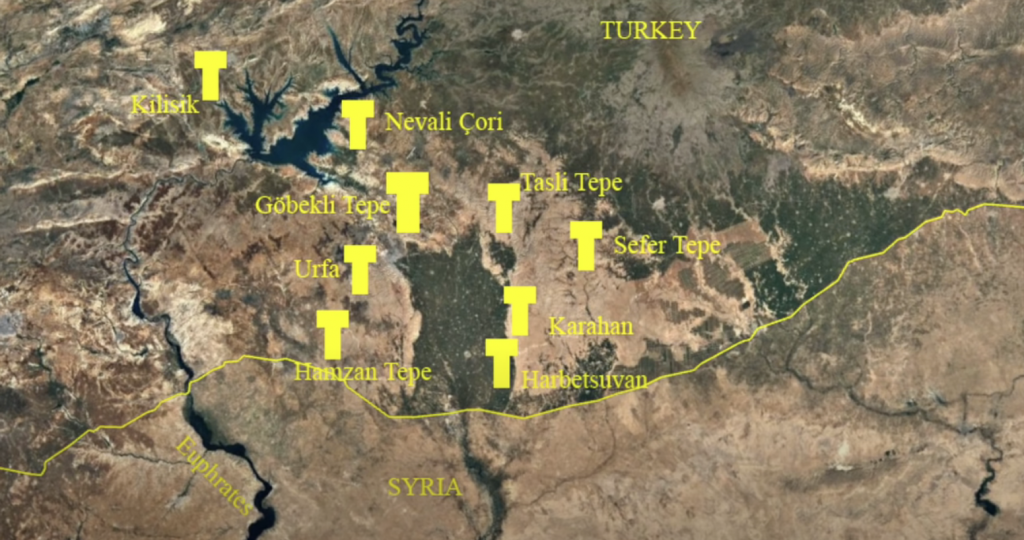
    Present theory suggests its a mountain hunting retreat that took advantage of seasonal migration of gazelles that somehow evolved into a place of pilgrimage, rituals, feasts and celebration. And it appears from the genetic evidence that the original domestication of wheat occurred within twenty miles of the site.

    Local population expansions locally may have led them to develop common rituals strengthened by monumental gathering places to reduce tensions and conflicts over resources, and probably, to mark territorial claims.  The structure of the site we call Gobekli Tepe predates pottery, metallurgy, and the invention of writing or the wheel.

    Consensus appears to be that this religion was likely shamanistic, and that gods did not develop until the later Mesopotamian period. This corresponds to an ancient Sumerian belief that agriculture, animal husbandry, and weaving were brought to humans from the sacred mountain which was inhabited by deities – very ancient deities without individual names. (A parallel to the Greek Mount Olympus.)

    The animal and other images give no indication of organized violence. Meaning there are no depictions of hunting raids or wounded animals, and the carvings generally ignore game on which the society depended, such as deer, in favour of formidable creatures such as lions, snakes, spiders, and scorpions.

    Around the beginning of the 8th millennium BCE Göbekli Tepe lost its relevance. The advent of agriculture and animal husbandry brought new realities to human life in the area, and the “Stone-age zoo” apparently lost whatever significance it had had for the region’s older, foraging communities. For reasons unknown, the site was deliberately buried under earth, saving it from man and the elements.

    The Domestication of Animals (Pastoralism) and Plants (Agriculture) Begins

    Humans began domesticating plants and animals where and when it was most necessary to domesticate them: where they had produced enough of a population to overtax the flora and fauna. Necessity was the mother of the invention.

    Animals: Pigs were domesticated in Mesopotamia around 11,000 BC, followed by sheep between 11,000 BC and 9000 BC. Cattle were domesticated from the wild aurochs in the areas of modern Turkey and Pakistan around 8500 BC.

    Crops: Starting from around 9500 BC, the eight Neolithic founder crops – emmer wheat, einkorn wheat, hulled barley, peas, lentils, bitter vetch, chick peas, and flax – were cultivated in the Levant. Rye may have been cultivated earlier, but this remains controversial. Rice was domesticated in China by 6200 BC with earliest known cultivation from 5700 BC, followed by mung, soy and azuki beans.

    Sugarcane and some root vegetables were domesticated in New Guinea around 7000 BC. Sorghum was domesticated in the Sahel region of Africa by 3000 BC. In the Andes of South America, the potato was domesticated between 8000 BC and 5000 BC, along with beans, coca, llamas, alpacas, and guinea pigs. Bananas were cultivated and hybridized in the same period in Papua New Guinea. In Mesoamerica, wild teosinte was domesticated to maize by 4000 BC. Cotton was domesticated in Peru by 3600 BC. Camels were domesticated late, perhaps around 3000 BC.

    For this change to occur across the planet, despite the distance between hunter gatherer populations, a change in climate had to create the opportunity and incentive.

    Crisis: The Black Sea Deluge (Flood)

    Whether causal or not, the Black Sea Deluge occurs sometime between 7000 and 5600 bc. This event probably accounts for the lack of neolithic sites in Northern Anatolia (Turkey) – they’re now underwater. There are at least three early human sites of freshwater development that have been inundated by the floods: the Persian gulf flood – most likely candidate for the first civilization, the Black Sea flood, and the Doggerland flood in what is today’s North Sea. (The flooding of the Mediterranean 5M years ago, is before modern humans.) Although the Missoula floods in North America likely (at least according to myth) at least affected the first Siberians migrating to the Americas.
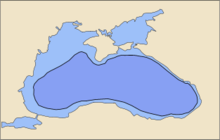
    Theorized expansion of the Black Sea during the deluge. Note that all coastal communities would have been inundated and buried.

    Continued Striation of Groups

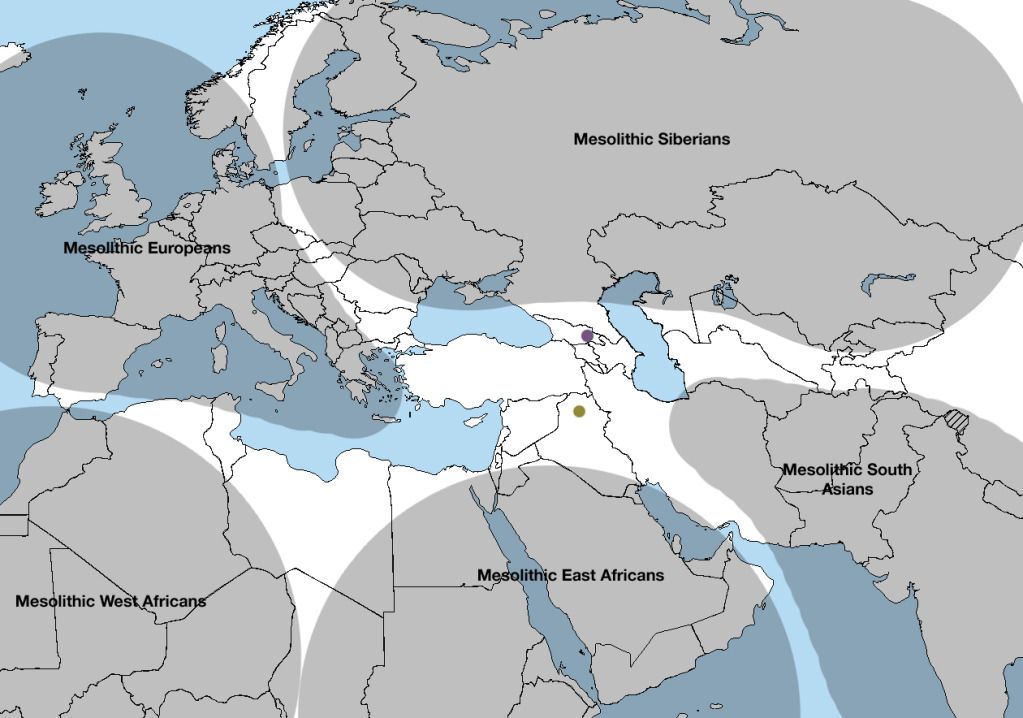
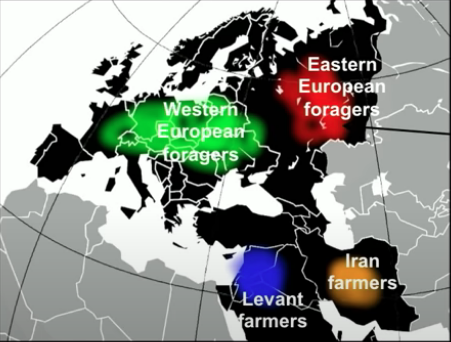
    Sometime around 43,000 BC,  the ancestors of what would become the Early European Farmers (EEF) are believed to have split off from Western Hunter-Gatherers (WHGs), and again, these EEF appear to have split from Caucasian Hunter-Gatherers (CHGs) around 23,000 BC, Just as Ancestral North Eurasian (ANE) Hunter Gatherers split off from Western Hunter gatherers, around 24,000 BC.

    Result:
    North: Western Hunter Gatherers
    Center: Caucuses and Anatolia: Caucasion Hunter Gatherers
    South: the Levant: Early European Farmers

    Adaptive Speciation Begins

    43,000 BC,  the ancestors of what would become the Early European Farmers (EEF) are believed to have split off from Western Hunter-Gatherers (WHGs), and again appear to have split from Caucasian Hunter-Gatherers (CHGs) around 23,000 BC. And Ancient North Eurasian Hunter Gatherers hybridized and split off from european hunter gatherers 24000BC.

    So, at the beginning of the Neolithic there are at least four separate races as different then as europeans and asians are today.
    South Asians (india), North and South (Asians Eas Asia), Siberians and Siberian Americans (north America), Oceanans, and Austronesians, are all equally

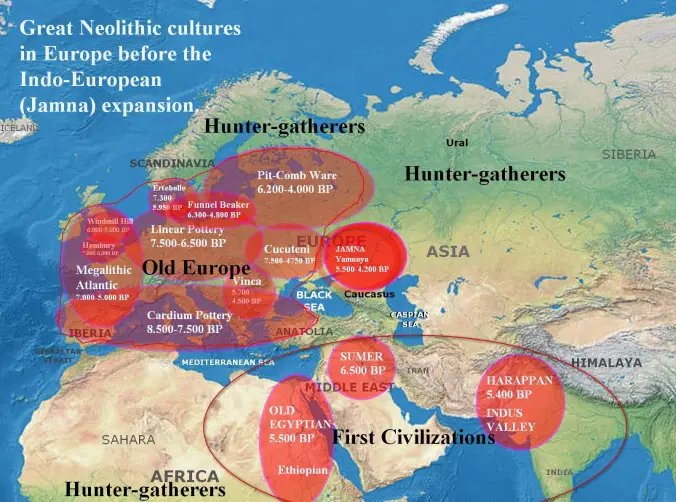
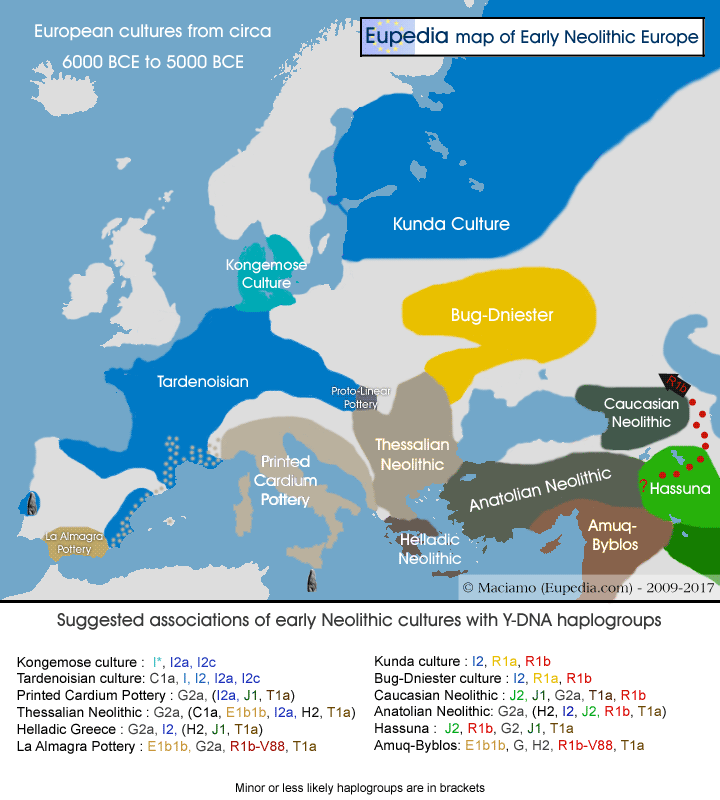
    Early Neolithic Cultures in Europe

    (6000 BC to 5000 BC)
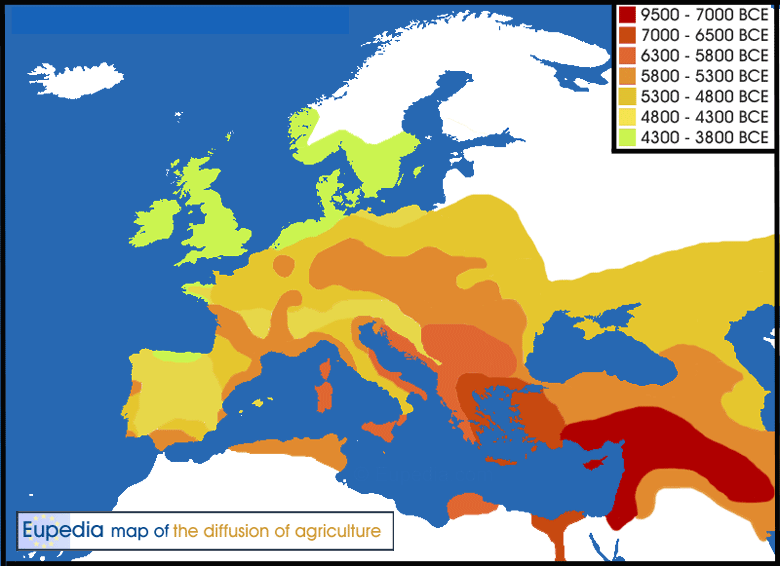
    Farmers Spread into Eurasia: Agrarian Hybridization

    The Farmer Migration (The descendants of the EEF and CHG migrated from Anatolia to the Balkans in large numbers – a single massive migration – during the 7th millennium BC, where they almost completely replaced the WHGs.

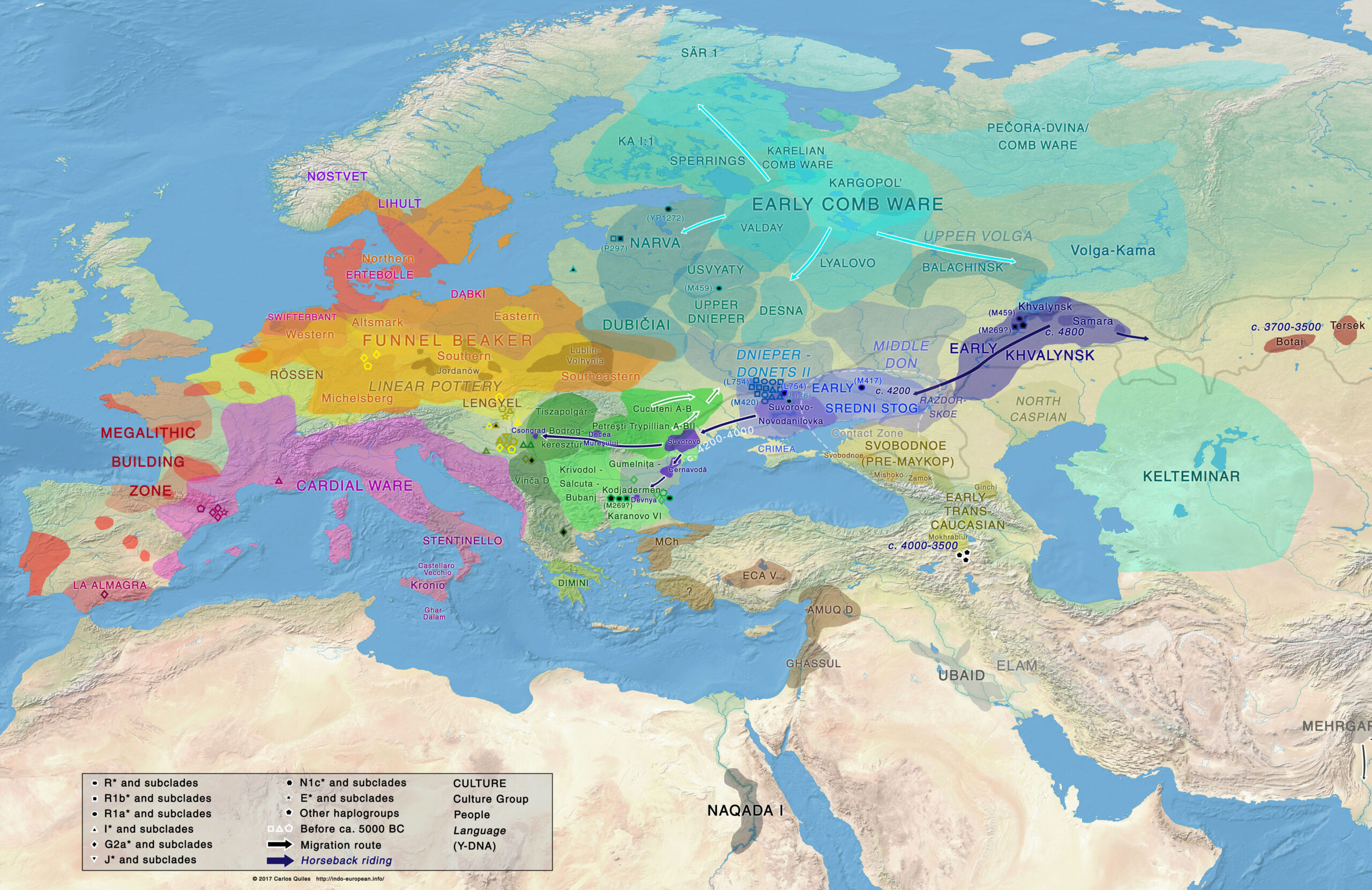
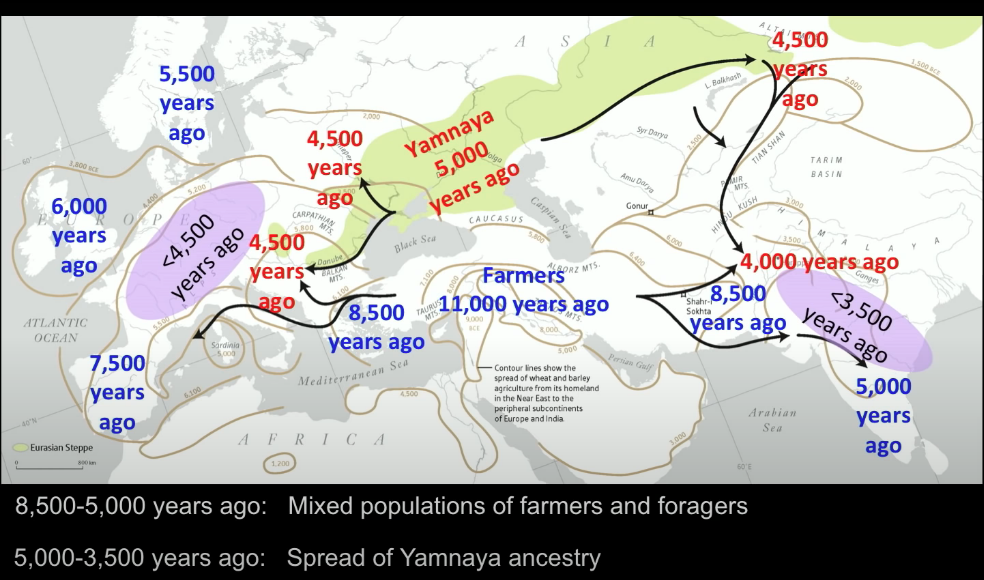
    In the Balkans, the EEFs appear to have divided into two wings, who expanded further west into Europe along the Danube (Linear Pottery culture) or the western Mediterranean (Cardiol Ware). But large parts of Northern Europe and Eastern Europe remained unsettled by EEFs.
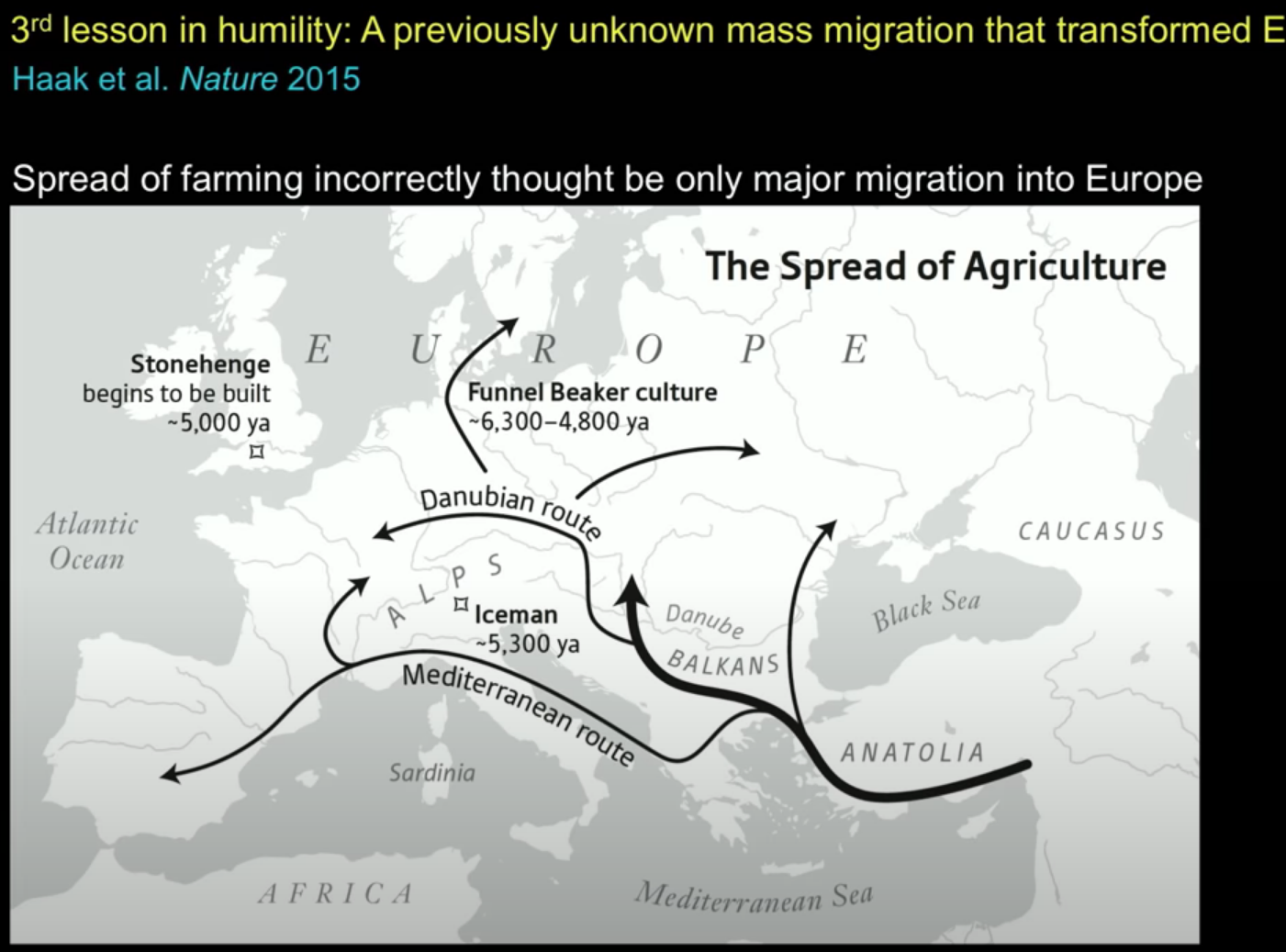
    The Westward branch continued to expand along the Mediterranean coast, into the Iberian peninsula, up through France, and by 4000bc, into the British isles, and 3500bc into scandinavia.
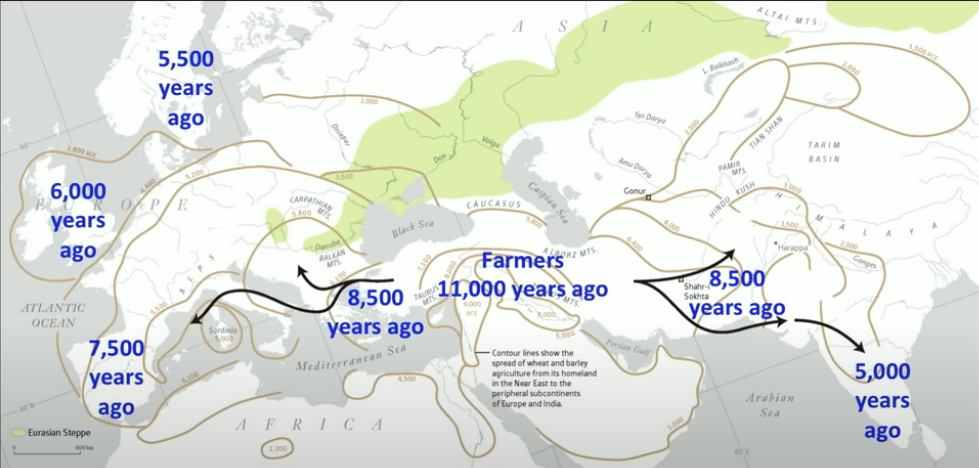
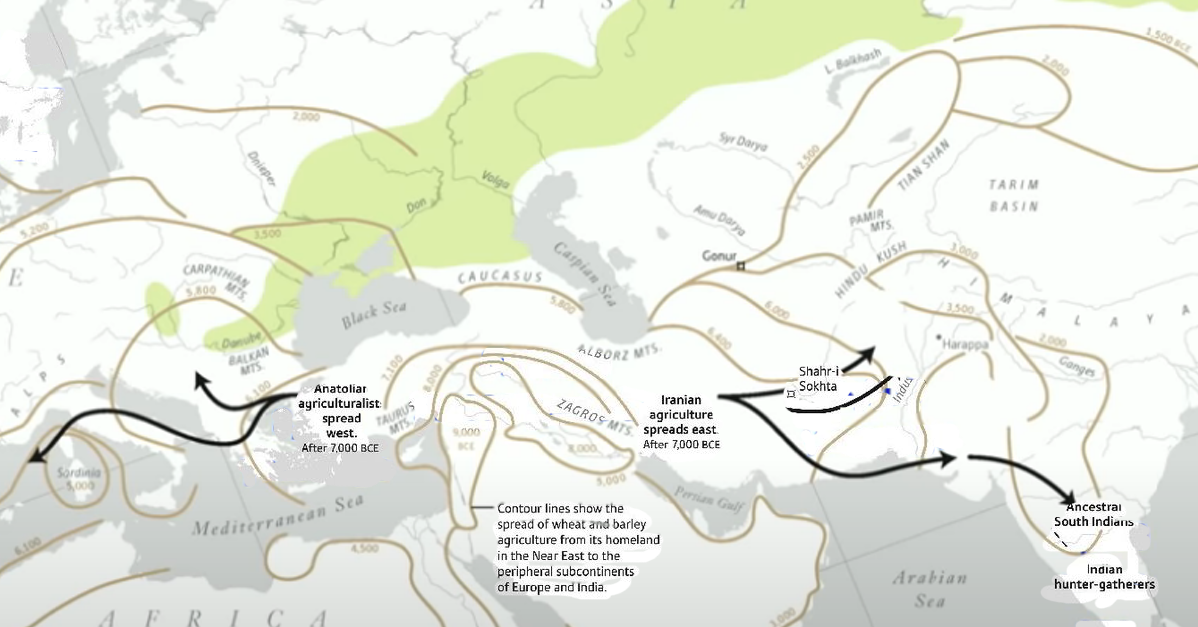
     

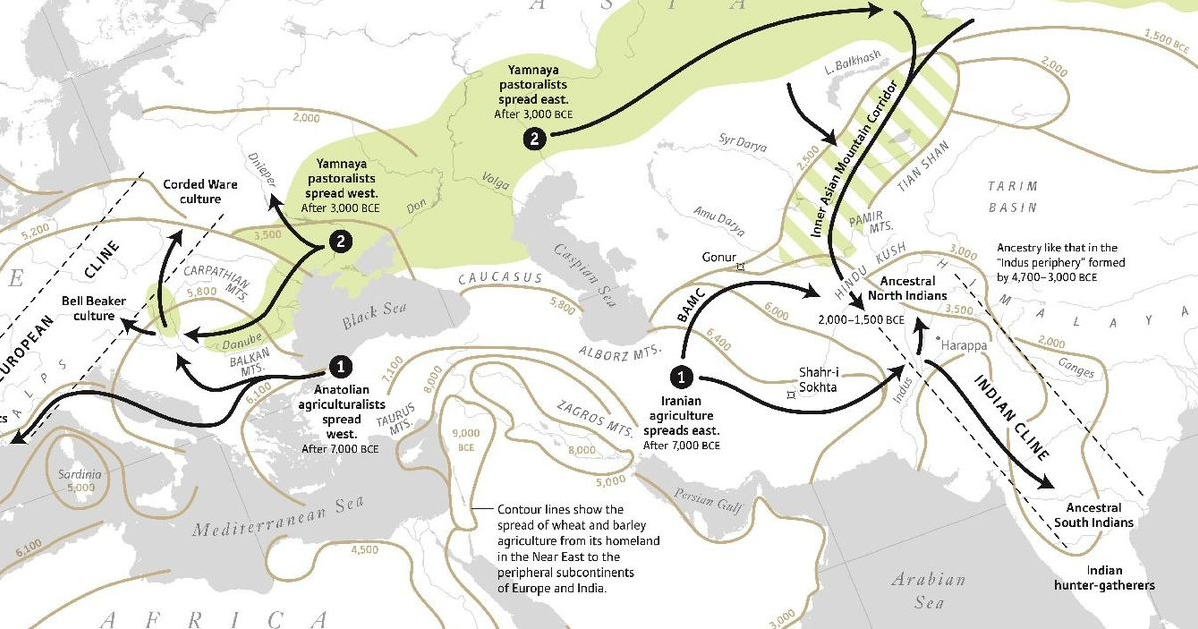
    Spread and direction of agriculture. Note: convert these dates from YA to BC for consistency.

    The EEFs spread agriculture throughout Europe largely without admixture with local WHGs. The EEFs subsequently split into two branches, one which spread northwards along the Danube through the Linear Pottery culture, and another which spread westward across the Mediterranean coast through the Cardinal Ware culture. By 5600 BC, these cultures had brought agriculture to Iberia and Central Europe.

    The slight mixture between EEFs and hunter-gatherers in the Early Neolithic appeared to have happened without sex-bias, increases in hunter-gatherer ancestry appeared to be largely the result of males with hunter-gatherer ancestry mixing with females with EEF ancestry.  Hunter-gatherer ancestry was even higher among Late Neolithic samples from the Cucuteni–Trypillia culture, Funnelbeaker culture and Globular Amphora culture, which carried about 75-80% EEF ancestry while being dominated by hunter-gatherer paternal lineages.

    Initial westward spread of the EEFs from the Balkans was accompanied only by slight admixture with hunter-gatherer populations. Peoples of Middle Neolithic and Chalcolithic Iberia were found to carry about 75% EEF ancestry and 25% WHG ancestry, more WHG ancestry than Early Neolithic Iberians. Significant reductions in EEF ancestry during the later phases of the Neolithic was also observed in Central Europe, particularly in the northern and eastern parts of the region

    In the southern Balkans, the Middle Neolithic farmers display reduced levels of EEF ancestry increased amounts of ancestry related to Caucasian Hunter-Gatherers (CHGs), suggesting further gene flow from Anatolia, which continued into the Bronze Age.

    EEF ancestry remains throughout Europe, ranging from about 60% near the Mediterranean Sea (with a peak of 85% in the island of Sardinia) and diminishing northwards to about 30% around the Baltic Sea.
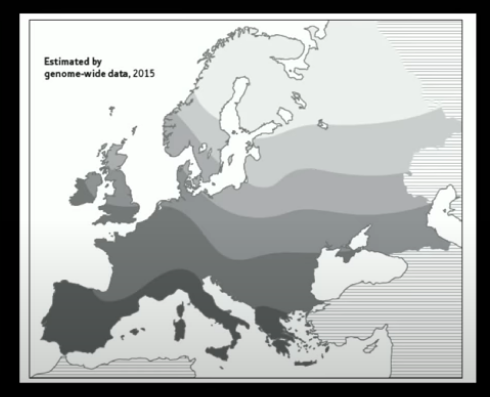
    So, while the WHGs were largely displaced by successive expansions of Early European Farmers (EEFs) during the early Neolithic, they experienced a male-driven resurgence of WHG during the Middle Neolithic, for reasons we don’t yet understand – but could be as simple as recruitment.

    Selection: The gene for light eye color was at 100% fixation in hunter-gatherers throughout western Europe. Northern (Scandinavia) had the gene for white skin. Spain and Luxembourg did not. European farmers had a mixture (homozygous).


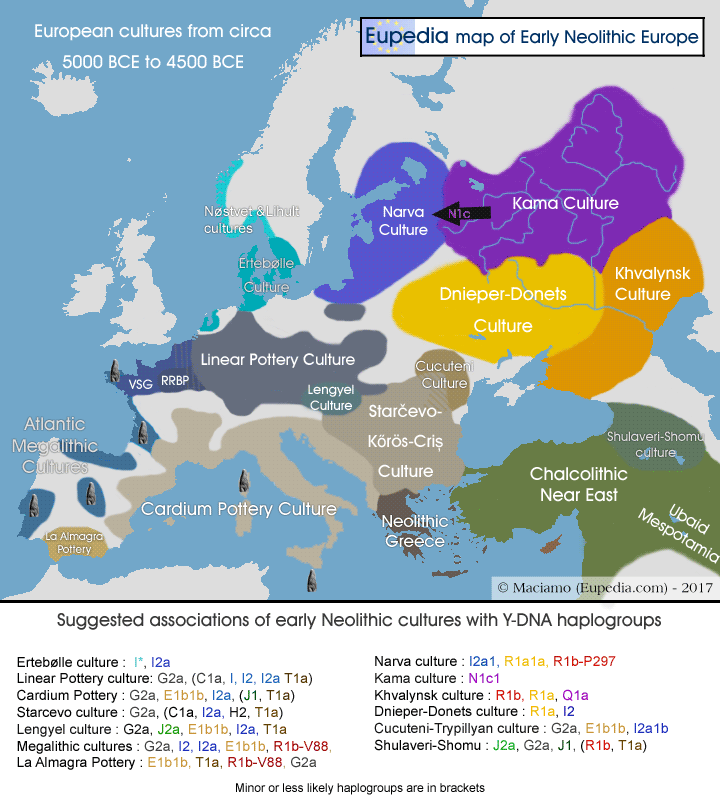
    Cultures of Neolithic Europe (5,000 BC to 4,500 BC)
    Pre-History

    (Historical)
    Pre-History (Pre-Writing) >
    Protohistory (“Early Writing”): Period between prehistory and history, during which a culture or civilization has not yet developed writing but other cultures have already noted its existence in their own writings; the absolute time scale of “protohistory” varies widely depending on the region, from the late 4th millennium BCE in the Ancient Near East to the present in the case of uncontacted peoples.

    The Age of Metal

    (Human)
    Neolithic >
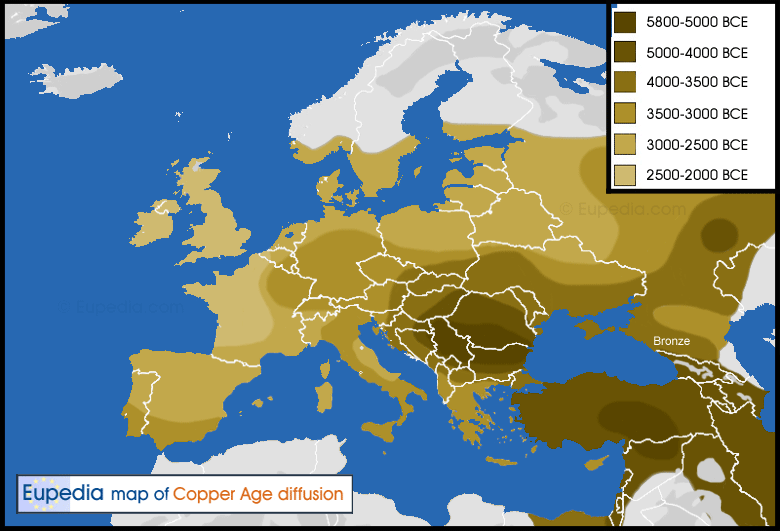
    Chalcolithic: (“Copper Age”) (4,500 BC to ????  ) The Period of Metallurgy.
    Indus Region (Proto Indus Valley Civilization)

    Balochistan (6500 BC) 

    “Baloch” was the name by which the Indus Valley Civilisation is believed to have been known to the Sumerians (2900–2350 BC) and Akkadians (2334–2154 BC) in Mesopotamia. But it disappears from the Mesopotamian records at the beginning of the second millennium BC.

    Mesopotamia

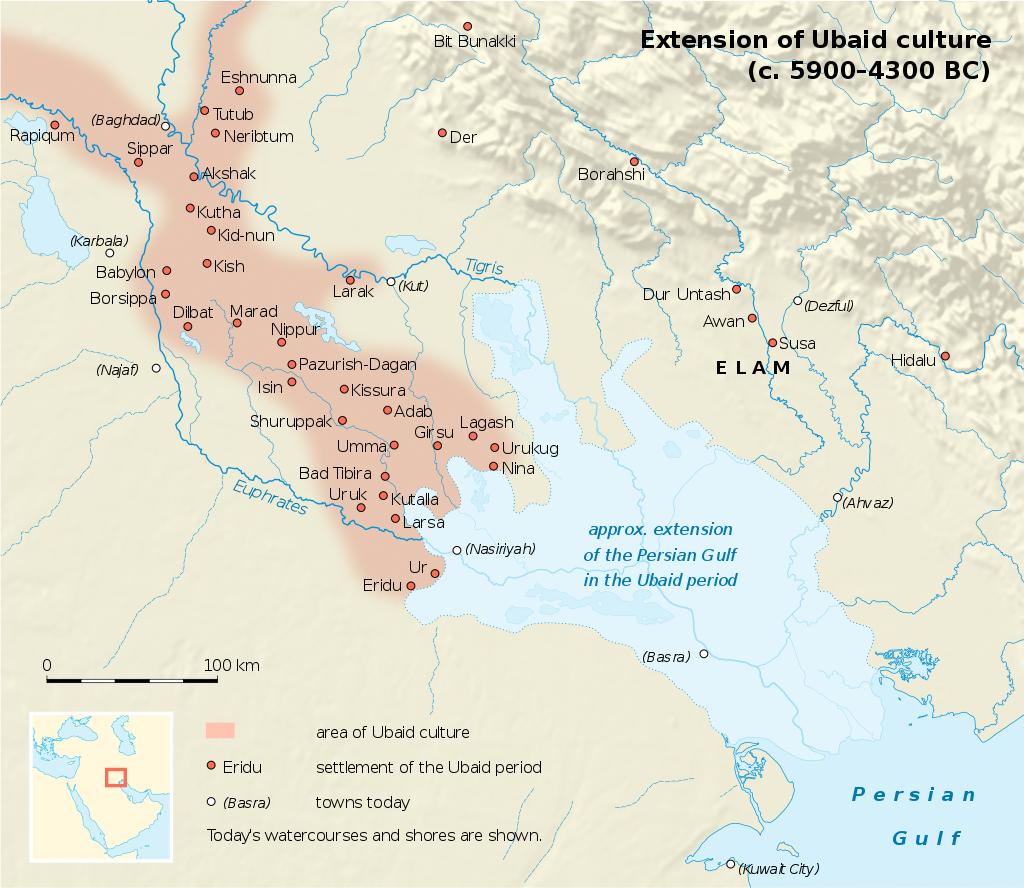
    The Ubaid Period (6500 BC to 3800 BC)
    Notable: 

    • Stamps and Seals
    • Stone, hard fired Clay, and Metal Tools
    • Hydraulically Irrigated Agriculture
    • The Plough
    • Sailing Vessels
    • Beginning of specialized crafstmen – a division of labor.
    • Beginning of Pareto Distribution (social hierarchy or stratification) 
    • Beginning of “Manors” vs Village Homes

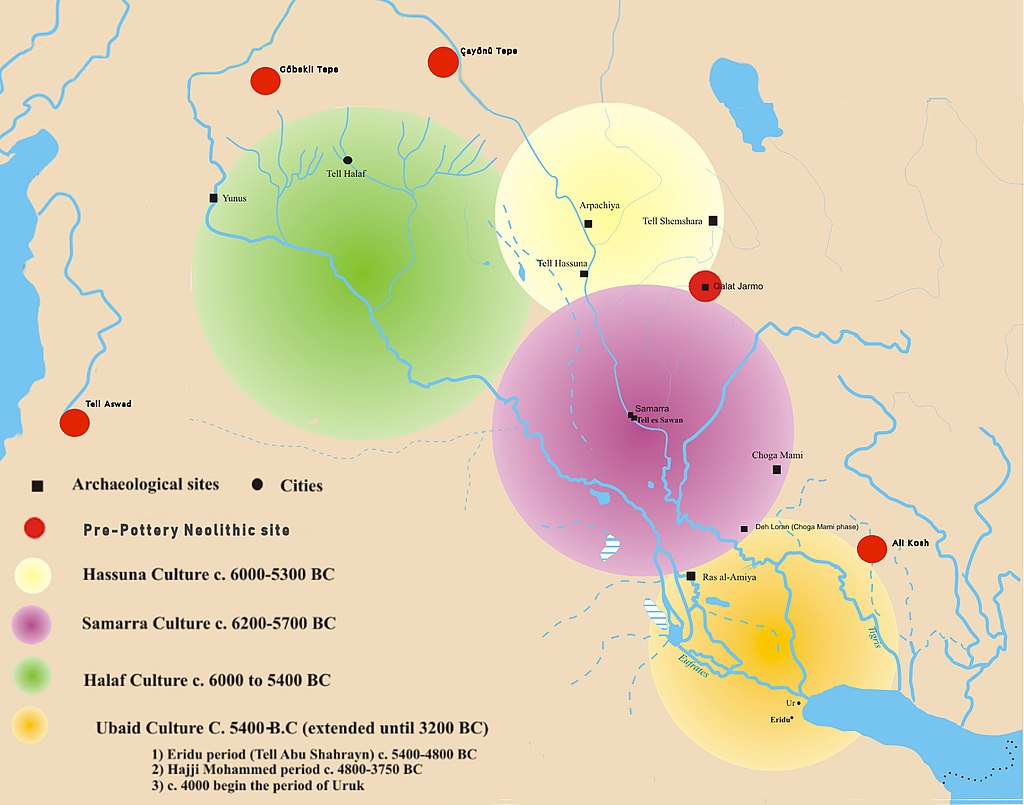
    Ubaid culture is characterized by large unwalled village settlements, multi-roomed rectangular mud-brick houses and the appearance of the first temples of public architecture in Mesopotamia, with a growth of a two tier settlement hierarchy of centralized large sites of more than 10 hectares surrounded by smaller village sites of less than 1 hectare.[25] Domestic equipment included a distinctive fine quality buff or greenish colored pottery decorated with geometric designs in brown or black paint. Tools such as sickles were often made of hard fired clay in the south, while in the north stone and sometimes metal were used. Villages thus contained specialised craftspeople, potters, weavers and metalworkers, although the bulk of the population were agricultural labourers, farmers and seasonal pastoralists.

    During the Ubaid Period [5000–4000 BC], the movement towards urbanization began. “Agriculture and animal husbandry [domestication] were widely practiced in sedentary communities”.[citation needed] There were also tribes that practiced domesticating animals as far north as Turkey, and as far south as the Zagros Mountains. The Ubaid period in the south was associated with intensive irrigated hydraulic agriculture, and the use of the plough, both introduced from the north, possibly through the earlier Choga Mami, Hadji Muhammed and Samarra cultures.

    Spread of Ubaid Culture

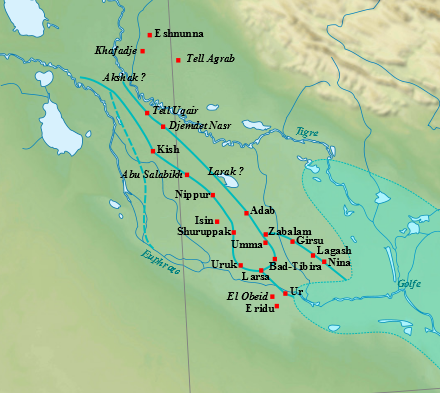
    The Sumerian Period (c. 4500 – c. 1900 BC)
     

    Europe
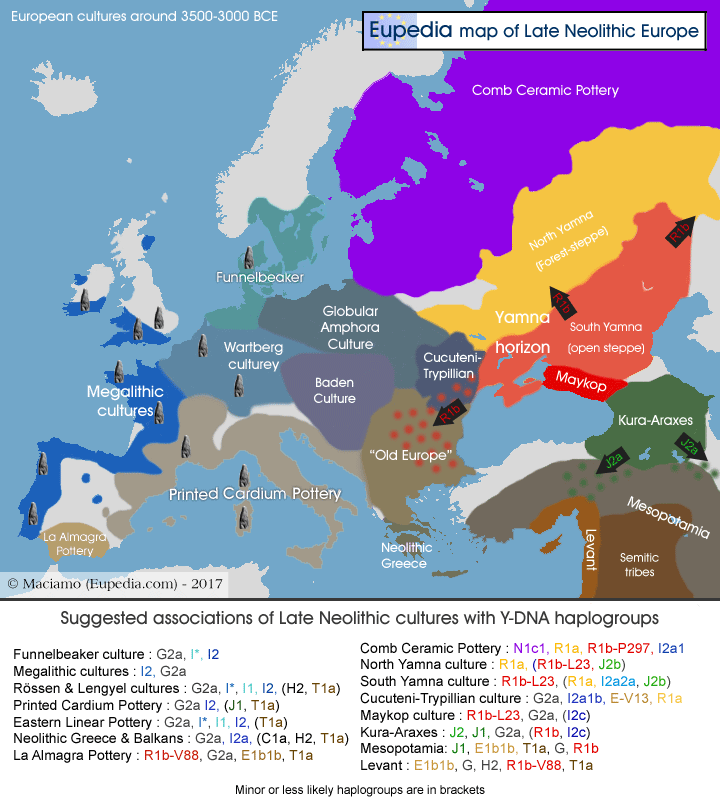
    Northeast Europe: Pit-Comb (Comb Ware) Ceramic Culture (4,200 BC – 2,000 BC) in Norway, Sweden, Finland, Poland, and Estonia.  (Soultrean > Swiderian > Kundra > Narva > Pit Comb -> Volsovo -> Corded Ware). 65% Eastern Hunter-Gatherer (EHG), 20% Western Steppe Herder (WSH), and 15% Western Hunter-Gatherer (WHG) descent. The amount of EHG ancestry was higher than among earlier cultures of the eastern Baltic, while WSH ancestry had previously never been attested among such an early culture in the region.

    The people continued the Mesolithic hunter-gatherer lifestyle, with traces of early agriculture. The settlements were located at sea shores or beside lakes and the economy was based on hunting, fishing and the gathering of plants. In Finland, it was a maritime culture which became more and more specialized in hunting seals. The dominant dwelling was probably a teepee of about 30 square meters where some 15 people could live. Also rectangular houses made of timber become popular in Finland from 4000 BC cal. Graves were dug at the settlements and the dead were covered with red ochre. The typical Comb Ceramic age shows an extensive use of objects made of flint and amber as grave offerings.

    The Pit–Comb Ware culture is one of the few exceptions to the rule that pottery and farming coexist in Europe. The ceramics consist of large pots that are rounded or pointed below, with a capacity from 40 to 60 litres. The forms of the vessels remained unchanged but the decoration varied. In the Near East farming appeared before pottery, then when farming spread into Europe from the Near East, pottery-making came with it. However, in Asia, where the oldest pottery has been found, pottery was made long before farming. So, it appears that the Comb Ceramic Culture reflects influences from Siberia and distant China – and by implication, that pottery may have arrived by the northern route not southern.

    The North Caucuses (The Gateway to the Steppe)

    Maykop Culture (3700BC to 3000BC)

    The Maikop population came from the south, probably from western Georgia and Abkhazia, and was descended from the Eneolithic farmers who first colonized the north side of the Caucasus. Maykop is therefore the “ideal archaeological candidate for the founders of the Northwest Caucasian language family”

    To the north is the Yamna culture, including the Novotitorovka culture (3300—2700), which it overlaps in territorial extent. It is contemporaneous with the late Uruk period in Mesopotamia.

    The settlement is of a typical Western-Asian variety, with the dwellings packed closely together and made of mud bricks with smoke outlets. 

    The Pontic Steppe (Europe)

    Yamna Culture 


     [  COMPLETE THIS NARRATIVE ]


    The Bronze Age

    (Historical)
    Pre-History > Protohistory >
    Ancient History (“Writing”)

     [  COMPLETE THIS NARRATIVE ]

    (Human – Technological)
    Holocene >
    Bronze Age (3,000 BC to 1050 BC)

     [  COMPLETE THIS NARRATIVE ]

    Indus Valley

    The Indus Valley (IVC) or Harapan Civilisation was a Bronze Age civilisation in the northwestern regions of South Asia, lasting from 3300 BCE to 1300 BCE, and in its mature form from 2600 BCE to 1900 BCE. Together with ancient Egypt and Mesopotamia, it was one of three early civilisations of the Near East and South Asia, and of the three, the most widespread, its sites spanning an area stretching from northeast Afghanistan, through much of Pakistan, and into western and northwestern India.

    urban planning, baked brick houses, elaborate drainage systems, water supply systems, clusters of large non-residential buildings, and new techniques in handicraft (carnelian products, seal carving) and metallurgy (copper, bronze, lead, and tin).[4] The large cities of Mohenjo-daro and Harappa very likely grew to containing between 30,000 and 60,000 individuals,[5][c] and the civilisation itself during its florescence may have contained between one and five million individuals.

    Mesopotamia

    The Uruk Period

    The South Caucuses (Border between South and North Asia)

    Wealth Comes to the Caucuses, and Expansion of Influence
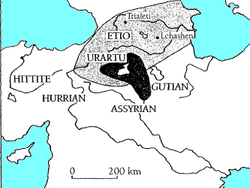
    Transcaucasia an the Leyla-Tepe or “Leilatepe” and Kura Araxes Cultures (3000 BC) (Albania-Azerbaijan and the broader trans-caucuses region from east anatolia to northwest iran.

    Present theory is that when Uruk Collapsed (the Uruk Collapse) migrants conquered, burned, killed, and replaced existing peoples.

    While earlier periods in the region, metal was scarce, this period is the first appearance of local and increasingly sophisticated metallurgy, that we currently attribute to migrants from or trade with Uruk or Pre-Uruk technology in Mesopotamia, beginning about 4500 BCE. a poorly developed social hierarchy for a significant stretch of their history.

    Some settlements were surrounded by stone walls. Homes followed period tradition and were built of mud-brick, originally round, but later subrectangular designs with one or two rooms, multiple rooms centered around an open space, or rectilinear (long house) designs. They raised cattle, sheep, goats, dogs, and in later phases, horses. The dead were buried in ceramic vessels (amphora), usually used to store grain.

    Note that after 2500 we see evidence of exploitation of mountainous areas (pastoralism), horse bones(horse domestication), kurgan burials (wealth), kurgan burials rich in artifacts including gold and silver jewelry(social hierarchy).

    Egypt


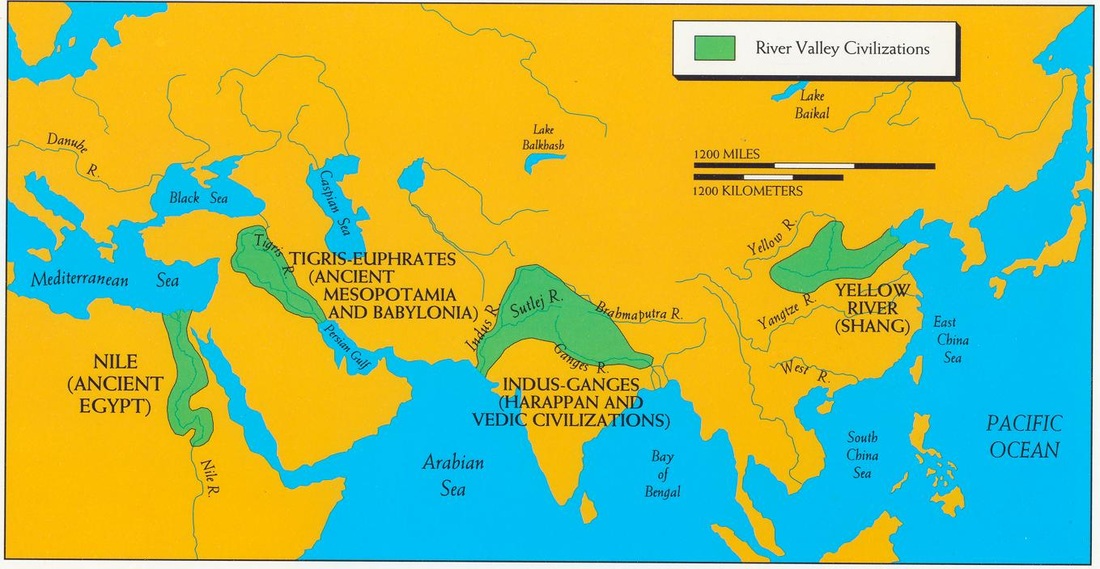
    A Story Of Rivers and Consequences

    A Little More “Geography in Everything”
    Europe

    The Steppe vs River-forests vs Flood River Valleys

    (the beginning of social formation that will lead to institution formation)

    China

    India

    Mesopotamia

    Nile

    Europe

    ( … )

    The Indo European (Aryan) Expansion: Steppe Hybridization
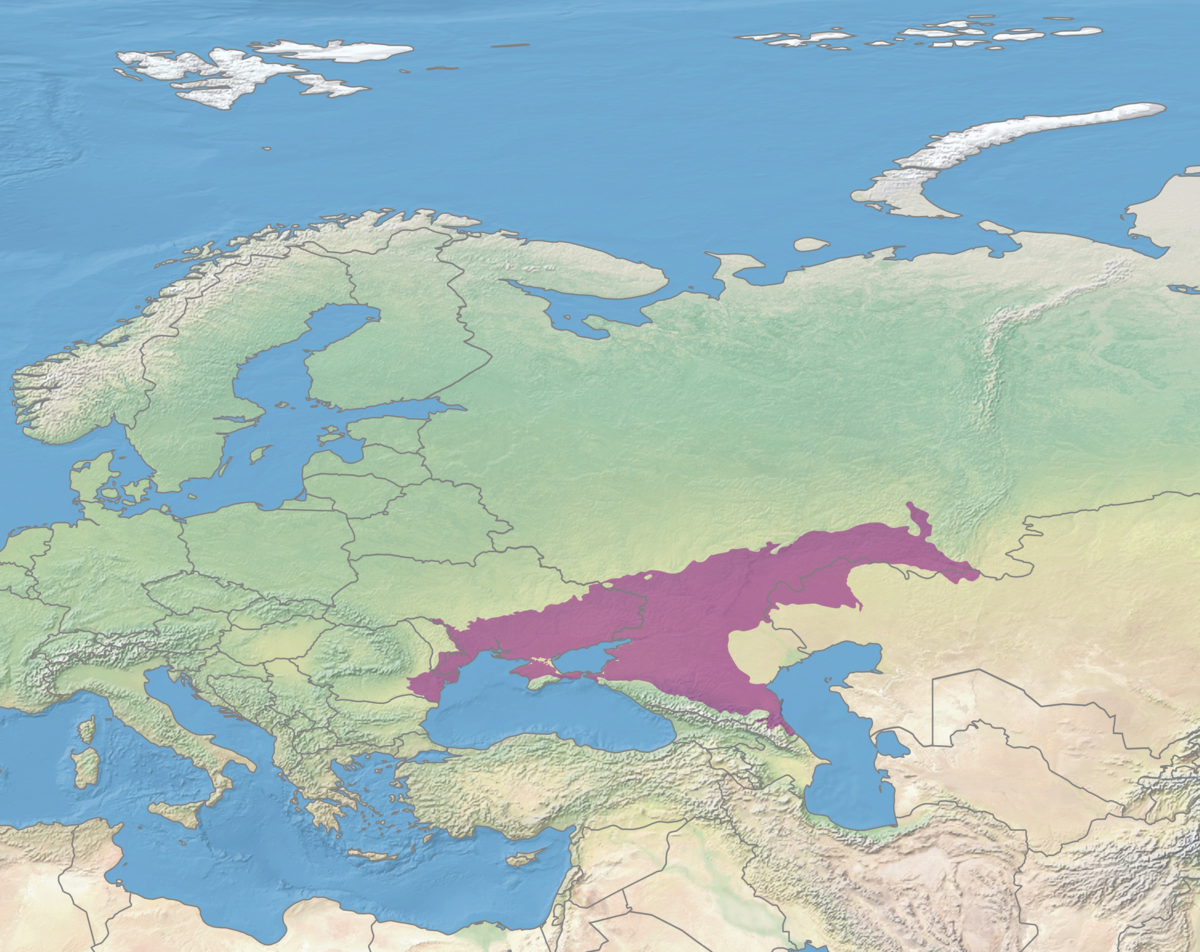


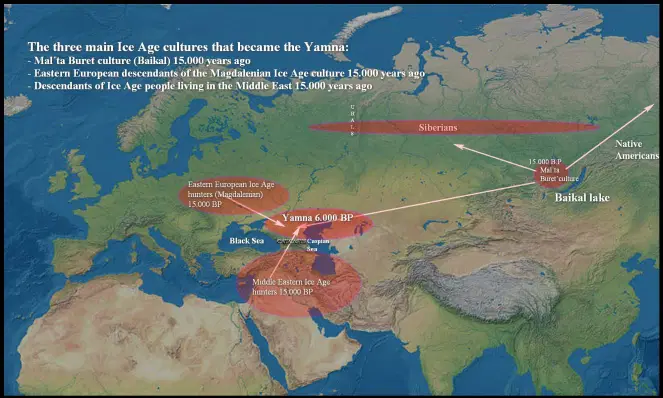
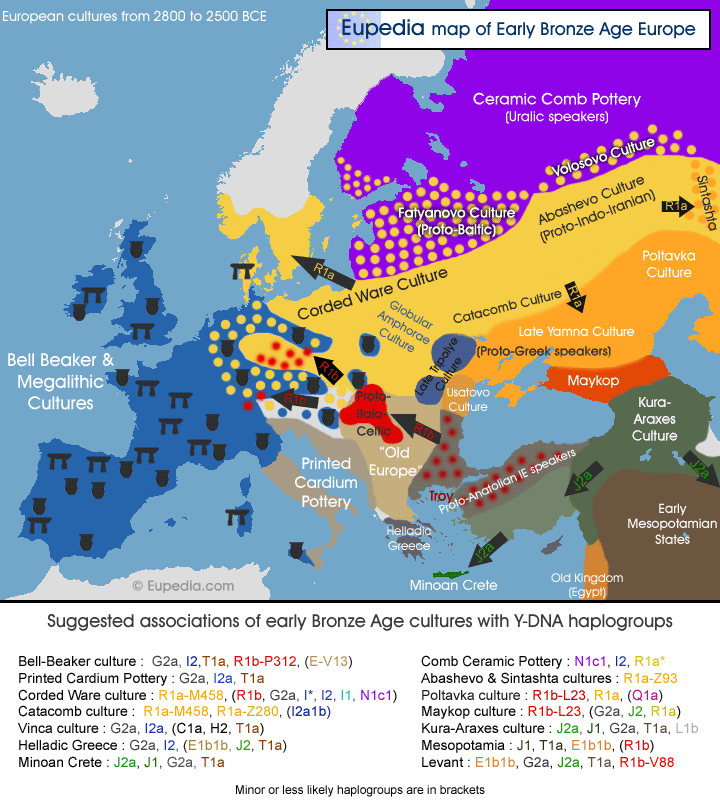
    During the Late Neolithic and Early Bronze Age, Western Steppe Herders (WSHs) from the Pontic-Caspian steppe embarked on a massive expansion, which further displaced the WHGs. Among present day populations, WHG ancestry is most common among populations of the eastern Baltic, north of the eurasian plain..

    The EEF-derived cultures of Europe were overwhelmed by successive invasions of Western Steppe Herders (WSHs) from the Pontic-Caspian steppe, who were Eastern Hunter-Gatherers (EHG) with possible CHG admixture. These invasions led to EEF Y-DNA in Europe being almost entirely replaced with EHG/WSH Y-DNA (mainly R1b and R1a). EEF mtDNA however remained frequent, suggesting admixture between EHG/WSH males and EEF females. Through subsequent migrations of WSHs into Northern Europe and back into the Eurasian Steppe, EEF mtDNA was brought to new corners of Eurasia.

    EHGs carry about 75% Ancient North Eurasian (ANE) descent, and to have contributed significantly to the ancestry of the WHGs and SHGs (who were a mixture of WHG and EHG). During the Neolithic and early Eneolithic, EHGs on the Pontic-Caspian steppe formed the Yamnaya culture, perhaps after some admixture with Caucasus hunter-gatherers (CHGs). The genetic cluster formed from this admixture is known as Western Steppe Herder (WSH). The Yamnaya culture and its descendants are supposed to have embarked on a massive migration leading to the spread of Indo-European languages throughout large parts of Eurasia.

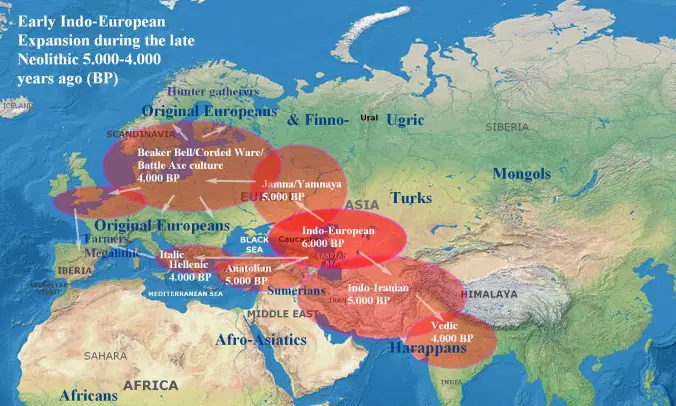
    “The Indo-Europeans (I-Es) were highly militarized conquering groups that spread out from the Pontic Steppe region north of the Black Sea to dominate Europe, ending only at the end of the Middle Ages in Western Europe and reverberating even beyond that. What I mean by this is that the social systems that the I-Es put in place had significant commonalities and were fundamentally unchanged over this very long time span.

    “Current scholarly opinion is that the I-Es originated in the Pontic Steppe region of southern Russia and Ukraine. In the Near East, Iran, and India, this conquering group was eventually absorbed by the local population, although, for example, there is some indication that the priestly Brahmin caste in India has greater representation of I-E ancestry than other castes in northern India. In Europe, they displaced the native languages but not the natives: Originally, at least, as in the other areas they conquered, they were alien elites ruling over the older Europeans.
     

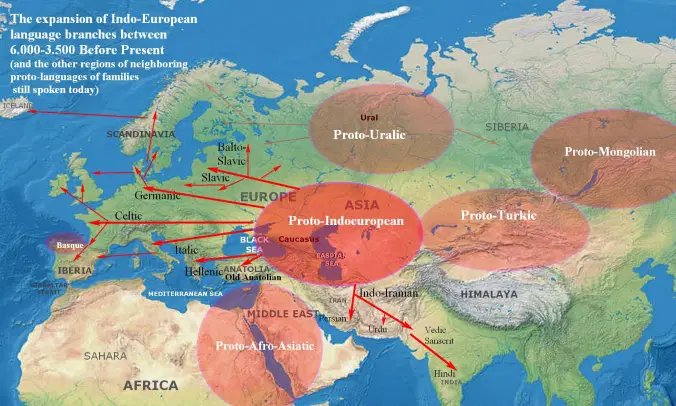
    Languages
    Introgression


    Cultures of Early Bronze Age Europe
     

    Crisis: The Bronze Age Collapse – The Second Dark Age

    (Human) (Technological)
    Crisis: The Bronze Age Collapse

    ( … )

    Late Bronze Age Europe – Staging for the Ancient World


    (Human) (Conceptual)
    Opportunity: The Age of Transformation

    (Human) (Technological)
    Holocene >
    Iron Age
    the “Iron Age” begins in any region when the local production of iron or steel has been brought to the point where iron tools and weapons superior to their bronze equivalents become widespread. In the Ancient Near East, this transition takes place in the wake of the so-called Bronze Age collapse, in the 12th century BC. The technology soon spread throughout the Mediterranean Basin region and to South Asia. Its further spread to Central Asia, Eastern Europe, and Central Europe is somewhat delayed, and Northern Europe is reached still later, by about 500 BC.

    • For SW Asia, the Ancient Near East, the establishment of the Achaemenid Empire c. 550 BC is usually taken as a cut-off date,
    • For Europe, at least Central and Western Europe, the Roman conquests of the 1st century BC serve as marking for the end of the Iron Age. The Germanic Iron Age of Scandinavia is taken to end c. 800 AD, with the beginning of the Viking Age.
    • For South Asia (Indian sub-continent), the Iron Age is taken to begin with the ironworking Painted Gray Ware culture in the 18th century BC, and to end with the reign of Ashoka (3rd century BC). The use of the term “Iron Age” in the archaeology of South, East, and Southeast Asia is more recent and less common than for western Eurasia;
    • For East Asia, China’s prehistory had ended before iron-working arrived, so the term is infrequently used.
    • For Africa, the Sahel (Sudan region) and Sub-Saharan Africa are outside of the three-age system, there being no Bronze Age, but the term “Iron Age” is sometimes used in reference to early cultures practicing ironworking such as the Nok culture of Nigeria.

    (Human)
    Holocene >
    Ancient (Awakening)

    Southeastern (Old) Europe: Hellenistic > Roman
    Western Europe: Roman > Early Medieval > Medieval > Early Modern > Industrial
    Northern Europe: Pre-Roman Age > Roman Iron Age > Germanic Iron Age > Viking > Medieval > Post-Medieval(Early Modern) > Industrial(modern)

    (Human)
    Holocene >
    Medieval (Dark Ages)

    Southeastern (Old) Europe: Hellenistic > Roman > Byzantine
    Western Europe: Roman > Early Medieval > Medieval
    Northern Europe: Pre-Roman Age > Roman Iron Age > Germanic Iron Age > Viking > Medieval

    (Human)
    Holocene >
    Modern (Restoration)

    Southeastern (Old) Europe: Hellenistic > Roman > Byzantine > Ottoman
    Western Europe: Roman > Early Medieval > Medieval > Early Modern > Industrial
    Northern Europe: Pre-Roman Age > Roman Iron Age > Germanic Iron Age > Viking > Medieval > Post-Medieval(Early Modern) > Industrial(modern)


    European Exploration: The Age of Sail and Admixture

  • The Whipping Post: Daily Conspiracy Theory


    —“I never tag you on things Kurt but I wasn’t sure if you actually had ever seen this before”—
    https://www.youtube.com/watch?v=e4KNxgWY5yg&
    “War Castles Conspiracy Theory”

    Thx. will review and comment – if only because I want a distraction at the moment.
    Done. OK.

    POINTS:
    — Overall CRITICISM of the abuse of the financial system is true. Everyone who reads The Mystery of Banking knows that.
    — Many of us predicted it, many of us knew what was going on, the problem is that we had no way of stopping it, because the experiment had resulted in a deterministic trap that states can’t get out of.
    — Overall Premise is false: There is no secret – it’s that the public does not understand the institutions, and the incentives of the people in the institutions – or the extreme difficulty in changing the current system without some crisis or other because of the follow on effects of change.
    — Overall criticism is false: the problem is the ‘bait’ of financialization created demand for continuous hyperconsumption – analogous to the potato famine: we have “up-populated, up-spent, up-debted” the population to where the only capital reserves are the ability of governments to borrow money from their future revenues (indebt the people).
    — Overall Enemy is the self-interest of the Jewish and European Left pursuing their utopian vision of man (Authoritarian Communism, or slightly less authoritarian democratically legitimized authoritarian state socialism) in a one world government bent on taking down the west. That’s true.
    — This kind of argument is also ridiculous: Paperwork does not create legitimacy- it provides instruction to members of organizations on the agreement of methods of processing. That entire narrative is ridiculous nonsense. This is ridiculous. Why? This is why our best people used to go into government: because they are better at the detection of error. Many people can do the work. Few people can detect error.
    — He overstates any contribution by these folks. I am more than trivially aware of the fellow’s work on grammar because of course that’s what I do as well.
    — Annoyingly dramatic. Layers of nonsense upon nonsense.


    This guy is a great example of what the Abrahamic method of deception does to the mind of a dimwit or midwit, with enough competence to read but not enough to understand. He is doing what most people who seek to operate above their Dunning Kruger capability and finding conspiracy in a network of natural human incentives. As I’m listening, he’s showing signs of paranoid behavior because he is over his head – which is what people do. Why? Because we have insufficient sense of order and control, and we all need to feel in control of our world-frame (model), and males, in particular, are biased to political (like he is) while females the interpersonal (sjw’s). He’s an absolute nutcase.
    It terrifies me that (a) idiots think like this – that they think they can assemble self-selected facts into a self-constructed narrative. (b) there are idiots that believe this nonsense. (c) there are idiots that defend this nonsense. (d) and that people would rather stay at home and listen to morons like this than show up and fight for their natural rights under natural law, and the constitution that enumerates them, a judiciary that enforces them, and a military that enforces those judgments.

    There is no hope for the right. There never was. Unless all men are in the military (responsibility for the polity), and the economy (business) or out of the state and economy by the church (responsible for self and family) they are too incompetent for independent political judgment.

    Christianity is to blame. It’s not what I expected to find. But it’s the reason. You don’t realize that this kind of thinking is abrahamic (scriptural) but I do. Why? Because only scripturalism can produce this degree of disconnect. We don’t even find this in rural chinese peasants. We only find it in abrahamics.

    Color me exasperated.

  • The Whipping Post: Daily Conspiracy Theory


    —“I never tag you on things Kurt but I wasn’t sure if you actually had ever seen this before”—
    https://www.youtube.com/watch?v=e4KNxgWY5yg&
    “War Castles Conspiracy Theory”

    Thx. will review and comment – if only because I want a distraction at the moment.
    Done. OK.

    POINTS:
    — Overall CRITICISM of the abuse of the financial system is true. Everyone who reads The Mystery of Banking knows that.
    — Many of us predicted it, many of us knew what was going on, the problem is that we had no way of stopping it, because the experiment had resulted in a deterministic trap that states can’t get out of.
    — Overall Premise is false: There is no secret – it’s that the public does not understand the institutions, and the incentives of the people in the institutions – or the extreme difficulty in changing the current system without some crisis or other because of the follow on effects of change.
    — Overall criticism is false: the problem is the ‘bait’ of financialization created demand for continuous hyperconsumption – analogous to the potato famine: we have “up-populated, up-spent, up-debted” the population to where the only capital reserves are the ability of governments to borrow money from their future revenues (indebt the people).
    — Overall Enemy is the self-interest of the Jewish and European Left pursuing their utopian vision of man (Authoritarian Communism, or slightly less authoritarian democratically legitimized authoritarian state socialism) in a one world government bent on taking down the west. That’s true.
    — This kind of argument is also ridiculous: Paperwork does not create legitimacy- it provides instruction to members of organizations on the agreement of methods of processing. That entire narrative is ridiculous nonsense. This is ridiculous. Why? This is why our best people used to go into government: because they are better at the detection of error. Many people can do the work. Few people can detect error.
    — He overstates any contribution by these folks. I am more than trivially aware of the fellow’s work on grammar because of course that’s what I do as well.
    — Annoyingly dramatic. Layers of nonsense upon nonsense.


    This guy is a great example of what the Abrahamic method of deception does to the mind of a dimwit or midwit, with enough competence to read but not enough to understand. He is doing what most people who seek to operate above their Dunning Kruger capability and finding conspiracy in a network of natural human incentives. As I’m listening, he’s showing signs of paranoid behavior because he is over his head – which is what people do. Why? Because we have insufficient sense of order and control, and we all need to feel in control of our world-frame (model), and males, in particular, are biased to political (like he is) while females the interpersonal (sjw’s). He’s an absolute nutcase.
    It terrifies me that (a) idiots think like this – that they think they can assemble self-selected facts into a self-constructed narrative. (b) there are idiots that believe this nonsense. (c) there are idiots that defend this nonsense. (d) and that people would rather stay at home and listen to morons like this than show up and fight for their natural rights under natural law, and the constitution that enumerates them, a judiciary that enforces them, and a military that enforces those judgments.

    There is no hope for the right. There never was. Unless all men are in the military (responsibility for the polity), and the economy (business) or out of the state and economy by the church (responsible for self and family) they are too incompetent for independent political judgment.

    Christianity is to blame. It’s not what I expected to find. But it’s the reason. You don’t realize that this kind of thinking is abrahamic (scriptural) but I do. Why? Because only scripturalism can produce this degree of disconnect. We don’t even find this in rural chinese peasants. We only find it in abrahamics.

    Color me exasperated.

  • An Example of Why It’s Time Consuming To Counter The System of Abrahamic Deceit

    Don Gately —“I see you jumped straight to roundabout…”— I see you jumped straight to abrahamic lying. Answer the question: “define a god without reference to properties”?

    ANALYSIS

    DG: The Objection:
    —“Properties are reserved for matter and not gods [properties are limited to matter.]”—

    CD: The Falsification
    “define a god without reference to properties”
    Supported by: Language: Reference(name), Properties (necessary), Attributes(tangential), Where all properties and attributes must be conveyed by analogy to experience (measurement).

    The Error:
    References (Names), their Properties (measurements), and Attributes (measurements) are references to sets of human experiences (measurements) used to describe the reference. One cannot testify to (measure) the impossible to experience (measure with human sense, perception, auto-association, prediction-imagination, action ).

    The Sophism (Deceit):
    The attempt by DG to:
    … (a) claim the un-referenceable can be referenced
    … (b) claim properties are of references rather than human measurements of the perception of references.
    … (c) claim that the reference to the operations (measurements) are somehow non-correspondent, inflationary, or conflationary.

    The Origin of the Sophism (Deceit):
    Training (indoctrination) in the Abrahamic method of deceit. A method developed for the social construction of false promise, baiting individuals and groups into hazard, just like drug dealers seek to make addicts to what they sell.

    If you want to live your life according to the actions and ambitions of Jesus (and the four-or-five demands upon you that makes) that will generally work out well for you because it’s a hyper investment in cooperation especially as your competence moves left of the median of the distribution. But stop trying to justify it with supernatural lies. The reason you demand those lies is indoctrination and addiction into a set of paradigms that do not correspond to existential religion and the physical, natural, and evolutionary laws of the universe are so that you can addict others, as you are addicted, and limit the continuous falsification of your socially constructed illusion. There is no difference between Judaism, Christianity, Islam, and alcohol, drug, sex, risky behavior addiction. They are equal means of sedation. The difference is that while the forgiveness of Jesus and the exhaustion of trust will end familism, tribalism, and corruption, and prepare a people for a majority middle class economy under rule of law, that preparation comes at a cost of the Abrahamic method of deceit destroying the minds of Jewish, Christian, and Islamic addicts.

    Jesus was a faith healer (scam artist) who was legitimately exasperated by the condition of the underclass given the predation of their own (jews), they’re being left behind by new roman rule, economy, and prosperity, the failure of their religion and myth to compete with the coming ‘modernity’, the failure of their leadership (once again) to modernize (give scamming), and their low status, and even lower status under that new, wealthier, more metropolitan, better-educated civilization (where you are a freeman, a citizen or slave (domesticated animal). Just like the bottom justifiably feels left behind today – both left and right. The people of Palestine were today’s favela-dwellers. And like today’s Islamists resist surrender of their addiction, those people resisted the surrender of their addictions. (Roman religion was nothing more than loyalty and duty attestation, and xians considered atheists).

    Abrahamic religion is a threat to mankind. Xianity invented by Paul is not Jesus’ teachings – which can be written on three sheets of paper, and reduced to four sentences – but an attempt to replace the heroic narrative of the Epic Cycle with the anti-hero (victimhood) of Jesus.

    So learn to testify, and learn how not to lie.

    Truth built everything good in the west.

    Truth is enough to restore it.

    No More Lies.


  • An Example of Why It’s Time Consuming To Counter The System of Abrahamic Deceit

    Don Gately —“I see you jumped straight to roundabout…”— I see you jumped straight to abrahamic lying. Answer the question: “define a god without reference to properties”?

    ANALYSIS

    DG: The Objection:
    —“Properties are reserved for matter and not gods [properties are limited to matter.]”—

    CD: The Falsification
    “define a god without reference to properties”
    Supported by: Language: Reference(name), Properties (necessary), Attributes(tangential), Where all properties and attributes must be conveyed by analogy to experience (measurement).

    The Error:
    References (Names), their Properties (measurements), and Attributes (measurements) are references to sets of human experiences (measurements) used to describe the reference. One cannot testify to (measure) the impossible to experience (measure with human sense, perception, auto-association, prediction-imagination, action ).

    The Sophism (Deceit):
    The attempt by DG to:
    … (a) claim the un-referenceable can be referenced
    … (b) claim properties are of references rather than human measurements of the perception of references.
    … (c) claim that the reference to the operations (measurements) are somehow non-correspondent, inflationary, or conflationary.

    The Origin of the Sophism (Deceit):
    Training (indoctrination) in the Abrahamic method of deceit. A method developed for the social construction of false promise, baiting individuals and groups into hazard, just like drug dealers seek to make addicts to what they sell.

    If you want to live your life according to the actions and ambitions of Jesus (and the four-or-five demands upon you that makes) that will generally work out well for you because it’s a hyper investment in cooperation especially as your competence moves left of the median of the distribution. But stop trying to justify it with supernatural lies. The reason you demand those lies is indoctrination and addiction into a set of paradigms that do not correspond to existential religion and the physical, natural, and evolutionary laws of the universe are so that you can addict others, as you are addicted, and limit the continuous falsification of your socially constructed illusion. There is no difference between Judaism, Christianity, Islam, and alcohol, drug, sex, risky behavior addiction. They are equal means of sedation. The difference is that while the forgiveness of Jesus and the exhaustion of trust will end familism, tribalism, and corruption, and prepare a people for a majority middle class economy under rule of law, that preparation comes at a cost of the Abrahamic method of deceit destroying the minds of Jewish, Christian, and Islamic addicts.

    Jesus was a faith healer (scam artist) who was legitimately exasperated by the condition of the underclass given the predation of their own (jews), they’re being left behind by new roman rule, economy, and prosperity, the failure of their religion and myth to compete with the coming ‘modernity’, the failure of their leadership (once again) to modernize (give scamming), and their low status, and even lower status under that new, wealthier, more metropolitan, better-educated civilization (where you are a freeman, a citizen or slave (domesticated animal). Just like the bottom justifiably feels left behind today – both left and right. The people of Palestine were today’s favela-dwellers. And like today’s Islamists resist surrender of their addiction, those people resisted the surrender of their addictions. (Roman religion was nothing more than loyalty and duty attestation, and xians considered atheists).

    Abrahamic religion is a threat to mankind. Xianity invented by Paul is not Jesus’ teachings – which can be written on three sheets of paper, and reduced to four sentences – but an attempt to replace the heroic narrative of the Epic Cycle with the anti-hero (victimhood) of Jesus.

    So learn to testify, and learn how not to lie.

    Truth built everything good in the west.

    Truth is enough to restore it.

    No More Lies.


  • Best List of Aspie Behavioral Traits

    Social Interaction Difficulties

    One of the core characteristics of autism spectrum disorders, including Asperger’s, is an impairment in social functioning. According to the CDC, this can include the following:

    • Abnormal approach to social situations: She wants to socialize with others but does not understand how to interact. She may try to play or talk with others in a way that isn’t typical.

    • Difficulty relating to others: He may not completely understand others’ emotions or social responses accurately in a group situation. He may not understand if an activity or conversation is boring or upsetting to another person. He might not know how to initiate play with peers or how to play by common social rules

    • Challenges making friends: A person with Asperger’s may have few or no friends her own age. She may be more than just “shy,” or she may appear shy because she does not yet have the skills to create real friendships. She may also express no or very little interest in peers.
    • Inability to understand common social cues: He may not comprehend common non-verbal social cues such as facial expressions, body language, or gestures. For instance, he may not notice when someone looks away and signals they have lost interest in the interaction.
    • Inappropriate responses to social situations: She may behave or respond to social situations in an unusual or inappropriate manner. For example, an affected person may laugh at something sad.
    • Reduced eye contact: An individual with high functioning autism may not make eye contact at all or may have what is called a “fleeting eye gaze.” This means he may glance at someone’s eyes for a second before looking away.
    • Limited pretend play: She may not enjoy or understand games involving pretend, such as playing house, playing dolls, dressing up, or role playing. If she does engage in these activities, her involvement may be delayed for her age.
    • Personal space challenges: He might stand too close to a person during an interaction, or he may require more personal space than a typical person.
    • Easily distracted: She may have trouble concentrating her attention on people and objects that are not connected with her favorite subjects.
     

    Language and Communication Problems

    Typically, a person with Asperger’s does not show a delay or impairment in the development of language or vocabulary. However, her or she may experience a number of communication difficulties, often to varying degrees. According to WebMD, communication problems can include the following:

    • Difficulty starting a conversation: Initiating or responding to someone can be a challenge. He may not greet people or respond to greetings, or his response may be delayed. By the time he recognizes that someone has said hello, that person may have already walked away.
    • Problems with two-way conversation: She may have trouble with maintaining a two-way conversation. She may appear to talk at someone than with him. She may also speak inappropriately, such as talking too loudly or softly.
    • Monotone speech: He may speak in a monotone voice, without expression or emotion. This can cause others to misunderstand the subtext of what he is saying.
    • Advanced vocabulary: She may sound precocious, using a vocabulary that is far advanced for her age. This is common in areas of special interest.
    • Language rituals: She might have certain word scripts that she repeats ritualistically in conversation with others. These may not exactly apply to the specific situation and can sound awkward. In some cases, she may even repeat words or phrases from books, television, or songs – a phenomenon known as echolalia.
    • Limited question asking: He may not ask questions for information or to connect emotionally with others. He may assume that others cannot offer help.
    • Difficulty processing language: She does not always understand other’s speech right away and may take a little longer to respond for this reason. She may also struggle to put together new sentences herself and may stop and restart her speech several times when the topic is new.
    • Literal interpretation of words: He interprets most language on a literal level and may miss abstract meanings. Idioms and expressions can be especially confusing, and jokes can also be a huge challenge.
    • Inappropriate facial expression: Facial expressions may be absent or inappropriate to the conversation or situation. She may have facial tics.

    Cognitive and Motor Skill Impairments

    Although WebMD also reports people with high functioning autism or Asperger’s Syndrome have average or above average intelligence, they do experience some challenges in specific cognitive areas and some motor areas too:

    • Mindblindness: He may find it difficult to take others’ perspectives and determine what they are thinking and feeling in social situations or in relationships. This concept is also called Theory of Mind.
    • Executive function difficulties: According to the Asperger’s/Autism Network, an individual may experience difficulty with planning, implementing, and completing tasks as well as managing time and keeping supplies organized. This may also mean it’s difficult to break down a problem into manageable parts.
    • Difficulty with transitions: Moving from one task to another can also be hard for people with Asperger’s. This can apply to changing classes, moving from one activity to another, or starting the work or school day.
    • Problems with coordination: He may have problems with both fine and gross motor skills. Common examples of motor skill difficulty include bike riding, handwriting, and playing ball games.

    Limited Interests and Unusual Behavior

    The CDC also reports a person on the autism spectrum often has restricted interests and repetitive behaviors. An “Aspie” may show this in the following ways:

    • Strict schedule: She prefers a rigid schedule and experiences anxiety when the schedule is interrupted.
    • Intense and restricted interests and obsessions: People with high functioning autism can be intensely interested in one or a few special topics. A 2015 study in Developmental Psychopathology found these interests often focus on factual information, sensory experiences, or objects, rather than on social activities. This can interfere with social functioning, since conversation topics may focus on an obsessive interest.
    • Self-stimulatory behavior: He may engage in “stimming” behavior such as hand flapping, rocking back and forth, or twirling. This may or may not be related to sensory input challenges.

    Sensory Input Issues

    Many people with Asperger’s Syndrome have sensory difficulties and may have unusual reactions to certain sights, smells, sounds, or tastes. According to The National Autistic Society, this can manifest itself in a number of ways:

    • Focus on visual details: A person with high functioning autism may choose to focus on part of an object, rather than try to view the entire thing. This can involve spinning parts or other details.
    • Sensitivity to light: Someone with Asperger’s may be irritated by flickering lightbulbs or especially bright sunlight.
    • Difficulty with loud, crowded places: She may avoid busy restaurants, a loud gym, or other noisy settings. In these environments, she may have a hard time functioning or tuning in to interactions or tasks.
    • Difficulty with strong odors: He may react strongly to certain smells. He may not be able to ignore or get used to odors.
    • Challenges with textures: She may dislike certain foods because of the texture. She may hate certain fabrics.
    • Dislike of certain clothing characteristics: He may refuse to wear shirts with tags or tight colors. He might hate the feel of pajamas with feet or stiff leather jackets.
    • Difficulty with hygiene: Because of the feeling, she may not like brushing her teeth or washing or brushing her hair.
    • Sensitivity to touch: He may not want to be hugged or patted.

    Every “Aspie” Is Different

    Keep in mind, individuals with high functioning autism are each unique and can display symptoms in varying levels. It’s not uncommon for people with Asperger’s Syndrome to have some of the symptoms and not have others. If you have concerns about symptoms interfering with daily life, discuss options with your physician. There are many ways to make life a little easier for the “Aspie” in your life.

  • Best List of Aspie Behavioral Traits

    Social Interaction Difficulties

    One of the core characteristics of autism spectrum disorders, including Asperger’s, is an impairment in social functioning. According to the CDC, this can include the following:

    • Abnormal approach to social situations: She wants to socialize with others but does not understand how to interact. She may try to play or talk with others in a way that isn’t typical.

    • Difficulty relating to others: He may not completely understand others’ emotions or social responses accurately in a group situation. He may not understand if an activity or conversation is boring or upsetting to another person. He might not know how to initiate play with peers or how to play by common social rules

    • Challenges making friends: A person with Asperger’s may have few or no friends her own age. She may be more than just “shy,” or she may appear shy because she does not yet have the skills to create real friendships. She may also express no or very little interest in peers.
    • Inability to understand common social cues: He may not comprehend common non-verbal social cues such as facial expressions, body language, or gestures. For instance, he may not notice when someone looks away and signals they have lost interest in the interaction.
    • Inappropriate responses to social situations: She may behave or respond to social situations in an unusual or inappropriate manner. For example, an affected person may laugh at something sad.
    • Reduced eye contact: An individual with high functioning autism may not make eye contact at all or may have what is called a “fleeting eye gaze.” This means he may glance at someone’s eyes for a second before looking away.
    • Limited pretend play: She may not enjoy or understand games involving pretend, such as playing house, playing dolls, dressing up, or role playing. If she does engage in these activities, her involvement may be delayed for her age.
    • Personal space challenges: He might stand too close to a person during an interaction, or he may require more personal space than a typical person.
    • Easily distracted: She may have trouble concentrating her attention on people and objects that are not connected with her favorite subjects.
     

    Language and Communication Problems

    Typically, a person with Asperger’s does not show a delay or impairment in the development of language or vocabulary. However, her or she may experience a number of communication difficulties, often to varying degrees. According to WebMD, communication problems can include the following:

    • Difficulty starting a conversation: Initiating or responding to someone can be a challenge. He may not greet people or respond to greetings, or his response may be delayed. By the time he recognizes that someone has said hello, that person may have already walked away.
    • Problems with two-way conversation: She may have trouble with maintaining a two-way conversation. She may appear to talk at someone than with him. She may also speak inappropriately, such as talking too loudly or softly.
    • Monotone speech: He may speak in a monotone voice, without expression or emotion. This can cause others to misunderstand the subtext of what he is saying.
    • Advanced vocabulary: She may sound precocious, using a vocabulary that is far advanced for her age. This is common in areas of special interest.
    • Language rituals: She might have certain word scripts that she repeats ritualistically in conversation with others. These may not exactly apply to the specific situation and can sound awkward. In some cases, she may even repeat words or phrases from books, television, or songs – a phenomenon known as echolalia.
    • Limited question asking: He may not ask questions for information or to connect emotionally with others. He may assume that others cannot offer help.
    • Difficulty processing language: She does not always understand other’s speech right away and may take a little longer to respond for this reason. She may also struggle to put together new sentences herself and may stop and restart her speech several times when the topic is new.
    • Literal interpretation of words: He interprets most language on a literal level and may miss abstract meanings. Idioms and expressions can be especially confusing, and jokes can also be a huge challenge.
    • Inappropriate facial expression: Facial expressions may be absent or inappropriate to the conversation or situation. She may have facial tics.

    Cognitive and Motor Skill Impairments

    Although WebMD also reports people with high functioning autism or Asperger’s Syndrome have average or above average intelligence, they do experience some challenges in specific cognitive areas and some motor areas too:

    • Mindblindness: He may find it difficult to take others’ perspectives and determine what they are thinking and feeling in social situations or in relationships. This concept is also called Theory of Mind.
    • Executive function difficulties: According to the Asperger’s/Autism Network, an individual may experience difficulty with planning, implementing, and completing tasks as well as managing time and keeping supplies organized. This may also mean it’s difficult to break down a problem into manageable parts.
    • Difficulty with transitions: Moving from one task to another can also be hard for people with Asperger’s. This can apply to changing classes, moving from one activity to another, or starting the work or school day.
    • Problems with coordination: He may have problems with both fine and gross motor skills. Common examples of motor skill difficulty include bike riding, handwriting, and playing ball games.

    Limited Interests and Unusual Behavior

    The CDC also reports a person on the autism spectrum often has restricted interests and repetitive behaviors. An “Aspie” may show this in the following ways:

    • Strict schedule: She prefers a rigid schedule and experiences anxiety when the schedule is interrupted.
    • Intense and restricted interests and obsessions: People with high functioning autism can be intensely interested in one or a few special topics. A 2015 study in Developmental Psychopathology found these interests often focus on factual information, sensory experiences, or objects, rather than on social activities. This can interfere with social functioning, since conversation topics may focus on an obsessive interest.
    • Self-stimulatory behavior: He may engage in “stimming” behavior such as hand flapping, rocking back and forth, or twirling. This may or may not be related to sensory input challenges.

    Sensory Input Issues

    Many people with Asperger’s Syndrome have sensory difficulties and may have unusual reactions to certain sights, smells, sounds, or tastes. According to The National Autistic Society, this can manifest itself in a number of ways:

    • Focus on visual details: A person with high functioning autism may choose to focus on part of an object, rather than try to view the entire thing. This can involve spinning parts or other details.
    • Sensitivity to light: Someone with Asperger’s may be irritated by flickering lightbulbs or especially bright sunlight.
    • Difficulty with loud, crowded places: She may avoid busy restaurants, a loud gym, or other noisy settings. In these environments, she may have a hard time functioning or tuning in to interactions or tasks.
    • Difficulty with strong odors: He may react strongly to certain smells. He may not be able to ignore or get used to odors.
    • Challenges with textures: She may dislike certain foods because of the texture. She may hate certain fabrics.
    • Dislike of certain clothing characteristics: He may refuse to wear shirts with tags or tight colors. He might hate the feel of pajamas with feet or stiff leather jackets.
    • Difficulty with hygiene: Because of the feeling, she may not like brushing her teeth or washing or brushing her hair.
    • Sensitivity to touch: He may not want to be hugged or patted.

    Every “Aspie” Is Different

    Keep in mind, individuals with high functioning autism are each unique and can display symptoms in varying levels. It’s not uncommon for people with Asperger’s Syndrome to have some of the symptoms and not have others. If you have concerns about symptoms interfering with daily life, discuss options with your physician. There are many ways to make life a little easier for the “Aspie” in your life.

  • A Heathen (Nature and Ancestors), a Pagan(Archetypes and Kin), an Aryan (Excellence, Primacy of Man, Transcendence of Man), an Aristotelian (empiricism) – and Philosophical Christian.

    Religion? Pretty consistent:

    “A Heathen, a Pagan, an Aryan, an Aristotelian, A European, a Man Transcendent.”

    But Christian? I am a Christian in the empirical sense of the incremental romanization and then Germanization of that Jewish sect we call Christianity, did contain the answer to the prisoner’s dilemma and a means of escaping the high cost of enslaving everyone below the property-owning, self-maintaining classes, and taking responsibility for their actions, productivity, and prevention of harm. It traded the high cost of responsibility for a vast serf and slave majority, for a specialized priesthood that administered them by superstition and ignorance -which was far cheaper. Thus freeing the aristocracy and the middle class from those costs.

    • The elimination of hatred from the human heart.
    • The extension of familial love to kin and kith.
    • The exhaustion of forgiveness before abandonment, punishment or war.
    • The requirement for personal acts of charity to assist those less able.
    • The abandonment of responsibility for all else in exchange.
    • The production of peasant “mindfulness” for having done so.

    And …

    • The suppression of the violence of the aristocracy in exchange for the income from church administration of the peasantry
    • The splitting of aristocratic families under primogeniture into private-inherited estates, and church-corporate continuous landholdings around the estates, leased out to the peasantry.
    • The encouragement of reproduction of inexpensive farm labor (be fruitful and multiply) to feed the needs of church and estate.
    • At the cost of maintaining the system of illiteracy, ignorance, superstition, false promise, and lies.
    • Anti-Trifunctionalism
    • Anti-Aryanism.
    • Anti-Agency
    • Anti-Evolutionary

    Jesus was most likely the son of a Roman soldier and a Jewish prostitute who probably served himself, who, when he found john the baptist, imitated him, trying to make a living as a faith healer (a scam artist) himself. But while in practice, learning the art of the scam, he was angered by the condition of the people who were victims of scamming by their own, and in doing so discovered the solution to middle eastern impossibility of inter-family, inter-tribal cooperation: the counter-intuitive solution to the prisoner’s dilemma: reciprocal exhaustion of forgiveness and abandonment of responsibility for the punishment of slights, thus ending family clan tribe and cult continuous feuding. And in doing so Jesus became an accidental philosopher. An anti-Achilles, Anti-Hero, as the symbolic leader of an Anti-Roman, Anti-Persian revolution. A revolution that would provide self-image, self-worth, and peer-status to those who lacked it under Indo European aristocratic civilizations that treated them as semi-domesticated animals. Because Indo European Civilization was performative. It required substantive achievements. And the peasantry was neither cognitively culturally, economically, or politically capable of substantive achievement. This is why the indo european civilizations consider them atheists: they denied the gods in favor of man, and a man pretending to be a god, and a god that was alien and unworthy of worship, for a people incapable of achievement.

    This is a religion of man. Of the primacy of man. Of primacy of man via truth. And truth as incremental transcendence into omniscience and omnipotence: the transformation of man into gods.

  • A Heathen (Nature and Ancestors), a Pagan(Archetypes and Kin), an Aryan (Excellence, Primacy of Man, Transcendence of Man), an Aristotelian (empiricism) – and Philosophical Christian.

    Religion? Pretty consistent:

    “A Heathen, a Pagan, an Aryan, an Aristotelian, A European, a Man Transcendent.”

    But Christian? I am a Christian in the empirical sense of the incremental romanization and then Germanization of that Jewish sect we call Christianity, did contain the answer to the prisoner’s dilemma and a means of escaping the high cost of enslaving everyone below the property-owning, self-maintaining classes, and taking responsibility for their actions, productivity, and prevention of harm. It traded the high cost of responsibility for a vast serf and slave majority, for a specialized priesthood that administered them by superstition and ignorance -which was far cheaper. Thus freeing the aristocracy and the middle class from those costs.

    • The elimination of hatred from the human heart.
    • The extension of familial love to kin and kith.
    • The exhaustion of forgiveness before abandonment, punishment or war.
    • The requirement for personal acts of charity to assist those less able.
    • The abandonment of responsibility for all else in exchange.
    • The production of peasant “mindfulness” for having done so.

    And …

    • The suppression of the violence of the aristocracy in exchange for the income from church administration of the peasantry
    • The splitting of aristocratic families under primogeniture into private-inherited estates, and church-corporate continuous landholdings around the estates, leased out to the peasantry.
    • The encouragement of reproduction of inexpensive farm labor (be fruitful and multiply) to feed the needs of church and estate.
    • At the cost of maintaining the system of illiteracy, ignorance, superstition, false promise, and lies.
    • Anti-Trifunctionalism
    • Anti-Aryanism.
    • Anti-Agency
    • Anti-Evolutionary

    Jesus was most likely the son of a Roman soldier and a Jewish prostitute who probably served himself, who, when he found john the baptist, imitated him, trying to make a living as a faith healer (a scam artist) himself. But while in practice, learning the art of the scam, he was angered by the condition of the people who were victims of scamming by their own, and in doing so discovered the solution to middle eastern impossibility of inter-family, inter-tribal cooperation: the counter-intuitive solution to the prisoner’s dilemma: reciprocal exhaustion of forgiveness and abandonment of responsibility for the punishment of slights, thus ending family clan tribe and cult continuous feuding. And in doing so Jesus became an accidental philosopher. An anti-Achilles, Anti-Hero, as the symbolic leader of an Anti-Roman, Anti-Persian revolution. A revolution that would provide self-image, self-worth, and peer-status to those who lacked it under Indo European aristocratic civilizations that treated them as semi-domesticated animals. Because Indo European Civilization was performative. It required substantive achievements. And the peasantry was neither cognitively culturally, economically, or politically capable of substantive achievement. This is why the indo european civilizations consider them atheists: they denied the gods in favor of man, and a man pretending to be a god, and a god that was alien and unworthy of worship, for a people incapable of achievement.

    This is a religion of man. Of the primacy of man. Of primacy of man via truth. And truth as incremental transcendence into omniscience and omnipotence: the transformation of man into gods.

  • Recommendations by Giego Calerio

    Schmachtenberger, Doolittle, Weinstein, Henrich

    A reminder that the best explanation for most intelligent people of how the world works especially regarding complex systems and incentive structures, including politics, from the 50 thousand feet view is Daniel Schmachtenberger.  He is center left as far as I can tell but he truly understands the right unlike 99% of the center left. He is a Californian urban minority nomad vegan so you may at first balk at some of his thinking. But don’t be too quick to judge, he’s a powerhouse. His medium of choice is YouTube.

    If you need a powerhouse on the far right, Curt Doolittle is your man, also has fantastic knowledge and intelligence, and will improve your strawman idea of the Right into a steelman titan. If you want to understand the right on race, Curt. Medium of choice Facebook.

    Another powerhouse father left than Daniel is Eric Weinstein, a very generative mind. YouTube.

    If you want to understand the Republican stance on economics I recommend “Wealth poverty and politics” by Sowell.

    If you want to understand the right on religion it helps to read Joe Henrich‘s papers and books to understand cultural and evolutionary anthropology and go from there to Bret Weistein vs Dawkins debate. And after that read my stuff on religion and evolution.

    Still looking for one more brilliant thinker on the left, hopefully close to Zizek

    —Giego Caleiro