Source: Original Site Post

  • It’s not that the best must rule, it’s that the worst must not.

    Just as falsification tells us what may be true by that which we cannot make false; and proofs tell us what is not false but not what is true; and the law tells us now what we must do, but only what we must not do; and evolution tells us only what fails, not what succeeds, it is not important that the best people lead, as much as it is important that the worst do not. For this reason we must limit access to power to those least likely to lead poorly. How do we know? Demonstrated character in familial, entrepreneurial, political, and military excellence over multiple generations. And the elimination of consideration of those who fail the test of character in familial, entrepreneurial, and military excellence across multiple generations.

    Nobility is most frequently demonstrated by intergenerational excellence. For those who cannot master their passions enough for good breeding, good rearing, good production, and good defense, have demonstrated by their actions that they and their families are unsuitable for leadership. Note that survival from the opinions of others in schooling, academy, politics and church, tell us nothing about an individual other than his ability remember and to obey, while engaging in various forms of politicking and deceit. Only family, commercial, and military experience tell us about the capacity of an individual to lead.
  • Defining “Bad”

    Whenever gain takes precedence over imposition of costs Whenever profit takes precedence over commons. Whenever financial markets take precedence over culture. Whenever law takes precedence over family. Whenever government takes precedence over industry. Whenever state takes precedence over tribe. Whenever empire takes precedence over nation.

    The British press are whining about the short-term impact of financial markets. The British people are worried about the long-term consequences to family, commons, culture, nation, and people. The madness is endemic. Kill the Napoleonic state
  • Defining “Bad”

    Whenever gain takes precedence over imposition of costs Whenever profit takes precedence over commons. Whenever financial markets take precedence over culture. Whenever law takes precedence over family. Whenever government takes precedence over industry. Whenever state takes precedence over tribe. Whenever empire takes precedence over nation.

    The British press are whining about the short-term impact of financial markets. The British people are worried about the long-term consequences to family, commons, culture, nation, and people. The madness is endemic. Kill the Napoleonic state
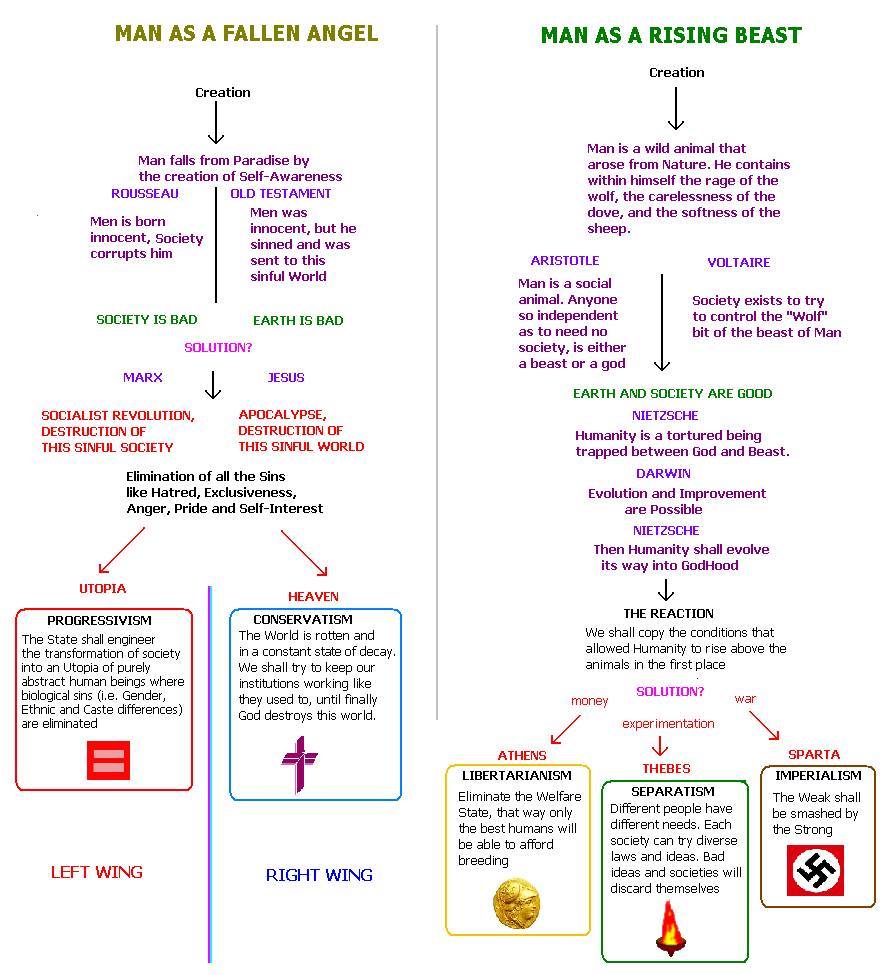
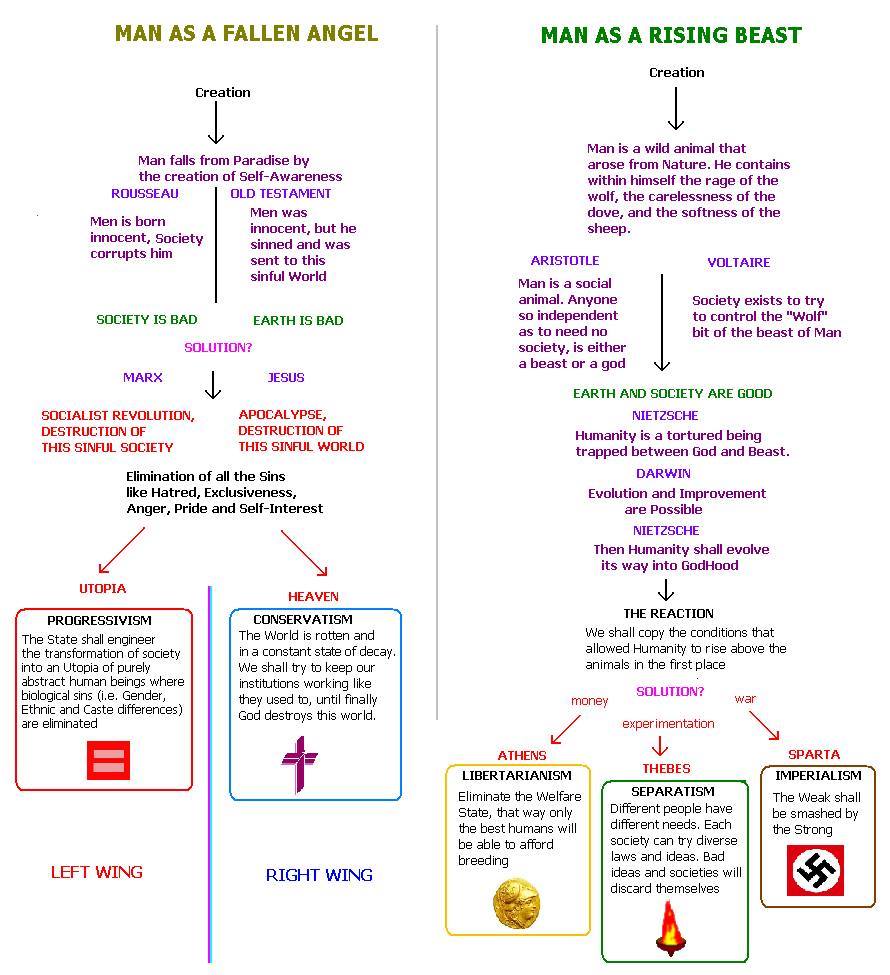
  • Translating Nietzsche Into Propertarian Language

    “Nietzche: Man is a tortured being trapped between god and beast” Doolittle: Man is a purely rational actor having to constantly choose between the short personal gratification at the expense of others and long term gratification through cooperation with others. With the optimum solution for both short and long term is to achieve personal perfection without causing retaliation by others that would destroy those ambitions. Most of us struggle in one way or another with the constant problem of achievement without causing retaliation (rejection, resistance, restitution, punishment).

    And at the same time we struggle with internal impulse and the impatient desire to achieve our ends and the frustration of having to worry about others rather than only the self. Nietzche uses romantic, poetic, narrative language to make this rather boring statement of cooperative economics. But by using that ancient primitive poetic language he fails to inform us as to the cause. And given that cause how to succeed. Hence why I say that Nietzche and propertarianism are compatible. The question is WHICH IS MORE ACTIONABLE? Read him for inspiration and integration with your soul. Choose Propertarianism as the means of achieving it. In retrospect I see my work as succeeding where Spencer failed. We had Darwin and Nietzche, but because of competition from the ‘new age’ provided by marx economically pseudoscientifiic and immoral Marx and immoral and correlative pseudoscientific keynes, the generation that included Spencer, pareto, weber and durkheim, and the generation that included Mises, Popper, Hayek, Brouwer, and Bridgman all failed. THey failed for the same reason the Greeks failed: they worked from the position of virtue and morality (contribution to commons) instead of simply grasping the reductio simplicity of man: we are all rational actors and choose cooperation when beneficial, and non-cooperation when it is beneficial, and we judge all our actions by the cost vs the likely return, given our experience. Man is not moral per se, he just evolved intuitions to assist him if he DOES wish to act morally because it is in his interest, and he must be cautioned that he will incur retaliation if he acts immorally by imposing costs upon others. So we understand man’s behavior as purely rational, and moral intuitions as warnings that we are likely to incurr retaliation for our actions.
  • Translating Nietzsche Into Propertarian Language

    “Nietzche: Man is a tortured being trapped between god and beast” Doolittle: Man is a purely rational actor having to constantly choose between the short personal gratification at the expense of others and long term gratification through cooperation with others. With the optimum solution for both short and long term is to achieve personal perfection without causing retaliation by others that would destroy those ambitions. Most of us struggle in one way or another with the constant problem of achievement without causing retaliation (rejection, resistance, restitution, punishment).

    And at the same time we struggle with internal impulse and the impatient desire to achieve our ends and the frustration of having to worry about others rather than only the self. Nietzche uses romantic, poetic, narrative language to make this rather boring statement of cooperative economics. But by using that ancient primitive poetic language he fails to inform us as to the cause. And given that cause how to succeed. Hence why I say that Nietzche and propertarianism are compatible. The question is WHICH IS MORE ACTIONABLE? Read him for inspiration and integration with your soul. Choose Propertarianism as the means of achieving it. In retrospect I see my work as succeeding where Spencer failed. We had Darwin and Nietzche, but because of competition from the ‘new age’ provided by marx economically pseudoscientifiic and immoral Marx and immoral and correlative pseudoscientific keynes, the generation that included Spencer, pareto, weber and durkheim, and the generation that included Mises, Popper, Hayek, Brouwer, and Bridgman all failed. THey failed for the same reason the Greeks failed: they worked from the position of virtue and morality (contribution to commons) instead of simply grasping the reductio simplicity of man: we are all rational actors and choose cooperation when beneficial, and non-cooperation when it is beneficial, and we judge all our actions by the cost vs the likely return, given our experience. Man is not moral per se, he just evolved intuitions to assist him if he DOES wish to act morally because it is in his interest, and he must be cautioned that he will incur retaliation if he acts immorally by imposing costs upon others. So we understand man’s behavior as purely rational, and moral intuitions as warnings that we are likely to incurr retaliation for our actions.
  • Democracy’s Monopoly Commons vs Rule of Law’s Market Commons

    The value of democracy in the selection of commons decreases with the size of the population voting. Why? because the size of the population increases the diversity of interests. And because democracy allows us only to choose between priorities from within common interest – it’s a monopolistic means of choosing which commons to produce. So when we increase in scale, we require markets to conduct exchanges between different common interests, not monopolies, to ignore our uncommon interests.

  • Democracy’s Monopoly Commons vs Rule of Law’s Market Commons

    The value of democracy in the selection of commons decreases with the size of the population voting. Why? because the size of the population increases the diversity of interests. And because democracy allows us only to choose between priorities from within common interest – it’s a monopolistic means of choosing which commons to produce. So when we increase in scale, we require markets to conduct exchanges between different common interests, not monopolies, to ignore our uncommon interests.

  • The Criminality of Rothbardian Ethics

    Moreover, the this is why libertarians were wrong in privatization. The difference between a commons and private goods, is that owners can consume private goods, and others cannot, whereas no-one can consume commons whether one was a contributor or not. Instead the market (locality) itself benefits from the *externalities* produced by the construction of the commons. So private property prohibits others from consumption, and commons prevent all from consumption. And whereas competition in the market creates incentives to produce private goods, competition in the construction of commons produces malincentives. Why? Because of loss aversion. Given that commons product benefits only be externality, they must be free of privatization in order to provide incentive to produce them. The libertarian solution was to make commons either impossible to produce due to malincentives, or to create vehicles for extraction by externality without contributing to production. pathways through two-dimensional space are particularly problematic since the only way to create private property is with a militia or military funded by the commons.

    The answer instead is to increase incentives for the private production of commons as a status signal and personal monument that outlast’s one’s lifetime, and can be inherited by one’s offspring. And to increase the scale of commons that can be produced by the public (market) production of commons that are free from privatization.