—“This scales along a continuum (with increasing fragility and negative effects as scale increases): The tribe is a softening of family boundaries through intermarriage and mutually beneficial collective action. The nation state is a dissolution of tribal boundaries through ideology or forced submission. Globalism is the suppression of nation state boundaries through fraud and deceit.”— #barbarianeconomist
Source: Original Site Post
-
Globalism Enables our Worst.
(by Bill Joslin December 18 at 2:30am )· Violence occurs at the boundary between in-group and out-group. Globalism attempts to create world peace by dissolving national sovereignty and thus dissolving the in-group out-group boundary on the global scale. By doing so, violence is transferred to non-state actors(rioting, ISIS etc). By destroying formal institutions (the state) the worst of our behavior finds new life in the social sphere (on the street at human scale).
-
Globalism Enables our Worst.
(by Bill Joslin December 18 at 2:30am )· Violence occurs at the boundary between in-group and out-group. Globalism attempts to create world peace by dissolving national sovereignty and thus dissolving the in-group out-group boundary on the global scale. By doing so, violence is transferred to non-state actors(rioting, ISIS etc). By destroying formal institutions (the state) the worst of our behavior finds new life in the social sphere (on the street at human scale).
-
The Game Theory of Sovereignty
Game Theory of Sovereignty (by William Butchman) a) Eli’s Theorem: “If you would be SOVEREIGN, you must fight. If you would win, you must confederate. If you would confederate, you must compromise. If you would compromise, you must accept limits on your actions. SOVEREIGNTY will be won only by those who desire to exercise it within limits considered reasonable by their peers.” b) Aristocratic Egalitarianism: Given the non-negotiable necessity of compromise inherit in confederation, Peerage is necessary, meaning that an egalitarianism is inherit within the circle of confederates, members cannot be subordinates under compulsion, members are equals. Conversely, despotism/tyranny destroys the incentive to cooperate thus: execution of tyrants (Julius Caesar). limited monarchy: Magna Carta, constitutional monarchy. c) Meritocracy (open entrance into aristocracy): As the sovereigns (aristocrats) will always be a tiny minority and the demands of sovereignty are great (expensive), a common strategy is to distribute the cost as widely as possible. So, rather than actively suppressing entrance to the Peerage, the incentive to encourage (maximize) entrance by all who display the desire and ability: Meritocracy. d) War: Sovereignty may only be won through martial prowess. e) Science: The high cost of war creates great incentive for an accurate understanding of the physical universe, that military action may be prosecuted successfully. f) Contractualism: The high cost of military action demands that the participants swear oaths of loyalty even to death and then deliver on those oaths, formalized into contracts of cooperation. g) Trust: Inherent in contract, which is a promise to pay, is the concept of trust. (I feel like this is not explanatory enough).
-
The Game Theory of Sovereignty
Game Theory of Sovereignty (by William Butchman) a) Eli’s Theorem: “If you would be SOVEREIGN, you must fight. If you would win, you must confederate. If you would confederate, you must compromise. If you would compromise, you must accept limits on your actions. SOVEREIGNTY will be won only by those who desire to exercise it within limits considered reasonable by their peers.” b) Aristocratic Egalitarianism: Given the non-negotiable necessity of compromise inherit in confederation, Peerage is necessary, meaning that an egalitarianism is inherit within the circle of confederates, members cannot be subordinates under compulsion, members are equals. Conversely, despotism/tyranny destroys the incentive to cooperate thus: execution of tyrants (Julius Caesar). limited monarchy: Magna Carta, constitutional monarchy. c) Meritocracy (open entrance into aristocracy): As the sovereigns (aristocrats) will always be a tiny minority and the demands of sovereignty are great (expensive), a common strategy is to distribute the cost as widely as possible. So, rather than actively suppressing entrance to the Peerage, the incentive to encourage (maximize) entrance by all who display the desire and ability: Meritocracy. d) War: Sovereignty may only be won through martial prowess. e) Science: The high cost of war creates great incentive for an accurate understanding of the physical universe, that military action may be prosecuted successfully. f) Contractualism: The high cost of military action demands that the participants swear oaths of loyalty even to death and then deliver on those oaths, formalized into contracts of cooperation. g) Trust: Inherent in contract, which is a promise to pay, is the concept of trust. (I feel like this is not explanatory enough).
-
Stoicism as a response to increase in scale.
(by James Augustus Berens ) JA BERENS ON STOICISM AND SCALE —“Stoicism functions as a tool for limiting the scope of human cognitive processes (cognition & responses to perceived changes in state) to the consequential (actionable at individual scale). The scope of man’s cognitive processes evolved under tribal/local scale with limited complexity. Under more complex systems, like those of post-industrial societies, information surpasses the scale of individual actionability, yet because of our innate cognitive biases we respond to, perceive and approach information as if it were consequential.
Complexity and the [perceived] randomness of events eliminate the feedback/information man receives from his actions. That is, as complexity increases, the difficulty of calculating the consequences of a given action or set of actions increases. Thus the need for stoicism as a mental instrument for goal-directed action in an increasingly complex world. It is no surprise, then, that much in the way that Doolittle and Taleb attack pseudoscience via operationalism and probability theory, respectively, we see a resurgence of stoicism guided by operational and probabilistic thinking. In respect to the former, we decrease uncertainty and launder our thoughts of error, bias, [self] deceit and wishful thinking; and, in respect to the latter, under uncertainty, through the investment and coordination of action to produce a convexity of returns/results (anti-fragility): investment in portfolios with limited down side and unlimited upside.”— James Augustus Berens SAME PROBLEM FACING THE GREEKS. Scale -
Stoicism as a response to increase in scale.
(by James Augustus Berens ) JA BERENS ON STOICISM AND SCALE —“Stoicism functions as a tool for limiting the scope of human cognitive processes (cognition & responses to perceived changes in state) to the consequential (actionable at individual scale). The scope of man’s cognitive processes evolved under tribal/local scale with limited complexity. Under more complex systems, like those of post-industrial societies, information surpasses the scale of individual actionability, yet because of our innate cognitive biases we respond to, perceive and approach information as if it were consequential.
Complexity and the [perceived] randomness of events eliminate the feedback/information man receives from his actions. That is, as complexity increases, the difficulty of calculating the consequences of a given action or set of actions increases. Thus the need for stoicism as a mental instrument for goal-directed action in an increasingly complex world. It is no surprise, then, that much in the way that Doolittle and Taleb attack pseudoscience via operationalism and probability theory, respectively, we see a resurgence of stoicism guided by operational and probabilistic thinking. In respect to the former, we decrease uncertainty and launder our thoughts of error, bias, [self] deceit and wishful thinking; and, in respect to the latter, under uncertainty, through the investment and coordination of action to produce a convexity of returns/results (anti-fragility): investment in portfolios with limited down side and unlimited upside.”— James Augustus Berens SAME PROBLEM FACING THE GREEKS. Scale -
Podcast with Richard Heathen
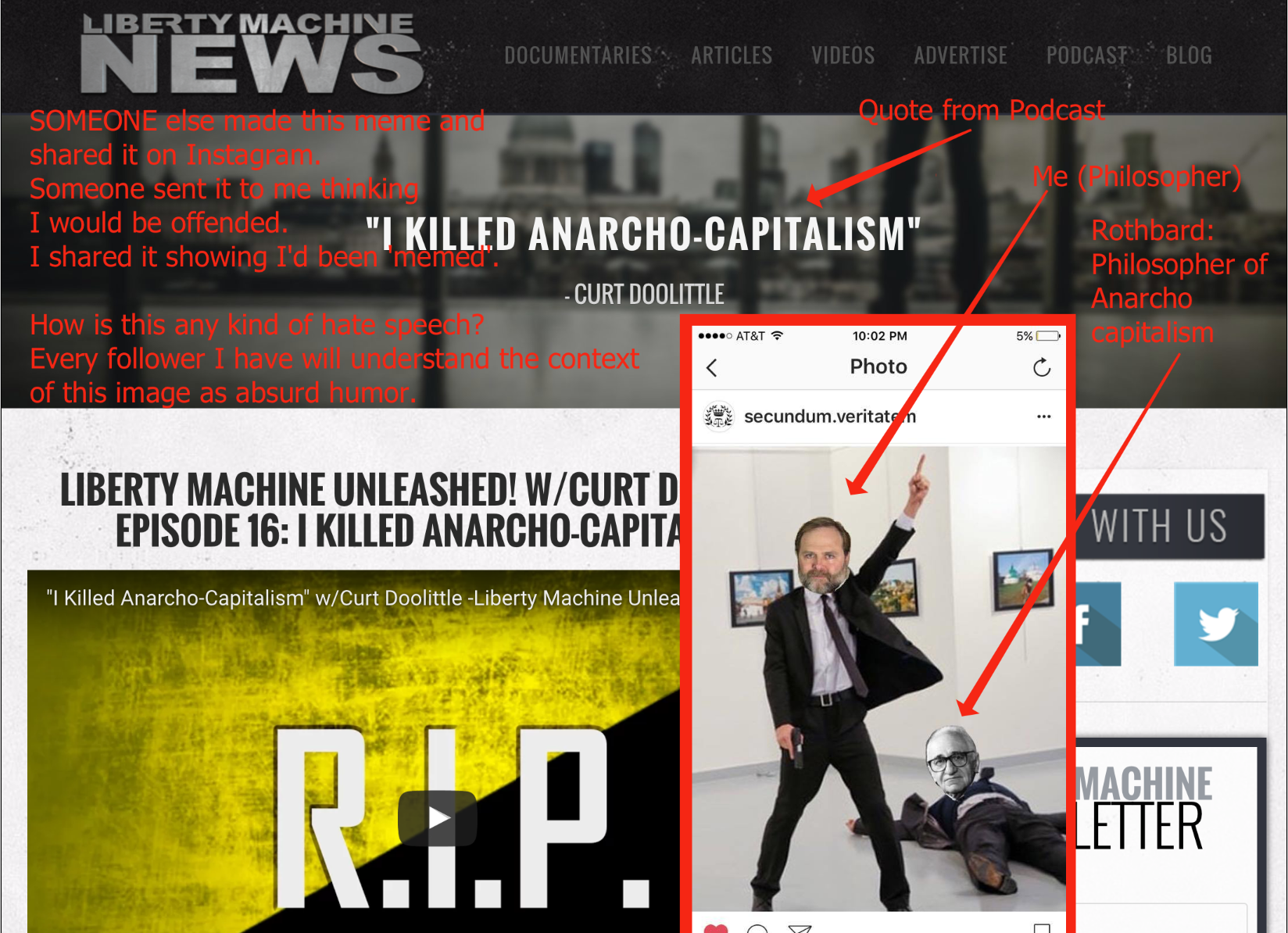
“I Killed Anarcho Capitalism” — Curt Doolittle
On the 16the episode of the Liberty Machine Unleashed! podcast Richard Heathen interviews Curt Doolittle, the Director of the Propertarian Institute and a philosopher of Epistemology, Ethics, Politics, Economics, and Natural Law, in the Conservative Libertarian tradition.
LINK: http://www.libertymachinenews.com/i-killed-anarcho-capitalism-wcurt-doolittle-liberty-machine-unleashed-episode-16.html