Source: Original Site Post

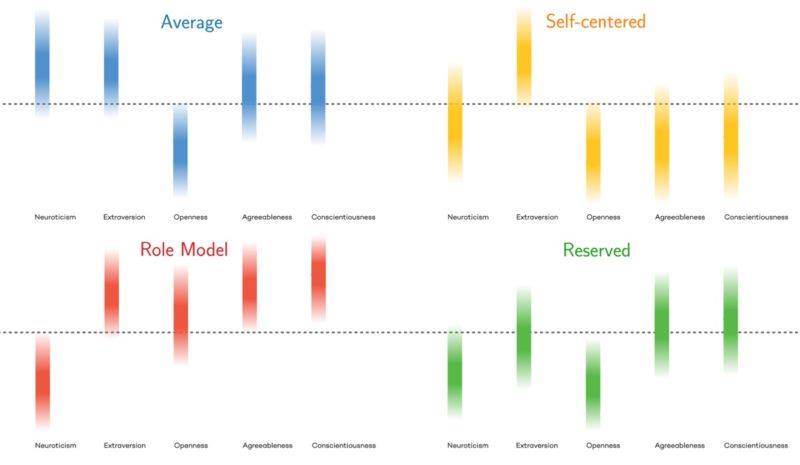
  • Clusters of Similar Personality Traits Produce Four Obvious Types

    ASCENDENT FEMALE BIAS Average: These people score high in neuroticism and extraversion, but score low in openness. It is the most typical category, with women being more likely than men to fit into it. ASCENDENT MALE BIAS Self-Centered: These people score very high in extraversion, but score low in openness, agreeableness, and conscientiousness. Most teenage boys would fall into this category, according to Revelle, before (hopefully) maturing out of it. The number of people who fall into this category decreases dramatically with age. ESTABLISHED FEMALE BIAS Role Models: These people score high in every trait except neuroticism, and the likelihood that someone fits into this category increases dramatically as they age. “These are people who are dependable and open to new ideas,” says Amaral. “These are good people to be in charge of things.” Women are more likely than men to be role models. ESTABLISHED MALE BIAS Reserved: This type of person is stable emotionally without being especially open or neurotic. They tend to score lower on extraversion but tend to be somewhat agreeable and conscientious. ABSTRACT —“Understanding human personality has been a focus for philosophers and scientists for millennia1. It is now widely accepted that there are about five major personality domains that describe the personality profile of an individual2,3. In contrast to personality traits, the existence of personality types remains extremely controversial4. Despite the various purported personality types described in the literature, small sample sizes and the lack of reproducibility across data sets and methods have led to inconclusive results about personality types5,6. Here we develop an alternative approach to the identification of personality types, which we apply to four large data sets comprising more than 1.5 million participants. We find robust evidence for at least four distinct personality types, extending and refining previously suggested typologies. We show that these types appear as a small subset of a much more numerous set of spurious solutions in typical clustering approaches, highlighting principal limitations in the blind application of unsupervised machine learning methods to the analysis of big data.”— https://www.nature.com/articles/s41562-018-0419-z
    42158427_10156647277197264_1595885877257568256_n_10156647277192264.jpg
  • The Essence of Europeanism Over Abrahamism

    —“Our ancestors took great men and turned them into Gods so that we could follow their example and rule ourselves. Abrahamism took God and anthropomorphized him so that we are better able to follow his commands and be ruled over.”— Andy Lunn

    [T]he middle east slaves and shepherds under the despots of the flood river valleys versus the european militia under chosen kings of the farmers and cattlemen of forest and plain. NO MORE LIES. Europa Juris: the cult of non submission.

  • The Essence of Europeanism Over Abrahamism

    —“Our ancestors took great men and turned them into Gods so that we could follow their example and rule ourselves. Abrahamism took God and anthropomorphized him so that we are better able to follow his commands and be ruled over.”— Andy Lunn

    [T]he middle east slaves and shepherds under the despots of the flood river valleys versus the european militia under chosen kings of the farmers and cattlemen of forest and plain. NO MORE LIES. Europa Juris: the cult of non submission.

  • Inequality Is the Wrong Problem. It’s Proximity.

    [I]t’s proximity to inequality that is the problem, not inequality in and of itself. inequality is a good thing if you separate. So solve the right problem: Revolt, Separate, Prosper, Speciate. 😉 (stay on message)

  • Inequality Is the Wrong Problem. It’s Proximity.

    [I]t’s proximity to inequality that is the problem, not inequality in and of itself. inequality is a good thing if you separate. So solve the right problem: Revolt, Separate, Prosper, Speciate. 😉 (stay on message)

  • Fascist? I’m a Fascist?

    [Y]eah. So… Truth, Reciprocity, Rule of Law, Markets that produce prosperity, Family as the central object of policy, paying the underclass not to breed, direct redistribution of liquidity and the polity’s dividends, ending all rent seeking and parasitism both political, financial, and commercial. Exclusionary Nationalism as a means of increasing tolerance for inter-class redistribution, increasing the opportunity for local status attainment; producing commons suitable to the demographics; reducing all possible costs of mutual cooperation and invention; public-private investment in technological, industrial, and commercial innovation. And total suppression of political warfare to impose any alternative. Yeah. Well, that’s my version of Natural Law and it looks a whole lot like NATIONAL SOCIALISM without the silly mustache. So yeah. In the sense that fascism refers to zero tolerance for opposition to all of the above, I’m definitely a fascist. And if you aren’t also then you have no idea what you’re saying other than advocating for free riding, parasitism and predation upon others. So the question is, if you’re not the same kind of fascist, then you’re by definition an unethical and immoral enemy of not only me and mine but all mankind.

  • Fascist? I’m a Fascist?

    [Y]eah. So… Truth, Reciprocity, Rule of Law, Markets that produce prosperity, Family as the central object of policy, paying the underclass not to breed, direct redistribution of liquidity and the polity’s dividends, ending all rent seeking and parasitism both political, financial, and commercial. Exclusionary Nationalism as a means of increasing tolerance for inter-class redistribution, increasing the opportunity for local status attainment; producing commons suitable to the demographics; reducing all possible costs of mutual cooperation and invention; public-private investment in technological, industrial, and commercial innovation. And total suppression of political warfare to impose any alternative. Yeah. Well, that’s my version of Natural Law and it looks a whole lot like NATIONAL SOCIALISM without the silly mustache. So yeah. In the sense that fascism refers to zero tolerance for opposition to all of the above, I’m definitely a fascist. And if you aren’t also then you have no idea what you’re saying other than advocating for free riding, parasitism and predation upon others. So the question is, if you’re not the same kind of fascist, then you’re by definition an unethical and immoral enemy of not only me and mine but all mankind.

  • 88% of Prime Age Men that Are out Of the Work Force, Are so Because of Health or Choice.

    —“Some new research on our of the labor force prime age men: Inactive, Disconnected, and Ailing: A Portrait of Prime-Age Men Out of the Labor Force (ht Noah Smith) This report is intended to enrich our understanding of who these prime-age “inactive” men are. It summarizes evidence from past research and fills out our picture of these men, providing some details about their past and present social and emotional lives. We introduce an under-utilized dataset little-known to economists and sociologists, the “National Epidemiological Survey on Alcohol and Related Conditions-III,” or NESARC-III. Consistent with other survey data, the NESARC-III indicates that in 2013, 11 percent of prime-age men were outside the labor force. Roughly 45 percent of them indicate that their current situation involves illness or disability. Roughly 15 percent of inactive men are in school, 5 to 10 percent are retired, and another 5 to 10 percent are homemakers or caregivers. About a quarter of prime-age inactive men do not fit any of these categories. Contrary to the common view that most of these men have “dropped out” of the labor force after becoming discouraged by the job market, few prime-age inactive men indicate this to be true, and only 12 percent of able-bodied prime-age inactive men indicate in household surveys that they want a job or are open to taking one. We confirm research by other scholars that a large number of inactive men are unambiguously and seriously sick or disabled. We provide new information, showing that many inactive men have poor physical health, poor mental health, or both. Over one-third of them (and nearly three in five disabled inactive men) are in the bottom quarter, nationally, of both physical and mental health. Inactive men have fewer skills than employed men and live in poorer homes, often relying on public safety nets to get by. Two-thirds of inactive men personally received government assistance in the preceding year. One-third of inactive men have been incarcerated (including nearly half of disabled inactive men). Along with other evidence presented here on mobility-impeding behavior, such high incarceration rates suggest employment challenges.”— Read more at https://www.calculatedriskblog.com/2018/09/inactive-disconnected-and-ailing.html#vGZ3m1Ip2sUtCWot.99

  • 88% of Prime Age Men that Are out Of the Work Force, Are so Because of Health or Choice.

    —“Some new research on our of the labor force prime age men: Inactive, Disconnected, and Ailing: A Portrait of Prime-Age Men Out of the Labor Force (ht Noah Smith) This report is intended to enrich our understanding of who these prime-age “inactive” men are. It summarizes evidence from past research and fills out our picture of these men, providing some details about their past and present social and emotional lives. We introduce an under-utilized dataset little-known to economists and sociologists, the “National Epidemiological Survey on Alcohol and Related Conditions-III,” or NESARC-III. Consistent with other survey data, the NESARC-III indicates that in 2013, 11 percent of prime-age men were outside the labor force. Roughly 45 percent of them indicate that their current situation involves illness or disability. Roughly 15 percent of inactive men are in school, 5 to 10 percent are retired, and another 5 to 10 percent are homemakers or caregivers. About a quarter of prime-age inactive men do not fit any of these categories. Contrary to the common view that most of these men have “dropped out” of the labor force after becoming discouraged by the job market, few prime-age inactive men indicate this to be true, and only 12 percent of able-bodied prime-age inactive men indicate in household surveys that they want a job or are open to taking one. We confirm research by other scholars that a large number of inactive men are unambiguously and seriously sick or disabled. We provide new information, showing that many inactive men have poor physical health, poor mental health, or both. Over one-third of them (and nearly three in five disabled inactive men) are in the bottom quarter, nationally, of both physical and mental health. Inactive men have fewer skills than employed men and live in poorer homes, often relying on public safety nets to get by. Two-thirds of inactive men personally received government assistance in the preceding year. One-third of inactive men have been incarcerated (including nearly half of disabled inactive men). Along with other evidence presented here on mobility-impeding behavior, such high incarceration rates suggest employment challenges.”— Read more at https://www.calculatedriskblog.com/2018/09/inactive-disconnected-and-ailing.html#vGZ3m1Ip2sUtCWot.99

  • Gates on What Keeps Him up At Night:

    1 – Antibiotic Resistance. 2 – The next Pandemic: “Disease X” 3 – The expansion of third world population such that medical resources are overwhelmed. 4 – The restoration of decline into poverty because of that demographic expansion. Well shared vision bill. ‘Cept that I am absolutely positive nothing can be done about the last two, and absolutely determined to prevent our genocide because of it. There has to remain a reserve of human capital to survive that cataclysm. QUOTES: Joe Shute,The Telegraph•September 18, 2018 —“When I ask which challenges to global health security he fears the most, Gates outlines three: antibiotic resistance, cuts to government funding to improve health in the world’s poorest countries, and the next unknown disease, referred to by the World Health Organisation simply as ‘Disease X’. “We are not fully prepared for the next global pandemic,” he says. “The threat of the unknown pathogen – highly-contagious, lethal, fast-moving – is real. It could be a mutated flu strain or something else entirely. The Swine Flu and 2014 Ebola outbreaks underscored the threat.” There is another threat on his mind, one which has often been treated as the ‘elephant in the room’ in the world of international development. Namely, the population explosion in Africa’s poorest countries and its future impact – either fueling poverty, political instability, conflict and refugees, or sparking a new boom in world growth as happened in India and China. … above all is one simple fact that even the eternally optimistic Gates warns could mean “to put it bluntly decades of progress in the fight against poverty and disease may be on the verge of stalling”. In short, as birth rates falter in the developed world, in the poorest parts of Africa they are booming. By 2050, the ten poorest countries on the continent are projected to more than double in population. “The thing that is mind-blowing is if the demographers who have been very accurate on these things are right about Africa, then you are going from 1bn today to 2bn at middle of century, to 4bn at the end of the century,” he says.”—