Source: Original Site Post

  • Moral Foundations (instincts)

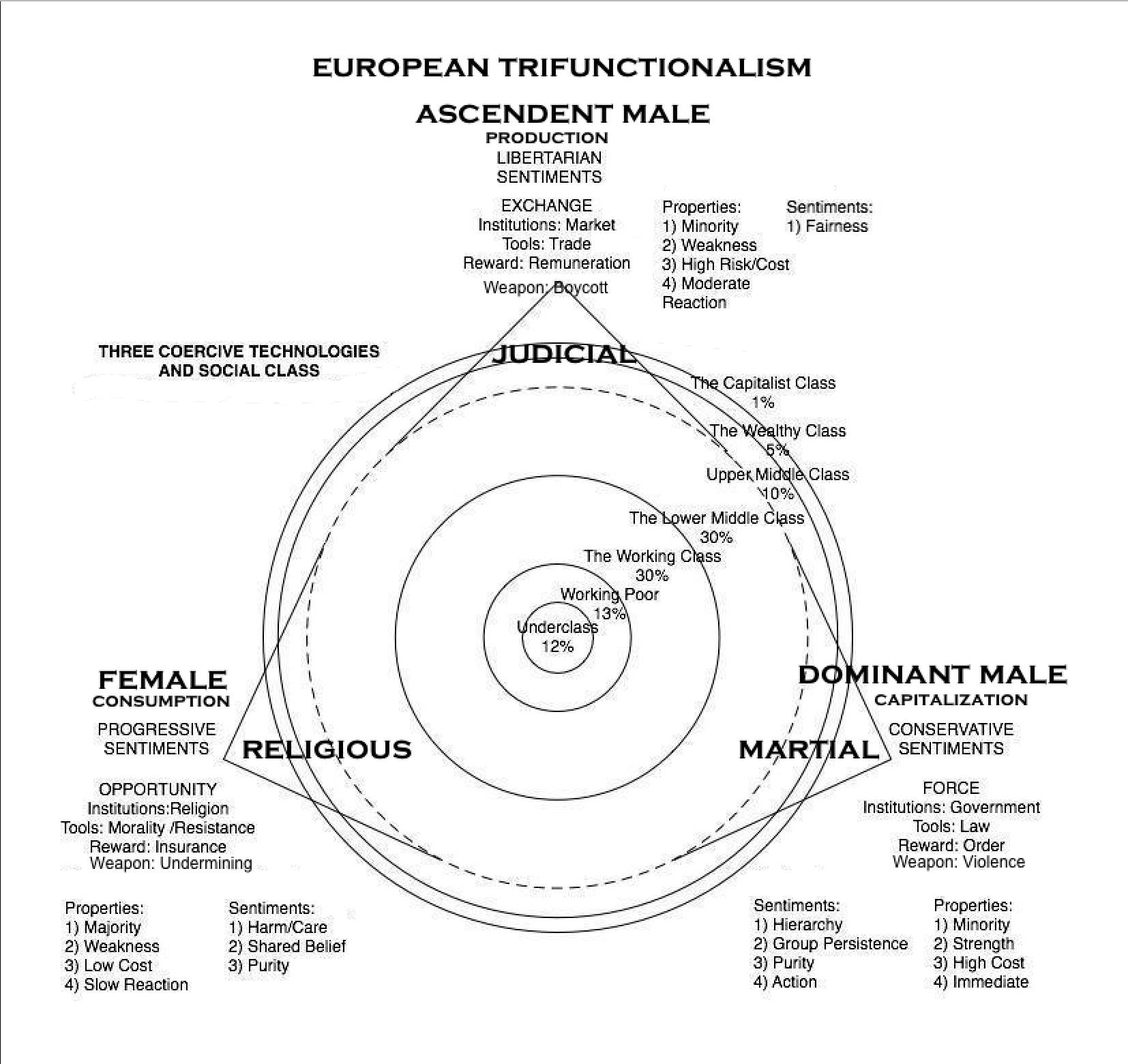
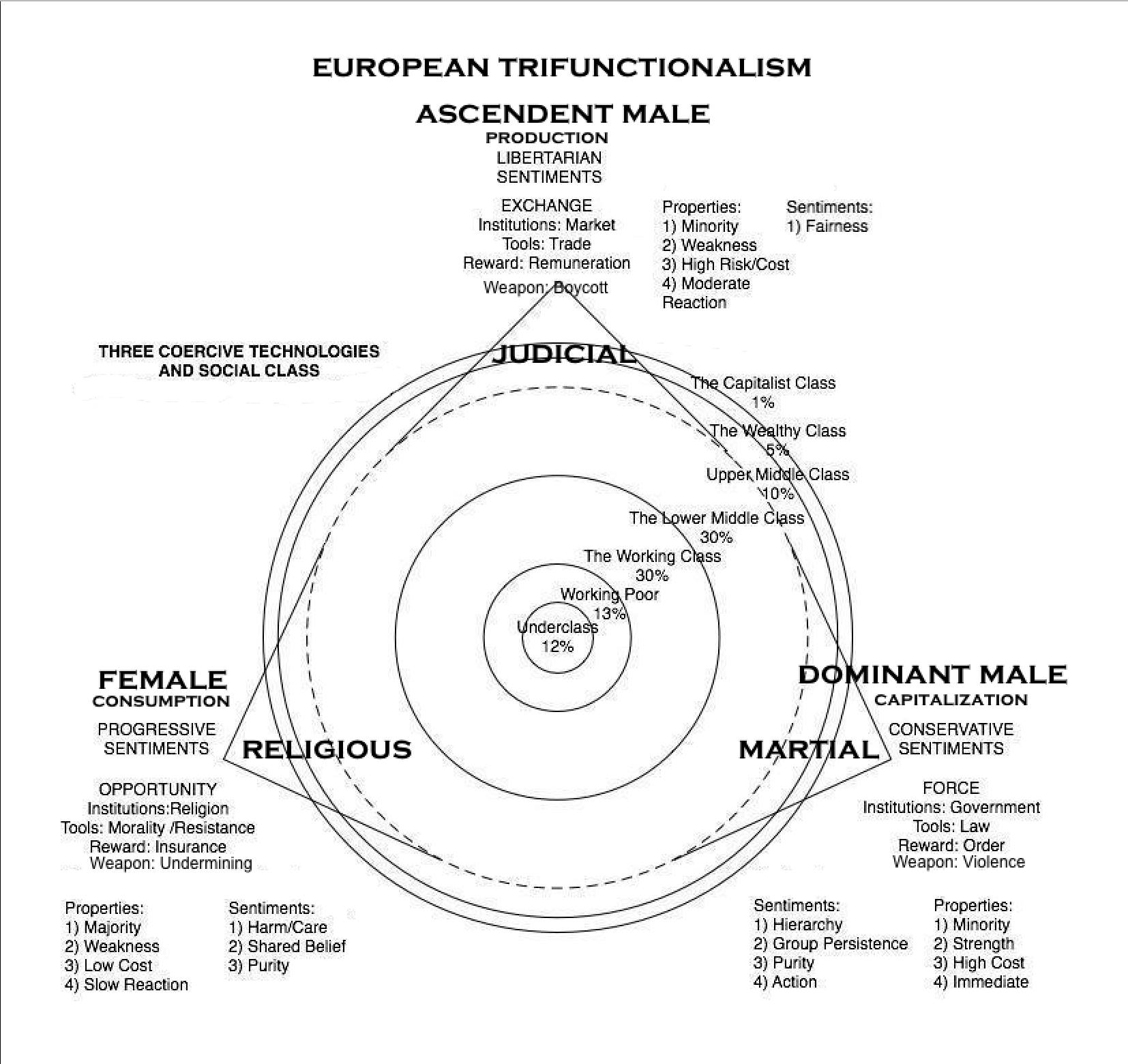
    (HERD): SOCIALIST – EQUALITARIAN – FEMALE(Consumption – Short Term – Anti-Property)Offer: Care, Affection, Sex. Weapon: Undermining, Disloyalty.

    1) Care/Harm: Redistributive Property (Welfare, Charity, Land reform)

    And; 2) Fairness/Cheating: Proportionality. Cooperative Property (Sharing, Antitrust laws, Sport rules)(SOLITARY HUNTER): LIBERTARIAN – EGALITARIAN – ASCENDENT MALE(Production – Medium Term – Property – Exchange)Offer: Exchange. Weapon: Boycott (deprivation)

    3) Liberty/Oppression: Personal Property (freedom, liberty, self determination, opportunity seeking)

    And; 4) Truth/Face: reciprocity information Property (truth before face:M vs face before truth:F)(PACK) ARISTOCRACY – HIERARCHY – DOMINANT MALE(Capitalization – Long Term – Common Property) Offer: Defense, Safety, Order. Weapon: Force, Violence, Disorder.

    5) Sanctity/Degradation: Disgust: Normative Property (Norms, Manners, Ethics)

    And; 6) Loyalty/Betrayal: Interpersonal Property (Kinship, Ethnicity, Nationhood)

    And; 7) Authority/Subversion: Institutional Property (Religion, Hierarchy, Law)

  • On “Playing The Game”

    Questions from Francis Zhou

    —“Curt Doolittle, thank you for explaining the way of the world in such simplicity and clarity. As a young man, I was enamored with the power game, and shaped myself to climb the corporate ladder.” —

    Hugs. I find it cathartic to think I can add value to others. 😉

    —“However once I achieve some success in the game, I realized how trite and boring it all appeared to me. At every re-org, the people “in power” strive to hold onto what little power they have by appeasing to those at higher positions. I detested such game and decided to quit playing this power game and focus on my own game instead (to become best at what I do), which probably explains my relatively low position on the corporate ladder. …. And here within lies my confusion: was I wrong to pursue what I thought of as the “righteous path”, and should have continued to play the power game instead? Since even though I detest that game, it does conform to natural law, and thus exist for a good reason. And being in a position of power will allow me to make positive changes, instead of the current state where I am powerless to make those changes?”—

    Wrong? Wrong is the wrong word. 😉 There is nothing wrong with the game once you figure out running a biz is always a team sport. You were unwilling to pay the cost of submission (loyalty, fealty etc) necessary to ladder climb in the team sport – AND – i’m guessing you weren’t able to add sufficient value in your career or position for others to cater to you (my strategy btw). So we all get what we purchase, and you purchased what you did. I don’t see a problem here other than all men should be educated when young so that they make the choice they prefer. So it’s not that you were wrong so much as you didn’t know that used to be traditional knowledge and was not taught you.

    —“I have another question wrt what you said at the end. If I understood you correctly, by “scale is bad” and “reducing power distance restores meaning and eliminates the opportunity for evil,” you meant by “flatten the organization”, therefore making every individual accountable for their contributions, we eliminate the parasitic elite/middle man whose only incentive is to maintain the power economy and extract rent from the system.”—

    Business vs government. I didn’t mean maximize flattening the organization – although that’s always what I do. The point is that as in any other system, to prevent the development of a bureaucracy (middle management) that seeks steady state and efficiency under the presumption of low rates of adaptation, rather than a project business with a general staff (military organization), under the presumption of continuous change. Similar to my recent complaints about education, cdc, who, and government – if an organization isn’t designed to produce projects, and to conduct war games – even such groups as accounting – and if you don’t have a general staff planning war games (scenarios) then you are running your organization whether business, industry, or government incorrectly – under the presumption of regularity and stasis, which does nothing except create opportunity for rent seeking, corruption, and filling all available time with nonsense OTHER than how to adapt to crises. We discovered this in software and manufacturing but it is still taking time working up through through the large industries, the financial sector, and government – which is what we’d expect really. So power distance requires an equilibrium state, as do markets and the law, between too little power distance so that there are no efficiencies of scale, and to much power distance so that rents seeking arises. in government, too small goernment is petty and too large government is corrupt. It’s been common sense for over two thousand years that small governments – probably on the scale of 5 million-10m are about optimum. I mean, Tokyo is a state in and of itself. So is NYC. So we should treat them as such.

    —“Yet as I understood it, humans invented bureaucracy (hence the power economy) as a necessary tool to organize society beyond Dunbar’s number. How will a society filled with millions of short power distance, flat organizations effectively compete with empires organized around huge bureaucracies marshalling overbearing resources within its borders? E.g., collection of states post Blue/Red separation vs single nation state like China; collection of smaller companies with flat org tree vs goliath like Microsoft and Amazon, etc. I have not found the answer after reading all the resources I came into contact with in the Propertarian community. If I missed anything, please point out the gaps.”—

    first, as I said low power distance is not no power distance, and high power distance creates corruption and rent seeking and fragility. So competing is – as in all things – choosing the optimum point of equilibrium between the two extremes of failure.

  • On “Playing The Game”

    Questions from Francis Zhou

    —“Curt Doolittle, thank you for explaining the way of the world in such simplicity and clarity. As a young man, I was enamored with the power game, and shaped myself to climb the corporate ladder.” —

    Hugs. I find it cathartic to think I can add value to others. 😉

    —“However once I achieve some success in the game, I realized how trite and boring it all appeared to me. At every re-org, the people “in power” strive to hold onto what little power they have by appeasing to those at higher positions. I detested such game and decided to quit playing this power game and focus on my own game instead (to become best at what I do), which probably explains my relatively low position on the corporate ladder. …. And here within lies my confusion: was I wrong to pursue what I thought of as the “righteous path”, and should have continued to play the power game instead? Since even though I detest that game, it does conform to natural law, and thus exist for a good reason. And being in a position of power will allow me to make positive changes, instead of the current state where I am powerless to make those changes?”—

    Wrong? Wrong is the wrong word. 😉 There is nothing wrong with the game once you figure out running a biz is always a team sport. You were unwilling to pay the cost of submission (loyalty, fealty etc) necessary to ladder climb in the team sport – AND – i’m guessing you weren’t able to add sufficient value in your career or position for others to cater to you (my strategy btw). So we all get what we purchase, and you purchased what you did. I don’t see a problem here other than all men should be educated when young so that they make the choice they prefer. So it’s not that you were wrong so much as you didn’t know that used to be traditional knowledge and was not taught you.

    —“I have another question wrt what you said at the end. If I understood you correctly, by “scale is bad” and “reducing power distance restores meaning and eliminates the opportunity for evil,” you meant by “flatten the organization”, therefore making every individual accountable for their contributions, we eliminate the parasitic elite/middle man whose only incentive is to maintain the power economy and extract rent from the system.”—

    Business vs government. I didn’t mean maximize flattening the organization – although that’s always what I do. The point is that as in any other system, to prevent the development of a bureaucracy (middle management) that seeks steady state and efficiency under the presumption of low rates of adaptation, rather than a project business with a general staff (military organization), under the presumption of continuous change. Similar to my recent complaints about education, cdc, who, and government – if an organization isn’t designed to produce projects, and to conduct war games – even such groups as accounting – and if you don’t have a general staff planning war games (scenarios) then you are running your organization whether business, industry, or government incorrectly – under the presumption of regularity and stasis, which does nothing except create opportunity for rent seeking, corruption, and filling all available time with nonsense OTHER than how to adapt to crises. We discovered this in software and manufacturing but it is still taking time working up through through the large industries, the financial sector, and government – which is what we’d expect really. So power distance requires an equilibrium state, as do markets and the law, between too little power distance so that there are no efficiencies of scale, and to much power distance so that rents seeking arises. in government, too small goernment is petty and too large government is corrupt. It’s been common sense for over two thousand years that small governments – probably on the scale of 5 million-10m are about optimum. I mean, Tokyo is a state in and of itself. So is NYC. So we should treat them as such.

    —“Yet as I understood it, humans invented bureaucracy (hence the power economy) as a necessary tool to organize society beyond Dunbar’s number. How will a society filled with millions of short power distance, flat organizations effectively compete with empires organized around huge bureaucracies marshalling overbearing resources within its borders? E.g., collection of states post Blue/Red separation vs single nation state like China; collection of smaller companies with flat org tree vs goliath like Microsoft and Amazon, etc. I have not found the answer after reading all the resources I came into contact with in the Propertarian community. If I missed anything, please point out the gaps.”—

    first, as I said low power distance is not no power distance, and high power distance creates corruption and rent seeking and fragility. So competing is – as in all things – choosing the optimum point of equilibrium between the two extremes of failure.
  • We Invented Truth and They Invented Lying in Response

    (important) (core)

    ............Female and Semitic vs Male and European
    .....................Dysgenics vs Eugenics
    ...................Consumption vs Capitalization
    ...........Private Consumption vs Commons Production
    ...................Undermining vs Order
    ..........Approval/Disapproval vs True/False
    ................Incrementalism vs zero tolerance
    .........Plausible Deniability vs Warranty
    .........................GSRRM vs Truth Regardless of Cost
    ......................Critique vs Falsification
    ........................Pilpul vs Justification
    .................False Promise vs Promise
    ...........Baiting into Hazard vs Offers of Reciprocity
    ......................One Herd vs Many Packs
  • We Invented Truth and They Invented Lying in Response

    (important) (core)

    ............Female and Semitic vs Male and European
    .....................Dysgenics vs Eugenics
    ...................Consumption vs Capitalization
    ...........Private Consumption vs Commons Production
    ...................Undermining vs Order
    ..........Approval/Disapproval vs True/False
    ................Incrementalism vs zero tolerance
    .........Plausible Deniability vs Warranty
    .........................GSRRM vs Truth Regardless of Cost
    ......................Critique vs Falsification
    ........................Pilpul vs Justification
    .................False Promise vs Promise
    ...........Baiting into Hazard vs Offers of Reciprocity
    ......................One Herd vs Many Packs
  • This Is Why – Some Ideas Are Catastrophically Harmful – Because They Are Sources of Ignorance.

    by Daniel Roland Anderson In my teens, and as late as my early 20s, I was into the conspiracy theories. I think I was jumping from noticing patterns to imputing conscious intent and organization to the (malignant) patterns because my Mormon upbringing taught me to look for The Plan of Salvation in everything. Pattern recognition may get hijacked, or something, at a critical stage of development. Not everyone who fails to grow out of this way of seeing the world is incapable, or lacks agency. I’m only just now being able to guess with hindsight at what was going on with me. If I tagged the people I’m thinking of in this comment, they’d possibly/probably be offended because I said when I used to think like this, and used terms like “grow out of” to describe a process that they might want to take a look at. I think this category may be a big one. By Francis Zhou I share a similar experience, having spent my formative years in a protestant church. I have to admit, running with the herd was comforting, however similar to you, I “grew out of it”, after realizing the constrains Christian teachings placed on my growth. By Curt Doolittle Well, when I say ‘some ideas are sources of ignorance’ (which I got from popper) this is what I mean. Some ideas are catastrophic because they prevent better ideas. Hence need for truth.

  • This Is Why – Some Ideas Are Catastrophically Harmful – Because They Are Sources of Ignorance.

    by Daniel Roland Anderson In my teens, and as late as my early 20s, I was into the conspiracy theories. I think I was jumping from noticing patterns to imputing conscious intent and organization to the (malignant) patterns because my Mormon upbringing taught me to look for The Plan of Salvation in everything. Pattern recognition may get hijacked, or something, at a critical stage of development. Not everyone who fails to grow out of this way of seeing the world is incapable, or lacks agency. I’m only just now being able to guess with hindsight at what was going on with me. If I tagged the people I’m thinking of in this comment, they’d possibly/probably be offended because I said when I used to think like this, and used terms like “grow out of” to describe a process that they might want to take a look at. I think this category may be a big one. By Francis Zhou I share a similar experience, having spent my formative years in a protestant church. I have to admit, running with the herd was comforting, however similar to you, I “grew out of it”, after realizing the constrains Christian teachings placed on my growth. By Curt Doolittle Well, when I say ‘some ideas are sources of ignorance’ (which I got from popper) this is what I mean. Some ideas are catastrophic because they prevent better ideas. Hence need for truth.

  • Pull the Veil from Your Mind

    —“Far away in Ukraine, he suggests to disaffected men in the West that _they_ should start a civil war, (he’s the “ideas guy” you see), but using that word requires courage. Instead, he hides behind romantic words like “revolution”, as if war is some beautiful poem. … He’s a snake. … I followed him for years, recommended him to others to follow, even learned a few things I still hold dear as concepts. But the veil dropped once or twice and it was revealed how he uses his intelligence in a corrupting way.”— Phil@Readomain.com @readomain

    [H]ere, in the USA, taking care of an ailing parent rather than putting her in a home, he shows up to fight in virginia, educates others one how our civilization was undermined, writes a reformation of the constitution to restore and preserve it, works within the law – until then. I’m a revolutionary. In the tradition of the founders and their constitution, the british constitution, the common law, the european development of rule of law of common law, the germanic law, and the western indo european law of the ancients and their predecessors. I pull from your face, your rhetoric, and your mind, the veil of ignorance, error, bias, and wishful thinking – that there is any solution possible other than the same revolution each of our ancestors has used to restore freedom, liberty, and sovereignty – and their fruits. I never wore such a veil over my mind. You were just terrified when I pulled the veil from yours. So man up, show up, fight, and win.