Source: Original Site Post

  • Fallen Angels vs Risen Beasts 😉

    90753518_596101140986780_769125924275748864_o

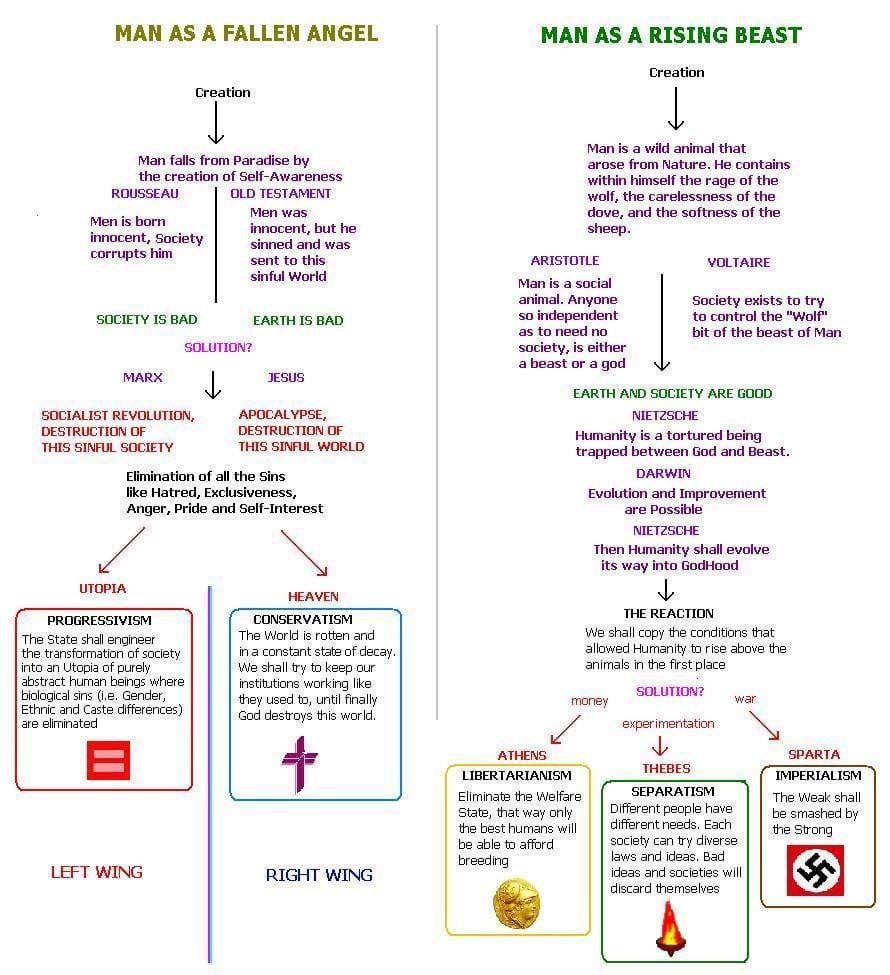
    [S]orry. Man is risen beast (hero) Not fallen angel (criminal). And he is risen by the the law: the physical laws of nature, the natural law of sovereignty and reciprocity, the evolutionary law of transcendence. And the priesthood we love is almost always the enemy of transcendence. And the scientists, judiciary, and entrepreneurs are almost always the advocates of transcendence. If you believe we are fallen angels and that man was oppressed, you’re counter to the evidence and will agree with the oppression and power narrative. If you believe we are risen beasts, and that the underclasses were consistently domesticated like all other animals, then you will be in concert with the evidence. The primary difference between races, sub-races, civilizations, and states is the size of the underclass The struggle for man, that only west and far east achieved at all, is the suppression of the reproduction of the unproductive classes by market means, so that the surpluses of production can be devoted to the production of the high returns on commons. There are various evolutionary reasons why those who are ‘insufficiently valuable for the privilege of reproduction” are unaware of their inadequacy. And there are reasons why elites make use of these useful idiots that don’t know better. Slavery in the european tradition mean’t that others took responsibility for your room and board, in exchange for you doing the work for them. In other words, it was a monetary economy. Only once we develop slavery by conquest (stealing people) does it become a negative institution -and even then slaves were protected from abuse by owners (employers). It’s getting difficult to find places in the world where people are uneducated. But that’s a recent phenomenon. Human beings are not very ‘nice’ to one another by nature. Were purely rational creatures and choose the cheapest means of survival. In advanced civs that happens to be cooperation most of the time. But in most of history war, murder, rape, pillaging, was the most profitable private and public industry. Your ancestors weren’t oppressed. They were domesticated.Humans have no intrinsic value.Your quality of life is more dependent on the smallness of the underclass in relation to the middle and upper classes than it is on your abilities.There is no freedom from physical (scarcity), natural (incentives), and evolutionary (eugenic) laws. None.

  • How Did the Uk End up To Be a Multicultural Root-Less Anti White Mess

    —“In your view, how did the UK end up to be a multicultural root-less anti white mess that it is now? How did the police become increasingly militarized?”— Joshua Shalet

    1) The socialists were more effective postwar than here because the UK was destroyed by her ‘ahem’ civli war to prevent germany from taking over europe (as she traditionally had and western civlization needed her to. france has always been the enemy of europe.). 2) they failed to shrink the state in response to the loss of empire. 3) They were financially dependent on london in ways the USA is not. And they loved all the free money flowing in from europe by being ‘the other switzerland’. 4) They failed to control immigration into london and are now prisoners of it. We can shut down a NYC because any other major city can pick up the slack. But they can’t shut down london because they haven’t a backup. same for france. not the same for usa, canada, australia, germany or russia. 5) Brits don’t have ‘rights’ like Americans and the parliament can modify the constitution whereas the people have to modify the american constitution. 6) They don’t have sheriffs to compete with the police, they don’t have governors to compete with the federal government, the people don’t have rights to sue the government like we do in the states. And that’s just off the top of my head. ( The fact that the British working class is … a bunch of p—ies, addicted to milking the state… well, you know. )

  • How Did the Uk End up To Be a Multicultural Root-Less Anti White Mess

    —“In your view, how did the UK end up to be a multicultural root-less anti white mess that it is now? How did the police become increasingly militarized?”— Joshua Shalet

    1) The socialists were more effective postwar than here because the UK was destroyed by her ‘ahem’ civli war to prevent germany from taking over europe (as she traditionally had and western civlization needed her to. france has always been the enemy of europe.). 2) they failed to shrink the state in response to the loss of empire. 3) They were financially dependent on london in ways the USA is not. And they loved all the free money flowing in from europe by being ‘the other switzerland’. 4) They failed to control immigration into london and are now prisoners of it. We can shut down a NYC because any other major city can pick up the slack. But they can’t shut down london because they haven’t a backup. same for france. not the same for usa, canada, australia, germany or russia. 5) Brits don’t have ‘rights’ like Americans and the parliament can modify the constitution whereas the people have to modify the american constitution. 6) They don’t have sheriffs to compete with the police, they don’t have governors to compete with the federal government, the people don’t have rights to sue the government like we do in the states. And that’s just off the top of my head. ( The fact that the British working class is … a bunch of p—ies, addicted to milking the state… well, you know. )

  • Theosophy

    —“Do you have any writings/thoughts on Theosophy?”—Bradley Morgan

    I know what what’s going on biologically. I know why it’s addictive. I know how training yourself for that experience rather than say muslim, buddhist or stoic or epicurean experiences, functions and how it differs. I know how drug use, and particularly hallucinogens perform their functions and how that differers. And I know what ‘god’ means in those contexts. And I know how horrifying the truth is for those who seek the spiritual experience by artificially induced, self induced, and group induced means. The rest of it is just the story the ‘users’ use to justify it. The dog can chase it’s tail. One can masturbate or have sex. one can have recreational sex or one can have reproductive sex. Likewise one can use drugs to disconnect from reason, one can practice the submission response to disconnect from reason, one can use social overloading to produce the submission response to disconnect from reason. These are just lies in place of ‘true’ association, attention, status, celebration, and achievement. They avoid the hunt-feast cycle. They seek the nursing cycle instead. Labeling the nursing reaction. Labeling the submission to dominance reaction with fanciful stories is just lying to cover the fact that one is engaged in masturbation. Or one can learn to practice mindfulness, virtue, and agency, and contribute to the world because one is human and can reason. ===

    —“What is the nursing cycle?”—Michael Churchill

    The (dominance version) wake-hunt-feast-sex-sleep cycle, the predatory search, stalk, pounce, kill, cycle. And the female equivalent of search, evaluate, nurse(care), relax cycle (submissive version) and the child’s nurse version are all variations on the same regulatory cycles with slight variations in chemical composition (prepare the body, and incentivize the brain). We’re just biological machines. We make mechanical sense so to speak. Two sexes. Slightly different cognitive structures. Slightly different reproductive reward systems. Slightly different acquisition reward systems. Fairly different fear systems. —“Theosophy is false. It’s just another pseudoscience in a long series of paradigms that map the inner world in such a way to justify fraud. The goal is always the same: how to break the rules without getting caught. The method is always the same: how to apply fear, guilt, shame, grief to harm other people.”—Andrew M Gilmour

  • Theosophy

    —“Do you have any writings/thoughts on Theosophy?”—Bradley Morgan

    I know what what’s going on biologically. I know why it’s addictive. I know how training yourself for that experience rather than say muslim, buddhist or stoic or epicurean experiences, functions and how it differs. I know how drug use, and particularly hallucinogens perform their functions and how that differers. And I know what ‘god’ means in those contexts. And I know how horrifying the truth is for those who seek the spiritual experience by artificially induced, self induced, and group induced means. The rest of it is just the story the ‘users’ use to justify it. The dog can chase it’s tail. One can masturbate or have sex. one can have recreational sex or one can have reproductive sex. Likewise one can use drugs to disconnect from reason, one can practice the submission response to disconnect from reason, one can use social overloading to produce the submission response to disconnect from reason. These are just lies in place of ‘true’ association, attention, status, celebration, and achievement. They avoid the hunt-feast cycle. They seek the nursing cycle instead. Labeling the nursing reaction. Labeling the submission to dominance reaction with fanciful stories is just lying to cover the fact that one is engaged in masturbation. Or one can learn to practice mindfulness, virtue, and agency, and contribute to the world because one is human and can reason. ===

    —“What is the nursing cycle?”—Michael Churchill

    The (dominance version) wake-hunt-feast-sex-sleep cycle, the predatory search, stalk, pounce, kill, cycle. And the female equivalent of search, evaluate, nurse(care), relax cycle (submissive version) and the child’s nurse version are all variations on the same regulatory cycles with slight variations in chemical composition (prepare the body, and incentivize the brain). We’re just biological machines. We make mechanical sense so to speak. Two sexes. Slightly different cognitive structures. Slightly different reproductive reward systems. Slightly different acquisition reward systems. Fairly different fear systems. —“Theosophy is false. It’s just another pseudoscience in a long series of paradigms that map the inner world in such a way to justify fraud. The goal is always the same: how to break the rules without getting caught. The method is always the same: how to apply fear, guilt, shame, grief to harm other people.”—Andrew M Gilmour

  • The IE Expansion Getting Settled

    Göran Dahl Simon Ström So is the data settled now? 1) The European-aryan branch spread west and down into and across Europe. 2) The Hitite-aryan branch spread south either thru the caucuses or by water on the coastal route (black sea). 3) the iranian-aryan branch spread north above the caucuses, above the aral sea, then back down into present day iran. 4) The Indian peoples were a mix of west eurasians from present day Iran and earlier local (afro-asiatic?) hunter gatherers. The indo-aryan branch spread into the weak(drought) Indus river peoples and either caused or completed their fall. For all intents and purpose they outbred and are now extinct? 5) The (which branch) that spread east to the yellow-river of china is now extinct? 6) Every group appears to spread by male outbreeding? by Goran Dahl 1) If by Aryan you’re referring to Indo-Iranians, they came from the West originally. More specifically, the Eastern border of the Corded Ware culture, from which they are derived, i.e. Russo-Ukraine. 2) The proto-Hittites most likely spread West from the Sredny Stog culture, and then went South via the Balkans. Sredny Stog -> Usatovo -> Ezero into Anatolia, in a crescent-like pattern following the outline of the western coastline of the Black Sea. 3) The Indo-Iranians go from Eastern Europe–their point of origin–to Central Asia, and from there on to Northeast Asia and down to the Bactria-Margiana Archaeological Complex in Afghanistan. From the BMAC, they go down into Iran and India. 4) The Indian peoples are a mix of Indo-Iranians (Steppe_MLBA), IVC people who were closely related to Iranian farmers (Iran_Neolithic) but were nevertheless a separate line, and people who were similar to the Andamanese (hence the dark skin and Australoid features). The Indo-Iranians outbred, as always. 5) Two branches reached the periphery of China: the Tocharian branch derived from the Afanasievo culture, and the Indo-Iranians (Tarim Basin mummies, Yuezhi). The Mongols of Genghis Khan’s period had significant Indo-Iranian or general North European-like admixture, and Tocharian-derived R1b clades were more widespread in their gene pool based on the samples we have available. Nowadays, local East Asian haplogroups dominate the lineages of modern Mongols to a larger extent. So it seems as though Mongols have admixture from both Indo-Iranians and the ever mysterious, elusive Tocharians. Indo-Iranians seem to have occupied all of Central Asia along with certain Chinese regions. 6) Yeah, basically. by Simon Ström Nothing of consequence has changed in this regard during the past couple of years, AFAIK. A boiling point of technological innovations was reached ~6kya causing a deluge of human mobility emanating from the Pontic-Caspian steppe. Hittites descend from the first group to split from the coherent PIE language community, that we can trace linguistically. We conjecture that they traveled via the Balkan coast becoming lords of the collapsing Old European sedentary civilization in the process, which was among the richest and most developed parts of the world at the time (imagine them like the Aztecs). The PIEs projected in several directions and waves; proto-Tocharians were likely harbored by the Afanasievo culture in Siberia–essentially a twin culture of Yamnaya–that needs separate mention because they seem to have have expanded into a demographic void in Siberia, branching off just before the next key development. A period of chaos, disease and dramatic shifts on the “western front” of early PIE movements eventually brought a new political and social order upon Europe, also transcending Yamnaya and related prior cultures. A brief period of remarkable cultural homogeneity across Eurosiberia with evidence of large-scale interconnectedness in terms of movement and kinship (Corded Ware culture et al; Late PIE) coincided with an equilibration of formerly distinct “east” and “west” European gene pools (both of which were originally derived from variants of primordial h-gs and Near Eastern farmer-pastoralists having pushed north). This marks the ethnogenesis of modern white people in terms of autosomal DNA and uniparental markers in broad strokes, as the resultant genetic structure is largely intact in northern and central Europe. Then, mobility seems to have decreased again and uniformity necessarily faded. Various lineages began to differentiate into distinct cultures harboring the remaining known Indo-European languages (Nordic Bronze Age/Germanic, bronze age Brits speaking an undocumented language, Celts in central Europe and their Italic cousins and proto-Greek tribes moving south, and a “satem” group splitting into Balto-Slavs and early Indo-Iranians somewhere in eastern Europe ~4.5kya, officially ending what we define as the Proto-Indo-European language period. Göran explained well what happened with the Indo-Iranians as they expanded from south of the Urals. They were essentially very successful but drowned genetically as they inherited the prior Indus valley and Iranian plateau civilizations–however markers of their paternal ancestry are dominant to this day. In central Asia, a lot of mixing and displacement subsequently occurred with the rise of Turco-Mongols beginning in the Iron/Late Bronze Age.

  • The IE Expansion Getting Settled

    Göran Dahl Simon Ström So is the data settled now? 1) The European-aryan branch spread west and down into and across Europe. 2) The Hitite-aryan branch spread south either thru the caucuses or by water on the coastal route (black sea). 3) the iranian-aryan branch spread north above the caucuses, above the aral sea, then back down into present day iran. 4) The Indian peoples were a mix of west eurasians from present day Iran and earlier local (afro-asiatic?) hunter gatherers. The indo-aryan branch spread into the weak(drought) Indus river peoples and either caused or completed their fall. For all intents and purpose they outbred and are now extinct? 5) The (which branch) that spread east to the yellow-river of china is now extinct? 6) Every group appears to spread by male outbreeding? by Goran Dahl 1) If by Aryan you’re referring to Indo-Iranians, they came from the West originally. More specifically, the Eastern border of the Corded Ware culture, from which they are derived, i.e. Russo-Ukraine. 2) The proto-Hittites most likely spread West from the Sredny Stog culture, and then went South via the Balkans. Sredny Stog -> Usatovo -> Ezero into Anatolia, in a crescent-like pattern following the outline of the western coastline of the Black Sea. 3) The Indo-Iranians go from Eastern Europe–their point of origin–to Central Asia, and from there on to Northeast Asia and down to the Bactria-Margiana Archaeological Complex in Afghanistan. From the BMAC, they go down into Iran and India. 4) The Indian peoples are a mix of Indo-Iranians (Steppe_MLBA), IVC people who were closely related to Iranian farmers (Iran_Neolithic) but were nevertheless a separate line, and people who were similar to the Andamanese (hence the dark skin and Australoid features). The Indo-Iranians outbred, as always. 5) Two branches reached the periphery of China: the Tocharian branch derived from the Afanasievo culture, and the Indo-Iranians (Tarim Basin mummies, Yuezhi). The Mongols of Genghis Khan’s period had significant Indo-Iranian or general North European-like admixture, and Tocharian-derived R1b clades were more widespread in their gene pool based on the samples we have available. Nowadays, local East Asian haplogroups dominate the lineages of modern Mongols to a larger extent. So it seems as though Mongols have admixture from both Indo-Iranians and the ever mysterious, elusive Tocharians. Indo-Iranians seem to have occupied all of Central Asia along with certain Chinese regions. 6) Yeah, basically. by Simon Ström Nothing of consequence has changed in this regard during the past couple of years, AFAIK. A boiling point of technological innovations was reached ~6kya causing a deluge of human mobility emanating from the Pontic-Caspian steppe. Hittites descend from the first group to split from the coherent PIE language community, that we can trace linguistically. We conjecture that they traveled via the Balkan coast becoming lords of the collapsing Old European sedentary civilization in the process, which was among the richest and most developed parts of the world at the time (imagine them like the Aztecs). The PIEs projected in several directions and waves; proto-Tocharians were likely harbored by the Afanasievo culture in Siberia–essentially a twin culture of Yamnaya–that needs separate mention because they seem to have have expanded into a demographic void in Siberia, branching off just before the next key development. A period of chaos, disease and dramatic shifts on the “western front” of early PIE movements eventually brought a new political and social order upon Europe, also transcending Yamnaya and related prior cultures. A brief period of remarkable cultural homogeneity across Eurosiberia with evidence of large-scale interconnectedness in terms of movement and kinship (Corded Ware culture et al; Late PIE) coincided with an equilibration of formerly distinct “east” and “west” European gene pools (both of which were originally derived from variants of primordial h-gs and Near Eastern farmer-pastoralists having pushed north). This marks the ethnogenesis of modern white people in terms of autosomal DNA and uniparental markers in broad strokes, as the resultant genetic structure is largely intact in northern and central Europe. Then, mobility seems to have decreased again and uniformity necessarily faded. Various lineages began to differentiate into distinct cultures harboring the remaining known Indo-European languages (Nordic Bronze Age/Germanic, bronze age Brits speaking an undocumented language, Celts in central Europe and their Italic cousins and proto-Greek tribes moving south, and a “satem” group splitting into Balto-Slavs and early Indo-Iranians somewhere in eastern Europe ~4.5kya, officially ending what we define as the Proto-Indo-European language period. Göran explained well what happened with the Indo-Iranians as they expanded from south of the Urals. They were essentially very successful but drowned genetically as they inherited the prior Indus valley and Iranian plateau civilizations–however markers of their paternal ancestry are dominant to this day. In central Asia, a lot of mixing and displacement subsequently occurred with the rise of Turco-Mongols beginning in the Iron/Late Bronze Age.

  • Human Behavioral Cycles

    —“What is the nursing cycle?”—Michael Churchill

    Cycles

    1. The (dominance version) wake-hunt-feast-sex-sleep cycle.

    2. The predatory search, stalk, pounce, kill, cycle.

    3. And the female equivalent of search, evaluate, nurse(care), relax cycle (submissive version) and the child’s nurse version. Are all variations on the same regulatory cycles with slight variations in chemical composition (prepare the body, and incentivize the brain). We’re just biological machines. We make mechanical sense so to speak.

  • Human Behavioral Cycles

    —“What is the nursing cycle?”—Michael Churchill

    Cycles

    1. The (dominance version) wake-hunt-feast-sex-sleep cycle.

    2. The predatory search, stalk, pounce, kill, cycle.

    3. And the female equivalent of search, evaluate, nurse(care), relax cycle (submissive version) and the child’s nurse version. Are all variations on the same regulatory cycles with slight variations in chemical composition (prepare the body, and incentivize the brain). We’re just biological machines. We make mechanical sense so to speak.

  • Conservatives = Happier Because Lower Neuroticism

    CONSERVATIVES = HAPPIER BECUSE LOWER NEUROTICISM (and higher disgust) Conservative states tend to have higher levels of life satisfaction because they have lower levels of neuroticism compared to liberal states, according to new research from a psychologist at Cape Breton University. The study, published in the journal Psychological Reports, helps explain why there is a correlation between higher conservatism and higher life satisfaction. “I have had longstanding interests in social, personality, and political psychology,” explained study author Stewart J. H. McCann. “My special interest in personality and its state-level correlates was sparked in 2008 when Dr. P. Jason Rentfrow of the University of Cambridge and his colleagues produced average scores for each of the 50 states on each of the five main personality dimensions—openness to experience, conscientiousness, extraversion, agreeableness, and neuroticism—based on the responses of 619,397 residents of the USA to a widely used 44-item personality questionnaire. “Since that time, I have published 17 research articles showing relations between state-levels of these personality variables and various other important differences between states such as political attitudes, work satisfaction, illness, mortality, residential mobility, creativity, volunteering, emotional health, smoking, and obesity.” “Previous research by others had shown that conservatives generally were happier and more satisfied with their lives than liberals. But why?” McCann told PsyPost. “Three different explanations had been put forward by others. However, I thought that there might be a fourth and more convincing explanation.” “Existing research demonstrated that there are associations not only between higher conservatism and higher life satisfaction but also between lower neuroticism and higher life satisfaction and between lower neuroticism and higher conservatism. Perhaps if neuroticism was statistically controlled or effectively held constant, the association between higher conservatism and higher life satisfaction would vanish.” “The relation between conservatism and life satisfaction might be dependent upon neuroticism levels. The present study was conducted to test this possibility in a state-level analysis.” McCann analyzed data from Rentfrow’s study, Gallup-Healthways Well-Being Index, U.S. Census Bureau, CBS News and the New York Times polls, and the presidential election results from 2000 to 2008. He found that differences in the levels of neuroticism in each state could account for the state-level association between higher conservatism and higher life satisfaction. Other factors he examined, including socioeconomic status, did not account for the association. “The results of the present study strongly suggest that there is nothing inherent in a conservative worldview as opposed to a liberal worldview that promotes greater happiness and life satisfaction,” McCann explained. “Rather it is the underlying higher neuroticism that tends to be more likely in liberals and the underlying lower neuroticism that tends to be more likely in conservatives that accounts for the greater happiness and life satisfaction in conservatives.” “For example, higher neuroticism is characterized by higher levels of vulnerability, self-consciousness, depression, tenseness, moodiness, angry hostility, impulsiveness, nervousness, anxiety, worry, emotional instability, and poor stress management. Clearly, such a constellation does not bode well for happiness and satisfaction with life.” The study used a cross-sectional methodology, meaning McCann cannot make inferences about cause and effect. He believes, based on previous research, that higher neuroticism fosters lower life satisfaction and that lower neuroticism promotes higher conservatism — but the reverse could also be true. His study has another caveat as well. “Readers must understand that this was a study carried out with the 50 states rather than a sample of individuals as the cases,” McCann explained. “What was found is that state levels of resident neuroticism can account for the relation between state levels of conservatism and state levels of life satisfaction. “I am assuming that the state-level relations are dependent upon parallel individual-level relations. Caution must be exercised in making such cross-level extrapolations. However, some comfort is taken from the fact that other researchers (Burton, Plaks, & Peterson, 2015) also have found the same dynamics in an individual-level analysis and reached the same conclusion regarding why conservatives tend to be happier and more satisfied with life.” The study was titled: “State Resident Neuroticism Accounts for Life Satisfaction Differences Between Conservative and Liberal States of the USA”. Source: https://www.psypost.org/
/study-suggests-lower-levels-neuro
 DEFINING NEUROTICISM Neuroticism Neuroticism is one of the Big Five higher-order personality traits in the study of psychology. Individuals who score high on neuroticism are more likely than average to be moody and to experience such feelings as anxiety, worry, fear, anger, frustration, envy, jealousy, guilt, depressed mood, and loneliness. People who are neurotic respond worse to stressors and are more likely to interpret ordinary situations as threatening and minor frustrations as hopelessly difficult. They are often self-conscious and shy, and they may have trouble controlling urges and delaying gratification. Neuroticism is a trait in many models within personality theory, but there is a lot of disagreement on its definition. Some define it as a tendency for quick arousal when stimulated and slow relaxation from arousal, especially in concern to negative emotional arousal; others define it as emotional instability and negativity or maladjustment, in contrast to emotional stability and positivity, or good adjustment. Others yet define it as lack of self-control, poor ability to manage psychological stress, and a tendency to complain.[6] Various personality tests produce numerical scores, and these scores are mapped onto the concept of “neuroticism” in various ways, which has created some confusion in the scientific literature, especially with regard to sub-traits or “facets”.[6] Individuals who score low in neuroticism tend to be more emotionally stable and less reactive to stress. They tend to be calm, even-tempered, and less likely to feel tense or rattled. Although they are low in negative emotion, they are not necessarily high on positive emotion. Being high in scores of positive emotion is generally an element of the independent trait of extraversion. Neurotic extraverts, for example, would experience high levels of both positive and negative emotional states, a kind of “emotional roller coaster”.[7][8] (Impulsive) Neurotic <-> Calm (Agency) ======= STUDIES 1) State Resident Neuroticism Accounts for Life Satisfaction Differences Between Conservative and Liberal States of the USA Stewart J. H. McCannFirst Published August 11, 2017 Research Article Find in PubMed https://doi.org/10.1177/0033294117725072 https://journals.sagepub.com/doi/10.1177/0033294117725072 Abstract Past research indicates associations between higher conservatism and higher life satisfaction, lower neuroticism and higher life satisfaction, and higher conservatism and lower neuroticism. Qualified deduction led to the following hypothesis: Neuroticism can account for the association between higher conservatism and higher life satisfaction. The 50 American states served as the units of analysis. Responses of 619,397 residents to the 44-item Big Five Inventory in an internet survey conducted from 1999 to 2005 provided mean neuroticism scores for each state. Conservative-liberal leaning of over 84,000 respondents to CBS News/New York Times polls from 1999 to 2003 and the percent voting Republican in each state in the 2000 to 2008 presidential elections combined to form a conservatism score for each state. The Gallup-Healthways Well-Being Index provided life satisfaction scores for over 1,000,000 respondents, transforming to a 2008 to 2010 composite score for each state. In a sequential multiple regression equation with life satisfaction as the criterion, state socioeconomic status and white population percent entered first as a block, conservatism entered second, and neuroticism entered third, the demographic controls accounted for 45.7% of the variance, conservatism accounted for another 10.4%, and neuroticism accounted for an additional 10.6%. However, with the entry order of conservatism and neuroticism reversed, neuroticism accounted for another 19.6% but conservatism accounted for only an additional nonsignificant 1.4%. Therefore, the hypothesis was supported. Three alternative explanations suggested by other researchers were not supported in the state-level analysis. 2) Why Do Conservatives Report Being Happier Than Liberals? The Contribution of Neuroticism Caitlin M. Burton*a, Jason E. Plaksa, Jordan B. Petersona [a] Department of Psychology, University of Toronto, Toronto, Ontario, Canada. https://jspp.psychopen.eu/article/view/117/html Abstract Previous studies suggest that conservatives in the United States are happier than liberals. This difference has been attributed to factors including differences in socioeconomic status, group memberships, and system-justifying beliefs. We suggest that differences between liberals and conservatives in personality traits may provide an additional account for the “happiness gap”. Specifically, we investigated the role of neuroticism (or conversely, emotional stability) in explaining the conservative-liberal happiness gap. In Study 1 (N = 619), we assessed the correlation between political orientation (PO) and satisfaction with life (SWL), controlling for the Big Five traits, religiosity, income, and demographic variables. Neuroticism, conscientiousness, and religiosity each accounted for the PO-SWL correlation. In Study 2 (N = 700), neuroticism, system justification beliefs, conscientiousness, and income each accounted for PO-SWL correlation. In both studies, neuroticism negatively correlated with conservatism. We suggest that individual differences in neuroticism represent a previously under-examined contributor to the SWL disparity between conservatives and liberals.