Source: Original Site Post

  • Scale and The Store of Trust

    Oct 15, 2019, 2:22 PM Jonathan Haidt on his book The Coddling of the American Mind standard.co.uk https://standard.co.uk/lifestyle/books/jonathan-haidt-the-coddling-of-the-american-mind-a4261081.html? SCALE AND THE STORE OF TRUST by Luke Weinhagen ( CD: I’m Sharing because of this bit of genius:

    —“The system can not scale beyond its ability to generate and store trust and begins to fail immediately when the extraction of stored trust exceeds the production of trust. That store can act as a buffer during a period of backsliding (and can enable a lot of really destructive behavior in the guise of “tolerance”), but it will not save us.”— Luke Weinhagen

    ) === COMPLETE POST ===

    —-“We came out of a century that had some of the worst horrors in history but which made extraordinary progress on almost every conceivable front in the decades afterwards, and now we’re backsliding.” — Jon Haidt

    Putting this in the context I’ve been building over the last couple weeks, the “progress” Haidt is describing (from my perspective) are the mechanisms we developed to foster the development of trust that became possible through the shared exposure to those horrors. I agree with both Haidt and Doolittle in that the outcome of this backsliding in inevitable should it continue. The lesson will impose itself. Whether we learn from it, kindly or not, is another matter. Looking at Curt’s response in the same context I’ve been using –

    “…conspicuous consumption of compromises between genes, gender, class, and interests” = extraction of trust. “…cooperative necessity in social orders…” = mechanisms for the production of trust

    The system can not scale beyond its ability to generate and store trust and begins to fail immediately when the extraction of stored trust exceeds the production of trust. That store can act as a buffer during a period of backsliding (and can enable a lot of really destructive behavior in the guise of “tolerance”), but it will not save us. “Domestication” is the process of transcendence from each of the lower foundational rules of human interaction to the next higher form of interaction/expansion of the capacity to store trust. THE FOUNDATIONS 1. Via Positiva: ……. The Golden Rule. 2. Via Negativa: ….. The Silver Rule. 3. Via Logica: ……….The Natural Law of Reciprocity. 4. Via Existentia: …. Rule of Law, ………………………….. … The Jury, and ………………………….. … Markets in everything. 5. Via Violentia: …. The Iron Rule. Might Makes Right. Both of these texts are worth a read when you get a chance. – Luke Weinhagen
  • Testimony (and humor)

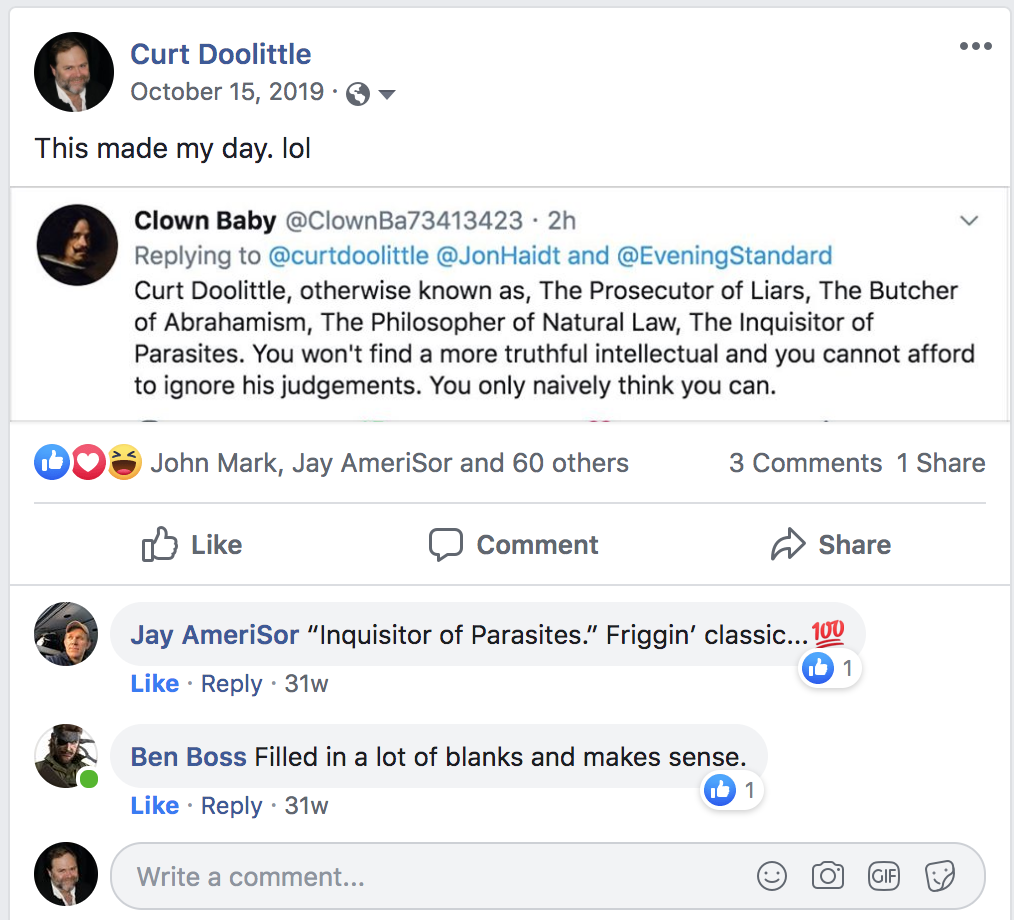
    —“Curt Doolittle, otherwise known as, The Prosecutor of Liars, The Butcher of Abrahamism, The Philosopher of Natural Law, The Inquisitor of Parasites. You won’t find a more truthful intellectual and you cannot afford to ignore his judgements. You only naively think you can.”— a Friend

  • “A Letter from Curt to The Christians” (so to Speak)

    A Letter to Christians youtube.com “A LETTER FROM CURT TO THE CHRISTIANS” (so to speak) ~35min. Explaining Prop. Objectives for Religion

  • “A Letter from Curt to The Christians” (so to Speak)

    A Letter to Christians youtube.com “A LETTER FROM CURT TO THE CHRISTIANS” (so to speak) ~35min. Explaining Prop. Objectives for Religion

  • Loans Against Trust

    Oct 15, 2019, 6:05 PM by Luke Weinhagen Law and contract can be used to subsidize for the absence of specific trust, such as between strangers or untested business partners. Both are “loans” against the stored trust in a polity. Enforced and insured by the commons in the form of “WE as a common polity will impose a cost on any party that breaches law or contract”. Law and contract only provide incentives for adherence where you can expect positive reciprocity (trust producing – rule of law) or where you can rely on the enforcement mechanisms to compel adherence (trust consuming – rule by law). Trust consumption eventually gets us back to “Might makes Right” and brings us back to the question “Why don’t I kill you and take your stuff?” (we descend the foundational rule stack). If trust is not there in some form, no one follow the law or sticks to contracts.

  • Loans Against Trust

    Oct 15, 2019, 6:05 PM by Luke Weinhagen Law and contract can be used to subsidize for the absence of specific trust, such as between strangers or untested business partners. Both are “loans” against the stored trust in a polity. Enforced and insured by the commons in the form of “WE as a common polity will impose a cost on any party that breaches law or contract”. Law and contract only provide incentives for adherence where you can expect positive reciprocity (trust producing – rule of law) or where you can rely on the enforcement mechanisms to compel adherence (trust consuming – rule by law). Trust consumption eventually gets us back to “Might makes Right” and brings us back to the question “Why don’t I kill you and take your stuff?” (we descend the foundational rule stack). If trust is not there in some form, no one follow the law or sticks to contracts.

  • ‘Contrast Godel with P – Request from Kash Vikas

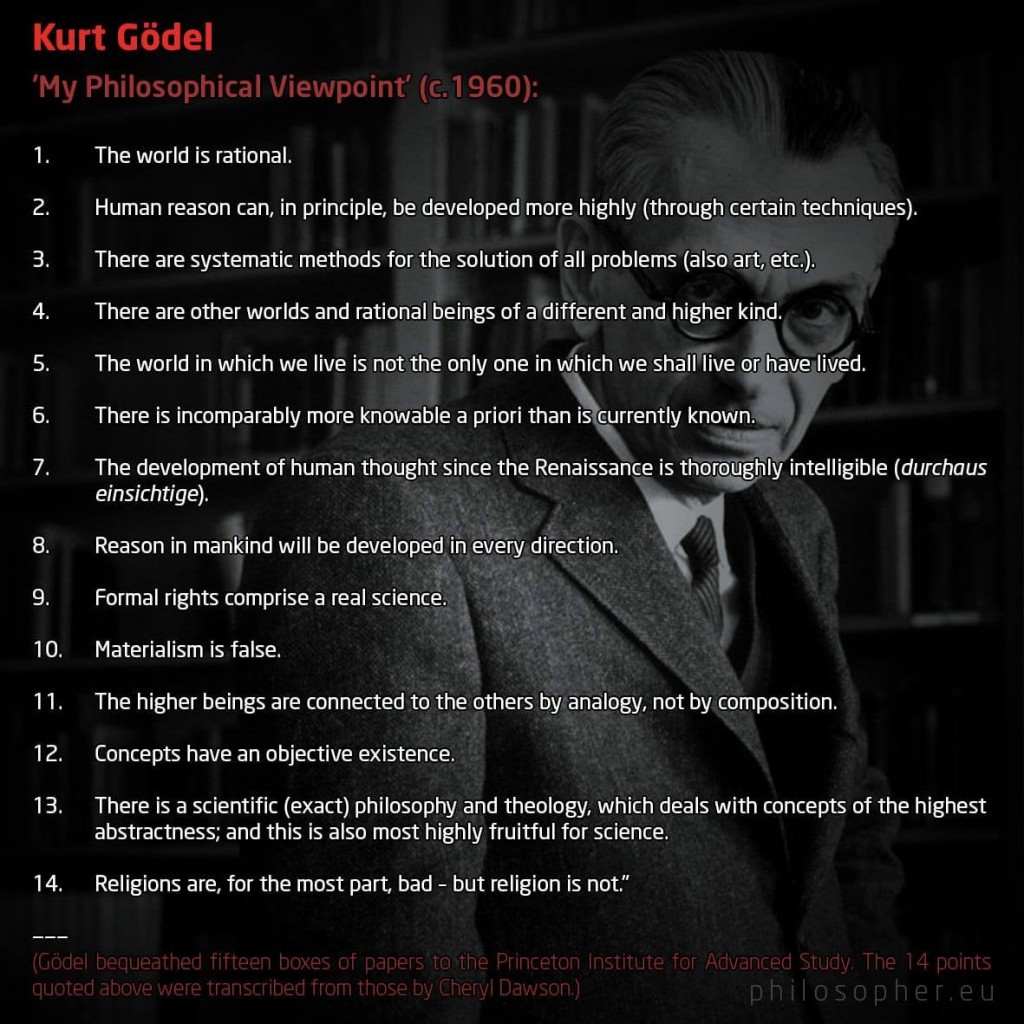
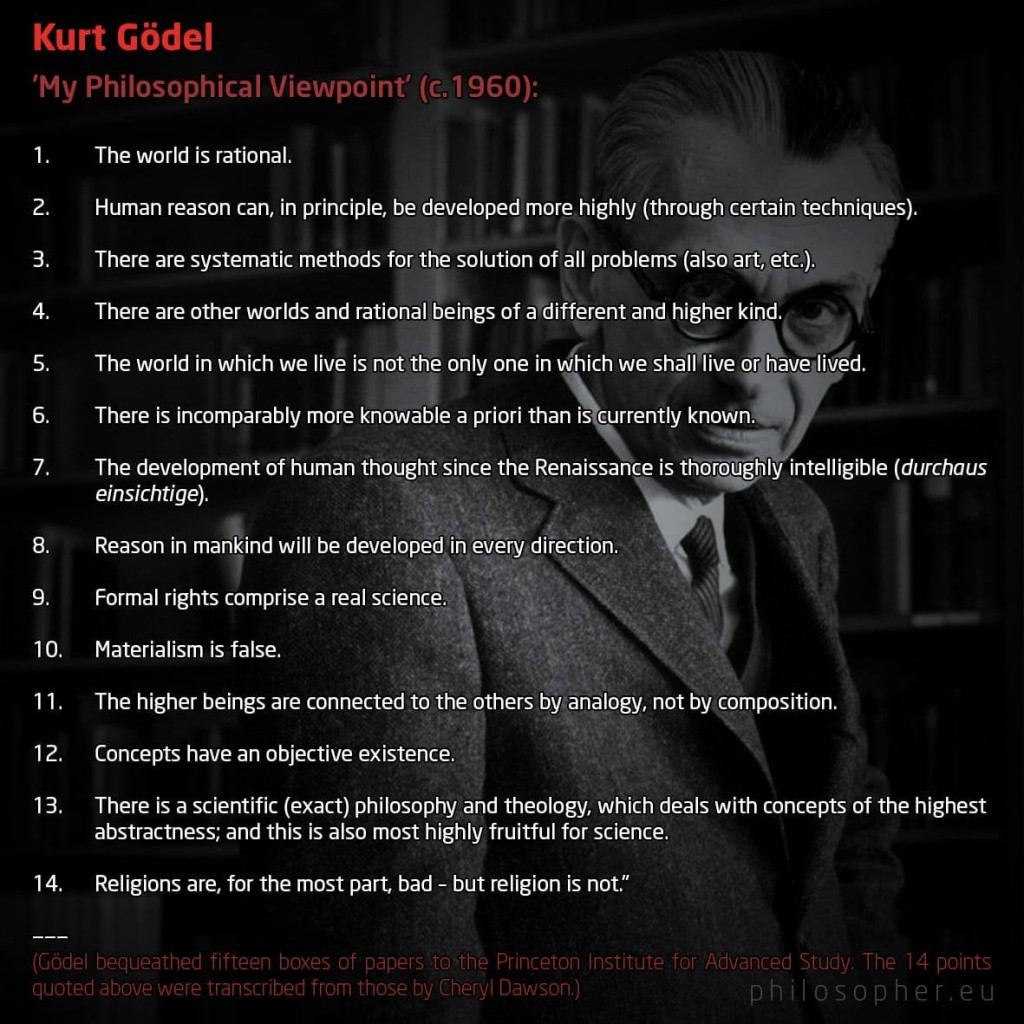
    Oct 16, 2019, 10:49 AM (Godel is a Platonist and I’m an Operationalist. This contrast is rather helpful in illustrating the operational vs platonist vs empirical.)

    1. Man acts rationally, and by rationally amorally. But given the disproportionate value of cooperation, and the disproportionate risk of retaliation, it’s just in his interest to act morally much more often than immorally.
      1a. We can incrementally reduce observations of the universe, using our senses, reason, and instrumentation to descriptions of invariant constant relations (paradigms)
      1b + 3. We can describe (explain) all of experience as constant relations (a single paradigm)
    2. While our ability to reason is constant, every increase convergence of our instruments and paradigms increases the explanatory power available to our reason.
    3. The capacity to reason is a deterministic product of entropy at convenient temperatures in convenient conditions, for sufficient periods of time. It is likely that given the vastness of the universe, other creatures have evolved reason, and that while the logic of constant relations will exist, and mathematics as a logic of constant positional relations will exist in some form, that the composition of experience that results from different body structures will result in different techniques for employing reason. (think octopi). And that the ability of these creatures may vastly outperform ours.
    4. Because we are able to use our powers of prediction using free association to construct a model of the world we exist in, and the worlds we might exist in, and the worlds we cannot exist in, we can experience, many candidate worlds.
      5b. The set of demands we evolved and express daily is largely invariant. The set of paradigms we use to imagine opportunities for fulfilling those demands evolves (and devolves) constantly. So while we largely increase the coherence of paradigms, and approach a single paradigm for describing the universe, we have experienced the world differently in the past than in the present, and will so again experience it differently in the future.
    5. If we can construct an operational grammar and paradigm for a given set of constant relations, we can produce an operational logic of that set of constant relations, and conduct experiments logically by trial and error as we do in mathematics. To do so we require convergence of paradigms to the point of marginal indifference of those logical constructions. But the Analytic program failed, and Godel and Frege et all were wrong – closure does not exist.
    6. Yes the development of thought since Aristotle expanded on Democritus, has been consistent and rational with the exception of the semitic abrahamic dark ages of supernatural ignorance.
    7. Reason is reason is reasoning and there is nothing to it. There are however endless permutations of reason especially as knowledge increases.
    8. The via-negativa of Natural Law can be restated in the via-positiva as Natural rights, and this logic and empirical combination produces a science of cooperation, and law the institutional enforcement of cooperation under that law, and economics the measure of it’s success, and economics the language of analysis and measurement within that science.
      10.The material(noun) and the Operational(verb) are true (exist, and are testifiable). The platonic (ideal) is false. All sets of constant relations are identified, retained, applied, reinforced, and revised by merging physical stimuli with physical organization of information in the brain, producing a hierarchy of changes in state over time we call ‘experience’. So while it is correct to say that the universe is deterministic (composed of constant relations), it is only correct to say that we can observe sets of constant relations, identify them (category), compare them, name them, and predict future states of of them, and in relation to them. These memories and predications like running consist of physical potential, that produce results in time. In other words, al of reality is constructed physically, from a hierarchy of changes in state over time we call experience.
    9. Concepts do not exist. the potential for Concepts exists. Running only exists when one is running. We have the potential to run. We have the potential to identify sets of constant relations (concepts), but experience of contexts only exist when we are acting to recall them in time.
    10. It appears we can know the most parsimonious paradigm, and host of parsimonious sub-paradigms of increasing complexity (permutations) allowing us to speak the truth using evidence – science; that we can know the same for choices using arguments – philosophy; and we can know the same for collective organization using stories – theology.
    11. Existing religions are bad to terrible to suicidal – but human psychological, social, political, and strategic demand for the products of ‘religion’ (order) are endless. So we need to educate one another in mindfulness, ethics(interpersonal), morality (extrapersonal), political, and strategic (competitive), by means gracefully increasing and decreasing in accessibility: parable, story, history, reason and general rules, science and outcomes.’
      CONTRAST WITH P – REQUEST FROM KASH VIKAS
      (Godel is a Platonist and I’m an Operationalist. This contrast is rather helpful in illustrating the operational vs platonist vs empirical.)

    12. Man acts rationally, and by rationally amorally. But given the disproportionate value of cooperation, and the disproportionate risk of retaliation, it’s just in his interest to act morally much more often than immorally.
      1a. We can incrementally reduce observations of the universe, using our senses, reason, and instrumentation to descriptions of invariant constant relations (paradigms)
      1b + 3. We can describe (explain) all of experience as constant relations (a single paradigm)

    13. While our ability to reason is constant, every increase convergence of our instruments and paradigms increases the explanatory power available to our reason.
    14. The capacity to reason is a deterministic product of entropy at convenient temperatures in convenient conditions, for sufficient periods of time. It is likely that given the vastness of the universe, other creatures have evolved reason, and that while the logic of constant relations will exist, and mathematics as a logic of constant positional relations will exist in some form, that the composition of experience that results from different body structures will result in different techniques for employing reason. (think octopi). And that the ability of these creatures may vastly outperform ours.
    15. Because we are able to use our powers of prediction using free association to construct a model of the world we exist in, and the worlds we might exist in, and the worlds we cannot exist in, we can experience, many candidate worlds.
      5b. The set of demands we evolved and express daily is largely invariant. The set of paradigms we use to imagine opportunities for fulfilling those demands evolves (and devolves) constantly. So while we largely increase the coherence of paradigms, and approach a single paradigm for describing the universe, we have experienced the world differently in the past than in the present, and will so again experience it differently in the future.
    16. If we can construct an operational grammar and paradigm for a given set of constant relations, we can produce an operational logic of that set of constant relations, and conduct experiments logically by trial and error as we do in mathematics. To do so we require convergence of paradigms to the point of marginal indifference of those logical constructions. But the Analytic program failed, and Godel and Frege et all were wrong – closure does not exist.
    17. Yes the development of thought since Aristotle expanded on Democritus, has been consistent and rational with the exception of the semitic abrahamic dark ages of supernatural ignorance.
    18. Reason is reason is reasoning and there is nothing to it. There are however endless permutations of reason especially as knowledge increases.
    19. The via-negativa of Natural Law can be restated in the via-positiva as Natural rights, and this logic and empirical combination produces a science of cooperation, and law the institutional enforcement of cooperation under that law, and economics the measure of it’s success, and economics the language of analysis and measurement within that science.
      10.The material(noun) and the Operational(verb) are true (exist, and are testifiable). The platonic (ideal) is false. All sets of constant relations are identified, retained, applied, reinforced, and revised by merging physical stimuli with physical organization of information in the brain, producing a hierarchy of changes in state over time we call ‘experience’. So while it is correct to say that the universe is deterministic (composed of constant relations), it is only correct to say that we can observe sets of constant relations, identify them (category), compare them, name them, and predict future states of of them, and in relation to them. These memories and predications like running consist of physical potential, that produce results in time. In other words, al of reality is constructed physically, from a hierarchy of changes in state over time we call experience.
    20. Concepts do not exist. the potential for Concepts exists. Running only exists when one is running. We have the potential to run. We have the potential to identify sets of constant relations (concepts), but experience of contexts only exist when we are acting to recall them in time.
    21. It appears we can know the most parsimonious paradigm, and host of parsimonious sub-paradigms of increasing complexity (permutations) allowing us to speak the truth using evidence – science; that we can know the same for choices using arguments – philosophy; and we can know the same for collective organization using stories – theology.
    22. Existing religions are bad to terrible to suicidal – but human psychological, social, political, and strategic demand for the products of ‘religion’ (order) are endless. So we need to educate one another in mindfulness, ethics(interpersonal), morality (extrapersonal), political, and strategic (competitive), by means gracefully increasing and decreasing in accessibility: parable, story, history, reason and general rules, science and outcomes.
  • ‘Contrast Godel with P – Request from Kash Vikas

    Oct 16, 2019, 10:49 AM (Godel is a Platonist and I’m an Operationalist. This contrast is rather helpful in illustrating the operational vs platonist vs empirical.)

    1. Man acts rationally, and by rationally amorally. But given the disproportionate value of cooperation, and the disproportionate risk of retaliation, it’s just in his interest to act morally much more often than immorally.
      1a. We can incrementally reduce observations of the universe, using our senses, reason, and instrumentation to descriptions of invariant constant relations (paradigms)
      1b + 3. We can describe (explain) all of experience as constant relations (a single paradigm)
    2. While our ability to reason is constant, every increase convergence of our instruments and paradigms increases the explanatory power available to our reason.
    3. The capacity to reason is a deterministic product of entropy at convenient temperatures in convenient conditions, for sufficient periods of time. It is likely that given the vastness of the universe, other creatures have evolved reason, and that while the logic of constant relations will exist, and mathematics as a logic of constant positional relations will exist in some form, that the composition of experience that results from different body structures will result in different techniques for employing reason. (think octopi). And that the ability of these creatures may vastly outperform ours.
    4. Because we are able to use our powers of prediction using free association to construct a model of the world we exist in, and the worlds we might exist in, and the worlds we cannot exist in, we can experience, many candidate worlds.
      5b. The set of demands we evolved and express daily is largely invariant. The set of paradigms we use to imagine opportunities for fulfilling those demands evolves (and devolves) constantly. So while we largely increase the coherence of paradigms, and approach a single paradigm for describing the universe, we have experienced the world differently in the past than in the present, and will so again experience it differently in the future.
    5. If we can construct an operational grammar and paradigm for a given set of constant relations, we can produce an operational logic of that set of constant relations, and conduct experiments logically by trial and error as we do in mathematics. To do so we require convergence of paradigms to the point of marginal indifference of those logical constructions. But the Analytic program failed, and Godel and Frege et all were wrong – closure does not exist.
    6. Yes the development of thought since Aristotle expanded on Democritus, has been consistent and rational with the exception of the semitic abrahamic dark ages of supernatural ignorance.
    7. Reason is reason is reasoning and there is nothing to it. There are however endless permutations of reason especially as knowledge increases.
    8. The via-negativa of Natural Law can be restated in the via-positiva as Natural rights, and this logic and empirical combination produces a science of cooperation, and law the institutional enforcement of cooperation under that law, and economics the measure of it’s success, and economics the language of analysis and measurement within that science.
      10.The material(noun) and the Operational(verb) are true (exist, and are testifiable). The platonic (ideal) is false. All sets of constant relations are identified, retained, applied, reinforced, and revised by merging physical stimuli with physical organization of information in the brain, producing a hierarchy of changes in state over time we call ‘experience’. So while it is correct to say that the universe is deterministic (composed of constant relations), it is only correct to say that we can observe sets of constant relations, identify them (category), compare them, name them, and predict future states of of them, and in relation to them. These memories and predications like running consist of physical potential, that produce results in time. In other words, al of reality is constructed physically, from a hierarchy of changes in state over time we call experience.
    9. Concepts do not exist. the potential for Concepts exists. Running only exists when one is running. We have the potential to run. We have the potential to identify sets of constant relations (concepts), but experience of contexts only exist when we are acting to recall them in time.
    10. It appears we can know the most parsimonious paradigm, and host of parsimonious sub-paradigms of increasing complexity (permutations) allowing us to speak the truth using evidence – science; that we can know the same for choices using arguments – philosophy; and we can know the same for collective organization using stories – theology.
    11. Existing religions are bad to terrible to suicidal – but human psychological, social, political, and strategic demand for the products of ‘religion’ (order) are endless. So we need to educate one another in mindfulness, ethics(interpersonal), morality (extrapersonal), political, and strategic (competitive), by means gracefully increasing and decreasing in accessibility: parable, story, history, reason and general rules, science and outcomes.’
      CONTRAST WITH P – REQUEST FROM KASH VIKAS
      (Godel is a Platonist and I’m an Operationalist. This contrast is rather helpful in illustrating the operational vs platonist vs empirical.)

    12. Man acts rationally, and by rationally amorally. But given the disproportionate value of cooperation, and the disproportionate risk of retaliation, it’s just in his interest to act morally much more often than immorally.
      1a. We can incrementally reduce observations of the universe, using our senses, reason, and instrumentation to descriptions of invariant constant relations (paradigms)
      1b + 3. We can describe (explain) all of experience as constant relations (a single paradigm)

    13. While our ability to reason is constant, every increase convergence of our instruments and paradigms increases the explanatory power available to our reason.
    14. The capacity to reason is a deterministic product of entropy at convenient temperatures in convenient conditions, for sufficient periods of time. It is likely that given the vastness of the universe, other creatures have evolved reason, and that while the logic of constant relations will exist, and mathematics as a logic of constant positional relations will exist in some form, that the composition of experience that results from different body structures will result in different techniques for employing reason. (think octopi). And that the ability of these creatures may vastly outperform ours.
    15. Because we are able to use our powers of prediction using free association to construct a model of the world we exist in, and the worlds we might exist in, and the worlds we cannot exist in, we can experience, many candidate worlds.
      5b. The set of demands we evolved and express daily is largely invariant. The set of paradigms we use to imagine opportunities for fulfilling those demands evolves (and devolves) constantly. So while we largely increase the coherence of paradigms, and approach a single paradigm for describing the universe, we have experienced the world differently in the past than in the present, and will so again experience it differently in the future.
    16. If we can construct an operational grammar and paradigm for a given set of constant relations, we can produce an operational logic of that set of constant relations, and conduct experiments logically by trial and error as we do in mathematics. To do so we require convergence of paradigms to the point of marginal indifference of those logical constructions. But the Analytic program failed, and Godel and Frege et all were wrong – closure does not exist.
    17. Yes the development of thought since Aristotle expanded on Democritus, has been consistent and rational with the exception of the semitic abrahamic dark ages of supernatural ignorance.
    18. Reason is reason is reasoning and there is nothing to it. There are however endless permutations of reason especially as knowledge increases.
    19. The via-negativa of Natural Law can be restated in the via-positiva as Natural rights, and this logic and empirical combination produces a science of cooperation, and law the institutional enforcement of cooperation under that law, and economics the measure of it’s success, and economics the language of analysis and measurement within that science.
      10.The material(noun) and the Operational(verb) are true (exist, and are testifiable). The platonic (ideal) is false. All sets of constant relations are identified, retained, applied, reinforced, and revised by merging physical stimuli with physical organization of information in the brain, producing a hierarchy of changes in state over time we call ‘experience’. So while it is correct to say that the universe is deterministic (composed of constant relations), it is only correct to say that we can observe sets of constant relations, identify them (category), compare them, name them, and predict future states of of them, and in relation to them. These memories and predications like running consist of physical potential, that produce results in time. In other words, al of reality is constructed physically, from a hierarchy of changes in state over time we call experience.
    20. Concepts do not exist. the potential for Concepts exists. Running only exists when one is running. We have the potential to run. We have the potential to identify sets of constant relations (concepts), but experience of contexts only exist when we are acting to recall them in time.
    21. It appears we can know the most parsimonious paradigm, and host of parsimonious sub-paradigms of increasing complexity (permutations) allowing us to speak the truth using evidence – science; that we can know the same for choices using arguments – philosophy; and we can know the same for collective organization using stories – theology.
    22. Existing religions are bad to terrible to suicidal – but human psychological, social, political, and strategic demand for the products of ‘religion’ (order) are endless. So we need to educate one another in mindfulness, ethics(interpersonal), morality (extrapersonal), political, and strategic (competitive), by means gracefully increasing and decreasing in accessibility: parable, story, history, reason and general rules, science and outcomes.
  • Testimony

    Oct 16, 2019, 5:29 PM

    —“I think the best thing about P is that it avoids the biggest rhetorical pitfalls of most boomers and old xers. Millenials and gen Z are mad that we have no community, society, fair ratio of marriageable women, reason to invest at all. Most of us would trade what we have now for communism, anarchy or any number of flawed systems. Philosophically fight club or the joker are more compelling than most or the abstract appeals pitched at us in the past 50 years, except for P. Nothing else really defines or offers appealing alternatives with actionable solutions. Thanks Curt Doolittle”—

      Hugs brother. 😉

  • Testimony

    Oct 16, 2019, 5:29 PM

    —“I think the best thing about P is that it avoids the biggest rhetorical pitfalls of most boomers and old xers. Millenials and gen Z are mad that we have no community, society, fair ratio of marriageable women, reason to invest at all. Most of us would trade what we have now for communism, anarchy or any number of flawed systems. Philosophically fight club or the joker are more compelling than most or the abstract appeals pitched at us in the past 50 years, except for P. Nothing else really defines or offers appealing alternatives with actionable solutions. Thanks Curt Doolittle”—

      Hugs brother. 😉