Source: Facebook

  • THE DEEPEST INSIGHT –“Seeing the world without the need for a moralistic overla

    THE DEEPEST INSIGHT

    –“Seeing the world without the need for a moralistic overlay, since the morality is indelibly in my heart already (and for those who lack it, it can’t be taught), and the truth is enough.”–


    Source date (UTC): 2019-01-16 07:37:00 UTC

  • We are not ruled by money but by human greed – where that worst greed is called

    We are not ruled by money but by human greed – where that worst greed is called ‘equality’.


    Source date (UTC): 2019-01-16 07:36:00 UTC

  • We evolved family habit > tribal custom > traditional law > religious law > poli

    We evolved family habit > tribal custom > traditional law > religious law > political and judicial law > rule of law > rule by credit > (and now) rule by information (as in china).


    Source date (UTC): 2019-01-16 07:35:00 UTC

  • TESTIMONY —“I’ve gotta say Curt, studying and meditating on (usually via diale

    TESTIMONY

    —“I’ve gotta say Curt, studying and meditating on (usually via dialectic with others for me) Propertarianism has felt like the foggy glasses have been lifted off my eyes.

    Seeing the world without the need for a moralistic overlay, since the morality is indelibly in my heart already (and for those who lack it, it can’t be taught), and the truth is enough.

    I just feel like with my synthesized application of even a basic understanding of operationalism, I can deal with just about any dilemma calmly and with resolute conviction.

    It’s a nice feeling my overdriven brain. It’s quite calming and puts me in a space of joyous hope for the changes ahead!

    So thanks for the psychological positive side effects of your movement.”— A Friend via PM


    Source date (UTC): 2019-01-16 07:32:00 UTC

  • THE HIDDEN DECLINE IN HUMAN CAPITAL—AND THE DANGER AHEAD by Peter Temin, Profess

    THE HIDDEN DECLINE IN HUMAN CAPITAL—AND THE DANGER AHEAD

    by Peter Temin, Professor Emeritus of Economics, Massachusetts Institute of Technology(MIT).

    U.S. GDP accounting underestimates intangible capital, overstates financial capital, and is all but oblivious to the the erosion of human and social capital. A serious growth slowdown is coming.

    The American economy changed rapidly in the last half-century. We kept track of this transformation through the National Income and Product Accounts (NIPA), a set of statistical constructs that were designed before these changes started. Our national accounts have stretched to accommodate new and growing service activities, but they are still organized by their original design. This can be seen in the growth of financial activity and the efforts of many economists to fit finance into our measurement of national product and of economic growth. I argue in my paper that our current economic data fail to describe accurately the path of growth in our new economy. They fail to see that the United States is consuming its capital stock now and will suffer later, rather like killing the family cow to have a steak dinner.

    Modern growth theory started with two papers by Robert M. Solow in the late 1950s. The first paper showed that it was possible to create a stable model of economic growth using a Keynesian model of investment and capital. The second paper showed that this model failed to explain most of American growth in the first half of the 20th century (Solow, 1956, 1957).

    Other economists expanded Solow’s model by adding additional types of capital: human capital, social capital, financial capital. The first addition was to add human capital by measuring the effect of education on productivity. This enabled economists to work with an expanded Solow model. The second addition was to add social capital. This was added in cross-sectional regressions and has not been applied to ongoing growth estimates. The third addition was added by assuming that wealth equals physical capital, that is, financial capital is indistinguishable from physical assets (Mankiw, Romer and Weil, 1992; Hall and Jones, 1999; Dasgupta, 2007; Piketty 2014).

    These additions furnished explanations of economic growth in the United States and other countries. The importance of these contributions was confirmed in many empirical studies, but the NIPA continues to calculate Private Fixed Investment, a Keynesian construct, as the investment part of GDP. This problem is acute in the data for finance. Philippon (2015, 1435) concluded that, “The unit cost of financial intermediation does not seem to have decreased significantly in recent years.” As he says, this is surprising on several grounds. I build on his work to understand whether this result is the result of how the underlying data were collected.

    This disconnect infects the calculation of economic growth. Griliches (1990, 1994) noted over two decades ago that more and more of GDP is composed of services, which also have been called intangibles. It is hard to estimate the output of the financial sector, for example, so it is measured by its inputs. As I will show, although this may give a useful measure of current activity, it is less informative about economic growth.

    There are two problems. It is hard to measure productivity if inputs and outputs are conflated. If we fail to include productivity growth of an increasing part of the national product, we increasingly will underestimate the growth of the national product. Further, if we do not have a good measure of output, it is almost impossible to measure investments in finance and other intangibles. If we do not have good measures of the various forms of capital listed here, we will not be able to think hard about longer-run growth. Concern about this latter point provides the motivation for this paper.

    Outside the literature on the national product, there are many treatments of these new forms of capital. In addition to financial capital, human capital has been the center of explanations for the United States’ economic domination in the twentieth century as well as the progress of individuals within the United States (Golden and Katz, 2008; Heckman, Pinto and Savelyev, 2013). Social capital has been the center of analyses of economic growth in the United States and elsewhere and in the long and short run (Putnam, 1993, 2000; Dasgupta, 2007). Measuring these forms of capital poses many of the same problems as measuring financial capital.

    I review in this paper the accounting methods used to compile investment data to understand how these other forms of capital behave in an economy that has changed markedly since the 1950s. I conclude that current accounting of growth in GDP fails to include the kind of investment that generates these other forms of capital. This conclusion has three implications. First, short-run growth as currently calculated bears more relation to short-run Keynesian analysis than to what we know about long-run economic growth. Second, financial capital increases inequality more than it generates growth for the entire economy. Third, we are now allowing human and social capital to depreciate, auguring ill for future economic growth in the United States.

    Peter Temin is Elisha Gray II Professor Emeritus of Economics at the Massachusetts Institute of Technology (MIT). His “The Political Economy of Mass Incarceration and Crime: An Analytic Model,” has just been published by the International Journal of Political Economy. A revised version of an earlier INET Working Paper, it will be freely available on line for the month after January 5, 2019: https://www.tandfonline.com/do…

    References

    Dasgupta, Partha. 2007. Economics: A Very Short Introduction. Oxford: Oxford University Press.

    Golden, Claudia, and Lawrence F. Katz. 2008. The Race between Eduction and Technology. Cambridge, MA Harvard University Press.

    Griliches, Zvi (ed.). Output Measurement in the Service Sectors. Chicago: Chicago University Press, 1990.

    Griliches, Zvi. 1994. “Productivity, R&D, and the Data Constraint.” American Economic Review, 84 (1): 1-23.

    Hall, Robert E., and Charles I. Jones. 1999. “Why Do Some Countries Produce So Much More Output per Worker than Others?” Quarterly Journal of Economics, 83-116.

    Heckman, James, Rodrigo Pinto, and Peter Savelyev. 2013. “Understanding the Mechanisms Through Which an Influential Early Childhood Program Boosted Adult Outcomes.” American Economic Review, 103 (6): 2052-2086.

    Mankiw, N. Gregory, David Romer and David N. Weil. 1992. “A Contribution to the Empirics of Economic Growth.” Quarterly Journal of Economics 107 (2): 407-37.

    Philippon, Thomas. 2015. “Has the US Financial Industry Become Less Efficient? On the Theory and Measurement of Financial Intermediation.” American Economic Review 105 (4), 1408-1438.

    Piketty, Thomas. 2014. Capital in the Twenty-First Century. Cambridge, MA: Harvard University Press.

    Putnam, Robert D. 1993. Making Democracy Work: Civic Tradition in Modern Italy. Princeton: Princeton University Press.

    Putnam, Robert D. 2000. Bowling Alone: The Collapse and Revival of American Community. New York: Simon and Shuster.

    Solow, Robert M. 1956. “A Contribution to the Theory of Economic Growth.” Quarterly Journal of Economics 70: 65-94.

    Solow, Robert M. 1957. “Technical Change and the Aggregate Production Function.” Review of Economics and Statistics 39: 312-20.

    VIA:

    https://www.ineteconomics.org/perspectives/blog/the-hidden-decline-in-human-capital-and-the-danger-ahead?

    PAPER:

    https://www.ineteconomics.org/uploads/papers/WP_86-Temin-Finance-in-Economic-Growth.pdf


    Source date (UTC): 2019-01-16 07:00:00 UTC
  • WHY YOUNG PEOPLE SAY THEY ARE NOT GOING TO CHURCH The 66 percent who said they s

    WHY YOUNG PEOPLE SAY THEY ARE NOT GOING TO CHURCH

    The 66 percent who said they stopped attending church regularly as young adults cited a variety of reasons for leaving.

    The reasons fell under four categories:

    Nearly all — 96 percent — cited life changes, including moving to college and work responsibilities that prevented them from attending.

    Seventy-three percent said church or pastor-related reasons led them to leave. Of those, 32 percent said church members seemed judgmental or hypocritical and 29 percent said they did not feel connected to others who attended.

    Seventy percent named religious, ethical or political beliefs for dropping out. Of those, 25 percent said they disagreed with the church’s stance on political or social issues while 22 percent said they were only attending to please someone else.

    And, 63 percent said student and youth ministry reasons contributed to their decision not to go. Of those, 23 percent said they never connected with students in student ministry and 20 percent said the students seemed judgmental or hypocritical.

    “We’re tapping into a lot of different feelings and logistical things as well,” said McConnell, pointing out that this age group is often in a time of transition.

    But leaving was not an intentional decision for many. Of those who dropped out, 71 percent said they did not plan on it.


    Source date (UTC): 2019-01-15 20:49:00 UTC

  • photos_and_videos/TimelinePhotos_SxeO6JU-xg/50060776_10156919540572264_374355124

    photos_and_videos/TimelinePhotos_SxeO6JU-xg/50060776_10156919540572264_374355124

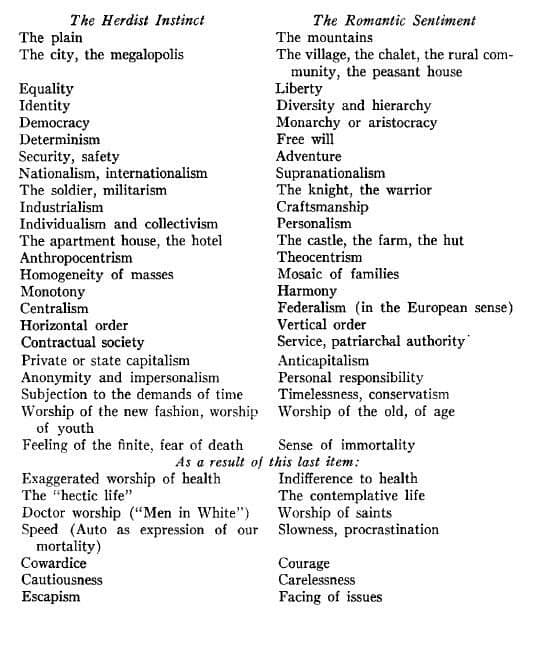
    photos_and_videos/TimelinePhotos_SxeO6JU-xg/50060776_10156919540572264_3743551245323862016_n_10156919540567264.jpg LEDDIHN’S HERD VS PACK

    by Skye Stewart

    Leddihn was very well cultured, a polyglot, and world traveler (86 countries).

    He thought lefties were herdists, open perhaps in some sense but close minded in most others.

    He charted these things as thus:Kari Anne Dorstad86 countries is very impressive !Jan 15, 2019, 7:38 PMJean LeonardWhere can I find more information on this?Jan 15, 2019, 10:00 PMCurt DoolittleSkye Stewart ^Jan 15, 2019, 10:52 PMDomagoy WattsHerdist vs Herder sentiment would have been more frank. There is a “jewy” quality to the mountains for the lack of a better word, going back to Mesopotamia (conflict of agricultural, settled Sumerians and their “Great Earth Mother” vs. patriarchal, herder progeny of Adam and his mountain god). Mountains are never the centers of civilizations and empires and are often regarded by the lowlanders as a the dwelling place of demons and damned. There is a ferocious aristocracy in the lowlands as well, especially in undomesticated and semi-domesticated lowlands – as in steppes. The aristocracy of horsemen often know how to remind mountain folks why they like to hide in the mountains to begin with. I’m a lowlander 100%.Jan 16, 2019, 6:41 AMChip SillsMontani semper liberiJan 16, 2019, 9:30 AMDomagoy WattsReiterlied

    Wohlauf, Kameraden, aufs Pferd, aufs Pferd!

    Ins Feld, in die Freiheit gezogen!

    Im Felde, da ist der Mann noch was werth,

    Da wird das Herz noch gewogen,

    Da tritt kein Anderer für ihn ein,

    Auf sich selber steht er da ganz allein.

    Aus der Welt die Freiheit verschwunden ist,

    Man sieht nur Herren und Knechte;

    Die Falschheit herrschet, die Hinterlist

    Bei dem feigen Menschengeschlechte.

    Der dem Tod ins Angesicht schauen kann,

    Der Soldat allein ist der freie Mann!

    https://kalliope.org/en/text/schiller2001102413Jan 16, 2019, 10:10 AMLEDDIHN’S HERD VS PACK

    by Skye Stewart

    Leddihn was very well cultured, a polyglot, and world traveler (86 countries).

    He thought lefties were herdists, open perhaps in some sense but close minded in most others.

    He charted these things as thus:


    Source date (UTC): 2019-01-15 18:59:00 UTC

  • How much longer are we going to have to tolerate butt-hurt libertarians? Give it

    How much longer are we going to have to tolerate butt-hurt libertarians?

    Give it up kids. Malinvestment like the rest of us. Move on.

    PATH OF MATURITY

    Democrat > Classical Liberal > Libertarian > Anarcho Capitalism > Neo Reaction > Propertarianism.

    Propertarianism = Perfect Government.

    1) Algorithmic Natural Law, and an Independent Judiciary of the law, and a ready, trained, militia.

    2) Choose: Nationalistic (eugenic) or Anti-Nationalistic (dysgenic)

    3) Choose your means of producing commons:

    Monarchic, Oligarchy (senate), Classical LIberal (classes), Social Democratic, Direct Democracy. Direct Economic Democracy.

    4) Choose your method of education (mindfulness(religion), ethics (manners, ethics, morals, laws), methods of calculation, general knowledge, occupational skills.)


    Source date (UTC): 2019-01-15 18:53:00 UTC

  • We don’t ask you to ‘believe’ in anything. We ask you to apply the method and re

    We don’t ask you to ‘believe’ in anything. We ask you to apply the method and refrain from causing harm to the physical, institutional, and informational, both private and common. And we’d prefer it if you also did your duty and demanded the same of others.

    It is a method that will change you first before you change your environment and you begin to change others. You will make it your own.

    And once the lightbulb goes on the world will be a much more simple and understandable place.


    Source date (UTC): 2019-01-15 18:09:00 UTC

  • “…a rightist with high openness?”— I’m not really a rightist. I am a paleo l

    —“…a rightist with high openness?”—

    I’m not really a rightist. I am a paleo libertarian by nature, and a classical liberal by intuition – I just understand that the rightists are right…. so to speak.

    The right is right. I can’t argue with the truth. It is what it is.

    So yes, I have high openness, High Loyalty, and High Disgust. I suppose if I wasn’t a bit of an aspie I would also like hierarchy more than I do. But since aspies consider everyone the the same level, maybe that’s the difference. And since everything has to ‘fit together’ in my systematizing aspie brain, and aspies are info-vores my libertarianism is probably more do to the aspiness and my instincts more conservative.


    Source date (UTC): 2019-01-15 18:06:00 UTC