Apr 16, 2020, 10:22 AM By Lucas Cort SOVEREIGNTY – DOMINANT MALE The male strategy creates sovereignty IN FACT – violence and Law – establishment of action, preservation and insurance between insurers. FREEDOM – ALL Those Sovereigns then grant PERMISSION to those of lesser insurance or specializations in the division of labour to act within the limits of that permission(markets) what we call FREEDOM. If FREEDOM is used as the starting point without understanding the necessity for sovereignty that makes freedom possible, then men will not pay the cost of defending the sovereigns who create freedom. LIBERTY – ASCENDANT MALE The ascendant male navigates the permissible freedom with LIBERTY(agency, autonomy). If LIBERTY is used the starting point without understanding the necessity for the larger structures of permission and insurance to uphold that permission, the idea of liberty (autonomy) can undermine the very thing that allows it to survive through entitlement (false priors) and possible negative externalities that undermine group cohesion (think libertarianism – baiting into hazard, etc). REDISTRIBUTION – FEMALE This can be divided further into the female strategy, which has the primarily focus on empathy using social transactions to create redistribution within the group. If REDISTRIBUTION is used as the starting point, first entitlement devoid merit, then hyper consumption, and redistribution undermine the value of the structure that allows it to navigate, just as the ascendant male.
Form: Sketch
-
The Hierarchy of Possibilities Prevents Error
Apr 16, 2020, 10:22 AM By Lucas Cort SOVEREIGNTY – DOMINANT MALE The male strategy creates sovereignty IN FACT – violence and Law – establishment of action, preservation and insurance between insurers. FREEDOM – ALL Those Sovereigns then grant PERMISSION to those of lesser insurance or specializations in the division of labour to act within the limits of that permission(markets) what we call FREEDOM. If FREEDOM is used as the starting point without understanding the necessity for sovereignty that makes freedom possible, then men will not pay the cost of defending the sovereigns who create freedom. LIBERTY – ASCENDANT MALE The ascendant male navigates the permissible freedom with LIBERTY(agency, autonomy). If LIBERTY is used the starting point without understanding the necessity for the larger structures of permission and insurance to uphold that permission, the idea of liberty (autonomy) can undermine the very thing that allows it to survive through entitlement (false priors) and possible negative externalities that undermine group cohesion (think libertarianism – baiting into hazard, etc). REDISTRIBUTION – FEMALE This can be divided further into the female strategy, which has the primarily focus on empathy using social transactions to create redistribution within the group. If REDISTRIBUTION is used as the starting point, first entitlement devoid merit, then hyper consumption, and redistribution undermine the value of the structure that allows it to navigate, just as the ascendant male.
-
Man – Production – Information
(information money prices)
-
Man – Production – Information
(information money prices)
-
Man – Production – Division of Perception Knowledge and Labor
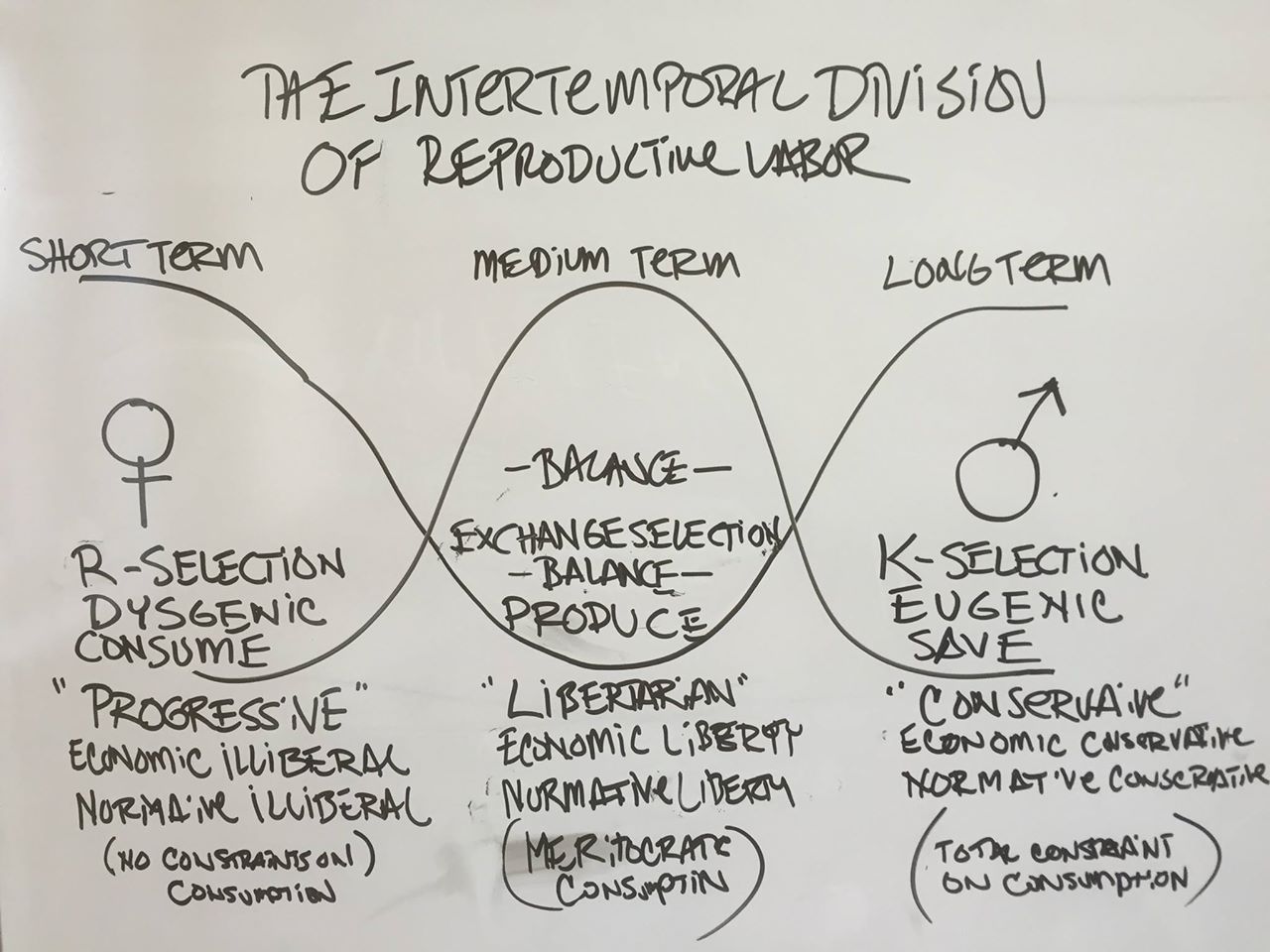
(Division of Labor) INTERTEMPORAL DIVISION OF PERCEPTION Inter-temporal Division of Reproductive Perception Knowledge Labor and Advocacy: The difference between the feminine (short term), libertarian (medium term) and conservative (long term) moral biases constitutes an inter-temporal division of perception, cognition, knowledge, labor, and advocacy.
Gender       Feminine       Ascendant    Masculine
-----------------------------------------------------

Strategy     Expenses       Income       Assets

Reproduction Dysgenic       Pragmatic    Eugenic

Morality     Care-Taking    Freedom      Loyalty

Coercion     Undermining    Remuneration Violence

Property     Collective     Individual   Hierarchical

Politics     Socialist      Libertarian  Authoritarian

Ability      Sex(affection) Cunning      Strength
-
Man – Organization – War
Conflict (AND WAR)
( …. ) Three choices THE THIRD QUESTION OF POLITICAL PHILOSOPHYThe question isn’t how we get along, it’s Genghis Khan’s question: “Why should the strong refrain from decimation, enslavement, enserfment, or rule for maximum profit?” The only incentive for the strong is whether cooperation is preferable to conquest. It is only preferable for conquest if it is sufficiently preferable to conquest to refrain from conquest. So, as the Great Khan said: “Given that cooperation is not preferable or possible, and serfdom and slavery are costly, that leaves decimation, or rule for the maximization of profit.”“We might prefer the former or the latter. However the enemy would undoubtedly prefer separation to decimation or rule under out maximization of profit. And this is the wise choice. Since we can still cooperate indirectly by trade while having no influence over one another within the same polity.” The problem the Khan faced is that he lacked the ability to produce institutions capable of sustained rule, just as expansionary aryans lacked the ability to produce institutions of sustained rule for maximum profit. The Indo-Aryans succeeded only under decimation and replacement in europe, not by any other means. The europeans killed the males and kept the females. The Persians stayed insular but were invaded by the Arabs, the indo-iranian’s are gone. The Anatolians are gone. The Caucasians are all but gone. So the Khan was wrong. Decimation was the right answer.
-
Man – Organization – War
Conflict (AND WAR)
( …. ) Three choices THE THIRD QUESTION OF POLITICAL PHILOSOPHYThe question isn’t how we get along, it’s Genghis Khan’s question: “Why should the strong refrain from decimation, enslavement, enserfment, or rule for maximum profit?” The only incentive for the strong is whether cooperation is preferable to conquest. It is only preferable for conquest if it is sufficiently preferable to conquest to refrain from conquest. So, as the Great Khan said: “Given that cooperation is not preferable or possible, and serfdom and slavery are costly, that leaves decimation, or rule for the maximization of profit.”“We might prefer the former or the latter. However the enemy would undoubtedly prefer separation to decimation or rule under out maximization of profit. And this is the wise choice. Since we can still cooperate indirectly by trade while having no influence over one another within the same polity.” The problem the Khan faced is that he lacked the ability to produce institutions capable of sustained rule, just as expansionary aryans lacked the ability to produce institutions of sustained rule for maximum profit. The Indo-Aryans succeeded only under decimation and replacement in europe, not by any other means. The europeans killed the males and kept the females. The Persians stayed insular but were invaded by the Arabs, the indo-iranian’s are gone. The Anatolians are gone. The Caucasians are all but gone. So the Khan was wrong. Decimation was the right answer.
-
Man – Classes
Classes
Reproductive Classes
Ugly asymmetric, disproportionate, people, with low neoteny, low gender dimorphism, with low intelligence, and anti-social personality disorders, dysfunctional families, beliefs, habits, and traditions. -vs- Beautiful symmetrical and proportional people, with high neoteny, high gender dimorphism, with high intelligence, and pro-sociality, functional families, beliefs, habits, and traditions. Elite – Extremely desirable Upper – Desirable throughout life. Middle – Desirable through fertility, Upper Lower – Desirable during peak fertility. Lower – Desirable only as ‘settling’ (last resort) Lowest – Undesirable Economic Classes
-
Man – Classes
Classes
Reproductive Classes
Ugly asymmetric, disproportionate, people, with low neoteny, low gender dimorphism, with low intelligence, and anti-social personality disorders, dysfunctional families, beliefs, habits, and traditions. -vs- Beautiful symmetrical and proportional people, with high neoteny, high gender dimorphism, with high intelligence, and pro-sociality, functional families, beliefs, habits, and traditions. Elite – Extremely desirable Upper – Desirable throughout life. Middle – Desirable through fertility, Upper Lower – Desirable during peak fertility. Lower – Desirable only as ‘settling’ (last resort) Lowest – Undesirable Economic Classes
-
Grid Explaining Commons-ism
GRID:
........................CHILD............................
.........ANARCHIST........VS..........COMMUNIST
......(heterogeneous, no commons, just consumption)
(diasporic, tribal, imperial subjects, "the men will do it")
.....no capitalization............no capitalization
......individual.....................collective
.......inequality.....................equality
.
MALE......................VS.........................FEMALE
.
.......inequality.....................equality
.......familial...................collective familial
...max capitalization .............max consumption
..(landed, national, self rule, "we're the men who do it")
..........(homogenous, commons, over consumption )
.........COMMONSIST........VS..........SOCIALIST
.........................PARENT............................
Humans have very comprehensible differences in instincts, and evolved to express those very comprehensible instincts, and then to make up stories justifying them.’ “THE ECONOMICS OF NATIONAL COMMONS-ISM”
1) Commons are a non consumable capitalization from which everyone benefits – a park where you can raise small children cuts the cost of yard ownership for example. Lacking a park where you can raise small children increases the cost of homes and yards, driving people out of high investment parenting. 2) Commons solve the problem of high investment parenting, without requiring high familial economic investment by every family. Families buy access to commons by high investment parenting, which creates incentive for the production of commons and their high returns. 3) We use high investment parenting in the production of high investment commons. We use high investment commons to facilitate high investment parenting. 4) This is what the middle working, and lower working classes sense is being stolen from them – the ability to use commons to produce high investment parenting. Best example is that they can’t afford to move away from malcontents by denying them access. 5) Low investment parenting immigrants and classes, decrease the incentive to produce commons that are then consumed for purposes of other than raising families. Low investment parenting immigrants and classes increase consumption that is upwardly redistributable to the financial sector, and decrease production of commons as redistribution to 6) Elites (advertising, media, financial, academic, political), will happily consume profits and income instead of investing in commons if lower working, working, and middle classes tolerate it. 7) The laboring, lower working, working, middle, and increasingly upper middle class, will only tolerate it until the low hanging fruit of consumption has been exhausted, and the demand for commons is restored. 8) Christianity is exceptional at producing respect for commons because behavior in the church environment (suppression of impulse) and the sacredness of the properties, extend to the commons. 9) In the absence of universal christian indoctrination we must us the law to suppress consumption (destruction) of the incentive to produce high trust, ‘sacred’ commons, suitable for the raising of children. And exporting ‘exploratory’ (teen, young adult) behavior (pre-maturity) to labor (markets) sport(competition) and external (wild) commons.WE ARE TRYING TO ARTICULATE “NATIONAL COMMONS-ISM” by Luke Weinhagen I have a suspicion that what many are grasping at within NatSoc is not a socialization of the economy but rather a commonization (not communization) of the government. This is what the west was aimed at solving but without full-accounting under P’s complete description of property, government became just another marketable commodity under globalist capitalism. What we are really trying to articulate is a form of National Commonsism. The resistance to “socializing” any part of our civic under our current model of “governance as commodity” is it effectively means selling whatever was socialized to big interest and international agents. There is no trust. National Commonsism == Kinship Capitalism == reciprocity protected by full-accounting — CD: Always count on luke for genius. Edit(Y’all gotta thank Luke Weinhagen for that framing. Been fussing with it myself and wasn’t until he put the frame around it that I could write the economics of it. But this concept has legs.) “Commons-ism”