—“What do believe is the qualitative difference between human and animal language?”—Bob Robertson
As far as I know animals do not possess language, it only exists within humans. All other creatures merely manage to communicate.
Charles Hockett (1967) introduced a generally accepted check list for language, a set of features that all human languages possess. His seven key properties are:
1 – productivity (the ability to create and understand new utterances): system which makes it possible to construct an unlimited number of sentences from a limited set of rules.
2 – arbitrariness (when signs/words do not resemble the things they represent),
3 – displacement (the ability to refer to the past and to things not present), and
4 – duality of pattern (the combination of a phonological system and a grammatical system),
5 – interchangeability (the ability to transmit and to receive messages by exchanging roles),
6 – specialization (when the only function of speech is communication and the speaker does not act out his message),
7 – cultural transmission (the ability to teach/learn from other individuals, e.g. by imitation).
As far as I know the reason humans can speak is simply brain size and complexity (long chains). But I won’t go into all of it here. But the ability to imagine futures, imagine stories, ‘self-observe’ and describe those stories in a series of symbols, using a series of rules’ takes a great deal of processing power.
While we can see elements of these patterns in parrots, corvids, dolphins, and the apes, we must teach them, and they say very simple things – because they only think very simple things.
Assuming we selected and trained enough chimpanzees to use sign language to build a self sustaining community of them, and assuming we could leave them on an island for a few centuries, it’s possible that sign language would persist. I suspect the problem is that it’s hard to produce a community of chimps with the intelligence necessary for perpetuation.
—“What do believe is the qualitative difference between human and animal language?”—Bob Robertson
As far as I know animals do not possess language, it only exists within humans. All other creatures merely manage to communicate.
Charles Hockett (1967) introduced a generally accepted check list for language, a set of features that all human languages possess. His seven key properties are:
1 – productivity (the ability to create and understand new utterances): system which makes it possible to construct an unlimited number of sentences from a limited set of rules.
2 – arbitrariness (when signs/words do not resemble the things they represent),
3 – displacement (the ability to refer to the past and to things not present), and
4 – duality of pattern (the combination of a phonological system and a grammatical system),
5 – interchangeability (the ability to transmit and to receive messages by exchanging roles),
6 – specialization (when the only function of speech is communication and the speaker does not act out his message),
7 – cultural transmission (the ability to teach/learn from other individuals, e.g. by imitation).
As far as I know the reason humans can speak is simply brain size and complexity (long chains). But I won’t go into all of it here. But the ability to imagine futures, imagine stories, ‘self-observe’ and describe those stories in a series of symbols, using a series of rules’ takes a great deal of processing power.
While we can see elements of these patterns in parrots, corvids, dolphins, and the apes, we must teach them, and they say very simple things – because they only think very simple things.
Assuming we selected and trained enough chimpanzees to use sign language to build a self sustaining community of them, and assuming we could leave them on an island for a few centuries, it’s possible that sign language would persist. I suspect the problem is that it’s hard to produce a community of chimps with the intelligence necessary for perpetuation.
—“What do believe is the qualitative difference between human and animal language?”—Bob Robertson
As far as I know animals do not possess language, it only exists within humans. All other creatures merely manage to communicate.
Charles Hockett (1967) introduced a generally accepted check list for language, a set of features that all human languages possess. His seven key properties are:
1 – productivity (the ability to create and understand new utterances): system which makes it possible to construct an unlimited number of sentences from a limited set of rules.
2 – arbitrariness (when signs/words do not resemble the things they represent),
3 – displacement (the ability to refer to the past and to things not present), and
4 – duality of pattern (the combination of a phonological system and a grammatical system),
5 – interchangeability (the ability to transmit and to receive messages by exchanging roles),
6 – specialization (when the only function of speech is communication and the speaker does not act out his message),
7 – cultural transmission (the ability to teach/learn from other individuals, e.g. by imitation).
As far as I know the reason humans can speak is simply brain size and complexity (long chains). But I won’t go into all of it here. But the ability to imagine futures, imagine stories, ‘self-observe’ and describe those stories in a series of symbols, using a series of rules’ takes a great deal of processing power.
While we can see elements of these patterns in parrots, corvids, dolphins, and the apes, we must teach them, and they say very simple things – because they only think very simple things.
Assuming we selected and trained enough chimpanzees to use sign language to build a self sustaining community of them, and assuming we could leave them on an island for a few centuries, it’s possible that sign language would persist. I suspect the problem is that it’s hard to produce a community of chimps with the intelligence necessary for perpetuation.
Original tweet unavailable — we could not load the text of the post this reply is addressing on X. That usually means the tweet was deleted, the account is protected, or X does not expose it to the account used for archiving. The Original post link below may still open if you view it in X while signed in.
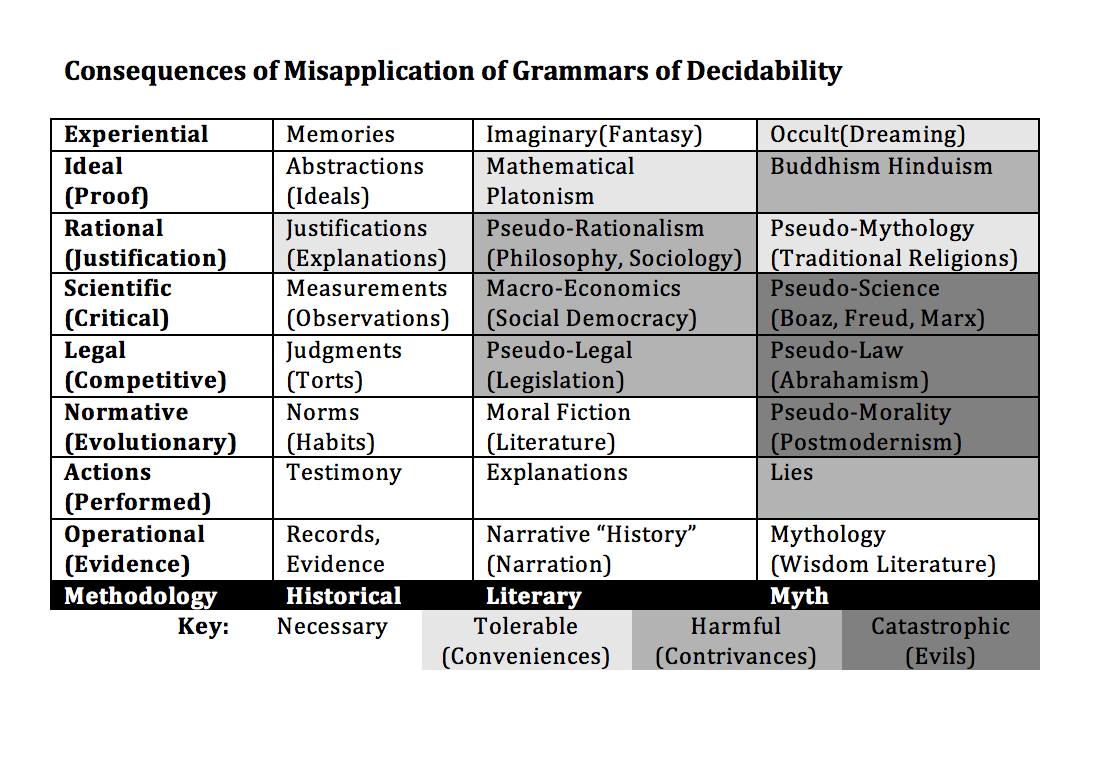
photos_and_videos/TimelinePhotos_43196237263/21762741_10155736915752264_894322098281463268_o_10155736915752264.jpg Luke Thomas@[1059559839:2048:Philip Bunn] I think “misapplication of grammars” is most aptSep 21, 2017 10:25am
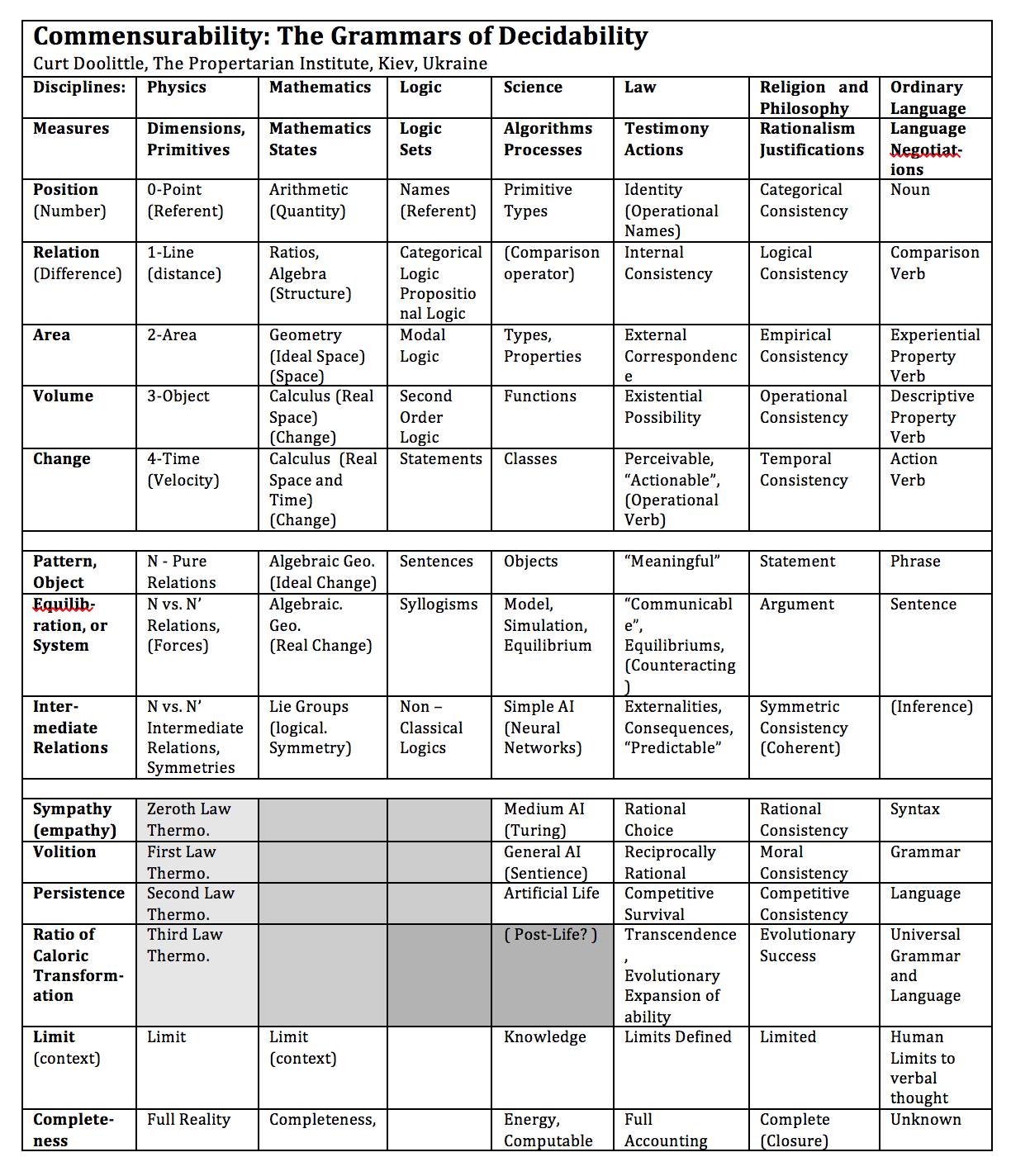
photos_and_videos/TimelinePhotos_43196237263/21686716_10155736641582264_2538181367473503859_o_10155736641582264.jpg Graham NearyComparison verb? “Is bigger than”?Sep 20, 2017 1:28pmCurt Doolittleany comparison whatsoever, but yes, bigger, smaller, etc…Sep 20, 2017 2:15pmGraham NearyComparative adjectivesSep 20, 2017 2:28pmCurt Doolittlethx ;)Sep 20, 2017 2:28pmCurt DoolittleI suppose I could add Fiction, Deception, and Fictionalism next to it, and then cover the entire spectrum.Sep 20, 2017 2:47pmLincoln ThurmanQuadrivum:
Arithmetic = number in itself.
Geometry = number in space.
Music = number in time.
And,
Astronomy = number in time and space.
Maybe some input.Sep 20, 2017 4:57pmMea CulbaCideSep 21, 2017 1:09amTHE GRAMMARS OF DECIDABILITY
Brain breaking, maybe, but informative if you grok it.
Can I get feedback on this from fellow supergeeks?
In order to show Testimonial grammar I’m trying to demonstrate the scope of each grammar (language) we have developed for making comparisons.
I want to do this so that I can recategorize natural language from just ‘verbs’ to categories of verbs. And just names to names of types, functions, classes, objects, etc….
Lots to write about on this topic. Lots also to write about on axiomatic vs algorithmic vs rational, vs theoretic etc.
Original tweet unavailable — we could not load the text of the post this reply is addressing on X. That usually means the tweet was deleted, the account is protected, or X does not expose it to the account used for archiving. The Original post link below may still open if you view it in X while signed in.