Form: Quote Commentary

  • “One in 5 (20%) Americans have read the entire Bible at least once — including a

    —“One in 5 (20%) Americans have read the entire Bible at least once — including about one in 10 (9%) who’ve read it through multiple times. Just over half (53%) have read relatively little of it, and 1 in 10 haven’t read it at all.”—

    I wonder what percent of americans have read the constitution? In the flyover country I assume it’s still required as part of 8th grade education. I suspect it declines elsewhere.


    Source date (UTC): 2020-02-28 17:20:00 UTC

  • THE PROBLEM by Predmetsky Rosenborg You don’t have to be an atheist (I’m not) to

    THE PROBLEM

    by Predmetsky Rosenborg

    You don’t have to be an atheist (I’m not) to see that it is impossible to produce a Christian constitution from Christian doctrine because it is impossible to produce Christian doctrine from Christian scriptures. A constitution requires clarity, which is impossible to accomplish with the religious texts of any religion.


    Source date (UTC): 2020-02-28 12:00:00 UTC

  • WHY EMPIRES FALL: ACCUMULATED RENTS AND DYSGENIA —“British historian Arnold To

    WHY EMPIRES FALL: ACCUMULATED RENTS AND DYSGENIA

    —“British historian Arnold Toynbee spent his career trying to figure out why even the greatest nations and empires seem to be relatively helpless in escaping cycles of decline once they have taken hold.

    I think we have accumulated enough scientific knowledge to understand what drives self-reinforcing dysgenic demographic feedback loops to lock in and become seemingly path dependent until ever lower average Intelligence/conscientiousness and concomitant low trust cause social fracture and economic collapse.

    Codified legal prohibitions of anything encouraging or contributing to the furtherance of such dysgenic undertows is evidently both moral (reciprocal) and necessary.”—Scott De Warren

    Yep. Book on this topic in fact.

    Civilizations develop an aristocracy by genetic advantage that provides a strategic advantage, then the classes expand to take advantage of the aristocratic advantage, then, everyone maximizes rents, the middle class serves consumers, consumers breed, the underclass increases, until all advantage has been consumed by the underclass, and no capital is available for adaptation to opportunity, threat, stress, or shock.


    Source date (UTC): 2020-02-28 11:10:00 UTC
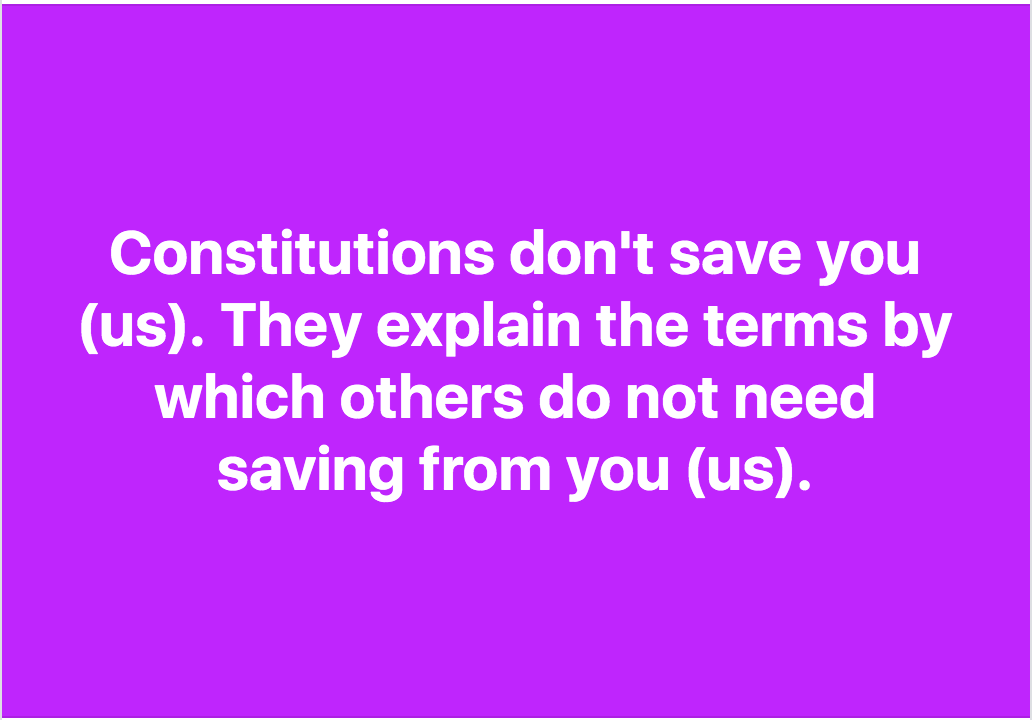
  • Good Example (Godel, Chomsky)

    —“Not quite, as Godel presented a mathematical model of this phenomenon. You cannot reduce this to mere positivistic linguistics. On which point, are you not assuming Chomsky’s universal grammar with your definition of grammar? If so, this has been shown to be unempirical.”—

    I didn’t say anything like that. I’m saying that he’s correct. I haven’t met anyone other than the author of the best book on the subject that understands the limit of Godel’s argument: (a) we identify new constant relations (experiences) (b) we invent new references (c) we invent new paradigms (d) we require grammars to talk about them (e) we can make ungrammatical statements. Godel said it. Turing said it. Kripke said it. So there is no closure to logic without appeal to the operational, empirical, limits and completeness, and even then there is only closure on falsification not justification. THE FUNDAMENTAL PROBLEM FOR PEOPLE IN PHILOSOPHY AND THEOLOGY: There is nothing positivistic in P. It’s purely falsificationary. Either it survives adversarial competition by the terms stated in testimonialism or it doesn’t. If more than one does, then we just don’t know and nothing else can be said. In general, i have found that the first and most significant hurdle that people have trouble with – at least those not educated in the sciences – is that all propositions are contingent and all truth propositions are achieved by falsification. And P articulates the METHOD for universal falsification. ==== Afterward: Chomsky was trying to bring Turing to language. His original paper is simply pulling Turing into language. Chomsky’s contribution – from my understanding – is correctly stating that: (a) the brain produces experience by continuous recursive disambiguation. (b) linguistic thought consists of rules of continuous recursive disambiguation. (c) grammar regardless of language consists of rules of continuous recursive disambiguation. (d) language serves as a system of measurement for thought – albeit we use many different paradigms (metaphysics) within each human language, and these paradigms vary according to the correspondent vs the three non-correspondent (fictionalisms). (e) there appear to be higher demands on cognition for higher levels of thought. And we should expect aliens if there are any to use simpler or more complex grammatical structures given their abilities.

  • Good Example (Godel, Chomsky)

    —“Not quite, as Godel presented a mathematical model of this phenomenon. You cannot reduce this to mere positivistic linguistics. On which point, are you not assuming Chomsky’s universal grammar with your definition of grammar? If so, this has been shown to be unempirical.”—

    I didn’t say anything like that. I’m saying that he’s correct. I haven’t met anyone other than the author of the best book on the subject that understands the limit of Godel’s argument: (a) we identify new constant relations (experiences) (b) we invent new references (c) we invent new paradigms (d) we require grammars to talk about them (e) we can make ungrammatical statements. Godel said it. Turing said it. Kripke said it. So there is no closure to logic without appeal to the operational, empirical, limits and completeness, and even then there is only closure on falsification not justification. THE FUNDAMENTAL PROBLEM FOR PEOPLE IN PHILOSOPHY AND THEOLOGY: There is nothing positivistic in P. It’s purely falsificationary. Either it survives adversarial competition by the terms stated in testimonialism or it doesn’t. If more than one does, then we just don’t know and nothing else can be said. In general, i have found that the first and most significant hurdle that people have trouble with – at least those not educated in the sciences – is that all propositions are contingent and all truth propositions are achieved by falsification. And P articulates the METHOD for universal falsification. ==== Afterward: Chomsky was trying to bring Turing to language. His original paper is simply pulling Turing into language. Chomsky’s contribution – from my understanding – is correctly stating that: (a) the brain produces experience by continuous recursive disambiguation. (b) linguistic thought consists of rules of continuous recursive disambiguation. (c) grammar regardless of language consists of rules of continuous recursive disambiguation. (d) language serves as a system of measurement for thought – albeit we use many different paradigms (metaphysics) within each human language, and these paradigms vary according to the correspondent vs the three non-correspondent (fictionalisms). (e) there appear to be higher demands on cognition for higher levels of thought. And we should expect aliens if there are any to use simpler or more complex grammatical structures given their abilities.

  • RT @Outsideness: “… males love ranking.”

    RT @Outsideness: “… males love ranking.” https://www.takimag.com/article/ranking-ruth/ …


    Source date (UTC): 2020-02-26 14:59:12 UTC

    Original post: https://twitter.com/i/web/status/1232681527416324096

  • Feb 26, 2020, 2:56 PM

    https://www.jpost.com/Diaspora/Antisemitism/1-in-5-Europeans-says-secret-Jewish-cabal-runs-the-world-survey-finds-618830https://www.jpost.com/Diaspora/Antisemitism/1-in-5-Europeans-says-secret-Jewish-cabal-runs-the-world-survey-finds-618830Updated Feb 26, 2020, 2:56 PM


    Source date (UTC): 2020-02-26 14:56:00 UTC

  • 2020-02-26

    2020-02-26

    https://twitter.com/curtdoolittle/status/1232676662430572544 https://t.co/mLhnpT5ZZs

  • Martin Štěpán Germanic religion, in so far it can be called that, wasn’t in any

    Martin Štěpán

    Germanic religion, in so far it can be called that, wasn’t in any way centralized. There was no organization and no book every tribe would have. Every tribe’s version could slowly evolve and diverge, especially if they didn’t come into contact. What we have comes from Iceland written after Christianity was already in place. Even though the gods were shared and Odin does appear to be the head of the pantheon everywhere (Tacitus – central European Germanics, Geoffrey of Monmouth – Saxons) but who knows how the personalities and the stories might have differed.

    Bill Joslin

    fight fire with fire, and psychopomp with psychopomp.

    P, in clarifying the reality of the socio-economic world, turns the wheel of gods, one more rotation back to tyr. law, born of martial culture which domesticates .. a natural response to Fenrir breaking his chains to race across the sky undoing the domestication of our animal nature.

    Bill Smith

    This. This is good.

    Curt.

    Yeah, Bill has a thing there. That’s a good thing.


    Source date (UTC): 2020-02-26 12:42:00 UTC

  • Thinking Things Thru Is Scary

      —“Faith without works is dead.”—John Brennan —“Faith without works is free riding. It’s a crime. ;)”—Curt Doolittle —“Faith without works is: 1 – Baiting into hazard for oneself in both religious and logical terms, 2 – Making an unfalsifiable promise to the commons (i.e believe in Jesus and be saved in afterlife), 3 – Parasitism on others within the higher-trust group of other faithful All of which are violations of reciprocity. Even though faith attempts to define reciprocity as “Do unto others as you would have them do unto you” it lacks the grammar to break it down to what it really means and how to apply it. P. solves that problem.”—James Dmitro Makienko