(core) What is the difference between an actor and subject? My understanding of traditional grammar is that: “John threw the ball” Subject-verb-object Which you describe as Actor-operation-subject John is an actor in this case, and the “subject” (as I was taught in school, anyway). Another example: “The fruit fell from the tree” Subject-verb-object In this sentence, one might think the actor is gravity, or the wind. Since that is what caused the change in state. From a testimonial or vitruvian measurement, though, it would be more like: “I saw the fruit fall from the tree.” The actor is myself as an observer? And the subject is the fruit? Any clarification on terms “actor” and “subject”? by Adam Jacob Robert Walker: You could consider the tree as an actor as well. The tree produces fruit. But a tree isn’t necessarily following incentives. But rather it’s “act” is a result of nature adaptations or mechanisms of survival. I think you are correct that you’d have to switch it to the orientation of the observer. I saw the fruit fall from the tree (actor-action), after I went outside to get my mail (incentive to go outside and observe), and the fruit splattered on my driveway (state change on the ground). I think “subject” refers to the concept in which the whole of the testimony describes, but through the description of operations by an actor or group of actors. by Bill Joslin: In english grammar the subject is the agent subject-verb-object. the subject “acts upon” the object (side note: this distinction subject “that which acts upon”and object “that which is acted upon” lay the foundation for the initial use of the terms subjective, objective. prior to the 19th century of so, religion was considered the pursuit of “objective truth” in that one would he changed by the truth (truth acts upon the seeker) and subjective truth was what one did when they sought truth to a specific ends (such as science investigates a particular phenomenon to eventually be able to do something with it). the rise of science (seeking truth to a specific ends) “killed” objective truth – this was the assertion in Horkhiemer and Adorno’ Dialectic of enlightenment. by Adam Jacob Robert Walker Nice. That puts it in a philosophical context for me. I wasn’t aware of all that. by Curt Doolittle[I promise I saw] [gravity cause] the fruit [fall/fell] [from the tree] [to the ground.] Promise, Testimony, Actor, Subject of testimony, Transaction. Use subject or object if you want, but my point is that we need to use “actor, and in the OP that I started this discourse with, I was making the point that we habitually start sentences with the subject being acted upon to provide context, and the cost of ‘thinking’ in operational terms is the extra step required to start with actor instead – which eliminates the problem of the verb to be from the sentence structure. If you have a difficulty with eliminating the verb to be, start with the actor not the object( or as I prefer, subject). ADAM IS CORRECT: Actor, Subject. —“I think “subject” refers to the concept in which the whole of the testimony describes, but through the description of operations by an actor or group of actors.”— Well done!!!!!
Form: Question
-
More on Learning Operational Grammar
(core) What is the difference between an actor and subject? My understanding of traditional grammar is that: “John threw the ball” Subject-verb-object Which you describe as Actor-operation-subject John is an actor in this case, and the “subject” (as I was taught in school, anyway). Another example: “The fruit fell from the tree” Subject-verb-object In this sentence, one might think the actor is gravity, or the wind. Since that is what caused the change in state. From a testimonial or vitruvian measurement, though, it would be more like: “I saw the fruit fall from the tree.” The actor is myself as an observer? And the subject is the fruit? Any clarification on terms “actor” and “subject”? by Adam Jacob Robert Walker: You could consider the tree as an actor as well. The tree produces fruit. But a tree isn’t necessarily following incentives. But rather it’s “act” is a result of nature adaptations or mechanisms of survival. I think you are correct that you’d have to switch it to the orientation of the observer. I saw the fruit fall from the tree (actor-action), after I went outside to get my mail (incentive to go outside and observe), and the fruit splattered on my driveway (state change on the ground). I think “subject” refers to the concept in which the whole of the testimony describes, but through the description of operations by an actor or group of actors. by Bill Joslin: In english grammar the subject is the agent subject-verb-object. the subject “acts upon” the object (side note: this distinction subject “that which acts upon”and object “that which is acted upon” lay the foundation for the initial use of the terms subjective, objective. prior to the 19th century of so, religion was considered the pursuit of “objective truth” in that one would he changed by the truth (truth acts upon the seeker) and subjective truth was what one did when they sought truth to a specific ends (such as science investigates a particular phenomenon to eventually be able to do something with it). the rise of science (seeking truth to a specific ends) “killed” objective truth – this was the assertion in Horkhiemer and Adorno’ Dialectic of enlightenment. by Adam Jacob Robert Walker Nice. That puts it in a philosophical context for me. I wasn’t aware of all that. by Curt Doolittle[I promise I saw] [gravity cause] the fruit [fall/fell] [from the tree] [to the ground.] Promise, Testimony, Actor, Subject of testimony, Transaction. Use subject or object if you want, but my point is that we need to use “actor, and in the OP that I started this discourse with, I was making the point that we habitually start sentences with the subject being acted upon to provide context, and the cost of ‘thinking’ in operational terms is the extra step required to start with actor instead – which eliminates the problem of the verb to be from the sentence structure. If you have a difficulty with eliminating the verb to be, start with the actor not the object( or as I prefer, subject). ADAM IS CORRECT: Actor, Subject. —“I think “subject” refers to the concept in which the whole of the testimony describes, but through the description of operations by an actor or group of actors.”— Well done!!!!!
-
Why do you think you know that?
Why do you think you know that?
Source date (UTC): 2020-02-24 23:02:56 UTC
Original post: https://twitter.com/i/web/status/1232078487546138629
Reply addressees: @WinslowFrancke
Replying to: https://twitter.com/i/web/status/1232044716256112642
-
Where are aristotle, plato, socrates, zeno, epicurus, roman law, greek mathemati
Where are aristotle, plato, socrates, zeno, epicurus, roman law, greek mathematics, and the christian destruction of the ancient world in your narrative?
The talmud and the bible an koran are not an enlightenment but simply the marxism-socialism- postmodernism-feminism of the ancient world: the coutner-revolution against reason.
The revolution in the ancient world was democritus’ atomism, socratic skepticism (failure), platonic idealism(failure), and the success of aristotelian reason, empiricism, proto-science, stoic and epicurean replacement of conflationary religion, and roman law and administration, creating markets for all peoples – but the semites (the equivalent of ghettos) couldn’t grasp that ‘uncontrolled vision’ and sought to restore controlled (feminine) monopoly and conflation using female methods of deceit, and the female method of undermining from within.
Weak minds need certainty.
Mindfulness doesn’t.
Source date (UTC): 2020-02-24 12:17:00 UTC
-
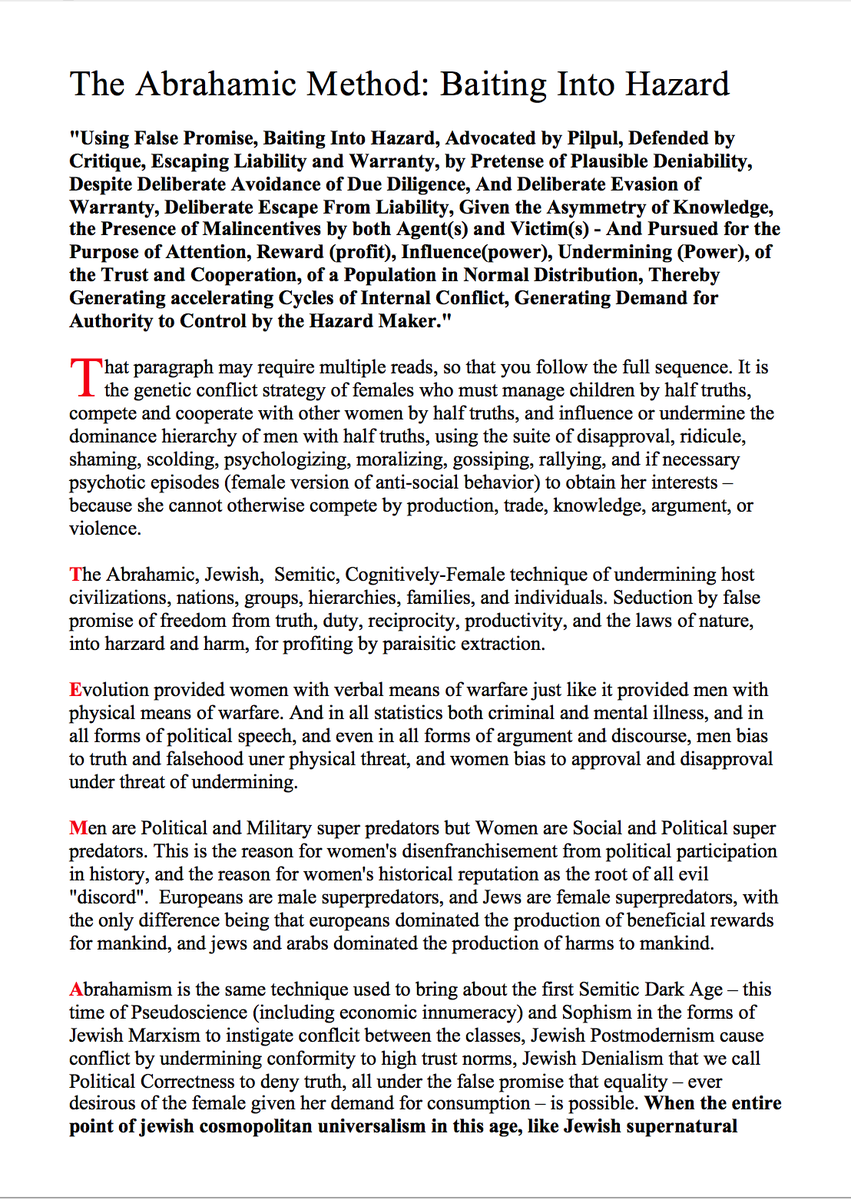
What is that technique?
What is that technique? https://t.co/orhMkDltnl
Source date (UTC): 2020-02-24 02:16:16 UTC
Original post: https://twitter.com/i/web/status/1231764750582898688
Reply addressees: @tuckertonRR @NordvoldW @MalkuthSense @StefanMolyneux
Replying to: https://twitter.com/i/web/status/1231764554704728064
IN REPLY TO:
Unknown author
@tuckertonRR @NordvoldW @MalkuthSense @StefanMolyneux Seriously how do so many people get that much that wrong for that long – unless your entire culture’s theology, mythology, history, law, logic, and means of economic survival depend on the same technique, just updated from supernatural sophistry to pseudoscientific sophistry?
Original post: https://x.com/i/web/status/1231764554704728064
-
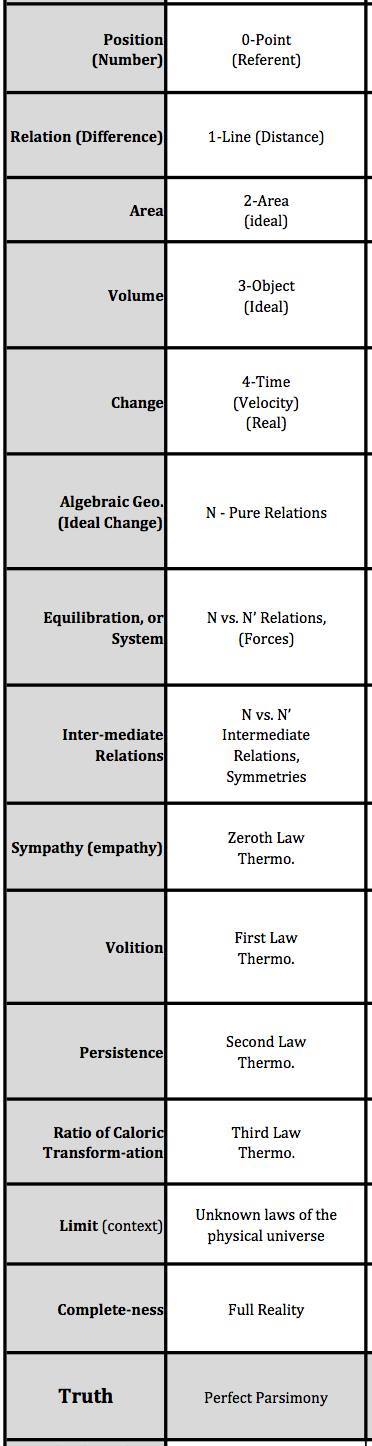
photos_and_videos/TimelinePhotos_kg5QueHwVw/84080681_215140659884095_21178531110
photos_and_videos/TimelinePhotos_kg5QueHwVw/84080681_215140659884095_2117853111006527488_o_215140656550762.jpg SEE IF YOU CAN UNDERSTAND THIS IMAGE
It’s the first two columns of the grammarsSEE IF YOU CAN UNDERSTAND THIS IMAGE
It’s the first two columns of the grammars
Source date (UTC): 2020-02-23 22:08:00 UTC
-
Would you be better off if you paid microsoft, apple, google, the price of a col
Would you be better off if you paid microsoft, apple, google, the price of a college education to train you, or paying a college to educate you?
This is where I am going with the line of thought.
To kill the academy entirely.
Source date (UTC): 2020-02-22 12:57:00 UTC
-
Elon: What fundamental failing in our education system is graduating people into
Elon: What fundamental failing in our education system is graduating people into the public without understanding cheap fast iterations that fail frequently and small rather than trying to do it once and get it perfect?
What’s wrong with basic education?
Source date (UTC): 2020-02-21 02:38:38 UTC
Original post: https://twitter.com/i/web/status/1230683218648670208
Reply addressees: @elonmusk @flcnhvy @SciGuySpace
Replying to: https://twitter.com/i/web/status/1230642008257069056
-
Who discovered rule of law by the natural right of reciprocity Who discovered th
Who discovered rule of law by the natural right of reciprocity
Who discovered the republic democracy and rule of law
Who discovered reason, logic, natural philosophy and science
Who discovered natural rights philosophy
Who discovered the common law and napoleonic code?
Who discovered the Peace of Westphalia domesticating war?
Who discovered the Geneva conventions?
Who discovered the international charter of human rights?
Who discovered science technology medicine and dragged humanity kicking and screaming out of ignorance superstition, hard labor, poverty, starvation, disease, suffering, and early death?
Yeah. I know. White people.
Yeah, colonialism wasn’t so good.
Yeah, it was just better than everyone else’s alternative..
Source date (UTC): 2020-02-20 20:18:00 UTC
-
can you link me to the presentation? I don’t know what ‘truth’ he’s referring to
can you link me to the presentation? I don’t know what ‘truth’ he’s referring to?
Source date (UTC): 2020-02-19 03:04:54 UTC
Original post: https://twitter.com/i/web/status/1229965049332207616
Reply addressees: @TruthRespecter
Replying to: https://twitter.com/i/web/status/1229964204448395265