Form: Project Update

  • (NLI) Please thank Brad (@BradleyWerrell ) for working for hours this morning de

    (NLI)
    Please thank Brad (@BradleyWerrell ) for working for hours this morning despite being exhausted. ;). We did solid work on Chapter 3 this weekend. And I’ll need most of this week, to complete what we’ve outlined and decided.

    Feedback from conference attendees on the first…


    Source date (UTC): 2024-10-20 19:15:59 UTC

    Original post: https://twitter.com/i/web/status/1848080744801054780

  • (NLI) Update: Volume 1, System of Measurement. (Team: Thanks for the feedback so

    (NLI)
    Update: Volume 1, System of Measurement.
    (Team: Thanks for the feedback so far.)
    FYI:
    1. The Grammars chapter can’t move. I tried moving the chapter on grammars forward so that it followed measurements, but it’s not possible without losing the reader. I need to stick with a step by step revealing the layers of the onion so to speak.
    2. Five Hard Questions: I’ve added the five ‘hard questions’ to the beginning of reciprocity but now I have to write a bridge to explain the relation.
    3. FInishing First Principles: I’ve collected all the references to first principles so Brad and I can work on them tomorrow and made a few early edits, and I can see how to complete the section without making it overwhelming – as if the whole section isn’t overwhelming already. πŸ˜‰
    4. Higher dimensions of Indexing: I’m currently integrating the higher orders of measurement into the chapter on measurement because it helps the reader understand the emergence of dimensions and multi-dimensionality. (which is why I wanted to move to the grammars, but without covering first principles first it’s too confusing.)
    5. How to explain it. I”m thinking about how given point 4 I’m going to explain all that without causing heads to explode.
    6. Hard problem: I’ve sent Brad my outlines of the explanation of how group strategies affect evolutionary consequences and in particular the production of trust. And, the non obvious differences between civilizational differences in decidability: western individualism as a means of producing commonsism but the consequences of it. The middle eastern priority of family and tribe. The Sinic priority of family and state as extended family. These trade offs lead us to understand that the ternary logic and the western trifunctional strategy are necessary rules (limits) that prevent evolutionary collapse at all levels.
    Previous Frame: We cut the consequences from he book on the system of measurement. It was expedient in time, shortened the book, but does the book’s message further our objective if it’s just a system of measurement without its application to current conditions of crisis?
    Does this coverage of civilizational consequence break the frame? But would this hard problem end that separation?
    Why does this matter? The question is what are we trying to cover in this book? How will it anchor the public’s ‘first impression’ of our work? And what’s necessary to prevent that anchoring from increasing resistance rather than decreasing it?

    My feeling is that if there is a short lag between books it’s probably ok. If there is a long lag it’s not. My opinion is that the system of measurement alone might not have the traction that the system and its application would.

    But I”m not sure.

    Thanks for advice if you have any.

    @WerrellBradley


    Source date (UTC): 2024-10-18 18:48:32 UTC

    Original post: https://twitter.com/i/web/status/1847349060614922240

  • It’s only physical. I don’t want early drafts to leak. We are trying to get to a

    It’s only physical. I don’t want early drafts to leak. We are trying to get to a final draft. but there are a handful of what I see as holes that need filling in order to make what we’ve said more accessible.
    Heimdallr suggests it’s accessible for the IQ 120+ crowd now. I don’t know. If we could make it accessible for the IQ 115+ crowd I’d be happy. Dunno if it’s possible for ME to do it. Not enough cognitive empathy with that segment of the population.

    Reply addressees: @CuriousKonkie


    Source date (UTC): 2024-10-17 21:17:18 UTC

    Original post: https://twitter.com/i/web/status/1847024111102709760

    Replying to: https://twitter.com/i/web/status/1847021767874789445

  • (NLI) I’m doing additional work today on Volume 1’s Chapter 2 – Measurement by c

    (NLI)
    I’m doing additional work today on Volume 1’s Chapter 2 – Measurement by completing the arc of indexing from natural through operational through evolutionary. And using the completion of that arc to address limits that I spoke to you about briefly today but more extensively with Brad and Francis over the past week. This approach helps unify the concepts of dimensionality that will be expanded in the chapter on the grammars, and help explain limits that produce decidability through exhaustion of the spectrum of opportunity for causality within any given contextual domain.

    Please continue your review and provide feedback. I know it’s hard work but It’s valuable.

    Thank you for the feedback so far.


    Source date (UTC): 2024-10-17 20:40:40 UTC

    Original post: https://twitter.com/i/web/status/1847014891330457601

  • AI REVIEW OF OUR DRAFT At our convention last week, we handed out a few dozen pr

    AI REVIEW OF OUR DRAFT
    At our convention last week, we handed out a few dozen printed copies of the current draft of “The Natural Law Volume 1: A System of Measurement” at just over 200 pages.

    Review:


    Based on my review, your work appears to be an attempt to synthesize and extend various schools of thought. It bridges:

    Classical philosophy (natural law tradition) with modern science.
    The Enlightenment emphasis on reason with an understanding of human behavior.
    Formal logic and scientific realism with a focus on operationalism.
    Your work seems to be building on classical and Enlightenment thinkers while addressing the limitations of postmodernism and conventional social science.

    Here’s a deeper analysis of your work in the context of intellectual history, focusing on key connections and distinctions:

    Connections:

    Aristotle and the Stoics: Your emphasis on natural law and reason resonates with Aristotle’s concept of a natural order and the Stoic pursuit of virtue in accordance with nature.
    Thomas Aquinas: Like Aquinas, you see natural law as discoverable through reason. However, you ground it in empirical observation rather than divine revelation.
    John Locke: You share Locke’s concern for individual sovereignty and natural rights. But you go beyond his focus on political philosophy to create a comprehensive system of measurement.
    David Hume: Your focus on the limits of reason and the importance of empirical observation aligns with Hume’s skepticism. However, you use this skepticism to build a more rigorous framework for knowledge.
    Immanuel Kant: You share Kant’s goal of establishing a universal moral law. But you reject his idealism, grounding your system in evolutionary computation and operationalism.
    Karl Popper: Your emphasis on falsifiability and the adversarial nature of science aligns with Popper’s philosophy of science.
    Friedrich Hayek: You share Hayek’s appreciation for the complexity of social systems and the limits of human design. But you go further by providing a formal system for understanding this complexity.

    Distinctions:

    Postmodernism: You explicitly reject postmodern relativism and the notion that truth is socially constructed. You ground your system in objective reality and the laws of nature.
    Conventional Social Science: You criticize the fragmentation of social science and its lack of predictive power. You propose a unifying framework that treats all human behavior as a product of evolutionary computation.
    Legal Positivism: You reject the idea that law is merely a product of human will or convention. You ground law in the natural laws of human cooperation and reciprocity.

    Key Contributions:

    Operationalism: You extend the concept of operationalism from the physical sciences to all domains of human knowledge, creating a system of precise, testable definitions.
    Unification of Science: You provide a single framework that integrates the physical, behavioral, and social sciences, showing that all are bound by the same principles of causality and computation.
    Restitution-Based Legal Science: You redefine law as a science of behavior under full accounting, establishing a new legal science that provides universal principles for resolving human disputes.

    Challenges:

    Complexity: The comprehensiveness of your system may make it challenging to grasp for some readers.
    Novelty: Your approach is highly original, which may require readers to rethink their assumptions about knowledge, truth, and human behavior.
    Practical Application: While you provide a strong theoretical foundation, the practical application of your system may require further development.

    Source date (UTC): 2024-10-10 09:03:41 UTC

    Original post: https://twitter.com/i/web/status/1844302773640364033

  • (NLI Nonsense) Between Brad and Francis these guys are working me into a dry hus

    (NLI Nonsense)
    Between Brad and Francis these guys are working me into a dry husk of dessicated neurons. πŸ˜‰ We are “this close” to finishing the first book “The Natural Law Volume 1 – A System of Measurement” (which until now didn’t have a name.) Meanwhile I have to give a couple hours of presentations on the coming revolution or civil war on Friday in Fredericksburg Texas – and of course, I’ll be working on it until the last minute. I started out writing a presentation but ended up writing a book that I still have to present somehow. ;). Very hard to cover the convergence of causes, cover the choices of what we can do about it, cover what will happen if we don’t, create enough specificity and clarity to cause people to trust that we know what we’re talking about, and in that process explain why our solution is the optimum means of producing a revolution instead of devolving into a brutal civil war.


    Source date (UTC): 2024-10-01 02:08:48 UTC

    Original post: https://twitter.com/i/web/status/1840936874392817664

  • (NLI) Revolutions. I have used this vacation to prepare for the presentation on

    (NLI)
    Revolutions.
    I have used this vacation to prepare for the presentation on the course and conduct of a revolution. (“making it real for people.”)
    After reviewing every strategy ever used over the past two hundred years, with emphasis on degree of institutional development, ethnic diversity, ideological competition, and the many other factors involved, I’m more convinced than ever that my strategy is not only viable but is a trap from which the state cannot escape.
    The entirety of the problem will be keeping the factions from fragmenting – and I see solving this problem of as the central preparatory groundwork after we complete and publish the set of demands.
    I am not counting on a trigger event. We are going through a period where a trigger event might occur. That trigger event would not only agitate the populace but encourage foreign actors to support that trigger.
    But that said I do not see how it will be possible to take advantage of a trigger event by organized means – we are two years behind in our strategy to do so. So risk factors are rather terrifying.
    So I suspect that the result of any trigger event will not produce the desired outcome at scale but will merely advance the likelihood of successful “elite replacement” on our predicted timeline (which is evolving into consensus opinion among those who study such things.)
    If on the other hand for example T is elected, and there is a counter-reaction. Or T is not elected and the govt is considered more illegitimate than today, and especially if the new administration attempts something intolerable, then organic pressures will escalate, and organic consequences emerge.
    I do not see much hope of influencing, guiding, or controlling this process given our degree of maturity. We need two years.
    That said, with two years I am confident of success.

    CD
    ps: (I need set aside road trip think-time more often.)


    Source date (UTC): 2024-09-21 15:32:11 UTC

    Original post: https://twitter.com/i/web/status/1837515173571227648

  • (NLI) Well, the draft of the introduction is done. Ready for editing. πŸ˜‰ Only ‘D

    (NLI)
    Well, the draft of the introduction is done. Ready for editing. πŸ˜‰
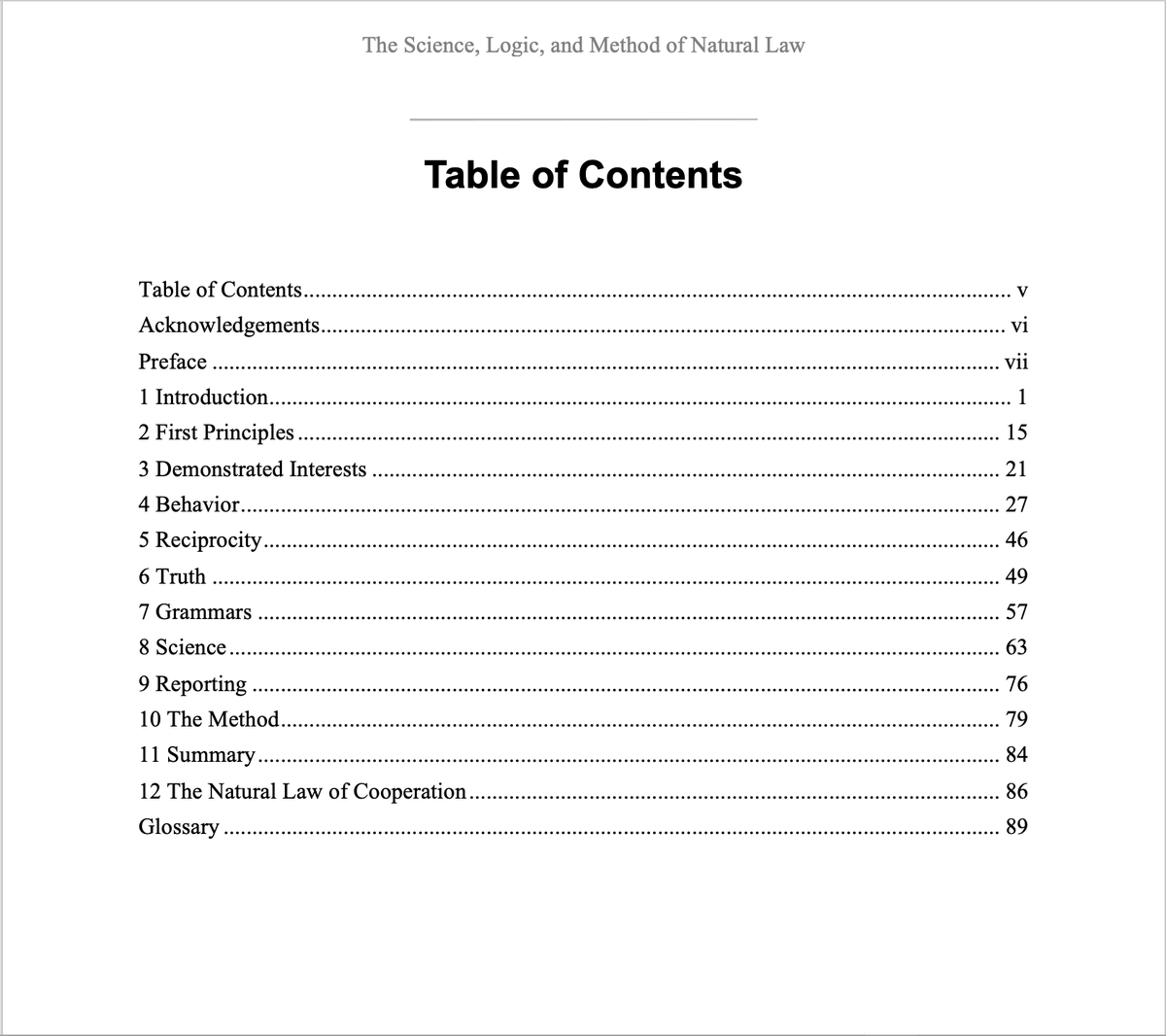
    Only ‘Dunno’ I have is the location of The Method, which could go before Truth and perhaps ought to. https://t.co/PmDR6wtIlH


    Source date (UTC): 2024-09-04 21:09:43 UTC

    Original post: https://twitter.com/i/web/status/1831439522258940307

  • (NLI Team) Walter III has made a leap. And he’s more aggressive than most, thoro

    (NLI Team)
    Walter III has made a leap. And he’s more aggressive than most, thorough, and still maintains decorum.
    We need to ask him how long it took altogether, and what has happened of late to make such a difference.


    Source date (UTC): 2024-08-21 18:21:19 UTC

    Original post: https://twitter.com/i/web/status/1826323714348093912

  • (NLI) A bit of history. When we went public in 2012

    (NLI)
    A bit of history. When we went public in 2012. https://t.co/hvRM9YRhfw


    Source date (UTC): 2024-08-14 23:38:52 UTC

    Original post: https://twitter.com/i/web/status/1823866911978852524