Form: Mini Essay

  • Rock, Paper, Scissors: Three Coercive Technologies, and Three Social Classes

    Rock, Paper, Scissors: Three Coercive Technologies, and Three Social Classes

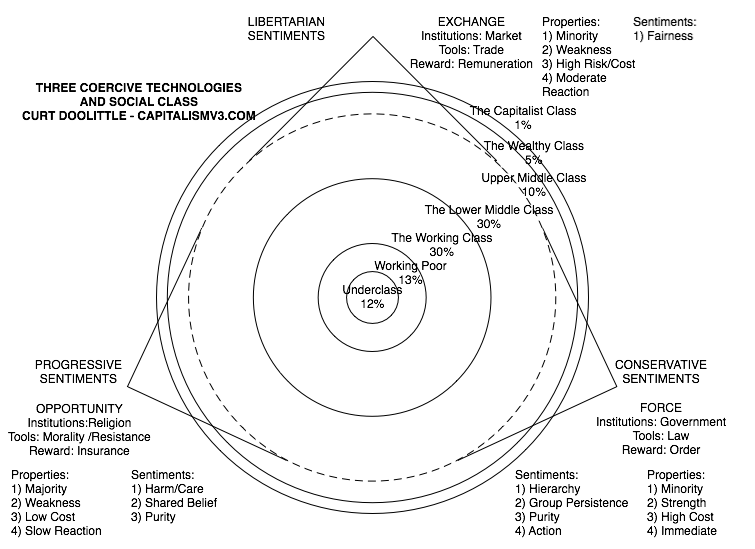
    theecoercivetechnologies

    There are three means of coercing groups of people with institutions 1) Force, or the threat of force A person has a VIOLENCE INCENTIVE to behave in a particular way when it has been made known to him that failure to do so will result in some form of physical aggression being directed at him by other members of the collectivity in the form of inflicting pain or physical harm on him or his loved ones, depriving him of his freedom of movement, or perhaps confiscating or destroying his treasured possessions. 2) Remuneration or payment A person has a REMUNERATIVE INCENTIVE to behave in a particular way if it has been made known to him that doing so will result in some form of material reward he will not otherwise receive. If he behaves as desired, he will receive some specified amount of a valuable good or service (or money with which he can purchase whatever he wishes) in exchange. 3) Moral claims (collective goods) A person has a MORAL INCENTIVE to behave in a particular way when he has been taught to believe that it is the “right” or “proper” or “admirable” thing to do. If he behaves as others expect him to, he may expect the approval or even the admiration of the other members of the collectivity and enjoy an enhanced sense of acceptance or self-esteem. If he behaves improperly, he may expect verbal expressions of condemnation, scorn, ridicule or even ostracism from the collectivity, and he may experience unpleasant feelings of guilt, shame or self-condemnation. And a persuasive argument can consist of one or more of these strategies, often in great complexity. People give priority one or more different weighted combinations, or perhaps ‘chordic’ representations of these strategies. They do so out of habit, and class inclination, just as they follow religious and class sentiments due to their upbringing. People who belong to institutions have different capacities for adopting these strategies. Force requires discipline and long Time Bias. Remuneration requires cunning and invention. Moral claims require loyalty to consensus, and absorption of, and therefore payment of, opportunity costs. Different social classes have different time biases and consist of people with different time preferences, requiring different types of discipline under different social and economic conditions. ie: it is easier to have a long time preference if one is genetically disposed to better impulse control, and lives in greater security. It is easier to have a short time preference if one is more persuaded by impulses, less disciplined, and in an environment of scarcity. The social classes are organized by intelligence. Intelligence is the ability to absorb content in real time, to learn abstractions in time, and to permute those abstractions in application to problems in real time. Intelligence regresses toward the mean over generations. THerefore class membership is an indicator of the likelihood of class mobility, and upper class position is difficult to maintain. While we use the word ‘middle class’, and most people in the west live middle class lifestyles, the middle class means possessing disposable income and participating in the market. Therefore the majority of citizens are in the upper proletariat and lower middle classes, which we call the working, white collar working and craftsman classes. There are different costs to these institutions: Force is extremely expensive. Creating non-corruption, and order (some network of property definitions and their means of transfer). Property is a term for a scarce good that must used, consumed or transformed in the process of production, even if that process is human sustenance. Remunerative institutions require the complex task of concentrating capital then maintaining it in a constantly changing kaleidic and competitive environment. Moral claims require constant advocacy, verbal skill, maintenance of numerous relationships, and constant payment of opportunity costs. The Social classes have different access to each of these forms of coercion. Those in the institutional class, or upper class, have access to force in the form of policy and law. Those in the capitalist class, or middle, have access to capital : money, and market institutions. In each strategy people form elites, and organizations for utilizing those strategies. The elites create philosophical frameworks. Each of these frameworks consists of moral claims, and institutional means of perpetuating those claims, and the social benefits of adopting those claims. Each of these institutions is open to corruption, which is the privatization of opportunity and reward, for personal consumption at group expense. Corruption is fraud. Each of these strategies, their organizations, institutionas and elites compete against other strategies, organizations and elites, and each attempts to use it’s organization for discounts against other organizations. This competition is analogous to the game of Rock, Paper, Scissors, if more complicated: each group can sucessfully compete against one another under most circumstances, but can defeat and be defeated by some other combination of forces. The human mind is comfortable with identity and causality. It can with practice, understand a one dimensional causal spectrum. It can, with effort, understand two dimensions of cuasality. It can with more effort understand three dimensions of a causal spectrum. Human emotions for example, consist of probably no more than three stimuli: dominance, pleasure and activiation. And that all human emotions, in their seemingly infinite varieity can be described as using these three axis of stimuli. Likewise, human social behavior consists of three different forms of coercion, in some combination, and this leads set of axis leads to seemingly infinite variety. But it only seems infinite. At it’s base, there are only three forms of social organization.These three forms can be combined, as they are in the majority of the population in some manner or another. Or they can be used as one of three specializtions, each of which attempts to play rock, paper, scissors, with the other two.

  • Is It Worth Our Efforts? An Prayer For Revolution By The Nobility

    When we invented farming, money and cities, we had to convert the barbarians into peasants. As a consequence, we had to endure their disastrous magical religions. When we invented credit, and machines, we had to convert the peasants into proles. As a consequence, we had to endure their ridiculous Marxism and it’s murderous and impoverishing consequences. When we invented fiat money, nationalism, mass production, we had to covert the proles into consumers,. As a consequence had to endure their ridiculous redistributionism, multiculturalism, feminism, and Democratic Socialism

    [callout]I pray thee God, deliver us unto Kings, and save us from ‘The People’.[/callout]

    When we invented consumer credit and digital technology, we tired to to convert consumers into middle class citizens, and entrepreneurs. As a consequence we have had to endure conversion into a minority, loss of sovereignty, declining birth rates, and threats of Islamist movements. In retrospect, our advances are unwanted. The proles are a permanent resistance movement. A permanent detriment to the species. Our advances are unwanted and unappreciated. We are demonized by the lower class, not as heroes acting for the good of all but as selfish malcontents. There is never enough improvement to sate the desires of people whose real motivation is to counteract the one irreconcilable problem: The daily reality of their social status as consumers, proles, peasants and barbarians – as the lower class. Their status is written on their faces. IN their genes. In their body language. In their speech. They cannot escape it. They rail against their betters, envying what they do not have, cannot have, and would not have, but for the efforts of their betters. Why then, do we simply not return the consumers, proles, and peasants to barbarism and ourselves to nobility in the process? The proles act as if their threats of revolution are meaningful. When, the opposite is just as clearly true: That the strong can easily eat the weak. Maybe it’s time to recognize the futility of our heroism. The few have always been able to buy the cooperation of a minority willing to oppress the rest. If only in our self defense. To stop them from destroying the world we have made. “I pray thee God, deliver us unto Kings, and save us from ‘The People’.”

  • Philosophy is the Doctrine of the Middle Class

    Leading an organization of human beings of any size, is a complex and difficult task. Human events are kaleidic. The common people have complex and conflicting motivations and incentives. Leaders must convey near omniscience because their followers are moved at the lowest cost in the shortest time under the assumption of near omniscience. Power is obtained by a mixture of discipline, cunning, compromise, threats, perseverance, demographics and luck. Power is held by a mixture of habituation and limited, tacit consent – almost entirely because the alternatives are uncertain and therefore more risky, costly and frightening. THE UPPER CLASSES, HISTORY, INSTITUTIONS AND LAW Those who are the victors, and those who create the rules rules, do not write philosophy — they take actions, make decisions, speeches, art, and policy. They create institutions: The administrative tools of human cooperation. Their followers write history. History is the only form of philosophy with any substantive truth content. There are very few books of Aristocratic philosophy: Aristotle, Machiavelli, Pareto, Weber. Perhaps some of the scholastics. In the west, administrative philosophy of the church is divided from the military and commercial philosophy of the Manor-Kings. The writers of the church are members of the middle class or the aristocracy. But history and the record of history is the writing of the nobility. THE MIDDLE CLASSES AND PHILOSOPHY The vast number of works of political philosophy have been written by the upper middle and middle classes. Nearly all political philosophy is by definition revolutionary – there is no need to use verbal coercion when one has the means by which to enact ones will without verbal coercion. Western philosophy is an advisory program. It counsels. It suggests. It persuades. Western philosophy is utilitarian. It is moral and most importantly it is both technical and commercial. Western philosophy establishes the contract terms of the middle class, by which they are willing to be administered by the aristocracy. THE LOWER CLASSES AND RELIGION All religion is political philosophy. It is the philosophy of resistance. Religion establishes the contract with the peasantry. It sets the terms by which they are willing to be administered by the aristocracy. The power to resist. To refuse to act. Is a power. It is the power of the weak. But in vast numbers. It is a vast power. Religious symbols are resistance movement symbols. Whether dress, or icon, mythical figure or scripture. Religious movements are resistance movements. Resistance through unity. VIOLENCE RULES But we must be cautious when consuming philosophical writing. It is largely acts of justification. To defend ourselves against it, we must ensure that we study our history as well, because philosophy influences and justifies —- but violence and law rules. All legal products, all philosophical products, all religious products – all political products of all kinds, are an effort to rotate elites for the purpose of class benefit. Marx was right that there exists a class struggle. He was wrong that it will end. He was wrong that the proletariat would ever win. The fact is, that there are vast differences in ability between individuals. That these differences are genetic. That our classes are a genetic hierarchy. And that genes regress toward the mean. For these reasons, we will always have class rotation. And law, philosophy and religion will be the means by which each group seeks to hold or obtain power.

  • It’s Not Colonization, It’s Containment

    Obama was warned by Bush, along with the other democratic candidates, that once he gained office he would not be able to exit either country. The one who paid attention to that warning was Clinton. Obama softened slightly but was more reliant on the radical left. So he wasn’t as careful. Now that he’s in office he can’t fulfill his promises to his radical left supporters. Contrary to some of the nonsense I’ve been reading from the left lately, we aren’t colonizing the muslim world. We wouldn’t want to. It’s thankless work. It’s expensive. And they’re too primitive to be of value to us as colonies. The labor is too ignorant and uneducated to function as laborers. The people are too poor to function as consumers for advanced goods. The institutions and infrastructure are too corrupt and unreliable to assist in production and distribution. So, It isn’t colonialization. It’s containment. Americans spent the last century containing communism, and the result was a conversion of the marxist economies to totalitarian capitalism, and perhaps the greatest shift in human standard of living since the invention of farming. While communism was a religion masquerading as a political movement, Islam is a political movement masquerading as a religion, and is the current replacement for marxism – a means of the world underclass to counteract the effect of modernization on their primitive social orders. Like marxism, islam is a primitivist and economically destructive political movement – perhaps more destructive than was it’s prior instantiation, which we call Roman era christianity. The underlying military and political problem is that Islamic Civilization does not have a core state, and that of the core state candidates (iran, pakistan, saudi arabia and turkey) three choices are corrupt, despotic and terrible, and the fourth is unlikely. The impact of the schism is still with the civilization. From a strategic geopolitical position, Core states can be pressured to keep fringe states in line and out of military action. Islam (magian or perhaps magical civilization is a better term) cannot be contained without a core state. Therefore Islam is the new communism until there is enough of a reformation in one of the states that a reliable core state can be formed. THE STRATEGY IS TO DESTABILIZE UNTIL A CORE STATE CAN FORM DUE TO INTERNAL PRESSURE. This is probably too grown-up an analysis for people who think that people who have grown up, real jobs, and real responsibilities, are not acting on emotional or antiquated mystical fantasies like ‘colonialization’ rather than pragmatic economic and security concerns. But that doesn’t mean that the truth shouldn’t be told to those who actually have the capacity for such understanding. The best answer is for us to build 200 nuclear power plants and to get off of oil, and let the middle east fall back into barbarism until they are ready to abandon their magianism and join the modern world. CURT

  • Capitalism? It’s Cooperative Technology. It’s Not A Religion.

    A laugh. From a Galambos Fan. A link to a posting on Dubai’s economy.

    “Capitalism is that societal structure whose mechanism is capable of protecting all forms of property completely.” — Galambos   Is the new epic-center of capitalism to be the Islamic World?

    They already have a religion… 😉 But let’s look at this Islamic world:

    • Low median iq.
    • Poor education.
    • Science-denying biases.
    • Rampant mysticism.
    • Religious schism.
    • No core state

    Dubai simply has no oil and wants to be the Switzerland of the Muslim world. This is not a capitalist strategy per se. It makes no appeal to the social order.  Instead It is a casino strategy – draw from extended regions whomever you can regardless of how they obtained their money.  Capitalism is either a social order with incentives for all members, or it is a platonic and absurd personal philosophy that runs counter to the facts.  😉 Curt

  • Rereading The Constitution Of Liberty Leads To A Few New Insights On Freedom

    I’ve read Hayek’s The Constitution Of Liberty twice again lately while editing it so that I could convert the text to spoken audio. The resulting audio is imperfect — because my editing of the multitude of optically recognized characters is imperfect — but for personal consumption it’s works just fine. But editing a text forces you to read it more carefully than casual reading does. The first time I read it I did not really appreciate the book’s depth of reasoning. I don’t even remember when I did read it the first time. I was probably in my early thirties? But it’s more than that. Because one needs considerable knowledge of the field, it is not apparent to the casual reader that he is making logically NECESSARY arguments – especially given Hayek’s gentle, advisory, tone. Hayek felt that the writer should show sympathy for his opponents. A technique which is very useful in engaging the reader, but a tone that is also prone to misinterpretation of the underlying purpose of his arguments. I have, and so have others, said, that Hayek’s great failing was in failing to defeat Keynes. He left that task for history because he thought it so obvious. But he did not understand the attractiveness of the positivist methodology when opposed only by the conservative libertarian framework that solves for freedom as an absolute good.

    [callout]Freedom is intuitive as an experience, but counter-intuitive as a process.[/callout]

    FREEDOM IS INTUITIVE AS AN EXPERIENCE, BUT COUNTER-INTUITIVE AS A PROCESS Besides being both an [glossary:appropriated term], and an [glossary:expanded term], Freedom is a proscription against the political input of actions for the purpose of obtaining unspecified (and promissory) output actions. And as such Freedom is logically inconsistent to the human mind, whose action orientation finds such systemic solutions all but impossible to believe, and in retrospect finds the relations between cause and effect, deterministic or accidental, rather than the result of a policy of restraint – “not acting”. While the cause of our tradition of freedom is to be found in the military tactics of western chieftains and their retinue, and their distrust of the concentration of power, and the social status accorded those who rose as leaders by merit in commerce and war, it bears noting that the rarity of Freedom as a sentiment is in no small part due, to the fact that the very idea of unorganized action is illogical to the human mind. HAYEK SOLVES FOR FREEDOM Hayek is ‘solving’ for freedom and western civilization. I think the assumption is that by solving for these things, we create great wealth. But human beings do not solve for freedom, they solve for gaining experience and certainty of gaining them at the lowest cost and risk. While different social classes solve for different TIME frames in which they gain those experience, and how they perceive risk, we all solve for experiences. We call this acquisitiveness, which is a vulgar commercial way of expressing the same series of concepts. Solving for that which is incomprehensible as an input, and which cannot logically be connected with outputs assumes that the reader agrees with the proposition that freedom is a ‘good’ in the first place. SOLVING FOR UNEMPLOYMENT They Keynesian prescription is to solve for unemployment and use monetary policy, despite the fact that doing so exaggerates booms and busts. They Hayekian prescription is to solve for productivity and prices, and then unemployment will maintain natural levels. The social democratic prescription (which is the only option available to smaller states) is to solve for high taxation and high redistribution that pays the unemployed to stay home. The Poor Totalitarian prescription (in china) is to employ everyone in some productive capacity and redistribute via state control of capital. The Poorer Socialist prescription (India) is to pay the private sector to accomplish what the state lacks the resources to do. (Which I’m a fan of.) The worst solution is solving for unemployment because it distorts the economy. NOTE: While I use the term Freedom here, I use the term “Sovereignty” in my work because Freedom is an appropriated and expanded term that has lost meaning. Liberty likewise, holds a similar problem. These terms too often describe experiences rather than necessary causes. Sovereignty means that you have a monopoly over yourself and your property. Freedom means the absence of coercion. And that is too loose a definition. Monopoly over one’s self and property is much clearer. It means that the individual is the only state.

  • Putin: Your Cow Better Be Silent

    Putin Slams West for Wikileaks’ Assange Arrest : Putin Suggests U.S. Criticism Is the Pot Calling the Kettle http://abcnews.go.com/International/putin-slams-west-wikileaks-arrest/story?id=12364345 Putin criticizes supposedly democratic institutions for clamping down on a dissident.

    “The villagers say, that if your neighbor’s cow is mooing, yours better be silent”. Which is the Russian equivalent of ‘the pot calling the kettle black’.

    [callout] In fact, what’s impressive about the Wikileaks data, is that the USA actually looks like a pretty benevolent, if mildly overstretched and incompetent, empire, whose only material problem is creating a responsible, peaceful, core state for Islam[/callout]

    I wrote two days ago that arresting Assange is nonsense unless we have a real property crime. Unless property is transferred (technology secrets) and unless there is material harm ( our people get killed), or a trust is broken on a contract with a foreign government (we are trying to help rescue some government from oppression) there is not really a crime. In fact, what’s impressive about the Wikileaks data, is that the USA actually looks like a pretty benevolent, if mildly overstretched and incompetent, empire, whose only material problems are assisting in the maturity of market-participating states everywhere, and in particular creating a responsible, peaceful, core state for Islam – solving a serious problem for the world by helping modernize a violent, non-market, ignorant, superstitious and primitive expansionist culture so that it can play with the rest of the grownups in the world. Putin is one of my personal Heroes. I think, for Russia, he’s a perfect leader, and the leader that they need. Is Russia, and is all of Byzantine Christianity corrupt? Yes. Is the state an oligarchy? Yes. Is that bad for Russia at this point in it’s lifetime? No. Democracy, or at least, civic republicanism is NOT something that’s intrinsically good. Corruption is bad. Democracy can be a check on corruption. But only when the middle class is fully active, and fully enfranchised. Otherwise, the people will vote themselves into totalitarianism. Russians in particular will do so. Putin should be Tzar. Russia needs a King. The west needs kings. We all need kings. Not kings that can write laws. Kings that can veto abuses of the law. We may not know what we should do. But we can know what we should not do. And that is a job of a great monarch. Kings make it impossible to compete for political power, and force people to compete for economic power. That’s the beauty of monarchy.

  • A Decidedly Christian Set Of Laws In 1603

    I hadn’t read Hugo Grotius’ Commentary before today. It is an interesting attempt to provide a coherent set of legal principles. Even if it is just very simply a recitation of Biblical principles with european legal conventions. I would never agree to place such faith in Magistrates, or any other officer of the state. They are only human beings, and not exceptional human beings at that. I give my violence to the state to use justly on my behalf, so that I may spend my time in other activities, in our division of knowledge and labor. That does not mean that it has the ability to act justly on my behalf, or the will to act justly on my behalf, nor has it demonstrated that it has the tendency to act justly on my behalf. I do not believe that any officer of the state is better equipped to make judgements over property than I am. And those are the only judgements a man need know. If he must do other than that, he submits to servitude. Now, once we possess a significant market, we must have administrators, and regulators of that market, and citizens who adhere to the manners, morals, ethics, taxes and regulations that prevent fraud, theft, and violence within that market, are it’s shareholders. Those shareholders will often seek to escape payment, or to transfer liability and risk onto others, or to draw more than their earnings from the corporation of the market that we call the state. I recognize that such thefts are invisible to men without the adminstration of the state to monitor them. As such, I agree that we must have courts and jurors. However, should these men, in the observance of their duties, abridge the laws of property, of theft, of violence, or fraud and deception in the course of their duties — even if it is to pursue just ends, or if such men, in the name of ease, or efficiency, or laziness or stupidity, or most importantly, the fallacy of just democratic law making, then I do not allow them to use my violence on my behalf, to seek reparation from my fellow men. And instead, I must withdraw my violence from the account of the state, and use it at my own discretion.

    Commentary on the Law of Prize and Booty [1603] by Hugo Grotius Table Of Rules And Laws Compiled From Chapter II Of The Commentary Rules rule i. What God has shown to be His Will, that is law. rule ii. What the common consent of mankind has shown to be the will of all, that is law. rule iii. What each individual has indicated to be his will, that is law with respect to him. rule iv. What the commonwealth has indicated to be its will, that is law for the whole body of citizens. rule v. What the commonwealth has indicated to be its will, that is law for the individual citizens in their mutual relations. rule vi. What the magistrate has indicated to be his will, that is law in regard to the whole body of citizens. rule vii. What the magistrate has indicated to be his will, that is law in regard to the citizens as individuals. rule viii. Whatever all states have indicated to be their will, that is law in regard to all of them. rule ix. In regard to judicial procedure, precedence shall be given to the state which is the defendant, or whose citizen is the defendant; but if the said state proves remiss in the discharge of its judicial duty, then that state shall be the judge, which is itself the plaintiff, or whose citizen is the plaintiff. Laws law i. It shall be permissible to defend [one’s own] life and to shun that which threatens to prove injurious. law ii. It shall be permissible to acquire for oneself, and to retain, those things which are useful for life. law iii. Let no one inflict injury upon his fellow. law iv. Let no one seize possession of that which has been taken into the possession of another. law v. Evil deeds must be corrected. law vi. Good deeds must be recompensed. law vii. Individual citizens should not only refrain from injuring other citizens, but should furthermore protect them, both as a whole and as individuals. law viii. Citizens should not only refrain from seizing one another’s possessions, whether these be held privately or in common, but should furthermore contribute individually both that which is necessary to [other] individuals and that which is necessary to the whole. law ix. No citizen shall seek to enforce his own right against a fellow citizen, save by judicial procedure. law x. The magistrate shall act in all matters for the good of the state. law xi. The state shall uphold as valid every act of the magistrate. law xii. Neither the state nor any citizen thereof shall seek to enforce his own right against another state or its citizens, save by judicial procedure. law xiii. In cases where [the laws] can be observed simultaneously, let them [all] be observed; when this is impossible, the law of superior rank shall prevail.

  • Arresting Assange For What? Say Again?

    OK. I just dont get arresting Assange for getting women to sleep with him, and not using a condom. We’d need an awful lot of additional jails. Either arrest the guy for the real reason that you want him, or you’re abusing the justice system. I’m not a fan of this guy, and I think public opinion will crowsdsource his guilt or innocence correctly. But this kind of legalism is simply abusive. I don’t let the state use my violence on my behalf for injustice. I give my violence to the state to use on my behalf in order to prevent and resolve disputes between my fellow citizens over theft, fraud and violence. I do not give my violence to the state to use on my behalf to trump up bad manners into illegal actions for the purpose of political nonsense. It’s just proving his position that our governments are corrupt. Arrest him for distributing state secrets (even if they are meaningless so far). Make an example of him if you want. But we’re going to have to legalize prostitution, universally license all women, and men are going to have to ask for receipts in order to have sex and prove it was voluntary. Ridiculous. Brits should be ashamed.

  • The Globalization Of Status and Beauty and The Rise In Rhinoplasty

    I read and commented on a piece recently that lamented the rise in rhinoplasty (nose jobs) among Iranian women, seeking smaller more feminine noses. But I am not sure it’s a reason for lament. SOCIAL AND ECONOMIC STATUS Self modification is partly popular because it is expensive and demonstrates that you have joined the market-participating (middle) classes. So, partly, this is about status seeking. Status seeking is important because it controls access to mates. It is not as important for men as women. Women are more status conscious of men, and men more beauty conscious of women. In reality this is a pretty successful algorithm for a population to follow. It increases everything good, and causes rotation of elites and genes. INTERNATIONAL STATUS AND POWER Aside from local trends, people also adopt status signals based upon which culture has ‘power’. As the west rose, western dress and ‘looks’ increased in status. As the west declines in power, regional preferences are becoming favored. (We see this in the returning preference for paternalism in china for example.) So STATUS properties are plastic and to some degree — they are a ‘fashion’.

    [callout]Think of it as part of ‘globalization’: symmetry across all human forms.[/callout]

    UNIVERSAL SYMBOLS OF BEAUTY Conversely, there are certain properties of beauty that are universal, such as health, waist-hip ratio, height weight proportionality, long legs, and hemispheric symmetry. It turns out that, “on the whole” people view large noses as asymmetric now that they have exposure to enough human variety to see them as a asymmetric. Therefore, regional “racial” symbols of attraction are subject to change because of exposure to a large number of different faces, with different status attributes. THE CONCEPT OF PHYSICAL SYMMETRY UNDER GLOBALIZATION Think of it as part of ‘globalization’: symmetry across all human forms. Although across all cultures, there appears to be a universally attractive look, and this look is associated with being ‘white’ the truth is that it’s just the greatest symmetry that can be obtained in the human form as we currently undertand it. (This is an interesting area of research.) But it is not whiteness. It’s symmetry on the one hand and ‘feminine fineness’ over masculine mass that determines beauty (in women). So this tendency is a mathematical expression. (I read recently that prettier women have more children so that it’s likely that the process will improve, but then there are gene-pool collisions that simply haven’t worked themselves out in every region.) COUNTERACTING TRENDS It might be useful to note that people will not likely adopt asymmetric modifications (enlarged noses) in order to achieve status. People will tend to increase their appreciation for local asymmetry (traits dominant in their local group) if it is associated with greater status – such as nationalistic or racial traits. Therefore the fashionability of nose modification will drop even if the permanent attraction of smaller noses as more attractive doesn’t. In other words, the priority of these different status symbols can change over time. We see racial feature preferences in Jewish, African American, Greek and Italian populations. It has gone out of fashion and become impolitic for white northern europeans to classify themselves racially beautiful examples, and instead they simply refer to more general ‘beauty’. Despite that other racial groups do maintain their preferences. ITS AFFECTING ‘WHITE’ PEOPLE AS WELL It may be interesting to note that white women currently envy african buttocks and east asian body weight distribution, rather than traditional fertility-driven ‘curviness” — so feature-envy it works both ways. It may also be interesting to note that ‘white’ skin color is a fashion, not an absolute. Skin clarity demonstrates health, and lighter appears to be more attractive than darker, no matter what race you’re in. But It appears we like ‘very light coffee colored’ as the ultimate symbol of health, because ‘very white’ that borders on translucent is also now associated with lack of skin plasticity (aging badly). So, we are ‘learning’ some things that are meaningful as well. BEAUTY IS A COMPLEX NETWORK So, beauty is determined by a number of properties: International cultural power status. Local Economic Status, symmetry, femininity, healthiness, and “globalization” – exposure to greater choice. We can all feel equally inadequate. (Spoken as a small nosed, short, northern european.)