Form: Mini Essay

  • photos_and_videos/TimelinePhotos_43196237263/29694489_10156264709207264_61685063

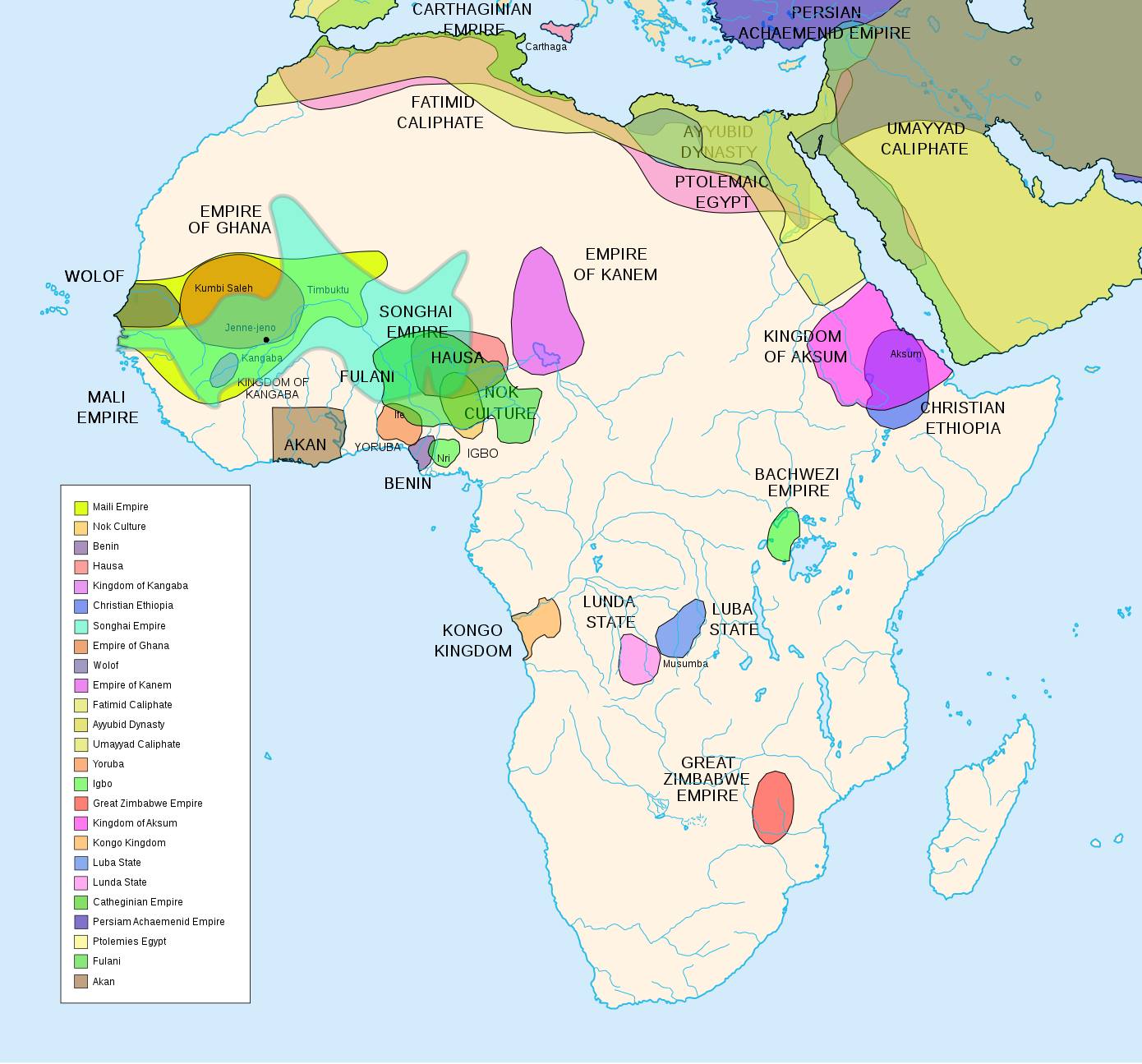
    photos_and_videos/TimelinePhotos_43196237263/29694489_10156264709207264_6168506320564518912_o_10156264709202264.jpg FOUR AFRICAS

    If you look at Africa, North Africa developed rapidly under the Egyptians and Phoenicians, and only failed under islam.

    If you look at west africa, it sure looks like civilization should have taken off there, and the only thing I can see so far is (a) limited productivity of the territory meaning high cost of administration, (b) lack of eurasian or south american domesticated animals and vegetables, (c) painful disease gradients, and (d) isolation from trade once they reached sufficient scale, that they needed eurasian technology from others to continue scale. I’m just too ignorant still to understand. But it looks like a ‘Jared Diamond’ argument there.

    If you look at east africa, the two red sea routes (the isthmus across the south, and the river at the north) this territory was ‘hostile and unexplored’ and the trade route poorly usd until roman times (and was prime booty for islam).

    If you look at the territory between east and west africa, and between east africa and the highlands of southern africa, these regions are just too costly to transit for trade – especially in comparison to the mediterranean. I mean, geography is just … damn, africa is HUGE.

    The route across the isthmus like that between alaska and siberia was walkable or at least open to simple migration out of africa. The semitic peoples (i think) developed out of west eurasians on this land bridge route, then moved north, and once the semitic peoples developed they migrated southward and established kingdoms in the horn of africa. (the one that is now slowly splitting off of africa to form a large island as big as the british isles.)

    Even once horses were introduced, the climate is not beneficial for raising horses (especially compared to mongolia or the european plain).

    Trade tended to round the west coast rather than cross the center. Meaning that trade with west africa was prohibitively distant until the age of sail.

    —“cavalryman in West Africa ultimately lost out to the musketeer. Firearms were not only, eventually, a more efficient arm of warfare: they were also very much cheaper than horses. The same happened in Asia, of course: but perhaps not quite so inevitability. For a very long time firearms were inferior both in range and rate of fire to the Turkish compound bow. The Tatars of the Crimea were still, in the seventeenth century, raiding effectively in Eastern Europe against the opposition of field artillery and troops armed with muskets. And western writers on Ottoman expansion have tended to lay too much emphasis on the Janissaries – infantry musketeers – as against the Ottomans’ more significant light cavalry. But gunpowder had nevertheless sounded the death-knell of the mounted archer’s invincibility. In West Africa the heyday of the cavalryman lasted for a much shorter period than in Asia – not more than five centuries”—

    Still have to study each of these west african empires, because it sure looks like there was sufficient mass there.William L. BengeThe space race has money flowing into whether or not and then how to teraform Mars, while there’s an entire continent on earth that could benefit from a similar tecnnological push for teraforming: Africa. Except, very unlike Mars, there’d be scores of corrupt governments on the continent to have to contend with at every turn. Definitely prohibitive. Unfortunate.Apr 05, 2018 1:44amWilliam L. BengeLushness from coast to coast on the continent, along with robust agg, would be the next wonder of the world.Apr 05, 2018 1:47amWilliam L. BengeWould make the great pyramids of Egypt look like child’s play, Panama canal too.Apr 05, 2018 1:49amWilliam L. BengeNevermind, the mohammedans would have to be domesticated first. Idea wrecked.Apr 05, 2018 1:52amJames HarroldThough wouldn’t terraforming a subsection of the planet have possible unforeseen consequences for the whole planet. At least on mars, there’s no life (that we’ve detected) so theres little collateral damage if we attempt to terraform it.Apr 06, 2018 9:09amWilliam L. BengeYes, seems undeniable would offer surprises but since my expertise here is nil have to say IDHDC as to what a reasonable purview looks like on the topic. I mean, the fact that actual scientists are conversing about terraforming a planet and even conducting field research for it has me, well it’s surreal my man.Apr 06, 2018 9:37amJames HarroldOh yeah definitely. And usually they start with smaller scale proof of concept and for the most part I think Africa has parts that could be interesting to experiment with. I was just kind of running that simulation in my head and remembering some case studies of even much smaller changes completely changing ecosystems for better or for worse.Apr 06, 2018 9:48amFOUR AFRICAS

    If you look at Africa, North Africa developed rapidly under the Egyptians and Phoenicians, and only failed under islam.

    If you look at west africa, it sure looks like civilization should have taken off there, and the only thing I can see so far is (a) limited productivity of the territory meaning high cost of administration, (b) lack of eurasian or south american domesticated animals and vegetables, (c) painful disease gradients, and (d) isolation from trade once they reached sufficient scale, that they needed eurasian technology from others to continue scale. I’m just too ignorant still to understand. But it looks like a ‘Jared Diamond’ argument there.

    If you look at east africa, the two red sea routes (the isthmus across the south, and the river at the north) this territory was ‘hostile and unexplored’ and the trade route poorly usd until roman times (and was prime booty for islam).

    If you look at the territory between east and west africa, and between east africa and the highlands of southern africa, these regions are just too costly to transit for trade – especially in comparison to the mediterranean. I mean, geography is just … damn, africa is HUGE.

    The route across the isthmus like that between alaska and siberia was walkable or at least open to simple migration out of africa. The semitic peoples (i think) developed out of west eurasians on this land bridge route, then moved north, and once the semitic peoples developed they migrated southward and established kingdoms in the horn of africa. (the one that is now slowly splitting off of africa to form a large island as big as the british isles.)

    Even once horses were introduced, the climate is not beneficial for raising horses (especially compared to mongolia or the european plain).

    Trade tended to round the west coast rather than cross the center. Meaning that trade with west africa was prohibitively distant until the age of sail.

    —“cavalryman in West Africa ultimately lost out to the musketeer. Firearms were not only, eventually, a more efficient arm of warfare: they were also very much cheaper than horses. The same happened in Asia, of course: but perhaps not quite so inevitability. For a very long time firearms were inferior both in range and rate of fire to the Turkish compound bow. The Tatars of the Crimea were still, in the seventeenth century, raiding effectively in Eastern Europe against the opposition of field artillery and troops armed with muskets. And western writers on Ottoman expansion have tended to lay too much emphasis on the Janissaries – infantry musketeers – as against the Ottomans’ more significant light cavalry. But gunpowder had nevertheless sounded the death-knell of the mounted archer’s invincibility. In West Africa the heyday of the cavalryman lasted for a much shorter period than in Asia – not more than five centuries”—

    Still have to study each of these west african empires, because it sure looks like there was sufficient mass there.

    Source date (UTC): 2018-04-04 18:30:00 UTC

  • KNOWN CRITICISMS OF THE WORK (repost) It’s not like my work isn’t open to critic

    KNOWN CRITICISMS OF THE WORK

    (repost)

    It’s not like my work isn’t open to criticism. The whole point of doing work in public is to attract criticism in order to improve the work. Friends, followers, and lurkers have been incredibly helpful and contributed significantly to my ‘community’ project: propertarianism.

    The correct criticisms of my work are:

    1 – it’s not published (that’s true).

    2 – it’s not finished in complete enough form that you can understand it without following me for a while. (That’s True.)

    3 – I conflate (not on purpose) metaphysics, epistemology and ethics (decidability), with political advocacy (market government) with the cause of western civilization (aryanism: heroism, truth, promise(contract), sovereignty, rule by voluntary reciprocity, and markets in everything as a consequence). This confuses people. It’s a good criticism.

    4 – Law (decidability) isn’t ‘enough’ for pedagogy (meaning), and people need religion: ritual and myth. (intuition). This is true. But one of my open research questions is this: is nature, history of family, and history of real heroes, and the truth enough if wrapped in ritual and festival? Can we have a ‘religion without lies’. And I think the answer is yes. The problem is, that’s an entirely different scope of work. And I don’t engage in the pragmatism of conflating the via negativa of law (truth) and the via-positiva of education (religion). So in keeping with the competition between via-positiva and via-negativa my intention is to produce two works, the first law, the second, ‘religion’. I have had this intention for a very long time. I don’t see how to avoid it. I had originally intended to incorporate the law in the CENTER of the ‘religious’ prose with fables in the beginning and history at the end. But that would lead to a ridiculously large tome no one could possibly carry around (i’ve tried). It is possible to condense the scientific content into a constitution of Natural Law (‘the law’) and place that in the center between myth and history. And so I might do that (if I live long enough). But I don’t want to conflate using pragmatism, the necessary competition between very clear truth, and very clear wisdom. That would only continue to duplicate the CRIME of the Abrahamists.

    5 – It’s not sufficiently explanatory. Well it is actually and that’s what will horrify you as all your sacred cows are slaughtered without mercy. My work consists of constant relations from physics through sentience. And it’s as dehumanizing as was darwin, copernicus, and aristotle.

    6 – It’s pretty counter-intuitive, and hard to understand, because of the terminology. (this is true. but because I must create a universal language of decidability across all fields of human knowledge, I pulled the best term from each field, deflated it, arranged them in series, and this ‘competition’ caused extraordinary narrowing of meaning ( ergo, vast increases in precision). So just as eliminating the divine from argument to gain greater precision we eliminate conflation from argument to gain greater precision.

    7 – There are no known technical criticisms. The truth is, that I do not know of any technical criticism of my work and I am seriously doubtful that there will exist any such criticisms – ever. It will take you a very long time to understand why. The reason is, that while I am writing in prose form, the thought process I use is procedural testing of relational calculus. (that’s what databases do). Just as I write law in the language of philosophy using the methods of science. It will be very hard to criticize what I have done here. As far as I know it is not possible. And I am an exhaustive analyst.

    But the fact that you don’t understand algebraic geometry, understand formal logic, Understand relational calculus, understand algorithms, or understand testimonialism’s dimensional grammar that depends upon definitions in the form of relational calculus, is just a lack of familiarity with the grammar.

    And I don’t write everything formally. I start with quick sketches, and when I’m done, I should end up with little more than one or more series of dimensional definitions, with all the ‘meaning’ deducible from that set of definitions.

    Once I have that then I iterate on explaining it until I get as close as possible to aphorisms if I am lucky or operational proofs otherwise, and sometimes I just resort to a narrative that make use of the terms in order to provide context.

    In other words, I’m writing PROGRAMS, and text is just inline documentation for definitions that perform functions.


    Source date (UTC): 2018-04-04 14:34:00 UTC

  • HAS NO ALLIES, ONLY DEPENDENTS **China has no allies. She only has dependents.**

    https://www.quora.com/Are-China-and-Russia-now-military-allies/answer/Curt-Doolittle?share=ddcc003b&srid=u4QvCHINA HAS NO ALLIES, ONLY DEPENDENTS

    **China has no allies. She only has dependents.**

    This principle is central to east asian thought. There are no equals. In all circumstances someone is superior and another is subordinate.

    When confucius could not solve the problem of politics he directed all men to organize into a paternal hierarchy, from the emperor on down to the new born child.

    When chinese history says ‘middle kingdom’ they mean ‘the center of the world’ with them at the top.

    Chinese thought requires the preservation of harmony – meaning non disruption of the status hierarchy. Even if that means doing everything possible to avoid speaking the truth.

    Chinese strategy, is to delay and deceive, while building up offensive and defensive capability, until a competitor can no longer even negotiate, but simply obey.

    This is a very paternal model of thought. It is not necessarily a bad one, for the simple reason that chinese pursuit of harmony, and parenting is somewhat grounded in their (rather questionable) morality.

    That said, they will kill millions of their own happily if necessary, and have far less regard for human life than westerners (or indo europeans in general) do or can even imagine.

    So no, **China has no allies, she has only enemies, subordinates, and candidate subordinates.**

    This is all you really need to understand about chinese policy, culture, and civilization. Just as heroism sovereignty, reciprocity and truth are all you need to understand the west. In this sense we are not very compatible civilizations.Updated Apr 4, 2018, 12:05 PM


    Source date (UTC): 2018-04-04 12:05:00 UTC

  • Far more people are mentally ill than is obvious from daily discourse. The princ

    Far more people are mentally ill than is obvious from daily discourse. The principle reason is that they are vastly under socialized and their less than able minds are not constrained by continuous training under pressure of peers.

    Americans are de facto crazy, where other peoples are de facto escapist, religious, or superstitious. This is because we have attributed to and demanded from ordinary people the agency of the middle, upper middle and upper classes.

    And the fact is that the reason people are in the middle and upper classes is precisely because they possess agency that others do not.


    Source date (UTC): 2018-04-04 11:30:00 UTC

  • A REMINDER: “I DON’T HATE ON ANYONE.” I’m not anti anyone at all. I’m not a raci

    A REMINDER: “I DON’T HATE ON ANYONE.”

    I’m not anti anyone at all. I’m not a racist in particular. I’m anti parasitism in all its forms, particularly falsehoods. I’m anti-folly. And I’m anti-conflict.

    Now, Natural Law of cooperation that we call ‘reciprocity’ tells us what NOT to do. So I end up writing a lot of “Reprimands” (as a follower explained recently.)

    And I write reprimands of pretty much group on earth – particularly my own.

    Where I come from is this: There was, that I know of, only one enlightenment – that of Britain – and it was purely empirical. Every culture, in response, has resisted that empirical enlightenment.

    If we were at the end of the french or german or russian counter-enlightenments, I would attack them. but the french, the germans, and the Russians (or at least the jewish Russians) committed suicide.

    At present we are at the end of the American Christian, and Ashkenazi-jewish counter-enlightenemtns, and in the midst of the Muslim counter-enlightenments.

    So of course, my work will place greater emphasis on current examples of interest in the current era, than it will on the french, german, and russian.

    And of course, I criticize the chinese and indian civilizations as well.

    Now, empirically, I have to accept that the fundamental problem all civilizations face is the underclass, and that all present, past, and even more so future, questions will be determined by how we answer the fundamental problem of the ‘drag’ that the underclasses place upon mankind.

    And I understand that this is a difficult problem. But that single problem is solved by soft eugenics: one child policy for the unproductive, and paying them to have either one child only or no children at all. This will, as a consequence attach status to having multiple children, and … attach lack of status to those with wealth that do not.

    And this is the only solution I know of that is achieved by reciprocity under natural law.

    So if I offend you then you must answer these questions differently. And you will, of necessity, have a very difficult time finding a better method of calculating a happy prosperous mankind without entering into hubris or deceit.


    Source date (UTC): 2018-04-04 11:17:00 UTC

  • Ancient Family History Is Different from What Was Handed Down

    . (family history nonsense) Growing up we were told that our most distant ancestor had some crime or other that he apologized for, and gave money to Mont St Michelle. That wasn’t true at all. He merely gave witness to the legal proceedings. Fun with the “telephone game” of family history. The other was that one gave all his possession to a monastery. But of course, that’s what you did when you joined one. (Not that a am really sure of anything prior to 1350. Nor is anyone else for that matter. I’m still trying to get hold of something I can trust between the time the family disappears from the south of england, and … it sure looks like, moves north and then west. Always have property. Seems they were always literate. My ‘intuition’ tells me there was a little fortune seeking military nonsense going on in scotland and that this maybe didn’t turn out as they’d hoped, and resettled in the west.) This is the other axis I want to check. But I don’t think we can distinguish that clearly yet: THE HUSMERAE The Husmerae were a tribe or clan in Anglo-Saxon England, possibly forming an early settlement of the Hwicce subkingdom. The Husmerae settled on the banks of the River Stour, prior to 736.[1] They probably took their name from Usmere, a pool on the boundary of Wolverley whose name in preserved in Ismere House in Churchill, Worcestershire.[2] The tribe is mentioned only in the Ismere Diploma of 734, and subsequent charters relating to the same property until 964, when Usmere occurs on the boundary of Cookley in Wolverley.[1][3] This charter was for the foundation of a coenubium (minster). That minster was probably at Kidderminster, quite probably occupying the site of the parish church there.[4] Although the Husmerae may have been of West Saxon origin, settling into the area some time after the West Saxon defeat of the Britons at the Battle of Dyrham in 577, the Ismere Diploma suggests that Husmerae is the ancient name for area, although uncertainty over its provenance leave the origins of the name open to question [5] —- HWICCE Hwicce (Old English: /ʍi:kt͡ʃe/ [hw-eek-chay]) was a tribal kingdom in Anglo-Saxon England. According to the Anglo-Saxon Chronicle, the kingdom was established in 577, after the Battle of Deorham. After 628, the kingdom became a client or sub-kingdom of Mercia as a result of the Battle of Cirencester. The Tribal Hidage assessed Hwicce at 7000 hides, which would give it a similar sized economy to the kingdoms of Essex and Sussex. The exact boundaries of the kingdom remain uncertain, though it is likely that they coincided with those of the old Diocese of Worcester, founded in 679–80, the early bishops of which bore the title Episcopus Hwicciorum. The kingdom would therefore have included Worcestershire except the northwestern tip, Gloucestershire except the Forest of Dean, the southwestern half of Warwickshire, the neighbourhood of Bath north of the Avon, plus small parts of Herefordshire, Shropshire, Staffordshire and north-west Wiltshire.[1][2] —- ABBEY OF MONT ST. MICHEL, FOR BENEDICTINE MONKS, IN THE DIOCESE OF AVRANCHES. [Original Charters in Archives of La Manche, (fn. 1) and in private hands; Cartulary in Public Library of Avranches, No. 210. (fn. 2) ] [? 1085–1087.] (Original in archives. (fn. 46) Trans. Vol. II. fo. 247.) 718. Charter of William (Wilgelmus) son of Hugh de Silliaco. For forgiveness of all the misdeeds of himself, his predecessors and his successors, he grants in the time of William (Wilgelmi) king of the English, of Hoel bishop of Le Mans, of Ubert the vicomte and of Geoffrey de Mayenne (Mahena), to the monks of St. Michael, for the brotherhood and the prayers of St. Michael and the monks his servants, all the dues on his land of the monks’ demesne [to be enjoyed] as their own in peace, Ralf the monk and Andrew receiving them, on behalf of that house with a green branch of thorn (cum spine viridi ramo), Oldeburga (sic) allowing the gift on behalf of (loco) his other sons and accepting the benefits [of brotherhood] for them. Testimonio Willelmi de Vernico, et Amelini forestarii, et Berardi de Silliaco; Warini filii Rogeri; Radulfi de Dolieta; Erberti de Orca; Thebaldi capellani; Droconi[s] de Sancto Christoforo; Fulconi[s] Droardi, etc.
    Apr 02, 2018 9:50pm
  • Ancient Family History Is Different from What Was Handed Down

    . (family history nonsense) Growing up we were told that our most distant ancestor had some crime or other that he apologized for, and gave money to Mont St Michelle. That wasn’t true at all. He merely gave witness to the legal proceedings. Fun with the “telephone game” of family history. The other was that one gave all his possession to a monastery. But of course, that’s what you did when you joined one. (Not that a am really sure of anything prior to 1350. Nor is anyone else for that matter. I’m still trying to get hold of something I can trust between the time the family disappears from the south of england, and … it sure looks like, moves north and then west. Always have property. Seems they were always literate. My ‘intuition’ tells me there was a little fortune seeking military nonsense going on in scotland and that this maybe didn’t turn out as they’d hoped, and resettled in the west.) This is the other axis I want to check. But I don’t think we can distinguish that clearly yet: THE HUSMERAE The Husmerae were a tribe or clan in Anglo-Saxon England, possibly forming an early settlement of the Hwicce subkingdom. The Husmerae settled on the banks of the River Stour, prior to 736.[1] They probably took their name from Usmere, a pool on the boundary of Wolverley whose name in preserved in Ismere House in Churchill, Worcestershire.[2] The tribe is mentioned only in the Ismere Diploma of 734, and subsequent charters relating to the same property until 964, when Usmere occurs on the boundary of Cookley in Wolverley.[1][3] This charter was for the foundation of a coenubium (minster). That minster was probably at Kidderminster, quite probably occupying the site of the parish church there.[4] Although the Husmerae may have been of West Saxon origin, settling into the area some time after the West Saxon defeat of the Britons at the Battle of Dyrham in 577, the Ismere Diploma suggests that Husmerae is the ancient name for area, although uncertainty over its provenance leave the origins of the name open to question [5] —- HWICCE Hwicce (Old English: /ʍi:kt͡ʃe/ [hw-eek-chay]) was a tribal kingdom in Anglo-Saxon England. According to the Anglo-Saxon Chronicle, the kingdom was established in 577, after the Battle of Deorham. After 628, the kingdom became a client or sub-kingdom of Mercia as a result of the Battle of Cirencester. The Tribal Hidage assessed Hwicce at 7000 hides, which would give it a similar sized economy to the kingdoms of Essex and Sussex. The exact boundaries of the kingdom remain uncertain, though it is likely that they coincided with those of the old Diocese of Worcester, founded in 679–80, the early bishops of which bore the title Episcopus Hwicciorum. The kingdom would therefore have included Worcestershire except the northwestern tip, Gloucestershire except the Forest of Dean, the southwestern half of Warwickshire, the neighbourhood of Bath north of the Avon, plus small parts of Herefordshire, Shropshire, Staffordshire and north-west Wiltshire.[1][2] —- ABBEY OF MONT ST. MICHEL, FOR BENEDICTINE MONKS, IN THE DIOCESE OF AVRANCHES. [Original Charters in Archives of La Manche, (fn. 1) and in private hands; Cartulary in Public Library of Avranches, No. 210. (fn. 2) ] [? 1085–1087.] (Original in archives. (fn. 46) Trans. Vol. II. fo. 247.) 718. Charter of William (Wilgelmus) son of Hugh de Silliaco. For forgiveness of all the misdeeds of himself, his predecessors and his successors, he grants in the time of William (Wilgelmi) king of the English, of Hoel bishop of Le Mans, of Ubert the vicomte and of Geoffrey de Mayenne (Mahena), to the monks of St. Michael, for the brotherhood and the prayers of St. Michael and the monks his servants, all the dues on his land of the monks’ demesne [to be enjoyed] as their own in peace, Ralf the monk and Andrew receiving them, on behalf of that house with a green branch of thorn (cum spine viridi ramo), Oldeburga (sic) allowing the gift on behalf of (loco) his other sons and accepting the benefits [of brotherhood] for them. Testimonio Willelmi de Vernico, et Amelini forestarii, et Berardi de Silliaco; Warini filii Rogeri; Radulfi de Dolieta; Erberti de Orca; Thebaldi capellani; Droconi[s] de Sancto Christoforo; Fulconi[s] Droardi, etc.
    Apr 02, 2018 9:50pm
  • The Case for Compensatory Eugenics

    Well, politics like economics is counter intuitive, and in some sense wrong: humans flock to opportunities; humans defect when it’s in their interests, and the central problem is limiting the opportunities that they can flock and defect to, to those that are productive rather than parasitic – which preserves cooperation, at least among others than the underclasses that have no choice. And the only means of protecting against parasitism is competition. And the only means of mediating that competition is the common law of tort – meaning, the common law of non-parasitism. In most of history, we lacked control of birth, had high infant mortality, required an entire multi-generational family, if not a clan, to provide sufficient productivity to survive, and as such offspring, despite high mortality, were both a necessity and relatively uncontrollable consequence of sex between people for whom sex, food and other people were the most available forms of entertainment (And release from toil). Agrarians work far harder than pastoralists, who work harder than hunter gatherers. We work less hard but we also lack the benefits of socialization, (sex), and intergenerational protection. In other words, socialization and mindfulness decrease with rates of production. The very idea that competition creates harmony at the expense of the underclass is not novel. However, we are no longer producing only malthusian surpluses, we no longer require intergenerational families for insurance, we are no longer prisoners of accidental reproduction, and no longer face high child mortality. So, it’s actually pretty simple to pay the unproductive not to reproduce. And this continuously eliminates the unproductive, those who lack ability, and those who lack agency, from the population. Now, I do not know why anyone would object to this particular issue other than some sort of status signaling. but then, I don’t understand why status signaling, should not be limited to truthful expression any less than all other forms of truthful express, if in fact, the individual is economically supported by the community. The real reason for opposition is the female basalt intuition that sees the world as equal rather than a distribution, and as such fears she lacks the merit to reproduce, and that if she does reproduce this might expose her to conflict with other females, or subject her children to risk because of reproductive inequality. The other reason is the priesthood and intellectual salesman’s loss of market share. Since without an underclass the priesthood eventually disappears and turns into public intellectuals. And public intellectuals again lose market share, because the suppression of moral hazard, fictionalism, falsehood, deprives them of the ability to advocate for underclass parasitism. At present levels of human ability a distribution around 125, with 2/3 of the is probably the maximum, and probably desirable. I really don’t see any reason that number can’t move higher, but it can’t probably move without direct manipulation of the genome. That said, the benefits are LOGARITHMIC above 105. The future will be determined, like the present, by the size of our underclasses. The only competitive advantage any society possesses other than territorial resource, is SMALLER UNDERCLASSES.
    Apr 03, 2018 10:32am
  • The Case for Compensatory Eugenics

    Well, politics like economics is counter intuitive, and in some sense wrong: humans flock to opportunities; humans defect when it’s in their interests, and the central problem is limiting the opportunities that they can flock and defect to, to those that are productive rather than parasitic – which preserves cooperation, at least among others than the underclasses that have no choice. And the only means of protecting against parasitism is competition. And the only means of mediating that competition is the common law of tort – meaning, the common law of non-parasitism. In most of history, we lacked control of birth, had high infant mortality, required an entire multi-generational family, if not a clan, to provide sufficient productivity to survive, and as such offspring, despite high mortality, were both a necessity and relatively uncontrollable consequence of sex between people for whom sex, food and other people were the most available forms of entertainment (And release from toil). Agrarians work far harder than pastoralists, who work harder than hunter gatherers. We work less hard but we also lack the benefits of socialization, (sex), and intergenerational protection. In other words, socialization and mindfulness decrease with rates of production. The very idea that competition creates harmony at the expense of the underclass is not novel. However, we are no longer producing only malthusian surpluses, we no longer require intergenerational families for insurance, we are no longer prisoners of accidental reproduction, and no longer face high child mortality. So, it’s actually pretty simple to pay the unproductive not to reproduce. And this continuously eliminates the unproductive, those who lack ability, and those who lack agency, from the population. Now, I do not know why anyone would object to this particular issue other than some sort of status signaling. but then, I don’t understand why status signaling, should not be limited to truthful expression any less than all other forms of truthful express, if in fact, the individual is economically supported by the community. The real reason for opposition is the female basalt intuition that sees the world as equal rather than a distribution, and as such fears she lacks the merit to reproduce, and that if she does reproduce this might expose her to conflict with other females, or subject her children to risk because of reproductive inequality. The other reason is the priesthood and intellectual salesman’s loss of market share. Since without an underclass the priesthood eventually disappears and turns into public intellectuals. And public intellectuals again lose market share, because the suppression of moral hazard, fictionalism, falsehood, deprives them of the ability to advocate for underclass parasitism. At present levels of human ability a distribution around 125, with 2/3 of the is probably the maximum, and probably desirable. I really don’t see any reason that number can’t move higher, but it can’t probably move without direct manipulation of the genome. That said, the benefits are LOGARITHMIC above 105. The future will be determined, like the present, by the size of our underclasses. The only competitive advantage any society possesses other than territorial resource, is SMALLER UNDERCLASSES.
    Apr 03, 2018 10:32am
  • It’s better stated that women have costly opportunities but have little competit

    It’s better stated that women have costly opportunities but have little competition, and males have cheap opportunities and infinite competition; and that women are trying to capture better opportunities and men are simply trying to increase the number of opportunities. ( Ergo, larger testicals for polyamorous apes and smaller testicals for dominant apes. )

    There is nothing natural about*lifetime* monogamy, and everything natural about serial pairing off. The reason being *classes*. Pairing off provides Nash Optimums, just as much as markets produce Pareto Distributions.

    The problem with lifetime monogamy is that it evolved with and is dependent upon PROPERTY. For some people that property is part of the shared attraction (status). For others it is not so – they lack marginally sufficient productive ability to produce status signals, or to alter their sexual, social, economic, political, and military market values.

    Ergo we should see Power Couples at the top with lifetime marriages, affairs in the mature middle class, but preservation of lifetime monogamy, serial relationships in the lower classes.

    Which is what we see.

    One of the consequences of post industrial wealth (caused by the capture of energy) is that we can afford to pursue our preferences rather than have those preferences constrained by the previous conditions.

    This is what we see. We see vast exploration of preferences because we can afford to explore them (conduct research protgrams, and either succeed or fail) but at some point we have to measure the externalities produced, and that is what conservatives do…. we measure the intertemporal consequences. We are the long term ‘limiters’ that defend the gene pool – or fail to.

    The economic consequences of pairing off are substantial. The economic consequences of lifetime monogamy are substantial. The economic consequences of homogeneity and eugenic reproduction are substantial. In fact, they might be the most substantial. The way we restore these very-high-returns is simply *to stop funding alternatives thru redistribution* and let meritocracy reign again.

    That will produce families, and suppress underclass reproduction, and as a consequence produce greater wealth.


    Source date (UTC): 2018-04-03 16:55:00 UTC