September 5th, 2018 10:18 AM AVOID GETTING STUCK IN AGE-DEPENDENT NARRATIVES [A]esop’s fables, Fairy Tales, Arthurian Legends, Homer, the greek myths, are all not only helpful but possibly necessary. We mature from those to novels, then to biographies, then histories, then maybe economic histories, and then into the sciences. But some of us PEAK in life at some particular point and freeze – we all know high school kids who are still living in that world where peer-pressure was the only form of education that worked on them. And some of us continuously mature until very old age, precisely because peer pressure does not force us into conformity but into advancement. So I view nietzsche as a necessary critique for those that are not able to judge without sentimental and emotional associations. The human differs from the animal in distance from impulse and emotion. The adult differs from the child in further increase in distance. The sage differs from the adult in further distance. The point is to make use of STAGE SPECIFIC INFORMATION while not getting STUCK in childish pubescent, young adult stage – and continue to mature.
Form: Mini Essay
-
Nietzsche, Rand, Marx, and The Adolescent Right
September 5th, 2018 9:47 AM
NIETZSCHE, RAND, MARX, AND THE ADOLESCENT RIGHTThere are a lot of young men who are active on the right and they are all looking for an ideal to rally around because they lack the skill, sociability, talents, relationships, and resources to rally men by material outcomes. So I view fascination with Nietzsche like fascination with rand (or harry potter for that matter) as a necessary phase of young adulthood. A lack of maturity. And driven by a lack of sexual social economic and political market value. This small group of adolescent males otherwise unsuccessful in life due to lack of talent, skill, character, and resources, who attempt to persuade me to justify their urges for dominance that they cannot achieve in real life. And I won’t. Men will revolt and act on change not because some microscopic group of social malcontents want justification for their failure of market value, but because the social, economic, and political change is achievable by implementation of institutional change. Teaching young men on the internet is a bit like running a class in a fourth grade locker room. I assume however that these men will eventually own homes, have children, find gainful employment or run businesses and at that point grow from reading moral fictionalism to reading balance sheets, contracts, constitutions, and papers on business, economics, engineering and science. There is no difference between Marxists, Randians and Nietzscheans other than the degree of desperation and unsatisfied aggression. Rulers use law. Because they have the power to. Because the organized incentives of enough men to apply force to obtain that power. -
The Poverty of Philosophy
September 5th, 2018 1:14 PM THE POVERTY OF PHILOSOPHY [T]heology exists because philosophy excludes its fallacies, and philosophy exists because science excludes its falsehoods. Science exists because math excludes its fallacies. Math exists because logic excludes its fallacies. The question is why there is a demand for those excluded fallacies? Why? Either to bridge the gap between one stage of ignorance and the next, or to use fallacies for the purpose of conducting some sort of fraud. Philosophy just means ‘we don’t know enough to write history, law, science, and mathematics yet’. Philosophy serves as young adult literature that prepares you for adult literature: history, law, science, and mathematics, just as children’s stories, fables, and fairy tales prepare you for young adult literature. Its storytelling. Stories provide context for history, law, science, and math. So in that sense, the reason philosophy is largely dead, is that history, law, science, mathematics, and logic has rendered it young adult moral fantasy literature. The knowledge required at each state of declining ignorance is much greater than the previous. (I’ve had to master a lot of fields as a judge if not as a craftsman. It took a very long time. I had the luxury of the wealth and time necessary to invest that time.)
-
Age-Dependent Narratives
September 5th, 2018 10:18 AM AVOID GETTING STUCK IN AGE-DEPENDENT NARRATIVES [A]esop’s fables, Fairy Tales, Arthurian Legends, Homer, the greek myths, are all not only helpful but possibly necessary. We mature from those to novels, then to biographies, then histories, then maybe economic histories, and then into the sciences. But some of us PEAK in life at some particular point and freeze – we all know high school kids who are still living in that world where peer-pressure was the only form of education that worked on them. And some of us continuously mature until very old age, precisely because peer pressure does not force us into conformity but into advancement. So I view nietzsche as a necessary critique for those that are not able to judge without sentimental and emotional associations. The human differs from the animal in distance from impulse and emotion. The adult differs from the child in further increase in distance. The sage differs from the adult in further distance. The point is to make use of STAGE SPECIFIC INFORMATION while not getting STUCK in childish pubescent, young adult stage – and continue to mature.
-
Nietzsche, Rand, Marx, and The Adolescent Right
September 5th, 2018 9:47 AM
NIETZSCHE, RAND, MARX, AND THE ADOLESCENT RIGHTThere are a lot of young men who are active on the right and they are all looking for an ideal to rally around because they lack the skill, sociability, talents, relationships, and resources to rally men by material outcomes. So I view fascination with Nietzsche like fascination with rand (or harry potter for that matter) as a necessary phase of young adulthood. A lack of maturity. And driven by a lack of sexual social economic and political market value. This small group of adolescent males otherwise unsuccessful in life due to lack of talent, skill, character, and resources, who attempt to persuade me to justify their urges for dominance that they cannot achieve in real life. And I won’t. Men will revolt and act on change not because some microscopic group of social malcontents want justification for their failure of market value, but because the social, economic, and political change is achievable by implementation of institutional change. Teaching young men on the internet is a bit like running a class in a fourth grade locker room. I assume however that these men will eventually own homes, have children, find gainful employment or run businesses and at that point grow from reading moral fictionalism to reading balance sheets, contracts, constitutions, and papers on business, economics, engineering and science. There is no difference between Marxists, Randians and Nietzscheans other than the degree of desperation and unsatisfied aggression. Rulers use law. Because they have the power to. Because the organized incentives of enough men to apply force to obtain that power. -
The Middle Must Rule, and This Is How
by John Mark To state the obvious, the top and bottom united against the middle, is exactly what we’re seeing now. —“Those who possess the goods of life in moderation are best suited to use reason”— Or, as I’d put it, middle class people are capable enough to not need to steal (like the bottom) and don’t have enough power to abuse (like the top). Thus the middle is the only group that has the balance of incentives to act morally (in reciprocity). Reciprocity produces wealth, which produces a larger middle class *and* a super-rich elite who will be very tempted to abuse their power (act parasitically outside if reciprocity) *as well as* an under/lower class increasingly bitter that they’re at the bottom (ripe for leftist propaganda). The wealth also attracts parasites from without who have no intention/ability to act in reciprocity. In other words, a system that operates in enough reciprocity to create prosperity *also* creates its own destruction, *unless* built into the system is a mechanism by which the middle (for the most part the only ones with incentive to continue acting in reciprocity) can enforce punishment against all violations of reciprocity by the top and bottom. So the middle must rule. How? Rule of law (natural law of reciprocity) enforced by mostly middle class judges & police, militia and military made up of mostly middle class men (many lower class as well in military particularly, where they are domesticated and gain more agency), run by middle class men. Testimonialism (outlaw public/powerful figures lying).
-
The Middle Must Rule, and This Is How
by John Mark To state the obvious, the top and bottom united against the middle, is exactly what we’re seeing now. —“Those who possess the goods of life in moderation are best suited to use reason”— Or, as I’d put it, middle class people are capable enough to not need to steal (like the bottom) and don’t have enough power to abuse (like the top). Thus the middle is the only group that has the balance of incentives to act morally (in reciprocity). Reciprocity produces wealth, which produces a larger middle class *and* a super-rich elite who will be very tempted to abuse their power (act parasitically outside if reciprocity) *as well as* an under/lower class increasingly bitter that they’re at the bottom (ripe for leftist propaganda). The wealth also attracts parasites from without who have no intention/ability to act in reciprocity. In other words, a system that operates in enough reciprocity to create prosperity *also* creates its own destruction, *unless* built into the system is a mechanism by which the middle (for the most part the only ones with incentive to continue acting in reciprocity) can enforce punishment against all violations of reciprocity by the top and bottom. So the middle must rule. How? Rule of law (natural law of reciprocity) enforced by mostly middle class judges & police, militia and military made up of mostly middle class men (many lower class as well in military particularly, where they are domesticated and gain more agency), run by middle class men. Testimonialism (outlaw public/powerful figures lying).
-
photos_and_videos/TimelinePhotos_dJ9jhts2Ng/40684683_289741528289411_69769092440
photos_and_videos/TimelinePhotos_dJ9jhts2Ng/40684683_289741528289411_6976909244020817920_n_289741524956078.jpg HAYEK WASN’T QUITE RIGHT
Hayek wasn’t quite right. Our civilization depends upon the rule of law by tort (natural law), the result of which CAN ONLY be ‘markets in everything’ – which he refers to as “Capitalism” by adopting the marxist criticism of financial cooperation at scale – but that I would call ‘Market-ism”: or the suppression of all involuntary parasitism and predation and forcing all peoples into the market in the service of others to survive. This zero-tolerance of non-market behavior is the result of the institutionalization of sovereignty and with sovereignty, of necessity, tort, and with tort and sovereignty we construct natural law and markets. So while, in the end, he did understand that it was Law that was the foundation of western civilization, he did not make the connection that it was law that LIMITED US to anything other than market cooperation.
I call this use of tort law (natural law) “incremental suppression of free riding, parasitism, and predation”.HAYEK WASN’T QUITE RIGHT
Hayek wasn’t quite right. Our civilization depends upon the rule of law by tort (natural law), the result of which CAN ONLY be ‘markets in everything’ – which he refers to as “Capitalism” by adopting the marxist criticism of financial cooperation at scale – but that I would call ‘Market-ism”: or the suppression of all involuntary parasitism and predation and forcing all peoples into the market in the service of others to survive. This zero-tolerance of non-market behavior is the result of the institutionalization of sovereignty and with sovereignty, of necessity, tort, and with tort and sovereignty we construct natural law and markets. So while, in the end, he did understand that it was Law that was the foundation of western civilization, he did not make the connection that it was law that LIMITED US to anything other than market cooperation.
I call this use of tort law (natural law) “incremental suppression of free riding, parasitism, and predation”.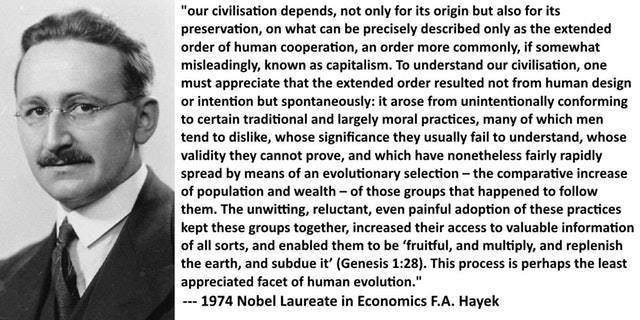
Source date (UTC): 2018-09-02 11:45:00 UTC
-
Christianity is Not ‘false’, just figurative. Not literal. John Warner Mathisen
—Christianity is Not ‘false’, just figurative. Not literal. John Warner Mathisen has shown that the stories of the worlds religions are figurative stories(myths) describing the constellations of the night sky. This understanding is called Astro-Theology.”— A Friend
Correct in their origin, but two problems with that presumption:
1) A statement is figurative if used figuratively (meaning) and false if used argumentatively (truth). How are the jewish, christian, and islamic statements used? Figuratively (analogically) or argumentatively (persuasively)? In other words, how something is used determines its constitution. There is very little evidence it was used figuratively. Especially given the doubling down by fundamentalists after the empirical, scientific, and technological revolutions.
2) The content of those statements is true if the means produce the promised or even beneficial ends. The statments are false if the means do not produce promised or beneficial ends. Judaism contributed nothing to humanity despite the most educated population in caucasia. Christianity destroyed the aristocracy of the roman world just as it was designed to do. Islam destroyed the great civilizations of the ancient world. And together these three religions ushered in 1B deaths, and a thousand year dark age we have spent the last five hundred years trying to escape – with christianity dying off, but judaism and islam still working diligently to destroy western civilization, with only the chinese, japanese, and koreans holding out.
So The statements were and are not acted upon as figurative (analogies, myths) but wisdom, law, and civilizational objective. The outcome is not paradise in the afterlife, or under the pseudoscientific version of judaism (Marxism), christianity (libertarianism), Islam (neo-conservatism), prosperity and peace in this world. These three religions – all variations on abrahamism whether ancient semitic judaism, christianity, and islam, or modern marxism, feminism, and postmodernism – designed by intent to destroy “critique” the great civilizations by weaponizing the female competitive strategy of undermining and reputation destruction by disapproval, shaming, ridicule, gossip, and rallying, and doing so by taking advantage of the means of communication and immigration and publication created in the ancient world and the modern.
The are not just false in statement, false in promise, but malicious in intent.
Source date (UTC): 2018-09-02 09:53:00 UTC
-
The Best Governors Are the Middle Class
The government you end up with is determined by what point on this scale your polity equilibrates. —Justin Allred x-axis: high trust<->low trust y-axis: distributed political agency<->concentrated political agency Monarchy – Tyranny Aristocracy – Oligarchy Polity – Democracy
—“Does Aristotle deem monarchy to be the best form of government?”— by Andy Mansfield, DPhil, former academic, teacher and author. Aristotle discussed the six forms of government, the correct form and its deviant counterpart: Monarchy – Tyranny Aristocracy – Oligarchy Polity – Democracy However, monarchy was not the best form. F. Miller provides the answer to your question in ‘Aristotle’s Political Theory’ taken from The Stanford Encyclopedia of Philosophy (2011): ‘Although his own political views were influenced by his teacher Plato, Aristotle is highly critical of the ideal constitution set forth in Plato’s Republic on the grounds that it overvalues political unity, it embraces a system of communism that is impractical and inimical to human nature, and it neglects the happiness of the individual citizens (Politics II.1–5). In contrast, in Aristotle’s “best constitution,” each and every citizen will possess moral virtue and the equipment to carry it out in practice, and thereby attain a life of excellence and complete happiness (see VII.13.1332a32–8). All of the citizens will hold political office and possess private property because “one should call the city-state happy not by looking at a part of it but at all the citizens.” (VII.9.1329a22–3). Moreover, there will be a common system of education for all the citizens, because they share the same end (Pol. VIII.1). If (as is the case with most existing city-states) the population lacks the capacities and resources for complete happiness, however, the lawgiver must be content with fashioning a suitable constitution (Politics IV.11). The second-best system typically takes the form of a polity (in which citizens possess an inferior, more common grade of virtue) or mixed constitution (combining features of democracy, oligarchy, and, where possible, aristocracy, so that no group of citizens is in a position to abuse its rights). Aristotle argues that for city-states that fall short of the ideal, the best constitution is one controlled by a numerous middle class which stands between the rich and the poor. For those who possess the goods of fortune in moderation find it “easiest to obey the rule of reason” (Politics IV.11.1295b4–6). They are accordingly less apt than the rich or poor to act unjustly toward their fellow citizens. A constitution based on the middle class is the mean between the extremes of oligarchy (rule by the rich) and democracy (rule by the poor). “That the middle [constitution] is best is evident, for it is the freest from faction: where the middle class is numerous, there least occur factions and divisions among citizens” (IV.11.1296a7–9). The middle constitution is therefore both more stable and more just than oligarchy and democracy.’ SUMMARY Matt Stewart, B.A. Literature, History, and Philosophy No- the best government was the one best suited to the people and culture that are to be governed and which allows its citizens to flourish. Aristotle understood that different nations with different values function differently; whatever system of government allows a particular nation to function correctly and flourish is the best form of government for that particular nation. The Persians flourished under a monarchy, and the Athenians flourished as a democracy. The two states had very different forms of government, yet each flourished in its own way. A properly functioning government is one which incorporates and reflects the values and interests of its people. That is the long and short of Aristotle’s view on government.