TO PRODUCE UNITY – WE HAVE TO TALK TO EACH POLITICAL FACTION ON THEIR TERMS
I want to be able to respect different people with different intuitions, beliefs, and understandings. P-law and Nationalism and markets for polities for everyone is in everyone’s interest. Monopoly political orders are impossible and contrary to the natural right of self determination.
We are separating the african, muslim, christian, wn/natsoc, and mainstream ‘libertarian” discussions into individual groups because we lost most of the (silent) military people due to natsoc activity.
We must reach people on their own terms and build unity for DIFFERENT political orders under P-law: Let A Thousand Nations Bloom. And mixing muslim, christian, wn/natsoc, world government, antifa-marxist groups versus constitutionalist, civnat, social democratic, and traditional democratic groups prohibit outreach to one another.
Until enough people understand P in each faction, comprehension, cross conversation, and collective coopartion against our united enemy of the (((financial, media, entertainment, academy))) that seeks to destry our civilizations cannot be achieved.
Our mission is to reach everyone so that ‘separation’ is possible at the expense of the (((financial, media, entertainment, academy))) and state bureaucracy, and if separation is not possible then escalation to conflict is necessary.
But stifling the conversation before people understand their options is counter-productive. And so the only valuable arguments or ideas are those that are in fact arguments so to speak. And all you do when you cross paradigmatic boundaries is cloud the conversation – when P-law is UNIFYING across ALL PEOPLE who wish to live their lives as they do without imposing costs upon the way of life of others by doing so.
So understand your audience. The main feeds are mainstream (rule of law, monarchic, republican, democratic mixed economy,. Post Monopoly paradigms: Christian, Muslim, WN, NATSOC, Globalist, Antifa-Marxist content to those audiences and mainstream P-content to the mainstream audiences.
I think radicalism, revolution, and pursuit of renaissance is personally costly for leadership. I’m a career executive entrepreneur who built my fortunes – starting in my early twenties – by acquisition and integration of companies consisting of people with different levels of education and experience. It is easier for me to see the world paternally rather than parentally, and managerially rather than interpersonally. And even more so militarily and politically rather than socially and familial.
Within the spectrum of Political, Executive, Paternal, Parental, or Peerage relationships, our ‘reward’ – feedback – for our leadership varies across a big difference in not only people but time – and our frustration or self doubt must be held in check by our confidence in a field of mixed successes and failures over time.
Because we wish to measure the change in individuals – rather than the social construction of organizational change that occurs through the fragmentary understanding of ever increasing numbers until they system (market) of people itself is self-correcting because there are sufficient fragments among people with partial knowledge and variation in ability that they collectively coalesce over time into emergent fundamental rules of concept, thought, paradigm, argument, and behavior without the reinforcement of the underlying understanding.
I think some of us don’t have the stomach for ‘crossing the chasm’ into hostile territory: where we increasingly encounter people with increasingly greater differences in intuitions, understandings and wants. I think each of us needs to continue to discover whether we are supporter, activist, supplier, fighter, leader, and whether we educate as co-operator and ally, advisor and peer, a teacher and parent, a paternal executive, or a general for whom sacrifices – including of those we value – are the costs of winning wars for those whom we may not – but who have no other advocates. And given the spectrum of our current conditions we may not be in a personal position to choose our preference from the full range of choices available.
But this is the stage we are at. Where we have a solution, there is market demand for it, and we must migrate from parents and small business owners to ‘industry leaders’ before we next migrate to politicians and generals. For some of us the cost of making a mark on history is worth paying. For others it is not. We can only make mark that we are willing and able to. But every mark adds to the whole.
The only people who matter are those willing and able. The only people who matter at the beginning at first are those who fight, those who assist those who fight, and those who do not resist them. The rest are not important until they must be governed. But they are the ones who talk the most – generating demand for rule by those willing.
photos_and_videos/TimelinePhotos_kg5QueHwVw/95016109_268491657882328_6860192446895095808_n_268491654548995.jpg THE HARDWARE PROBLEM LIMITING AI
Yep. The problem is the entire industry is built for central computation limited by frequency (heat) rather than distributed association and prediction limited only by numbers(cool) – and what we need is billions of trivial circuits whose primary difference from neurons(really dendrites-synapses) is in creating many local logical (addresses) rather than physical (dendritic-synaptic) connections, storing trivial (sparse) bits of memory in sequences. In addition the context (episode) creates an index in time AND space and each fragment of information is locally co-associated with those positions.
Every neuron, micro-column, macro-column, region of the brain is trivially simple, but in concert they produce in parallel what cannot be done by increasing frequency(and heat).
Graphics processors are architected for parallel processing and so we ‘hijacked’ them in the 2000’s for AI use. And since the human brain uses triangles and hexagons for producing its world model, the graphics processor does solve HALF of the underlying problem: the neocortex is a doubling (folding over) with six layers, of the entorhinal cortex (three layers), dividing the responsibility of identity (top) and relative position (bottom), with the outputs passed forward in the cognitive hierarchy in a vast market competition for coherence.
So it’s not that we don’t (at least now, because this is all recent knowledge) know how to create general intelligence (I certainly do). Its that (as turing said) we built the machines for math (top down) instead of thinking (bottom up) with math as merely one of the grammars (logics) resulting from it.
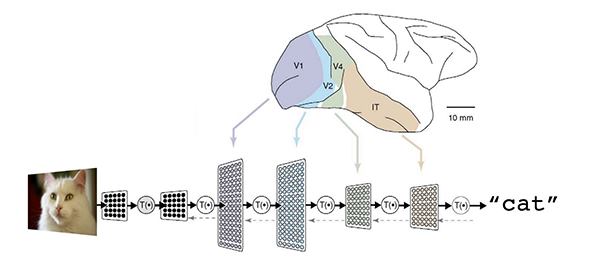
So the current issue as I understand it, is that we cannot achieve in software what we need hardware for. So we need a manhattan project to produce thinking machines only because the industry is constructed for the opposite aim, and current (primitive) neural networks can categorize but only do so with vast amounts of information and manual tuning.
In this illustration from the attached web page, we see the limit of what current AI is able to do: categorize, and only after lots of training and tuning. This means application specific hardware because the hardware is constructed ‘incorrectly’ still for the task of general intelligence.
Conversely there are many functions where we do not want a general intelligence – which exchanges increase in possibility of error for decrease in cost of adaptation. Robots are dangerous because they’re not intelligent, but there are many cases where not-intelligent danger, and intelligent danger are a trade off.
So we have market demand for (a) simple software problems (b) application specific ai problems, and (c) general ai problems.THE HARDWARE PROBLEM LIMITING AI
Yep. The problem is the entire industry is built for central computation limited by frequency (heat) rather than distributed association and prediction limited only by numbers(cool) – and what we need is billions of trivial circuits whose primary difference from neurons(really dendrites-synapses) is in creating many local logical (addresses) rather than physical (dendritic-synaptic) connections, storing trivial (sparse) bits of memory in sequences. In addition the context (episode) creates an index in time AND space and each fragment of information is locally co-associated with those positions.
Every neuron, micro-column, macro-column, region of the brain is trivially simple, but in concert they produce in parallel what cannot be done by increasing frequency(and heat).
Graphics processors are architected for parallel processing and so we ‘hijacked’ them in the 2000’s for AI use. And since the human brain uses triangles and hexagons for producing its world model, the graphics processor does solve HALF of the underlying problem: the neocortex is a doubling (folding over) with six layers, of the entorhinal cortex (three layers), dividing the responsibility of identity (top) and relative position (bottom), with the outputs passed forward in the cognitive hierarchy in a vast market competition for coherence.
So it’s not that we don’t (at least now, because this is all recent knowledge) know how to create general intelligence (I certainly do). Its that (as turing said) we built the machines for math (top down) instead of thinking (bottom up) with math as merely one of the grammars (logics) resulting from it.
So the current issue as I understand it, is that we cannot achieve in software what we need hardware for. So we need a manhattan project to produce thinking machines only because the industry is constructed for the opposite aim, and current (primitive) neural networks can categorize but only do so with vast amounts of information and manual tuning.
In this illustration from the attached web page, we see the limit of what current AI is able to do: categorize, and only after lots of training and tuning. This means application specific hardware because the hardware is constructed ‘incorrectly’ still for the task of general intelligence.
Conversely there are many functions where we do not want a general intelligence – which exchanges increase in possibility of error for decrease in cost of adaptation. Robots are dangerous because they’re not intelligent, but there are many cases where not-intelligent danger, and intelligent danger are a trade off.
So we have market demand for (a) simple software problems (b) application specific ai problems, and (c) general ai problems.
1) Commons are a non consumable capitalization from which everyone benefits – a park where you can raise small children cuts the cost of yard ownership for example. Lacking a park where you can raise small children increases the cost of homes and yards, driving people out of high investment parenting.
2) Commons solve the problem of high investment parenting, without requiring high familial economic investment by every family. Families buy access to commons by high investment parenting, which creates incentive for the production of commons and their high returns.
3) We use high investment parenting in the production of high investment commons. We use high investment commons to facilitate high investment parenting.
4) This is what the middle working, and lower working classes sense is being stolen from them – the ability to use commons to produce high investment parenting. Best example is that they can’t afford to move away from malcontents by denying them access.
5) Low investment parenting immigrants and classes, decrease the incentive to produce commons that are then consumed for purposes of other than raising families. Low investment parenting immigrants and classes increase consumption that is upwardly redistributable to the financial sector, and decrease production of commons as redistribution to
6) Elites (advertising, media, financial, academic, political), will happily consume profits and income instead of investing in commons if lower working, working, and middle classes tolerate it.
7) The laboring, lower working, working, middle, and increasingly upper middle class, will only tolerate it until the low hanging fruit of consumption has been exhausted, and the demand for commons is restored.
8) Christianity is exceptional at producing respect for commons because behavior in the church environment (suppression of impulse) and the sacredness of the properties, extend to the commons.
9) In the absence of universal christian indoctrination we must us the law to suppress consumption (destruction) of the incentive to produce high trust, ‘sacred’ commons, suitable for the raising of children. And exporting ‘exploratory’ (teen, young adult) behavior (pre-maturity) to labor (markets) sport(competition) and external (wild) commons.Updated Apr 27, 2020, 9:38 PM
Artworks, whether craft, decoration, design, or art, need only fulfill their promise. This is why student and amature art fails. In order to fulfill the minimum promise the work must not make false promise. We can appreciate good craft, decoration, design, and art. We can appreciate all the arts by the same criteria: craft, decoration, design, and art.
Japanese ritualistic behavior in food preparation, cooking carpentry, and the crafts is the best example of institutionalized excellence. Italian design has never been equalled. Gothic architecture never equalled. German music never equalled. Russian literature never equalled.
Like Judaism, Christianity, and Islam, Communism promised a universal government of the underclasses.The french invented pre-communist european state socialism, Italians post-communist intolerant State socialism in Fascism. Via the French, we forced the Germans into ACTING on it.
@DineshDSouza Nat’l Fascism was increase in Napoleon’s pre-industrial State and Military Total War, to post-industrial State, Military, Economic, Culture, and informational Total War against International Political,Economic, Cultural and informational extra-state total war of Jewish Communism.
Nat’l Fascism was increase in Napoleon’s pre-industrial State and Military Total War, to post-industrial State, Military, Economic, Culture, and informational Total War against International Political,Economic, Cultural and informational extra-state total war of Jewish Communism.
Nat’l Fascism was expansion of Napoleon’s Pre-Industrial State and Military Total War, to post-industrial State, Military, Economic, Culture, and informational Total War against International Political,Economic, Cultural and informational extra-state total war of Jewish Communism.
Like Judaism, Christianity, and Islam, Communism promised a universal government of the underclasses.The french invented pre-communist european state socialism, Italians post-communist intolerant State socialism in Fascism. Via the French, we forced the Germans into ACTING on it.
Napoleon……………..Fascism……………….Communism
Civilizational……………National……………….International
… Total War…………… Total War……………..Total War
… … Pre-industrial….. …Post-Industrial…… Post Ind.
Religion combines wisdom literature, rituals, and social assembly to create personal, interpersonal, social, and political mindfulness with of a system of intuitive, coherent measurement, that relieves the pre-consious brain of stress about status, conflict, and uncertainty. We gain the elation of the primitive animal running with, hunting, feasting, resting, and safety within the pack (herd). Narratives (stories) using archetypes (expressions of instincts) are the most imprecise but universal and easily understood system of measurement.
Christianity works. Religion works. Institutions, traditions, laws, and norms work. For the same reason: error elimination on one hand, and norm creation on the other, together which reduce cognitive load, which reduce stress, which maintains self image, which maintains status in interacting with others.
Of the christian sects it appears that we find the best of something in each group. In evangelical protestantism we find the closest to Jesus’ teachings. In orthodoxy we find the preservation of tradition, and nationalism. In Catholicism we find an attempt at an intellectual and philosophical expansion of the underlying theology. In secular christianity we find the completion of the christian evolution into the via negativa natural law AND via positiva christian love.
I can quite easily explain what we find as failing in each of those traditions – most of which result in (a) universalism (b) failure to accommodate the fundamental, ritualistic-traditional, phiosophical-moral, and scientific spectrum – and worse, a failure to integrate and retain our martial gods and their teachings – that saved us in the real world when christianity failed.
I admit when I’m wrong all the time. I make many mistakes (irrelevant) but I err (relevant) very infrequently. Not because I am special but because the P-method makes it very, very, difficult to err.
In my work, I assume that very little genetic ‘evolution’ occurs at all. And that instead, humans possess an extraordinary ability to express multiple evolutionary strategies in response to changes, pressures, and shocks.
We can call upon an amazing wealth of genetic expression of ability if we need to. And it can occur rapidly by institutional and status shifts, or slowly over centuries.
So I see our genes as an inventory of expressible biases that in combinations produce very different divisions of perception, cognition, knowledge and labor. From the effeminate Ashkenazi gender reversal, to the physical immaturity of Asians, to the masculine African and Muslim, and to everything in between.
It’s not clear that we haven’t already passed ‘peak human’ and that once we stopped speciation with the development of large populations, long range trade, and cities. In other words, it’s adaptively preferable to have a large dumb aggressive, highly reproductive, consumptive, expansionary society rather than the benevolent and advanced worlds of star trek we imagine. If anything history shows that civilizations grow to the point where they have funded the evolution of competitors who then conquer them.
But we have this wonderful adaptive hierarchy available to us.