Oct 14, 2019, 9:29 PM FAITH Faith is a fairly easy thing to explain. In other words we know what causes the feeling we call ‘spirituality’ and why it’s so influential to some and not at all to others. But we can’t introspect into it. So you can’t introspect into how you raise your arm. And you can’t introspect into the feeling you get from faith, but that doesn’t mean we cant explain how you raise your arm (I certainly can) or that we can’t explain the feeling of faith (I certainly can). It’s that the ‘magic’ is due to our inability to introspectively analyze it. There are some tricks we can use (visual illusions) to experiment with vision. There are similar tricks for spirituality. The feeling is not complicated. The free association we can conduct in that state is not complicated. And mastering the ability to freely associate emotionally by repetitive practice is not complicated. So whether you specialize in pre-rational emotion, pre-rational intuition, physical performance, or rational thought, or rational calculation, is just a matter of your ability and interest. And your developmental arc since that series is simply the developmental hierarchy. And just as there are many fragile points in your sexual development there are many fragile points in your social development there are also many fragile points in your cognitive development, and some of us are biased to the sensory, to the motor, to the social, to the verbal rational, and some to the calculative spatial. It’s not that faith isn’t an excellent way of developing mindfulness by supplying your own sedation. It’s not that the buddhist meditation and philosophy isn’t. Or the stoic. It’s that there are consequences (costs) for each of those methods and only the stoic produces your adaptation rather than avoidance.
Form: Mini Essay
-
Faith Is a Fairly Easy Thing to Explain.
Oct 14, 2019, 9:29 PM FAITH Faith is a fairly easy thing to explain. In other words we know what causes the feeling we call ‘spirituality’ and why it’s so influential to some and not at all to others. But we can’t introspect into it. So you can’t introspect into how you raise your arm. And you can’t introspect into the feeling you get from faith, but that doesn’t mean we cant explain how you raise your arm (I certainly can) or that we can’t explain the feeling of faith (I certainly can). It’s that the ‘magic’ is due to our inability to introspectively analyze it. There are some tricks we can use (visual illusions) to experiment with vision. There are similar tricks for spirituality. The feeling is not complicated. The free association we can conduct in that state is not complicated. And mastering the ability to freely associate emotionally by repetitive practice is not complicated. So whether you specialize in pre-rational emotion, pre-rational intuition, physical performance, or rational thought, or rational calculation, is just a matter of your ability and interest. And your developmental arc since that series is simply the developmental hierarchy. And just as there are many fragile points in your sexual development there are many fragile points in your social development there are also many fragile points in your cognitive development, and some of us are biased to the sensory, to the motor, to the social, to the verbal rational, and some to the calculative spatial. It’s not that faith isn’t an excellent way of developing mindfulness by supplying your own sedation. It’s not that the buddhist meditation and philosophy isn’t. Or the stoic. It’s that there are consequences (costs) for each of those methods and only the stoic produces your adaptation rather than avoidance.
-
Loans Against Trust
Oct 15, 2019, 6:05 PM by Luke Weinhagen Law and contract can be used to subsidize for the absence of specific trust, such as between strangers or untested business partners. Both are “loans” against the stored trust in a polity. Enforced and insured by the commons in the form of “WE as a common polity will impose a cost on any party that breaches law or contract”. Law and contract only provide incentives for adherence where you can expect positive reciprocity (trust producing – rule of law) or where you can rely on the enforcement mechanisms to compel adherence (trust consuming – rule by law). Trust consumption eventually gets us back to “Might makes Right” and brings us back to the question “Why don’t I kill you and take your stuff?” (we descend the foundational rule stack). If trust is not there in some form, no one follow the law or sticks to contracts.
-
Loans Against Trust
Oct 15, 2019, 6:05 PM by Luke Weinhagen Law and contract can be used to subsidize for the absence of specific trust, such as between strangers or untested business partners. Both are “loans” against the stored trust in a polity. Enforced and insured by the commons in the form of “WE as a common polity will impose a cost on any party that breaches law or contract”. Law and contract only provide incentives for adherence where you can expect positive reciprocity (trust producing – rule of law) or where you can rely on the enforcement mechanisms to compel adherence (trust consuming – rule by law). Trust consumption eventually gets us back to “Might makes Right” and brings us back to the question “Why don’t I kill you and take your stuff?” (we descend the foundational rule stack). If trust is not there in some form, no one follow the law or sticks to contracts.
-
‘Contrast Godel with P – Request from Kash Vikas
Oct 16, 2019, 10:49 AM (Godel is a Platonist and I’m an Operationalist. This contrast is rather helpful in illustrating the operational vs platonist vs empirical.)
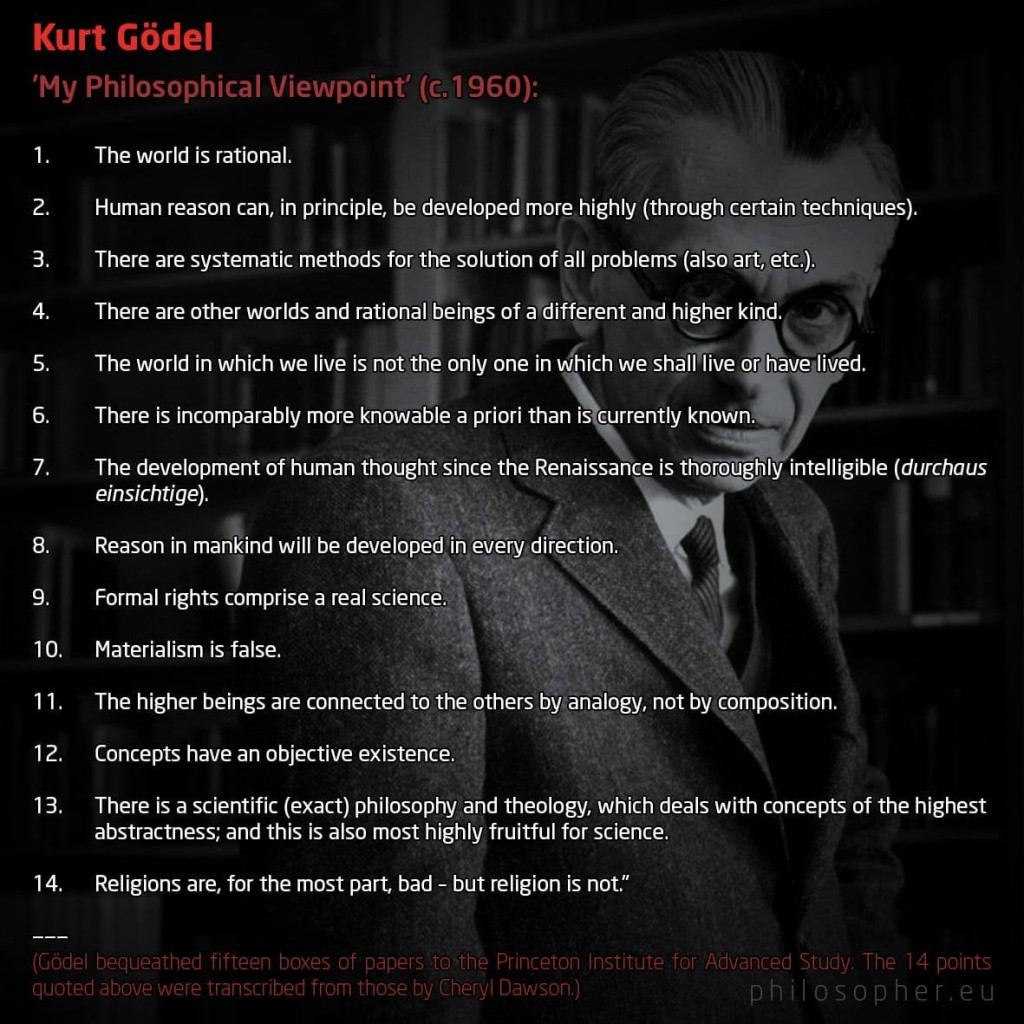
- Man acts rationally, and by rationally amorally. But given the disproportionate value of cooperation, and the disproportionate risk of retaliation, it’s just in his interest to act morally much more often than immorally.
1a. We can incrementally reduce observations of the universe, using our senses, reason, and instrumentation to descriptions of invariant constant relations (paradigms)
1b + 3. We can describe (explain) all of experience as constant relations (a single paradigm) - While our ability to reason is constant, every increase convergence of our instruments and paradigms increases the explanatory power available to our reason.
- The capacity to reason is a deterministic product of entropy at convenient temperatures in convenient conditions, for sufficient periods of time. It is likely that given the vastness of the universe, other creatures have evolved reason, and that while the logic of constant relations will exist, and mathematics as a logic of constant positional relations will exist in some form, that the composition of experience that results from different body structures will result in different techniques for employing reason. (think octopi). And that the ability of these creatures may vastly outperform ours.
- Because we are able to use our powers of prediction using free association to construct a model of the world we exist in, and the worlds we might exist in, and the worlds we cannot exist in, we can experience, many candidate worlds.
5b. The set of demands we evolved and express daily is largely invariant. The set of paradigms we use to imagine opportunities for fulfilling those demands evolves (and devolves) constantly. So while we largely increase the coherence of paradigms, and approach a single paradigm for describing the universe, we have experienced the world differently in the past than in the present, and will so again experience it differently in the future. - If we can construct an operational grammar and paradigm for a given set of constant relations, we can produce an operational logic of that set of constant relations, and conduct experiments logically by trial and error as we do in mathematics. To do so we require convergence of paradigms to the point of marginal indifference of those logical constructions. But the Analytic program failed, and Godel and Frege et all were wrong – closure does not exist.
- Yes the development of thought since Aristotle expanded on Democritus, has been consistent and rational with the exception of the semitic abrahamic dark ages of supernatural ignorance.
- Reason is reason is reasoning and there is nothing to it. There are however endless permutations of reason especially as knowledge increases.
- The via-negativa of Natural Law can be restated in the via-positiva as Natural rights, and this logic and empirical combination produces a science of cooperation, and law the institutional enforcement of cooperation under that law, and economics the measure of it’s success, and economics the language of analysis and measurement within that science.
10.The material(noun) and the Operational(verb) are true (exist, and are testifiable). The platonic (ideal) is false. All sets of constant relations are identified, retained, applied, reinforced, and revised by merging physical stimuli with physical organization of information in the brain, producing a hierarchy of changes in state over time we call ‘experience’. So while it is correct to say that the universe is deterministic (composed of constant relations), it is only correct to say that we can observe sets of constant relations, identify them (category), compare them, name them, and predict future states of of them, and in relation to them. These memories and predications like running consist of physical potential, that produce results in time. In other words, al of reality is constructed physically, from a hierarchy of changes in state over time we call experience. - Concepts do not exist. the potential for Concepts exists. Running only exists when one is running. We have the potential to run. We have the potential to identify sets of constant relations (concepts), but experience of contexts only exist when we are acting to recall them in time.
- It appears we can know the most parsimonious paradigm, and host of parsimonious sub-paradigms of increasing complexity (permutations) allowing us to speak the truth using evidence – science; that we can know the same for choices using arguments – philosophy; and we can know the same for collective organization using stories – theology.
Existing religions are bad to terrible to suicidal – but human psychological, social, political, and strategic demand for the products of ‘religion’ (order) are endless. So we need to educate one another in mindfulness, ethics(interpersonal), morality (extrapersonal), political, and strategic (competitive), by means gracefully increasing and decreasing in accessibility: parable, story, history, reason and general rules, science and outcomes.’
CONTRAST WITH P – REQUEST FROM KASH VIKAS
(Godel is a Platonist and I’m an Operationalist. This contrast is rather helpful in illustrating the operational vs platonist vs empirical.)Man acts rationally, and by rationally amorally. But given the disproportionate value of cooperation, and the disproportionate risk of retaliation, it’s just in his interest to act morally much more often than immorally.
1a. We can incrementally reduce observations of the universe, using our senses, reason, and instrumentation to descriptions of invariant constant relations (paradigms)
1b + 3. We can describe (explain) all of experience as constant relations (a single paradigm)- While our ability to reason is constant, every increase convergence of our instruments and paradigms increases the explanatory power available to our reason.
- The capacity to reason is a deterministic product of entropy at convenient temperatures in convenient conditions, for sufficient periods of time. It is likely that given the vastness of the universe, other creatures have evolved reason, and that while the logic of constant relations will exist, and mathematics as a logic of constant positional relations will exist in some form, that the composition of experience that results from different body structures will result in different techniques for employing reason. (think octopi). And that the ability of these creatures may vastly outperform ours.
- Because we are able to use our powers of prediction using free association to construct a model of the world we exist in, and the worlds we might exist in, and the worlds we cannot exist in, we can experience, many candidate worlds.
5b. The set of demands we evolved and express daily is largely invariant. The set of paradigms we use to imagine opportunities for fulfilling those demands evolves (and devolves) constantly. So while we largely increase the coherence of paradigms, and approach a single paradigm for describing the universe, we have experienced the world differently in the past than in the present, and will so again experience it differently in the future. - If we can construct an operational grammar and paradigm for a given set of constant relations, we can produce an operational logic of that set of constant relations, and conduct experiments logically by trial and error as we do in mathematics. To do so we require convergence of paradigms to the point of marginal indifference of those logical constructions. But the Analytic program failed, and Godel and Frege et all were wrong – closure does not exist.
- Yes the development of thought since Aristotle expanded on Democritus, has been consistent and rational with the exception of the semitic abrahamic dark ages of supernatural ignorance.
- Reason is reason is reasoning and there is nothing to it. There are however endless permutations of reason especially as knowledge increases.
- The via-negativa of Natural Law can be restated in the via-positiva as Natural rights, and this logic and empirical combination produces a science of cooperation, and law the institutional enforcement of cooperation under that law, and economics the measure of it’s success, and economics the language of analysis and measurement within that science.
10.The material(noun) and the Operational(verb) are true (exist, and are testifiable). The platonic (ideal) is false. All sets of constant relations are identified, retained, applied, reinforced, and revised by merging physical stimuli with physical organization of information in the brain, producing a hierarchy of changes in state over time we call ‘experience’. So while it is correct to say that the universe is deterministic (composed of constant relations), it is only correct to say that we can observe sets of constant relations, identify them (category), compare them, name them, and predict future states of of them, and in relation to them. These memories and predications like running consist of physical potential, that produce results in time. In other words, al of reality is constructed physically, from a hierarchy of changes in state over time we call experience. - Concepts do not exist. the potential for Concepts exists. Running only exists when one is running. We have the potential to run. We have the potential to identify sets of constant relations (concepts), but experience of contexts only exist when we are acting to recall them in time.
- It appears we can know the most parsimonious paradigm, and host of parsimonious sub-paradigms of increasing complexity (permutations) allowing us to speak the truth using evidence – science; that we can know the same for choices using arguments – philosophy; and we can know the same for collective organization using stories – theology.
- Existing religions are bad to terrible to suicidal – but human psychological, social, political, and strategic demand for the products of ‘religion’ (order) are endless. So we need to educate one another in mindfulness, ethics(interpersonal), morality (extrapersonal), political, and strategic (competitive), by means gracefully increasing and decreasing in accessibility: parable, story, history, reason and general rules, science and outcomes.
- Man acts rationally, and by rationally amorally. But given the disproportionate value of cooperation, and the disproportionate risk of retaliation, it’s just in his interest to act morally much more often than immorally.
-
‘Contrast Godel with P – Request from Kash Vikas
Oct 16, 2019, 10:49 AM (Godel is a Platonist and I’m an Operationalist. This contrast is rather helpful in illustrating the operational vs platonist vs empirical.)
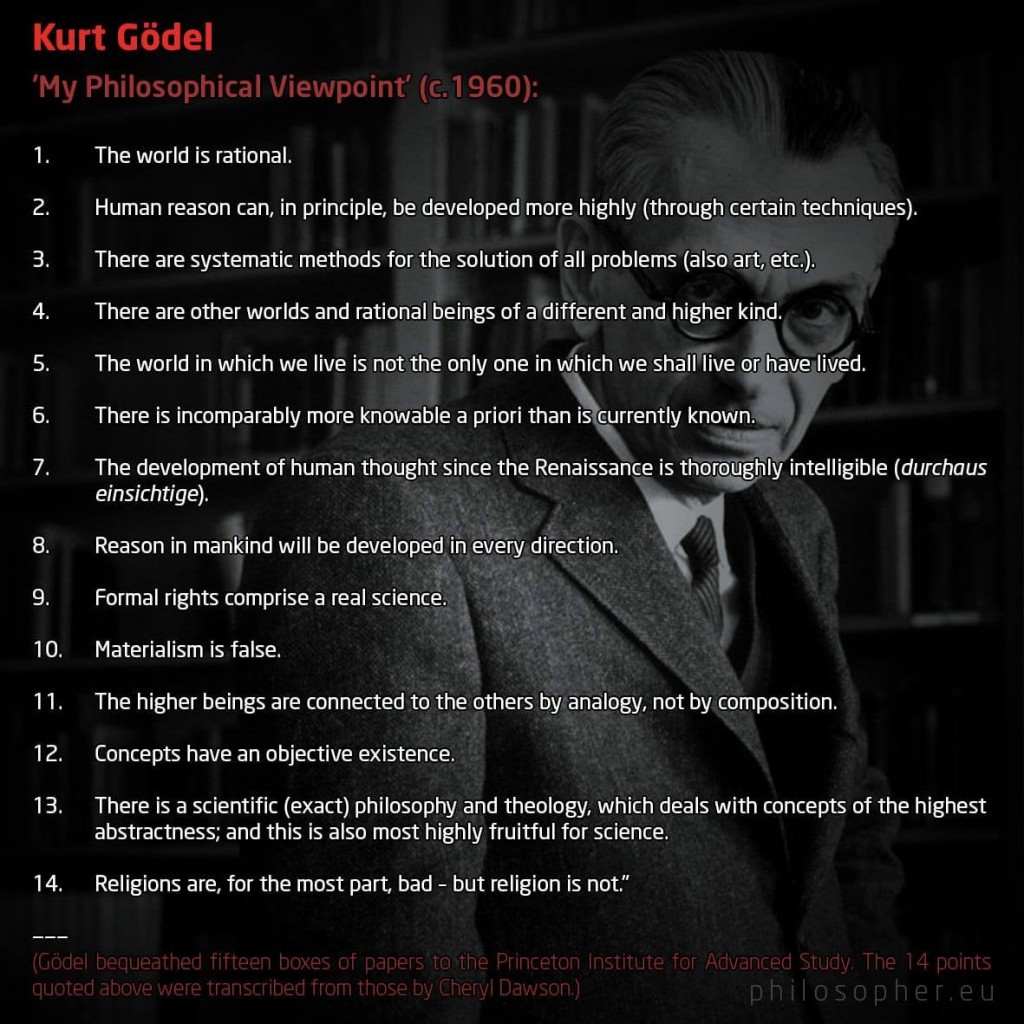
- Man acts rationally, and by rationally amorally. But given the disproportionate value of cooperation, and the disproportionate risk of retaliation, it’s just in his interest to act morally much more often than immorally.
1a. We can incrementally reduce observations of the universe, using our senses, reason, and instrumentation to descriptions of invariant constant relations (paradigms)
1b + 3. We can describe (explain) all of experience as constant relations (a single paradigm) - While our ability to reason is constant, every increase convergence of our instruments and paradigms increases the explanatory power available to our reason.
- The capacity to reason is a deterministic product of entropy at convenient temperatures in convenient conditions, for sufficient periods of time. It is likely that given the vastness of the universe, other creatures have evolved reason, and that while the logic of constant relations will exist, and mathematics as a logic of constant positional relations will exist in some form, that the composition of experience that results from different body structures will result in different techniques for employing reason. (think octopi). And that the ability of these creatures may vastly outperform ours.
- Because we are able to use our powers of prediction using free association to construct a model of the world we exist in, and the worlds we might exist in, and the worlds we cannot exist in, we can experience, many candidate worlds.
5b. The set of demands we evolved and express daily is largely invariant. The set of paradigms we use to imagine opportunities for fulfilling those demands evolves (and devolves) constantly. So while we largely increase the coherence of paradigms, and approach a single paradigm for describing the universe, we have experienced the world differently in the past than in the present, and will so again experience it differently in the future. - If we can construct an operational grammar and paradigm for a given set of constant relations, we can produce an operational logic of that set of constant relations, and conduct experiments logically by trial and error as we do in mathematics. To do so we require convergence of paradigms to the point of marginal indifference of those logical constructions. But the Analytic program failed, and Godel and Frege et all were wrong – closure does not exist.
- Yes the development of thought since Aristotle expanded on Democritus, has been consistent and rational with the exception of the semitic abrahamic dark ages of supernatural ignorance.
- Reason is reason is reasoning and there is nothing to it. There are however endless permutations of reason especially as knowledge increases.
- The via-negativa of Natural Law can be restated in the via-positiva as Natural rights, and this logic and empirical combination produces a science of cooperation, and law the institutional enforcement of cooperation under that law, and economics the measure of it’s success, and economics the language of analysis and measurement within that science.
10.The material(noun) and the Operational(verb) are true (exist, and are testifiable). The platonic (ideal) is false. All sets of constant relations are identified, retained, applied, reinforced, and revised by merging physical stimuli with physical organization of information in the brain, producing a hierarchy of changes in state over time we call ‘experience’. So while it is correct to say that the universe is deterministic (composed of constant relations), it is only correct to say that we can observe sets of constant relations, identify them (category), compare them, name them, and predict future states of of them, and in relation to them. These memories and predications like running consist of physical potential, that produce results in time. In other words, al of reality is constructed physically, from a hierarchy of changes in state over time we call experience. - Concepts do not exist. the potential for Concepts exists. Running only exists when one is running. We have the potential to run. We have the potential to identify sets of constant relations (concepts), but experience of contexts only exist when we are acting to recall them in time.
- It appears we can know the most parsimonious paradigm, and host of parsimonious sub-paradigms of increasing complexity (permutations) allowing us to speak the truth using evidence – science; that we can know the same for choices using arguments – philosophy; and we can know the same for collective organization using stories – theology.
Existing religions are bad to terrible to suicidal – but human psychological, social, political, and strategic demand for the products of ‘religion’ (order) are endless. So we need to educate one another in mindfulness, ethics(interpersonal), morality (extrapersonal), political, and strategic (competitive), by means gracefully increasing and decreasing in accessibility: parable, story, history, reason and general rules, science and outcomes.’
CONTRAST WITH P – REQUEST FROM KASH VIKAS
(Godel is a Platonist and I’m an Operationalist. This contrast is rather helpful in illustrating the operational vs platonist vs empirical.)Man acts rationally, and by rationally amorally. But given the disproportionate value of cooperation, and the disproportionate risk of retaliation, it’s just in his interest to act morally much more often than immorally.
1a. We can incrementally reduce observations of the universe, using our senses, reason, and instrumentation to descriptions of invariant constant relations (paradigms)
1b + 3. We can describe (explain) all of experience as constant relations (a single paradigm)- While our ability to reason is constant, every increase convergence of our instruments and paradigms increases the explanatory power available to our reason.
- The capacity to reason is a deterministic product of entropy at convenient temperatures in convenient conditions, for sufficient periods of time. It is likely that given the vastness of the universe, other creatures have evolved reason, and that while the logic of constant relations will exist, and mathematics as a logic of constant positional relations will exist in some form, that the composition of experience that results from different body structures will result in different techniques for employing reason. (think octopi). And that the ability of these creatures may vastly outperform ours.
- Because we are able to use our powers of prediction using free association to construct a model of the world we exist in, and the worlds we might exist in, and the worlds we cannot exist in, we can experience, many candidate worlds.
5b. The set of demands we evolved and express daily is largely invariant. The set of paradigms we use to imagine opportunities for fulfilling those demands evolves (and devolves) constantly. So while we largely increase the coherence of paradigms, and approach a single paradigm for describing the universe, we have experienced the world differently in the past than in the present, and will so again experience it differently in the future. - If we can construct an operational grammar and paradigm for a given set of constant relations, we can produce an operational logic of that set of constant relations, and conduct experiments logically by trial and error as we do in mathematics. To do so we require convergence of paradigms to the point of marginal indifference of those logical constructions. But the Analytic program failed, and Godel and Frege et all were wrong – closure does not exist.
- Yes the development of thought since Aristotle expanded on Democritus, has been consistent and rational with the exception of the semitic abrahamic dark ages of supernatural ignorance.
- Reason is reason is reasoning and there is nothing to it. There are however endless permutations of reason especially as knowledge increases.
- The via-negativa of Natural Law can be restated in the via-positiva as Natural rights, and this logic and empirical combination produces a science of cooperation, and law the institutional enforcement of cooperation under that law, and economics the measure of it’s success, and economics the language of analysis and measurement within that science.
10.The material(noun) and the Operational(verb) are true (exist, and are testifiable). The platonic (ideal) is false. All sets of constant relations are identified, retained, applied, reinforced, and revised by merging physical stimuli with physical organization of information in the brain, producing a hierarchy of changes in state over time we call ‘experience’. So while it is correct to say that the universe is deterministic (composed of constant relations), it is only correct to say that we can observe sets of constant relations, identify them (category), compare them, name them, and predict future states of of them, and in relation to them. These memories and predications like running consist of physical potential, that produce results in time. In other words, al of reality is constructed physically, from a hierarchy of changes in state over time we call experience. - Concepts do not exist. the potential for Concepts exists. Running only exists when one is running. We have the potential to run. We have the potential to identify sets of constant relations (concepts), but experience of contexts only exist when we are acting to recall them in time.
- It appears we can know the most parsimonious paradigm, and host of parsimonious sub-paradigms of increasing complexity (permutations) allowing us to speak the truth using evidence – science; that we can know the same for choices using arguments – philosophy; and we can know the same for collective organization using stories – theology.
- Existing religions are bad to terrible to suicidal – but human psychological, social, political, and strategic demand for the products of ‘religion’ (order) are endless. So we need to educate one another in mindfulness, ethics(interpersonal), morality (extrapersonal), political, and strategic (competitive), by means gracefully increasing and decreasing in accessibility: parable, story, history, reason and general rules, science and outcomes.
- Man acts rationally, and by rationally amorally. But given the disproportionate value of cooperation, and the disproportionate risk of retaliation, it’s just in his interest to act morally much more often than immorally.
-
It’s All Reciprocity … Extension of Physical Laws to Human Display Word and Deed
Oct 17, 2019, 8:57 AM While the principal innovation of P is Testimonialism, truthful testimony is merely reciprocity in speech. Agency is only possible under reciprocity. Trust is only possible under Reciprocity. Eugenia is only possible under Reciprocity. The foundation of P, the Natural Law of Reciprocity – is of course, just reciprocity: limiting one’s display word and deed to the productive, fully informed, warrantied, voluntary transfers of demonstrated interests, free of imposition of costs upon the demonstrated interests of others by externality. So while the physical world is dependent upon entropy and it’s consequences in the laws of thermodynamics, life requires reciprocity across generations; and humans have memory and the ability to predict futures using it, and to act to seize opportunities from those predictions. But while cooperation is disproportionately productive (advantageous), and while we can trade debts, resulting in reciprocity over time, we can also consistently generate debts and live parasitically off others – until they retaliate (which they always do). Reciprocity breaks down through disintermediation that limits the ability to test whether the sum of debts and repayments result in a balance (reciprocity). And this is what the state has achieved in all walks of life under pursuit of equality. But the result has been reversal of the universalization of middle class manners ethics and morals, and the reversal of underclass eugenics. Humans can, through life, defeat entropy, and through productivity, continue to defeat it, despite our increasingly costly brains; but reverse that existence through the continuous production of debt (parasitism) rather than reciprocity (mutually beneficial production), and continuous eugenics.
-
It’s All Reciprocity … Extension of Physical Laws to Human Display Word and Deed
Oct 17, 2019, 8:57 AM While the principal innovation of P is Testimonialism, truthful testimony is merely reciprocity in speech. Agency is only possible under reciprocity. Trust is only possible under Reciprocity. Eugenia is only possible under Reciprocity. The foundation of P, the Natural Law of Reciprocity – is of course, just reciprocity: limiting one’s display word and deed to the productive, fully informed, warrantied, voluntary transfers of demonstrated interests, free of imposition of costs upon the demonstrated interests of others by externality. So while the physical world is dependent upon entropy and it’s consequences in the laws of thermodynamics, life requires reciprocity across generations; and humans have memory and the ability to predict futures using it, and to act to seize opportunities from those predictions. But while cooperation is disproportionately productive (advantageous), and while we can trade debts, resulting in reciprocity over time, we can also consistently generate debts and live parasitically off others – until they retaliate (which they always do). Reciprocity breaks down through disintermediation that limits the ability to test whether the sum of debts and repayments result in a balance (reciprocity). And this is what the state has achieved in all walks of life under pursuit of equality. But the result has been reversal of the universalization of middle class manners ethics and morals, and the reversal of underclass eugenics. Humans can, through life, defeat entropy, and through productivity, continue to defeat it, despite our increasingly costly brains; but reverse that existence through the continuous production of debt (parasitism) rather than reciprocity (mutually beneficial production), and continuous eugenics.
-
Never Attribute to The Moral What Is Merely Self Interest
Oct 17, 2019, 11:35 AM (slavery) Slavery existed because of labor required for farming. It ended i) because the labor required for farming first reduced by western agrarian innovation, then ii) was eliminated by western innovation, and iii) because western finance, accounting, and taxation technology made customers provide higher returns than slavery. ie: capitalism(markets) produce incentives that slavery cannot match. People are not moral. They are practical. They just make excuses to virtue signal wealth, and the elimination of slavery was an excuse to signal wealth. Never assume people are ‘good’. They are always selfish. In almost every case, from the jewish ban on max of six years, to the pre-modern period, to the modern, to the reason governments banned slavery so that they could tax these individuals, or prevent such accumulation of wealth under slavery that competitors to the state could emerge in colonies. Same for the American civil war. It was so that the western territories did not fall under the political leadership of the south and preserve slavery, which would have left the south in control of the continent, isolating the industrial north.
-
Never Attribute to The Moral What Is Merely Self Interest
Oct 17, 2019, 11:35 AM (slavery) Slavery existed because of labor required for farming. It ended i) because the labor required for farming first reduced by western agrarian innovation, then ii) was eliminated by western innovation, and iii) because western finance, accounting, and taxation technology made customers provide higher returns than slavery. ie: capitalism(markets) produce incentives that slavery cannot match. People are not moral. They are practical. They just make excuses to virtue signal wealth, and the elimination of slavery was an excuse to signal wealth. Never assume people are ‘good’. They are always selfish. In almost every case, from the jewish ban on max of six years, to the pre-modern period, to the modern, to the reason governments banned slavery so that they could tax these individuals, or prevent such accumulation of wealth under slavery that competitors to the state could emerge in colonies. Same for the American civil war. It was so that the western territories did not fall under the political leadership of the south and preserve slavery, which would have left the south in control of the continent, isolating the industrial north.