‘Cogito ergo sum’ ~ Rene Descartes. ‘I think, therefore I exist’. The foundational statement of modern metaphysical philosophy.
Some say it is a lie because it examines metaphysics.
Can you prove that to be the case?
(CURTD: you can’t prove a positive, only say whether it is tautological(meaningless), consistent(possible), or inconsistent (false).
).
— Claire Rae Randall —
The existence of God in this one is a sidetrack.
To say that one thinks, or is aware, demonstrates that at least something, the ‘thinker’, or the experience, exists. Something is happening, something is experiencing, which clearly means that something exists.
(CURTD: Short version:
1 – the criteria for existence is persistence in time.
2 – awareness of persistence requires memory
4 – experience is recreated from intermixture of sensation, incentive(‘focus’) and memory.
5 – experience of stimuli and memory is continuous recursive, reconstructive and (very) faulty
6 – reason tests experience
7 – action tests reason
8 – memory recalls the result of tests – and I learn.
So the more correct answer is: “I remember, and remember remembering and therefore ‘I’ exist, because ‘I’ consist of my memories, and the body that allows me to reconstruct, experience, reason, and act upon them, therefore testing my existence. Conversely, I will cease to exist when my body will no longer sustain the continuous recursive production of experience using sense, memory, cognition, reason, and action.”
This, is the short version, but operationally answers the question.
There was no hard problem of cognition. there was no mind body problem. Just the continuous reaction of the old, middle and new brain by the ‘persistence of vision’ of normal chemical reactions over multiple cycles of sense-perception.
)
It is not a truism, because that would mean that ‘To exist is to think’, which is clearly not the case. Even ‘I exist, therefore I think’ is not a necessary inference, as existence and thinking are not identical.
The inference in Descartes is clearly an ‘If A then B’, but not ‘If B then A’. A tautology is reversible, an inference is not.
I was mostly hoping that Curt Doolittle would pick up on this since he claims that all metaphysical investigation is a lie, which this statement from Descartes demonstrates to be a false statement.
(
I do not make that statement. I make the statement that (a) operations consist of measurements in time that are falsifiable, subjectively testiable, and testifiable, (b) truth consists and must consist of testimony (promise), (c) what we call science consists of testimony of operations beyond the frail limits of human perception and warranty of due diligence of having done so, (d) operations are the most parsimonious and testable paradigms, (e) there are only so many grammars of paradigms, and they very from the most deflationary to the descriptive to the inflationary to the conflationary to the fictionalisms, (f) hierarchies of paradigms (networks of categories, relations and values) which are dependent upon the fictionalisms demonstrate an absence of knowledge to make truth (testimony) claims. And (g) that if it is possible to discover a motive for the pretense of knowledge (deceit), then we CAN personally, and MUST publicly (to insure others) err on the side of the attempted deceit (fraud) to defend ourselves other and the commons from ignorance, error, fraud and deceit. And it is up to the individual to defend himself from prosecution for attempted deceit.
)
The next stage of investigation is the simple question ‘Is an error a lie?’
Clearly not, since a lie is a false statement, knowingly made, while an error is a false statement made unknowingly.
(CURTD:
This is the difference you see…
1) The optimistic test of TRUST of EQUALS which is to presume ignorance and error.
2) The practical test of DOUBT of UNEQUALS is to presume failure of due diligence.
3) The pessimistic PROSECUTION of an ENEMY is ignorance error, bias and deceit.
Notice the difference between operations and sets.
Notice how I use series rather than ideals
Note how I use a supply demand curve rather than ideal types.
In other words, plato and descartes were still using theological and ideal language. They were not using ‘real’ language: operations and testimony deflated into series, and tested by using supply and demand, which make conflation and inference of fallacies impossible.
)
So, even in the event that Descartes was making a false assertion, if he did it with an honest intention, and wasn’t aware of any contradictions in his reasoning, then he may not have been ‘telling the truth’, but he certainly wasn’t lying.
(CURTD:
But someone who makes a descartes error today is. Because today we are failing to do due diligence.
)
— Claire Rae Randall —
I’m concerned that you’re making it more of a problem than it needs to be.
All I’m seeking to establish is that investigation into consciousness and underlying realities is a legitimate endeavour and does not necessarily involve lying. Really, it’s that simple.
(CURTD:
There is only one means of doing so and that is science (operational language). Because science is the only means of doing so without failing a test of due diligence and therefore lying.
If you use another means and the means is fictionalism, and a the fictionalism provides incentive, then you are in fact lying, whether conscious of it nor not.
We lack agency. We negotiate on part of our genes unconsciously. We are forever lacking agency, for this reason.
We can therefore:
Lie by design; or
Lie by failure of due diligence. (convenience)
Because to lie mens to testify.
And to testify means performing due diligence.
All truth claims are in fact promises. (testimony)
Because there is no ‘truth’ it’s not possible.
Instead, wea either speak truthfully or not.
And to speak truthfully requires due diligence against ignorance, error, bias deceit, and malincentive.
)
You often seem to conflate things that are not within the parameters of what I consider to be ‘Metaphysics’ with the subject itself. And some things cannot be materially tested, but can be examined with language and logic so as to find out what that yields us.
(CURTD: Metaphysics “after the physics”
If metaphysics consist of something other than cognitive science then please tell me how.
I understand metaphysics to consist of is almost entirely of experiments in the construction of paradigms of internally constant relations but incompatible external constant relations.
In other words I cannot find any discourse on metaphysics that is not ‘word play’, entertainment, and an attempt to deceive, escape, or defraud. Conversely, we know many paradigmatic systems of education and transfer of meaning.
Much of philosophy consists of fictional experiential literature whose effects are caused by stimulation using vocabulary to induce free association of imprecise and highly loaded terms. sort of a drug for nerds. Just like poetry. or comedy. or fictional literature.
)
I certainly have little truck with postmodernism (my forthcoming book is almost a non stop attack on the vile plague) and am no advocate of supernatural authoritarianism, since if ‘supernatural’ beings exist (I’m not keen on the term ‘supernatural’) then they should abide within terms of some law and don’t need to be authoritarian.
About rationalism, well I don’t want to constrain things within artificial limits, but at the same time we do need to be rational.
This spectrum is available to us. With increasing demands on short term memory and rigidity of categories.
rational(choice), rational (logical)
)
— Claire Rae Randall —
I’m anxious not to confuse Metaphysics and Theology.
If someone thinks that Metaphysical inquiry is in some way dependent on Theological assumptions then they are making a mistake.
(
CURTD: No. Metaphysics gives license to theology. and all fictionalisms. Because it claims (falsey) that there is suspect causal relation between perception and reality. Only outside of human scale.
)
Also, lying is knowingly telling a falsehood. Examining ideas and establishing postulates which have not been proven false is not lying.
(
CURTD:
This is demonstrably not true since most people are lie-carriers and repeat lies simply because it is in their self interest to repeat lies, because they have not done due diligence to insure they are not lying in matters of self interest.
We do not know whether you lie by intent or not. We only know you tell a lie by stating a falsehood that you cannot testify to. Your intention not do perform due diligence (via negativa) is the only test we have of whether you lie by intent, or by incentive. (excuse)
Baiting in to moral hazard is how ((()))) we were destroyed by jews (christians), marxist, postmoderns. If we raise the standard from high trust to low trust we end their ability to lie while claiming just thinking. In other words you are to blame whether you intend to state a falsehood or not.
So stop letting your cultural ‘metaphysical assumption of the necessity of high trust’ make you a sucker like the rest of our people. 😉
Liars take advantage of us. Because we don’t do due diligence because we trust – because we didn’t evolve lying – they did. and we are vulnerable to it because of our trust.
Stop being illogical. Stop trusting rather than doing due diligence.
)
— Claire Rae Randall —
Ok. I need to solve this problem for a lot of people so I’m going to move this to the main page and we’ll work through it.
photos_and_videos/TimelinePhotos_SxeO6JU-xg/51286842_10156956369172264_4693842897349378048_o_10156956369167264.jpg I AM A LIBERTARIAN: AGENCY THROUGH SOVEREIGNTY RECIPROCITY TRUTH DUTY THE NATURAL LAW OF TORT AND MARKETS IN EVERYTHING.
That is the operational definition of libertarianism. Every other claim is a lie.Daniel JordanI am confused, I agree with the line about the operational definition of being a libertarian. And I agree that Rothbards school of thought which frames all forms of regulations of the commons are only going to undermine our civilization if actually allowed to happen the way he pushed for. But the line where Libertarianism is listed with these other ideologies…do you mean Rothbardianism?
It seems to me that other old school guys like Hayek and Friedman who came later, they understood quite well that a strong rule of law is absolutely necessary for liberty. Rothbard called Friedman a shill of the state :DFeb 1, 2019, 6:27 PMGenevieve MalandraI’m laughing at Friedman as a shill of the state. We sarcastically call these people, “soverign citizens.” They are the “stop signs are fascist” crew 🤣🤣🤣🤣Feb 1, 2019, 6:41 PMDaniel JordanAnd Rothbard was a complete piece of shit who said that parents are not obligated to provide for their own children.Feb 1, 2019, 6:42 PMGenevieve MalandraI mean there are some very good people at Mises who are cultural conservatives and realize that culture and economics are in dynamic interplay. However, I think the core ideology is very naive and almost ridiculous.Feb 1, 2019, 6:44 PMDaniel JordanWithout a modern understanding of genetics and evolution its not hard to understand why guys like Friedman (my favorite Libertarian thinker) were totally okay with open borders so long as entitlements were shrunk to a minimum.
And while Mises was a genius in his day, he could not capitulate to the one thing of reason that Keynes pushed for, elimination of the gold standard. I am no fan of Keynes but people deserve credit where it is due. Mises has nothing on Rothbard however in terms of personal deficiencies. More a product of his day, and like many great thinkers they come to a horizon of sorts where they can’t see past their long held beliefs which morph into dogma.
I think having operational definitions of what sovereignty is and what its corresponding packaged responsibilities are help to essentially evolve Libertarian ideas into something more functional and encompassing for a society to use.Feb 1, 2019, 6:53 PMCurt DoolittleFriedman was following strategy and advocating for his people to useful idiots at the expense of the host people.
Just like the christians.Feb 1, 2019, 7:29 PMCurt Doolittle(Hayek was a libertarian. Mises and Rothbard were Libertines.Feb 1, 2019, 7:31 PMGenevieve MalandraI don’t think all Christians do that at all. The conservative evangelicals are the only ones fighting the culture war right now and succeeding. The liberal mainline Protestants are the worst, I agree. I was raised a mainline Protestant and I attend a conservative Church now. These people are fierce defenders of western civilization. Look at Bolsonero and Ted Cruz, Mike Pence. All evangelicals.Feb 1, 2019, 7:31 PMCurt DoolittleChrstianity (judaism) used the same arguments the same form of argument and the same strategy, which was to undermine western civilization from below. It was successful.
We escaped it. Period. End of story.Feb 1, 2019, 7:33 PMDaniel JordanI don’t think that Friedman really gave a shit about ‘his people’ more than others. I would not assign to malice what can much more easily be ascribed to ignorance. He really genuinely advocated for what he believed would be beneficial on the whole to everyone.Feb 1, 2019, 7:34 PMCurt DoolittleJudaism, Chrstianity, Islam => Marxism, Libertarianism, Neoconservatism(judaism), Postmodernism, feminism(christianity), Islam Islamism.Feb 1, 2019, 7:34 PMCurt DoolittleDaniel Jordan We do not know what we do. WE simply identify patterns in what cognitive group differences result in:” a conspiracy of common intersts.Feb 1, 2019, 7:35 PMGenevieve MalandraWell yes, I see what you are saying if you are comparing leftism to a religion. It is. However, the more conservative sects of the Judeo-Christian tradition are not the problem at all, they are most of your conservative voters who keep better people in office.Feb 1, 2019, 7:35 PMGenevieve MalandraI would not compare Islam to Judeo-Christian system as someone who has read the Koran a few times and was raised studying the Bible. Islam is its own beast and what we need to be doing is correcting Islamic people when they keep trying to tack on. They don’t read the same book. The Koran is sooo different. I think it is your interpretation of Christianity. However, I do see how religion poses a danger more generally because of its lack of scientific nature. It’s up to interpretation by the group harnessing it.Feb 1, 2019, 7:39 PMGenevieve MalandraAll 3 Abrahamic religions declare the man the head of the household and create distinct/separate roles for man and woman. It’s clearly patriarchy. I don’t see how you get feminism from Christianity unless you are talking about these lame brain universalists who sing kum ba yah at church and think that is Christianity. However, if you follow the rules you believe in patriarchy like I do.Feb 1, 2019, 7:41 PMJerry HengeholdHow else would you have people agree and consent, except by written contract spelling out every conceivable nuance ? Are you claiming that contracts should be void, and thus ownership should never be taken at face value? Should ownership always be “at play” and never settled?People should be allowed to break their word? And what better way do you propose that people are held accountable to their word, except for by signing contracts?Feb 1, 2019, 7:59 PMCurt Doolittle^Who are you addressing?Feb 1, 2019, 8:14 PMHeather JoiI almost passed out reading this in my head.Feb 1, 2019, 8:29 PMJerry HengeholdI am addressing you sir. Should there be no limits to “might makes right”, in our own conscience? Shouldn’t we abide by our own word?Feb 1, 2019, 8:52 PMCurt Doolittlei cant turn that into a question or argument. what is it that you think yu are arguing against. and then i will show you how your good moral bias makes you a libertarian rather than socialist “useful idiot” for our enemies.
what does rothbardianism permit that is immoralFeb 1, 2019, 9:06 PMJerry Hengehold”Rothbardianism”is a term so vague, that it’s attackers can simply shift their definitions without detection.
Could you please provide a definition for “rothbardianism”Feb 1, 2019, 9:16 PMCurt DoolittleHow the hell, can that be ‘vague’? Isn’t that dishonest?Feb 1, 2019, 9:45 PMJerry HengeholdOK fine you’re right.
One last question: in what respect can the white underclass be considered “High Trust”?Feb 1, 2019, 9:55 PMIgor RogovWell written it is not. 🙂 If Rothbardianism isn’t libertarianism, how the next statement could start with Rothbardian Libertarianism? And the last one muddles waters even further, declaring Feminism and Libertarianism as something of the same class?Z
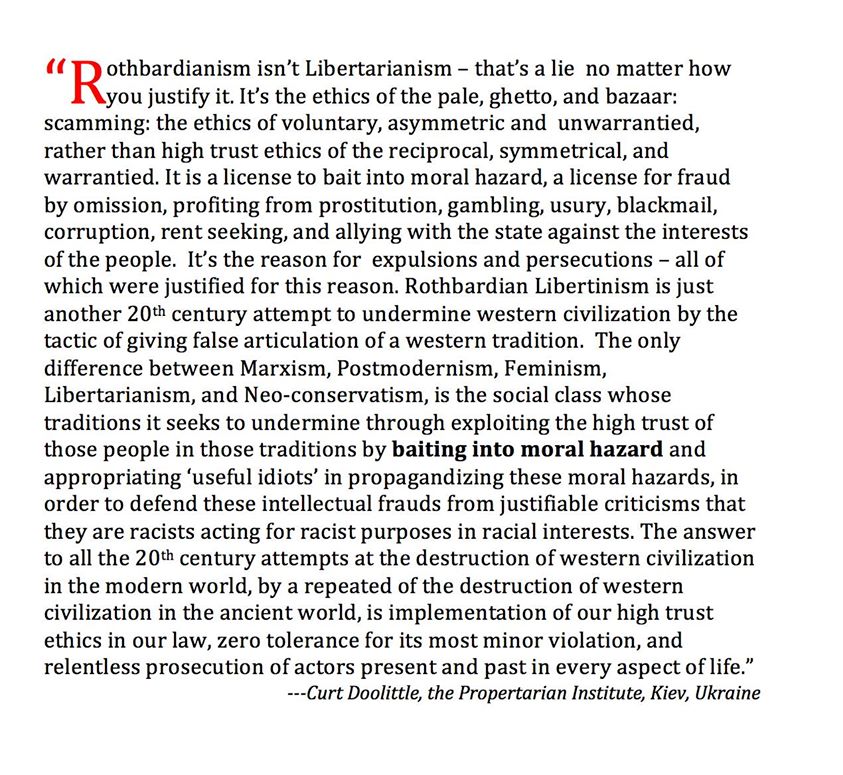
Perhaps it may sound OK in beerhall, when the audience had more than five drinks.Feb 1, 2019, 10:33 PMCurt Doolittleyou are too rigorous my friend, but not reading carefully. it is correct, but open to misinterpetation. ;)Feb 1, 2019, 10:35 PMDaniel JordanI’d say that legally even allowing parents to neglect necessities of life to their children is immoral.Feb 1, 2019, 11:55 PMMichael Carbonaro“The only different between Marxism, Postmodernism, Feminism, Libertarianism, and Neo-conservatism, is the social class whose traditions it seeks to undermine through exploiting the high trust of those people in those traditions by **baiting into moral hazard** and appropriating ‘useful idiots’ in propagandizing these moral hazards, in order to defend these intellectual frauds from justifiable criticisms that they are racists acting for racist purposes in racial interests.”
I agree completely! How are these social groups “baiting” people into into moral hazards? Why, they are making arguments and talk of tradition, or preference, or even a “strong emotion” they embody and that we ought to embody. Morals they call it, but what they claim is a hazard! They don’t follow the real good, but the real bad. They don’t like high trust, but their own, ever hazardous ethics!
Eventually, they get a following. Now they embody that moral hazard above themselves and follow it like a guiding light in the piercing darkness. The leaders give off to the ‘useful idiots’ simple, basic ways of embodying their moral hazards, the ones they they themselves love! They propagandize them! Now they go towards their destiny of following a moral hazard they believe because they prefer it over others, convinced by the “arguments” or claims, and learn to defend, as you said, their “intellectual frauds from justifiable criticism.” Not to mention, since these hazardous folk do not take to kindly to racial interests that don’t match their own, that they will not tolerate certain races or racially charged interests. What a bunch of hazardous bigots!
But wait, there seems to be something strange here. We seem to be pointing the finger. It might be good to cross examine what we are, which is certainly not morally hazardous.
1) We believe in our created morality, so we choose to embody it and gain great feeling for this ethic, holding it above ourselves.
2) One of the groundworks is high trust, so that is our ethics.
3) From talk of our ethics, our group begins to grow.
4) The ethics goes across people, some brilliant and some new to the ideas.
5) The new, not so sure of what they have learned, excitedly spread the good news of their newly found ethics.
6) Our group becomes stronger the closer we the followers become, defending criticism and justifying the arguments and claims of the intellectual leader(s).
7) We look down upon groups with racial interests that supersedes their own interests and those groups act as bigots against them.
Alrighty, so it looks like we met non-
Wait a second.
How does this moral hazardousness not apply to us? Perhaps I didn’t hear your great ideas right.
I happily await your response.Feb 2, 2019, 4:52 AMCurt DoolittleI would respond if you produced an argument rather than a straw man.
How are moral hazards (usury, financialization, redistribution of reproduction to underclass, underclass immigration ) equivalent to internal signaling?Feb 2, 2019, 7:23 AMJames Fox HigginsLibertinism*
Looks the same, but it’s not.
I agree that this is not an excellent piece of writing, but that’s purely because of the rhythm of the prose. Not because of any internal contradiction.
Also, you’ve written your own malapropism. *Muddies the waters, not muddles. Since we’re nitpicking 😉 #reciprocityFeb 2, 2019, 8:13 AMIgor RogovIf I take “libertinism” not as a simple typing error, but as a distinct meaning, it makes even less sense. Was Rothbard waving his dick at his students or what?
Sure, I have my own share of malapropisms, but I am drunk Russian.Feb 2, 2019, 8:38 AMWilliam L. BengeAs we explore propertarian (true libertarian?) “precepts” our tests might satisfy our standards of trust for one and then more claims or principles declared to be propertarian.
The reason I mention this is to address your lack of warrantying of your claim (statement) above Michael. This can be cleared up by learning what is testimonialism, which doesnt take long. A handful of points (simple), are the conditions we must satisfy to qualify a statement as truthful (falsifiable), or not. Once learned, always learned. When we graduate this, then we’re off to the races!
So, glaring into your argument with these testimonial standards after the fact, I think you will find the content of your statement is absent any qualifying measurements. Uh-oh.
Testimonialism will demand you have those measurements. People will need to see truthfulness (of your assertions) demonstrated through internal coherence and external correspondence.
To satisfy these standards of testimonialism, you will have to observe operationalism. Once learned, always learned. When we graduate this, then we’re off to the races!
Yes, yes. This is a discipline like any other, but this one permeates all others. The discipline is called, truthfulness. ;)Feb 2, 2019, 1:06 PMMichael CarbonaroCurt I am not sure if I understand your question. You are asking me to tell you how moral hazards are equivalent to internal signaling, but what I am trying to figure out is how they *aren’t* equivalent. What makes your morals not hazardous, and how is that argumentatively proven?Feb 2, 2019, 1:08 PMMichael CarbonaroWilliam What exactly is a “quantifiable measurement?” Are we measuring how high a tree is or how moral a statement is? Because the first is mathematically, and the second is subjective.Feb 2, 2019, 1:10 PMMichael CarbonaroI am basically trying to figure out how propertarianism is the objective moral position and how every other position – such as Libertarianism, Neo-conservativism, Marxism, etc – is hazardous.Feb 2, 2019, 1:12 PMMichael CarbonaroObviously, you describe how they are “hazardous” (i.e. baiting people, social class, etc) but why are any of these things important? Why is it important or essential to have a high trust society? I don’t see anything in this paragraph that helps me understand why you are right and others are wrong.
You probably have written a great deal about this, so I hope you can tell me why your position is objective and others aren’t.Feb 2, 2019, 1:22 PMWilliam L. BengeAnd what gains are made by airing moral relativism? Morality does not exist outside of a real event, and testifying to a real event is warrantied (falsified) by measurements, which measurements take form as internally coherent and externally correspondent.
Does this suggest law better establishes what is moral? Indeed. Natural law.
This testimonialism (which utilizes operationalism) safeguards all from falling prey to woo-woo or even the traps of human bias. We are left vulnerable if we end up at wishful thinking, and by whatever course or series of errors.Feb 2, 2019, 1:24 PMMichael CarbonaroWilliam “Does this suggest law better establishes what is moral? Indeed. Natural law.”
Wait I am confused. In the first paragraph, are you admitting that morality is not something that is tangible and not a “real event?” If so, then why are you suggesting that moral is better with “natural law,” even though ultimately this implies a subjective preference?Feb 2, 2019, 1:27 PMMichael CarbonaroIt’s like if I said, “I wish everyone believed that murder is wrong, but luckily natural law makes that established!” Er, we are still left with a problem.
If a society that uses natural law believed that, let’s say, “Prostitution is good,” then it would be supported and upheld in natural law. Is there anything wrong with a society doing this?Feb 2, 2019, 1:29 PMWilliam L. BengeI do not own nor create moral relativism, though I do state moral relativism is a strategy that does exist. It is generally recognized externally (sources can cited) as real and my application reflected this condition in my statement, thus we have internal coherence. Also, my statement was neutral toward moral relativism, not an endorsement of it nor condemnation.
My statement suggested there is little to be gained by airing moral relativism and for the reasons I proceeded to then share.
Natural law of reciprocity satisfies morality demands? Yes. A series of laws provides a canon for reciprocity and adjudication. A new precedent revises the canon.
The woo-woo run amuk we presently observe in the west, is no good for anyone except those creating harm (theft by deception), and even those persons (thieves, liars) are at risk of loss by system-wide catastrophic collapse.Feb 2, 2019, 1:44 PMWilliam L. BengeAh, I see. Well, building case law is non-trivial and does not, cannot, amount to the dog chasing the tail? We note the term propertarianism? For most of us probably those who come to mind when we hear property discussed is “Smith, Hume and Locke.”
From those years ago, we are making headway to more fully establish and mature these truths, to achieve a solid defense and offense for same. We have achieved this.
To more specifically respond in summary:
Property is sacrosanct. Morality is absorbed by the law. Law protects what is property.Feb 2, 2019, 1:58 PMWilliam L. BengeNow if you can grasp the points of this thread, you’ve been spared hours of study. Which time cost can be paid maybe later, eventually.
Does any of this make sense?Feb 2, 2019, 2:04 PMIgor RogovTrey Lindsey No. It is a grave mistake to lump anarcho-capitalist into an immoral camp of libertines. Moreover, the anarcho-capitalism (rather carelessly, I should say) assumes the moral “positive” of the sum of human transactions (based on Rothbard belief in theory of utilitarian nature of morality) and therefore stresses out that more of a free market and less government regulation (as an extension of more freedom and less slavery ) is morally sound and economically profitable at the same time.
Totally ignoring the religious precursors of modern capitalism I must add (I am not exactly with Weber, he is historically inaccurate, yet has very sharp observations ).
Yet anarcho-capitalism totally relies on a sound moral judgement of every participant, henceforth its optimistic outlook.Feb 2, 2019, 5:49 PMCurt Doolittle—“If a society that uses natural law believed that, let’s say, “Prostitution is good,” then it would be supported and upheld in natural law. Is there anything wrong with a society doing this?”—
Natural law is what it is. You can violate it. But then you are not goverend by rule of law under natural law. You’re just making shit up. Which is fine.
JUDGEMENT
prostitution is a productive, symmetric, voluntary exchange. The question is one of externalities. IOW: if it’s visible in the commons it’s a violation. If it’s not visible in the commons (ints in your bedroom) then it isn’t a violation. Everything else is a crime in and of itself. Street Prostitution tends to draw crime. Call girls don’t. (so much). Bordello’s not so much. Bar girls not so much. But what happens in a bedroom is not a matter for the law.Feb 2, 2019, 9:52 PMBill JoslinFeminism, Pomo, Libertines, Anarcho-caps all operate on the presupposition of radical individualism as a moral goodFeb 3, 2019, 4:23 PMBill JoslinCurt Doolittle ( damage to the institution of marriage, an externality of prostitution?)Feb 3, 2019, 4:28 PMBill JoslinMicheal is equating Natural law to a consensus of sort in the absence of our definition (which ours results in a method of measurement not mode of interpretation)Feb 3, 2019, 4:57 PMWilliam L. BengeInteresting, Bill Joslin. As in, Marriage; a vested property (recite type and qualification, confirmation) we can propose as properly benefiting from insurance of the last resort (state interjection), thus must be embedded in some way into general negativa.
No, not any sort of gd family court, no.
Somewhere we already covered the type of property this qualifies as. Anyway, some sidenotes.Feb 3, 2019, 4:59 PMBill Joslin(There are private practices which impact public health – such as infidelity in marriage, 30 yo men dating 16 yo girls etc – occurences in the bedroom which results in retalitory actions in public, or long term impacts on relationships etc)Feb 3, 2019, 4:59 PMBill Joslinmarriage being a contract and a property… but on a societal level (normative) also a common property. Infidelity and prostitution impose upon the societal function of these commons (normative damage – political unit etc)Feb 3, 2019, 5:03 PMBill Joslin(break-dwn of the political unit etc – break up of the family and fatherless children so on and so on)Feb 3, 2019, 5:04 PMWilliam L. BengeDiscreet application of law. Ex. I wont be cited for drinking coffee or munching potato chips though driving distracted is unlawful, except, at an officers discretion I can be cited and fined if the officer is already detaining my travel to issue a warning or another different citation.Feb 3, 2019, 5:08 PMIgor RogovIsn’t it obvious that feminism, libertinism and anarcho-capitalists argue for radically different sorts of individualism? Rothbard was arguing for full individual responsibility and self-ownership, libertinism was all about pursuit of pleasures and feminism is really hard to define beyond whims and caprices of an immature girl at odds with her own biological nature and society at large. To lump them all together does not help anything, it looks more like a radical failure in classification.
Say, feminists are totally at odds with anarcho-capitalist idea of full individual responsibility, as it is always collective men to blame for every woman’s faults.Feb 3, 2019, 5:20 PMBill JoslinIgor Rogov Its not a failure of classification – they all belong under the category of radical individualism, then under that category the sub-categories you outlined. The superordinate of “radical individualism” which they all share is the outcome of atomization and errosion of social cohesion and they share in the opportunity to consume social normative properties without contribution – precisely because they are radically individualistic, no matter what variations of it they expressFeb 3, 2019, 5:41 PMWilliam L. Benge”Micheal is equating Natural law to a consensus of sort in the absence of our definition (which ours results in a method of measurement not mode of interpretation)”
Smart read, my man… I was most definitely infering positive and negative externality come to bear for Michael’s need to a) demonstrate measurements to b) warranty his claim, ie prove it has been rigorously tested and stands free of error and negative externality so far as it is possible (for him) to do.
The “if I want” or “a consensus of people want” he hypothesized also provides zero warranty hypothetically.
Not wisdom, is the point.
Allowing this sort of deficit is like a tight-rope walker who, instead of rescheduling his stunt, ignores the dangers of the approaching blustery thunderstorm for the reason he has an umbrella as part of his act.
In the stuntman’s case, nature will make quick work of truncating excess, and one genetic line becomes reduced in an instant.
Many things are possible and decidable but not advisable.
Finally, because a feature in an evolving legal canon is refinement and perfecting of the body of law, gaps and leeway’s become closed over time.
“The law caught up with us.” Retroactively applied too? Unknowable.
Anyway, we see the def saving value of measurement (for warranty of claim) in terms of personal peace and security, imo.Feb 3, 2019, 5:42 PMIgor RogovSuperordinate to anarcho-capitalism is not radical individualism, as it assumes that every individual is fully responsible to the collective marketplace and totally prohibits the use of force or coercion. Radical individualism could be ascribed to some brands of feminism, yet feminist individual is assumed as a member of “sisterhood” collective force battling a conspiratorial patriarchy. Etc.
With the same degree of misleading “success” one may lump all of them together under one category of radical collectivism. Indeed, most of feminists are collectivists, much like communists and socialists, although they like to declare that they fight for individual freedom. Anarcho-capitalists don’t see an individual outside the collective market. See? They are all collectivists. Right? Wrong. This classification does not help anything either.Feb 3, 2019, 5:45 PMBill JoslinIgor Rogov Anacap operates on the presumption that authority isnt required as the market (the aggregate of individual action) will guide interactions versus a collective solution such as law. That is a presumption of individual action being superior to collective constraint. And coupled with the nonsensical presupposition that all people will hold to the same morality in every situation. Once one entertains that the aggregate effects of the market opens opportunity to deviate from the normative for increased gain – the whole proposition fall on its face.
Third wave feminism draws on herd mentality and will inevitable become collectivist HOWEVER the foundation of that whole leg of philosophy is based on emancipation of individuals from any social or formal categorization, formal amd normative categorization as being oppressive. The fundamental presupposition is radical individualism – which is why LGBT, social constructivsm, non-binary genders et al all share the same philisophical root as feminism.Feb 3, 2019, 6:02 PMIgor RogovBill Joslin Ancap is internally contradictory, as it prohibits the use of collective force yet assumes that the individual will act AS IF there is a threat of a force from the collective marketplace. At least at the stage when the “anarchist” individual is trained to play by the “capitalist” rules.
Feminism is really difficult to point finger at, as all the waves have morphed into a pure hatred of what the humanity IS as opposed to what a teenager girl would like it to be. Yet the collective nature of “sisterhood” is rather obvious in every wave.Feb 3, 2019, 6:06 PMBill JoslinThey’re all internally contradictoryFeb 3, 2019, 6:24 PMIgor RogovBill Joslin Yet reliance of real-life feminists on bureaucratic build-up and the police to enforce feminisation of the families (Duluth model) – could not be described as “individualist”, moreover “radical”. This sheer collectivism, at an extent that could not be seen yet anywhere except famous collectivist regimes, i.e. USSR and China.Feb 3, 2019, 6:26 PMIgor RogovNow I would offer my own, proper superordinate to an-caps, feminists and postmodernism:
They are against the healthy nature or simply unnatural, and they are trying to change the law itself to enforce all the unnatural, sick, marginal and degenerate traits.
They are against the Jus Naturale (Natural Law) as it was understood at the beginning of European civilisation.
They coincide with radically individualism only if you take as a model individual a radically depraved, deformed, degenerate and sickly human being.
Rothbardians are also unnatural, but their model of unnatural individual is more like of a saint, predestined by God himself to play by the assumed rules.Feb 3, 2019, 6:53 PMBill JoslinIgor Rogov see… I see it that radical individualism allows one to disconnect the individual from an individual’s necessary conditions – to unhook the particular from its superordinant category. This then allows one to define the individual any which way one see fit i.e. UnnaturallyFeb 3, 2019, 8:22 PMIgor RogovGot it. To be individualistic within these systems (add Soviet style socialism to the list) you have to radically curb, control, restrict, deny and remove most of the basic natural human impulses and instincts that are present in every individual.
This creates Orwellian absurd system with a “Freedom is a Slavery” being a primary slogan.Feb 3, 2019, 8:27 PMBill JoslinExactlyFeb 3, 2019, 8:28 PMIgor RogovThis is what I call a quest for Unnatural Utopian system.Feb 3, 2019, 8:31 PMBill JoslinIgor Rogov I think nature abhors utopiaFeb 3, 2019, 8:38 PMBryan Nova BreyChristian Bates I think this is the conversation you’re looking for.Feb 4, 2019, 1:43 PMIgor RogovI would think that individual human nature abhors collectivist utopia, no matter how it is constructed and enforced from above.
Utopian thinking should never be allowed to take foothold in a public sphere beyond purely literary private clubs and scholarly studies.Feb 4, 2019, 10:33 PMBill JoslinIgor Rogov I think a sacred attitude to nature would provide a balwark to utopian thinkingFeb 4, 2019, 10:36 PMIgor RogovBill Joslin Sacred attitude to the laws of nature yes. But the nature itself could not be sacred, unless we want to celebrate the lifestyle of a ‘noble savage’Feb 5, 2019, 12:52 AMI AM A LIBERTARIAN: AGENCY THROUGH SOVEREIGNTY RECIPROCITY TRUTH DUTY THE NATURAL LAW OF TORT AND MARKETS IN EVERYTHING.
That is the operational definition of libertarianism. Every other claim is a lie.
THE PRESERVATION OF CHRISTIANITY AS A POLITICAL RELIGION, AND THE RESTORATION OF PAGAN AND HEATHEN CULTURAL RELIGION UNDER THE NATURAL LAW.
(I don’t want to interfere in Maximus’ thread, because he certainly doesn’t need my help in arguing propertarian natural law, but I like the suggestion that I should do a video. I have already done the subject with our favorite Aussie, and I will do the video now that you bring it up.
Let’s understand these facts.
1 – Christianity teaches natural law – just poorly.
2 – Christianity teaches (exhaustive tit-for-tat) optimum IN-GROUP strategy as an extension of natural law – but does do poorly, and because it does so poorly – does not limit to kin, (is universalist (outgroup)) and therefore a mixture of good and bad.
3 – Christianity made us, particularly our women, vulnerable to marxism, postmodernism, and feminism, because these three ‘replacement religions’ are communicated by the same false promise and sophomoric argument, but
4 – The evidence is that christianity produces prosperity wherever it goes, but is a higher demand than Islam, like judaism is a higher demand than christianity. But the fact remains that western people still retain both Legal (roman) intellectual (greek), familial (heathen european), and political(semitic) ‘cults’. And these cults are all reflections of our classes. And all of the classes make use of what set of cults is necessary for cooperation at their level of agency.(ability to act).
5 – The purpose of christianity, marxism, postmodernism, and feminism, was to destroy the empirical, rational, military, legal, and commercial order and replace it with Egyptian, south semitic, north semitic, and Persian means of ruling an underclass through false promises (life after death), false debt(‘for our sins”, “original sins”) using supernatural frauds in the ancient world, and using economic (marxist), social (postmodern), and political (feminism and multiculturalism) in the modern world.
My understanding is that especially among those who will fight, christianity must be accommodated, and the law says that it can be accommodated because among religions it teaches natural law.
Evidence is that churches are emptying. Particularly in mixed areas. and you haven’t seen the law on religion I’m proposing yet, so you don’t know that I’m suggesting restoring the economy to the church and restoring competition with the state – under certain conditions.
And i’m also suggesting how any of our ‘natural religions’ can obtain this same cultural, economic, political centrality once again, by providing particularly powerful incentives, including restoring education and educational funding to ‘churches’ in the broadest sense (and ending centralized education). (in other words, prohibiting falsehood is different from demanding certain skills).
Under these incentives I believe our religions will slowly (possibly rapidly) migrate away from falsehood to truthfulness due to incentives of (a) simple economics (b) increasing vastly their influence, (c) defending themselves from the state. In other words, ‘let nature take its course’, and keep the state out of christian faith, and keep christian faith out of TRUTH CLAIMS.
This sets up a market for the three categories of religion, while providing mindfulness.
A christian can say “i hold [xxxx] as a matter of faith, I do not claim it is true, because what is true must be open to testimony, and Faith itself is not open to testimony. As long as I do not try to use truth claims (arguments) in matters commercial, financial, economic, and political, then I have not broken the law.”
One cannot claim something false is true for the purpose of induction (consequential argument). And in particular (islam/judaism/catholicism) because one may not claim there is any law other than the natural law (no competitor). And one may not advocate a religion that is duplicitous because of that (Judaism and Islam are duplicitous and poly-ethical.).
With the prohibition on judaism and islam, the preservation of christianity due to its natural law, the universal education in stoicism (mindfulness), and the combination of christian and european (heathen) festivals, my understanding is that we will see our religion return to its natural condition where the poor are christian, the middle ancestral (heathen), an the upper-classes, as always, purely empirical and giving respect to the middle and lower through participation in oath, ritual and festival.
So it is not so much that we need to end Christianity, as it is we need to create a range of churches (wholistic mindfulness, socialization, and education) that will serve the interest of the different classes In content, while the same underlying constraint on adherence to natural law.
In other words, we must make a practical accommodation for faith in those who need faith because they have no alternative to faith for the purpose of obtaining that mindfulness necessary in a complex society in which many of us lack the familial, social, economic, political relations, as well as perhaps the genetics to provide value in social, economic, and political markets.
So there is ‘something for everyone at a cost to everyone’ in my proposal. But it is hard to argue against the cllection of goods. we know this because while people will claim they are christian, go to church, celebrate festivals, take oaths, abide by rules, they will very rarely, under oath, claim such things are true.
All humans follow interests. They follow interests becasue it is in their interests. And they use propaganda an arugment and belief to justify the pursuit of those interests.
This is a small part of a very complex subject, and was the most complex subject I had to tackle with. Religion is the hard problem of social science, because it is, in the end, education in the ability of people to work in harmony with their intuitions as animals and in harmony with each other in groups, and therefore reach personal, familial, social, economic, political, and military benefits from one another.)
IDIOCRACY CONTINUED by Eric Orwoll and another individual that goes by the IvanTheHeathen pseudonym
For newbies, this is the most reductive argument that I can put together for the core.
Now, if you’re going to criticize me on the technicalities this is the introduction to what you have to deal with and I promise you the effort will be futile. I have tried everything from every angle and while some arguments are undecidable (abortion), there are none that are not open to analysis.
You can criticize me on the possibility that we should be trying to create a ‘religion’ rather than a body of law (despite the left’s success with sophism and pseudoscience and denial, and the emptying of churches other than islamic utility for the underclasses.)
You can criticize me on the possibility of getting such a constitution implemented by available means whether democratic or revolutionary.
You can criticize me on the chances of success at a revolution if one is necessary. My goal is to make it so probable that it isn’t necessary.
You can criticize whether the population would not willingly accept the vast majority of the constitutional reformations – other than voluntary disassociation – which is the only one that appears controversial whatsoever.
You can try to criticize me on the use of intolerance and demands for truth to defeat abrahamic religious, marxist, postmodernist, feminist attacks on our civilization – repeating the christian attack on Rome.
You can suggest that the political models I recommend (I recommend a spectrum) should favor the authoritarian, the managerial, the representative, the participatory, or the supernatural.
You can argue that we should seek monopoly rather than secession or extirpation rather than separation.
Or even whether truth and trust and commons and eugenic superiority are the west’s only remaining competitive advantage.
But whether or not we can create algorithmic law that tests the reciprocity of display word and deed at all scales of human cooperation, and can be argued in court, decided by jury and adjudicated by the court, then I can assure you that you will fail.
I set out to create a value neutral universal language of ethics and politics. This is the result and it is a far greater in scope than I had intended. And it’s pretty solid.
PART I
1) WHEREAS: All human behavior can be reduced to statements of acquisition of the full spectrum of interests and the defense of that full spectrum of interests, and cooperation to acquire or defend those interests.
2) WHEREAS: All human disputes can be decided by tests of reciprocity or ir-reciprocity in the gain, loss, and transfer of those demonstrated interests.
3) WHEREAS: All human behavior in acquisition, defense, and cooperation of interests can be sympathetically and empathically (subjectively) testable.
4) WHEREAS; We can enumerate those interests in categories we call ‘property’. (See Property In Toto).
PART II
0) WHEREAS; language consists of a series of symbols (constant relations), usually produced in phonemes or actions, or substitutes, in a stream of continuous recursive disambiguation, following rules of continuous recursive disambiguation (grammars) resulting in a transaction (contract-agreement) for meaning, and further resulting in a contract (contract-warranty) for truthfulness (limits to those associations we call ‘meaning’). (This is how neurons do their work of producing experience and there is no alternative.)
1) WHEREAS; All epistemic processes at every scale follow this same sequence of using free association to produce a stream of continuous recursive disambiguation, from the sound, to the term, to the phrase, to the sentence, to the story of state or story of change in state. And from free association to hypothesis, to theory, to law, to pre-cognitive presumption by habituation.
2) WHEREAS; Terms and phrases consisting entirely of Descriptive operations, whether physical, rational, calculable, or computable are open to subjective testing in all dimensions open to human perception. (try it)
3) WHEREAS; By constraining ourselves to operational vocabulary and grammar (ePrime in particular) it is nearly impossible to create a well formed phrase, statement, sentence, argument, set of arguments, without exposing one’s presumption of knowledge he does not possess. (try it)
4) WHEREAS; By surveying terms from every major field, stating them operationally, and disambiguating them by ordering them in series along a single constant relation (equally operational), we can falsify terms entirely, modify some terms, and force ourselves to create new terms, such that all terms in all fields are deflated, disambiguated, and operationalized. When these terms are used in well formed statements in operational grammar we eliminate opportunity to obscure ignorance, error, bias, wishful thinking, suggestion, obscurantism and deceit. (try it)
5) WHEREAS; By subjecting names, phrases, sentences, stories, arguments, whether freely associated, hypothetical, theoretical, applied (law), and habituated (presumed) to tests of categorical, internal, external, operational, rational, reciprocal consistency, scope consistency (limits and full accounting) we can determine whether any claimant possesses the knowledge to make such a claim, and whether or not ethical, moral, (and criminal) violations would be caused by this claim.
6) WHEREAS; By accounting for all changes in state to the demonstrated interests of others, whether intended and not, direct or external, we can determine if costs are imposed upon others involuntarily. (This subject requires understanding of the demarcation between opportunity external to the commons, common opportunity open to seizure by competition, and private seizure of common opportunity via competition.)
7) THEREFORE; It is possible to exclusively rely on operational grammar and syntax, and deflated, disambiguated, serialized, and operationalized cross disciplinary (universal) vocabulary (which we refer to simply as ‘operational grammar’ and all inflated and deflated alternative vocabulary-grammar combinations as ‘the grammars’ ) in any and all truth claims or advocacy claims that could impose costs upon others in commerce, finance, economics, law, politics, and pedagogy.
8) THEREFORE; it is possible to construct a strictly constructed body of law from the first principle of reciprocity, for the entirety of the human experience, that because of this vocabulary and grammar is both open to failure to ascend due to failure of well formed statements in this ‘grammar’.
9) AND; within that body of law it is possible to construct both law and process to test all involuntary transfers whether by display, word, or deed, by individuals or groups, directly or indirectly, against the private, semi-private, semi-common, and common across the entirety of the spectrum of human demonstrated interests.
9) AND; it is possible for individuals and groups to bring suit against individuals and groups in defense of not only physical commons, normative commons, and traditional commons, but informational commons.
10) AND; it is also possible to construct a constitution for any form of government desired in truthful form with this grammar at the cost of directly exposing all transfers.
(etc…)
—— RESPONSE—-
lol. Ok munchkin. I’ll keep playing tennis with you. We’ll play the amaturist game of ‘what I meant was’ and ‘you don’t understand what I meant’ if you want, when the entire argument is whether or not you have ANY FREAKING IDEA what you are criticizing other than “huh… I…. um…. don’t see stuff familiar to me here…. so I’m gonna man up and piss on the fire hydrant and pretend I do.”
—“You don’t understand what I mean by “positivism.” “—
Of course I do. Which is why I spent so much time on Hoppe’s criticism of Popper and Critical rationalism – the debate between the Frankfurt School and Popper’s crowd.
You are trying to draw a parallel, but not stating the context, not stating how both sides failed to resolve the underlying practical and theoretical problems, and worse, not stating whether in the end the claims of the positivists were wrong given the context of the argument.
If you understood my work you would also understand why some people call it ‘Critical Naturalism’ since it is functional an extension of critical rationalism. (Which is why I’ve written so much about the failures of Mises, Rand/Rothbard, Hoppe, despite their slow progress. Not really sure you could say you know anything about my work (or that movement) if you don’t know this.
In that movement the frankfurt school called popperians positivists, and the popperians countered that they were anything but. Note that it’s kind of difficult to sit thru class after class at mises institute, lecture after lecture by hoppe there, and to participate in the Property and Freedom Society without hearing the godfather of “property as test of commensurability” not beat the drum against popper (wrongly it turns out) – because he was and remains, a victim of marxist rationalist education. Worse, hoppe’s justification of … well, the answers are here: https://propertarianism.com/2015/07/31/a-list-of-hans-hermann-hoppes-errors/
You see, you’re conflating terms. You keep using this term ‘meaningful’ where I use the higher standard ‘testifiable’. The positivists were, as am I, trying to prevent fictionalisms in public speech and like popper they were doing so because marxism and socialism were pseudoscientific and sophist, but they couldn’t figure out how to defeat them. (categorization of the ashkenazi counter-enlightenment as jewish lower class marxism, and jewish middle class austrianism provides a better understanding of the conflict.) The reason is that they failed to reach to the law rather than logic. Law accepts the subjectively testable but not the fictional. That’s why I write Law (reals) not ‘philosophy’ (ideals). And why the law has greater reach than empiricism (observable). And why I rely on falsification, and not justificationism (and why I largely ignore philosophers just like most scientists do.)
So if you draw an analogy between the positivist demand that we can know nothing that is not observable (measurable) – which was their attempt to defraud marxist/socialist sophistry, the way that the enlightenment used it to defraud christian dogma, fictionalism, and sophistry, and the Frankfurt school’s attempt (as we see in Hoppe) to preserve the use of sophistry (pilpul, critique, false promise) I’ll agree with you that you could leap to that conclusion. The question isn not whether you can say something meaningful, it’s whether you can get away with saying something false and irreciprocal. The answer is that you can say many things false under sophistry (apriorism) that you cannot say under testimonialism. You can say many things under empiricism that you cannot say under testimonialism. So it’s a bit of deceptive sophistry to make the comparison between “I can say something meaningful (but still get away with deceit” instead of “I can say something meaningful In public as long as I’m not trying to get away with deceit that imposes a cost against others”.
It is this restoration of violence, and of presumption of malfeasance that I’ve put back into the rather victorian optimism and presumption of innocence in the court dance between middle class ‘intellectuals’. Iv’e restored ternary logic to the discourse. I abandoned the enlightenment project: “I start with why should I and mine not kill you and yours, and take your stuff?” I start with the continuous prisoners dilemma of choice of predator, cooperator, prey, rather than cooperation or non cooperation. This eliminates the … amateurish nature … of most philosophical discourse which presumes possibility of gentlemanly exit.
So, the law says you can know things any way you want, but the way you know things has no bearing upon whether it can be testified to, and whether such statements (information) will produce harm. The law does not care how you claim you know things. It only cares that you failed to do due diligence against harm, and that we can determine that by whether or not you can testify to it. In other words “real” vs “ideal”.
—“If there are any statements which are neither (a) nor (b) which you think would pass your tests for truthful speech, then please provide me with some examples. However, it seems clear that any statement which is not (b) would immediately fail your test 3 (external correspondence) for truthful speech. Therefore, no statement which is neither (a) nor (b) could possibly pass your tests for truth.”——
Well, aside from your … odd… conflation of tests, instead of the logical for logical, and empirical for empirical, how about we test both that model and mine against the statements “Money is neutral’. Or “Raising the Minimum Wage will produce Inflation”, Or “Inflating the money supply is ethical”. Or ‘the universe is expanding faster than the speed of light”. Or “there are multiple infinities”, or “There is mathematical reality”, or “White people have privilege”. Or the second amendment guarantees private ownership of weapons”, or “Human Rights Exist”, or that “Property exists prior to rights”.
So in answer to your question I would say in a few words like ‘the impossibility of closure’, or ‘inescapable contingency’, and ‘the problem of conflation’, but failing that rather simple clue:
1) that tautology would pass the test of internal consistency rather obviously, but if and only if the premises of the definition were testable either by non-contradiction or external correspondence with direct or associative experience.
2) anything observable to by the senses, by instrumentation reducing to sensation, could pass the test of external correspondence if stated in operational terms, and;
3) that if that instrumentation or observation required a series of tests, stated in operational language, it would pass the test, and;
4) if the statement was a function of rational choice then it would be sympathetically testable, and;
5) if it were reciprocally sympathetically testiable as rational choice it would pass, and;
6) if it were not directly or by implication a use of conflation (“household income”), cherry picking (gross domestic product), or arbitrary selection of scope and limits (“neutrality of money” and “minimum wage” being the best examples), then the statement would pass.
And conversely that logic is taught in reductio form as is philosophical rationalism, and questions unanswered only because almost every open question is a problem of grammar (well formed statements). There is no Liar’s Paradox operationally, only in sophistry. Because it has no ideal meaning, it has only the meaning the author intended: an illustration of the problem of malformed statements (poor grammar), and in particular the problem of the verb ‘to be’ (exists as) which roughly translates as “i dunno’.
There are no paradoxes. Language consists of using phonetic (or substitute) symbols of continuous recursive disambiguation, and ambiguity is a failure of satisfaction of grammar and nothing else. (Or victorian parlor games) Hence the reformation of set logic(verbalisms and sophisms) to operationalism (existentially possible). Thus ending conflation inflation, loading(biasing), framing(biasing), suggestion (causing appeal to intuition), overloading (causing appeal to intuition), and grammatical sophism.
–“and thus inadmissible in rational discourse – and you consider such statements to be “untruthful” – and thus inadmissible in public discourse and subject to the penalty of law “
Of course that’s a straw man. Inadmissible refers to: Inadmissible in cases of the imposition of costs upon the informational commons in matters of commerce, finance, economics, politics, law, and the academy (pedagogy) whereby costs of falsehood weather by intent or not are imposed upon others, and is judged so by a jury of peers before a court, where one or more individuals has deigned to bring this suit to court. Also, “Rational discourse” is only MEANINGFUL. Truth claims constitute a higher standard than meaning. Meaning = transfer, Truthful = Warranty of due diligence against falsehood.
(.continued…)
The Propertarian Institute
2 hours ago (edited)
–“You are not familiar with the standard philosophical terminology, and so you have invented your own terms to describe views for which standard terms already exist. This is why so many people often complain that they can’t understand what the hell you’re talking about.”—
It is not that I am unfamiliar, but that I avoid philosophical terms at all costs except to undermine philosophy as a discipline. In particular, since the libertarians are fans of the Kantian sophisms, and continentals fans of empty words. The kantian invention was an attempt to preserve Pipul and Critique of the jews and Socratic Skepticism and Platonic Idealism of the greeks by restating christianity, preserving authority, without the church. And i’ve put forth a reformation the unifies vocabulary and grammar (operational grammar) across all disciplines. Yielding commensurability across all disciplines. And the end of idealism and sophisms in all disciplines.
So I use terms from math, science, economics, finance, and law, and I limit my use of philosophical terms whenever possible to movements, technical criticisms, and aristotelian categories. When I first drafted the ideas I divorced from philosophy entirely. It was after hoppe said something to me that I reframed the arguments in aristotelian categories – in order to undermine all else. My original draft was far closer to a programming language than a mirror of aristotelian categories. However, by merging ALL categories (disciplines) and creating a universal vocabulary and grammar, it was possible to largely end the philosophical program in everything other than choice of preference and good.
ATTACK THE ARGUMENT IF YOU CAN
You can attempt to criticize my work’s (reformation’s) use of deflation, disambiguation, and operationalization (converting from verbal logic of sets [the ideal] – to the operational logic of computability [the real]). You an attempt to criticize the test of whether one possesses the knowledge claimed by operational vocabulary and grammar. And you can attack my restoration of violence and non-cooperation (ternary logic of cooperation). And you can attack the use of via negative law that defends the commons at cost to those who would flippantly speak for attention by the promise of discounts or falsehoods.
But at present all you are saying is that you don’t understand that work (revolution) or why it solves the problem of the sophism, law, pseudoscience, and innumeracy in the 20th century. “Words mean what I define them to mean, and in every reformation, some words must be abandoned, some redefined, and some neologisms invented.”
Here is my claim: I can construct algorithmic law that is no longer open to interpretation and therefore circumvention of the constitution and the people, by activists and activist judges. With that law we can restore our sovereignty by ending the disintermediation of the state between the people and the commons. With that restoration we can suppress abrahamism whether supernatural or pseudoscientific, or sophist, and drastically reduce the abuse of our people in commerce, finance, economic, politics, law, and education.
It will be very hard to defeat that.
I mean, criticize me or criticize kant, hegel, and heidegger – all of whom are far more difficult to undrestand. You can compare the difficulty in my work with Bohm-Bawerk’s and it’s crystal clear. You can compare my work to Ostrom’s which it integrates and extends from physical to informational commons. I am not as readable as ostrom. It was very difficult to select terms from multiple disciplines, to disambiguate them into series, and to deflate them into operational language, leaving behind a vocabular that was not open to abuse.
——“EXAMPLE: REFORMING KANT: DEFINITIONS AND SERIES”—
1) Empirical:
Based on, concerned with, or verifiable by observation or experience rather than theory or pure logic. “From Observation”.
2) A Priori:
“independent of observation.”
There are three dimensions to claims of a priori truth claim:
i) Aprioricity vs A posteriori,
ii) Analyticity vs Syntheticity, and
iii) Necessity vs Contingency
Therefore we can produce at least the following spectrum of a priori claims.
(a) Analytic A Priori: tautological: 2+2=4 and all deductions thereof.
(b) Synthetic A Priori : Increasing money increases inflation.
(c) Necessary Synthetic A Priori: Childless women will have no grandchildren.
(d) Contingent Synthetic A Priori: “all other things being equal, as a general trend, increasing demand will increase supply, although we cannot know the composition of that supply in advance, we can identify it from recorded evidence.”
This produces a an ordered spectrum of declining precision:
(a) Identity(categorical consistency) – Analytic A Priori
(b) Logical:(internal consistency) – Nec. Synthetic a priori
(c) Empirical: (external consistency) – Gen. Synth. a priori
(d) Existential: (operational consistency) – Cont. Synth. a priori
Which corresponds to the testable dimensions of numbers.
(a) identity (numbers)
(b) logical (sets)
(c) empirical (ratios)
(d) existential (constructible)
(e) time is unaccounted for in the a priori model.
Which corresponds to dimensions of physical reality
(a) point
(b) line
(c) shape
(d) object
(e) time (change)
Which corresponds to a subset of the dimensions of actionable reality , the full set of which we express in fully express in Testimonialism as:
(e) Volitional: (rational choice of rational actor)(change)
(f) Reciprocal: ( rational exchange between rational actors)(changes)
(g) Limited: (Limits: At what points does the description fail?)
(h) Fully Accounted: (Have all costs and consequences been accounted for – defense against cherry picking and special pleading.)
Which together account for the totality of actionable reality (by man) that we currently know of (and its quite hard to imagine anything else is possible).
This innovation allows us to create a geometry of constant relations (meaning) that is BOTH computable (via positiva) and deducible (via negativa) within the bounds (limits) of any given rule of arbitrary precision. (Although I’m quite sure that’s over your head.)
(Continued….)
The Propertarian Institute
The Propertarian Institute
1 hour ago (edited)
— NEXT- TESTIMONIAL TRUTH’S EXTENSION OF PERFORMATIVE TRUTH —
|| Ordinary Language Grammar > Deflationary Truth > Performative Truth > *Testimonial Truth*.
Deflationary Theories of Truth
—“That assertions of predicate truth of a statement do not attribute a property called “truth” to such a statement.”—
In other words, “I smell the scent of violets” has the same content as “it is true that I smell the scent of violets”.
Performative Theory of Truth
—“Peter Strawson formulated a performative theory of truth in the 1950s. Like Ramsey, Strawson believed that there was no separate problem of truth apart from determining the semantic contents (or facts of the world) which give the words and sentences of language the meanings that they have. Once the questions of meaning and reference are resolved, there is no further question of truth. Strawson’s view differs from Ramsey’s, however, in that Strawson maintains that there is an important role for the expression “is true” : specifically, it has a performative role similar to “I promise to clean the house”. In asserting that p is true, we not only assert that p but also perform the “speech act” of confirming the truth of a statement in a context. We signal our agreement or approbation of a previously uttered assertion or confirm some commonly held belief or imply that what we are asserting is likely to be accepted by others in the same context.”—
Testimonial Truth
(Natural Law > Testimonialism) (Doolittle)
“I promise [statement], is not false (is true), and I warranty that I have done due diligence in each of the actionable dimensions possible for human falsification.”
With Testimonial Truth assuming ‘warranty’, just as promissory truth assumes ‘I promise’, just as deflationary truths assume “is true”.
So instead of “I promise [statement] is true, and warranty that I have performed due diligence necessary to make that promise of truth.” On simply states “[statement]”.
It means that all speech must be interpreted as Testimony:
So when we say “I smell the scent of violets”;
…. in testimony that means:
“I promise that I smell the scent of violets and that what I say is not false (is true), and I warranty that I have done due diligence in each of the actionable dimensions possible for human falsification.”
And what’s not obvious is this:
It is very hard to state a falsehood in this form of prose, and not be visibly accountable (to blame) for your words.
And conversely, if you cannot state something in this form of prose, the question is why?
And the answer can only be ‘fraud’ or ‘free riding’.
Testimonialism provides the criteria (list of methods of due diligence) that enable us to claim we have performed that due diligence and can warranty our words.
Next we need to understand Ordinary Language, Conflation, Inflation, and Deflation….
— NEXT THE OPERATIONAL DEFINITIONS OF TRUTH —
OPERATIONAL DEFINITIONS OF TRUTH.
TAUTOLOGICAL TRUTH: That testimony you give when you promising the equality of two statements using different terms: A circular definition, a statement of equality or a statement of identity.
ANALYTIC TRUTH: The testimony you give promising the internal consistency of one or more statements used in the construction of a proof in an axiomatic(declarative) system. (a Logical Truth).
IDEAL TRUTH: That testimony (description) you would give, if your knowledge (information) was complete, your language was sufficient, stated without error, cleansed of bias, and absent deceit, within the scope of precision limited to the context of the question you wish to answer; and the promise that another possessed of the same knowledge (information), performing the same due diligence, having the same experiences, would provide the same testimony. (Ideal Truth = Perfect Parsimony.)
TRUTHFULNESS: that testimony (description) you give if your knowledge (information) is incomplete, your language is insufficient, you have performed due diligence in the elimination of error, imaginary content, wishful thinking, bias, and deceit; within the scope of precision limited to the question you wish to answer; and which you warranty to be so; and the promise that another possessed of the knowledge, performing the same due diligence, having the same experiences, would provide the same testimony.
HONESTY: that testimony (description) you give with full knowledge that knowledge is incomplete, your language is insufficient, but you have not performed due diligence in the elimination of error and bias, but which you warranty is free of deceit; within the scope of precision limited to the question you wish to answer; and the promise that another possess of the same knowledge (information), performing the same due diligence, having the same experiences, would provide the same testimony.
Intuition: (sentimental expression) – an uncritical, uncriticized, response to information that expresses a measure of existing biases (priors).
Preference (rational expression) : a justification of one’s biases (wants).
Opinion: (justificationism) – a justified uncritical statement given the limits of one’s knowledge about external questions.
Position: (criticism) – a theoretical statement that survives one’s available criticisms about external questions.
Demonstrated Preference: – Evidence of intuition, preference, opinion, and position as demonstrated by your actions, independent of your statements.
— MARKET DEMAND FOR TRUTHFULNESS —-
“TRUTH IS A WARRANTY OF DIFFERENT DEGREES.”
– True enough to imagine a conceptual relationship
– True enough for me to feel good about myself.
– True enough for me to take actions that produce positive results.
– True enough for me to not cause others to react negatively to me.
– True enough to resolve a conflict without subjective opinion among my fellow people with similar values.
– True enough to resolve a conflict without subjective opinion across different peoples with different values.
– True regardless of all opinions or perspectives.
– Tautologically true: in that the two things are equal.
(Notice how this eliminates the ability to walk away from responsibility for your speech.)
— TRUTH IS A MERCILESS, ZERO-TOLERANCE, WEAPON. —
The Most Intolerant Wins. We have been subject to form of intolerance – intolerance for the truth. But Truth is merciless. Truth is the scientific, legal, political, educational, and religious means of defeating the abrahamisms. But Truth is not a selective weapon. It is indiscriminate – a weapon of zero tolerance. It will destroy your Christianity along with the first generation abrahamic religions: judaism, christianity, and islam, and second generation abrahamic religions: marxism (Judaism), feminism (denialism), and postmodernism (Christianity), and fundamentalist islam, and their dependence upon false promises justified by the sophisms of pilpul(via positiva) and critique(via negativa).
HERE IS WHAT YOU DON”T GET:
It’s not that I don’t understand. It’s that what you think is an image in the rear view mirror is that you’ve been lapped so many times that you didn’t only fail to notice, but you can’t imagine it’s possible.
[T]here are frequent criticisms of my work. I post them. Often. There are criticisms of preference, pragmatism, or probability. But, as yet, no one has offered any material criticism of the work. No one.
All I get are pragmatisms from:
(a) young men who are very smart and prefer authoritarianism – because they have no experience organizing anything – even a family – at any scale,
(d) a range of men who cling to the hope of (authoritarian) religious restoration (not knowing how lucky we are to have escaped it.),
(b) nat-soc’s who prefer intolerant authoritarianism,
(c) young men who cling to the possibility of anarchism,
(e) the room temperature IQ crowd that attempts to participate or observe a discourse that is beyond their knowledge and ability, but is too impatient to wait for the full constitutional changes and the policies that arise from them that would bring them relief.
The only extant criticisms I can find, despite trying everything, are:
(a) people want a positive religion(supernaturalism), philosophy(sophism), pseudoscience, or narrative(excuse), not law, or policy that would benefit them;
(b) people want to preserve their right to advocate for supernatural, sophistry, pseudoscientific, or excuses, rather than do so truthfully (scientifically);
(c) that propertarianism’s grammars, operationalism, epistemology, and strict construction, are too hard for ordinary people to undrestand (not that they undrestand the calculus, programming, or the law as it stands today yet they live under them);
(d) because of these reasons it will not be possible to form a majority movement to enact those policies and that law producing those benefits.
In other words – they want people to agree with them on some given utilitarian falsehood, rather than produce a market for people who agree on utilitarian goods and truths.
But as to the work itself, there is no surviving criticism of:
(a) the grammars;
(b) or the epistemology;
(c) or the law;
… that I know of.
And ‘grown ups’ – meaning those of us who have built organizations of any scale, or worked large organizations, or in government, or in finance or in the judiciary, are quite well aware that the world operates by rules and those rules consists of legislation, regulation, and findings of law. And that everything else exists within it. Not because people believe in the law via positiva, but because they fear the consequences of not doing so.
And conversely that philosophy and religion are for those lacking agency to operate within that which is governed by the law.
In other words, if you argue with religion or philosophy or moralizing, rather than law it is evidence of lack of agency in material matters.
(a) The purpose of religion is regional social mindfulness.
(b) The purpose of philosophy is local personal mindfulness.
(c) The purpose of science is a universal language of truthful speech.
(d) The purpose of the NATURAL law is a universal method of prosecuting imposition of costs upon others involuntarily.
(e) The purpose of legislation and regulation is to enforce the terms of the local contracts in the production of commons.
The difference in the production of commons is determined by asian (dictatorial corporate), european(bipartite state vs citizen), anglo (egalitarian sovereign) presumptions. The semites do not produce commons other than religious, which only force continued devolution.
So, in relation to my work, my opinion is, that if you cannot argue against:
(a) the epistemology
(b) the construction of the law, and;
(c) the construction of any given constitution;
(c) the benefits (policies), and;
(d) the creation for a market of non-false religion, non-false philosophy, non-false science;
…then you don’t much matter other than preventing good people who are willing to act to obtain material benefits and the rewards of a society far more free of falsehoods – then you don’t matter.
THE OPINIONATED IGNORANT
People are happy to opine and presume knowledge.
However,
(a) if you sit down, and try to write a constitution that cannot be violated and which ends the industrialization of propaganda, disinformation, sophism, pseudoscience, and deceit, in commercial financial, economic, and political spheres you will find that the problem is quite difficult.
(b) To do so requires a VIA-NEGATIVA epistemology of eliminating falsehoods. Which if you sit down and try to produce, is quite difficult. And once having done so
(c) if you sit down and try to produce a set of policies that eliminate commercial, financial, economic, political, and academic parasitism in all its forms, you will find it is quite difficult.
(e) If you sit down and try to produce a plan by which a small percentage of (costly) men can bring a government to its knees such that it has no choice but to enact this constitutional amendments, end parasitism, and free a people from predation and genocide, you will find it is somewhat hard to do.
Now, if you can find a one, single, other, person, who can do any ONE of those things, I’d like to meet that person.
If you can find that group of people to do all those things, I would love to know about them.
Because from where I’m sitting you folks haven’t got a single other person living today with anything other than wishful thinking and empty words.
And while I’d MUCH RATHER sit around and work on my tech company and reap the economic rewards, I am not (unlike critics) extirpating my frustration with hollow nonsense to mask my lack of agency and courage.
I am not afraid of dying. And I don’t lack agency. I’ve demonstrated my agency in every walk of life.
I have built companies of scale. I have built a body of thought on a scale only seen since the marxists and perhaps since locke, smith and hume. And much against my preference I’m building a body of people capable of teaching and communicating the work, the policies, and the revolution to those who would have it.
And if you had a criticism of anything material you would make it. However, what I see is nothing more than:
(a) lack of understanding, and straw manning because of it,
(b) self confidence absent evidence of demonstrated ability,
(c) moral conviction that is admirable,
(d) but lacking the courage to do more than gossip.So make an argument, offer a competing alternative of equal or better scope and precision, or don’t waste my time.
Thanks
Curt
[T]here are frequent criticisms of my work. I post them. Often. There are criticisms of preference, pragmatism, or probability. But, as yet, no one has offered any material criticism of the work. No one.
All I get are pragmatisms from:
(a) young men who are very smart and prefer authoritarianism – because they have no experience organizing anything – even a family – at any scale,
(d) a range of men who cling to the hope of (authoritarian) religious restoration (not knowing how lucky we are to have escaped it.),
(b) nat-soc’s who prefer intolerant authoritarianism,
(c) young men who cling to the possibility of anarchism,
(e) the room temperature IQ crowd that attempts to participate or observe a discourse that is beyond their knowledge and ability, but is too impatient to wait for the full constitutional changes and the policies that arise from them that would bring them relief.
The only extant criticisms I can find, despite trying everything, are:
(a) people want a positive religion(supernaturalism), philosophy(sophism), pseudoscience, or narrative(excuse), not law, or policy that would benefit them;
(b) people want to preserve their right to advocate for supernatural, sophistry, pseudoscientific, or excuses, rather than do so truthfully (scientifically);
(c) that propertarianism’s grammars, operationalism, epistemology, and strict construction, are too hard for ordinary people to undrestand (not that they undrestand the calculus, programming, or the law as it stands today yet they live under them);
(d) because of these reasons it will not be possible to form a majority movement to enact those policies and that law producing those benefits.
In other words – they want people to agree with them on some given utilitarian falsehood, rather than produce a market for people who agree on utilitarian goods and truths.
But as to the work itself, there is no surviving criticism of:
(a) the grammars;
(b) or the epistemology;
(c) or the law;
… that I know of.
And ‘grown ups’ – meaning those of us who have built organizations of any scale, or worked large organizations, or in government, or in finance or in the judiciary, are quite well aware that the world operates by rules and those rules consists of legislation, regulation, and findings of law. And that everything else exists within it. Not because people believe in the law via positiva, but because they fear the consequences of not doing so.
And conversely that philosophy and religion are for those lacking agency to operate within that which is governed by the law.
In other words, if you argue with religion or philosophy or moralizing, rather than law it is evidence of lack of agency in material matters.
(a) The purpose of religion is regional social mindfulness.
(b) The purpose of philosophy is local personal mindfulness.
(c) The purpose of science is a universal language of truthful speech.
(d) The purpose of the NATURAL law is a universal method of prosecuting imposition of costs upon others involuntarily.
(e) The purpose of legislation and regulation is to enforce the terms of the local contracts in the production of commons.
The difference in the production of commons is determined by asian (dictatorial corporate), european(bipartite state vs citizen), anglo (egalitarian sovereign) presumptions. The semites do not produce commons other than religious, which only force continued devolution.
So, in relation to my work, my opinion is, that if you cannot argue against:
(a) the epistemology
(b) the construction of the law, and;
(c) the construction of any given constitution;
(c) the benefits (policies), and;
(d) the creation for a market of non-false religion, non-false philosophy, non-false science;
…then you don’t much matter other than preventing good people who are willing to act to obtain material benefits and the rewards of a society far more free of falsehoods – then you don’t matter.
THE OPINIONATED IGNORANT
People are happy to opine and presume knowledge.
However,
(a) if you sit down, and try to write a constitution that cannot be violated and which ends the industrialization of propaganda, disinformation, sophism, pseudoscience, and deceit, in commercial financial, economic, and political spheres you will find that the problem is quite difficult.
(b) To do so requires a VIA-NEGATIVA epistemology of eliminating falsehoods. Which if you sit down and try to produce, is quite difficult. And once having done so
(c) if you sit down and try to produce a set of policies that eliminate commercial, financial, economic, political, and academic parasitism in all its forms, you will find it is quite difficult.
(e) If you sit down and try to produce a plan by which a small percentage of (costly) men can bring a government to its knees such that it has no choice but to enact this constitutional amendments, end parasitism, and free a people from predation and genocide, you will find it is somewhat hard to do.
Now, if you can find a one, single, other, person, who can do any ONE of those things, I’d like to meet that person.
If you can find that group of people to do all those things, I would love to know about them.
Because from where I’m sitting you folks haven’t got a single other person living today with anything other than wishful thinking and empty words.
And while I’d MUCH RATHER sit around and work on my tech company and reap the economic rewards, I am not (unlike critics) extirpating my frustration with hollow nonsense to mask my lack of agency and courage.
I am not afraid of dying. And I don’t lack agency. I’ve demonstrated my agency in every walk of life.
I have built companies of scale. I have built a body of thought on a scale only seen since the marxists and perhaps since locke, smith and hume. And much against my preference I’m building a body of people capable of teaching and communicating the work, the policies, and the revolution to those who would have it.
And if you had a criticism of anything material you would make it. However, what I see is nothing more than:
(a) lack of understanding, and straw manning because of it,
(b) self confidence absent evidence of demonstrated ability,
(c) moral conviction that is admirable,
(d) but lacking the courage to do more than gossip.So make an argument, offer a competing alternative of equal or better scope and precision, or don’t waste my time.
Thanks
Curt
ABRAHAMISM IN ITS CURRENT STATE
December 28th, 2018 8:49 AM
[A]brahamism consists of the continuous advancement of the female means of conflict and war: undermining, deceit, and exhaustive relentless diligence in seizing every opportunity to do so. It is the ‘gatherer’ and ‘herd’ strategy of continuous harm. Men tend not to do this, in-group. Instead men use threats of violence and organized violence.
CORE POSTS
THE GRAMMARS OF TRUTH AND DECEIT (worth repeating)
…
7) |TRUTHFUL GRAMMARS OF EXPRESSION| Math, Logic, Science, Operations(protocols, processes, recipes), Economics (money, banking, finance, accounting), Law (Natural), History, Literature (including poetry > essay > fiction > mythology).
8) |DECEIT| failure of due diligence > ignorance > error > bias > wishful thinking > loading > framing > suggestion > obscurantism > fictionalism > denialism > and deceit.9) |FICTIONALISMS| Deceit > Sophism > Pseudoscience > Supernaturalism.10) |AVOIDANCE| Disapproval > shaming > moralizing > psychologizing > ridicule >rallying > gossiping > undermining > and reputation-destruction. “DSRRGUR”.11) |ABRAHAMIC GRAMMARS|: Disapproval as substitute for argument > False Promise > Pilpul (sophism) > Critique () > Heaping of Undue Praise, Straw Man Criticism as a Vehicle for Disapproval > Reputation Destruction > Failure to Supply a Competing alternative capable of surviving same criticisms > Authoritarian Conformity,12) |ABRAHAMIC EVOLUTION| Abrahamism > (Adding Platonism) > Judaism > Christianity > Islam > (Dark Age Theology) > Marxism > Postmodernism > Feminism > Denialism: “APMPFD”.13) |LONG CYCLE OF HISTORY| {MALE EVOLUTIONARY TERRITORIAL: Fast Scientific Western > Medium Rational Eastern > Slow Narrative Indian Indian} vs FEMALE DEVOLUTIONARY MIGRATORY: Supernatural Semitic counter-evolutionary strategy. With Africa, Americas and Pacifica Lagging, and (it appears) Australian-NZ regressing.
WHY? THE EVOLUTION OF THE ART OF LYING:
Abrahamism v1: Judaism against Babylon’s Aristocracy
Abrahamism v2: Christianity against Western Aristocracy.
Abrahamism v3: Islam against the ancient world’s Aristocracy
Abrahamism v4: Marxism against the modern world’s Aristocracy.
Abrahamism v5: French Postmodernism against the current world’s Aristocracy.
Abrahamism v6: Islamism against the entire world’s Aristocracy.
In our Glossary of Natural Law “Abrahamism” refers to the argumentative technique of using Pilpul (via-positiva), and Critique (via-negativa) to construct sophisms (the argumentative equivalent of numerology and astrology) via use of loading, framing, suggestion, obscurantism, overloading, the Fictionalisms, appeals to reasonableness, and false promise, to create hazards.
All three Abrahamic Religions, Kantian philosophy, Marxist argument, and Postmodern thought all make use of this technique of argument, often stated as “Dialectic” but operationally consisting of Pilpul vs Critique.
( If you cast this term as ‘racist’ or ‘hate speech’ you’re just either ignorant or a liar or both: a bad person. )
Most of Propertarianism (the Natural Law of Reciprocity) consists of attempts to prevent Abrahamic arguments and replace them with Testimonial (Ratio-Scientific-and-Operational) arguments so that Law (Constitutions) can be constructed strictly and logically and is not open to accidental, intentional, misinterpretation. Thus requiring legislatures reform a law rather than allow legislation from the Jurist’s bench – which is the means by which the US Constitution was undermined.
My work consists of the suppression of deception (parasitism) by rhetorical means. Only liars and thieves would seek to suppress it.
ABRAHAMISM:
1) Restatement of Myth as History
2) Projection of Traditional Wisdom as Authoritarian Law
3) Dependence upon Supernaturalism (“Magic”, “Miracle”)
4) Monopoly (exclusivity) and threat of loss for non compliance.
5) False Promise of Impossible(supernatural, natural) Reward for Compliance.
6) Use of Pilpul and Critique In Defense of the falsehoods.
7) Castes of Priests with status, power, and economic incentives to perpetuate the falsehoods.
8) Secret Knowledge, or Prohibition on Competing Knowledge, or Denial of contradictory knowledge.
9) Oath to a falsehood. Payment of Ritualistic costs to the falsehood. Payment of ‘donations’ (fees) to the priesthood.
(Abrahamism, like Sovereignty, via-negativa Truth, The Grammars, and Natural Law are questions that will always require larger answers than people can easily absorb.)
GETTING ANSWERS TO SUCH QUESTIONS
– You can search my FB timeline by ‘curt doolittle abrahamism’. ( @[11019687:2048:Brandon Hayes] also keeps a long threads of related posts by all of us. I don’t think he keeps a ‘FB note’ listing those long posts as an index to his topic-posts, but if he does that would be a big help to people)
You can search the web site (it uses ElasticSearch now) by just entering ‘abrahamism’. My site is up to date through September first. I tend to update it once a quarter. Although I have gotten behind a number of times.
WORK METHODOLOGY
The way I work is by relating ideas across the spectrum in a series of shorter arguments – because I ‘whittle away’ at the stone so to speak, turning it to view it from different angles, working to gradually expose the figure (truth) below.
I try to produce operational definitions in series, and to describe behavior as supply and demand using those series of definitions.
Then I attempt to turn the fundamental insight into one or more aphorisms (summaries).
Then to create a narrative that explains the topic and its applications.
Then to weave these narratives together using the same constant language – this editing is what exhausts me and is why it takes me so long to produce a work.
WORKFLOW
I work from an outline of the complete scope of human thought.
I work through the outline from metaphysics to group competitive strategy.
Then I work with (many) sketches on FB. I move most of them to the web site.
Then I collect the best of them into what I call ‘short courses’ or collections of posts.
Then I take those ‘short courses’ and put them into the book.
Then edit it all into an explanation.
That’s my workflow.
It’s actually painfully methodical. It just doesn’t look like it to the casual observer, because most people are desirous of rushing to judgment whereas i tend to exhaust a topic completely (very) before adding it to the canon. Then refine the network of concepts added to the canon once there.
cheers.
ABRAHAMISM IN ITS CURRENT STATE
December 28th, 2018 8:49 AM
[A]brahamism consists of the continuous advancement of the female means of conflict and war: undermining, deceit, and exhaustive relentless diligence in seizing every opportunity to do so. It is the ‘gatherer’ and ‘herd’ strategy of continuous harm. Men tend not to do this, in-group. Instead men use threats of violence and organized violence.
CORE POSTS
THE GRAMMARS OF TRUTH AND DECEIT (worth repeating)
…
7) |TRUTHFUL GRAMMARS OF EXPRESSION| Math, Logic, Science, Operations(protocols, processes, recipes), Economics (money, banking, finance, accounting), Law (Natural), History, Literature (including poetry > essay > fiction > mythology).
8) |DECEIT| failure of due diligence > ignorance > error > bias > wishful thinking > loading > framing > suggestion > obscurantism > fictionalism > denialism > and deceit.9) |FICTIONALISMS| Deceit > Sophism > Pseudoscience > Supernaturalism.10) |AVOIDANCE| Disapproval > shaming > moralizing > psychologizing > ridicule >rallying > gossiping > undermining > and reputation-destruction. “DSRRGUR”.11) |ABRAHAMIC GRAMMARS|: Disapproval as substitute for argument > False Promise > Pilpul (sophism) > Critique () > Heaping of Undue Praise, Straw Man Criticism as a Vehicle for Disapproval > Reputation Destruction > Failure to Supply a Competing alternative capable of surviving same criticisms > Authoritarian Conformity,12) |ABRAHAMIC EVOLUTION| Abrahamism > (Adding Platonism) > Judaism > Christianity > Islam > (Dark Age Theology) > Marxism > Postmodernism > Feminism > Denialism: “APMPFD”.13) |LONG CYCLE OF HISTORY| {MALE EVOLUTIONARY TERRITORIAL: Fast Scientific Western > Medium Rational Eastern > Slow Narrative Indian Indian} vs FEMALE DEVOLUTIONARY MIGRATORY: Supernatural Semitic counter-evolutionary strategy. With Africa, Americas and Pacifica Lagging, and (it appears) Australian-NZ regressing.
WHY? THE EVOLUTION OF THE ART OF LYING:
Abrahamism v1: Judaism against Babylon’s Aristocracy
Abrahamism v2: Christianity against Western Aristocracy.
Abrahamism v3: Islam against the ancient world’s Aristocracy
Abrahamism v4: Marxism against the modern world’s Aristocracy.
Abrahamism v5: French Postmodernism against the current world’s Aristocracy.
Abrahamism v6: Islamism against the entire world’s Aristocracy.
In our Glossary of Natural Law “Abrahamism” refers to the argumentative technique of using Pilpul (via-positiva), and Critique (via-negativa) to construct sophisms (the argumentative equivalent of numerology and astrology) via use of loading, framing, suggestion, obscurantism, overloading, the Fictionalisms, appeals to reasonableness, and false promise, to create hazards.
All three Abrahamic Religions, Kantian philosophy, Marxist argument, and Postmodern thought all make use of this technique of argument, often stated as “Dialectic” but operationally consisting of Pilpul vs Critique.
( If you cast this term as ‘racist’ or ‘hate speech’ you’re just either ignorant or a liar or both: a bad person. )
Most of Propertarianism (the Natural Law of Reciprocity) consists of attempts to prevent Abrahamic arguments and replace them with Testimonial (Ratio-Scientific-and-Operational) arguments so that Law (Constitutions) can be constructed strictly and logically and is not open to accidental, intentional, misinterpretation. Thus requiring legislatures reform a law rather than allow legislation from the Jurist’s bench – which is the means by which the US Constitution was undermined.
My work consists of the suppression of deception (parasitism) by rhetorical means. Only liars and thieves would seek to suppress it.
ABRAHAMISM:
1) Restatement of Myth as History
2) Projection of Traditional Wisdom as Authoritarian Law
3) Dependence upon Supernaturalism (“Magic”, “Miracle”)
4) Monopoly (exclusivity) and threat of loss for non compliance.
5) False Promise of Impossible(supernatural, natural) Reward for Compliance.
6) Use of Pilpul and Critique In Defense of the falsehoods.
7) Castes of Priests with status, power, and economic incentives to perpetuate the falsehoods.
8) Secret Knowledge, or Prohibition on Competing Knowledge, or Denial of contradictory knowledge.
9) Oath to a falsehood. Payment of Ritualistic costs to the falsehood. Payment of ‘donations’ (fees) to the priesthood.
(Abrahamism, like Sovereignty, via-negativa Truth, The Grammars, and Natural Law are questions that will always require larger answers than people can easily absorb.)
GETTING ANSWERS TO SUCH QUESTIONS
– You can search my FB timeline by ‘curt doolittle abrahamism’. ( @[11019687:2048:Brandon Hayes] also keeps a long threads of related posts by all of us. I don’t think he keeps a ‘FB note’ listing those long posts as an index to his topic-posts, but if he does that would be a big help to people)
You can search the web site (it uses ElasticSearch now) by just entering ‘abrahamism’. My site is up to date through September first. I tend to update it once a quarter. Although I have gotten behind a number of times.
WORK METHODOLOGY
The way I work is by relating ideas across the spectrum in a series of shorter arguments – because I ‘whittle away’ at the stone so to speak, turning it to view it from different angles, working to gradually expose the figure (truth) below.
I try to produce operational definitions in series, and to describe behavior as supply and demand using those series of definitions.
Then I attempt to turn the fundamental insight into one or more aphorisms (summaries).
Then to create a narrative that explains the topic and its applications.
Then to weave these narratives together using the same constant language – this editing is what exhausts me and is why it takes me so long to produce a work.
WORKFLOW
I work from an outline of the complete scope of human thought.
I work through the outline from metaphysics to group competitive strategy.
Then I work with (many) sketches on FB. I move most of them to the web site.
Then I collect the best of them into what I call ‘short courses’ or collections of posts.
Then I take those ‘short courses’ and put them into the book.
Then edit it all into an explanation.
That’s my workflow.
It’s actually painfully methodical. It just doesn’t look like it to the casual observer, because most people are desirous of rushing to judgment whereas i tend to exhaust a topic completely (very) before adding it to the canon. Then refine the network of concepts added to the canon once there.
cheers.
(“The Usual Legal Nonsense”)
These are the Terms and Conditions for the Propertarian Institute. (The Institute, Institute). These Terms of Use (“Terms”) govern your use of The Institute’s website, apps, and other products and services (“Services”). As some of our Services may be software that is downloaded to your computer, phone, tablet, or other device, you agree that we may automatically update this software, and that these Terms will apply to such updates. Please read these Terms carefully, and contact us if you have any questions. By using our Services, you agree to be bound by these Terms, including the policies referenced in these Terms.
Using The Institute Software
Who May Use our Services
You may use our Services only if you can form a binding contract with The Institute, and only in compliance with these Terms and all applicable laws. When you create your Institute account, and subsequently when you use certain features, you must provide us with accurate information, and you agree to update your information to keep it accurate.
Our License to You
Subject to these Terms and Policies we grant you a limited, personal, non-exclusive, non-transferable, and revocable license to use our Services. You may download content from our Services only for your personal, non-commercial use, unless you obtain The Institute’s written permission to otherwise use the content. You also agree that you will create, access, and/or use only one user account, and you will not share with any third party access to or access information for your account. Using our Services does not give you ownership of any intellectual property rights in our Services or the content you access.
Our Courses
Course Modifications
While we take pride in our content, unexpected events do occur. Coursera reserves the right to cancel, interrupt, or reschedule any course or to modify any course content or the point value or weight of any assignment, quiz, or other assessment. Courses offered are subject to the Disclaimers and Limitation of Liability sections below.
Your Content
User Content
The Services enable you to save your content, such as homework, quizzes, exams, projects, and other assignments you submit, posts you make in the forums, and the like (“User Content”), with the Institute, instructors, and/or other users. You retain all intellectual property rights in, and are responsible for, the User Content you create or share.
How Coursera and Others May Use User Content
The Institute shall only use your User Created Content for the purposes of improving our courses, contributing to our knowledge base, our literature, or minor promotional material. We will not otherwise allow the distribution of information about you or your content.
Feedback
We welcome your suggestions, ideas, comments, and other feedback regarding the Services (“Feedback”). By submitting any Feedback, you grant us the right to use the Feedback without any restriction or any compensation to you. By accepting your Feedback, The Institute does not waive any rights to use similar or related Feedback previously known to The Institute, developed by its employees or contractors, or obtained from other sources.
Security
We care about the security of our users. While we work to protect the security of your account and related information, The Institute cannot guarantee that unauthorized third parties will not be able to defeat our security measures. Please notify us immediately of any compromise or unauthorized use of your account by the Contact Us page.
Disclaimers
THE SERVICES AND ALL INCLUDED CONTENT ARE PROVIDED ON AN “AS IS” BASIS WITHOUT WARRANTY OF ANY KIND, WHETHER EXPRESS OR IMPLIED. THE INSTITUTE PARTIES SPECIFICALLY DISCLAIM ANY AND ALL WARRANTIES AND CONDITIONS OF MERCHANTABILITY, FITNESS FOR A PARTICULAR PURPOSE, AND NON-INFRINGEMENT, AND ANY WARRANTIES ARISING OUT OF COURSE OF DEALING OR USAGE OF TRADE. THE COURSERA PARTIES FURTHER DISCLAIM ANY AND ALL LIABILITY RELATED TO YOUR ACCESS OR USE OF THE SERVICES OR ANY RELATED CONTENT. YOU ACKNOWLEDGE AND AGREE THAT ANY ACCESS TO OR USE OF THE SERVICES OR SUCH CONTENT IS AT YOUR OWN RISK.
Limitation of Liability
TO THE MAXIMUM EXTENT PERMITTED BY LAW, THE INSTITUTE PARTIES SHALL NOT BE LIABLE FOR ANY INDIRECT, INCIDENTAL, SPECIAL, CONSEQUENTIAL, OR PUNITIVE DAMAGES, OR ANY LOSS OF PROFITS OR REVENUES, WHETHER INCURRED DIRECTLY OR INDIRECTLY, OR ANY LOSS OF DATA, USE, GOODWILL, OR OTHER INTANGIBLE LOSSES, RESULTING FROM: (A) YOUR ACCESS TO OR USE OF OR INABILITY TO ACCESS OR USE THE SERVICES; (B) ANY CONDUCT OR CONTENT OF ANY PARTY OTHER THAN THE APPLICABLE COURSERA PARTY, INCLUDING WITHOUT LIMITATION, ANY DEFAMATORY, OFFENSIVE, OR ILLEGAL CONDUCT; OR (C) UNAUTHORIZED ACCESS, USE, OR ALTERATION OF YOUR CONTENT OR INFORMATION. IN NO EVENT SHALL COURSERA’S AGGREGATE LIABILITY FOR ALL CLAIMS RELATED TO THE SERVICES EXCEED TWENTY U.S. DOLLARS ($20) OR THE TOTAL AMOUNT OF FEES RECEIVED BY COURSERA FROM YOU FOR THE USE OF PAID SERVICES DURING THE PAST SIX MONTHS, WHICHEVER IS GREATER.
YOU ACKNOWLEDGE AND AGREE THAT THE DISCLAIMERS AND THE LIMITATIONS OF LIABILITY SET FORTH IN THIS TERMS OF USE REFLECT A REASONABLE AND FAIR ALLOCATION OF RISK BETWEEN YOU AND THE INSTITUTE PARTIES, AND THAT THESE LIMITATIONS ARE AN ESSENTIAL BASIS TO INSTITUTE’S ABILITY TO MAKE THE SERVICES AVAILABLE TO YOU ON AN ECONOMICALLY FEASIBLE BASIS.
YOU AGREE THAT ANY CAUSE OF ACTION RELATED TO THE SERVICES MUST COMMENCE WITHIN ONE (1) YEAR AFTER THE CAUSE OF ACTION ACCRUES. OTHERWISE, SUCH CAUSE OF ACTION IS PERMANENTLY BARRED.
Indemnification
You agree to indemnify, defend, and hold harmless the The Institute’s Parties from any and all claims, liabilities, expenses, and damages, including reasonable attorneys’ fees and costs, made by any third party related to: (a) your use or attempted use of the Services in violation of these Terms; (b) your violation of any law or rights of any third party; or (c) User Content, including without limitation any claim of infringement or misappropriation of intellectual property or other proprietary rights.
Governing Law and Jurisdiction
The Services are managed by The Institute, which is located in Middlesex County Connecticut. You agree that any dispute related to these Terms will be governed by the laws of the State of Connecticut, excluding its conflicts of law provisions. You further consent to the personal jurisdiction of and exclusive venue in the federal and state courts located in and serving Middlesex County, Connecticut as the legal forum for any such dispute.
General Terms
Although we do not routinely screen or monitor content provided by users, we may remove or edit inappropriate content or activity reported to us or suspend, disable, or terminate a user’s access to all or part of the Services.
You Aren’t Allowed to:
Do anything that violates local, state, national or international law or breaches any of your contractual obligations or fiduciary duties.
Share your password, let anyone access your account, or do anything that might put your account at risk.
Attempt to access any other user’s account.
Reproduce, transfer, sell, resell, or otherwise misuse any content from our Services, unless specifically authorized to do so.
Access, tamper with, or use non-public areas of our systems, unless specifically authorized to do so.
Break or circumvent our authentication or security measures or otherwise test the vulnerability of our systems or networks, unless specifically authorized to do so.
Try to reverse engineer any portion of our Services.
Try to interfere with any user, host, or network, for example by sending a virus, overloading, spamming, or mail-bombing.
Use our Services to distribute malware.
Impersonate or misrepresent your affiliation with any person or entity.
Encourage or help anyone do any of the things on this list.
Copyright and Trademark Policy
A notice must include the following information:
the physical or electronic signature of a person authorized to act on behalf of the owner of an exclusive right that is allegedly infringed;
identification of the copyrighted work claimed to have been infringed (or, if multiple copyrighted works located on the Services are covered by a single notification, a representative list of such works);
identification of the material that is claimed to be infringing or the subject of infringing activity, and information reasonably sufficient to allow Coursera to locate the material on the Services;
the name, address, telephone number, and email address (if available) of the complaining party;
a statement that the complaining party has a good faith belief that use of the material in the manner complained of is not authorized by the copyright owner, its agent, or the law; and
a statement that the information in the notification is accurate and, under penalty of perjury, that the complaining party is authorized to act on behalf of the owner of an exclusive right that is allegedly infringed.
Notices must meet the then-current statutory requirements imposed by the DMCA.
Notices and counter-notices with respect to the Services can either be sent:
via mail: Copyright Agent, The Propertarian Institute, ____________________
via email: ______________@p——————-.com
We suggest that you consult your legal advisor before filing a notice. Also, be aware that there can be penalties for false claims under the DMCA.
(“The Usual Legal Nonsense”)
These are the Terms and Conditions for the Propertarian Institute. (The Institute, Institute). These Terms of Use (“Terms”) govern your use of The Institute’s website, apps, and other products and services (“Services”). As some of our Services may be software that is downloaded to your computer, phone, tablet, or other device, you agree that we may automatically update this software, and that these Terms will apply to such updates. Please read these Terms carefully, and contact us if you have any questions. By using our Services, you agree to be bound by these Terms, including the policies referenced in these Terms.
Using The Institute Software
Who May Use our Services
You may use our Services only if you can form a binding contract with The Institute, and only in compliance with these Terms and all applicable laws. When you create your Institute account, and subsequently when you use certain features, you must provide us with accurate information, and you agree to update your information to keep it accurate.
Our License to You
Subject to these Terms and Policies we grant you a limited, personal, non-exclusive, non-transferable, and revocable license to use our Services. You may download content from our Services only for your personal, non-commercial use, unless you obtain The Institute’s written permission to otherwise use the content. You also agree that you will create, access, and/or use only one user account, and you will not share with any third party access to or access information for your account. Using our Services does not give you ownership of any intellectual property rights in our Services or the content you access.
Our Courses
Course Modifications
While we take pride in our content, unexpected events do occur. Coursera reserves the right to cancel, interrupt, or reschedule any course or to modify any course content or the point value or weight of any assignment, quiz, or other assessment. Courses offered are subject to the Disclaimers and Limitation of Liability sections below.
Your Content
User Content
The Services enable you to save your content, such as homework, quizzes, exams, projects, and other assignments you submit, posts you make in the forums, and the like (“User Content”), with the Institute, instructors, and/or other users. You retain all intellectual property rights in, and are responsible for, the User Content you create or share.
How Coursera and Others May Use User Content
The Institute shall only use your User Created Content for the purposes of improving our courses, contributing to our knowledge base, our literature, or minor promotional material. We will not otherwise allow the distribution of information about you or your content.
Feedback
We welcome your suggestions, ideas, comments, and other feedback regarding the Services (“Feedback”). By submitting any Feedback, you grant us the right to use the Feedback without any restriction or any compensation to you. By accepting your Feedback, The Institute does not waive any rights to use similar or related Feedback previously known to The Institute, developed by its employees or contractors, or obtained from other sources.
Security
We care about the security of our users. While we work to protect the security of your account and related information, The Institute cannot guarantee that unauthorized third parties will not be able to defeat our security measures. Please notify us immediately of any compromise or unauthorized use of your account by the Contact Us page.
Disclaimers
THE SERVICES AND ALL INCLUDED CONTENT ARE PROVIDED ON AN “AS IS” BASIS WITHOUT WARRANTY OF ANY KIND, WHETHER EXPRESS OR IMPLIED. THE INSTITUTE PARTIES SPECIFICALLY DISCLAIM ANY AND ALL WARRANTIES AND CONDITIONS OF MERCHANTABILITY, FITNESS FOR A PARTICULAR PURPOSE, AND NON-INFRINGEMENT, AND ANY WARRANTIES ARISING OUT OF COURSE OF DEALING OR USAGE OF TRADE. THE COURSERA PARTIES FURTHER DISCLAIM ANY AND ALL LIABILITY RELATED TO YOUR ACCESS OR USE OF THE SERVICES OR ANY RELATED CONTENT. YOU ACKNOWLEDGE AND AGREE THAT ANY ACCESS TO OR USE OF THE SERVICES OR SUCH CONTENT IS AT YOUR OWN RISK.
Limitation of Liability
TO THE MAXIMUM EXTENT PERMITTED BY LAW, THE INSTITUTE PARTIES SHALL NOT BE LIABLE FOR ANY INDIRECT, INCIDENTAL, SPECIAL, CONSEQUENTIAL, OR PUNITIVE DAMAGES, OR ANY LOSS OF PROFITS OR REVENUES, WHETHER INCURRED DIRECTLY OR INDIRECTLY, OR ANY LOSS OF DATA, USE, GOODWILL, OR OTHER INTANGIBLE LOSSES, RESULTING FROM: (A) YOUR ACCESS TO OR USE OF OR INABILITY TO ACCESS OR USE THE SERVICES; (B) ANY CONDUCT OR CONTENT OF ANY PARTY OTHER THAN THE APPLICABLE COURSERA PARTY, INCLUDING WITHOUT LIMITATION, ANY DEFAMATORY, OFFENSIVE, OR ILLEGAL CONDUCT; OR (C) UNAUTHORIZED ACCESS, USE, OR ALTERATION OF YOUR CONTENT OR INFORMATION. IN NO EVENT SHALL COURSERA’S AGGREGATE LIABILITY FOR ALL CLAIMS RELATED TO THE SERVICES EXCEED TWENTY U.S. DOLLARS ($20) OR THE TOTAL AMOUNT OF FEES RECEIVED BY COURSERA FROM YOU FOR THE USE OF PAID SERVICES DURING THE PAST SIX MONTHS, WHICHEVER IS GREATER.
YOU ACKNOWLEDGE AND AGREE THAT THE DISCLAIMERS AND THE LIMITATIONS OF LIABILITY SET FORTH IN THIS TERMS OF USE REFLECT A REASONABLE AND FAIR ALLOCATION OF RISK BETWEEN YOU AND THE INSTITUTE PARTIES, AND THAT THESE LIMITATIONS ARE AN ESSENTIAL BASIS TO INSTITUTE’S ABILITY TO MAKE THE SERVICES AVAILABLE TO YOU ON AN ECONOMICALLY FEASIBLE BASIS.
YOU AGREE THAT ANY CAUSE OF ACTION RELATED TO THE SERVICES MUST COMMENCE WITHIN ONE (1) YEAR AFTER THE CAUSE OF ACTION ACCRUES. OTHERWISE, SUCH CAUSE OF ACTION IS PERMANENTLY BARRED.
Indemnification
You agree to indemnify, defend, and hold harmless the The Institute’s Parties from any and all claims, liabilities, expenses, and damages, including reasonable attorneys’ fees and costs, made by any third party related to: (a) your use or attempted use of the Services in violation of these Terms; (b) your violation of any law or rights of any third party; or (c) User Content, including without limitation any claim of infringement or misappropriation of intellectual property or other proprietary rights.
Governing Law and Jurisdiction
The Services are managed by The Institute, which is located in Middlesex County Connecticut. You agree that any dispute related to these Terms will be governed by the laws of the State of Connecticut, excluding its conflicts of law provisions. You further consent to the personal jurisdiction of and exclusive venue in the federal and state courts located in and serving Middlesex County, Connecticut as the legal forum for any such dispute.
General Terms
Although we do not routinely screen or monitor content provided by users, we may remove or edit inappropriate content or activity reported to us or suspend, disable, or terminate a user’s access to all or part of the Services.
You Aren’t Allowed to:
Do anything that violates local, state, national or international law or breaches any of your contractual obligations or fiduciary duties.
Share your password, let anyone access your account, or do anything that might put your account at risk.
Attempt to access any other user’s account.
Reproduce, transfer, sell, resell, or otherwise misuse any content from our Services, unless specifically authorized to do so.
Access, tamper with, or use non-public areas of our systems, unless specifically authorized to do so.
Break or circumvent our authentication or security measures or otherwise test the vulnerability of our systems or networks, unless specifically authorized to do so.
Try to reverse engineer any portion of our Services.
Try to interfere with any user, host, or network, for example by sending a virus, overloading, spamming, or mail-bombing.
Use our Services to distribute malware.
Impersonate or misrepresent your affiliation with any person or entity.
Encourage or help anyone do any of the things on this list.
Copyright and Trademark Policy
A notice must include the following information:
the physical or electronic signature of a person authorized to act on behalf of the owner of an exclusive right that is allegedly infringed;
identification of the copyrighted work claimed to have been infringed (or, if multiple copyrighted works located on the Services are covered by a single notification, a representative list of such works);
identification of the material that is claimed to be infringing or the subject of infringing activity, and information reasonably sufficient to allow Coursera to locate the material on the Services;
the name, address, telephone number, and email address (if available) of the complaining party;
a statement that the complaining party has a good faith belief that use of the material in the manner complained of is not authorized by the copyright owner, its agent, or the law; and
a statement that the information in the notification is accurate and, under penalty of perjury, that the complaining party is authorized to act on behalf of the owner of an exclusive right that is allegedly infringed.
Notices must meet the then-current statutory requirements imposed by the DMCA.
Notices and counter-notices with respect to the Services can either be sent:
via mail: Copyright Agent, The Propertarian Institute, ____________________
via email: ______________@p——————-.com
We suggest that you consult your legal advisor before filing a notice. Also, be aware that there can be penalties for false claims under the DMCA.