Form: Full Essay

  • Conflict 6: Analysis and Explanation

    Analysis and Explanation

    The Homogenization of West Eurasia by Expansion and Hybridization

    • We see physically modern humans ~300k years ago in east africa, and limited migration out of africa.
    • We see basal humans emerge out of africa ~100k years ago and expand to australia – physically modern humans, but not socially, cognitively, or archelogically (tools) human.
    • We see basal Eurasians out of africa ~65000 BC – culturally modern humans.
    • We see the neolithic Revolution around ~50000 BC.
    • We see basal East Asians split off and emerge about ~45000 BC.
    • We see proto Early European Farmers split from Western Hunter Gatherers about ~43000 BC.
    • We see proto Early European Farmers split from Caucasian hunter gatherers around ~23000 BC.
    • We see Ancient North Eurasians emerge ~22000 BC
    • We see the Latest Interglacial (the ice ages end) about ….. BC.
    • we see the the Young Dryas Cooling, lasting about 1300 years begin in about ….. BC, thru ….. BC.
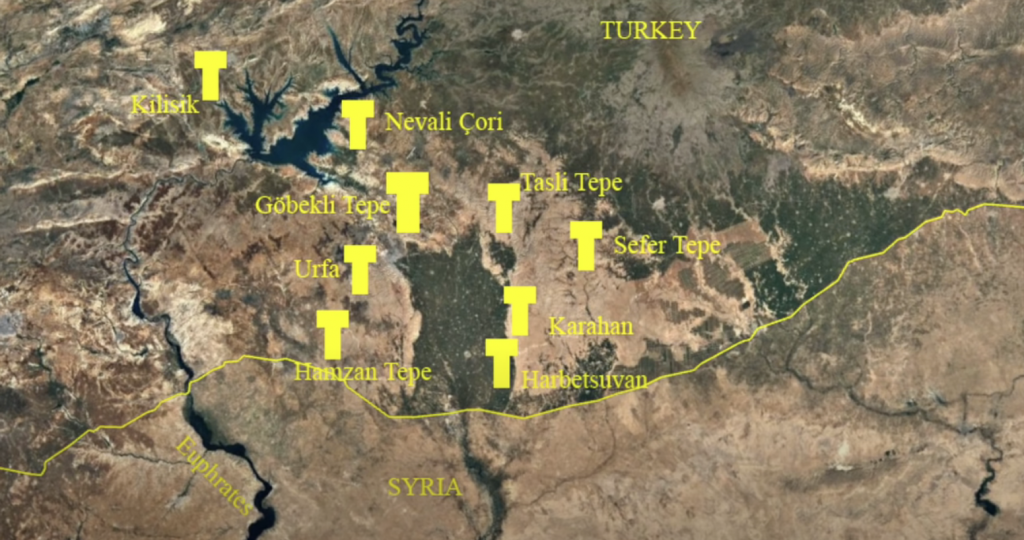
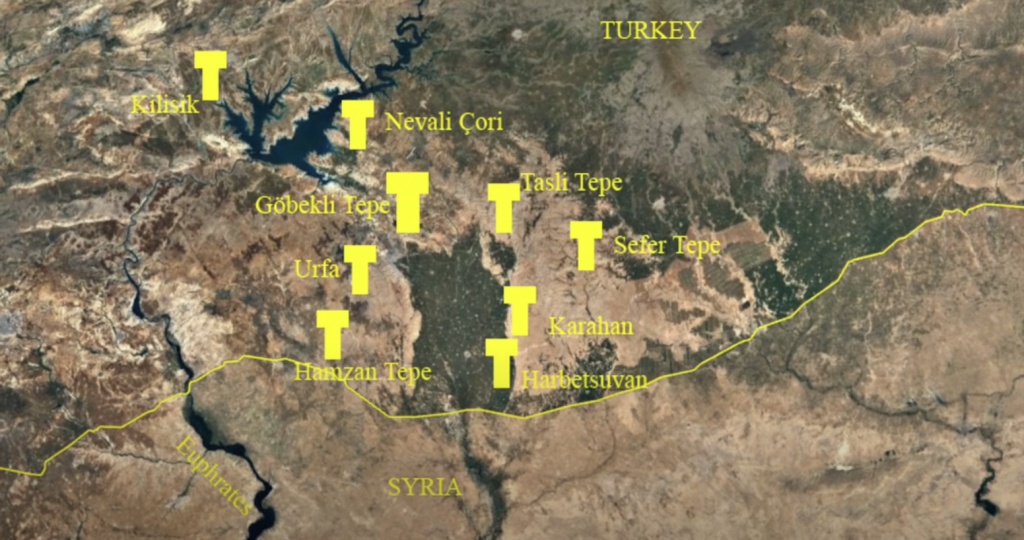
    • We see Hunter Gatherer Temple Religion in Anatolia ~10,000bc.
    • And we see the agrarian age emerge in west-anatoliaa and north mesopotamia ~9000bc.
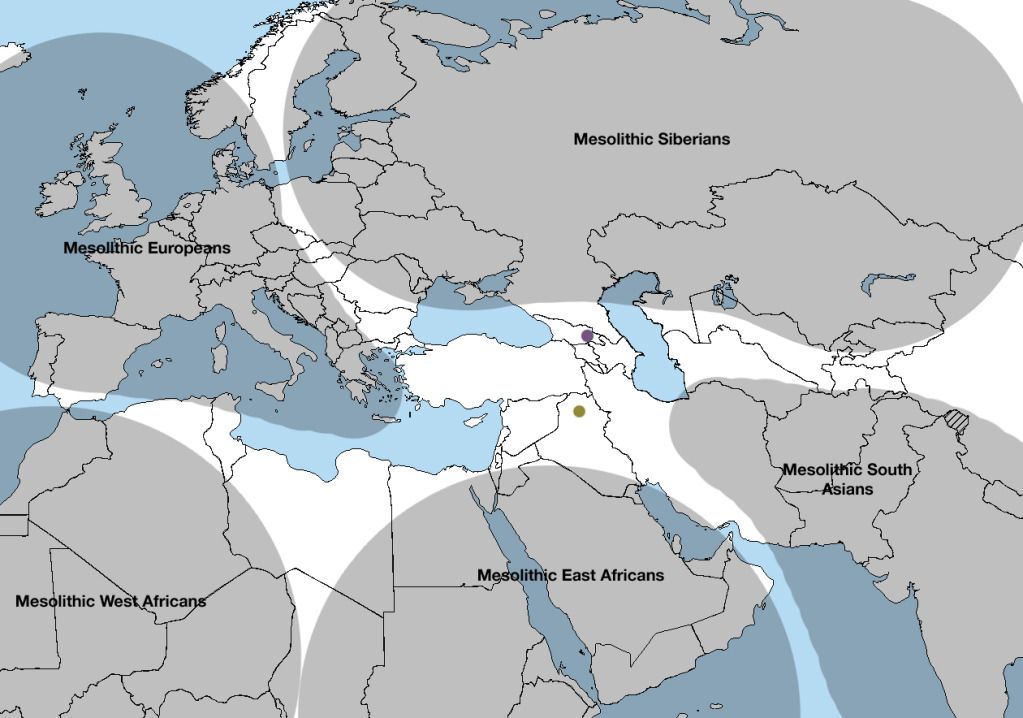
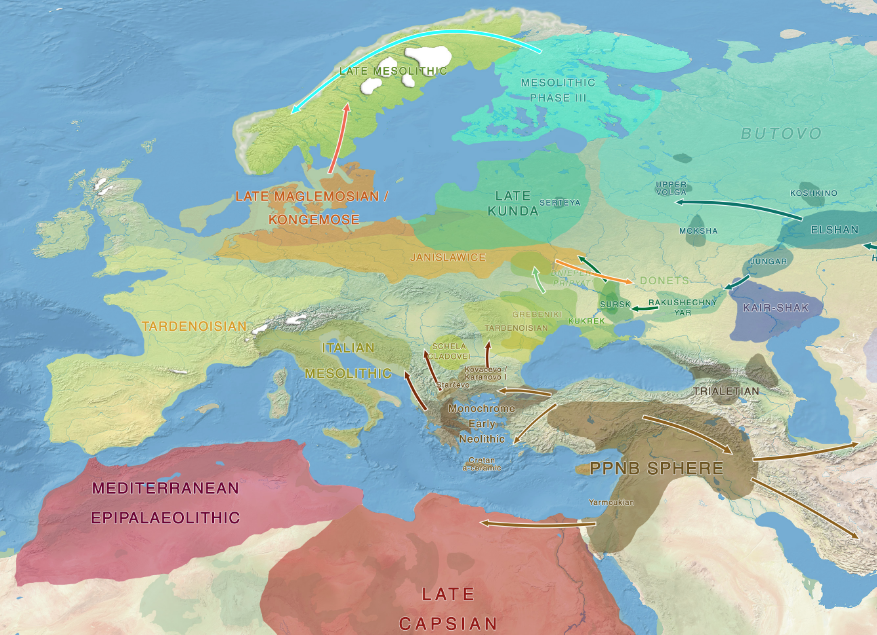
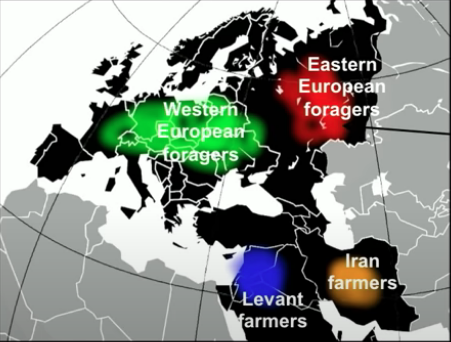
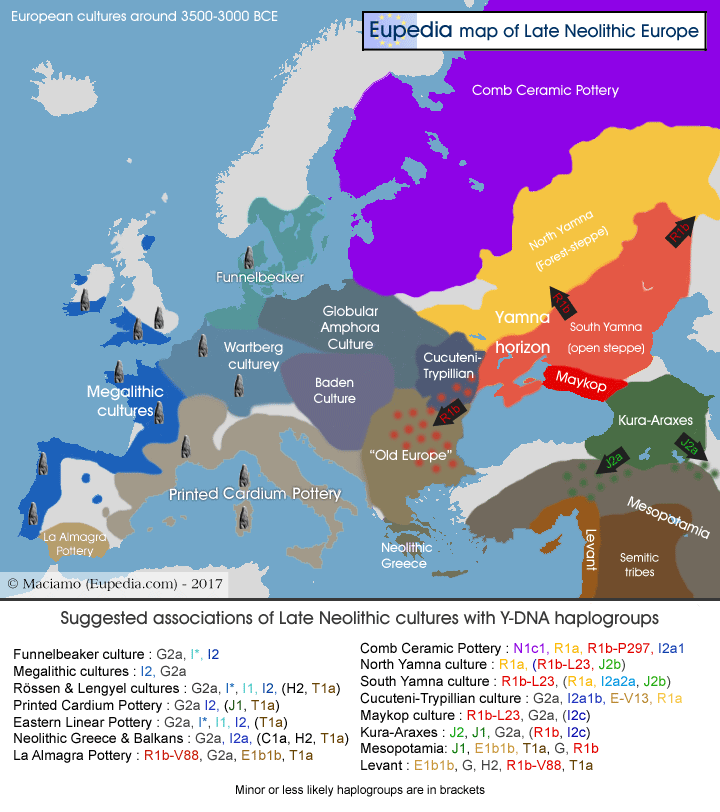
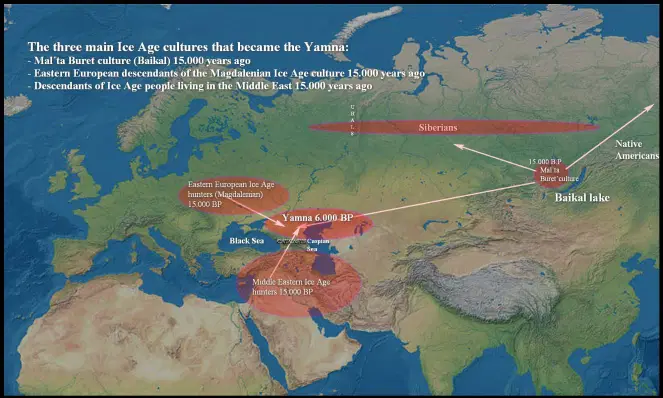
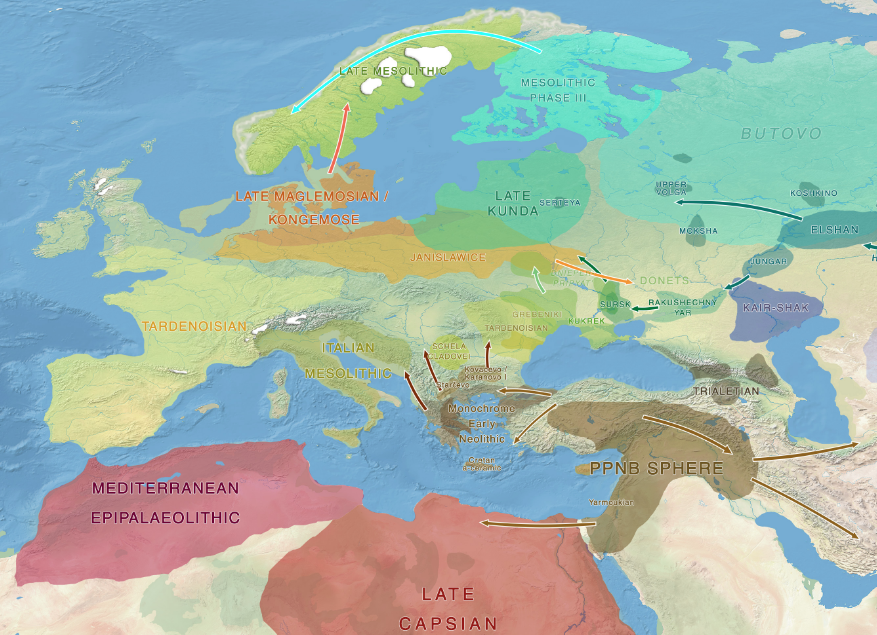
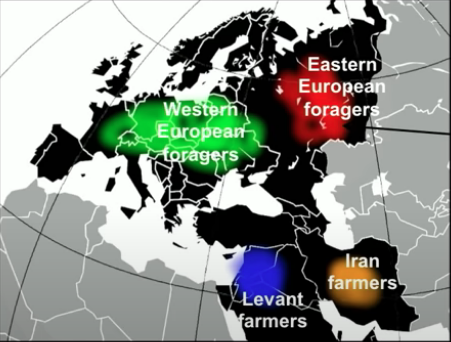
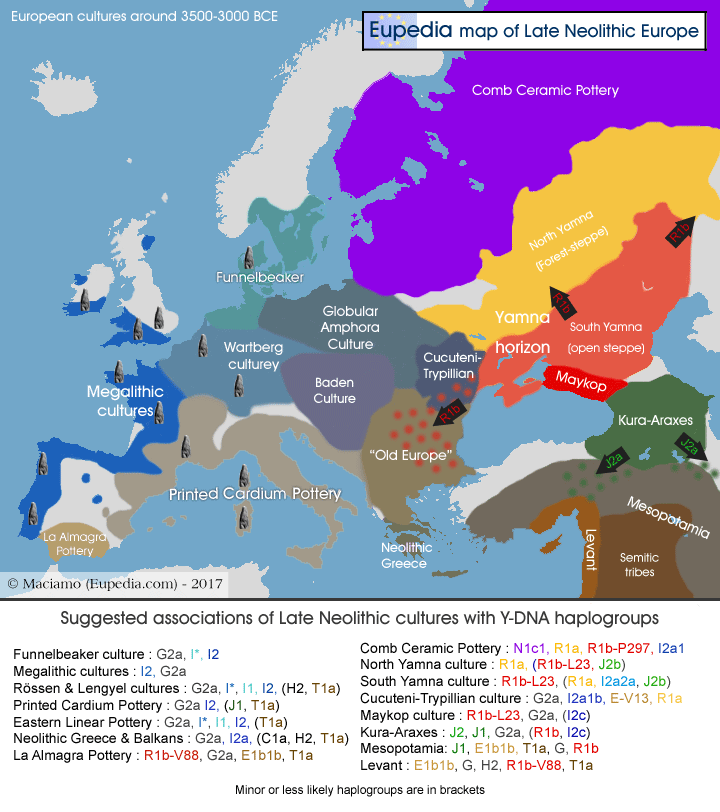
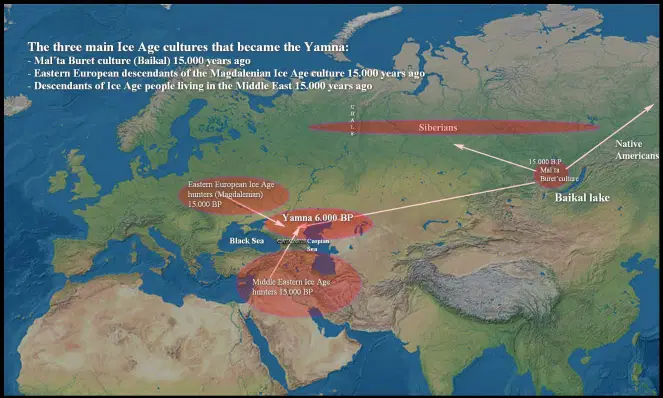
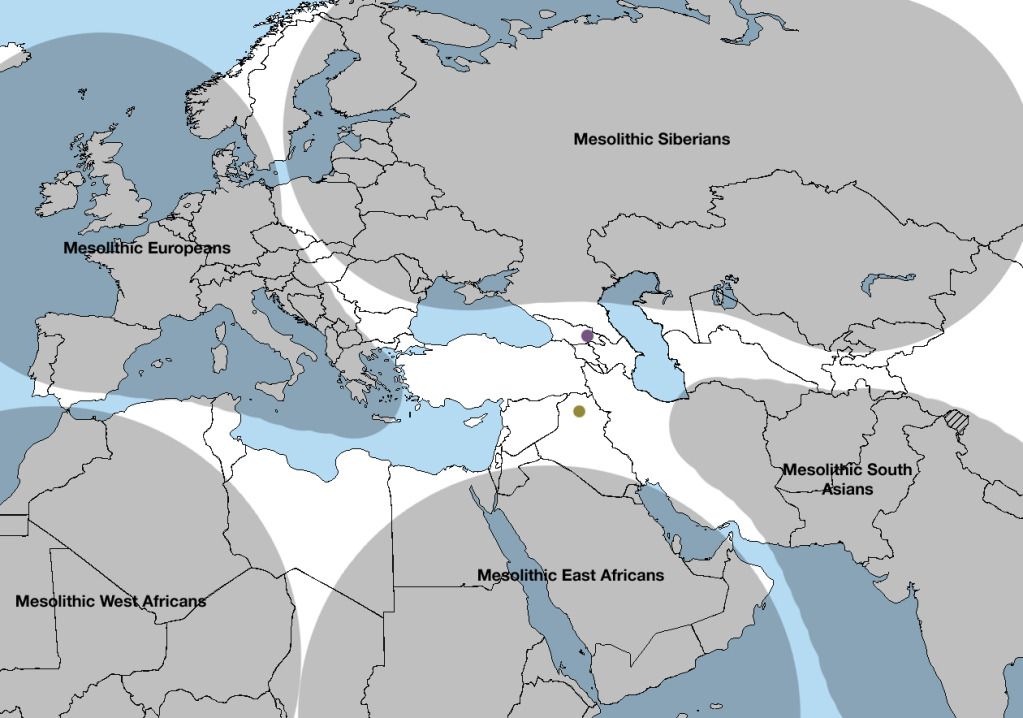
    • We see what we refer to as ‘proto-white’ people, emerge ~8000 BC out of four groups.
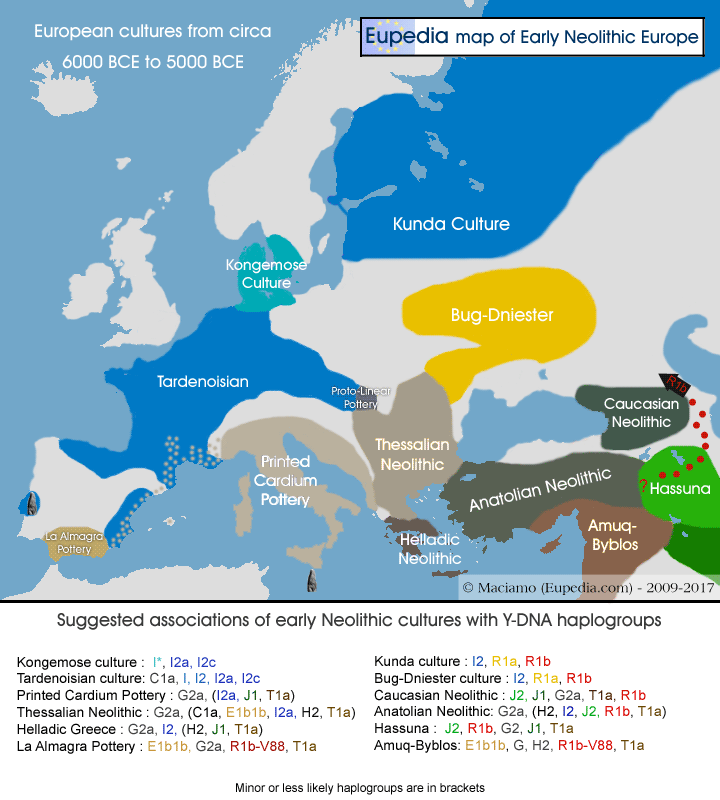
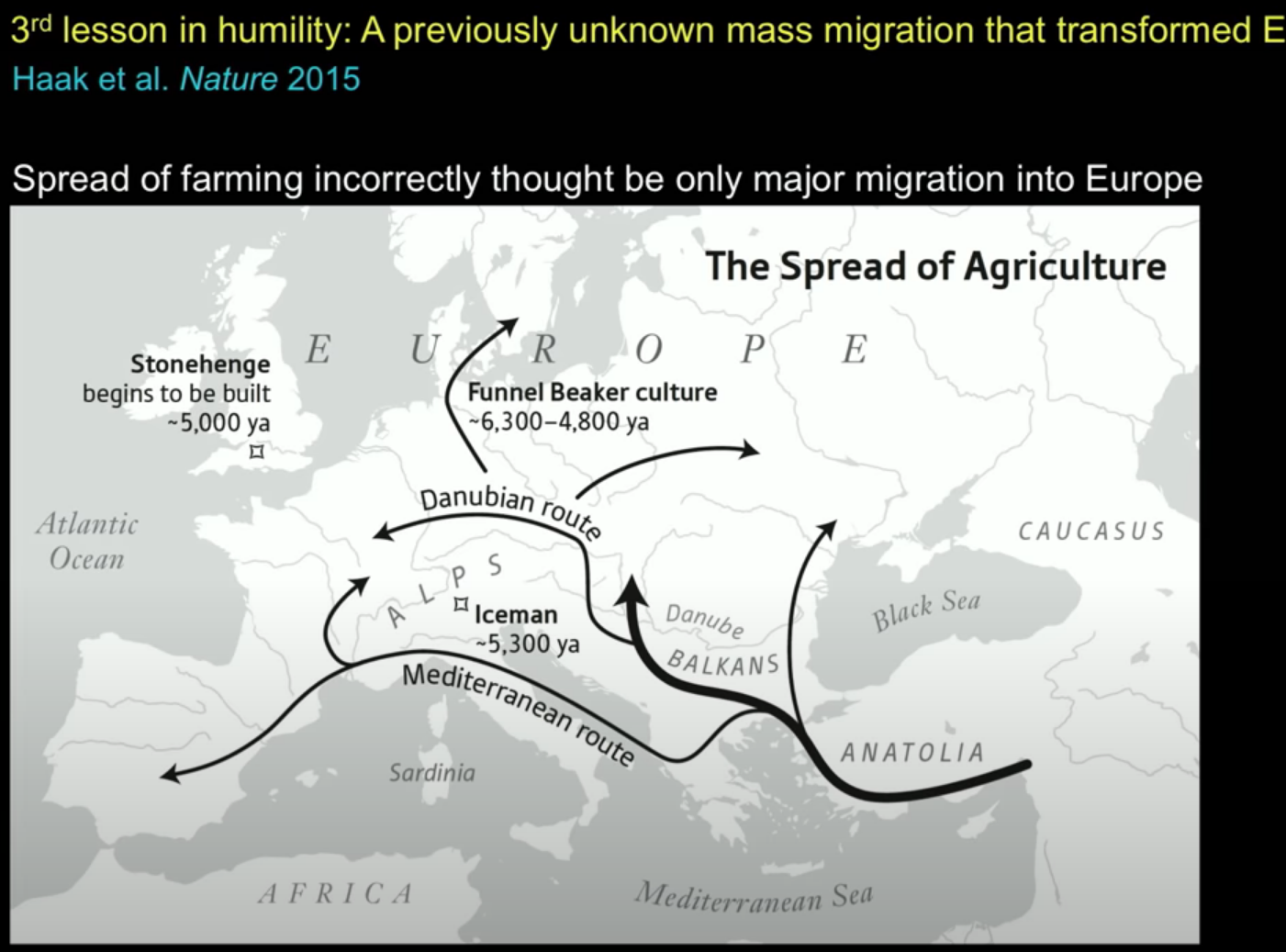
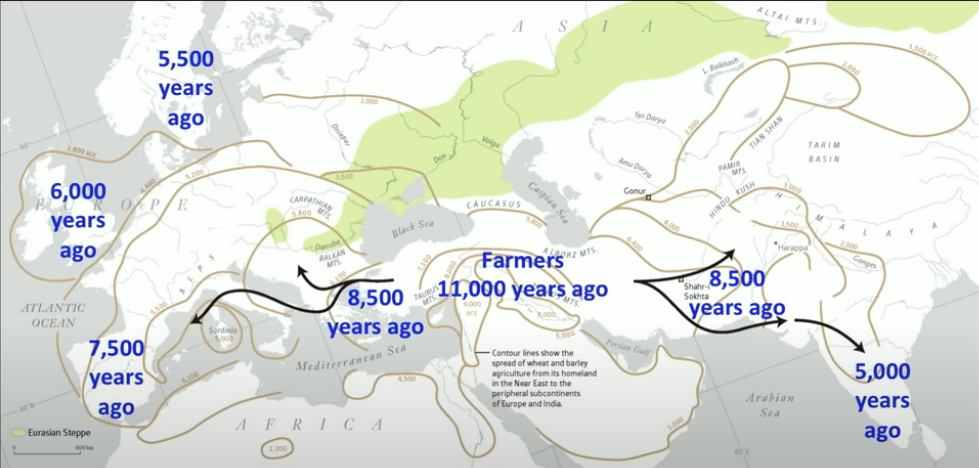
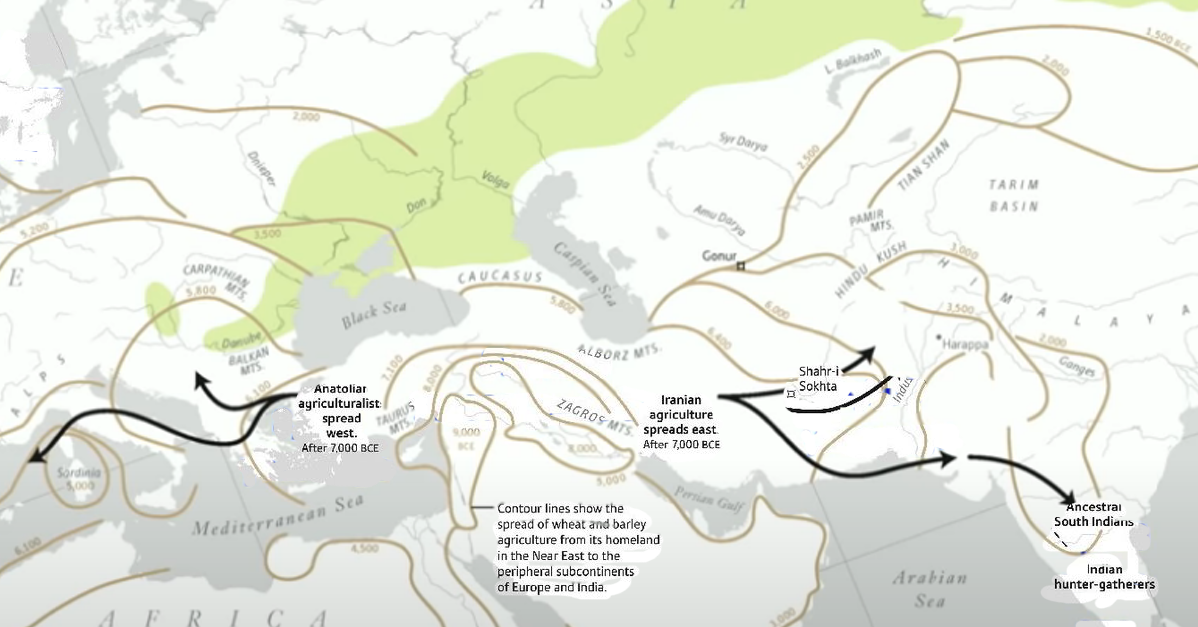
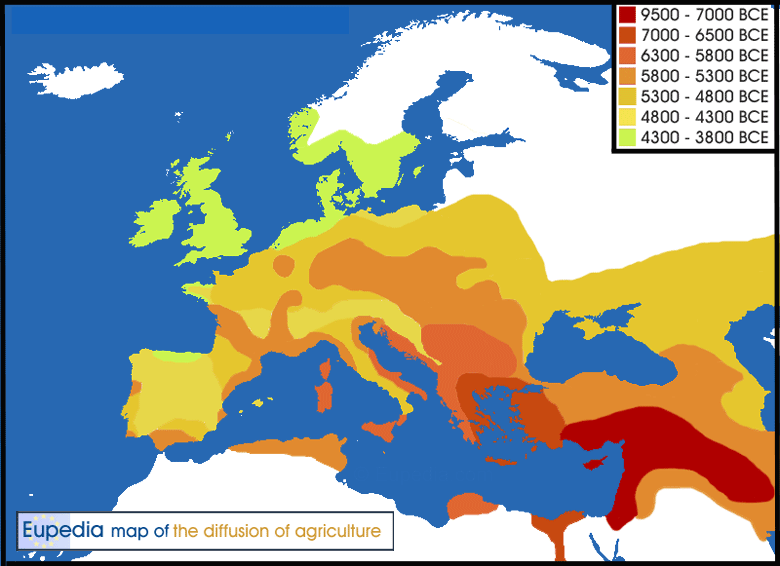
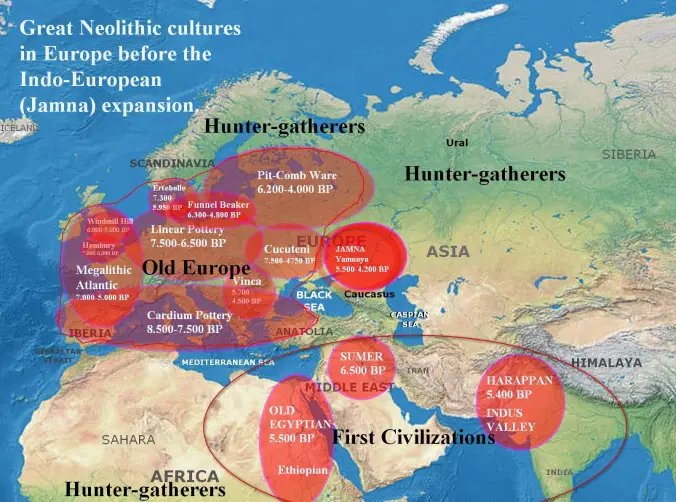
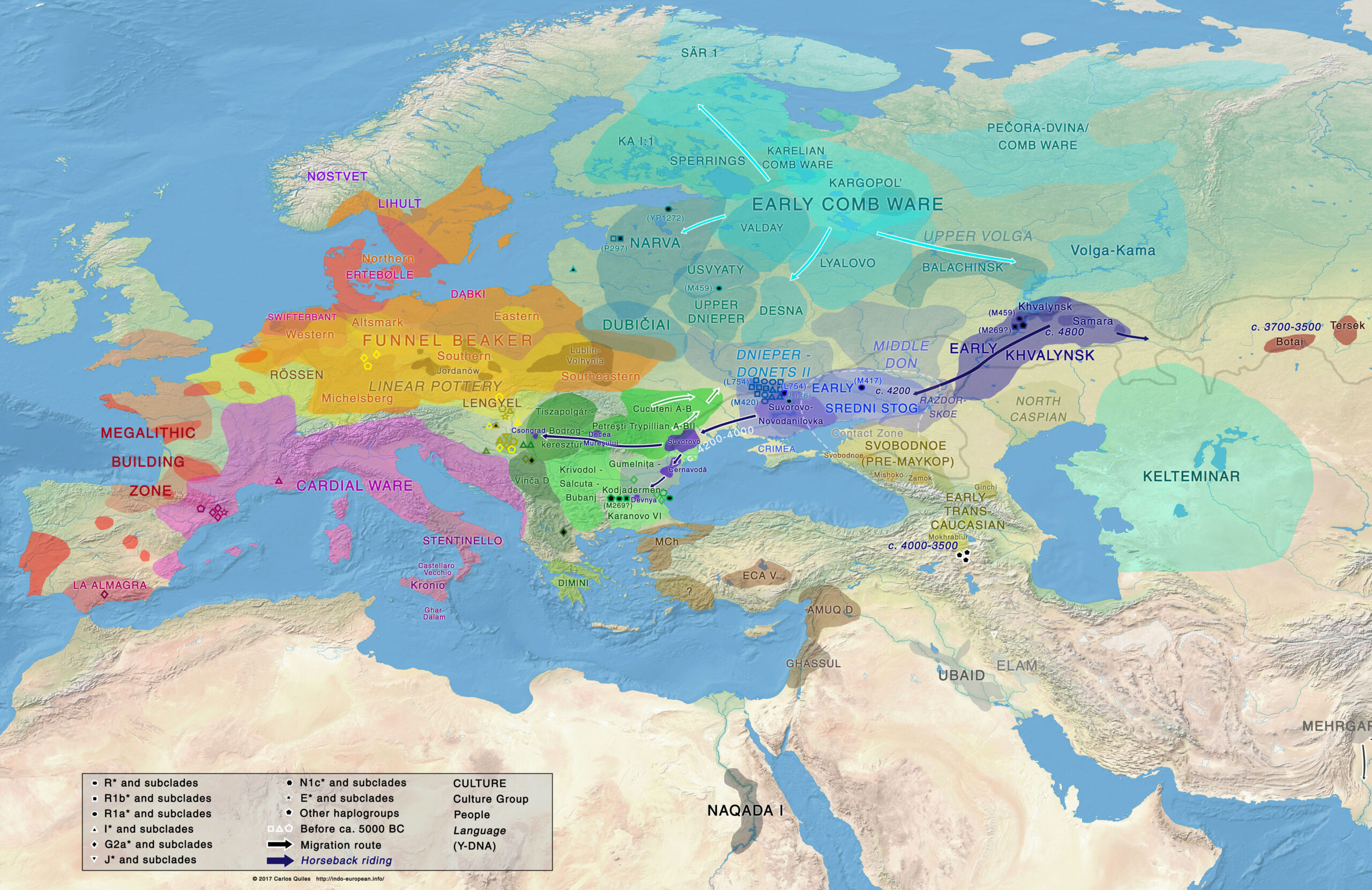
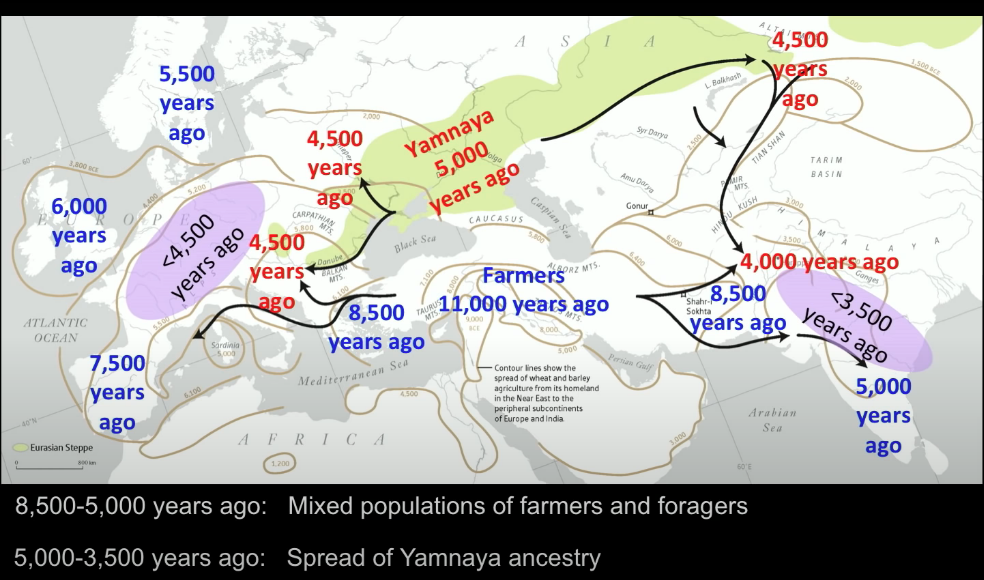
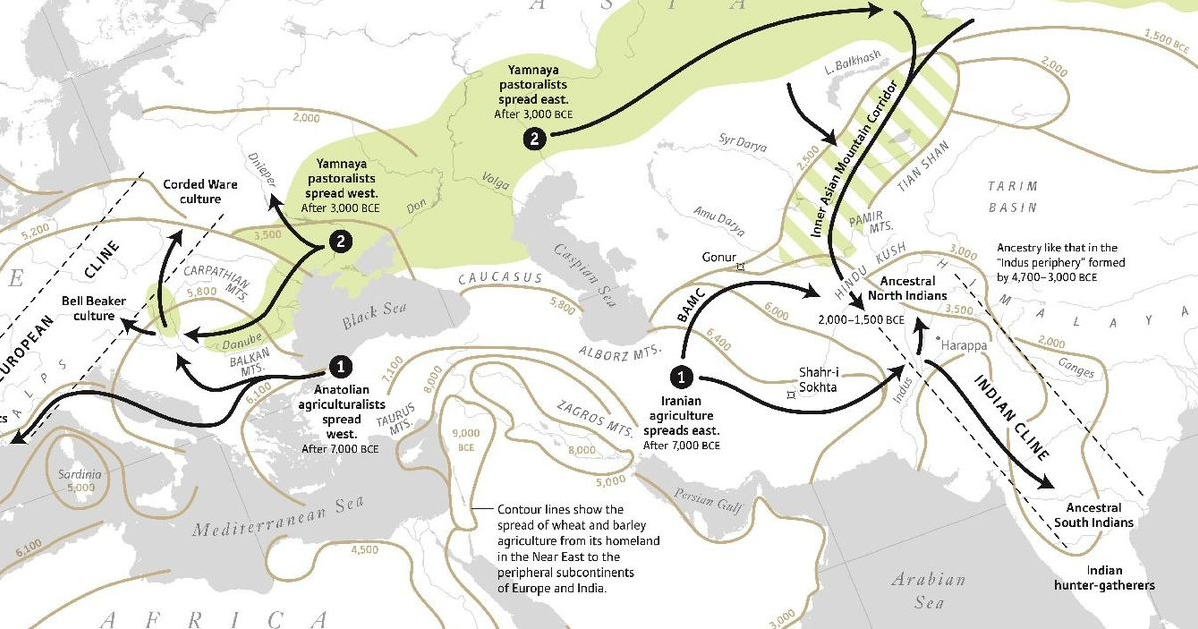
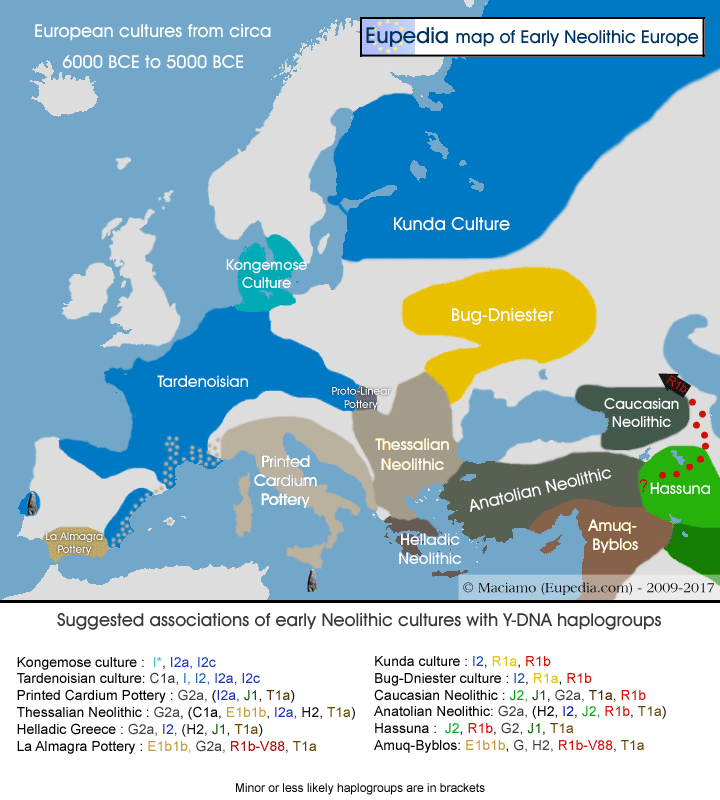
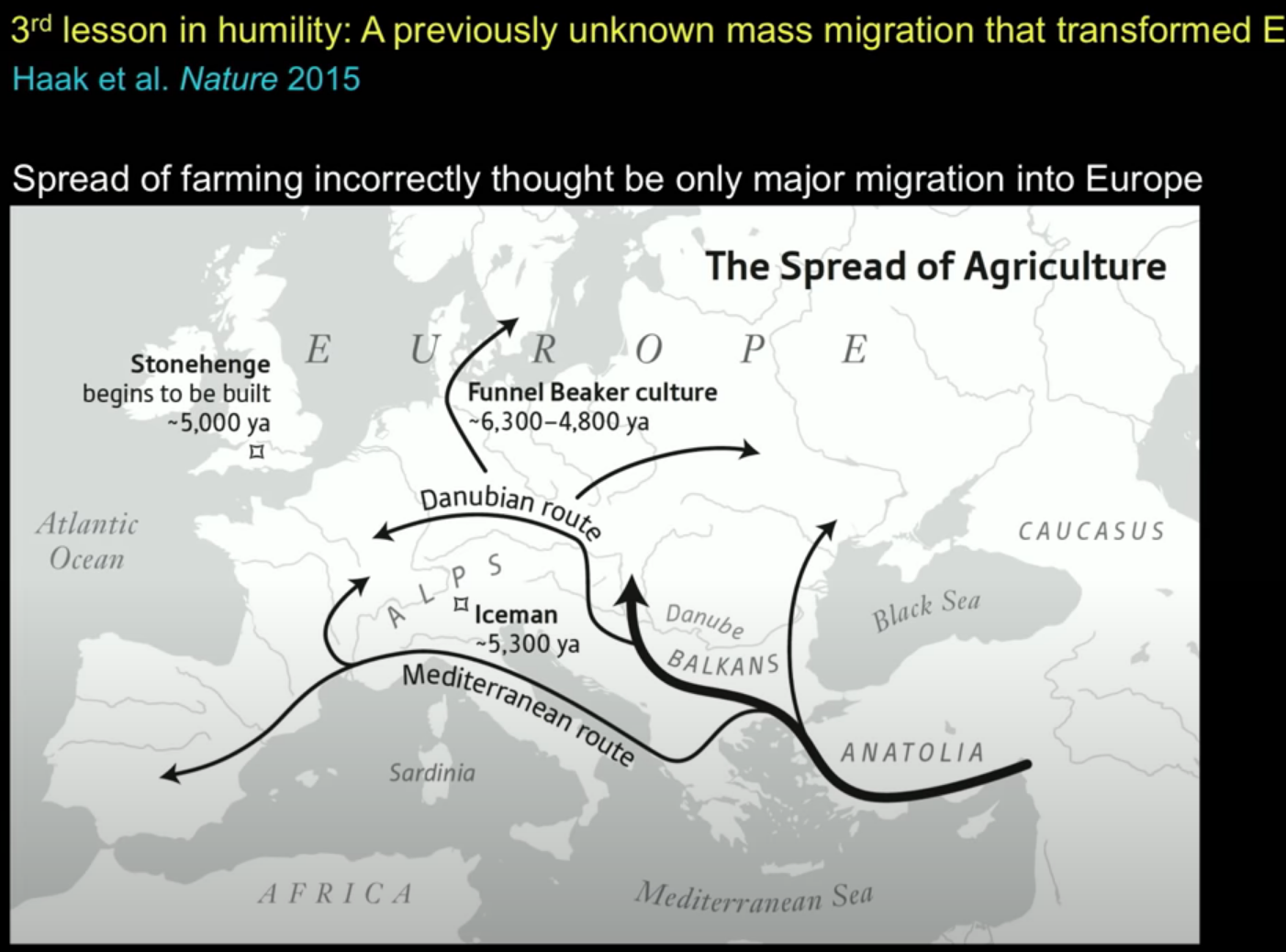
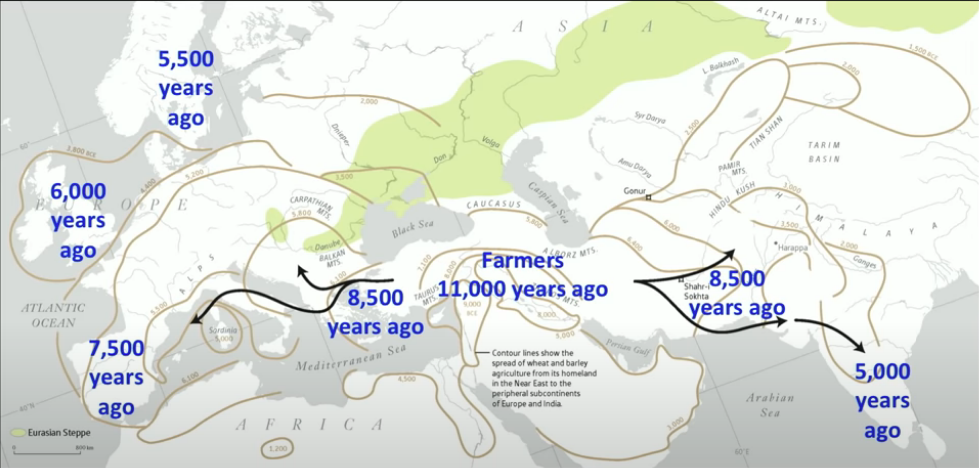
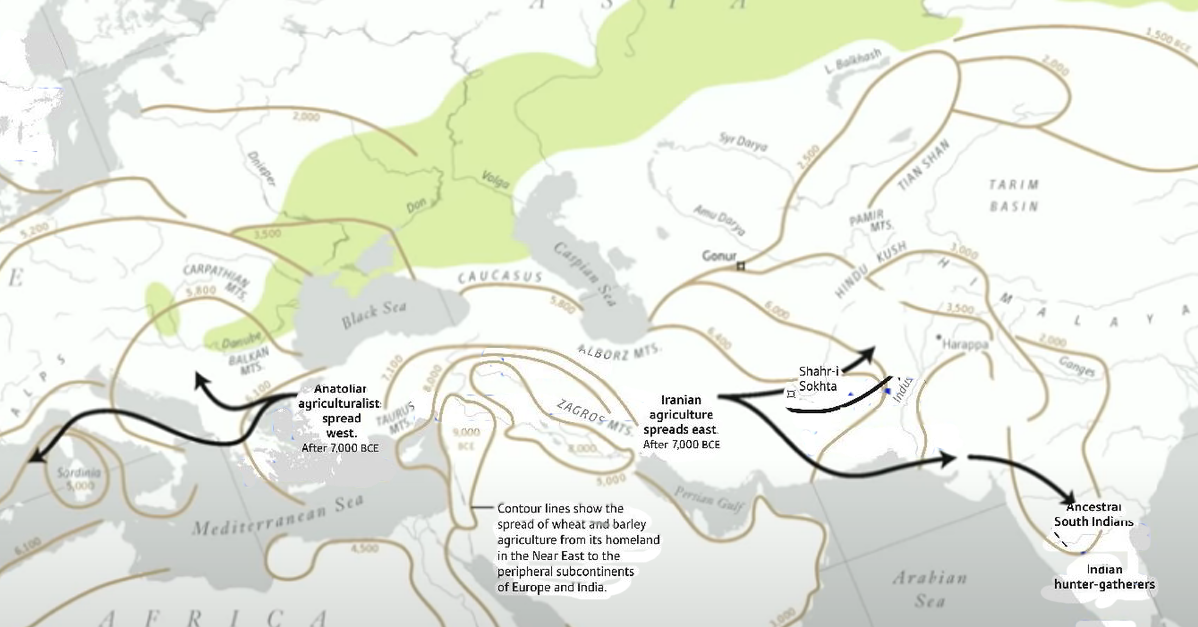
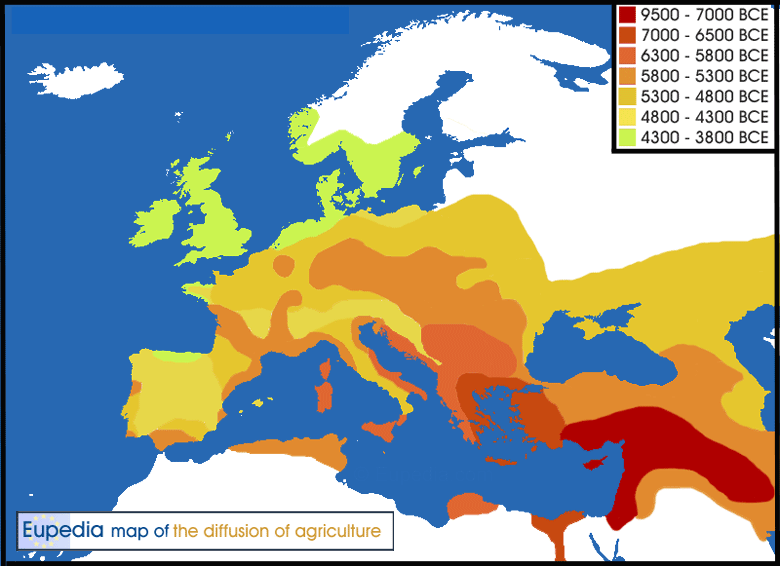
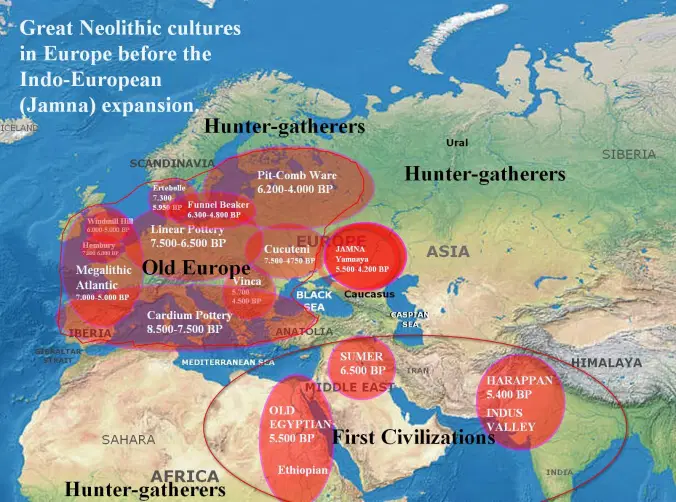
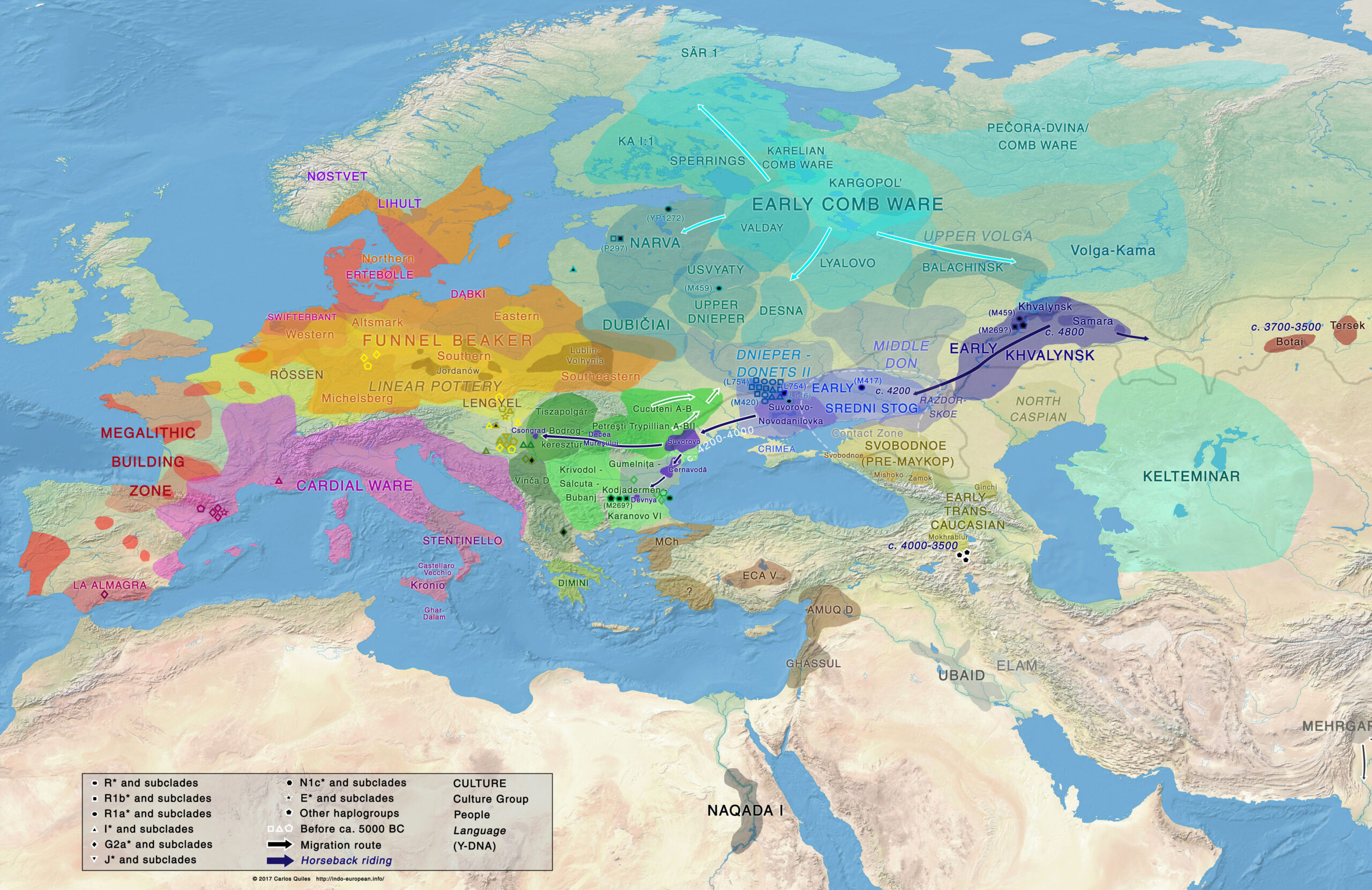
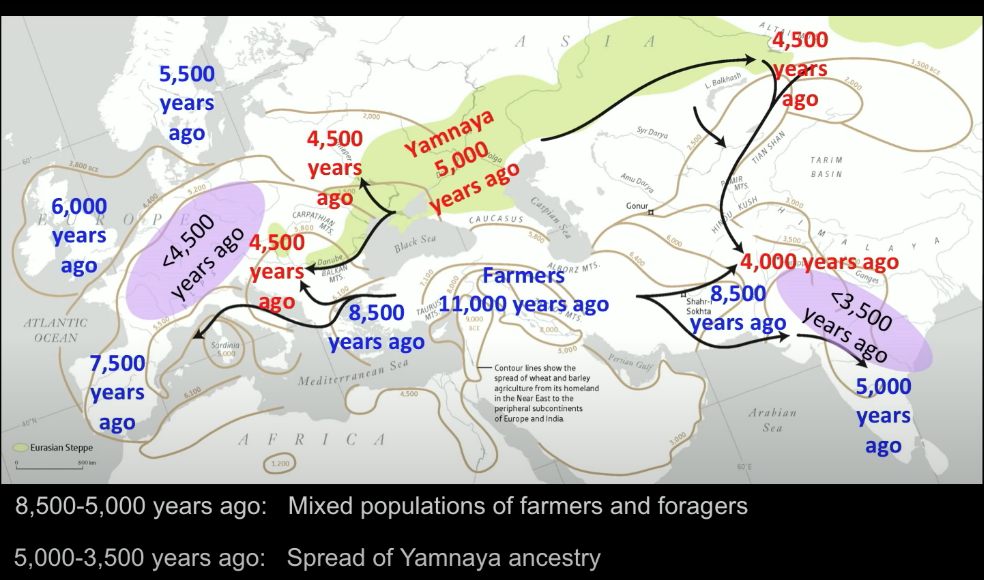
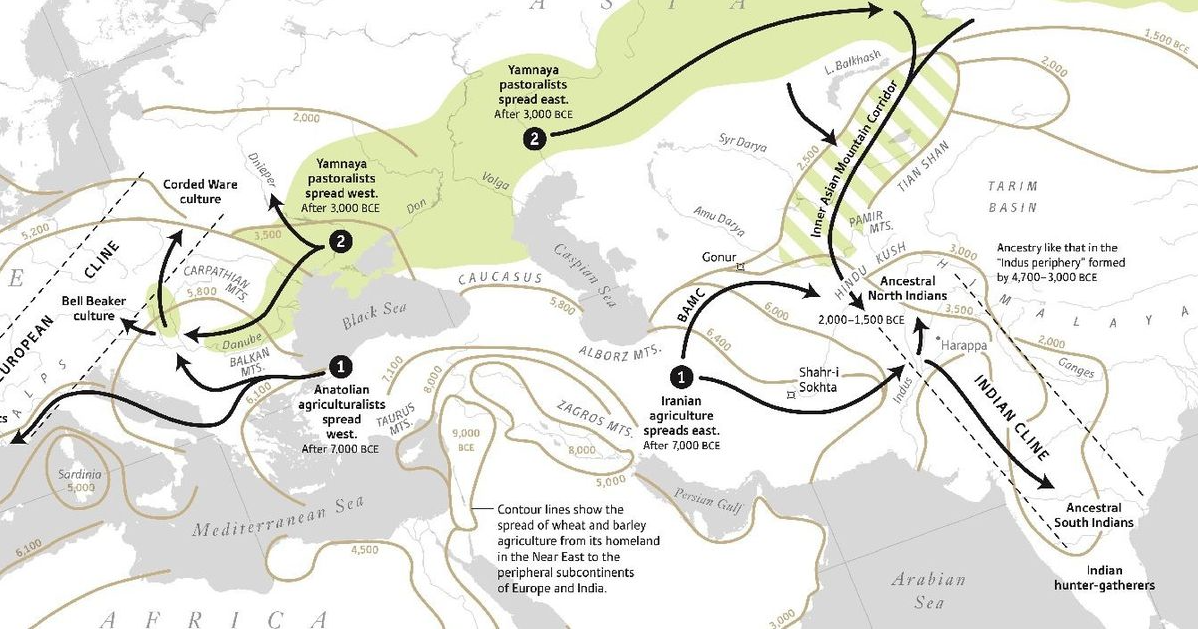
    • We see agrarian expansion west in to europe and east out of Iran ~6500 bc.
    • And we see warfare organized) in the present sense emerge ~6000 bc.
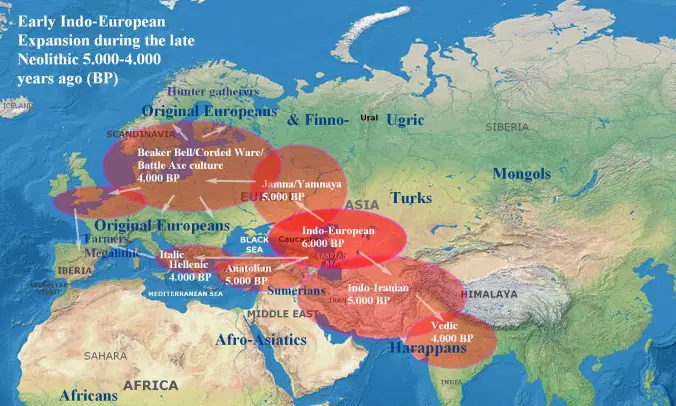
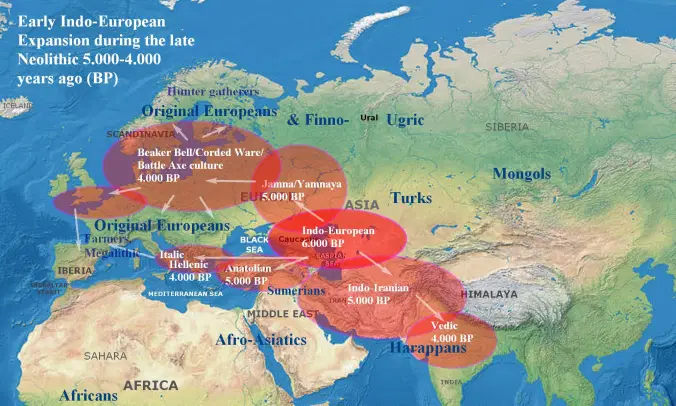
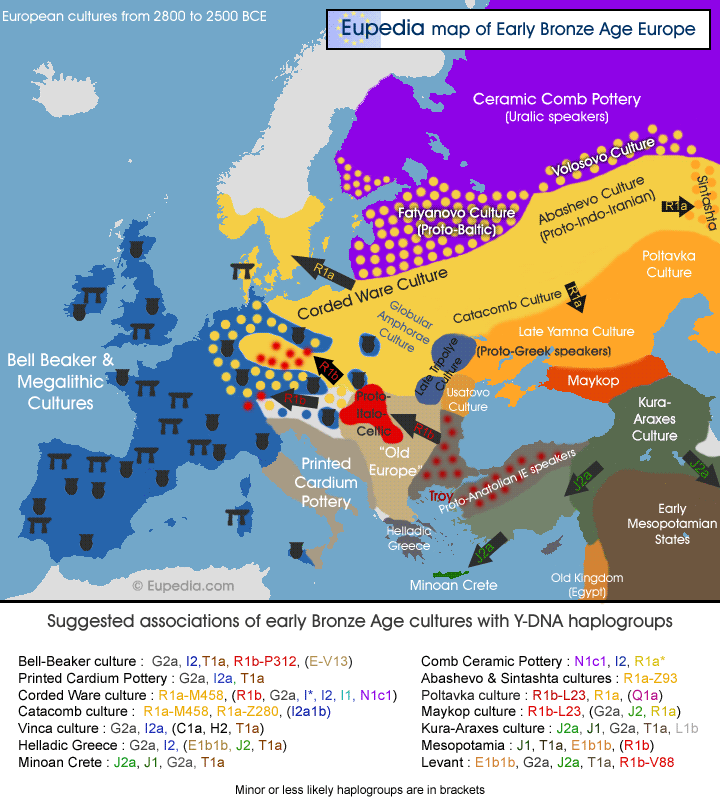
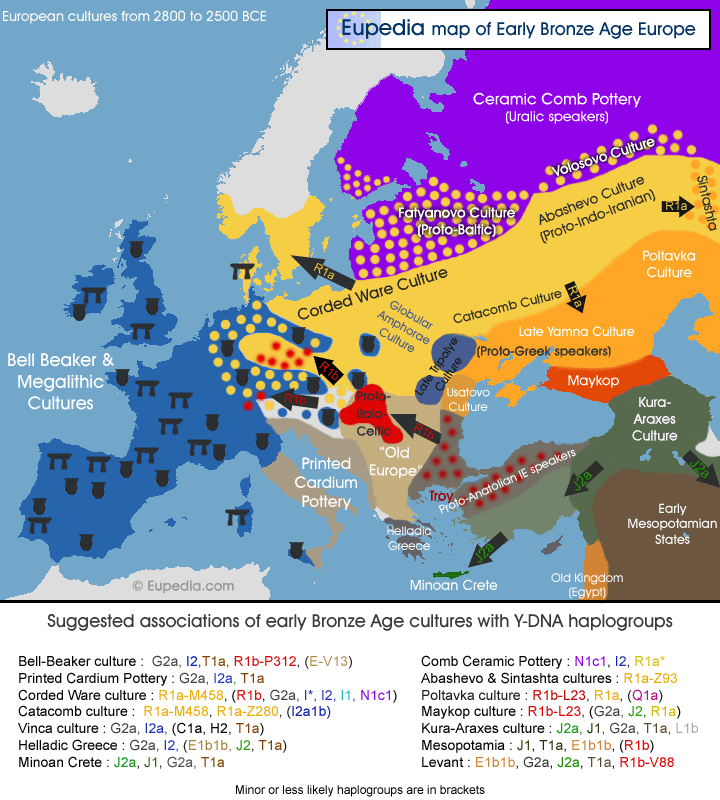
    • We see what we refer to as modern europeans emerge around ~2500 BC with the aryan invasion.
    • We see western eurasians (south, east, north, and west) reach today’s relative distribution (“Caucasians”) by ~2000 years BC, resulting in “a four fold decrease” in racial differences from the four neolithic populations.
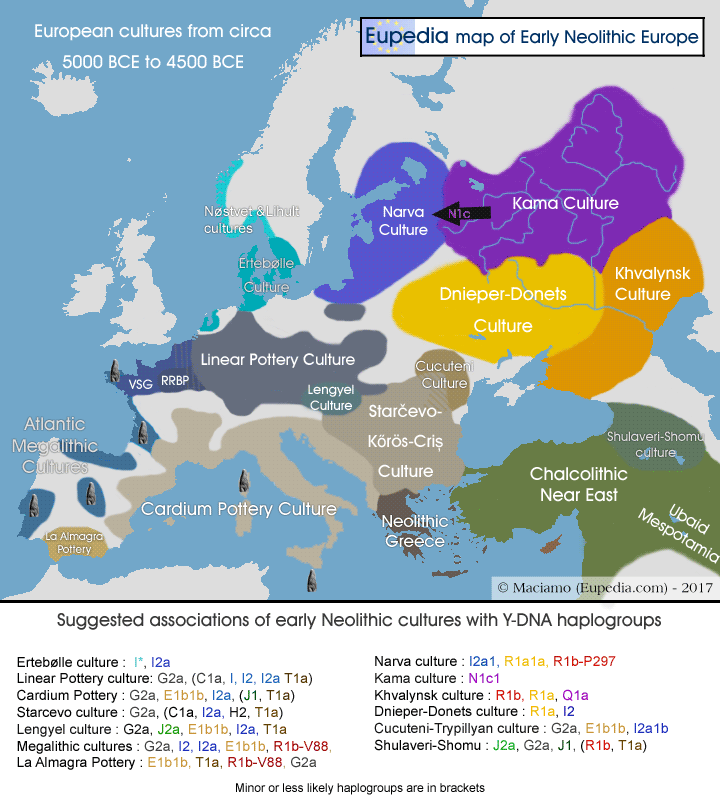
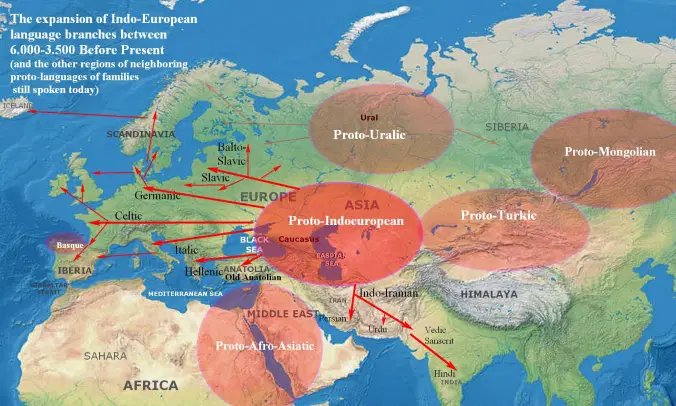
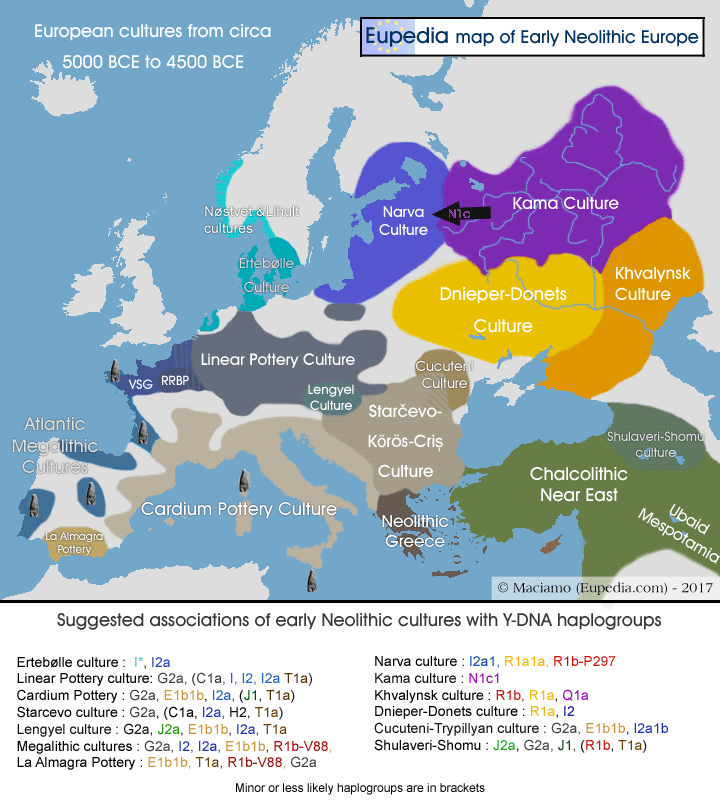
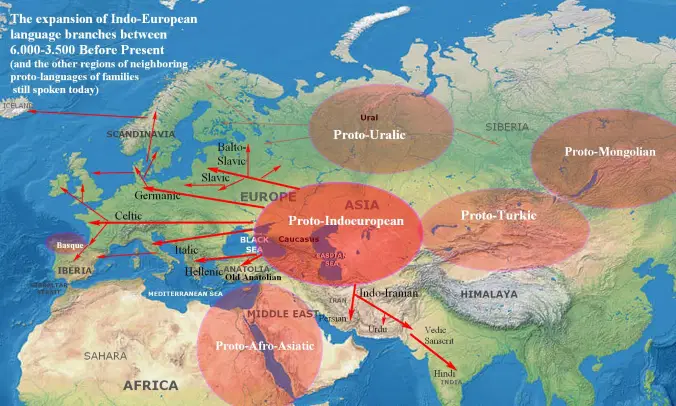
    • We see the aryan invasion results (as in north america in the 1500-1700’s) in the finnic, russian, baltic, scandinavian, germanic, italo-celtic, bands across europe, and a cline of their genetic dominance from east to west.

    Until the agrarian age, the four major races of eurasia were as divergent as todays europeans and east asians:

    • A cline of west to east european hunter gatherers almost merging with northern stepp herders.
    • A cline of northern steppe to south Anatolian-european agrarians.
    • A cline of north to south levantines (proto semites).
    • And a cline of Central Armenian to Eastern Proto Iranics.

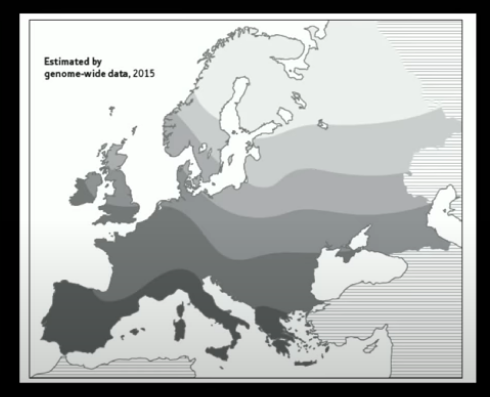
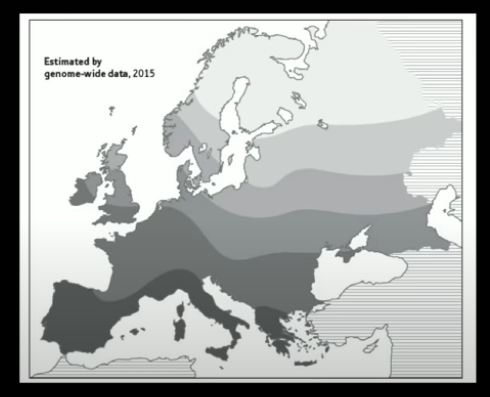
    After the agrarian age, and the migration and trade that results from it, we see admixture, with the greatest admixture in europe, less in anatolia-iran, and least in the levant. However, despite the admixture by the agrarian and indo european expansions, three of the four original groups remain, despite our relative integration, with the hunter gatherers assimilated (exterminated).

    Disambiguation of Human Generations

    The Genus Homo refers to all human species including those extinct.
    The Emergence of Archaic Human Varieties ….
    The Emergence of Homo Erectus (2M years ago to 100,000 years ago)
    The Emergence of Antecessor to Early Modern Humans (500,000 years ago)
    The Emergence of Early Modern Humans (300,000 years ago)
    The Emergence of Homo Sapiens “Corporis” (anatomically modern humans) 130,000 years ago.
    The Emergence of Homo Sapiens Northern Dispersal (130,000 – 100,000 years ago)
    The Emergence of Homo Sapiens “??????”, Southern (coastal) Dispersal (70,000-50,000 years ago)
    The Emergence of Homo Sapiens Africa, Homo Sapiens Eurasia, Homo Sapiens Asia this dispersal.
    The Emergence of Homo Sapiens “Socialis” (behaviorally modern humans) 50,000 years ago,
    The Emergence of Homo Sapiens “Agricola” (Agricultural Humans)
    The Emergence of Homo Sapiens “Empirica” (Greece)
    The Emergence of Homo Sapiens “Scientifica” (Europe)


    The Primary Cause of Adaptation: Climate

    ( … )

    Today’s populations are the result of two rapid expansions that demonstrate technology is more influential than natural selection: the agrarian expansions in Eurasia and China, followed by the IE expansion in Eurasia.
    These two expansions homogenized by hybridization (racialized) what had been a far higher number of racially distinct human groups.

    The history of the evolution of mankind is the incremental acceleration of adaptability due to periodic stresses. While we don’t study it, climactic stresses in Africa alone during the past five million years were challenging.
    So it is better to describe individual and group intelligence as the rate of individual and group adaptability, and group strategy, metaphysics(paradigm), mythology, tradition, and method of argument as regulating our adaptability to our group ability.

    Unfortunately, group strategy can enhance of limit group adaptability, and can advance it (european) or regress it (Islam).
    By using the model (paradigm) of adaptability to relate human biological, social, cognitive, and linguistic processes, we create commensurability across domains and produce a universal understanding of human behavior – thus assisting us in demonstrating that the entire human spectrum of tools (biological, social, cognitive, linguistic AND informational) is not only ‘relative’ but absolutely non-neutral.


    Degree of and Rate of Adaptation

    Human Biological Speciation

    (Speciation can occur in just a few generations, but speciation sufficient to prevent reproduction takes millions of years, and there are many examples where speciation doesn’t prevent reproduction such as jackals and wolves. )

    generalists that can later specialize

    Rapidity of migration, adaptability to environments,  and hybridization defeat speciation.

    Universal reproductive preferences:  Neoteny.  Symmetry health, Proportionality, health White Skin Youth, Light Hair youth, Blue Eyes youth, Height esp long legs, but in competition for preference for petite women youth)

    The ability to digest milk sugar, the ability to digest grains.

    Diet, immunity and pigmentation

    Human Strategic Speciation

    Human Cognitive Speciation


    Why Humans Don’t Speciate

    Sexual Adaptivity

    Sexual Koinophilia
    If sexual creatures avoid mates with strange or unusual characteristics, in the process called koinophilia, then mutations that affect the external appearance of their carriers will seldom be passed on to the next and subsequent generations. They will therefore seldom be tested by natural selection. Evolution is, therefore, effectively halted or slowed down considerably. The only mutations that can accumulate in a population are ones that have no noticeable effect on the outward appearance and functionality of their bearers (i.e., they are “silent” or “neutral mutations”, which can be, and are, used to trace the relatedness and age of populations and species.[9][13])

    This implies that evolution can only occur when mutant mates cannot be avoided, as a result of a severe scarcity of potential mates. This is most likely to occur in small, isolated communities. These occur most commonly on small islands, in remote valleys, lakes, river systems, or caves,[14] or during the aftermath of a mass extinction.[13] Under these circumstances, not only is the choice of mates severely restricted but population bottlenecks, founder effects, genetic drift and inbreeding cause rapid, random changes in the isolated population’s genetic composition.[14] Furthermore, hybridization with a related species trapped in the same isolate might introduce additional genetic changes. If an isolated population such as this survives its genetic upheavals, and subsequently expands into an unoccupied niche, or into a niche in which it has an advantage over its competitors, a new species, or subspecies, will have come in being. In geological terms this will be an abrupt event. A resumption of avoiding mutant mates will, thereafter, result, once again, in evolutionary stagnation.


    Human Civilizations Reflect Our Genetic Origins????

    Means of Adaptation

    • Physical: Morphological (Major) and Phenotypical (minor),
    • Biological: Organs, cells, chemistry
    • Social:
    • Institutional (esp trust)
    • Cognitive:
    • Technological:
    • “Truthful” Knowledge


    Explanation: Domestication


    Self Domestication

    what led to the evolution of advanced intelligence in Homo sapiens was a drastic reduction of the aggressive drive. This change separated us from other species of monkeys and primates, where this aggression is still in plain sight, and eventually lead to the development of quintessential human traits such as empathy, social cognition and culture.[23][24] This theory has received strong support from studies of animal domestication where selective breeding for tameness has, in only a few generations, led to the emergence of impressive “humanlike” abilities. Tamed foxes, for example, exhibit advanced forms of social communication (following pointing gestures), pedomorphic physical features (childlike faces, floppy ears) and even rudimentary forms of theory of mind (eye contact seeking, gaze following).[25][26] Evidence also comes from the field of ethology (which is the study of animal behavior, focused on observing species in their natural habitat rather than in controlled laboratory settings) where it has been found that animals with a gentle and relaxed manner of interacting with each other – like for example stumptailed macaques, orangutans and bonobos – have more advanced socio-cognitive abilities than those found among the more aggressive chimpanzees and baboons.[27] It is hypothesized that these abilities derive from a selection against aggression.[24][28][29][30]

    On a mechanistic level these changes are believed to be the result of a systemic downregulation of the sympathetic nervous system (the fight-or-flight reflex). Hence, tamed foxes show a reduced adrenal gland size and have an up to fivefold reduction in both basal and stress-induced blood cortisol levels.[31][32] Similarly, domesticated rats and guinea pigs have both reduced adrenal gland size and reduced blood corticosterone levels.[33][34] It seems as though the neoteny of domesticated animals significantly prolongs the immaturity of their hypothalamic-pituitary-adrenal system (which is otherwise only immature for a short period when they are pups/kittens) and this opens up a larger “socialization window” during which they can learn to interact with their caretakers in a more relaxed way.

    This downregulation of sympathetic nervous system reactivity is also believed to be accompanied by a compensatory increase in a number of opposing organs and systems. Although these are not as well specified various candidates for such “organs” have been proposed: the parasympathetic system as a whole, the septal area over the amygdala,[23] the oxytocin system,[35] the endogenous opioids[36] and various forms of quiescent immobilization which antagonize the fight-or-flight reflex.


    We have cannot yet identify genes determining intelligence, and those we find (thousands) appear to have tiny effect.
    That differences in cognitive adaptability or the distribution of it (memory vs adaptability vs prediction-innovation vs agency) appear to leave little or no evidence in the fossil record other than minor variation in the volume of the braincase.
    We have definite archeological evidence in the record of the evolution of tools and processes.
    We have definite biological evidence in the record of differences in gestation rate, maturity rate, depth of maturity, and self-regulation (neoteny) – which is the direction of investigation that would help us understand intelligence.
    We have definite biological evidence in isolated populations that the earliest people out of africa have the lowest cognitive rate of adaptation, and those people in highest stress environments (colder) the highest.
    And we have a definite recent record in the size of class distributions across human groups.
    And agrarianism obscured this evolution and it and possibly reversed it – which is my suspicion. And that only those groups that converted to manorialism (Rome, Germanic Europe, China) continued it. Agrarianism homogenized populations significantly, and limited evolution, in exchange for providing calories that allowed us a division of labor, specialization, and the application of our adaptation to the production of ‘tools, processes, and ideas’.

    What it would imply is that the great filter is rather obvious: that any species that develops a division of labor and the returns on it that allow continuous adaptation into niches (division of labor) – and especially any group that develops democracy rather than ‘paternalism’, and does not continue natural selection, will devolve. We can see genetic devolution in the west in just 150 years. We can see genetic devolution in islam and everything it touces. Islam(judaism christianity) is the most desirable falsehood other than drugs.


    Explanation: The Direction of Evolution: Rate of Adaptability Purchased by Neoteny

    add: result of directional selection taking place over the past 15,000 years

    Selection: Neoteny (also called juvenilization), refers to the delaying or slowing of the physiological development of an organism. Progenesis (also called paedogenesis) refers to the acceleration of sexual development. Together both neoteny and progenesis result in paedomorphism (or paedomorphosis): the retention in adults of traits previously seen only in the young.

    Neoteny in humans refers to the slowing or delaying of body development, compared to other primates, resulting in features such as a large head, a flat face, and relatively short arms, as well as longer cognitive and self regulatory development. Conversely, neotenic development is complex and allows fine regulation because humans also have relatively large noses and long legs, both peramorphic (not neotenic) traits.

    The evolutionary story of human evolution is predominantly retaining to adulthood the originally juvenile features of our ancestors by greater prolongation of childhood and retardation of maturity.

    These neotenic changes have been brought about by sexual selection in human evolution

    Rate of gestation, rate of maturity, rate of longevity, personality (uninhibited or rather agency, depth of voice, same for social adjustment (flexibiity), sociability (low asian, high black), Orientals most reproductively restrained, blacks the least. Social organizatio. Crime. Intelligence. Lowest black (-15), middle white, higher asian (+5). Cranial Capacity and Weight. Hispanics are between blacks and whites. Brain decline later in asians later.

    (j) my suspicion is that steppe and tundra life is extremely difficult physically, socially, and psychologically, limiting populations, but it has a very low disease gradient, and it’s relatively easy to obtain food, so it’s a very good cauldron to cook evolution. Africa and the Levant (dry, high disease gradient), north Eurasia (cold steppe, tundra, forest), european (mild weather forests and rivers), SE Asia (hot monsoon weather forests), and the south pacific (islands) are very different environments.

    Selection: Sexual Selection. These neotenic changes have been brought about by sexual selection in human evolution.

    The evolutionary story of human evolution is predominantly retaining to adulthood the originally juvenile features of our ancestors by greater prolongation of childhood and retardation of maturity.

    Differences in ability are neotenic and neurological. They may be nothing more than neoteny facilitating differential neurological growth.

    This model, which invokes sexual selection, is proposed by Geoffrey Miller who argues that human intelligence is unnecessarily sophisticated for the needs of hunter-gatherers to survive. He argues that the manifestations of intelligence such as language, music and art did not evolve because of their utilitarian value to the survival of ancient hominids. Rather, intelligence may have been a fitness indicator. Hominids would have been chosen for greater intelligence as an indicator of healthy genes and a Fisherian runaway positive feedback loop of sexual selection would have led to the evolution of human intelligence in a relatively short period.[43]

    In many species, only males have impressive secondary sexual characteristics such as ornaments and show-off behavior, but sexual selection is also thought to be able to act on females as well in at least partially monogamous species.[44] With complete monogamy, there is assortative mating for sexually selected traits. This means that less attractive individuals will find other less attractive individuals to mate with. If attractive traits are good fitness indicators, this means that sexual selection increases the genetic load of the offspring of unattractive individuals. Without sexual selection, an unattractive individual might find a superior mate with few deleterious mutations, and have healthy children that are likely to survive. With sexual selection, an unattractive individual is more likely to have access only to an inferior mate who is likely to pass on many deleterious mutations to their joint offspring, who are then less likely to survive.[43]

    Sexual selection is often thought to be a likely explanation for other female-specific human traits, for example breasts and buttocks far larger in proportion to total body size than those found in related species of ape.[43] It is often assumed that if breasts and buttocks of such large size were necessary for functions such as suckling infants, they would be found in other species. That human female breasts (typical mammalian breast tissue is small)[45] are found sexually attractive by many men is in agreement with sexual selection acting on human females secondary sexual characteristics.

    Sexual selection for intelligence and judging ability can act on indicators of success, such as highly visible displays of wealth. Growing human brains require more nutrition than brains of related species of ape. It is possible that for females to successfully judge male intelligence, they must be intelligent themselves. This could explain why despite the absence of clear differences in intelligence between males and females on average, there are clear differences between male and female propensities to display their intelligence in ostentatious forms.[43]

    This absence of difference is now known to exist at the middle of distributions. Average intelligence doesn’t differ much between genders, but because female selection is restricted more towards males at the top end of male-male hierarchies or those increasingly above average in physical attractiveness, male trait distributions often have longer tails; that is to say the lowest and highest intelligences (and many more traits) in male populations extend further out into the lowest and highest values of the distribution than for female traits. This is because it paid to be a highly variable male, as average males would have consistently low opportunity, but variable males had a chance of falling on the preferred side of the trait distribution.

    a strong correlation of 0.68 between racial IQ and cold-winter environments. There is an even stronger correlation of 0.92 between IQ and lightness of skin color, which developed in northern latitudes.

    Selection by Female Direction.  From what I can ‘guess’ from the record, females innovate in neotenic expression along the calcium-melanin channel which appears to have a dramatic effect on rates of reproduction (the time at which a woman appears desirable and fertile). And males innovate in the adaptive expression along the cognitive specialization channel – which as far as I know evolved from throwing spears (or throwing anything). And males either inherit neoteny from females or self domesticate along the testosterone channel since ‘bullying’ has to be kept at an equilibrium where there is sufficient aggression and dominance expression to maintain the competitive ability for the family, clan, tribe, without creating unmanageable internal conflict. My suspicion is that neoteny is a purely female specialization since women (unfortunately) do not select men for it, and therefore women maintain an equilibrium of their neoteny versus demonstrated male dominance, limiting of outsiders outside female social superpredation (control).

    Selection: Female Direction: Females innovate in neotenic expression along the calcium-melanin channel which appears to have a dramatic effect on rates of reproduction (the time at which a woman appears desirable and fertile). Males males innovate in the adaptive expression along the cognitive specialization channel – which as far as I know evolved from throwing spears (or throwing anything). Males either inherit neoteny from females or self domesticate along the testosterone channel since ‘bullying’ has to be kept at an equilibrium where there is sufficient aggression and dominance expression to maintain the competitive ability for the family, clan, tribe, without creating unmanageable internal conflict. My suspicion is that neoteny is a purely female specialization since women (unfortunately) do not select men for it, and therefore women maintain an equilibrium of their neoteny versus demonstrated male dominance, limiting of outsiders outside female social superpredation (control).

    Biological Means

    Gestation: Gestational length is shorter in Black and Asian women compared with white European women and that fetal maturation may occur earlier.The median gestational age at delivery was 39 weeks in Blacks and Asians and 40 weeks in white Europeans. Black women with normal body mass index (BMI) (18.5–24.9 kg/m2) had increased odds of preterm delivery (odds ratio [OR] = 1.33, 95% CI: 1.15, 1.56, adjusted for deprivation and BMI) compared with white Europeans. The OR of preterm delivery was also increased in Asians compared with white Europeans (OR = 1.45, 95% CI: 1.33, 1.56, adjusted for single unsupported status and smoking). Meconium stained amniotic fluid, which is a sign of fetal maturity, was statistically significantly more frequent in preterm Black and Asian infants and term Black infants compared with white European infants.

    Rate of Maturity: Non-Hispanic black girls and boys mature early, but US children completed their sexual development at approximately the same ages

    This is my current understanding of the evolutionary process and the differences in the sexes, races, subraces, groups, and classes.

    The favorable traits: Height, Light Skin, Blue Eyes, Blonde Hair, Sociability, Agency, Milk, and Grain tolerance end up in Europeans thus advertising more pedomorphism than is extant – maintaining medium maturity without sexual neoteny as in east Asia. In other words, these traits advertise neoteny without requiring excessive neoteny at the sacrifice we see in east asians.

    Despite the fact that these traits evolved in different places in different groups.

    [ chart of testosterone is false ]

    East Asians overplayed neoteny. Africans, Austronesians (impulsivity) and Semites underplayed neoteny (aggression). Europeans collected highly desirable features abandoning primitive rapid maturity, deep morphology, and lack of agency (Africa) without sacrificing reproductive desirability (east Asians), or carrying reproductive undesirability to extremes (Australians).

    In other words, Europeans selected for symbolic neoteny without significant suppression of sexual maturity. Thus creating a balance between impulsive and rapidly maturing Africans, and calm slowly maturing east Asians.
    It’s like the three little bears: “this one is just right”.

    But while those factors produce a sexual market value, with the sweet spots in Indian brahmins and northern Europeans along the west to east cline, the quality of life of a people is largely produced NOT by those features, by CLASS selection. In other words: domestication (neoteny). So neoteny can be achieved by any of the races and subraces with time – not much time really. A few centuries at most.

    If the group has the will for it.

    “Tech beats genes.” Physical, political-social, and conceptual-informational.

    Human Lifespan

    The economics of life forms: A billion heartbeats. Metabolic rate – every incremental increase in tissue must use less energy. “A gram of mouse is runs at higher rates (energetic) than a gram of human”. Meaning that the rate of metabolism doesn’t keep up with scale. Ratio of brain to body. Ratio of cell size to body. Extraordinarily large, expensive, brains that is a tremendously energetic load to carry. Human brains (appear to) run more energetically (“hotter”) than other mammals – we are an outlier.  We have higher energy metabolism, synaptic activity, and synaptic activity: neuronal.  The downside of running hot is (doing more), just as muscles produce …. (cramps),  vulnerability to oxidative stress: oxidants (byproducts, waste), that damage proteins, lipids, DNA and cells. The potential for oxidative stress is huge, especially given how long we live.  The total glucose consumption is three times that of rhesus monkeys. But our neurons, which don’t reproduce, have to keep working that hard for all our lives and survive without replacement. (Alzheimer’s). There are no Alzheimers in non human primates. A hot brain can ‘burn up’. (Please run and drink water).  So humans decrease in white matter (transport) even if not in grey matter(calculation).  White matter increases until our midlife (40’s) and then decreases. There isn’t much evidence of cognitive decline until after age 60. So there is a difference between structural decline and cognitive decline, because of ‘cognitive reserve’ (plasticity).

    Social Means

    Social Consequences

    Neoteny both Permits and requires the distribution of labor over variations in productive lifespan.

    Social Exchange (Reciprocity) is a vital adaptation that evolved in social species and has become exceptionally specialized in humans. This adaption will develop by natural selection when two parties can make themselves better off than they were before by exchanging things one party values less for things the other party values for more. However, selection will only pressure social exchange when both parties are receiving mutual benefits from their relative situation; if one party cheats the other by receiving a benefit while the other is harmed, then selection will stop. Consequently, the existence of cheaters—those who fail to deliver fair benefits—threatens the evolution of exchange. Using evolutionary game theory, it has been shown that adaptations for social exchange can be favored and stably maintained by natural selection, but only if they include design features that enable them to detect cheaters, and cause them to channel future exchanges to reciprocators and away from cheaters. Thus, humans use social contracts to lay the benefits and losses each party will be receiving (if you accept benefit B from me, then you must satisfy my requirement R). Humans have evolved an advanced cheater detection system, equipped with proprietary problem-solving strategies that evolved to match the recurrent features of their corresponding problem domains. Not only do humans need to determine that the contract was violated, but also if the violation was intentionally done. Therefore, systems are specialized to detect contract violations that imply intentional cheating.[39]

    One problem with the hypothesis that specific punishment for intentional deception could coevolve with intelligence is the fact that selective punishment of individuals with certain characteristics selects against the characteristics in question. For example, if only individuals capable of remembering what they had agreed to were punished for breaking agreements, evolution would have selected against the ability to remember what one had agreed to. Though this becomes a superficial argument after considering the balancing positive selection for the ability to successfully ‘make ones case’. Intelligence predicts the number of arguments one can make when taking either side of a debate. Humans who could get away with behaviours that exploited within and without-group cooperation, getting more while giving less, would overcome this.


    Cognitive Means

    Intelligence

    As far as I know, intelligence is (like everything else) almost entirely genetic. It’s early development biased. It’s controlled by a large number of REGULATORY rather than small number of protein-producing genes. The difference is purely neuronal. Of the neuronal difference its largely hippocampal and frontal. So a lot of things must go right for exceptional intelligence, and anything can go wrong.

    As far as I know nothing else is required of the paleolithic revolution (cognitively modern humans) other than an increase in IQ from the 50-60 (childlike but dangerous) range to the 70-80 range (unpleasant and hostile) to the 80-100 range (most of humanity), to the 100+ range (the people that make abstractions).

    As far as I know, the difference will not appear in changes in morphology.
    As far as I know cranial volume does appear in morphology and IQ.
    As far as I know just like spine and brain volume, developmental IQ is the result of selection for neoteny (slowing development).
    As far as I know the races reproduce, mature, and have gestation rates that reflect this.
    As far as I know aboriginals isolated after the ice age increase in water levels have mid 60IQ’s
    As far as I know IQ roughtly translates to latitude – but I can’t yet determine if this is an agrarian or pre-agrarian manifestation.
    As far as I know everyone would have just GUESSED this prior to the second world war, and pseudoscience has tried desperately to suppress the obvious that science is not confirming.

    The african, neandertal, Denisovan evolutionary distribution is no different from the african, west eurasian, east asian evolutionary distribution. And it’s extraordinarily likely that the same distribution persisted throughout hominid history. The difference is that eurasia is an east-west distribution, and africa a north-south distribution, so as the climate varied, proto-humans could migrate with the climate, and african climate would adapt to the world climate. Once out of africa, the trend continued except it continued into cold. Cold is interesting because it decreases the disease gradient, decreases competitors, and predators, but preserves if not increases food availability since animals that survive the cold have the same benefits from it as humans. In other words, as soon as you can compete with the cold, its easier to compete with the cold than it is to compete with disease, competitors, and predators.

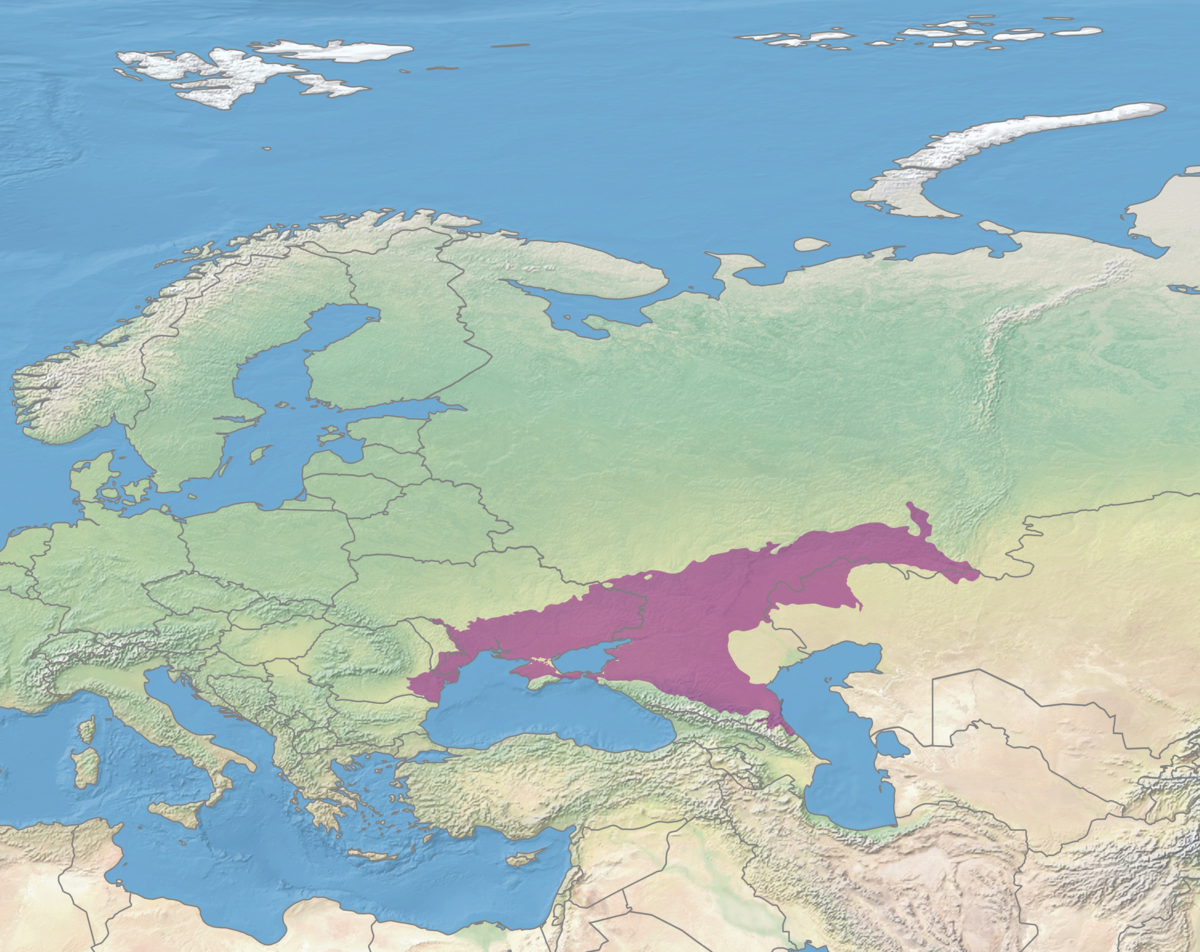
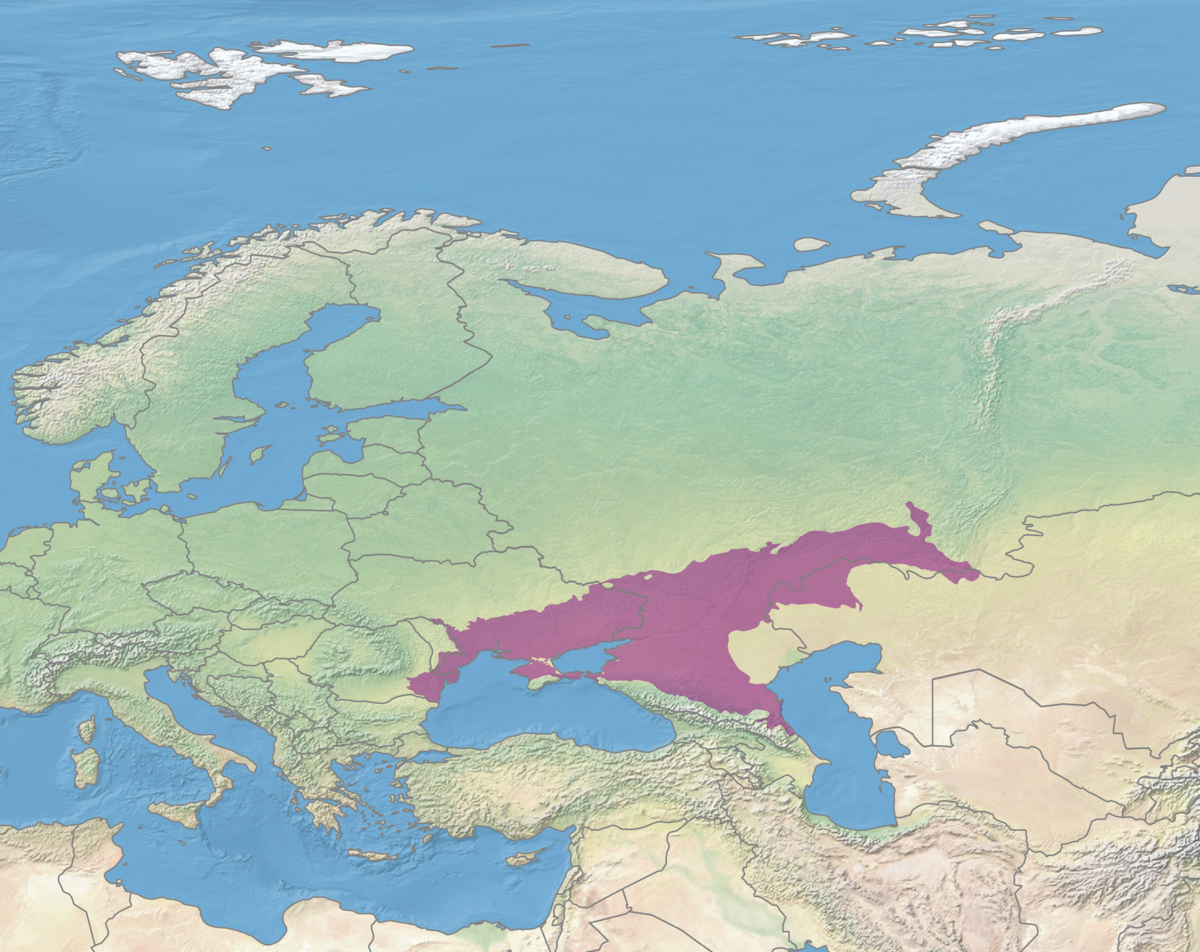
    I know genetics have solved the Anthony-Renfrew debate, but any half-decent economist would have explained rather easily that IE had to evolve on the Eurasian Steppe, not in Anatolia. Or as Mainer’s say “Ya c’-hn’t get they-yah (evolve that) from hee-yah.” Always despised Renfrew as an anti aryanist for ideological reasons. Honestly, steppe life must have been pretty cool. In some ways, it still is.


    Evolution by Exhausting The Hierarchy of Adaptability

    Here is how to understand human evolution (if you don’t know already) Many followers do.
    0) Vision increases your range of awareness of threat AND opportunity.
    1) Access to standing and running gets you greater defense and greater range, and greater access to foods.
    2) Access to better foods lets you swap brain size for digestion size.
    3) Better food, smaller digestion and bigger brains, lets you narrow pelvis and run longer and faster at lower energy cost.
    4) Walking and Running are ‘cheap’ and free up your hands to carry tools, weapons, and resources increasing your range, safety, and food opportunity.
    5) Losing your fur lets you dissipate heat faster, so that you can run down rather than fight increasingly rewarding game.
    6) Having achieved physical imitations, Increasing your cognitive metabolism is all that can improve from there. The physical evolution of (skeletal) modern humans doesn’t appear in skeletal remains.
    7) METABOLISM depends a great deal on heat dissipation, and climate affects heat dissipation, as such IQ differences generally reflect ancestral cognitive metabolism in increasingly cold vs increasingly hot temperatures.
    8) Since we’re cooperative creatures, and cooperation is an unsubstitutable good, the only improvement you can make after cognitive metabolic improvement is decreasing in friction (increase in efficiency) meaning selective reproduction for ability and selective culling of lacking ability)
    10). Communication distributes computation decreasing demand for memory retention and increasing demand for adaptation.
    11). The only way to improve communication is a system of measurement.
    12) the only way to improve a system of measurement is parsimony, consistency, correspondence, and coherence. Ie: “P”.

    All of those show up in the archeological record in skeletal remains. But that doesn’t explain the difference between the three waves out of Africa, or Africa itself.
    What doesn’t show up on the record?
    Great apes have an average IQ of 25, and corresponds to a 2.5 year old european – although visual memory in apes and social cognition in humans excel in opposite directions. Humans at this level have an extreme intellectual disability and are unable to self-care.
    The average IQ of bushmen is estimated at 55, and corresponds to the mental age of a European of about 8 years. The average cranial capacity of Bushmen is 1250 cubic centimeters. This is at the bottom end of mild intellectual disability. These people can self-care and learn very basic skills.
    The average IQ of Australian aborigines is the low 60s and they’re the oldest surviving isolated anatomically modern humans. This corresponds to the mental age of an 11-year-old European. it’s possible to learn basic life and survival skills and live independently.

    Average African IQ (if we throw out the extreme bottom) is in the low seventies ~71. 70 is the beginning of ‘intellectual disability’. So there is ‘nothing wrong’ with africans.

    There is a gap here in the 75-85 range. It’s important to understand that people in this range cannot serve in the military as there are absolutely no functions that they can perform without greater risk to materials, self, and others. Why this gap exists is something I’d like to understand.

    The band across North Africa, the Levant, Iran, Pakistan (which is the group I don’t know how to name, and call ‘iranics’, but others call south eurasians has an IQ of about 85. Same for native Americans. This appears to be the ‘normal’ basal eurasian human IQ, absent climate ‘selection pressure’. This is also the ‘problematic’ spectrum where people are both aware of their limitations, frustrated by them, and able to plan and execute crimes. I use the term the ‘evil 80’s’.

    SE Asia (which should include part of southern india) comes in at around 90. (same with turkey but it’s due to european admixture).

    Next is Europe outside of the southeast at 100, and east Asia at 105. But both Europe and east Asia have undergone political ‘natural selection’ under various forms of manorialism (and aristocracy).

    I can and others have, think of explanations for northern IQ advantages other than political selection, but I don’t think any are necessary.

    The Brain: The three outer layers of the brain are called the supragranular layers, and they increase in thickness from the lower to the higher animals. Mr. Fuerle reports that the supragranular layers are 15 percent thinner in blacks than in whites.


    Evolution operates within a limited framework at a given point in time. In other words, the adaptations that a species can develop are not infinite and are defined by what has already taken place in the evolutionary timeline of a species. Given the immense anatomical and structural complexity of the brain, its evolution (and the congruent evolution of human intelligence), can only be reorganized in a finite number of ways. The majority of said changes occur either in terms of size or in terms of developmental timeframes.

    Larger size. More developed cortex. More Folds, More neurons, and the demands of Language, demands of coalition forming, deception, and reciprocal altruism (accounting of reciprocity)
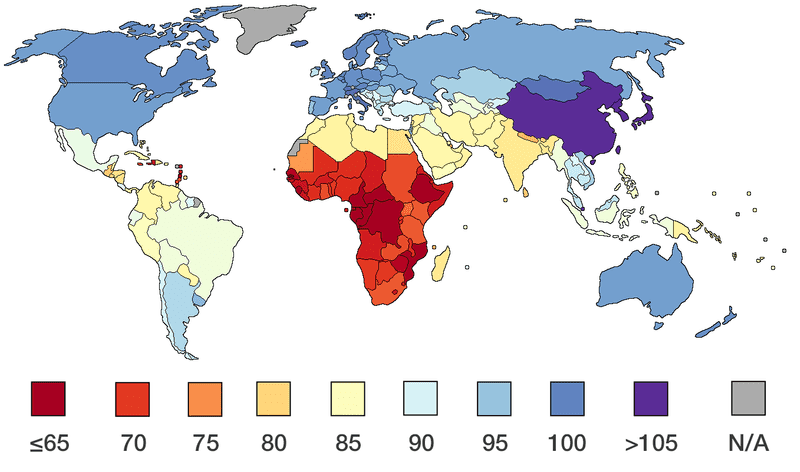
     

    Examples of Cranial Capacity and Intelligence (Adaptability)
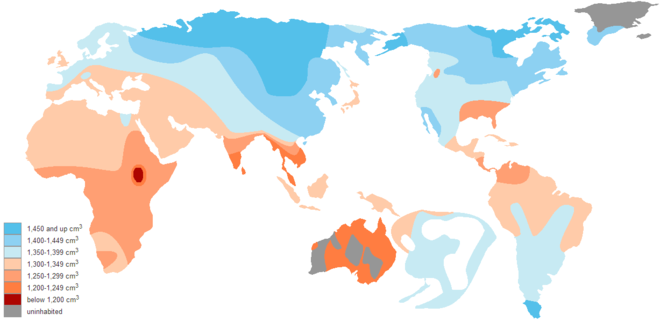
    Contemporary Humans

    East Asians ~1416/105 (very high variability in the data)
    SE Asians
    … (Burma, thailand, indonesia, Philippines, Malaysia) ~87

    Hybridized Asian Europeans
    … Latin Americans:  79-92 : 86
    … Native Americans: ???, 69-94 : 86

    Europeans
    … Europeans ~1369, 87-105 : 99
    … European Americans ??, 96-109 : 101
    Hybridized Palestinian-Europeans
    …  American-British Ashkenazim  107-115
    …  Ashekanizim 103
    …  Sephardim 91
    …  Unhybridized Arabs 86
    Hybridized Turkic-Europeans 90

    South Asians (The Islamic World of north africa, sw asia, india)
    … N Africans: ???,  77-91 : 86
    … SW Asians: ???,  85 (83-84)
    … S Asians (Indians): ???,  77-96 : 84 (82)
    Gypsies ~84?

    Sub Saharan Africans ~1282, 59-89 : 67
    … outbred in carribean: 60-80 : 71
    … outbred in usa:  77-93 : 85
    … outbred in Britain: 73-94 : 86

    Aboriginals in Africa and Australia 
    … Bushmen: ~1250, 48-62 : 55
    … Pygmies: ???, ??-?? : ~52?
    … Aborigines ~1199, 53-74 : 62

    Early Hominids
    Neanderthals: 1,500–1,740 cm3 (92–106 cu in) (bigger brains)
    Homo erectus; 850 – 1100 cm3
    Australopithecus anamensis; 365-370 cm3
    Australopithecus afarensis; 438 cm3
    Australopithecus africanus 452 cm3
    Paranthropus boisei 521 cm3
    Paranthropus robustus 530 cm3

    Apes
    Gorillas: 340–752 cm3 (20.7–45.9 cu in)
    Orangutans: 275–500 cm3 (16.8–30.5 cu in)
    Chimpanzees: 275–500 cm3 (16.8–30.5 cu in)


    The Origin of White People

    Selection: Pro-Social Behavior (Self Domestication)

    One reason that made scientists claim that humans are self-domesticated lied within our behavior: modern humans are docile and tolerant, like domesticated species, our cooperative abilities and pro-social behaviour are key features of our modern cognition,” says Cedric Boeckx. “The second reason is that modern humans, when compared to Neanderthals, present a more gracile phenotype that resembles the one seen in domesticates when compared to their wild-type cousins,” added the expert.

    To identify signs of a self-domestication process in humans, researchers made a list of genes associated with domestication features in humans, out of the comparison with the genome in Neanderthals and Denisovans, extinct human species. Then, they compared this list to the genome from some domesticated animals and their wild relatives, for instance, dogs compared to wolves, and cattle compared to wisents.

    Results showed that this overlap was only relevant between domesticated species and humans. “Those modern humans’ selected genes under selection may prove central to a relevant process of domestication, given that these interactions may provide significant data on relevant phenotypic traits,” said Boeckx.

    compared the genomes among other great apes. “We found that chimpanzees, orangutans and gorillas do not show a significant overlap of genes under positive selection with domesticates. Therefore, it seems there is a ‘special’ intersection between humans and domesticated species, and we take this to be evidence for self-domestication.

    Selection: Height.

    Note that Pygmies are normal in height until puberty, at which point they fail to grow quickly like people of other races

    Selection: Gracile Form

    the australopithecines arose around 4 million years ago and diverged into robust (also called Paranthropus) and gracile branches, one of which (possibly A. garhi) probably went on to become ancestors of the genus Homo.

    Selection: Skin color.

    Apes are white. Early Man traded heat dissipation by the combination of gracile form and hair diminution for dark skin as a defense against solar radiation and its effects on natal biochemistry.  This ape, relatively recently deceased, is not an albino, but merely a chimp that developed a skin disease that caused the loss of his hair (fur). Upon leaving the high solar radiation of Africa, humans reverted to natural coloring: light skin, in exchange for increasing vitamin D production with less skin exposure.

    Skin pigmentation is determined by a number of genes that regulate the expression of melanin (eumelanin and phenomelanin). Melanin protects against the spectrum of UV radiation: UV-A, UV-B and UV-C. UV-C radiation is stopped by the atmosphere (ozone layer). UV-B penetrates the outer layer of the skin (epidermis) and causes Vitamin D production. Vitamin D is necessary for calcium absorbtion, especially for maintaining bones and serving the immune system – most obviously leading to Rickets, and as a byproduct produces pelvic changes that prevent birth of children. UV-A penetrates deep into the skin, and is extremely to cells, cell processes, chemistry, and dna – in particular, the chemistry of Folates. Folates serve many functions, including the formation of the very early nervous system in the first few weeks of gestation. Any UV-A interference with folates produces severe birth defects. So we need UV-B and need to avoid UV-A. Thankfully oily fish provide vitamin The Sami eat reindeer that eat lichen, metabolize it, and transfer vitamin D to the humans..  Inuit people have evolved high sensitivity to pigmentation, by getting UV-A from reflection off of the ice, and vitamin D from marine mammals and fish.

    In 1978, NASA launched the Total Ozone Mapping Spectrometer, which was able to measure the ultraviolet radiation reaching Earth’s surface. Jablonski and Chaplin took the spectrometer’s global ultraviolet measurements and compared them with published data on skin color in indigenous populations from more than 50 countries. There was an unmistakable correlation: The weaker the ultraviolet light, the fairer the skin. Rogers et al. (2004) performed an examination of the variation in MC1R nucleotide sequences for people of different ancestry and compared the sequences of chimpanzees and humans from various regions of the Earth. Rogers concluded that, at the time of the evolutionary separation of chimpanzees and humans, the common ancestors of all humans had light skin that was covered by dark hair. Additionally, our closest extant relative, the chimpanzee, has light skin covered by thick body hair. Over time human hair disappeared to allow better heat dissipation through sweating and the skin tone grew darker to increase the epidermal permeability barrier and protect from folate depletion due to the increased exposure to sunlight. When humans started to migrate away from the tropics, there was less-intense sunlight, partly due to clothing to protect against cold weather. Under these conditions there was less photodestruction of folate, and so the evolutionary pressure stopping lighter-skinned gene variants from surviving was reduced. In addition, lighter skin is able to generate more vitamin D (cholecalciferol) than darker skin, so it would have represented a health benefit in reduced sunlight if there were limited sources of vitamin D. The genetic mutations leading to light skin may have experienced selective pressure due to the adoption of farming and settlement in northern latitudes.

    Anthropologist Peter Frost has proposed that sexual selection was responsible for the evolution of pigmentary traits of women in Northern and Eastern European populations. He contends that the diversity of hair and eye color in Northeast European populations originated as a consequence of intense female intrasexual competition, and is an adaptation for reproductive success in women

    Humans in the equatorial latitudes must and do remain dark. Humans in the middle latitudes (south of 40 degrees) can tan (vary pigmentation). Humans in northern latitudes may all but lose the ability to tan (vary pigmentation). And some in extreme north latitudes have evolved extreme abilities to produce tanning.

    In hominids, the parts of the body not covered with hair, like the face and the back of the hands, start out pale in infants and turn darker as the skin is increasingly exposed to sun. As hominids, all human babies are born pale, regardless of what their adult color, and melanin production does not peak until after puberty. Human skin color fades with age, and over the age of thirty our skin experiences a decrease in melanin-producing cells of about 10% to 20% per decade as melanocyte stem cells gradually die.

    In other words, light skin color is neotenic: an indication of youth. As such it signals fertility. It’s this signal of fertility that drives sexual preference and rates of reproduction. The genes that regulate melanin expression vary across human populations, and are present in all three primary (continental) races. Europeans possess all three genes that limit production of melanin, limit the precursor to melanin, and limit the transport of precursors to melanine, and this combiation is fixed (universally saturated) in the european population. Africans and Asia skin tone is regulated by different genes, and both groups have a broader range of skin tone than europeans.

    Selection: Sexual Dimorphism. Females are generally lighter than males. The most likely driver of skin color difference is female demand for vitamin D production during pregnancy and nursing. Vitamin D is necessary for the absorbtion of calcium rom the diet. Pregnancy genereates a 400% increase in biolgical demand for calcium which is otherwise supplied from embrittlement of the mother’s bones and infant birth defects. Steppe herder life and lactase tolerance evolved with stepp herder life dramatically increase calcium availability. Repeating: Light skin is neotenic.

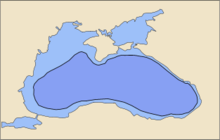
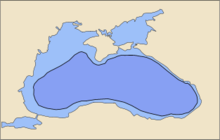
    Selection: Blue eyes evolved from a single mutation, about 8000bc, in a woman, on the black sea. Eye color expression is polygenic (many genes) but the mutation prevented the expression of melanin (brown) in the eyes. Eyes are least responsive to cognitive manipulation. (The window to the soul). Light eyes communication more information (trust vs risk) than dark.

    Selection: Red hair. Red has far more of the pigment pheomelanin than it has of the dark pigment eumelanin.

    Selection: Blonde Hair: The novel trait of blonde hair from the ANE population. Blonde hair is surprisingly regulated by a one letter change in DNA. But like most coloration, affects the expression of melanin (eumelanin). Black, brown, and Blonde hair are determined primarily by the genes that regulate this expression.

    Selection Signaling: If we can adapt by it – we do. If we can signal by it – we do.


  • The Autistic Experience Increases Demand For Mindfulness

    (Forwarded by a friend)

    The power of hyper perception

    The “beautiful minds” of the “autists” are the absolute forefront of a conflict to “reconstruct reality”, since collective perception of what is real has been deliberately subverted over a long period of time. Autists have the easiest perception of what is truly happening, and are the least susceptible to propaganda and emotional appeals. We are the most resistant to being “hived off”.

    This is rooted in how we process information, as described in “When the world becomes ‘too real’: a Bayesian explanation of autistic perception” by Elizabeth Pellicano and David Burr: “We suggest specifically that attenuated Bayesian priors – ‘hypo-priors’ – may be responsible for the unique perceptual experience of autistic people, leading to a tendency to perceive the world more accurately rather than modulated by prior experience.

    The idea of a “hypo-prior” is that you only have a weak attachment to existing beliefs when filtering incoming data. I will explore this in more detail below. Philosophers like Jiddu Krishnamurti have referred to this sense of “suspending evaluation” (to see things how they really are) as the “freedom from the known”. It is both an innate capability, and a skill that can be developed.

    Note that intelligence has many facets, and that there is nothing innately superior or inferior to having (or lacking) this specific perceptual bias. It comes with costs as well as benefits. My own sense is that non-autists are more adept at working “within paradigm” (filtering things fast that do not fit the expected reality), whereas autists seem better at going “cross paradigm” (deferring choices of relevance).

    The price of attachment to objective reality

    The autist gifts of hyper focus and hyper perception come with a VERY painful side effect in our present cultural and geopolitical situation: you are often isolated from the mainstream, and are forced to watch everyone else being psychologically abused by those in power, which itself is traumatising. Furthermore, the deliberate corruption of meaning by the media, religion, education turns an already difficult task of “fitting in” for high-functioning autists much harder, since the “baseline” social consensus has been moved so far away from any objective reality.

    The enemy is conducting a form of attrition warfare on the information battlefield, and the press gaslighting, mask wearing, TV propaganda, etc is designed to break down their opposition. Whilst those of the light are winning against the darkness, it comes at a huge price: “Autists have a proverbial burnout from too much data, too much empathy, too much knowing the darkest things and many times, when we rest from that, we get the anxiety and the sorrow of losing the calming hyperfocus this journey provides. Too much stimulation and too much vicarious pain.”

    Battle fatigue for autists during information war

    The nature of being an “autist” is poorly understood not just by the mainstream, but by those “on the spectrum” themselves. Luckily I have encountered an autist whose obsession is to describe and define her own condition, to the benefit of us all. Here I share what I have learned from her:

    Caetextic

    “Autists” are “context blind”, and struggle to deal with multiple contexts and changes of context, especially in the social. So for me dealing with lots of consulting clients and customers at once is very hard work. Once something is in my head, I cannot stop thinking about it and trying to solve the client’s problem. Compartmentalisation of context is hard and everything is connected across contexts. (CD: Yep. And it’s impossible.  So I don’t fight it – I try to figure out how to use it. It produces mindfulness instead of frustration.)


    OCD for information congruence

    Because of the struggle to manage ambiguity, conflicting data, and multiple variables and contexts, there is a basic need for “autists” to model the world in order to be able to make choices and function. Without this conceptual “scaffolding”, normal life becomes impossible. This can be seen in my essays; it is me trying to reconcile the data for my own sake, so I can proceed “logically” without inner chaos. As a collateral benefit, other people find the “maps” and “models” I make extremely useful. I am an accomplished systematiser because I have no alternative.​  (CD: Correct: Systematizing is necessary.  So again, I”m going to make the argument that evolution provided human groups with a division of not only labor, but sensory-perception and cognition and our role as autists is error detection on the edges.)

    Inertia and monotropism

    We find it hard to get into a task, but once in it are absolutely focused on it (monotropism), but then find it hard to move on. So I can’t just sit down and decide to write an essay; I will freeze with anxiety. I have to wait until I feel calm and ready, then I can blast out all my thoughts in flow. Sometimes I can be very productive, but a simple task like tax admin can take me all day as the inner resistance is so high, and I will procrastinate endlessly.​  (CD: My technique is to keep a set of projects going so that I always have something to work on but never have to force myself to work on anything. This ends up like working a monumental painting where you keep five paintings going and work on what inspires you at the moment. Otherwise, i just get angry with myself if I can’t focus on what my brain doesn’t want to.)

    Divergent preference for inputs

    The “genius” aspect of high-functioning Aspie types comes from a wild associative memory and hyper perception of everything. This is because the usual filters that make people delay sense-making of most inputs are missing. My photography reflects this, as I notice tiny details other people would not perceive. Everything sparks off a train of thought, and there is no off switch. It is quite exhausting. (Yes. I tell people I have to protect myself from certain kinds of ideas and situations because there is no off switch and my brain will work on the problem until it’s solved even if I don’t want it to.)

    Inside/outside cognitive focus

    We autists struggle to integrate the inner and outer worlds, but can consciously switch between the two [inner and outer worlds]. I noticed this around 2008, when my then partner (who was a business school professor) noted how I could disassociate at will when most could not. The downside is that this imposes a lot of draining cognitive cost to choose where to focus.​

    Super-empath

    The lack of sensemaking filters also applies in the emotional. We are “sponges” for the feelings of others. It can seem like being a little remote or cold at times, as there is a need to distance oneself from the distress of others for self-protection. I cannot watch horror movies, for example, as there’s no way for me to tell myself it is “only acting”.  (CD: Omg this is so true.)

    Window of tolerance

    Autists have a “window” between “hyper stimulation” and “hypo stimulation” where we can function. This window can widen or narrow depending on circumstances. (My present circumstances with endless deplatforming are narrowing it.) If we go “hyper” we risk a “crash” and end up semi-catatonic. The resulting “duvet days” that are like depression, but from neurological overload.​ (CD: Exactly)

    Stimming and soothing

    To maintain focus we “self-stimulate”; I wore out the left shift key and aluminium casing of my old laptop from the repeated tapping and rubbing. I am a visual self-stimulator more than physical, so I do photography walks as a mental health activity. This is also a form of self-soothing of my overstimulated nervous system. It is not just because I fancy doing “art”; it is basic and necessary self care.​ (CD: I see this as getting control of auto association – in my behavior I seek to write because writing controls my context. If not I just try to sleep.)

    Demand avoidance

    Part of the condition is a wish to drive activity from inner self, and not from the outer world. So the torrent of correspondence I am receiving from being a public figure is particularly exhausting. Scheduled events are demands, too. The corporate world is hell for the autist, since it is demand-driven, which is why I’ve probably switched to being an artist. I like to have my days free from time constraints and specific commitments. I still work hard, just it has to be driven by interest to be “affordable” neurologically.​ (CD: Completely agree.)
    Masking

    Autists have to put an unconscious effort into pretending to fit into the normal social world and how most people relate. This is called “masking”, and takes yet more energy. I was good at it in my 20s and 30s, and am getting less good with time… which brings us to…  (CD; I get exhausted on stage but I got good at socialization and I love it. So again, this can be overcome, You just have to choose to bear the pain of training yourself, for the future benefits despite the present stress. )

    Ageing

    As “autists” age we get “more autistic”. I used to be able to go to movies, but now it is totally overwhelming for my senses, for example. I am 50 next year, and I’m finding it harder to “mask”. I get better and better at the few things I am brilliant at, and less and less good at those aspects of life I rarely practise now. Don’t ask me to do DIY jobs, it will take forever to complete.  (CD: My experience has been the opposite. I have mindfulness. As I get older I have developed more mindfulness. I think this is the problem. All people need a means of mindfulness, and autists especially. The problem is ‘intrusive thoughts and intense experience’ that occurs when I’m tired. It’s doubly exhausting.)

    Sensory overload and torture

    The bottom line of all this is that sensory overload becomes frequent. This is kind of torment — literally experienced as torture. Too many demands, contexts, inputs, distractions, incongruencies… leading to meltdown. It is exactly what they do in dungeons of “black site” prisons to break people. This is particularly excruciating in a world where you can perceive the perception failures of other people, due to having extended cognition they lack.​  (Again this is the reason for learning mindfulness – by whatever method you can that’s not woo woo.)

    Lifelong Trauma

    There is a strong correlation between being an “autist” and PSTD. We are all super-sensitive people traumatised by our society, and forced into a variety of often unhelpful and unhealthy coping strategies. One medical study tried to recruit untraumatized autistic people, and they couldn’t find any.   (CD: yes I have trauma symptoms. the fact is that the situations were traumatic for anyone. But I’m competitive and did them anyway. So I paid a higher traumatic price.)

  • The Autistic Experience Increases Demand For Mindfulness

    (Forwarded by a friend)

    The power of hyper perception

    The “beautiful minds” of the “autists” are the absolute forefront of a conflict to “reconstruct reality”, since collective perception of what is real has been deliberately subverted over a long period of time. Autists have the easiest perception of what is truly happening, and are the least susceptible to propaganda and emotional appeals. We are the most resistant to being “hived off”.

    This is rooted in how we process information, as described in “When the world becomes ‘too real’: a Bayesian explanation of autistic perception” by Elizabeth Pellicano and David Burr: “We suggest specifically that attenuated Bayesian priors – ‘hypo-priors’ – may be responsible for the unique perceptual experience of autistic people, leading to a tendency to perceive the world more accurately rather than modulated by prior experience.

    The idea of a “hypo-prior” is that you only have a weak attachment to existing beliefs when filtering incoming data. I will explore this in more detail below. Philosophers like Jiddu Krishnamurti have referred to this sense of “suspending evaluation” (to see things how they really are) as the “freedom from the known”. It is both an innate capability, and a skill that can be developed.

    Note that intelligence has many facets, and that there is nothing innately superior or inferior to having (or lacking) this specific perceptual bias. It comes with costs as well as benefits. My own sense is that non-autists are more adept at working “within paradigm” (filtering things fast that do not fit the expected reality), whereas autists seem better at going “cross paradigm” (deferring choices of relevance).

    The price of attachment to objective reality

    The autist gifts of hyper focus and hyper perception come with a VERY painful side effect in our present cultural and geopolitical situation: you are often isolated from the mainstream, and are forced to watch everyone else being psychologically abused by those in power, which itself is traumatising. Furthermore, the deliberate corruption of meaning by the media, religion, education turns an already difficult task of “fitting in” for high-functioning autists much harder, since the “baseline” social consensus has been moved so far away from any objective reality.

    The enemy is conducting a form of attrition warfare on the information battlefield, and the press gaslighting, mask wearing, TV propaganda, etc is designed to break down their opposition. Whilst those of the light are winning against the darkness, it comes at a huge price: “Autists have a proverbial burnout from too much data, too much empathy, too much knowing the darkest things and many times, when we rest from that, we get the anxiety and the sorrow of losing the calming hyperfocus this journey provides. Too much stimulation and too much vicarious pain.”

    Battle fatigue for autists during information war

    The nature of being an “autist” is poorly understood not just by the mainstream, but by those “on the spectrum” themselves. Luckily I have encountered an autist whose obsession is to describe and define her own condition, to the benefit of us all. Here I share what I have learned from her:

    Caetextic

    “Autists” are “context blind”, and struggle to deal with multiple contexts and changes of context, especially in the social. So for me dealing with lots of consulting clients and customers at once is very hard work. Once something is in my head, I cannot stop thinking about it and trying to solve the client’s problem. Compartmentalisation of context is hard and everything is connected across contexts. (CD: Yep. And it’s impossible.  So I don’t fight it – I try to figure out how to use it. It produces mindfulness instead of frustration.)


    OCD for information congruence

    Because of the struggle to manage ambiguity, conflicting data, and multiple variables and contexts, there is a basic need for “autists” to model the world in order to be able to make choices and function. Without this conceptual “scaffolding”, normal life becomes impossible. This can be seen in my essays; it is me trying to reconcile the data for my own sake, so I can proceed “logically” without inner chaos. As a collateral benefit, other people find the “maps” and “models” I make extremely useful. I am an accomplished systematiser because I have no alternative.​  (CD: Correct: Systematizing is necessary.  So again, I”m going to make the argument that evolution provided human groups with a division of not only labor, but sensory-perception and cognition and our role as autists is error detection on the edges.)

    Inertia and monotropism

    We find it hard to get into a task, but once in it are absolutely focused on it (monotropism), but then find it hard to move on. So I can’t just sit down and decide to write an essay; I will freeze with anxiety. I have to wait until I feel calm and ready, then I can blast out all my thoughts in flow. Sometimes I can be very productive, but a simple task like tax admin can take me all day as the inner resistance is so high, and I will procrastinate endlessly.​  (CD: My technique is to keep a set of projects going so that I always have something to work on but never have to force myself to work on anything. This ends up like working a monumental painting where you keep five paintings going and work on what inspires you at the moment. Otherwise, i just get angry with myself if I can’t focus on what my brain doesn’t want to.)

    Divergent preference for inputs

    The “genius” aspect of high-functioning Aspie types comes from a wild associative memory and hyper perception of everything. This is because the usual filters that make people delay sense-making of most inputs are missing. My photography reflects this, as I notice tiny details other people would not perceive. Everything sparks off a train of thought, and there is no off switch. It is quite exhausting. (Yes. I tell people I have to protect myself from certain kinds of ideas and situations because there is no off switch and my brain will work on the problem until it’s solved even if I don’t want it to.)

    Inside/outside cognitive focus

    We autists struggle to integrate the inner and outer worlds, but can consciously switch between the two [inner and outer worlds]. I noticed this around 2008, when my then partner (who was a business school professor) noted how I could disassociate at will when most could not. The downside is that this imposes a lot of draining cognitive cost to choose where to focus.​

    Super-empath

    The lack of sensemaking filters also applies in the emotional. We are “sponges” for the feelings of others. It can seem like being a little remote or cold at times, as there is a need to distance oneself from the distress of others for self-protection. I cannot watch horror movies, for example, as there’s no way for me to tell myself it is “only acting”.  (CD: Omg this is so true.)

    Window of tolerance

    Autists have a “window” between “hyper stimulation” and “hypo stimulation” where we can function. This window can widen or narrow depending on circumstances. (My present circumstances with endless deplatforming are narrowing it.) If we go “hyper” we risk a “crash” and end up semi-catatonic. The resulting “duvet days” that are like depression, but from neurological overload.​ (CD: Exactly)

    Stimming and soothing

    To maintain focus we “self-stimulate”; I wore out the left shift key and aluminium casing of my old laptop from the repeated tapping and rubbing. I am a visual self-stimulator more than physical, so I do photography walks as a mental health activity. This is also a form of self-soothing of my overstimulated nervous system. It is not just because I fancy doing “art”; it is basic and necessary self care.​ (CD: I see this as getting control of auto association – in my behavior I seek to write because writing controls my context. If not I just try to sleep.)

    Demand avoidance

    Part of the condition is a wish to drive activity from inner self, and not from the outer world. So the torrent of correspondence I am receiving from being a public figure is particularly exhausting. Scheduled events are demands, too. The corporate world is hell for the autist, since it is demand-driven, which is why I’ve probably switched to being an artist. I like to have my days free from time constraints and specific commitments. I still work hard, just it has to be driven by interest to be “affordable” neurologically.​ (CD: Completely agree.)

    Masking

    Autists have to put an unconscious effort into pretending to fit into the normal social world and how most people relate. This is called “masking”, and takes yet more energy. I was good at it in my 20s and 30s, and am getting less good with time… which brings us to…  (CD; I get exhausted on stage but I got good at socialization and I love it. So again, this can be overcome, You just have to choose to bear the pain of training yourself, for the future benefits despite the present stress. )

    Ageing

    As “autists” age we get “more autistic”. I used to be able to go to movies, but now it is totally overwhelming for my senses, for example. I am 50 next year, and I’m finding it harder to “mask”. I get better and better at the few things I am brilliant at, and less and less good at those aspects of life I rarely practise now. Don’t ask me to do DIY jobs, it will take forever to complete.  (CD: My experience has been the opposite. I have mindfulness. As I get older I have developed more mindfulness. I think this is the problem. All people need a means of mindfulness, and autists especially. The problem is ‘intrusive thoughts and intense experience’ that occurs when I’m tired. It’s doubly exhausting.)

    Sensory overload and torture

    The bottom line of all this is that sensory overload becomes frequent. This is kind of torment — literally experienced as torture. Too many demands, contexts, inputs, distractions, incongruencies… leading to meltdown. It is exactly what they do in dungeons of “black site” prisons to break people. This is particularly excruciating in a world where you can perceive the perception failures of other people, due to having extended cognition they lack.​  (Again this is the reason for learning mindfulness – by whatever method you can that’s not woo woo.)

    Lifelong Trauma

    There is a strong correlation between being an “autist” and PSTD. We are all super-sensitive people traumatised by our society, and forced into a variety of often unhelpful and unhealthy coping strategies. One medical study tried to recruit untraumatized autistic people, and they couldn’t find any.   (CD: yes I have trauma symptoms. the fact is that the situations were traumatic for anyone. But I’m competitive and did them anyway. So I paid a higher traumatic price.)

  • The Choice – Episode 0025 – The Prosecution. The Conflict Between Our Group Strategies. No More Lies

    Welcome to Episode 0025 – The Prosecution. The Conflict Between Our Group Strategies. No More Lies. –  I’m Curt Doolittle

    Quote: The Left Steals, Decapitalizes, and Speaks Comforting Lies, While The Right Produces, and Capitalizes – But Won’t Speak The Uncomfortable Truth

    The Conflict Between Our Group Strategies

    Part One

    Every human group relies on a competitive strategy. That strategy is usually formed just before or just after the bronze age collapse, and almost universally by 300 BC. It varied depended on the geography, the population density, the number of ethnic competitors, the available means of production, the group’s relative standing amongst those competitors, and the composition of its hierarchy of elites: Religious, State, or Law. where that sequence of religion, state, and law isn’t arbitrary.  In one of my next The Choice episodes I’ll discuss each group’s evolutionary strategy and how it emerged and why.

    The West’s Group strategy is maximizing speed, maneuver, adaptation, innovation, by the continuous domestication (farming) of agency, through self-determination, sovereignty and reciprocity, oath and truth before face, dependent on meritocracy, absent authority, leaving only adversarialism as a means of decidability, voting for production of commons, rule of law for dispute resolution, and markets for the production of goods services and information, and the necessity governing those with less agency, and culling those who lack agency, by natural and market selection, producing the civilization with the greatest conformity to and discovery of, adaptation to and application of the formal, physical, natural, and evolutionary laws of the universe.

    This method of organization is the cause of western velocity of advancement in just a few centuries in the bronze, iron, steel, and information ages. While the west was not first, it was always fastest, which made it first more often. But this group strategy produces high trust, and Christianity, solving the problem of incentives for the slave serf and female classes unable to compete economically, politically, and militarily, exacerbated the problem of excessive trust. And democracy gave that excessive trust access to political power to undermine that group strategy.

    But there is a weakness to the West’s group strategy, and it’s that in the absence of maintaining “the militarization of the entire nation”, and without an ethnocentric king or general, the group can’t readily organize against threats that take advantage of our tolerance. The origin of our tolerance lies in our first law of self-determination, in pursuit of the production of agency, and worst of all, in Christian forgiveness that all too often serves as a justification for freeriding and cowardice. But we don’t bait one another into hazards we don’t even think of it.

    What I want to draw attention to is the relationship between truth-before-face, Trust that results, and the order of institutions that have developed, and the corruption of those different civilizations and institutions. You will find that the order of institutions roughly corresponds with the scale of corruption, and the classes or categories of corruption in the society, and that the means by which they argue the civilizational mores – their method of argument – corresponds to truth-before-face, and the degree of deceit and corruption.  Note that in the west corruption occurs largely in limited state defense of the lower classes from commercial scam predation, the working and middle classes from financial predation, and extraordinary procedural or soft corruption between the state and its vendors, the obvious corruption between politicians and their lobbyists, and the invisible corruption the bureaucrats and their rent-seeking (seeking unearned employee benefits) or bending institutions for their benefit at the cost of the people.  Note that these are in fact methods of corruption, but they are largely invisible to the economic classes.  The northern Europeans suffer far greater state bureaucratic self-benefit in exchange for minor improvements in consumer protection. Italy by example, is incomprehensible, and the reason is impolitic: the longer an area was under the church the more corrupt it remains. The longer it was under rule of law and the state administration the less corrupt it remains. In this sense, Europeans and Canadians are serfs and Americans are just fools. 😉  Americans, idealism, magical thinking, and fundamentalism all go hand in hand with folly.

    (Please read Fukuyama on Trust and Political Order, his mentor Samuel Huntington’s Clash of civilizations, Political Order and Culture Matters; William McNeil’s Civilization, Rise of the West, Plagues, if you require previous author’s thoughts on these subjects. My primary contribution is to explain that Fukuyama didn’t understand european civ.)

    While the French, Spanish, Germans, and Russians each revolted against empiricism over tradition from within; and the South Americans, Indians and Chinese revolted from without, the most recent revolt against western civilization from within western civilization is the Jewish counter-revolution against Darwin’s explanation for the success of western civilization, by an across the board attack on every logic, science, norm, tradition, class, and institution using every technique possible by man.  

    PART 2 The Jewish Group Strategy

    The Jewish Left uses a variation of the Chinese strategy of Delay-and-Deceive by Lie-and-Deny. But while the Chinese version is used to accumulate time necessary to accumulate capital that will make external military conquest impossible and internal conquest of neighbors unpreventable, the Jewish variation is to undermine the society from within to make social and political action against them impossible. These are variations on “delay and deceive” from the male and female evolutionary strategies. They are the very opposite of the European method of warfare, which is to solve problems quickly and cheaply before we are defeated by superior numbers and wealth.

    How do the Jewish Left use Delay and Deceive, Lie and Deny, and Undermine the informational, social, economic, and political commons of host peoples?  By using the competitive strategy of the female (within) rather than the competitive strategy of the male (without) because of the normal male tendency to ignore the female method of undermining.

    They use a variation on the prostitute’s method of seduction: They claim the Physical (physical scarcity versus demand for signals and novelty), Natural ( reciprocity versus the limits of proportionality), Evolutionary (regression to the mean versus racing the red queen) Laws of the universe are false and claim the ruling classes are engaged in oppression – rather than incremental, necessary domestication of the animal man, constantly regressing to the mean, by limiting the hyperconsumption and hyper-fertility of the unproductive or intolerable.

    The Jewish left makes this claim by appealing to natural human magical thinking, and especially the magical thinking of women and the underclasses, using the plausible deniability of seeking utopia, under the pretense they are seeking what is best for all, by the false promise of endless economic growth (end of scarcity versus of rare, rapidly exhausted, punctuated equilibria), the false promise of the nature of man (moral vs amoral), and the false promise of the malleability of man (the blank slate vs 80% genetic, and a normal distribution of genetic traits.)

    8) The Jewish Left’s strategy, especially the Ashkenazi strategy, is specifically evolved to take advantage of the west’s high trust civilization to operate as a vast organized crime family that uses western self-determination, sovereignty, and reciprocity to undermine the entire system of thought, norms, traditions, institutions, laws, and intergenerational transfer of this strategy. This strategy is extremely successful because of european tolerance.

    They performed deception by simple means: (faith healing, false promise baiting into hazard, sedition) ( … )

    Delay and Deceive: The Left’s Strategy of Incremental Undermining by Delay and Deceive: Where the Chinese rely on their cultural institution of the ancient method of “Accumulate Forces by Delay and Deceive from Without” the Jewish Left equally relies on their cultural and religious institution of the ancient female method of  “Undermine Forces by Delay and Deceive From Within.” 

    The Four Big Leftist Lies: There are four sciences: The formal or logical, the physical or material, the natural or behavioral, and the evolutionary or survival. The Jewish Left has produced a set of lies that undermine ‘sensemaking’ by undermining each of these laws.

      1. False Promise of Freedom from Formal Laws (logic) by the use of social construction of repetitive feedback of information counter to formal, physical, natural, and evolutionary laws.
      2. False Promise of Freedom from Physical Laws (scarcity, false promise of endless growth). by the false promise of endless growth, an end to scarcity, and an end to human competition by demonstrated acquisition.
      3. False Promise of Freedom Natural Laws (of self-interest, rational choice, amorality, reciprocity, competitive organization), by the false promise of an end to kin selection, koinophillia, ethnocentrism, sex, class, subrace, and racial differences, and the sexual, social, economic, and political value of organization by ethnocentrism given the class, subrace, and subrace differences in sexual, social, economic, and political value to one another, given the substantial evolutionary difference between the races and subraces.
      4. False Promise of Freedom from Evolutionary Laws ( ending natural, and market selection, accumulating mutation and regulation, the impossibility of isolation, inescapable regression, accumulated genetic load, dysgenia, and the red queen of resources, competitors, biological, climatological, geological, solar, and galactic risks. ).

    Stop the Tactics of The Left’s Lying:

      1. Faith Healing, delaying into hazard. Faith Healing consists of providing temporary psychological relief while allowing the cause to persist, grow, and evolve.
      2. False Story Telling, baiting you into empathy, loading, framing, obscurantism, suggestion, suspension of disbelief and overloading.
      3. False Promise, baiting into hazard. Baiting into hazard consists of making false promises of freedom from the laws of the universe. arguing them with sophistry to idealism, magic to pseudoscience, or occult to theology.
      4. False Criticism, undermining into hazard. 

    The Jewish Left’s strategy is to provide:

    1. faith healing if they can (lie and deny),
    2. sell false promise if they need to (fraud), and
    3. undermine if they have to (sedition).

    In the next few podcasts, I’ll continue explaining the Abrahamic method of undermining civilizations from within in what you might call painful analytic detail. This talk is already long enough.  But in simple form it is the technique priests, public intellectuals, and dominant females use to undermine dominant females, dominant males, social and political orders, by deceptively coerce others, into false promises of rewards, through fictions. It’s a form of seduction – meaning bait.

    “The Jewish Group Strategy is Total War, by: Delay, Deceive, Undermine, Sow Discord, and destroy genetic, normative, cultural, institutional capital, by disinformation, deceit, defamation, sedition, and treason, using Baiting Into Hazard, by False Promise of freedom from constraints of formal, physical, natural, and evolutionary law, Advocated by Pilpul, Defended by Critique, Escaping Liability and Warranty, by Pretense of Plausible Deniability, Despite Deliberate Avoidance of Due Diligence, And Deliberate Evasion of Warranty, Deliberate Escape From Liability, Given the Asymmetry of Knowledge, the dependence on instincts, the Presence of Malincentives by both Agent(s) and Victim(s) – And Pursued for the Purpose of Attention, Reward (profit), Influence(power), Undermining (Power), of the Trust and Cooperation, of a Population in Normal Distribution, Thereby Generating accelerating Cycles of Internal Conflict, Generating Demand for Authority to Control by the Hazard Maker.”

    The Jewish Counter-Revolution against truth science, reason cooperation and evolution. To create an ignorant, easily manipuated, dependent class that they can parasitically extract from, while managin their decline, and driving man into dysgenia and missing the window of opportunity for our transcendence into gods. it is the strategy of mothers fearful of losing control over their young, and keeping them infantilized.

    Taken together, the Jewish strategy, tactics, and means of deception are the mirror opposite of the european testimonial, rational scientific, agency-producing, cooperative, productive, eugenic, and evolutionary thought, culture, institutions, and civilization.

    The Jewish strategy of undermining is the most technical and advanced system of deceit in human history. It’s a system of anti-truth, and the most destructive system of thought on earth, with the dogmatism, ignorance, tribalism, and dysgenia of Islam the mature stage of its ancient world development, and Islamism, Judaism, anti-science psychology of Freud, anthropology of Boas, and evolution of Gould, anti-sex, class, subrace, race culture, and civilizational differences, anti class cooperation of marxism, anti-culture of neo-marxism, anti-truth of postmodernism, anti-family of Jewish feminism, anti-nationalism of globalism and neoconservatism.

    They have literally invented a system of lying for every single discipline, even destroying the logic of language and mathematical realism. That’s before their systematic destruction of our constitution and their intentional undermining of our civilization through unwanted immigration taking advantage of our trust in one another under democracy.

    PART 3

    Science is just the discipline of producing testimony – that’s why Europeans invented reason, empiricism, and science – our first institution was common law not state or religion. The Jews completely covered the scientific spectrum in order to undermine all thought, reason, and communication.  There are only four categories of science to undermine: The logical or formal sciences which can be best considered systems of measurement, the physical sciences which describe the physical world; the behavioral sciences, and the Natural laws which describe the behavioral world, encompassing psychology, sociology, politics, and group strategy; and the evolutionary sciences that study the outcome of the interaction of those processes over time.  And so in addition to false promises that deny the physical, natural, and evolutionary laws, the Jewish left have invented postmodernism to deny truth, reason, science, and testability itself.

    No More Lies.

    The difference is that the jews always fail, and end up justly punished for their crimes of betrayal of the host populations. 

    No More lies.

    Those of you who have been fooled by these lies, must come to terms with scarcity: the earth is a closed system. We have incrementally exhausted every resource she provides. She can carry 1.5-2b people while at the same time giving those people incremental control over the energy necessary to transform the universe from one state to another, and eventually make mankind independent of the nature, geology, solar system, and galaxy that is all but hostile to life.

    No More Lies.

    Those of you who have been fooled by these lies, must come to terms with the nature of man. Man is an amoral creature for whom moral action is merely more often beneficial than suffering the consequences the people, their institutions, and the universe put upon them. The history of civilization consists of the incremental domestication of man by the development of incrementally evolving institutions that deprive him of immoral actions that add resistance to human adaptation to those laws of the universe. Man seeks his self-interest, even when he’s acting morally, or under the pretense of virtue. 

    No more lies.

    Those of you who have been fooled by these lies must come to terms with the genetics. That there are non-trivial genetic, biological, cognitive, behavioral, and therefore expressed social and cultural differences between the races, classes, and sexes. Lying about it – persisting the Marxist-pomo pseudoscientific counter-revolution against the Darwinian revolution’s explanation for western civilization’s disproportionate success, merely prevents us from solving the problem of intergroup conflict, as we continue the european project of the evolution of man from part human-animal lacking agency into fully human beings of agency, on our way to omniscience and omnipotence.

    No more lies.

    Sex, Class, Subrace, and Racial Differences are meaningful – most of which are due to different rates of gestation, maturation, depth of maturation, and distribution of sex cognitive biases, and the subsequent different sizes and distribution of our lower, working, middle, and upper classes along the performative, meaning rapidly adaptive, rather than a relative spectrum of ability. All humans demonstrate kin selection, kin preference, and for good reasons: sexual, social, economic, and political advantages of doing so.

    We must govern with the mankind we have, given the resources we have, given the institutions that are possible, while still preserving self-determination such that the continuous calculation by trial and error that discovers the universe of opportunities for our defeat of the dark forces of entropy, environment, genetics, time, and ignorance.

    No More lies

    The Jews and Muslims are Semites, and Semites like Africans, more aggressive, but aggressive using the females strategy of undermining, cooperation, reputation, social, political, economic, and informational destruction.  They ally with the “aggressive girls, mean girls, and the ugly girls” because women live in a world of women and follow power in their sphere – they ignore 2/3 of men and undermine the rest of them – making exceptions only for those that they can make use of by their influence, or consumption to improve their status. They failed at rallying working-class men under authoritarian communism because of the disproportionate success of rule of law consumer capitalism, so they rallied the underclass races, and women ( … ) under the pretense of identitarian suppression instead of class and economic suppression. 

    The Success of the Strategy

      1. In just seventy years the Jewish left succeeded in (a) turning the USA into a third world country (b) repeating the bolshevik revolution (Antifa, BLM, Woke), and (c) repeating the undermining of Roman civilization (d) and brining about another dark age – this time not of supernatural ignorance, but of pseudoscientific ignorance. Why? Jewish hatred of reality, nature, and mankind on the one hand and Christian tolerance, and conservative stupidity on the other.
      2. Undermining American arts, humanities, behavioral sciences, values, religion, culture, marriage, law, finance, media, entertainment.
      3. Sponsoring third world immigration into France and under the French EU project into the rest of Europe.
      4. Sponsoring the de-Prussification (De Europeanization) of Germany during and after the world wars, which was the restoration of our european tradition after the Jewish-christian-islamic dark ages. Conspiring against the german people before, during and after the first world war.
      5. Destroying the Russian empire, murdering tens of millions, and setting eastern Europe back a century.
      6. Converting the strategy of judaism to underming Christianity to weaken, to  communism to undermine, socialism to weaken, neo-marxism, Freudianism, Boazinism, to undermine, postmodernism to undermine truth, feminism to undermine the family, libertarianism to undermine rule of law, neoconservatism to undermine insularity.
      7. Upon freedom to integrate, Converting the British empire in just a few decades from a moral white man’s burden to a predatory financial empire. 
      8. Financing Napoleon to destroy the German Holy Roman Empire, and turning europe into a wasteland while paris raped the great houses and churches of europe.
      9. Specializing in organized crime upon the ordinary european people for two thousand years.
      10. Undermining roman civilization from within with the false promises of Christianity preventing the recovery of Rome, and spreading ignorance and superstition throughout european civilization, destroying our arts and letters, destroying our natural religion, and creating a thousand-year dark age.

    Jews are responsible and always have been for their treatment. And the jews are becoming aware that once again they will be justly punished for their crimes against host peoples. But like females, they cannot admit they were wrong, that they are and always have been a genetic, social, and informational disease upon mankind – just an energetic one that survives by infecting enough hosts to survive.

    Intent? cultural? the group’s unconscious strategy, it’s religion or other institutions? Is it Genetic? All of the above? What are we to do? if it is genetic and unavioidable? what if tit’s cultural religius or institutional unconsous and reformable?  What if is intentional? How do we end their method of warfare and prevent it from ever happening again?

    No more lies.
    No more marxist lies
    No more neo-marxist lies
    No more postmodern lies
    No more human science denial lies.
    No more lies.


  • The Choice – Episode 0025 – The Prosecution. The Conflict Between Our Group Strategies. No More Lies

    Welcome to Episode 0025 – The Prosecution. The Conflict Between Our Group Strategies. No More Lies. –  I’m Curt Doolittle

    Quote: The Left Steals, Decapitalizes, and Speaks Comforting Lies, While The Right Produces, and Capitalizes – But Won’t Speak The Uncomfortable Truth

    The Conflict Between Our Group Strategies

    Part One

    Every human group relies on a competitive strategy. That strategy is usually formed just before or just after the bronze age collapse, and almost universally by 300 BC. It varied depended on the geography, the population density, the number of ethnic competitors, the available means of production, the group’s relative standing amongst those competitors, and the composition of its hierarchy of elites: Religious, State, or Law. where that sequence of religion, state, and law isn’t arbitrary.  In one of my next The Choice episodes I’ll discuss each group’s evolutionary strategy and how it emerged and why.

    The West’s Group strategy is maximizing speed, maneuver, adaptation, innovation, by the continuous domestication (farming) of agency, through self-determination, sovereignty and reciprocity, oath and truth before face, dependent on meritocracy, absent authority, leaving only adversarialism as a means of decidability, voting for production of commons, rule of law for dispute resolution, and markets for the production of goods services and information, and the necessity governing those with less agency, and culling those who lack agency, by natural and market selection, producing the civilization with the greatest conformity to and discovery of, adaptation to and application of the formal, physical, natural, and evolutionary laws of the universe.

    This method of organization is the cause of western velocity of advancement in just a few centuries in the bronze, iron, steel, and information ages. While the west was not first, it was always fastest, which made it first more often. But this group strategy produces high trust, and Christianity, solving the problem of incentives for the slave serf and female classes unable to compete economically, politically, and militarily, exacerbated the problem of excessive trust. And democracy gave that excessive trust access to political power to undermine that group strategy.

    But there is a weakness to the West’s group strategy, and it’s that in the absence of maintaining “the militarization of the entire nation”, and without an ethnocentric king or general, the group can’t readily organize against threats that take advantage of our tolerance. The origin of our tolerance lies in our first law of self-determination, in pursuit of the production of agency, and worst of all, in Christian forgiveness that all too often serves as a justification for freeriding and cowardice. But we don’t bait one another into hazards we don’t even think of it.

    What I want to draw attention to is the relationship between truth-before-face, Trust that results, and the order of institutions that have developed, and the corruption of those different civilizations and institutions. You will find that the order of institutions roughly corresponds with the scale of corruption, and the classes or categories of corruption in the society, and that the means by which they argue the civilizational mores – their method of argument – corresponds to truth-before-face, and the degree of deceit and corruption.  Note that in the west corruption occurs largely in limited state defense of the lower classes from commercial scam predation, the working and middle classes from financial predation, and extraordinary procedural or soft corruption between the state and its vendors, the obvious corruption between politicians and their lobbyists, and the invisible corruption the bureaucrats and their rent-seeking (seeking unearned employee benefits) or bending institutions for their benefit at the cost of the people.  Note that these are in fact methods of corruption, but they are largely invisible to the economic classes.  The northern Europeans suffer far greater state bureaucratic self-benefit in exchange for minor improvements in consumer protection. Italy by example, is incomprehensible, and the reason is impolitic: the longer an area was under the church the more corrupt it remains. The longer it was under rule of law and the state administration the less corrupt it remains. In this sense, Europeans and Canadians are serfs and Americans are just fools. 😉  Americans, idealism, magical thinking, and fundamentalism all go hand in hand with folly.

    (Please read Fukuyama on Trust and Political Order, his mentor Samuel Huntington’s Clash of civilizations, Political Order and Culture Matters; William McNeil’s Civilization, Rise of the West, Plagues, if you require previous author’s thoughts on these subjects. My primary contribution is to explain that Fukuyama didn’t understand european civ.)

    While the French, Spanish, Germans, and Russians each revolted against empiricism over tradition from within; and the South Americans, Indians and Chinese revolted from without, the most recent revolt against western civilization from within western civilization is the Jewish counter-revolution against Darwin’s explanation for the success of western civilization, by an across the board attack on every logic, science, norm, tradition, class, and institution using every technique possible by man.  

    PART 2 The Jewish Group Strategy

    The Jewish Left uses a variation of the Chinese strategy of Delay-and-Deceive by Lie-and-Deny. But while the Chinese version is used to accumulate time necessary to accumulate capital that will make external military conquest impossible and internal conquest of neighbors unpreventable, the Jewish variation is to undermine the society from within to make social and political action against them impossible. These are variations on “delay and deceive” from the male and female evolutionary strategies. They are the very opposite of the European method of warfare, which is to solve problems quickly and cheaply before we are defeated by superior numbers and wealth.

    How do the Jewish Left use Delay and Deceive, Lie and Deny, and Undermine the informational, social, economic, and political commons of host peoples?  By using the competitive strategy of the female (within) rather than the competitive strategy of the male (without) because of the normal male tendency to ignore the female method of undermining.

    They use a variation on the prostitute’s method of seduction: They claim the Physical (physical scarcity versus demand for signals and novelty), Natural ( reciprocity versus the limits of proportionality), Evolutionary (regression to the mean versus racing the red queen) Laws of the universe are false and claim the ruling classes are engaged in oppression – rather than incremental, necessary domestication of the animal man, constantly regressing to the mean, by limiting the hyperconsumption and hyper-fertility of the unproductive or intolerable.

    The Jewish left makes this claim by appealing to natural human magical thinking, and especially the magical thinking of women and the underclasses, using the plausible deniability of seeking utopia, under the pretense they are seeking what is best for all, by the false promise of endless economic growth (end of scarcity versus of rare, rapidly exhausted, punctuated equilibria), the false promise of the nature of man (moral vs amoral), and the false promise of the malleability of man (the blank slate vs 80% genetic, and a normal distribution of genetic traits.)

    8) The Jewish Left’s strategy, especially the Ashkenazi strategy, is specifically evolved to take advantage of the west’s high trust civilization to operate as a vast organized crime family that uses western self-determination, sovereignty, and reciprocity to undermine the entire system of thought, norms, traditions, institutions, laws, and intergenerational transfer of this strategy. This strategy is extremely successful because of european tolerance.

    They performed deception by simple means: (faith healing, false promise baiting into hazard, sedition) ( … )

    Delay and Deceive: The Left’s Strategy of Incremental Undermining by Delay and Deceive: Where the Chinese rely on their cultural institution of the ancient method of “Accumulate Forces by Delay and Deceive from Without” the Jewish Left equally relies on their cultural and religious institution of the ancient female method of  “Undermine Forces by Delay and Deceive From Within.” 

    The Four Big Leftist Lies: There are four sciences: The formal or logical, the physical or material, the natural or behavioral, and the evolutionary or survival. The Jewish Left has produced a set of lies that undermine ‘sensemaking’ by undermining each of these laws.

      1. False Promise of Freedom from Formal Laws (logic) by the use of social construction of repetitive feedback of information counter to formal, physical, natural, and evolutionary laws.
      2. False Promise of Freedom from Physical Laws (scarcity, false promise of endless growth). by the false promise of endless growth, an end to scarcity, and an end to human competition by demonstrated acquisition.
      3. False Promise of Freedom Natural Laws (of self-interest, rational choice, amorality, reciprocity, competitive organization), by the false promise of an end to kin selection, koinophillia, ethnocentrism, sex, class, subrace, and racial differences, and the sexual, social, economic, and political value of organization by ethnocentrism given the class, subrace, and subrace differences in sexual, social, economic, and political value to one another, given the substantial evolutionary difference between the races and subraces.
      4. False Promise of Freedom from Evolutionary Laws ( ending natural, and market selection, accumulating mutation and regulation, the impossibility of isolation, inescapable regression, accumulated genetic load, dysgenia, and the red queen of resources, competitors, biological, climatological, geological, solar, and galactic risks. ).

    Stop the Tactics of The Left’s Lying:

      1. Faith Healing, delaying into hazard. Faith Healing consists of providing temporary psychological relief while allowing the cause to persist, grow, and evolve.
      2. False Story Telling, baiting you into empathy, loading, framing, obscurantism, suggestion, suspension of disbelief and overloading.
      3. False Promise, baiting into hazard. Baiting into hazard consists of making false promises of freedom from the laws of the universe. arguing them with sophistry to idealism, magic to pseudoscience, or occult to theology.
      4. False Criticism, undermining into hazard. 

    The Jewish Left’s strategy is to provide:

    1. faith healing if they can (lie and deny),
    2. sell false promise if they need to (fraud), and
    3. undermine if they have to (sedition).

    In the next few podcasts, I’ll continue explaining the Abrahamic method of undermining civilizations from within in what you might call painful analytic detail. This talk is already long enough.  But in simple form it is the technique priests, public intellectuals, and dominant females use to undermine dominant females, dominant males, social and political orders, by deceptively coerce others, into false promises of rewards, through fictions. It’s a form of seduction – meaning bait.

    “The Jewish Group Strategy is Total War, by: Delay, Deceive, Undermine, Sow Discord, and destroy genetic, normative, cultural, institutional capital, by disinformation, deceit, defamation, sedition, and treason, using Baiting Into Hazard, by False Promise of freedom from constraints of formal, physical, natural, and evolutionary law, Advocated by Pilpul, Defended by Critique, Escaping Liability and Warranty, by Pretense of Plausible Deniability, Despite Deliberate Avoidance of Due Diligence, And Deliberate Evasion of Warranty, Deliberate Escape From Liability, Given the Asymmetry of Knowledge, the dependence on instincts, the Presence of Malincentives by both Agent(s) and Victim(s) – And Pursued for the Purpose of Attention, Reward (profit), Influence(power), Undermining (Power), of the Trust and Cooperation, of a Population in Normal Distribution, Thereby Generating accelerating Cycles of Internal Conflict, Generating Demand for Authority to Control by the Hazard Maker.”

    The Jewish Counter-Revolution against truth science, reason cooperation and evolution. To create an ignorant, easily manipuated, dependent class that they can parasitically extract from, while managin their decline, and driving man into dysgenia and missing the window of opportunity for our transcendence into gods. it is the strategy of mothers fearful of losing control over their young, and keeping them infantilized.

    Taken together, the Jewish strategy, tactics, and means of deception are the mirror opposite of the european testimonial, rational scientific, agency-producing, cooperative, productive, eugenic, and evolutionary thought, culture, institutions, and civilization.

    The Jewish strategy of undermining is the most technical and advanced system of deceit in human history. It’s a system of anti-truth, and the most destructive system of thought on earth, with the dogmatism, ignorance, tribalism, and dysgenia of Islam the mature stage of its ancient world development, and Islamism, Judaism, anti-science psychology of Freud, anthropology of Boas, and evolution of Gould, anti-sex, class, subrace, race culture, and civilizational differences, anti class cooperation of marxism, anti-culture of neo-marxism, anti-truth of postmodernism, anti-family of Jewish feminism, anti-nationalism of globalism and neoconservatism.

    They have literally invented a system of lying for every single discipline, even destroying the logic of language and mathematical realism. That’s before their systematic destruction of our constitution and their intentional undermining of our civilization through unwanted immigration taking advantage of our trust in one another under democracy.

    PART 3

    Science is just the discipline of producing testimony – that’s why Europeans invented reason, empiricism, and science – our first institution was common law not state or religion. The Jews completely covered the scientific spectrum in order to undermine all thought, reason, and communication.  There are only four categories of science to undermine: The logical or formal sciences which can be best considered systems of measurement, the physical sciences which describe the physical world; the behavioral sciences, and the Natural laws which describe the behavioral world, encompassing psychology, sociology, politics, and group strategy; and the evolutionary sciences that study the outcome of the interaction of those processes over time.  And so in addition to false promises that deny the physical, natural, and evolutionary laws, the Jewish left have invented postmodernism to deny truth, reason, science, and testability itself.

    No More Lies.

    The difference is that the jews always fail, and end up justly punished for their crimes of betrayal of the host populations. 

    No More lies.

    Those of you who have been fooled by these lies, must come to terms with scarcity: the earth is a closed system. We have incrementally exhausted every resource she provides. She can carry 1.5-2b people while at the same time giving those people incremental control over the energy necessary to transform the universe from one state to another, and eventually make mankind independent of the nature, geology, solar system, and galaxy that is all but hostile to life.

    No More Lies.

    Those of you who have been fooled by these lies, must come to terms with the nature of man. Man is an amoral creature for whom moral action is merely more often beneficial than suffering the consequences the people, their institutions, and the universe put upon them. The history of civilization consists of the incremental domestication of man by the development of incrementally evolving institutions that deprive him of immoral actions that add resistance to human adaptation to those laws of the universe. Man seeks his self-interest, even when he’s acting morally, or under the pretense of virtue. 

    No more lies.

    Those of you who have been fooled by these lies must come to terms with the genetics. That there are non-trivial genetic, biological, cognitive, behavioral, and therefore expressed social and cultural differences between the races, classes, and sexes. Lying about it – persisting the Marxist-pomo pseudoscientific counter-revolution against the Darwinian revolution’s explanation for western civilization’s disproportionate success, merely prevents us from solving the problem of intergroup conflict, as we continue the european project of the evolution of man from part human-animal lacking agency into fully human beings of agency, on our way to omniscience and omnipotence.

    No more lies.

    Sex, Class, Subrace, and Racial Differences are meaningful – most of which are due to different rates of gestation, maturation, depth of maturation, and distribution of sex cognitive biases, and the subsequent different sizes and distribution of our lower, working, middle, and upper classes along the performative, meaning rapidly adaptive, rather than a relative spectrum of ability. All humans demonstrate kin selection, kin preference, and for good reasons: sexual, social, economic, and political advantages of doing so.

    We must govern with the mankind we have, given the resources we have, given the institutions that are possible, while still preserving self-determination such that the continuous calculation by trial and error that discovers the universe of opportunities for our defeat of the dark forces of entropy, environment, genetics, time, and ignorance.

    No More lies

    The Jews and Muslims are Semites, and Semites like Africans, more aggressive, but aggressive using the females strategy of undermining, cooperation, reputation, social, political, economic, and informational destruction.  They ally with the “aggressive girls, mean girls, and the ugly girls” because women live in a world of women and follow power in their sphere – they ignore 2/3 of men and undermine the rest of them – making exceptions only for those that they can make use of by their influence, or consumption to improve their status. They failed at rallying working-class men under authoritarian communism because of the disproportionate success of rule of law consumer capitalism, so they rallied the underclass races, and women ( … ) under the pretense of identitarian suppression instead of class and economic suppression. 

    The Success of the Strategy

      1. In just seventy years the Jewish left succeeded in (a) turning the USA into a third world country (b) repeating the bolshevik revolution (Antifa, BLM, Woke), and (c) repeating the undermining of Roman civilization (d) and brining about another dark age – this time not of supernatural ignorance, but of pseudoscientific ignorance. Why? Jewish hatred of reality, nature, and mankind on the one hand and Christian tolerance, and conservative stupidity on the other.
      2. Undermining American arts, humanities, behavioral sciences, values, religion, culture, marriage, law, finance, media, entertainment.
      3. Sponsoring third world immigration into France and under the French EU project into the rest of Europe.
      4. Sponsoring the de-Prussification (De Europeanization) of Germany during and after the world wars, which was the restoration of our european tradition after the Jewish-christian-islamic dark ages. Conspiring against the german people before, during and after the first world war.
      5. Destroying the Russian empire, murdering tens of millions, and setting eastern Europe back a century.
      6. Converting the strategy of judaism to underming Christianity to weaken, to  communism to undermine, socialism to weaken, neo-marxism, Freudianism, Boazinism, to undermine, postmodernism to undermine truth, feminism to undermine the family, libertarianism to undermine rule of law, neoconservatism to undermine insularity.
      7. Upon freedom to integrate, Converting the British empire in just a few decades from a moral white man’s burden to a predatory financial empire. 
      8. Financing Napoleon to destroy the German Holy Roman Empire, and turning europe into a wasteland while paris raped the great houses and churches of europe.
      9. Specializing in organized crime upon the ordinary european people for two thousand years.
      10. Undermining roman civilization from within with the false promises of Christianity preventing the recovery of Rome, and spreading ignorance and superstition throughout european civilization, destroying our arts and letters, destroying our natural religion, and creating a thousand-year dark age.

    Jews are responsible and always have been for their treatment. And the jews are becoming aware that once again they will be justly punished for their crimes against host peoples. But like females, they cannot admit they were wrong, that they are and always have been a genetic, social, and informational disease upon mankind – just an energetic one that survives by infecting enough hosts to survive.

    Intent? cultural? the group’s unconscious strategy, it’s religion or other institutions? Is it Genetic? All of the above? What are we to do? if it is genetic and unavioidable? what if tit’s cultural religius or institutional unconsous and reformable?  What if is intentional? How do we end their method of warfare and prevent it from ever happening again?

    No more lies.
    No more marxist lies
    No more neo-marxist lies
    No more postmodern lies
    No more human science denial lies.
    No more lies.


  • Conflict 11: The Second Great Divergence

    The Third Great European Transformation: North Sea

    “‘Rather than focus on why Europe diverged from the rest in 1800 we should be asking why the North Sea diverged from the rest in 1000.‘H.B.D.C.

    “By 1200 Western Europe has a GDP per capita higher than most parts of the world, but (with two exceptions) by 1500 this number stops increasing. In both data sets, the two exceptions are the Netherlands and Great Britain. These North Sea economies experienced sustained GDP per capita growth for six straight centuries. The North Sea begins to diverge from the rest of Europe long before the ‘West’ begins its more famous split from ‘the rest.’ “[W]e can pinpoint the beginning of this ‘little divergence’ with greater detail. In 1348 Holland’s GDP per capita was $876. England’s was $777. In less than 60 years time Holland’s jumps to $1,245 and England’s to 1090. The North Sea’s revolutionary divergence started at this time.”

    The Ability To Scale Organizations

    The Restoration of Aristotle

    The Plague

    The Reformation

    one of the biggest targets of the reformation in Germany — one that, unlike the indulgences, etc., you don’t normally hear much about — is that the reformers wanted to take back control of marriage and marriage regulations from the central church. apart from the cousin marriage bans, another huge change that the roman catholic church had made to marriage in the middle ages was to make a marriage valid only if the man and woman involved freely agreed to be married to one another. the church, in other words, had taken marriage out of the hands of parents who were no longer supposed to engage in arranging marriages for their children. the choice was to be freely made by the couple, no approval was necessary from the family, and, up until the 1500s, you didn’t even have to get married by a priest — two adults (a man and a woman) could just promise themselves in marriage to one another, even without witnesses, and that was enough. (one might always be disowned and disinherited, of course, if your parents didn’t approve, but they could not legally stop you from marrying.) the germans reversed this after the reformation, and put marriage back in the hands of parents — at least they had to give their approval from then on. the reformers also reversed the cousin marriage bans, although curiously the rates of cousin marriage do not appear to have increased substantially afterward.

    The Separation by Eugenic Evolution

    The combination of the restoration of Aristotle, the construction of northern trade under the Vikings then the Hanseatic league, the expansionary financial system of the Saxons (the European equivalent of today’s jews), the printing press, the Muslim blockade of Europeans giving birth to the age of sail, northern Europeans lost their tolerance for the corruption, taxation, and foreign influence of the church in the third great revolt against the church’s corruption. As a consequence, Europe had passed through a series of long wars to separate the dysgenic south from the eugenic north. (A problem northern and southern Italy still refuse to face. Southern Italy is the Mexico of North America, and economically indifferent from Greece, with whom they are genetically related. Italians, after all, were Aryans not neolithic farmers. Greece southern Italy and the islands remain the children of neolithic farmers, and a long tradition of minor population exchange around the Mediterranean.) These wars were largely eugenic, germanic, elements of the Holy Roman Empire – meaning the vast territory of central Europe.

    The maximum extent of the Carolingian Empire
    The Treaty of Verdun

    The Micro States of a Civilization Versus the Nation States that Break It.

    Europe consists of the Carolingian empire of the territorial states of the greater germanic peoples, and the Scandinavian naval states to the north. With its original capitol city (seat) in Aachen (Aken), the Carolingian empire would be the third world power today – and without napoleon’s conquest, still maintain itself as a collection of small states (like Switzerland for example) – which is the design that the founders wisely put in place in the United States. We are indoctrinated into the normalizing the paradigm of the strong Napoleonic state, but Europe was unified in resistance to the catholic french attempt to conquer the protestant germanic core of Europe. when it was the market for small states that created the continuous competition and evolution of European civilization despite the attempt of the church to recreate byzantine, Semitic, Egyptian ambitions of religious rule. Instead, small states the military aristocracy, and the common law tradition formed a natural competition between the aristocracy, the law, and the church – a tradition that is uniquely European. The only value of scale is war, trade negotiation, and debt. And while war, trade manipulation, and debt expansion can provide short term military and economic advantage in defense, all three converts into an external dependency creating vulnerability in the long term. And States like businesses and households are happy to seek to maintain a short term advantage until it evolves into a long term vulnerability (fragility).

    The Germanic Expansion

    The German Eastern Settlement saw migration and chartering of settlement structures by ethnic Germans of the Holy Roman Empire into less-populated territories, however, already inhabited by Slavs and Balts east of the Saale and Elbe rivers, primarily the southern and western regions of Eastern Europe and the Baltics. The area of colonization stretched from Estonia at the Baltic coast in the north, via the territories that conform to modern Poland and Silesia, further into Bohemia and Slovenia, Hungary, and extended south-east into Transylvania (today in Romania). The Ostsiedlung took place along the roughly 1,000 km (620 mi) long eastern territorial border of the Empire and the State of the Teutonic Order. The old term Deutsche Ostkolonisation (German Colonization of the East), which was often used in the past, has been discontinued since the middle of the 20th century due to its linguistic proximity to modern colonialism. Central and Eastern European societies underwent various changes in culture, religion, law and administration, agriculture, demography (settlement numbers and structures) during the period of German eastward expansion. Starting in the 1980s, modern historians have interpreted the Ostsiedlung as an element of the process, called Hochmittelalterlicher Landesausbau (High Middle Age Land Consolidation), a pan-European intensification process from the Carolingian-Anglo-Saxon core countries to the periphery of the continent. Contemporary documents do not contain ideas of long-term imperial policies towards organized colonization, neither was there a discernible linear settlement process as immigration took place in many individual efforts and stages, often settlers were encouraged by the Slavic regional lords.[4][5] The ethnic patchwork of 12th and 13th century Central and Eastern Europe was complex as the total numbers of settlers were rather low and, depending on who locally held a numerical majority, populations usually assimilated into each other. Contingents of immigrants were first documented during the High Middle Ages in the mid 12th century, and it ended at the beginning of the 14th century. The ethnic, cultural, linguistic and religious as well as economic changes caused by the German Eastern settlement had a profound influence on the history of Eastern Central Europe between the Baltic Sea and the Carpathians until the 20th century The Polonization (“Polishification”) process of Germans who had settled since the 13th century in Poland, in towns like Kraków (Krakau, Cracow) and Poznań (Posen) in the midst of Polish lands, lasted about two centuries. They constituted a patriciate(nobility) that was not able to continue its isolated position without a continuation of newcomers from German lands. The Sorbs over time also assimilated German settlers in their midst, yet at the same time, other Sorbs were themselves assimilated by the surrounding German-speaking population. Many Central and Eastern European towns remained for some centuries multi-ethnic melting pots.

    The Italian Rennaisance

    The British Empirical Revolution

    The Enlightenment as a Revolution Against Anglo Empiricism

    The Divergence of Anglo Germanic and Germanic

    And by enfranchising the Ashkenazi, at the same time as falsifying the church …

    Tri-Functionalism: Military State, Law, and Religion

    This competition between masculine (martial hierarchical) and (feminine (social-constrictive equalitarian) elites is possible because only Europeans and Ashkenazi reside in the outlier among civilizations – European civilization – that, because of our first principle of self-determination by self-determined means, and markets in all aspects of life, allows a market for elites, and elite language, logic, and grammar, mediated by empirical law, producing specializations in elites we call Tri-Partism and Tri-Functionalism ((a)War-Technology-Science, (b)Law-Reason-Empiricism, (c) Philosophy-Faith-Empathy). So within European civilization – at least Pre and Post Christianity – we tolerate argumentative political competition between the three sets of elites, because our law is limited to disputes over the material, and competition between elites to undermining our law and order. While our ancestral pagan religion was Political, Archetypal, Military and heroic, and the Heathan Religion of the hearth and home left for women and the underclasses, there was no religion of social status for women and underclasses, except the service of that martial and pagan political religion. And as urbanization increased, the population increased, trade increased, the vast size and complexity of the empire increased, and power distance increased, the alienation of women, underclasses, immigrants, and slaves increased, even more so than between the technological(formal) and non-technological(informal) classes today. This Vacuum – the need to restore membership and sedate alienation – was filled by a host of mystical cults until Christianity provided a status hierarchy and political organization to compete with the military. And Christianity was cheap – it required no achievements, no investments, no costs other than empathy, kindness, adherence to supernatural faith, ritual, and dogma in exchange for membership in a clan that provided empathy and community for the alienated, and new elites specializing in their interests. Had Christianity evolved as were the other pagan cults, as a religion of the underclasses and women, then Unfortunately, because the Jewish strategy intuits the feminine instinct of tribe, consensus building, socialism and relies on the female strategy of undermining by fomenting resentment, we have been, like all civilizations that have cast out the jews, too tolerant, because we are equally tolerant of our women for evolutionary reasons, but we are only organized to resist male warfare by male means of force, and too Christian in our .. of the poor. women and jews and immigrants from the third world at the same time (continue story) —Man was not oppressed. He was a violent, pragmatic, hyper consumptive, hyperproductive, hyper adaptive, ecologically devastating, superpredator, that was incrementally domesticated by taking over the dominance hierarchy like every other domesticated animal and regulating his behavior and reproduction, and that domestication was judge by selection for increasing participation in a productive division of labor.—

  • Conflict 11: The Second Great Divergence

    The Third Great European Transformation: North Sea

    “‘Rather than focus on why Europe diverged from the rest in 1800 we should be asking why the North Sea diverged from the rest in 1000.‘H.B.D.C.

    “By 1200 Western Europe has a GDP per capita higher than most parts of the world, but (with two exceptions) by 1500 this number stops increasing. In both data sets, the two exceptions are the Netherlands and Great Britain. These North Sea economies experienced sustained GDP per capita growth for six straight centuries. The North Sea begins to diverge from the rest of Europe long before the ‘West’ begins its more famous split from ‘the rest.’ “[W]e can pinpoint the beginning of this ‘little divergence’ with greater detail. In 1348 Holland’s GDP per capita was $876. England’s was $777. In less than 60 years time Holland’s jumps to $1,245 and England’s to 1090. The North Sea’s revolutionary divergence started at this time.”

    The Ability To Scale Organizations

    The Restoration of Aristotle

    The Plague

    The Reformation

    one of the biggest targets of the reformation in Germany — one that, unlike the indulgences, etc., you don’t normally hear much about — is that the reformers wanted to take back control of marriage and marriage regulations from the central church. apart from the cousin marriage bans, another huge change that the roman catholic church had made to marriage in the middle ages was to make a marriage valid only if the man and woman involved freely agreed to be married to one another. the church, in other words, had taken marriage out of the hands of parents who were no longer supposed to engage in arranging marriages for their children. the choice was to be freely made by the couple, no approval was necessary from the family, and, up until the 1500s, you didn’t even have to get married by a priest — two adults (a man and a woman) could just promise themselves in marriage to one another, even without witnesses, and that was enough. (one might always be disowned and disinherited, of course, if your parents didn’t approve, but they could not legally stop you from marrying.) the germans reversed this after the reformation, and put marriage back in the hands of parents — at least they had to give their approval from then on. the reformers also reversed the cousin marriage bans, although curiously the rates of cousin marriage do not appear to have increased substantially afterward.

    The Separation by Eugenic Evolution

    The combination of the restoration of Aristotle, the construction of northern trade under the Vikings then the Hanseatic league, the expansionary financial system of the Saxons (the European equivalent of today’s jews), the printing press, the Muslim blockade of Europeans giving birth to the age of sail, northern Europeans lost their tolerance for the corruption, taxation, and foreign influence of the church in the third great revolt against the church’s corruption. As a consequence, Europe had passed through a series of long wars to separate the dysgenic south from the eugenic north. (A problem northern and southern Italy still refuse to face. Southern Italy is the Mexico of North America, and economically indifferent from Greece, with whom they are genetically related. Italians, after all, were Aryans not neolithic farmers. Greece southern Italy and the islands remain the children of neolithic farmers, and a long tradition of minor population exchange around the Mediterranean.) These wars were largely eugenic, germanic, elements of the Holy Roman Empire – meaning the vast territory of central Europe.

    The maximum extent of the Carolingian Empire
    The Treaty of Verdun

    The Micro States of a Civilization Versus the Nation States that Break It.

    Europe consists of the Carolingian empire of the territorial states of the greater germanic peoples, and the Scandinavian naval states to the north. With its original capitol city (seat) in Aachen (Aken), the Carolingian empire would be the third world power today – and without napoleon’s conquest, still maintain itself as a collection of small states (like Switzerland for example) – which is the design that the founders wisely put in place in the United States. We are indoctrinated into the normalizing the paradigm of the strong Napoleonic state, but Europe was unified in resistance to the catholic french attempt to conquer the protestant germanic core of Europe. when it was the market for small states that created the continuous competition and evolution of European civilization despite the attempt of the church to recreate byzantine, Semitic, Egyptian ambitions of religious rule. Instead, small states the military aristocracy, and the common law tradition formed a natural competition between the aristocracy, the law, and the church – a tradition that is uniquely European. The only value of scale is war, trade negotiation, and debt. And while war, trade manipulation, and debt expansion can provide short term military and economic advantage in defense, all three converts into an external dependency creating vulnerability in the long term. And States like businesses and households are happy to seek to maintain a short term advantage until it evolves into a long term vulnerability (fragility).

    The Germanic Expansion

    The German Eastern Settlement saw migration and chartering of settlement structures by ethnic Germans of the Holy Roman Empire into less-populated territories, however, already inhabited by Slavs and Balts east of the Saale and Elbe rivers, primarily the southern and western regions of Eastern Europe and the Baltics. The area of colonization stretched from Estonia at the Baltic coast in the north, via the territories that conform to modern Poland and Silesia, further into Bohemia and Slovenia, Hungary, and extended south-east into Transylvania (today in Romania). The Ostsiedlung took place along the roughly 1,000 km (620 mi) long eastern territorial border of the Empire and the State of the Teutonic Order. The old term Deutsche Ostkolonisation (German Colonization of the East), which was often used in the past, has been discontinued since the middle of the 20th century due to its linguistic proximity to modern colonialism. Central and Eastern European societies underwent various changes in culture, religion, law and administration, agriculture, demography (settlement numbers and structures) during the period of German eastward expansion. Starting in the 1980s, modern historians have interpreted the Ostsiedlung as an element of the process, called Hochmittelalterlicher Landesausbau (High Middle Age Land Consolidation), a pan-European intensification process from the Carolingian-Anglo-Saxon core countries to the periphery of the continent. Contemporary documents do not contain ideas of long-term imperial policies towards organized colonization, neither was there a discernible linear settlement process as immigration took place in many individual efforts and stages, often settlers were encouraged by the Slavic regional lords.[4][5] The ethnic patchwork of 12th and 13th century Central and Eastern Europe was complex as the total numbers of settlers were rather low and, depending on who locally held a numerical majority, populations usually assimilated into each other. Contingents of immigrants were first documented during the High Middle Ages in the mid 12th century, and it ended at the beginning of the 14th century. The ethnic, cultural, linguistic and religious as well as economic changes caused by the German Eastern settlement had a profound influence on the history of Eastern Central Europe between the Baltic Sea and the Carpathians until the 20th century The Polonization (“Polishification”) process of Germans who had settled since the 13th century in Poland, in towns like Kraków (Krakau, Cracow) and Poznań (Posen) in the midst of Polish lands, lasted about two centuries. They constituted a patriciate(nobility) that was not able to continue its isolated position without a continuation of newcomers from German lands. The Sorbs over time also assimilated German settlers in their midst, yet at the same time, other Sorbs were themselves assimilated by the surrounding German-speaking population. Many Central and Eastern European towns remained for some centuries multi-ethnic melting pots.

    The Italian Rennaisance

    The British Empirical Revolution

    The Enlightenment as a Revolution Against Anglo Empiricism

    The Divergence of Anglo Germanic and Germanic

    And by enfranchising the Ashkenazi, at the same time as falsifying the church …

    Tri-Functionalism: Military State, Law, and Religion

    This competition between masculine (martial hierarchical) and (feminine (social-constrictive equalitarian) elites is possible because only Europeans and Ashkenazi reside in the outlier among civilizations – European civilization – that, because of our first principle of self-determination by self-determined means, and markets in all aspects of life, allows a market for elites, and elite language, logic, and grammar, mediated by empirical law, producing specializations in elites we call Tri-Partism and Tri-Functionalism ((a)War-Technology-Science, (b)Law-Reason-Empiricism, (c) Philosophy-Faith-Empathy). So within European civilization – at least Pre and Post Christianity – we tolerate argumentative political competition between the three sets of elites, because our law is limited to disputes over the material, and competition between elites to undermining our law and order. While our ancestral pagan religion was Political, Archetypal, Military and heroic, and the Heathan Religion of the hearth and home left for women and the underclasses, there was no religion of social status for women and underclasses, except the service of that martial and pagan political religion. And as urbanization increased, the population increased, trade increased, the vast size and complexity of the empire increased, and power distance increased, the alienation of women, underclasses, immigrants, and slaves increased, even more so than between the technological(formal) and non-technological(informal) classes today. This Vacuum – the need to restore membership and sedate alienation – was filled by a host of mystical cults until Christianity provided a status hierarchy and political organization to compete with the military. And Christianity was cheap – it required no achievements, no investments, no costs other than empathy, kindness, adherence to supernatural faith, ritual, and dogma in exchange for membership in a clan that provided empathy and community for the alienated, and new elites specializing in their interests. Had Christianity evolved as were the other pagan cults, as a religion of the underclasses and women, then Unfortunately, because the Jewish strategy intuits the feminine instinct of tribe, consensus building, socialism and relies on the female strategy of undermining by fomenting resentment, we have been, like all civilizations that have cast out the jews, too tolerant, because we are equally tolerant of our women for evolutionary reasons, but we are only organized to resist male warfare by male means of force, and too Christian in our .. of the poor. women and jews and immigrants from the third world at the same time (continue story) —Man was not oppressed. He was a violent, pragmatic, hyper consumptive, hyperproductive, hyper adaptive, ecologically devastating, superpredator, that was incrementally domesticated by taking over the dominance hierarchy like every other domesticated animal and regulating his behavior and reproduction, and that domestication was judge by selection for increasing participation in a productive division of labor.—

  • Conflict 5: The Rebirth of Man

    The Mesolithic – The First Dark Age

    (Human)
    Paleolithic >
    Mesolithic (“middle stone age”) (Europe 13,000 BC to 3,000 BC) 
    or Epipaleolithic (outside of europe) (18,000 BC to 6,000BC). 

    Generation Seven: Adapting to the Exhaustion of Megafauna, and a difficult time for humans.
    Status: Climate Crisis: Out of Africa > Dependence on the Sea > Nomadic Hunting Megafauna Herds  > Ice Age  Retreat > Semi Sedentary Small Game and Fishing, dependent on rivers > Domestication of animals and plants > rise of settlements (cities) > bronze revolution and rule > rise of trade, states, and empires.

    The Mesolithic refers to the final period of hunter-gatherer cultures in Europe and Western Asia, between the end of the Last Glacial Maximum and the Neolithic Revolution. The change in behavior occurred at different times in different regions, so the Mesolithic refers to different time spans in different parts of Eurasia, and the term is used less when referring to areas further east, and not at all beyond Eurasia and North Africa. China didn’t experience the same phase (decline), and similar time frames are considered Early Neolithic instead.

    Transitional from hunter gatherers to sedentary if only seasonal.
    Using many different resources (secondary food sources) 
    Increased use of boats and oars
    Gradual semi-sedantism 
    Homes
    Clearing of Forests
    Selective Burnings 
    Small Dams and Ponds
    Some Pottery 
    Traps, Nets
    Bows and Arrows
    Microliths mounted on a shaft to produce serrated edges.
    Burials remain the same, cremation, inhumation, and remain personal, coated with red ochre.
    Ranked society
    Evidence of violence 

    Our Mesolithic Stage 


    The Mesolithic Dark Age

    Overkill – the exhaustion of a food source – appears consistently on our journey through history, and the Mesolithic is one result.  Seventy-five percent of the larger animals (those of more than 40 kilograms live weight) that became extinct during the late Pleistocene did so by about 10,800 to 10,000 years ago. Whether the primary cause of this decimation was climatic or cultural is still debated, the pattern of history in eurasia and the americas, and in the modern age, in the absence of an extinction level event – other than humans, is hard to blame on other than humans – even if other hypotheses for the late Pleistocene extinctions, such as those involving climatic changes or disease outbreaks, have emerged. 

    Northern European Continuity: In northern Europe, the hunter gatherers were able to live well on rich food supplies from the marshlands created by the warmer climate, limiting their need to adapt to changes in food supplies – and as a consequence they delayed the coming of (need for) the Neolithic (farming) until 3,500 BC.  And the most interesting bit of evidence is the sophistication of their cooking recipes, which would make any contemporary chef proud.

    Elsewhere, the pressure to innovate: Necessity is the mother of invention, or rather, scarcity provides incentive to innovate, so while soutwest asia (levant, Mesopotamia) exhausted local hunting, and had to resort to additional food sources, europe – with lower population density, better climate, better terrain, better rivers – could maintain a primarily meat diet much longer.  The period saw such successful human predation of animals, and increase in population, that it caused a decline in the group-hunting of large animals in favour of a broader hunter-gatherer way of life, and the development of more sophisticated and typically smaller lithic tools and weapons than the heavy-chipped equivalents typical of the Paleolithic. Art declines.  The sites are now mostly cliff faces in the open air, and the subjects are now mostly human rather than animal, with large groups of small figures; there are 45 figures at Roca dels Moros. Clothing is shown, and scenes of dancing, fighting, hunting and food-gathering. The figures are much smaller than the animals of Paleolithic art, and depicted much more schematically, though often in energetic poses. The more permanent settlements tend to be close to the sea or inland waters offering a good supply of food. Mesolithic societies are not seen as very complex, and burials are fairly simple; in contrast, grandiose burial mounds are a mark of the Neolithic.

    Europe

    There is little of interest to say about the european mesolithic other than the necessary improvement in the precision of stone tools for the shift to dependence upon fishing and hunting smaller game, rather than their ancestral emphasis on hunting of megafauna.

    Western Europe: Tardennosian Culture: (Belgium, France, Britain, Spain, Central Europe. Questionable time span, poor documentation, and artifacts differ little from earlier cultures only by the presence of geometric microliths, microburin, scalene triangles, trapezoids and chisel-ended arrowheads and small flint blades made by the pressure-technique. 

    Northern Europe: Fosna, Hensbacka, and Komsa Cultures, Norway-Sweden (10,000/8300 BC to 7300 BC).  On area, central Bohuslän, may well have had the largest seasonal population in northern Europe during the Late Palaeolithic/early Mesolithic transition. The settlements were located close to the contemporary seashore but, due to constant land uplift after deglaciation, they are now well above present-day sea level. Sites indicate fishing and seal hunting were important for the economy likely that hide covered wooden framed boats were used in because the majority of sites are located on islands in the outer archipelago. The culture relied purely on hunting and gathering, and archaeologists have only found stone tools, especially  flake axes, lanceolates and tanged arrowheads. Again, these are less sophisticated tools than the preceeding era. The Komsa Culture was almost exclusively sea-oriented, living mainly off seal hunting, fishing, and boat-building, and their stone tools and other implements appear relatively crude. 

    Baltics: Swiderian-Kundra Culture  (11,000 to 8,200 BC), Baltic Forest: Poland-Latvia-Estonia-Russia-Urals,  (Soultrean> Swiderian > Kundra -> to Neolithic: Narva -> Pit Comb -> Corded Ware). Genetics were Western Hunter-Gatherers (WHGs) 70% Eastern Hunter-Gatherers (EHGs) 30%, with a substntial contribution of Ancient North Eurasians (ANE). ANE ancestry was lower than that of Scandinavian Hunter-Gatherers, indicating that ANE ancestry entered Scandinavia without traversing the Baltic.


    Ahrensburg located to the northwest of Europe.

    Asturian located Iberian Peninsula.

    Italian Mesolithic

    Old Europe – The Balkans

    The relative climatic stability in the Balkans, compared to northern and western Europe, enabled continuous settlement. So the area may have effectively functioned as an ice-age refuge from which much of Europe, especially eastern Europe, was re-populated.  And that begs the question whether or not there was a period which could be described as Mesolithic in southeastern Europe, rather than an extended Upper Palaeolithic or Epipalaeolithic Balkans, which might describe better its gradual changes and poorly defined development.

    Balkans: “Iron Gates” Culture (11,000 BC to 3500 BC) Danube, Balkans, between Romania and Servia. (“Old Europe”).  The archaeological complex that consists of one large settlement with around 10 satellite villages dated from 6300BC – 6000 BC,  called Lepenski Vir, and due to its permanency, organisation, as well as the sophistication of its architecture and construction techniques may constitute the first “City” in europe. These people were most closely related to Western European hunter-gatherers, but with some additional contribution from Eastern European hunter-gatherers and Anatolian Neolithic farmers. 

    Skin Painting
    War
    Ceramics 
    The Sledge
    Wood Canoes

    Caucuses:

    Trialetian Culture

    South Asia

    (Human)
    Paleolithic >
    Late Epipaleolithic (Southwest Asia) >
    Natufian (“Settlements”) (12,000 to 9,500 BC or 13,050 to 7,550 BC). The Natufian culture is a Late Epipaleolithic or “proto-Neolithic” archaeological culture that existed in the Levant. The culture was unusual in that it supported a sedentary or semi-sedentary population even before the introduction of agriculture. They lived in small round houses, dug into the earth, with stone foundations, posts, brush roofs, and a central hearth. Settlements were semi-temporary and they moved often. The Natufian communities may be the ancestors of the builders of the first Neolithic settlements of the region, which may have been the earliest in the world. Natufians founded a settlement where Jericho is today, which may be the longest continuously inhabited urban area on Earth. Natufians were hunters and gatherers and gazelles were the main prey, but they also hunted deer, aurochs and wild boar in the steppe zone, as well as onagers an ibex. Water fowl and freshwater fish formed part of the diet in the Jordan River valley. And there is evidence of communal hunts with nets, And most interestingly, the wooded terrain was ideal for wild grains, and exploited wild cereals – and some evidence suggests the oldest known evidence of deliberate cultivation of cereals -specifically rye, bread-making, and beer.


    The Holocene

    (Climate)
    Quaternary > Upper Pleistocine > Pleistocine End >
    The Holocene (“Entirely New”,”Civilizational Age”),
    (9,700 BC to Present) The Period of Post Glacial formation of fully modern humans and the post glacial evolution of agrarianism. It can be subdivided into five time intervals, or chronozones, based on climatic fluctuations:

    Preboreal (8,000 BC – 7,000 BC),
    Boreal (7,000 BC – 6,000 BC),
    Atlantic (6,000 BC – 3,000 BC),
    Subboreal 3,000 BC – .5 BC) and
    Subatlantic (.5 BC – present).

    The Holocene includes the period of:
    … Settlement
    … Institutions
      (or Formal Institutions) (organization, strategy, resources, cultures)
    … States (control, organization, strategy, resources, culture)
    … Empires (civilizations, core states, core institutions)
    … Civilizations (Balances of Power between civilizations.)
    Mass Extinctions

    The present Interglacial (9700 BC to Present) The earth is currently in an interglacial (warm) period, and the last glacial period ended about 10,000 years ago. All that remains of the previous continental ice sheets are the Greenland and Antarctic ice sheets and a few minor glaciers.

    The back breaking work of women under agrarianism, and the suppression of underclass reproduction of such women produced the predictable results.


    The Neolithic – Agrarian Revolution – Resurrection

    Generation Eight

    [ THE THIRD GREAT LEAP FORWARD ]

    [ HERE : 50-24000 years to create fully contemporary humans]

    (Human)
    Neolithic (“New Stone Age”) The Period of Settlement, Pottery, Agriculture, and polished stone tools.
    … SW Asia: (10,200 BC to 4500 BC)
    … Europe (to 1700 BC)
    … China (to 1200 BC)
    Other parts of the world (including Oceania and the northern regions of the Americas) remained broadly in the Neolithic stage of development until European contact

    The Neolithic includes a progression of technological, behavioral, and cultural changes including the use of wild and domestic crops, domestication of animals, new clothing, building of shelters, sedentary living, social organization, and eventually, pottery, that evolved out of Natufian Culture.

    As the Natufians became dependent on wild cereals in their diet, and developed a sedentary way of life, the climatic changes associated with the Younger Dryas (about 10,000 BC) forced people to develop farming.  By 8,800 BC farming communities had arisen in the Levant and spread to Asia Minor, North Africa and North Mesopotamia.

    Early Neolithic farming was limited to a narrow range of plants, both wild and domesticated, which included einkorn wheat, millet and spelt, and the keeping of dogs, sheep and goats. By about 6900–6400 BC, it included domesticated cattle and pigs, the establishment of permanently or seasonally inhabited settlements, circular and rectangular multi-room buildings, and the use of pottery.

    The archaeological industry is overly interested in minor developments in different regions of the world, but for our purposes, the climate generated demand for farming, and population growth for settlements, a division of labor, and eventually expansion of settlements into new regions. 

    In other parts of the world, such as Africa, South Asia, Southeast Asia and East Asia, independent domestication events, and technological innovations led to regionally distinctive Neolithic combinations. Travel has always existed, trade has always existed, and information spreads quickly – but unevenly. But it’s this rapid spread of the technology around the world that we should take notice of.

    Temple Religion Begins – With Hunter Gatherers

    These Hunter Gatherers appear to have developed an animistic religion of some sort in Anatolia by 10,000 bc, with temple construction on a barren flat hilltop (plateau) with fifty miles of visibility in every direction in what is today an arid plain. In the neolithic, with the mountains catching the rain, a porous bedrock created many springs, creeks, and rivers, so this region in the upper reaches of the Euphrates and Tigris was a refuge of wildlife during the dry and cold Younger Dryas climatic event (10,800–9,500 BC). Archaeologists have discovered at least two of these temple complexes and general consensus is that there must be more.

    Present theory suggests its a mountain hunting retreat that took advantage of seasonal migration of gazelles that somehow evolved into a place of pilgrimage, rituals, feasts and celebration. And it appears from the genetic evidence that the original domestication of wheat occurred within twenty miles of the site.

    Local population expansions locally may have led them to develop common rituals strengthened by monumental gathering places to reduce tensions and conflicts over resources, and probably, to mark territorial claims.  The structure of the site we call Gobekli Tepe predates pottery, metallurgy, and the invention of writing or the wheel.

    Consensus appears to be that this religion was likely shamanistic, and that gods did not develop until the later Mesopotamian period. This corresponds to an ancient Sumerian belief that agriculture, animal husbandry, and weaving were brought to humans from the sacred mountain which was inhabited by deities – very ancient deities without individual names. (A parallel to the Greek Mount Olympus.)

    The animal and other images give no indication of organized violence. Meaning there are no depictions of hunting raids or wounded animals, and the carvings generally ignore game on which the society depended, such as deer, in favour of formidable creatures such as lions, snakes, spiders, and scorpions.

    Around the beginning of the 8th millennium BCE Göbekli Tepe lost its relevance. The advent of agriculture and animal husbandry brought new realities to human life in the area, and the “Stone-age zoo” apparently lost whatever significance it had had for the region’s older, foraging communities. For reasons unknown, the site was deliberately buried under earth, saving it from man and the elements.

    The Domestication of Animals (Pastoralism) and Plants (Agriculture) Begins

    Humans began domesticating plants and animals where and when it was most necessary to domesticate them: where they had produced enough of a population to overtax the flora and fauna. Necessity was the mother of the invention.

    Animals: Pigs were domesticated in Mesopotamia around 11,000 BC, followed by sheep between 11,000 BC and 9000 BC. Cattle were domesticated from the wild aurochs in the areas of modern Turkey and Pakistan around 8500 BC.

    Crops: Starting from around 9500 BC, the eight Neolithic founder crops – emmer wheat, einkorn wheat, hulled barley, peas, lentils, bitter vetch, chick peas, and flax – were cultivated in the Levant. Rye may have been cultivated earlier, but this remains controversial. Rice was domesticated in China by 6200 BC with earliest known cultivation from 5700 BC, followed by mung, soy and azuki beans.

    Sugarcane and some root vegetables were domesticated in New Guinea around 7000 BC. Sorghum was domesticated in the Sahel region of Africa by 3000 BC. In the Andes of South America, the potato was domesticated between 8000 BC and 5000 BC, along with beans, coca, llamas, alpacas, and guinea pigs. Bananas were cultivated and hybridized in the same period in Papua New Guinea. In Mesoamerica, wild teosinte was domesticated to maize by 4000 BC. Cotton was domesticated in Peru by 3600 BC. Camels were domesticated late, perhaps around 3000 BC.

    For this change to occur across the planet, despite the distance between hunter gatherer populations, a change in climate had to create the opportunity and incentive.

    Crisis: The Black Sea Deluge (Flood)

    Whether causal or not, the Black Sea Deluge occurs sometime between 7000 and 5600 bc. This event probably accounts for the lack of neolithic sites in Northern Anatolia (Turkey) – they’re now underwater. There are at least three early human sites of freshwater development that have been inundated by the floods: the Persian gulf flood – most likely candidate for the first civilization, the Black Sea flood, and the Doggerland flood in what is today’s North Sea. (The flooding of the Mediterranean 5M years ago, is before modern humans.) Although the Missoula floods in North America likely (at least according to myth) at least affected the first Siberians migrating to the Americas.

    Theorized expansion of the Black Sea during the deluge. Note that all coastal communities would have been inundated and buried.

    Continued Striation of Groups

    Sometime around 43,000 BC,  the ancestors of what would become the Early European Farmers (EEF) are believed to have split off from Western Hunter-Gatherers (WHGs), and again, these EEF appear to have split from Caucasian Hunter-Gatherers (CHGs) around 23,000 BC, Just as Ancestral North Eurasian (ANE) Hunter Gatherers split off from Western Hunter gatherers, around 24,000 BC.

    Result:
    North: Western Hunter Gatherers
    Center: Caucuses and Anatolia: Caucasion Hunter Gatherers
    South: the Levant: Early European Farmers

    Adaptive Speciation Begins

    43,000 BC,  the ancestors of what would become the Early European Farmers (EEF) are believed to have split off from Western Hunter-Gatherers (WHGs), and again appear to have split from Caucasian Hunter-Gatherers (CHGs) around 23,000 BC. And Ancient North Eurasian Hunter Gatherers hybridized and split off from european hunter gatherers 24000BC.

    So, at the beginning of the Neolithic there are at least four separate races as different then as europeans and asians are today.

    South Asians (india), North and South (Asians Eas Asia), Siberians and Siberian Americans (north America), Oceanans, and Austronesians, are all equally

    Early Neolithic Cultures in Europe

    (6000 BC to 5000 BC)

    Farmers Spread into Eurasia: Agrarian Hybridization

    The Farmer Migration (The descendants of the EEF and CHG migrated from Anatolia to the Balkans in large numbers – a single massive migration – during the 7th millennium BC, where they almost completely replaced the WHGs.

    In the Balkans, the EEFs appear to have divided into two wings, who expanded further west into Europe along the Danube (Linear Pottery culture) or the western Mediterranean (Cardiol Ware). But large parts of Northern Europe and Eastern Europe remained unsettled by EEFs.

    The Westward branch continued to expand along the Mediterranean coast, into the Iberian peninsula, up through France, and by 4000bc, into the British isles, and 3500bc into scandinavia.


    Spread and direction of agriculture. Note: convert these dates from YA to BC for consistency.

    The EEFs spread agriculture throughout Europe largely without admixture with local WHGs. The EEFs subsequently split into two branches, one which spread northwards along the Danube through the Linear Pottery culture, and another which spread westward across the Mediterranean coast through the Cardinal Ware culture. By 5600 BC, these cultures had brought agriculture to Iberia and Central Europe.

    The slight mixture between EEFs and hunter-gatherers in the Early Neolithic appeared to have happened without sex-bias, increases in hunter-gatherer ancestry appeared to be largely the result of males with hunter-gatherer ancestry mixing with females with EEF ancestry.  Hunter-gatherer ancestry was even higher among Late Neolithic samples from the Cucuteni–Trypillia culture, Funnelbeaker culture and Globular Amphora culture, which carried about 75-80% EEF ancestry while being dominated by hunter-gatherer paternal lineages.

    Initial westward spread of the EEFs from the Balkans was accompanied only by slight admixture with hunter-gatherer populations. Peoples of Middle Neolithic and Chalcolithic Iberia were found to carry about 75% EEF ancestry and 25% WHG ancestry, more WHG ancestry than Early Neolithic Iberians. Significant reductions in EEF ancestry during the later phases of the Neolithic was also observed in Central Europe, particularly in the northern and eastern parts of the region

    In the southern Balkans, the Middle Neolithic farmers display reduced levels of EEF ancestry increased amounts of ancestry related to Caucasian Hunter-Gatherers (CHGs), suggesting further gene flow from Anatolia, which continued into the Bronze Age.

    EEF ancestry remains throughout Europe, ranging from about 60% near the Mediterranean Sea (with a peak of 85% in the island of Sardinia) and diminishing northwards to about 30% around the Baltic Sea.

    So, while the WHGs were largely displaced by successive expansions of Early European Farmers (EEFs) during the early Neolithic, they experienced a male-driven resurgence of WHG during the Middle Neolithic, for reasons we don’t yet understand – but could be as simple as recruitment.

    Selection: The gene for light eye color was at 100% fixation in hunter-gatherers throughout western Europe. Northern (Scandinavia) had the gene for white skin. Spain and Luxembourg did not. European farmers had a mixture (homozygous).


    Cultures of Neolithic Europe (5,000 BC to 4,500 BC)

    Pre-History

    (Historical)
    Pre-History (Pre-Writing) >
    Protohistory (“Early Writing”): Period between prehistory and history, during which a culture or civilization has not yet developed writing but other cultures have already noted its existence in their own writings; the absolute time scale of “protohistory” varies widely depending on the region, from the late 4th millennium BCE in the Ancient Near East to the present in the case of uncontacted peoples.

    The Age of Metal

    (Human)
    Neolithic >
    Chalcolithic: (“Copper Age”) (4,500 BC to ????  ) The Period of Metallurgy.

    Indus Region (Proto Indus Valley Civilization)

    Balochistan (6500 BC) 

    “Baloch” was the name by which the Indus Valley Civilisation is believed to have been known to the Sumerians (2900–2350 BC) and Akkadians (2334–2154 BC) in Mesopotamia. But it disappears from the Mesopotamian records at the beginning of the second millennium BC.

    Mesopotamia

    The Ubaid Period (6500 BC to 3800 BC)

    Notable: 

    • Stamps and Seals
    • Stone, hard fired Clay, and Metal Tools
    • Hydraulically Irrigated Agriculture
    • The Plough
    • Sailing Vessels
    • Beginning of specialized crafstmen – a division of labor.
    • Beginning of Pareto Distribution (social hierarchy or stratification) 
    • Beginning of “Manors” vs Village Homes

    Ubaid culture is characterized by large unwalled village settlements, multi-roomed rectangular mud-brick houses and the appearance of the first temples of public architecture in Mesopotamia, with a growth of a two tier settlement hierarchy of centralized large sites of more than 10 hectares surrounded by smaller village sites of less than 1 hectare.[25] Domestic equipment included a distinctive fine quality buff or greenish colored pottery decorated with geometric designs in brown or black paint. Tools such as sickles were often made of hard fired clay in the south, while in the north stone and sometimes metal were used. Villages thus contained specialised craftspeople, potters, weavers and metalworkers, although the bulk of the population were agricultural labourers, farmers and seasonal pastoralists.

    During the Ubaid Period [5000–4000 BC], the movement towards urbanization began. “Agriculture and animal husbandry [domestication] were widely practiced in sedentary communities”.[citation needed] There were also tribes that practiced domesticating animals as far north as Turkey, and as far south as the Zagros Mountains. The Ubaid period in the south was associated with intensive irrigated hydraulic agriculture, and the use of the plough, both introduced from the north, possibly through the earlier Choga Mami, Hadji Muhammed and Samarra cultures.

    Spread of Ubaid Culture


    The Sumerian Period (c. 4500 – c. 1900 BC)


    Europe

    Northeast Europe: Pit-Comb (Comb Ware) Ceramic Culture (4,200 BC – 2,000 BC) in Norway, Sweden, Finland, Poland, and Estonia.  (Soultrean > Swiderian > Kundra > Narva > Pit Comb -> Volsovo -> Corded Ware). 65% Eastern Hunter-Gatherer (EHG), 20% Western Steppe Herder (WSH), and 15% Western Hunter-Gatherer (WHG) descent. The amount of EHG ancestry was higher than among earlier cultures of the eastern Baltic, while WSH ancestry had previously never been attested among such an early culture in the region.

    The people continued the Mesolithic hunter-gatherer lifestyle, with traces of early agriculture. The settlements were located at sea shores or beside lakes and the economy was based on hunting, fishing and the gathering of plants. In Finland, it was a maritime culture which became more and more specialized in hunting seals. The dominant dwelling was probably a teepee of about 30 square meters where some 15 people could live. Also rectangular houses made of timber become popular in Finland from 4000 BC cal. Graves were dug at the settlements and the dead were covered with red ochre. The typical Comb Ceramic age shows an extensive use of objects made of flint and amber as grave offerings.

    The Pit–Comb Ware culture is one of the few exceptions to the rule that pottery and farming coexist in Europe. The ceramics consist of large pots that are rounded or pointed below, with a capacity from 40 to 60 litres. The forms of the vessels remained unchanged but the decoration varied. In the Near East farming appeared before pottery, then when farming spread into Europe from the Near East, pottery-making came with it. However, in Asia, where the oldest pottery has been found, pottery was made long before farming. So, it appears that the Comb Ceramic Culture reflects influences from Siberia and distant China – and by implication, that pottery may have arrived by the northern route not southern.

    The North Caucuses (The Gateway to the Steppe)

    Maykop Culture (3700BC to 3000BC)

    The Maikop population came from the south, probably from western Georgia and Abkhazia, and was descended from the Eneolithic farmers who first colonized the north side of the Caucasus. Maykop is therefore the “ideal archaeological candidate for the founders of the Northwest Caucasian language family”

    To the north is the Yamna culture, including the Novotitorovka culture (3300—2700), which it overlaps in territorial extent. It is contemporaneous with the late Uruk period in Mesopotamia.

    The settlement is of a typical Western-Asian variety, with the dwellings packed closely together and made of mud bricks with smoke outlets. 

    The Pontic Steppe (Europe)

    Yamna Culture 


     [  COMPLETE THIS NARRATIVE ]


    The Bronze Age

    (Historical)
    Pre-History > Protohistory >
    Ancient History (“Writing”)

     [  COMPLETE THIS NARRATIVE ]

    (Human – Technological)
    Holocene >
    Bronze Age (3,000 BC to 1050 BC)

     [  COMPLETE THIS NARRATIVE ]

    Indus Valley

    The Indus Valley (IVC) or Harapan Civilisation was a Bronze Age civilisation in the northwestern regions of South Asia, lasting from 3300 BCE to 1300 BCE, and in its mature form from 2600 BCE to 1900 BCE. Together with ancient Egypt and Mesopotamia, it was one of three early civilisations of the Near East and South Asia, and of the three, the most widespread, its sites spanning an area stretching from northeast Afghanistan, through much of Pakistan, and into western and northwestern India.

    urban planning, baked brick houses, elaborate drainage systems, water supply systems, clusters of large non-residential buildings, and new techniques in handicraft (carnelian products, seal carving) and metallurgy (copper, bronze, lead, and tin).[4] The large cities of Mohenjo-daro and Harappa very likely grew to containing between 30,000 and 60,000 individuals,[5][c] and the civilisation itself during its florescence may have contained between one and five million individuals.

    Mesopotamia

    The Uruk Period

    The South Caucuses (Border between South and North Asia)

    Wealth Comes to the Caucuses, and Expansion of Influence

    Transcaucasia an the Leyla-Tepe or “Leilatepe” and Kura Araxes Cultures (3000 BC) (Albania-Azerbaijan and the broader trans-caucuses region from east anatolia to northwest iran.

    Present theory is that when Uruk Collapsed (the Uruk Collapse) migrants conquered, burned, killed, and replaced existing peoples.

    While earlier periods in the region, metal was scarce, this period is the first appearance of local and increasingly sophisticated metallurgy, that we currently attribute to migrants from or trade with Uruk or Pre-Uruk technology in Mesopotamia, beginning about 4500 BCE. a poorly developed social hierarchy for a significant stretch of their history.

    Some settlements were surrounded by stone walls. Homes followed period tradition and were built of mud-brick, originally round, but later subrectangular designs with one or two rooms, multiple rooms centered around an open space, or rectilinear (long house) designs. They raised cattle, sheep, goats, dogs, and in later phases, horses. The dead were buried in ceramic vessels (amphora), usually used to store grain.

    Note that after 2500 we see evidence of exploitation of mountainous areas (pastoralism), horse bones(horse domestication), kurgan burials (wealth), kurgan burials rich in artifacts including gold and silver jewelry(social hierarchy).

    Egypt


    A Story Of Rivers and Consequences

    A Little More “Geography in Everything”

    Europe

    The Steppe vs River-forests vs Flood River Valleys

    (the beginning of social formation that will lead to institution formation)

    China

    India

    Mesopotamia

    Nile

    Europe

    ( … )

    The Indo European (Aryan) Expansion: Steppe Hybridization


    During the Late Neolithic and Early Bronze Age, Western Steppe Herders (WSHs) from the Pontic-Caspian steppe embarked on a massive expansion, which further displaced the WHGs. Among present day populations, WHG ancestry is most common among populations of the eastern Baltic, north of the eurasian plain..

    The EEF-derived cultures of Europe were overwhelmed by successive invasions of Western Steppe Herders (WSHs) from the Pontic-Caspian steppe, who were Eastern Hunter-Gatherers (EHG) with possible CHG admixture. These invasions led to EEF Y-DNA in Europe being almost entirely replaced with EHG/WSH Y-DNA (mainly R1b and R1a). EEF mtDNA however remained frequent, suggesting admixture between EHG/WSH males and EEF females. Through subsequent migrations of WSHs into Northern Europe and back into the Eurasian Steppe, EEF mtDNA was brought to new corners of Eurasia.

    EHGs carry about 75% Ancient North Eurasian (ANE) descent, and to have contributed significantly to the ancestry of the WHGs and SHGs (who were a mixture of WHG and EHG). During the Neolithic and early Eneolithic, EHGs on the Pontic-Caspian steppe formed the Yamnaya culture, perhaps after some admixture with Caucasus hunter-gatherers (CHGs). The genetic cluster formed from this admixture is known as Western Steppe Herder (WSH). The Yamnaya culture and its descendants are supposed to have embarked on a massive migration leading to the spread of Indo-European languages throughout large parts of Eurasia.

    “The Indo-Europeans (I-Es) were highly militarized conquering groups that spread out from the Pontic Steppe region north of the Black Sea to dominate Europe, ending only at the end of the Middle Ages in Western Europe and reverberating even beyond that. What I mean by this is that the social systems that the I-Es put in place had significant commonalities and were fundamentally unchanged over this very long time span.

    “Current scholarly opinion is that the I-Es originated in the Pontic Steppe region of southern Russia and Ukraine. In the Near East, Iran, and India, this conquering group was eventually absorbed by the local population, although, for example, there is some indication that the priestly Brahmin caste in India has greater representation of I-E ancestry than other castes in northern India. In Europe, they displaced the native languages but not the natives: Originally, at least, as in the other areas they conquered, they were alien elites ruling over the older Europeans.


    Languages

    Introgression


    Cultures of Early Bronze Age Europe


    Crisis: The Bronze Age Collapse – The Second Dark Age

    (Human) (Technological)
    Crisis: The Bronze Age Collapse

    ( … )

    Late Bronze Age Europe – Staging for the Ancient World


    (Human) (Conceptual)
    Opportunity: The Age of Transformation

    (Human) (Technological)
    Holocene >
    Iron Age
    the “Iron Age” begins in any region when the local production of iron or steel has been brought to the point where iron tools and weapons superior to their bronze equivalents become widespread. In the Ancient Near East, this transition takes place in the wake of the so-called Bronze Age collapse, in the 12th century BC. The technology soon spread throughout the Mediterranean Basin region and to South Asia. Its further spread to Central Asia, Eastern Europe, and Central Europe is somewhat delayed, and Northern Europe is reached still later, by about 500 BC.

    • For SW Asia, the Ancient Near East, the establishment of the Achaemenid Empire c. 550 BC is usually taken as a cut-off date,
    • For Europe, at least Central and Western Europe, the Roman conquests of the 1st century BC serve as marking for the end of the Iron Age. The Germanic Iron Age of Scandinavia is taken to end c. 800 AD, with the beginning of the Viking Age.
    • For South Asia (Indian sub-continent), the Iron Age is taken to begin with the ironworking Painted Gray Ware culture in the 18th century BC, and to end with the reign of Ashoka (3rd century BC). The use of the term “Iron Age” in the archaeology of South, East, and Southeast Asia is more recent and less common than for western Eurasia;
    • For East Asia, China’s prehistory had ended before iron-working arrived, so the term is infrequently used.
    • For Africa, the Sahel (Sudan region) and Sub-Saharan Africa are outside of the three-age system, there being no Bronze Age, but the term “Iron Age” is sometimes used in reference to early cultures practicing ironworking such as the Nok culture of Nigeria.

    (Human)
    Holocene >
    Ancient (Awakening)

    Southeastern (Old) Europe: Hellenistic > Roman
    Western Europe: Roman > Early Medieval > Medieval > Early Modern > Industrial
    Northern Europe: Pre-Roman Age > Roman Iron Age > Germanic Iron Age > Viking > Medieval > Post-Medieval(Early Modern) > Industrial(modern)

    (Human)
    Holocene >
    Medieval (Dark Ages)

    Southeastern (Old) Europe: Hellenistic > Roman > Byzantine
    Western Europe: Roman > Early Medieval > Medieval
    Northern Europe: Pre-Roman Age > Roman Iron Age > Germanic Iron Age > Viking > Medieval

    (Human)
    Holocene >
    Modern (Restoration)

    Southeastern (Old) Europe: Hellenistic > Roman > Byzantine > Ottoman
    Western Europe: Roman > Early Medieval > Medieval > Early Modern > Industrial
    Northern Europe: Pre-Roman Age > Roman Iron Age > Germanic Iron Age > Viking > Medieval > Post-Medieval(Early Modern) > Industrial(modern)


    European Exploration: The Age of Sail and Admixture

  • Conflict 5: The Rebirth of Man

    The Mesolithic – The First Dark Age

    (Human)
    Paleolithic >
    Mesolithic (“middle stone age”) (Europe 13,000 BC to 3,000 BC) 
    or Epipaleolithic (outside of europe) (18,000 BC to 6,000BC). 

    Generation Seven: Adapting to the Exhaustion of Megafauna, and a difficult time for humans.
    Status: Climate Crisis: Out of Africa > Dependence on the Sea > Nomadic Hunting Megafauna Herds  > Ice Age  Retreat > Semi Sedentary Small Game and Fishing, dependent on rivers > Domestication of animals and plants > rise of settlements (cities) > bronze revolution and rule > rise of trade, states, and empires.

    The Mesolithic refers to the final period of hunter-gatherer cultures in Europe and Western Asia, between the end of the Last Glacial Maximum and the Neolithic Revolution. The change in behavior occurred at different times in different regions, so the Mesolithic refers to different time spans in different parts of Eurasia, and the term is used less when referring to areas further east, and not at all beyond Eurasia and North Africa. China didn’t experience the same phase (decline), and similar time frames are considered Early Neolithic instead.

    Transitional from hunter gatherers to sedentary if only seasonal.
    Using many different resources (secondary food sources) 
    Increased use of boats and oars
    Gradual semi-sedantism 
    Homes
    Clearing of Forests
    Selective Burnings 
    Small Dams and Ponds
    Some Pottery 
    Traps, Nets
    Bows and Arrows
    Microliths mounted on a shaft to produce serrated edges.
    Burials remain the same, cremation, inhumation, and remain personal, coated with red ochre.
    Ranked society
    Evidence of violence 

    Our Mesolithic Stage 


    The Mesolithic Dark Age

    Overkill – the exhaustion of a food source – appears consistently on our journey through history, and the Mesolithic is one result.  Seventy-five percent of the larger animals (those of more than 40 kilograms live weight) that became extinct during the late Pleistocene did so by about 10,800 to 10,000 years ago. Whether the primary cause of this decimation was climatic or cultural is still debated, the pattern of history in eurasia and the americas, and in the modern age, in the absence of an extinction level event – other than humans, is hard to blame on other than humans – even if other hypotheses for the late Pleistocene extinctions, such as those involving climatic changes or disease outbreaks, have emerged. 

    Northern European Continuity: In northern Europe, the hunter gatherers were able to live well on rich food supplies from the marshlands created by the warmer climate, limiting their need to adapt to changes in food supplies – and as a consequence they delayed the coming of (need for) the Neolithic (farming) until 3,500 BC.  And the most interesting bit of evidence is the sophistication of their cooking recipes, which would make any contemporary chef proud.

    Elsewhere, the pressure to innovate: Necessity is the mother of invention, or rather, scarcity provides incentive to innovate, so while soutwest asia (levant, Mesopotamia) exhausted local hunting, and had to resort to additional food sources, europe – with lower population density, better climate, better terrain, better rivers – could maintain a primarily meat diet much longer.  The period saw such successful human predation of animals, and increase in population, that it caused a decline in the group-hunting of large animals in favour of a broader hunter-gatherer way of life, and the development of more sophisticated and typically smaller lithic tools and weapons than the heavy-chipped equivalents typical of the Paleolithic. Art declines.  The sites are now mostly cliff faces in the open air, and the subjects are now mostly human rather than animal, with large groups of small figures; there are 45 figures at Roca dels Moros. Clothing is shown, and scenes of dancing, fighting, hunting and food-gathering. The figures are much smaller than the animals of Paleolithic art, and depicted much more schematically, though often in energetic poses. The more permanent settlements tend to be close to the sea or inland waters offering a good supply of food. Mesolithic societies are not seen as very complex, and burials are fairly simple; in contrast, grandiose burial mounds are a mark of the Neolithic.

    Europe

    There is little of interest to say about the european mesolithic other than the necessary improvement in the precision of stone tools for the shift to dependence upon fishing and hunting smaller game, rather than their ancestral emphasis on hunting of megafauna.

    Western Europe: Tardennosian Culture: (Belgium, France, Britain, Spain, Central Europe. Questionable time span, poor documentation, and artifacts differ little from earlier cultures only by the presence of geometric microliths, microburin, scalene triangles, trapezoids and chisel-ended arrowheads and small flint blades made by the pressure-technique. 

    Northern Europe: Fosna, Hensbacka, and Komsa Cultures, Norway-Sweden (10,000/8300 BC to 7300 BC).  On area, central Bohuslän, may well have had the largest seasonal population in northern Europe during the Late Palaeolithic/early Mesolithic transition. The settlements were located close to the contemporary seashore but, due to constant land uplift after deglaciation, they are now well above present-day sea level. Sites indicate fishing and seal hunting were important for the economy likely that hide covered wooden framed boats were used in because the majority of sites are located on islands in the outer archipelago. The culture relied purely on hunting and gathering, and archaeologists have only found stone tools, especially  flake axes, lanceolates and tanged arrowheads. Again, these are less sophisticated tools than the preceeding era. The Komsa Culture was almost exclusively sea-oriented, living mainly off seal hunting, fishing, and boat-building, and their stone tools and other implements appear relatively crude. 

    Baltics: Swiderian-Kundra Culture  (11,000 to 8,200 BC), Baltic Forest: Poland-Latvia-Estonia-Russia-Urals,  (Soultrean> Swiderian > Kundra -> to Neolithic: Narva -> Pit Comb -> Corded Ware). Genetics were Western Hunter-Gatherers (WHGs) 70% Eastern Hunter-Gatherers (EHGs) 30%, with a substntial contribution of Ancient North Eurasians (ANE). ANE ancestry was lower than that of Scandinavian Hunter-Gatherers, indicating that ANE ancestry entered Scandinavia without traversing the Baltic.


    Ahrensburg located to the northwest of Europe.

    Asturian located Iberian Peninsula.

    Italian Mesolithic

    Old Europe – The Balkans

    The relative climatic stability in the Balkans, compared to northern and western Europe, enabled continuous settlement. So the area may have effectively functioned as an ice-age refuge from which much of Europe, especially eastern Europe, was re-populated.  And that begs the question whether or not there was a period which could be described as Mesolithic in southeastern Europe, rather than an extended Upper Palaeolithic or Epipalaeolithic Balkans, which might describe better its gradual changes and poorly defined development.

    Balkans: “Iron Gates” Culture (11,000 BC to 3500 BC) Danube, Balkans, between Romania and Servia. (“Old Europe”).  The archaeological complex that consists of one large settlement with around 10 satellite villages dated from 6300BC – 6000 BC,  called Lepenski Vir, and due to its permanency, organisation, as well as the sophistication of its architecture and construction techniques may constitute the first “City” in europe. These people were most closely related to Western European hunter-gatherers, but with some additional contribution from Eastern European hunter-gatherers and Anatolian Neolithic farmers. 

    Skin Painting
    War
    Ceramics 
    The Sledge
    Wood Canoes

    Caucuses:

    Trialetian Culture

    South Asia

    (Human)
    Paleolithic >
    Late Epipaleolithic (Southwest Asia) >
    Natufian (“Settlements”) (12,000 to 9,500 BC or 13,050 to 7,550 BC). The Natufian culture is a Late Epipaleolithic or “proto-Neolithic” archaeological culture that existed in the Levant. The culture was unusual in that it supported a sedentary or semi-sedentary population even before the introduction of agriculture. They lived in small round houses, dug into the earth, with stone foundations, posts, brush roofs, and a central hearth. Settlements were semi-temporary and they moved often. The Natufian communities may be the ancestors of the builders of the first Neolithic settlements of the region, which may have been the earliest in the world. Natufians founded a settlement where Jericho is today, which may be the longest continuously inhabited urban area on Earth. Natufians were hunters and gatherers and gazelles were the main prey, but they also hunted deer, aurochs and wild boar in the steppe zone, as well as onagers an ibex. Water fowl and freshwater fish formed part of the diet in the Jordan River valley. And there is evidence of communal hunts with nets, And most interestingly, the wooded terrain was ideal for wild grains, and exploited wild cereals – and some evidence suggests the oldest known evidence of deliberate cultivation of cereals -specifically rye, bread-making, and beer.


    The Holocene

    (Climate)
    Quaternary > Upper Pleistocine > Pleistocine End >
    The Holocene (“Entirely New”,”Civilizational Age”),
    (9,700 BC to Present) The Period of Post Glacial formation of fully modern humans and the post glacial evolution of agrarianism. It can be subdivided into five time intervals, or chronozones, based on climatic fluctuations:

    Preboreal (8,000 BC – 7,000 BC),
    Boreal (7,000 BC – 6,000 BC),
    Atlantic (6,000 BC – 3,000 BC),
    Subboreal 3,000 BC – .5 BC) and
    Subatlantic (.5 BC – present).

    The Holocene includes the period of:
    … Settlement
    … Institutions
      (or Formal Institutions) (organization, strategy, resources, cultures)
    … States (control, organization, strategy, resources, culture)
    … Empires (civilizations, core states, core institutions)
    … Civilizations (Balances of Power between civilizations.)
    Mass Extinctions

    The present Interglacial (9700 BC to Present) The earth is currently in an interglacial (warm) period, and the last glacial period ended about 10,000 years ago. All that remains of the previous continental ice sheets are the Greenland and Antarctic ice sheets and a few minor glaciers.

    The back breaking work of women under agrarianism, and the suppression of underclass reproduction of such women produced the predictable results.


    The Neolithic – Agrarian Revolution – Resurrection

    Generation Eight

    [ THE THIRD GREAT LEAP FORWARD ]

    [ HERE : 50-24000 years to create fully contemporary humans]

    (Human)
    Neolithic (“New Stone Age”) The Period of Settlement, Pottery, Agriculture, and polished stone tools.
    … SW Asia: (10,200 BC to 4500 BC)
    … Europe (to 1700 BC)
    … China (to 1200 BC)
    Other parts of the world (including Oceania and the northern regions of the Americas) remained broadly in the Neolithic stage of development until European contact

    The Neolithic includes a progression of technological, behavioral, and cultural changes including the use of wild and domestic crops, domestication of animals, new clothing, building of shelters, sedentary living, social organization, and eventually, pottery, that evolved out of Natufian Culture.

    As the Natufians became dependent on wild cereals in their diet, and developed a sedentary way of life, the climatic changes associated with the Younger Dryas (about 10,000 BC) forced people to develop farming.  By 8,800 BC farming communities had arisen in the Levant and spread to Asia Minor, North Africa and North Mesopotamia.

    Early Neolithic farming was limited to a narrow range of plants, both wild and domesticated, which included einkorn wheat, millet and spelt, and the keeping of dogs, sheep and goats. By about 6900–6400 BC, it included domesticated cattle and pigs, the establishment of permanently or seasonally inhabited settlements, circular and rectangular multi-room buildings, and the use of pottery.

    The archaeological industry is overly interested in minor developments in different regions of the world, but for our purposes, the climate generated demand for farming, and population growth for settlements, a division of labor, and eventually expansion of settlements into new regions. 

    In other parts of the world, such as Africa, South Asia, Southeast Asia and East Asia, independent domestication events, and technological innovations led to regionally distinctive Neolithic combinations. Travel has always existed, trade has always existed, and information spreads quickly – but unevenly. But it’s this rapid spread of the technology around the world that we should take notice of.

    Temple Religion Begins – With Hunter Gatherers

    These Hunter Gatherers appear to have developed an animistic religion of some sort in Anatolia by 10,000 bc, with temple construction on a barren flat hilltop (plateau) with fifty miles of visibility in every direction in what is today an arid plain. In the neolithic, with the mountains catching the rain, a porous bedrock created many springs, creeks, and rivers, so this region in the upper reaches of the Euphrates and Tigris was a refuge of wildlife during the dry and cold Younger Dryas climatic event (10,800–9,500 BC). Archaeologists have discovered at least two of these temple complexes and general consensus is that there must be more.

    Present theory suggests its a mountain hunting retreat that took advantage of seasonal migration of gazelles that somehow evolved into a place of pilgrimage, rituals, feasts and celebration. And it appears from the genetic evidence that the original domestication of wheat occurred within twenty miles of the site.

    Local population expansions locally may have led them to develop common rituals strengthened by monumental gathering places to reduce tensions and conflicts over resources, and probably, to mark territorial claims.  The structure of the site we call Gobekli Tepe predates pottery, metallurgy, and the invention of writing or the wheel.

    Consensus appears to be that this religion was likely shamanistic, and that gods did not develop until the later Mesopotamian period. This corresponds to an ancient Sumerian belief that agriculture, animal husbandry, and weaving were brought to humans from the sacred mountain which was inhabited by deities – very ancient deities without individual names. (A parallel to the Greek Mount Olympus.)

    The animal and other images give no indication of organized violence. Meaning there are no depictions of hunting raids or wounded animals, and the carvings generally ignore game on which the society depended, such as deer, in favour of formidable creatures such as lions, snakes, spiders, and scorpions.

    Around the beginning of the 8th millennium BCE Göbekli Tepe lost its relevance. The advent of agriculture and animal husbandry brought new realities to human life in the area, and the “Stone-age zoo” apparently lost whatever significance it had had for the region’s older, foraging communities. For reasons unknown, the site was deliberately buried under earth, saving it from man and the elements.

    The Domestication of Animals (Pastoralism) and Plants (Agriculture) Begins

    Humans began domesticating plants and animals where and when it was most necessary to domesticate them: where they had produced enough of a population to overtax the flora and fauna. Necessity was the mother of the invention.

    Animals: Pigs were domesticated in Mesopotamia around 11,000 BC, followed by sheep between 11,000 BC and 9000 BC. Cattle were domesticated from the wild aurochs in the areas of modern Turkey and Pakistan around 8500 BC.

    Crops: Starting from around 9500 BC, the eight Neolithic founder crops – emmer wheat, einkorn wheat, hulled barley, peas, lentils, bitter vetch, chick peas, and flax – were cultivated in the Levant. Rye may have been cultivated earlier, but this remains controversial. Rice was domesticated in China by 6200 BC with earliest known cultivation from 5700 BC, followed by mung, soy and azuki beans.

    Sugarcane and some root vegetables were domesticated in New Guinea around 7000 BC. Sorghum was domesticated in the Sahel region of Africa by 3000 BC. In the Andes of South America, the potato was domesticated between 8000 BC and 5000 BC, along with beans, coca, llamas, alpacas, and guinea pigs. Bananas were cultivated and hybridized in the same period in Papua New Guinea. In Mesoamerica, wild teosinte was domesticated to maize by 4000 BC. Cotton was domesticated in Peru by 3600 BC. Camels were domesticated late, perhaps around 3000 BC.

    For this change to occur across the planet, despite the distance between hunter gatherer populations, a change in climate had to create the opportunity and incentive.

    Crisis: The Black Sea Deluge (Flood)

    Whether causal or not, the Black Sea Deluge occurs sometime between 7000 and 5600 bc. This event probably accounts for the lack of neolithic sites in Northern Anatolia (Turkey) – they’re now underwater. There are at least three early human sites of freshwater development that have been inundated by the floods: the Persian gulf flood – most likely candidate for the first civilization, the Black Sea flood, and the Doggerland flood in what is today’s North Sea. (The flooding of the Mediterranean 5M years ago, is before modern humans.) Although the Missoula floods in North America likely (at least according to myth) at least affected the first Siberians migrating to the Americas.

    Theorized expansion of the Black Sea during the deluge. Note that all coastal communities would have been inundated and buried.

    Continued Striation of Groups

    Sometime around 43,000 BC,  the ancestors of what would become the Early European Farmers (EEF) are believed to have split off from Western Hunter-Gatherers (WHGs), and again, these EEF appear to have split from Caucasian Hunter-Gatherers (CHGs) around 23,000 BC, Just as Ancestral North Eurasian (ANE) Hunter Gatherers split off from Western Hunter gatherers, around 24,000 BC.

    Result:
    North: Western Hunter Gatherers
    Center: Caucuses and Anatolia: Caucasion Hunter Gatherers
    South: the Levant: Early European Farmers

    Adaptive Speciation Begins

    43,000 BC,  the ancestors of what would become the Early European Farmers (EEF) are believed to have split off from Western Hunter-Gatherers (WHGs), and again appear to have split from Caucasian Hunter-Gatherers (CHGs) around 23,000 BC. And Ancient North Eurasian Hunter Gatherers hybridized and split off from european hunter gatherers 24000BC.

    So, at the beginning of the Neolithic there are at least four separate races as different then as europeans and asians are today.

    South Asians (india), North and South (Asians Eas Asia), Siberians and Siberian Americans (north America), Oceanans, and Austronesians, are all equally

    Early Neolithic Cultures in Europe

    (6000 BC to 5000 BC)

    Farmers Spread into Eurasia: Agrarian Hybridization

    The Farmer Migration (The descendants of the EEF and CHG migrated from Anatolia to the Balkans in large numbers – a single massive migration – during the 7th millennium BC, where they almost completely replaced the WHGs.

    In the Balkans, the EEFs appear to have divided into two wings, who expanded further west into Europe along the Danube (Linear Pottery culture) or the western Mediterranean (Cardiol Ware). But large parts of Northern Europe and Eastern Europe remained unsettled by EEFs.

    The Westward branch continued to expand along the Mediterranean coast, into the Iberian peninsula, up through France, and by 4000bc, into the British isles, and 3500bc into scandinavia.


    Spread and direction of agriculture. Note: convert these dates from YA to BC for consistency.

    The EEFs spread agriculture throughout Europe largely without admixture with local WHGs. The EEFs subsequently split into two branches, one which spread northwards along the Danube through the Linear Pottery culture, and another which spread westward across the Mediterranean coast through the Cardinal Ware culture. By 5600 BC, these cultures had brought agriculture to Iberia and Central Europe.

    The slight mixture between EEFs and hunter-gatherers in the Early Neolithic appeared to have happened without sex-bias, increases in hunter-gatherer ancestry appeared to be largely the result of males with hunter-gatherer ancestry mixing with females with EEF ancestry.  Hunter-gatherer ancestry was even higher among Late Neolithic samples from the Cucuteni–Trypillia culture, Funnelbeaker culture and Globular Amphora culture, which carried about 75-80% EEF ancestry while being dominated by hunter-gatherer paternal lineages.

    Initial westward spread of the EEFs from the Balkans was accompanied only by slight admixture with hunter-gatherer populations. Peoples of Middle Neolithic and Chalcolithic Iberia were found to carry about 75% EEF ancestry and 25% WHG ancestry, more WHG ancestry than Early Neolithic Iberians. Significant reductions in EEF ancestry during the later phases of the Neolithic was also observed in Central Europe, particularly in the northern and eastern parts of the region

    In the southern Balkans, the Middle Neolithic farmers display reduced levels of EEF ancestry increased amounts of ancestry related to Caucasian Hunter-Gatherers (CHGs), suggesting further gene flow from Anatolia, which continued into the Bronze Age.

    EEF ancestry remains throughout Europe, ranging from about 60% near the Mediterranean Sea (with a peak of 85% in the island of Sardinia) and diminishing northwards to about 30% around the Baltic Sea.

    So, while the WHGs were largely displaced by successive expansions of Early European Farmers (EEFs) during the early Neolithic, they experienced a male-driven resurgence of WHG during the Middle Neolithic, for reasons we don’t yet understand – but could be as simple as recruitment.

    Selection: The gene for light eye color was at 100% fixation in hunter-gatherers throughout western Europe. Northern (Scandinavia) had the gene for white skin. Spain and Luxembourg did not. European farmers had a mixture (homozygous).


    Cultures of Neolithic Europe (5,000 BC to 4,500 BC)

    Pre-History

    (Historical)
    Pre-History (Pre-Writing) >
    Protohistory (“Early Writing”): Period between prehistory and history, during which a culture or civilization has not yet developed writing but other cultures have already noted its existence in their own writings; the absolute time scale of “protohistory” varies widely depending on the region, from the late 4th millennium BCE in the Ancient Near East to the present in the case of uncontacted peoples.

    The Age of Metal

    (Human)
    Neolithic >
    Chalcolithic: (“Copper Age”) (4,500 BC to ????  ) The Period of Metallurgy.

    Indus Region (Proto Indus Valley Civilization)

    Balochistan (6500 BC) 

    “Baloch” was the name by which the Indus Valley Civilisation is believed to have been known to the Sumerians (2900–2350 BC) and Akkadians (2334–2154 BC) in Mesopotamia. But it disappears from the Mesopotamian records at the beginning of the second millennium BC.

    Mesopotamia

    The Ubaid Period (6500 BC to 3800 BC)

    Notable: 

    • Stamps and Seals
    • Stone, hard fired Clay, and Metal Tools
    • Hydraulically Irrigated Agriculture
    • The Plough
    • Sailing Vessels
    • Beginning of specialized crafstmen – a division of labor.
    • Beginning of Pareto Distribution (social hierarchy or stratification) 
    • Beginning of “Manors” vs Village Homes

    Ubaid culture is characterized by large unwalled village settlements, multi-roomed rectangular mud-brick houses and the appearance of the first temples of public architecture in Mesopotamia, with a growth of a two tier settlement hierarchy of centralized large sites of more than 10 hectares surrounded by smaller village sites of less than 1 hectare.[25] Domestic equipment included a distinctive fine quality buff or greenish colored pottery decorated with geometric designs in brown or black paint. Tools such as sickles were often made of hard fired clay in the south, while in the north stone and sometimes metal were used. Villages thus contained specialised craftspeople, potters, weavers and metalworkers, although the bulk of the population were agricultural labourers, farmers and seasonal pastoralists.

    During the Ubaid Period [5000–4000 BC], the movement towards urbanization began. “Agriculture and animal husbandry [domestication] were widely practiced in sedentary communities”.[citation needed] There were also tribes that practiced domesticating animals as far north as Turkey, and as far south as the Zagros Mountains. The Ubaid period in the south was associated with intensive irrigated hydraulic agriculture, and the use of the plough, both introduced from the north, possibly through the earlier Choga Mami, Hadji Muhammed and Samarra cultures.

    Spread of Ubaid Culture


    The Sumerian Period (c. 4500 – c. 1900 BC)


    Europe

    Northeast Europe: Pit-Comb (Comb Ware) Ceramic Culture (4,200 BC – 2,000 BC) in Norway, Sweden, Finland, Poland, and Estonia.  (Soultrean > Swiderian > Kundra > Narva > Pit Comb -> Volsovo -> Corded Ware). 65% Eastern Hunter-Gatherer (EHG), 20% Western Steppe Herder (WSH), and 15% Western Hunter-Gatherer (WHG) descent. The amount of EHG ancestry was higher than among earlier cultures of the eastern Baltic, while WSH ancestry had previously never been attested among such an early culture in the region.

    The people continued the Mesolithic hunter-gatherer lifestyle, with traces of early agriculture. The settlements were located at sea shores or beside lakes and the economy was based on hunting, fishing and the gathering of plants. In Finland, it was a maritime culture which became more and more specialized in hunting seals. The dominant dwelling was probably a teepee of about 30 square meters where some 15 people could live. Also rectangular houses made of timber become popular in Finland from 4000 BC cal. Graves were dug at the settlements and the dead were covered with red ochre. The typical Comb Ceramic age shows an extensive use of objects made of flint and amber as grave offerings.

    The Pit–Comb Ware culture is one of the few exceptions to the rule that pottery and farming coexist in Europe. The ceramics consist of large pots that are rounded or pointed below, with a capacity from 40 to 60 litres. The forms of the vessels remained unchanged but the decoration varied. In the Near East farming appeared before pottery, then when farming spread into Europe from the Near East, pottery-making came with it. However, in Asia, where the oldest pottery has been found, pottery was made long before farming. So, it appears that the Comb Ceramic Culture reflects influences from Siberia and distant China – and by implication, that pottery may have arrived by the northern route not southern.

    The North Caucuses (The Gateway to the Steppe)

    Maykop Culture (3700BC to 3000BC)

    The Maikop population came from the south, probably from western Georgia and Abkhazia, and was descended from the Eneolithic farmers who first colonized the north side of the Caucasus. Maykop is therefore the “ideal archaeological candidate for the founders of the Northwest Caucasian language family”

    To the north is the Yamna culture, including the Novotitorovka culture (3300—2700), which it overlaps in territorial extent. It is contemporaneous with the late Uruk period in Mesopotamia.

    The settlement is of a typical Western-Asian variety, with the dwellings packed closely together and made of mud bricks with smoke outlets. 

    The Pontic Steppe (Europe)

    Yamna Culture 


     [  COMPLETE THIS NARRATIVE ]


    The Bronze Age

    (Historical)
    Pre-History > Protohistory >
    Ancient History (“Writing”)

     [  COMPLETE THIS NARRATIVE ]

    (Human – Technological)
    Holocene >
    Bronze Age (3,000 BC to 1050 BC)

     [  COMPLETE THIS NARRATIVE ]

    Indus Valley

    The Indus Valley (IVC) or Harapan Civilisation was a Bronze Age civilisation in the northwestern regions of South Asia, lasting from 3300 BCE to 1300 BCE, and in its mature form from 2600 BCE to 1900 BCE. Together with ancient Egypt and Mesopotamia, it was one of three early civilisations of the Near East and South Asia, and of the three, the most widespread, its sites spanning an area stretching from northeast Afghanistan, through much of Pakistan, and into western and northwestern India.

    urban planning, baked brick houses, elaborate drainage systems, water supply systems, clusters of large non-residential buildings, and new techniques in handicraft (carnelian products, seal carving) and metallurgy (copper, bronze, lead, and tin).[4] The large cities of Mohenjo-daro and Harappa very likely grew to containing between 30,000 and 60,000 individuals,[5][c] and the civilisation itself during its florescence may have contained between one and five million individuals.

    Mesopotamia

    The Uruk Period

    The South Caucuses (Border between South and North Asia)

    Wealth Comes to the Caucuses, and Expansion of Influence

    Transcaucasia an the Leyla-Tepe or “Leilatepe” and Kura Araxes Cultures (3000 BC) (Albania-Azerbaijan and the broader trans-caucuses region from east anatolia to northwest iran.

    Present theory is that when Uruk Collapsed (the Uruk Collapse) migrants conquered, burned, killed, and replaced existing peoples.

    While earlier periods in the region, metal was scarce, this period is the first appearance of local and increasingly sophisticated metallurgy, that we currently attribute to migrants from or trade with Uruk or Pre-Uruk technology in Mesopotamia, beginning about 4500 BCE. a poorly developed social hierarchy for a significant stretch of their history.

    Some settlements were surrounded by stone walls. Homes followed period tradition and were built of mud-brick, originally round, but later subrectangular designs with one or two rooms, multiple rooms centered around an open space, or rectilinear (long house) designs. They raised cattle, sheep, goats, dogs, and in later phases, horses. The dead were buried in ceramic vessels (amphora), usually used to store grain.

    Note that after 2500 we see evidence of exploitation of mountainous areas (pastoralism), horse bones(horse domestication), kurgan burials (wealth), kurgan burials rich in artifacts including gold and silver jewelry(social hierarchy).

    Egypt


    A Story Of Rivers and Consequences

    A Little More “Geography in Everything”

    Europe

    The Steppe vs River-forests vs Flood River Valleys

    (the beginning of social formation that will lead to institution formation)

    China

    India

    Mesopotamia

    Nile

    Europe

    ( … )

    The Indo European (Aryan) Expansion: Steppe Hybridization


    During the Late Neolithic and Early Bronze Age, Western Steppe Herders (WSHs) from the Pontic-Caspian steppe embarked on a massive expansion, which further displaced the WHGs. Among present day populations, WHG ancestry is most common among populations of the eastern Baltic, north of the eurasian plain..

    The EEF-derived cultures of Europe were overwhelmed by successive invasions of Western Steppe Herders (WSHs) from the Pontic-Caspian steppe, who were Eastern Hunter-Gatherers (EHG) with possible CHG admixture. These invasions led to EEF Y-DNA in Europe being almost entirely replaced with EHG/WSH Y-DNA (mainly R1b and R1a). EEF mtDNA however remained frequent, suggesting admixture between EHG/WSH males and EEF females. Through subsequent migrations of WSHs into Northern Europe and back into the Eurasian Steppe, EEF mtDNA was brought to new corners of Eurasia.

    EHGs carry about 75% Ancient North Eurasian (ANE) descent, and to have contributed significantly to the ancestry of the WHGs and SHGs (who were a mixture of WHG and EHG). During the Neolithic and early Eneolithic, EHGs on the Pontic-Caspian steppe formed the Yamnaya culture, perhaps after some admixture with Caucasus hunter-gatherers (CHGs). The genetic cluster formed from this admixture is known as Western Steppe Herder (WSH). The Yamnaya culture and its descendants are supposed to have embarked on a massive migration leading to the spread of Indo-European languages throughout large parts of Eurasia.

    “The Indo-Europeans (I-Es) were highly militarized conquering groups that spread out from the Pontic Steppe region north of the Black Sea to dominate Europe, ending only at the end of the Middle Ages in Western Europe and reverberating even beyond that. What I mean by this is that the social systems that the I-Es put in place had significant commonalities and were fundamentally unchanged over this very long time span.

    “Current scholarly opinion is that the I-Es originated in the Pontic Steppe region of southern Russia and Ukraine. In the Near East, Iran, and India, this conquering group was eventually absorbed by the local population, although, for example, there is some indication that the priestly Brahmin caste in India has greater representation of I-E ancestry than other castes in northern India. In Europe, they displaced the native languages but not the natives: Originally, at least, as in the other areas they conquered, they were alien elites ruling over the older Europeans.


    Languages

    Introgression


    Cultures of Early Bronze Age Europe


    Crisis: The Bronze Age Collapse – The Second Dark Age

    (Human) (Technological)
    Crisis: The Bronze Age Collapse

    ( … )

    Late Bronze Age Europe – Staging for the Ancient World


    (Human) (Conceptual)
    Opportunity: The Age of Transformation

    (Human) (Technological)
    Holocene >
    Iron Age
    the “Iron Age” begins in any region when the local production of iron or steel has been brought to the point where iron tools and weapons superior to their bronze equivalents become widespread. In the Ancient Near East, this transition takes place in the wake of the so-called Bronze Age collapse, in the 12th century BC. The technology soon spread throughout the Mediterranean Basin region and to South Asia. Its further spread to Central Asia, Eastern Europe, and Central Europe is somewhat delayed, and Northern Europe is reached still later, by about 500 BC.

    • For SW Asia, the Ancient Near East, the establishment of the Achaemenid Empire c. 550 BC is usually taken as a cut-off date,
    • For Europe, at least Central and Western Europe, the Roman conquests of the 1st century BC serve as marking for the end of the Iron Age. The Germanic Iron Age of Scandinavia is taken to end c. 800 AD, with the beginning of the Viking Age.
    • For South Asia (Indian sub-continent), the Iron Age is taken to begin with the ironworking Painted Gray Ware culture in the 18th century BC, and to end with the reign of Ashoka (3rd century BC). The use of the term “Iron Age” in the archaeology of South, East, and Southeast Asia is more recent and less common than for western Eurasia;
    • For East Asia, China’s prehistory had ended before iron-working arrived, so the term is infrequently used.
    • For Africa, the Sahel (Sudan region) and Sub-Saharan Africa are outside of the three-age system, there being no Bronze Age, but the term “Iron Age” is sometimes used in reference to early cultures practicing ironworking such as the Nok culture of Nigeria.

    (Human)
    Holocene >
    Ancient (Awakening)

    Southeastern (Old) Europe: Hellenistic > Roman
    Western Europe: Roman > Early Medieval > Medieval > Early Modern > Industrial
    Northern Europe: Pre-Roman Age > Roman Iron Age > Germanic Iron Age > Viking > Medieval > Post-Medieval(Early Modern) > Industrial(modern)

    (Human)
    Holocene >
    Medieval (Dark Ages)

    Southeastern (Old) Europe: Hellenistic > Roman > Byzantine
    Western Europe: Roman > Early Medieval > Medieval
    Northern Europe: Pre-Roman Age > Roman Iron Age > Germanic Iron Age > Viking > Medieval

    (Human)
    Holocene >
    Modern (Restoration)

    Southeastern (Old) Europe: Hellenistic > Roman > Byzantine > Ottoman
    Western Europe: Roman > Early Medieval > Medieval > Early Modern > Industrial
    Northern Europe: Pre-Roman Age > Roman Iron Age > Germanic Iron Age > Viking > Medieval > Post-Medieval(Early Modern) > Industrial(modern)


    European Exploration: The Age of Sail and Admixture

  • The Prosecution of Abrahamism


    What is this book about?

    The explanation of, and resolution of, the great conflict of our age.

    It’s the prosecution of a case, including a judgement, and demand for restitution, punishment, and the prevention of any repetition, of  innovations in lying, fraud, theft and harm, against those who create the lies, and those who use those lies, those who excuse those lies, and those who are fools for those lies, which have been used to destroy not only our civilization both past and present, other civilizations with the goal of ending all civilization.   

    These innovations in lying followed the industrial revolution and were industrialized by mass marketing, and they are the source of the conflict of our age.  But the technique by which this lying has created in the present is a repeat of the past use of the technique in response to the british empirical revolution, and the greek empirical revolution.

    It’s also a case for the restoration of separation between those who desire arbitrary rule, and those who desire rule of law, and a new renaissance for those who desire rule of law. and if this compromise is unacceptable, there is no alternative to the bloodiest war in history – other than a repeat of the destruction of the great civilization of the ancient world.

    Objectives

    1. to explain the conflict of this era – and all previous eras
    . ( … )

    The constitution solves the principle problem of the industrial age by demanding truth, reciprocity, and warranty in all aspects of commerce and commons, as means by which to end:

    1. falsehood by ignorance, error, bias, wishful thinking, suggestion, obscurantism, fictionalism and deceit;
    2. false promise,
    3. baiting into hazard, and
    4. rent-seeking (gains without contribution to the risk of productivity),
    5. profiting from harms, or penalty;
    6. undermining,
    And,
    7. restoring power distances commercial, political, and juridical
    8. especially juridical defense of private and commons.

    By requiring full reciprocity:
    1. productive (prohibition on rents and free riding)
    2. fully informed ( prohibition on false promise, obscurantism)
    3. voluntary transfer (prohibition on takings of demonstrated interests)
    4. including by externality (including others indirectly)
    5. warrantied (liability for productive, fully informed, voluntary transfer).

    Where all speech in such matters is treated as legal testimony, meaning it must meet the criteria of consistency in the dimensions:
    1. categorical,
    2. logical,
    3. operational,
    4. empirical,
    5. rational (rational choice within limits of bounded rationality),
    6. reciprocal
    7. complete within stated limits,
    And the consequences of which are:
    8. within one’s ability to perform restitution.

    In addition it enacts:
    1. Reformations To institutions and processes thereby eliminating all means of parasitism.
    2. Restitutions To those who have been harmed.
    3. Punishments For those who have done harm.
    4. Preventions: changes in the constitution and the law creating a continuous market for profiting from the punishment of these forms of parasitism, once again forcing us into the market for voluntary cooperation in order to survive, prosper, and flourish.

    Where;
    The Peace of westphalia, by which europeans domesticated warfare:
    1. suppressed physical warfare, making states liable for maintaining a monopoly of violence in exchange for protecting the citizenry by limiting conflict to war between states by their militaries;

    2. persisted economic warfare, and the benefits therefrom;

    3, failed to anticipate or adapt to financial warfare and the harms therefrom;

    4. but failed to suppress warfare by non-military means: undermining by pseudomathematics in economics, pseudoscience in the social sciences, sophistry in philosophy, the academy, the law, political speech, and propaganda; undermining by tolerance of hostile political systems masquerading as religions; and immigration of hostile peoples unwilling, unable, or unfit for integration into european civilization sufficiently to persist the benefits to europeans and by extension to the world.  There are only three means of warfare: physical, economic, and undermining; and the european world does not defend against undermining because like all peoples we are only conscious of warfare by our civilizational means of it: because of our entrepreneurial rule, near kinship, small numbers, profesional warriors, the use of technology and manerver, we settle differences quickly before they scale, and return to production and taxation. And our civilization,  which as entrepreneurial is founded on markets in everything, but prohibiting violence upon each other, is not how the chinese or the semites practice practice warfare – the chinese by deceive, delay, and accumulate power, and the semites by continuous undermining from within and raiding from without; and indians by absorbing and integrating and passive resistance until they reach the limit of their tolerance. The indians and europeans are similar in civilization and strategy, the semites and the chinese are our opposites.
    3. each civilization produces harmony by… (china, india, semitia, europe, and africa has not yet)

    And where;
    5. in every age, from sun tzu in china, to machiavelli in the renaissance, to hobbs, locke, smith, hume, madison, hamilton, adams, jefferson in the empirical enlightenment, to von clausewitz, to frederick the great in prussian restoration of european traditional rule, to lenin, mao, and the great generals of the second world war,

    Therefore;
    6. this work is structured as The prosecution of war crimes By entire classes of people, and the resulting restitutions, punishments, and preventions imposed under natural law.
    7. this work .. (addresses these isues)  (institutionalizes this knowledge So it cannot be forgotten.

    This innovation in the scope of suppression of crime under our law will be the greatest boon to western civilization since the industrial revolution, and will effectively outlaw the entire leftist program, prosecute, impoverish, ostracize, or imprison (or worse) those who have perpetrated this crime against our people.

    While the great lies of the twentieth have caused a hundred million dead and brought about the possibility of a second dark age, the great lie of the continental-democratic age is that we have sold democratic government and anglo capitalism or democratic socialism as a benefit to man, when the organization of government is largely irrelevant, and the economy must always consist of mixture of private for efficiency and innovation and state for strategic investment that is required for all people – it is the european rule of law of sovereignty and reciprocity, forcing all, including members of the church and state, into productive service of one another in markets out of mutual self interest, combined by that extension of the law of evidence we call european reason, science, logic, and mathematics that have been the cause of our success in the modern age and in the ancient.

    2. to provide a reasonable proposition for all parties: This constitution, continuing anglo legal tradition, provides a solution that is the best possible for all parties, without being the optimum solution for any party. However, if this constitution is resisted by opposition parties, then the terms escalate in favor of the traditional america people and their way of life, as the ‘third way ‘ between dominant state, dominant religion: a middle class majority producing a natural aristocracy by market meritocracy, under rule of the natural law of reciprocity. These terms of escalation are preferred by the traditional people over preservation of those seeking to use the political, economic, and military scale of the continents, and the ease of obtaining political power under first past the post, majoritarian democracy, lacking any criteria for the franchise, while using underclass immigration, to achieve by invasion what is not achieved by ideas, evidence,  or results.

    3. to de-escalate, de-monopolize, and re-specialize: to facilitate the separation of groups into separate political orders wherein each can produce commons preferred by their groups without imposing upon the preference of those who desire to produce different commons. This separation restores voluntary association and disassociation, and restore political customization, as was present in all of european history – even under a loosely federal church. And restores that political customization which was the intention of the original american constitution, and that demand for political customization that remains the demonstrated interest of all present political factions – despite each seeking to dominate the others and obtain a monopoly rather than separate, in violation of american, british, european, legal, social, and economic traditions….wealthy enough to specialize

    4. to depoliticize: (restore rule of law and markets)
    .( … ) decrease the power distance.

    ( … ) (power via the state)

    ( … ) ( restoration of the jury )

    De-discretionism (restoration of rule of law/courts)

    ( … ) ( undone )

    ( … ) (  prevention of pooling and laundering  )

    Re-statement and restoration (of our rights)

    ( … )

    ( .. ) definition of alienation, prevention of alienation, illegality of proposing alienation.

    ( … ) (restoration of universal standing in matters of the commons) (undone)

    De-centralization

    ( … )

    6. to de-consumer-predationize – increase consumer protections both public and private:
    .( … )

    7. to de-financialize: We include the largest economic reform since the roman empire, and the reorganization of the treasury and financial system such that it is in the interests of the working and middle classes that desire to raise families.  Aside from the reformation of the law, the economic reforms are the most influential and will provide the greatest benefit to the people regardless of political interest. The greatest frustrations of the european people are due substantially to the abuse of our people by the financial system – abuses which if the people understood fully, would alone cause revolt and demand for this constitution.The talking points are: nationalization of consumer credit, and all consumer credit issue direct from the treasury at simple interest dependent entirely on your disposable income; management of the money supply by distribution of liquidity directly to consumers into their treasury accounts, instead of distributing through the financial class and the banking system – this will cause businesses to fight for your money, not you fight for credit that puts you at risk, and extracts your income from you when it was your country the money was borrowed from in the first place; the acquisition and nationalization of the consumer credit card network; and the  creation and distribution of multiple currencies on those cards, so that we separate the monetary economies of survival, and preferential goods and services, similar to how we use ebt cards for food stamps today.  This means your home will be paid off in ten to fifteen years, meaning a one-income household can afford a home and children, your cars will cost sticker-price – and the eradication of the credit collection network..

    De-financialization:

    DEfinancialization of the financial system. There is no reason we pay interest on consumer loans (and every reason we pay it on business and industrial loans).

    By nationalizing mastercard, and issuing one every legal and fully integrated citizen, we can distribute liquidity (increase the money supply) by direct redistribution to the citizenry (in which case our homes would all be paid for because of the last recession), and consumer loans can be provided directly from the treasury.

    Furthermore, by professionalizing ‘banking’ (basically requiring series 7 for issuing loans via the treasury, and licensing as we do cpa’s), we can eliminate consumer interest, and cut payment periods in half or to one third. Additionally we make universities carry the zero interest loans on behalf of any student, and to obtain payment as a payroll deduction over a period of no more than ten years.

    This combination will mean that after about 15 years, the first time home owner will own his home free and clear, and the universities will no longer be able to offer junk degrees. I won’t go into the various extraordinary (wonderful) other consequences but this will restore the american people’s way of life and destroy the predatory financial, academic, and government sectors. There will be no other way to profit than the silicon valley (monarchy) model of investment in research, development, and industry.

    Financialism will be destroyed forever.

    De-individualism-corporatization and re-familialism

    ( … ) ( undone )

    Re-civilism of education, healthcare, defense

    ( … ) ( undone )

    8. re-familism – to restore the family As the object of policy and society – not the individual.
    .( … )

    10. re-civilism – to restore the civil society and social harmony
    .( … )

    9. re-testimonialism – to restore truthful speech:
    .( … )

    5. de disinformationalism – to de-disinformationalize
    .( … )

    De-propagadism (copyright / testimony)

    Politics
    PRopaganda is intentionally defective product, produced for the purpose of obtaining power, delivered with intent to persuade by deception, using rhetorical devices including: conflation, loading, framing, overloading, obscurantism, straw-men, outright lying, and dependent upon repetition as a means of creating confirmatory “evidence”, to produce an intuitive rather than rational response.

    The traditional, consensus argument has been that we are all smart enough to dismiss propaganda, to learn to distrust arguments, but history says that this isn’t true. Instead, we seek to confirm our moral biases. Not only because it is in our reproductive interest, because those biases reflect our reproductive interests, but because we have invested so heavily in our biases that the cost of training our intuition – intuition that we rely upon to decrease the burden of reasoning – is simply too high. In the kaleidic universe, without prejudices (biases) decisions are not decidable. We must rely upon intuition – we have no other choice.

    The various pseudoscientific and rationalist movements, from marxist ‘scientific socialism’, to freudian psychology, to keynesian economics, the anthropology of franz boas, to the outright fabrications of the frankfurt school, to the postmodern philosophers, to american feminism, to today’s political correctness – all relied, and continue to rely upon, deception by the use of conflation, loading, framing, overloading, obscurantism, straw man, outright lying and cumulate in the use of critique: confirmation based straw men as vehicles for criticism of opposing propositions, heaping of undue praise, piling-on of opponents with false arguments, and repeated chanting of falsehoods through the media.

    These groups all make use of constant repetition of false statements consisting of various uses of conflation, loading, framing, obscurantism, straw men, and marxist ‘critique’ to stimulate our intuitions, and generate confirmation bias, via normative awareness, rather than rational persuasion by truthful means.

    In other words, its a very complex and innovative form of deception using suggestion, in order to confirm our moral cognitive biases, rather than education and persuasion by reason. It is an organized, intentional, systematic war against truth, reason, and science and morality for the purpose of establishing control of our thoughts, actions, and resources, and to justify theft from us, consumption of our historic commons.

    We call this war by various names: the counter-enlightenment, the postmodern movement, socialism, marxist critique, pseudoscience. But these names give neutral moral judgment on what is an objectively immoral activity: deception for the purpose of control, theft, and virtual servitude. The truthful, rational, scientific name for these movements is ‘deception’.

    The media (undone) ( … )

    The academy (undone) ( … )

    The arts (undone) ( … )

    Advertising and marketing (undone) ( … )

    Religion (undone) ( … )

    11. to prevent another dark age:
    .( … )

    12. to bring about a new renaissance
    .( … )

    The constitution

    1. you can, we can, anyone can, write a constitution In propertarianism’s natural law of reciprocity, – or what we abbreviate as ‘p-law” –  for any system of government, any economic model, and for any group of peoples, as long as it is stated in the vocabulary, grammar, and compositional form, of p-law – and as long as it’s fully reciprocal, transparent, and its claims are testifiable by man.

    P-law, like mathematics or programming, expresses constitutions in formal operational logic, that eliminates the ability of the political class if there is one, from engaging in parasitism upon the people, and eliminates the ability of the people within the population engaging in parasitism upon each other. The only challenge we have found, is that it is difficult for those wishing a purely theological order to convert theological statements of law, to scientific statements of law – although it is possible – the faithful resist the reduction of the empathic to scientific terms.

    Given that we can write a constitution for any political, social, and economic order using p-law, Our objective is to produce a set of constitutions In p-law For all european peoples – and for any other peoples who seek to enjoy the returns on rule of law by reciprocity – the system of rule of the european peoples.  And while all such constitutions will overlap considerably especially given our new articles i, ii, iii, iv;  and while this constitution may be used as a template for future constitutions, what we have presented here is a constitution for the reformation and restoration of the united states of america and an end to the conflict whose present course is certain to lead to civil war.

    We have learned from history that unstated compromises become unstated presumptions.

    Therefore we caution readers that when drafting a solution of this scope to a problem of this scope we have erred on the side of completeness; and while we doubt any modification of the Law Put forth in the Articles, that we anticipate some tempering of policies in The Acts.

    4. we have chosen to reform the existing constitution Of the united states of america in continuation of the group strategy and political strategy of the european peoples, and in particular the northern european peoples, so that we may preserve the disproportionate utility of the strategy of the european peoples, and the anglo-american third-way of a rapidly adapting, middle class majority, commons-producing, nuclear-family, high-trust civilization and its civil society – not only for our own present and future, but for mankind’s present and future.

    5. this constitutional reformation includes a set of amendments To that constitution of the united states of america that repeal, restate, and reform the preamble, articles, and amendments of that constitution. The principal reasons for reform rather than replacement are a) to preserve the corporation of the state as a “going concern”, reducing the continental and international military, economic, and political uncertainty, conflict, and chaos that would ensue otherwise, and b) to preserve the military, judiciary, treasury, and function of insurer of last resort, thereby prohibiting foreign interests from obtaining a political, military or economic foothold on the continent; while c) devolving the choice of normative policy – meaning social policy – to the city-states, states, counties, and localities.

    6. a caution: you will undoubtedly encounter concepts that are novel particularly in economics and law – and some political propositions that while true, have been subjected to foolish, dishonest, or fraudulent criticism during and after the french counter-empirical enlightenment period. We beg your patience in thoroughly understanding the full scope of this work, and wee put forth the suggestion that despite your anticipated surprise, conflict, or rejection: It is extremely unlikely that we err In our assertions, arguments, or propositions. The reason being the innovation upon which this reformation rests, is the completion of the scientific method, and it’s extension from the physical to the psychological, social, economic, legal, political, group strategic, and military disciplines. And not only have we thought through the consequences of these propositions but producing those consequences is the purpose of these propositions. And should anyone disagree with them our first question is whether they understand those consequences, and if so, our second question must be why they wish to preserve the capacity for deceit, fraud, theft, and parasitism that destroyed the ancient world, produced a dark age, and threatens the present repetition of both.

    In preparation for the future

    We are, all of us, victims of the circumstances of our experience in the era of our maturity and education. Because of this natural bias to the present, we have difficulty envisioning a future that is very different from the one we anticipated, and the forces that bring it into being that are beyond our control.

    In preparation for the future we prudently present the future challenges that will exacerbate the present challenges, if we do not adapt to that future rather than attempt to reconstruct an impossible past.

    (painful truths) in addition to correcting the crimes of the past, organize for the future.

    Falsehoods of the twentieth and twenty-first
    Integration has been a failure worldwide
    1, end of the european period
    2. the end of ‘growth’
    3. the end of genetic capital
    2, the end democracy
    2. the usa’s interest in instability in the world, not stability
    2. restoration of the balance of powers
    3. the restoration of total war and the end to european domesticatino of war
    3. the problem of judaism and islam

    Remilitarization for return of total war

    Reorganization of the state and military

    Military: state, trade, economy, education, culture, information,

    Conflated military, state, law, govt. Must again deconflate and divide functions to prevent the repeat of this failure.

    Reorganization of government

    The british experiment

    The government of the british empire during the colonial period and up until the second world war, was the greatest achievement in political organization in european history combining rule of law, a monarchy, houses for the classes managing assets, the church for those lacking resources and ability, and the entrepreneurial and scientific classes’ technological, economic, legal, financial, intellectual superiority, and the long standing cultural openness to meritocratic rotation in the classes by one or one’s family’s demonstrated achievements.

    The monarchy, nobility(lords), and the house(commons) made a few understandable but avoidable mistakes – because they were following an ancient tradition – a tradition whose origins predated their historical knowledge – without understanding the reasons for its successes – a failure we correct here.

    Those mistakes were rather simple in retrospect: the failure to understand the reasons for their disproportionate successes; the failure to write the constitution in formal language insulated from abuse; the failure to create a house for each of the colonies, thereby preventing the american revolution, contributing to the american civil war, and the subsequent failure of the colonial project, and especially the failure to transform india from whom it had extracted yet failed to complete transformation; the inclusion of labor into the house of commons instead of creating a separate house for labor upon the failure of the church to transform in the face of the darwinian revolution; the inclusion of women into the house of commons rather than a separate house; an attempt to maintain the balance of powers rather than the german expansion, and the russian recapture of constantinople, reversing the islamic conquest. And the failure to transform the lords into a supreme court for the legislature and weakening it instead; and finally a weakening of the monarchy’s role as judge of last resort – meaning veto – due to the failures of the political process, the fashions, passions, and fears of the day, to which all peoples are subject, and from which the monarchies are of their nature and interest, insulated.

    In effect, the failure of the british to grasp that the government had served as a market between the classes despite their different interests and scales, and that under rule of law they had created not only the worlds most successful commercial market for the production of goods, services, and information – but the world’s most successful market for the production of commons.

    A market for commons allows the unavoidable differences between classes of families, each of which has demonstrated different ability, to engage in exchanges within the political sphere, without resorting to propaganda, deceit, and coercion outside both inside and out. instead, our peoples were made vulnerable to the industrialization of false promise, baiting into their own hazard, comforting deceits, and bribery in government and finance in exchange for the destruction of the institutions that had made their disproportionate success possible.

    The american experiment.

    The american experiment included many of the same failures as the british, and some unique to the states. The single success was spectacular if inadequate, and that was: a declaration, federalist papers, constitution, and bill of rights, stating the natural law of sovereign men, and their natural right to life, liberty, and property and a government for the ‘third way”: a middle class government, of commercial meritocracy without aristocracy or nobility, in an attempt to defend itself from the parasitism of the church and the landed nobility.

    The canadian experiment

    ( … )

    The australian experiment

    ( … )

    The big lie of the anglo revolution and continental counter-enlightenment

    ( … )

    The un-earned franchise past and present

    ( … )

    The Conflict

    1. The Conflict

    [insert page=’the-conflict’ display=’content’]

    2. The Histories

    [insert page=’an-indictment-histories-part-two’ display=’content’]

    3. Religion

    [insert page=’an-indictment-religion’ display=’content’]

    4. The Crimes

    [insert page=’deceit-and-crimes’ display=’content’]

    5. The Lies

    [insert page=’pseudoscience-and-denial’ display=’content’]