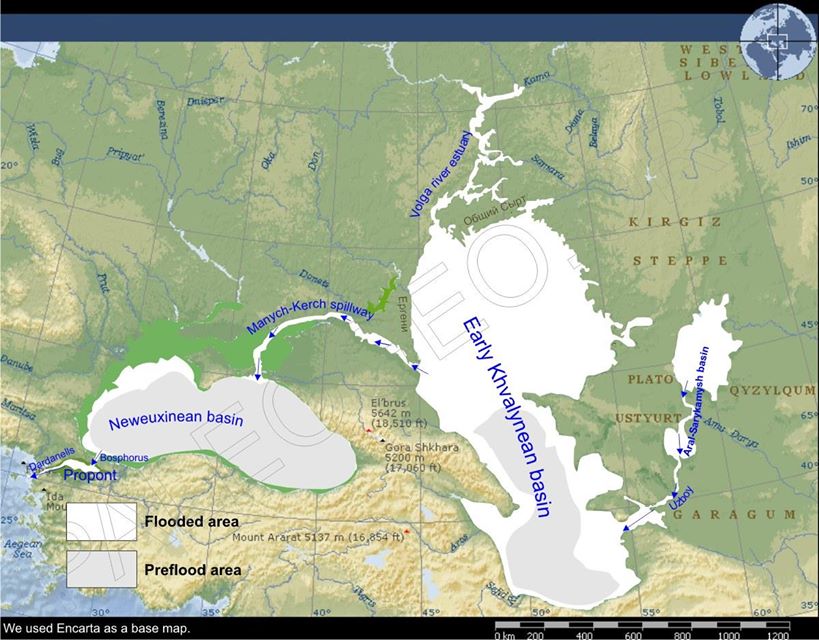
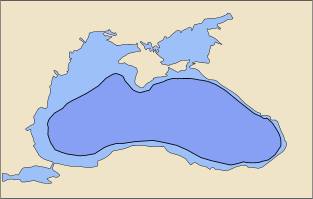
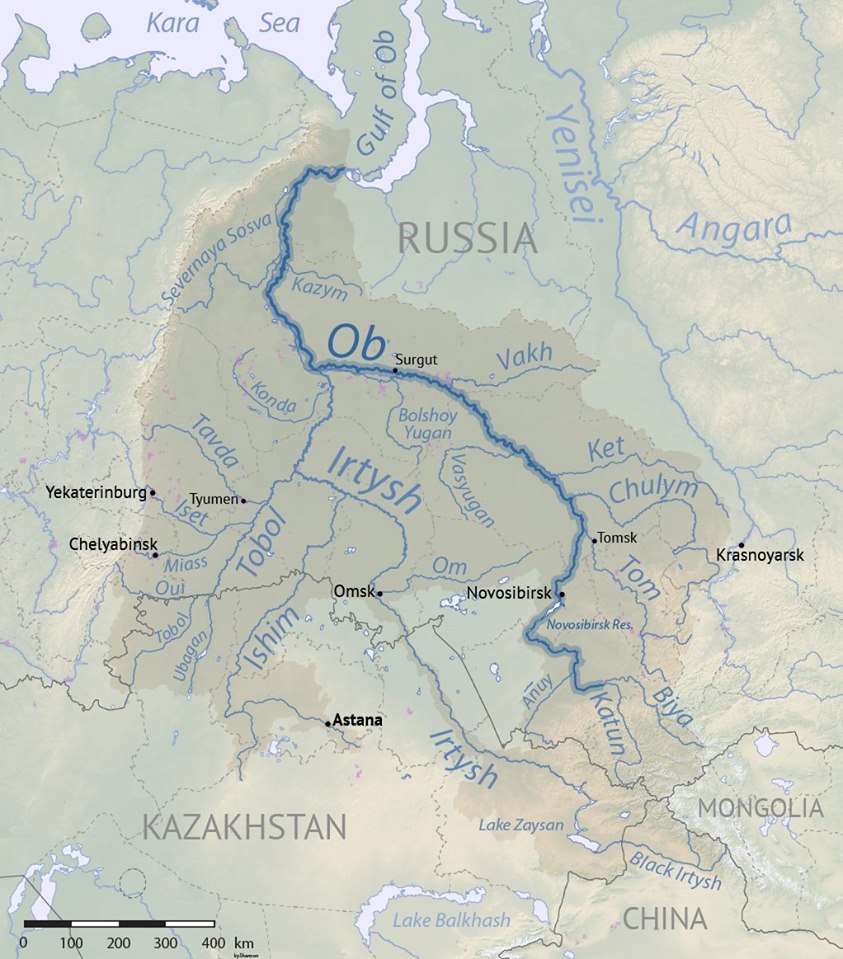
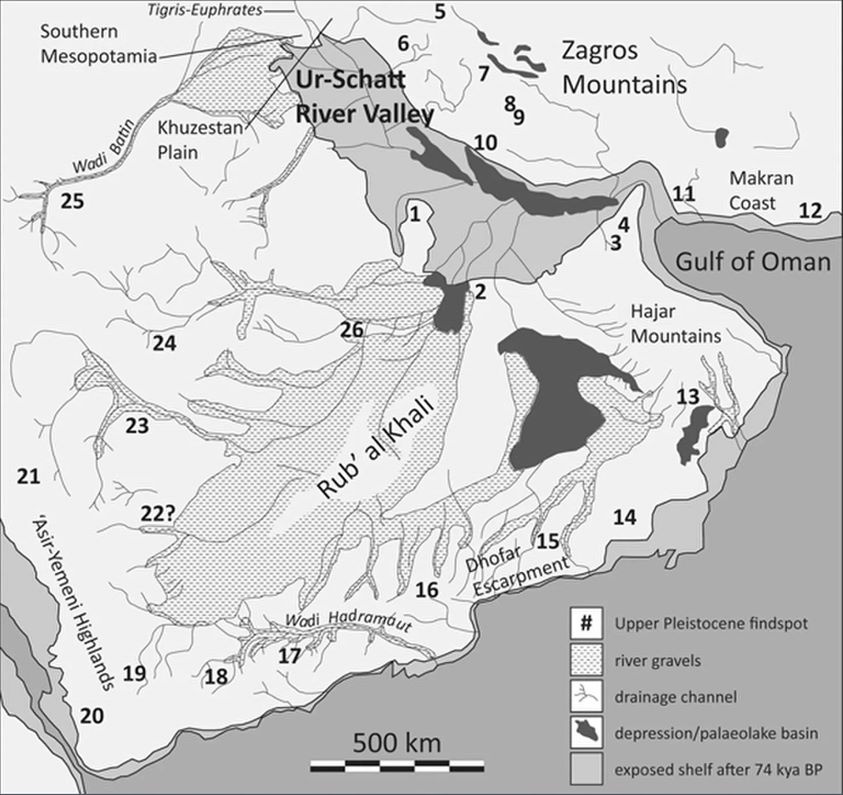
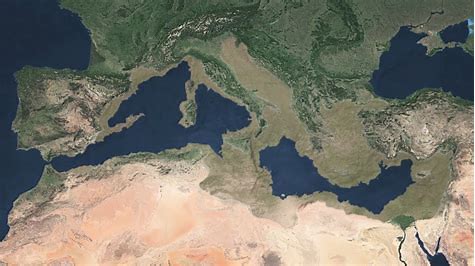
photos_and_videos/TimelinePhotos_SxeO6JU-xg/50550781_10156936558337264_1778979139085139968_o_10156936558332264.jpg photos_and_videos/TimelinePhotos_SxeO6JU-xg/49397699_10156936558442264_5142895841408712704_n_10156936558437264.jpg Radu M Oleniuchttps://medium.com/@nikolaypeshev/7-500-b-c-the-flood-in-the-black-sea-studies-legends-and-disputes-891ac73a2081Jan 23, 2019, 4:01 PMCurt Doolittle( AFAIK the only dispute is the rate and extent. )Jan 23, 2019, 4:49 PM photos_and_videos/TimelinePhotos_SxeO6JU-xg/47032372_10156936558542264_4012363898236698624_o_10156936558537264.jpg photos_and_videos/TimelinePhotos_SxeO6JU-xg/51103734_10156936558412264_3845484593218060288_o_10156936558402264.jpg photos_and_videos/TimelinePhotos_SxeO6JU-xg/50442141_10156936560347264_6421461241255952384_n_10156936560342264.jpg The mediterranean, the persian gulf, the ob river valley, the black sea the caspian sea. There wasn’t just ONE great flood.
—“Debunking Paul Krugman is a little like beating up the special ed kid”– Joe Redtree
–“The Sanctuary Cities have already seceded from the government and actively violated the constitutional requirement for federal control of immigration and naturalization.”—CD
—“Calling someone a purity spiraler is the rights equivalent of calling someone a racist.”—Marie Woods
—“The non-Occidental world worshiped the moon while the Occidents walked on it.”— George Hobbs
—“In the absence of the talent of empathy for others one can only rely on empathy with the self. in the absence of education in natural law we are forced to rely on empathy. As in all things intuition does not scale beyond the trivial.”—
—“The cost of parasitism has been crashing for decades.”— Richard Nikoley
—“We just need to restore the family as the primary insurer such that people struggle to produce families as insurers rather than the state as an insurer with poor judgement.”—CD
—“The only sport left worth watching is politics, and sport left worth participating in is civil war.”—James Santagata
—“Identifying what question one attempts to answer distinguishes the meaningful from the truthful and why these are not always interchangeable.”— Bill Joslin
—“Debunking Paul Krugman is a little like beating up the special ed kid”– Joe Redtree
–“The Sanctuary Cities have already seceded from the government and actively violated the constitutional requirement for federal control of immigration and naturalization.”—CD
—“Calling someone a purity spiraler is the rights equivalent of calling someone a racist.”—Marie Woods
—“The non-Occidental world worshiped the moon while the Occidents walked on it.”— George Hobbs
—“In the absence of the talent of empathy for others one can only rely on empathy with the self. in the absence of education in natural law we are forced to rely on empathy. As in all things intuition does not scale beyond the trivial.”—
—“The cost of parasitism has been crashing for decades.”— Richard Nikoley
—“We just need to restore the family as the primary insurer such that people struggle to produce families as insurers rather than the state as an insurer with poor judgement.”—CD
—“The only sport left worth watching is politics, and sport left worth participating in is civil war.”—James Santagata
—“Identifying what question one attempts to answer distinguishes the meaningful from the truthful and why these are not always interchangeable.”— Bill Joslin
I don’t want a prophet or an equivalent. I don’t even want a leader.
I want to be able to put gas in my truck without having to check if that’s going to cut into our grocery bill.
I want my Daughter to have a lifelong home – but at more than $200k a year we can’t afford in Toronto, because it would take 25 years to pay it off – and we only have about 20 left it us.
I’d like my daughter to be able to form a family and properly care for it without it demanding 60 hour work weeks from both parents (and to the point above – take an entire lifetime to pay off)
I’d like my phone and data bill to not be the second highest investment I make every month (costs as much as a car payment)
I’d like to go a day without having to defend my race, ancestors and culture to my daughter due to nonsense thrown at her daily.
I’d like a future for my progeny that contains happiness which doesn’t resemble a Pyrrhic victory.
I don’t want the future to look back at me, mine and my generation with resentment and regret (like I do to boomer et al) but with respect and inspiration…
And I want the path to achieve this to not require me to turn into a monster to change the course of our civilization.
I don’t want the genocide which is on our horizon.
THE HIDDEN DECLINE IN HUMAN CAPITAL—AND THE DANGER AHEAD
by Peter Temin, Professor Emeritus of Economics, Massachusetts Institute of Technology(MIT).
U.S. GDP accounting underestimates intangible capital, overstates financial capital, and is all but oblivious to the the erosion of human and social capital. A serious growth slowdown is coming.
The American economy changed rapidly in the last half-century. We kept track of this transformation through the National Income and Product Accounts (NIPA), a set of statistical constructs that were designed before these changes started. Our national accounts have stretched to accommodate new and growing service activities, but they are still organized by their original design. This can be seen in the growth of financial activity and the efforts of many economists to fit finance into our measurement of national product and of economic growth. I argue in my paper that our current economic data fail to describe accurately the path of growth in our new economy. They fail to see that the United States is consuming its capital stock now and will suffer later, rather like killing the family cow to have a steak dinner.
Modern growth theory started with two papers by Robert M. Solow in the late 1950s. The first paper showed that it was possible to create a stable model of economic growth using a Keynesian model of investment and capital. The second paper showed that this model failed to explain most of American growth in the first half of the 20th century (Solow, 1956, 1957).
Other economists expanded Solow’s model by adding additional types of capital: human capital, social capital, financial capital. The first addition was to add human capital by measuring the effect of education on productivity. This enabled economists to work with an expanded Solow model. The second addition was to add social capital. This was added in cross-sectional regressions and has not been applied to ongoing growth estimates. The third addition was added by assuming that wealth equals physical capital, that is, financial capital is indistinguishable from physical assets (Mankiw, Romer and Weil, 1992; Hall and Jones, 1999; Dasgupta, 2007; Piketty 2014).
These additions furnished explanations of economic growth in the United States and other countries. The importance of these contributions was confirmed in many empirical studies, but the NIPA continues to calculate Private Fixed Investment, a Keynesian construct, as the investment part of GDP. This problem is acute in the data for finance. Philippon (2015, 1435) concluded that, “The unit cost of financial intermediation does not seem to have decreased significantly in recent years.” As he says, this is surprising on several grounds. I build on his work to understand whether this result is the result of how the underlying data were collected.
This disconnect infects the calculation of economic growth. Griliches (1990, 1994) noted over two decades ago that more and more of GDP is composed of services, which also have been called intangibles. It is hard to estimate the output of the financial sector, for example, so it is measured by its inputs. As I will show, although this may give a useful measure of current activity, it is less informative about economic growth.
There are two problems. It is hard to measure productivity if inputs and outputs are conflated. If we fail to include productivity growth of an increasing part of the national product, we increasingly will underestimate the growth of the national product. Further, if we do not have a good measure of output, it is almost impossible to measure investments in finance and other intangibles. If we do not have good measures of the various forms of capital listed here, we will not be able to think hard about longer-run growth. Concern about this latter point provides the motivation for this paper.
Outside the literature on the national product, there are many treatments of these new forms of capital. In addition to financial capital, human capital has been the center of explanations for the United States’ economic domination in the twentieth century as well as the progress of individuals within the United States (Golden and Katz, 2008; Heckman, Pinto and Savelyev, 2013). Social capital has been the center of analyses of economic growth in the United States and elsewhere and in the long and short run (Putnam, 1993, 2000; Dasgupta, 2007). Measuring these forms of capital poses many of the same problems as measuring financial capital.
I review in this paper the accounting methods used to compile investment data to understand how these other forms of capital behave in an economy that has changed markedly since the 1950s. I conclude that current accounting of growth in GDP fails to include the kind of investment that generates these other forms of capital. This conclusion has three implications. First, short-run growth as currently calculated bears more relation to short-run Keynesian analysis than to what we know about long-run economic growth. Second, financial capital increases inequality more than it generates growth for the entire economy. Third, we are now allowing human and social capital to depreciate, auguring ill for future economic growth in the United States.
Peter Temin is Elisha Gray II Professor Emeritus of Economics at the Massachusetts Institute of Technology (MIT). His “The Political Economy of Mass Incarceration and Crime: An Analytic Model,” has just been published by the International Journal of Political Economy. A revised version of an earlier INET Working Paper, it will be freely available on line for the month after January 5, 2019: https://www.tandfonline.com/do…
References
Dasgupta, Partha. 2007. Economics: A Very Short Introduction. Oxford: Oxford University Press.
Golden, Claudia, and Lawrence F. Katz. 2008. The Race between Eduction and Technology. Cambridge, MA Harvard University Press.
Griliches, Zvi (ed.). Output Measurement in the Service Sectors. Chicago: Chicago University Press, 1990.
Griliches, Zvi. 1994. “Productivity, R&D, and the Data Constraint.” American Economic Review, 84 (1): 1-23.
Hall, Robert E., and Charles I. Jones. 1999. “Why Do Some Countries Produce So Much More Output per Worker than Others?” Quarterly Journal of Economics, 83-116.
Heckman, James, Rodrigo Pinto, and Peter Savelyev. 2013. “Understanding the Mechanisms Through Which an Influential Early Childhood Program Boosted Adult Outcomes.” American Economic Review, 103 (6): 2052-2086.
Mankiw, N. Gregory, David Romer and David N. Weil. 1992. “A Contribution to the Empirics of Economic Growth.” Quarterly Journal of Economics 107 (2): 407-37.
Philippon, Thomas. 2015. “Has the US Financial Industry Become Less Efficient? On the Theory and Measurement of Financial Intermediation.” American Economic Review 105 (4), 1408-1438.
Piketty, Thomas. 2014. Capital in the Twenty-First Century. Cambridge, MA: Harvard University Press.
Putnam, Robert D. 1993. Making Democracy Work: Civic Tradition in Modern Italy. Princeton: Princeton University Press.
Putnam, Robert D. 2000. Bowling Alone: The Collapse and Revival of American Community. New York: Simon and Shuster.
Solow, Robert M. 1956. “A Contribution to the Theory of Economic Growth.” Quarterly Journal of Economics 70: 65-94.
Solow, Robert M. 1957. “Technical Change and the Aggregate Production Function.” Review of Economics and Statistics 39: 312-20.
The 66 percent who said they stopped attending church regularly as young adults cited a variety of reasons for leaving.
The reasons fell under four categories:
Nearly all — 96 percent — cited life changes, including moving to college and work responsibilities that prevented them from attending.
Seventy-three percent said church or pastor-related reasons led them to leave. Of those, 32 percent said church members seemed judgmental or hypocritical and 29 percent said they did not feel connected to others who attended.
Seventy percent named religious, ethical or political beliefs for dropping out. Of those, 25 percent said they disagreed with the church’s stance on political or social issues while 22 percent said they were only attending to please someone else.
And, 63 percent said student and youth ministry reasons contributed to their decision not to go. Of those, 23 percent said they never connected with students in student ministry and 20 percent said the students seemed judgmental or hypocritical.
“We’re tapping into a lot of different feelings and logistical things as well,” said McConnell, pointing out that this age group is often in a time of transition.
But leaving was not an intentional decision for many. Of those who dropped out, 71 percent said they did not plan on it.
photos_and_videos/TimelinePhotos_SxeO6JU-xg/50060776_10156919540572264_3743551245323862016_n_10156919540567264.jpg LEDDIHN’S HERD VS PACK
by Skye Stewart
Leddihn was very well cultured, a polyglot, and world traveler (86 countries).
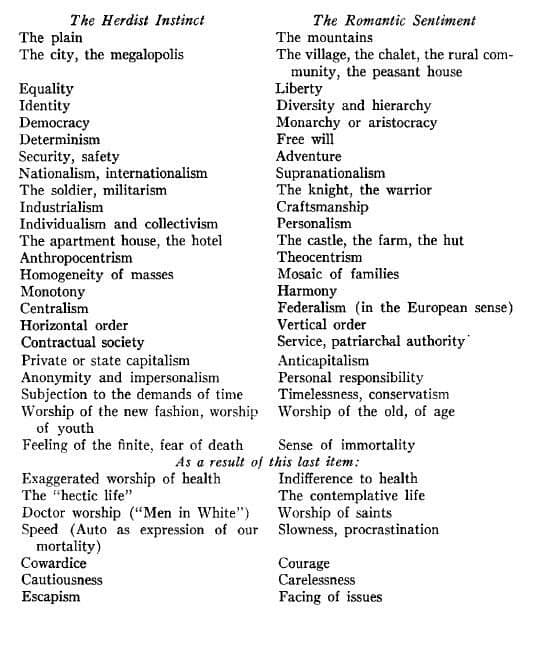
He thought lefties were herdists, open perhaps in some sense but close minded in most others.
He charted these things as thus:Kari Anne Dorstad86 countries is very impressive !Jan 15, 2019, 7:38 PMJean LeonardWhere can I find more information on this?Jan 15, 2019, 10:00 PMCurt DoolittleSkye Stewart ^Jan 15, 2019, 10:52 PMDomagoy WattsHerdist vs Herder sentiment would have been more frank. There is a “jewy” quality to the mountains for the lack of a better word, going back to Mesopotamia (conflict of agricultural, settled Sumerians and their “Great Earth Mother” vs. patriarchal, herder progeny of Adam and his mountain god). Mountains are never the centers of civilizations and empires and are often regarded by the lowlanders as a the dwelling place of demons and damned. There is a ferocious aristocracy in the lowlands as well, especially in undomesticated and semi-domesticated lowlands – as in steppes. The aristocracy of horsemen often know how to remind mountain folks why they like to hide in the mountains to begin with. I’m a lowlander 100%.Jan 16, 2019, 6:41 AMChip SillsMontani semper liberiJan 16, 2019, 9:30 AMDomagoy WattsReiterlied
Wohlauf, Kameraden, aufs Pferd, aufs Pferd!
Ins Feld, in die Freiheit gezogen!
Im Felde, da ist der Mann noch was werth,
Da wird das Herz noch gewogen,
Da tritt kein Anderer für ihn ein,
Auf sich selber steht er da ganz allein.
Aus der Welt die Freiheit verschwunden ist,
Man sieht nur Herren und Knechte;
Die Falschheit herrschet, die Hinterlist
Bei dem feigen Menschengeschlechte.
Der dem Tod ins Angesicht schauen kann,
Der Soldat allein ist der freie Mann!
https://kalliope.org/en/text/schiller2001102413Jan 16, 2019, 10:10 AMLEDDIHN’S HERD VS PACK
by Skye Stewart
Leddihn was very well cultured, a polyglot, and world traveler (86 countries).
He thought lefties were herdists, open perhaps in some sense but close minded in most others.
photos_and_videos/TimelinePhotos_SxeO6JU-xg/49730867_10156918955547264_5961805221238669312_o_10156918955542264.jpg photos_and_videos/TimelinePhotos_SxeO6JU-xg/49257776_10156918955582264_4103268169546727424_o_10156918955572264.jpg photos_and_videos/TimelinePhotos_SxeO6JU-xg/50063377_10156918955567264_1744997963429576704_o_10156918955557264.jpg photos_and_videos/TimelinePhotos_SxeO6JU-xg/49339083_10156918955917264_4499852985664274432_o_10156918955907264.jpg photos_and_videos/TimelinePhotos_SxeO6JU-xg/49938596_10156918955897264_1455433136644030464_o_10156918955887264.jpg SITE UPDATE (INSTITUTE, BLOG)
The Social Media (Collaboration) features are all working now.
1) The Feed = FB’s Home.
2) My Page = FB’s Profile Page
3) My Education = Classes I’m involved in.
4) Everyone(Forum) = FB Group (feed) with attached forum(topics).
5) Course Catalog.
You can:
1) Sign up for the mailing list
2) Register to participate in the chit chat (when there IS some)
3) Fill out your profile a bit.
Almost There….
4) (soon) Apply for Membership (taking classes).
(Application is just a way of making sure you know that this is real university level courses and that it’s real work, and that you aren’t an antagonist or some such thing…. etc).
TO DO:
1) Just a little more marketing blurbs, terms, and other nonsense to add.
WORDS IN RUSSIAN BUT NOT IN ENGLISH TELL US A LOT ABOUT RUSSIAN EMOTIONAL NORMATIVITY
1. Poshlost
Russian-American writer Vladimir Nabokov, who lectured on Slavic Studies to students in America, admitted that he couldn’t translate this word, which every Russian easily understands.
What is poshlost (пошлость)? Nabokov gives the following example: “Open any magazine and you’ll certainly find something like this – a family just bought a radio (a car, a refrigerator, silverware, it doesn’t matter), and the mother is clapping her hands, mad with joy, the children gathered around her with their mouths agape; the baby and the dog are leaning towards the table on which the `idol’ has been hoisted… a bit to the side victoriously stands the father, the proud breadwinner. The intense “poshlosity” of such a scene comes not from the false exaggeration of the dignity of a particular useful object, but from the assumption that the greatest joy can be bought and that such a purchase ennobles the buyer.”
“This word includes triviality, vulgarity, sexual promiscuity and soullessness,” added the late Professor Svetlana Boym from Harvard University.
2. Nadryv
German Wikipedia has an entire article dedicated to the word nadryv (надрыв). This is a key concept in the writings of Russian writer Fyodor Dostoevsky. The word describes an uncontrollable emotional outburst, when a person releases intimate, deeply hidden feelings.
Moreover, Dostoevsky’s nadryv implies a situation in which the protagonist indulges in the thought that he can find in his soul something that may not even exist. That’s why the nadryv often expressed imaginary, excessively exaggerated and distorted feelings. One part of the novel, Brothers Karamazov, is called “Nadryvs.”
3. Khamstvo
Soviet émigré writer Sergei Dovlatov wrote about this phenomenon in the article “This Untranslatable Khamstvo,” commenting that “Khamstvo is nothing other than rudeness, arrogance and insolence multiplied by impunity.”
In Dovlatov’s view, it’s with impunity that khamstvo (хамство) outright kills us. It’s impossible to fight it; you can only resign yourself to it. “I’ve lived in this mad, wonderful, horrifying New York for ten years and am amazed by the absence of khamstvo. Anything can happen to you here, but there’s no khamstvo. You can be robbed but no one will shut the door in your face,” added the writer.
4. Stushevatsya
Some linguists believe stushevatsya (стушеваться) was introduced by Fyodor Dostoevsky, who used it for the first time in a figurative sense in his novella, The Double. This word means to be less noticeable, go to the background, lose an important role, noticeably leave the scene, become confused in an awkward or unexpected situation, become meek.
5. Toska
This Russian word can be translated as “emotional pain,” or “melancholy,” but this does not transmit all of its depth. Vladimir Nabokov wrote that, “Not one word in English can transmit all the nuances of toska (тоска). This is a feeling of spiritual suffering without any particular reason. On a less dolorous level, it’s the indistinct pain of the soul…vague anxiety, nostalgia, amorous longing.”
6. Bytie
This word comes from the Russian byt'(to exist). In Russian-English dictionaries this philosophical concept is translated as “being.” However, bytie (бытие) is not just life or existence, it’s the existence of an objective reality that is independent of human consciousness (cosmos, nature, matter).
7. Bespredel
Eliot Borenstein, professor of Slavic Studies at New York University, explains that bespredel (беспредел) literally means “without restrictions or limits.” Translators often use “lawlessness” (bezzakonie). In Russian, however, the meaning of bespredel is much broader, and refers to the behavior of a person who violates not only the law, but also moral and social norms.
8. Avos’
It’s rather difficult to explain to people of other nationalities what this means. Interestingly, many people believe that avos’ (авось) is the main Russian national trait. Hoping for the avos’ means doing something without planning, without putting in much effort, counting on success.
9. Yurodivy
Yurodivy: Russian ‘Umberto Eco’ demystifies the Holy Fool
Yurodivys (юродивые) in ancient Rus’ were people who voluntarily renounced earthly pleasures in the name of Christ. Such people looked like madmen, and led a wandering lifestyle with the aim of obtaining inner peace and defeating the root of all sin – pride. They were valued and were considered close to God. Their opinions and prophecies were taken into consideration and they were even feared.
10. Podvig
This word is often translated into English as “feat” or “achievement,” but it has other meanings. Podvig (подвиг) is not just a result, or the achievement of an objective; it’s a brave and heroic act, an action performed in difficult circumstances. Russian literature often mentions military, civilian podvigs and even scientific podvigs. Moreover, this word is a synonym for selfless acts, for example, a podvig in the name of love.
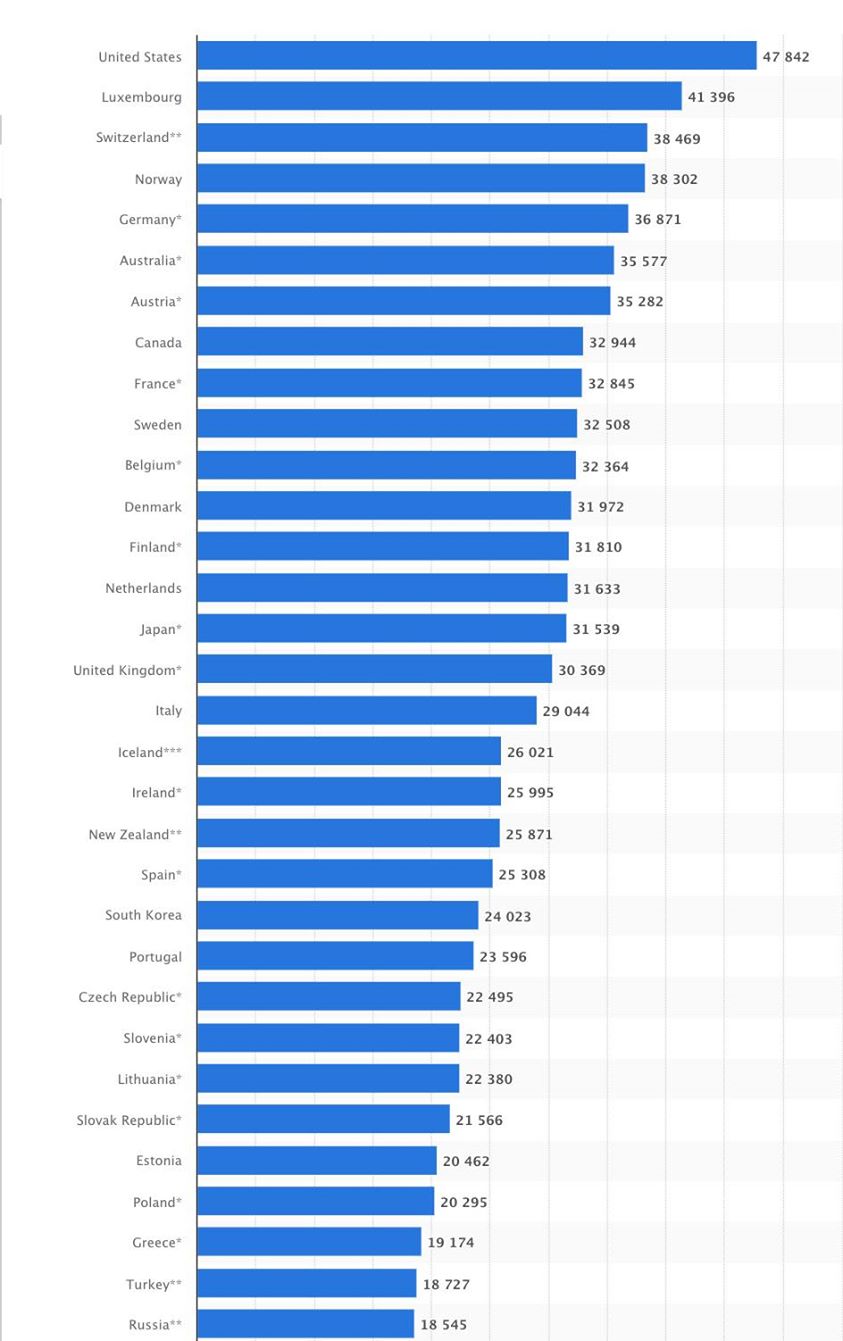
photos_and_videos/TimelinePhotos_SxeO6JU-xg/49813504_10156915427212264_6875945394799378432_o_10156915427207264.jpg Gross adjusted household disposable income per capita of OECD countries in 2017 (in U.S. dollars)
WHY BRITS SEEM POOR (THEY ARE)Gregory GichevI wanna eventually learn more about SwitzerlandJan 13, 2019, 10:09 PMCurt DoolittleThere is nothing to learn. Superior people and culture, superior geographic position, offering banking services to wealthy people who seek to avoid abusive taxation. Now, aside from that it’s fucking gorgeous, and the men all serve in the militia so they’re fit. etc. But they’re swiss german and they still have no fucking sense of humor…lolJan 13, 2019, 10:13 PMCurt DoolittleThe best country you can have is one that has a militia, white collar biz, the siwss method of governmnet, and a SMALL POPULATION. The trick isto be SMALL and WHITE.Jan 13, 2019, 10:14 PMDemelza HaysThat’s why I live in Liechtenstein :)Jan 13, 2019, 10:47 PMDemelza HaysAKA Switzerland on steroids.Jan 13, 2019, 10:47 PMDarren HowellDon’t know how Australia made it that high on the list? Certainly not representative of folks I know 😔Jan 13, 2019, 10:52 PMMichael DetrickIt would be very interesting to see a graph of the GAHDI per capita (isn’t there a glitch in saying “household” and “per capita” together?) adjusted to the cost of living in each of these countries as well as a comparison of the cost of living and the standard of living. Given these variables and based on my travels to many of the countries on this list, I would tend to predict that the USA will still be at the top of the list. All the more reason for us to adopt socialist policies so we can all be poor and miserable together.Jan 13, 2019, 11:08 PMKari Anne DorstadWell im happy to know that this is just a gross assessment! Yes I totally understand that ! I’ll pass all this info on to the next generation !Jan 14, 2019, 12:47 AMJohn ReevesLet a thousand Liechtensteins bloom! (Each with their own nuclear arsenal 😏)Jan 14, 2019, 12:59 AMJohn ReevesMurrika is wealthy because of our diversity and faith in God (Israel).Jan 14, 2019, 1:01 AMVengefül BobmoranIt’s amazing how much richer USA is compared to the other White and ‘new’ countries.
Also, WTF Canada, how can you be so poor while sharing so much with USA?Jan 14, 2019, 1:58 AMScott CameronMost of the big gains in personal wealth in the UK come from real estate. There are more people living in England (50+ million) than there are living in California (37 million) and the population keeps increasing despite a sub replacement birth rate. That’s why the British pay the highest real estate taxes in the world.Jan 14, 2019, 1:59 AMJohn ReevesThe UK is a giant real estate ponzi scheme. A more extreme, concentrated version of what boomers are doing in the US.Jan 14, 2019, 2:00 AMLucy GummyScott Cameron British millennials are so poor it’s not even funnyJan 14, 2019, 3:10 AMScott CameronLucy Gummy https://www.youtube.com/watch?v=LrniPwzF7dQJan 14, 2019, 3:12 AMPhill KnyspelDoes this account for welfare like healthcare? Because brits do have access to that.Jan 14, 2019, 3:17 AMLars Lessingand forcing your USD on everybodyJan 14, 2019, 3:22 AMAlex MacleodAccess only in principle.Jan 14, 2019, 3:24 AMLisa OuthwaiteYeah, they have to force us to pay for that because nobody in their right mind would do so voluntarily.Jan 14, 2019, 3:24 AMCody CoxThis doesn’t accurately reflect income disparity and is misleading. I’ll bet a steak dinner that the average US joe is poorer than the average Brit.Jan 14, 2019, 3:26 AMSteven JacksonPhill Knyspel well we pay (those of us who work) £250/month for the privilege of waiting 3 weeks to see a gp and 8 hours in a&eJan 14, 2019, 4:07 AMLisa Outhwaite70% of the NHS budget goes towards treating lifestyle choice diseases. After pensions, it is our largest outgoing so in effect we spend more on managing people’s sugar habits than we do defence and education combined.Jan 14, 2019, 4:40 AMFrancesco Principi…like the italiansJan 14, 2019, 4:41 AMSteven JacksonLisa Outhwaite exactly, we pay to keep the irresponsible supplied with drugs and surgery when 90+% of the time a change in lifestyle or diet would cure everything.
Also, cousin marriage and birth defects are putting stress on the system hereJan 14, 2019, 4:50 AMPhill KnyspelI am not interested in arguing the merits and cons of state provided healthcare I was just pointing out that this should be included in regards to gdp per capita and the same goes for education.Jan 14, 2019, 5:21 AMPhill KnyspelAlso you only wait 8 hours because the nhs is strained due to mass migration. If this was reduced the nhs would be fine .Jan 14, 2019, 5:23 AMPhill KnyspelHow much would an insurance plan in the USA cost that covers everything like the nhs does cost?
Serious question to any American because I have no idea .Jan 14, 2019, 5:24 AMSteven JacksonPhill Knyspel that’s why I said £250/month is the average people pay towards the NHS. Business pays a good bit and some is redirected from other taxes.
Migration is not the only problem, it’s a government run system, management grows exponentially while the labour shrinks. Tenders for supplying the NHS are always overpriced, drugs cost the NHS many times more than supermarkets or private pharmacies. It’s unsustainable because it is not market based.Jan 14, 2019, 5:27 AMPhill KnyspelOk well how much do americans pay? How much is their average insurance plan that would provide the same service that I currently have access to in the uk ?Jan 14, 2019, 5:29 AMLisa OuthwaiteNHS is a monstrous cash-cow for pharmaceuticals, that feed off a sick and ageing population as a guaranteed source of income and with no market competition. It needs disbanding and replacing with something more competitive.Jan 14, 2019, 5:30 AMPhill KnyspelLisa Outhwaite how much does your current insurance plan cost and what are you not covered for ?Jan 14, 2019, 5:31 AMLisa OuthwaitePhill Knyspel I live in the UK.Jan 14, 2019, 5:32 AMSean RingWhat kind of tax deductions do Germany, Australia, Austria, and Canada have? Their tax rates are punitive. Is it because they have a high population of tax-savvy entrepreneurs?Jan 14, 2019, 6:03 AMNïcholas JüryMight be skewed due to the amount of billionaires who live in the US 🤷🏼♂️Jan 14, 2019, 7:10 AMGordon E. ComstockDemelza Hays So steroids make your country small. Good to know!Jan 14, 2019, 7:38 AMCurt DoolittleJan 14, 2019, 8:57 AMCurt DoolittleJan 14, 2019, 9:00 AMCurt DoolittleTHE USA FAVORS THE MIDDLE. THE UK THE BOTTOM.Jan 14, 2019, 9:03 AMCurt DoolittleJan 14, 2019, 9:03 AMCurt DoolittleThe UK will get worse faster from immigration of the third world than the usa.Jan 14, 2019, 9:04 AMCurt DoolittleITALY IS NOT A POOR COUNTRY.Jan 14, 2019, 9:05 AMCurt DoolittleITALY VS UK
https://countryeconomy.com/countries/compare/italy/ukJan 14, 2019, 9:05 AMCurt DoolittleIt is better to be poor in the uk, working class in canada, middle class in the usa, and it doesn’t matter WHERE you are upper middle outside of western civ. And it doesn’t matter where you are upper anywhere.Jan 14, 2019, 9:06 AMCurt DoolittleNote that middle-class in usa != middle class uk.Jan 14, 2019, 9:07 AMFrancesco PrincipiCurt you must consider that the quality of the pubblic administration in Italy are worst then in UK by far.Jan 14, 2019, 9:09 AMDeclan CahillIreland could’ve been like the swissJan 14, 2019, 9:15 AMCurt DoolittleOf course, yes, but that only means that italy would be as wealthy as france with better administration. (which would require better law, better courts, and an intolerant public)Jan 14, 2019, 9:23 AMZachary BertCan I come visit any of you?
I was looking at Ukraine or Mongolia.Jan 14, 2019, 11:20 AMZachary BertWhat [[[Kind]]] Of American?Jan 14, 2019, 11:21 AMPhill KnyspelOk so you live in the uk .Well the American healthcare system ranks lower than the uk in basically every metric .Jan 14, 2019, 11:28 AMLisa OuthwaitePhill Knyspel That doesn’t alter any of the points I’ve made above. Saying that another system is worse, hardly bolsters the argument.Jan 14, 2019, 11:37 AMPhill KnyspelEvery instance of a free market healthcare system accounting for similar populations is inferior.
Handing healthcare entirely to the free market always results in a more expensive and inferior service for everyoneJan 14, 2019, 11:39 AMCurt DoolittleTotal Taxes per Person in the USA is:
$8,943 (states vary from 4kpp to 16kpp in Delaware.
Rough cost of medicaid per person in the USA is:
$2k for child
$3-4k for Adults
$10k for the aged. (=3+ adults)
$20k for the disabled (=5+ adults)
The Private sector pays for working folk, and the public for non-working folk. Realistically working folk pay for themselves AND non-working folk.
The USA Spends waaaay more on healthcare per capita than any other country, but then we have AMAZING health care compared to every other country.
– Per capita national health expenditures:
$10,348 (2016)
– Total national health expenditures:
$3.3 trillion (2016)
– Total national health expenditures as a percent of Gross Domestic Product:
17.9% (2016)
– Percent of national health expenditures for hospital care:
32.4% (2016)
– Percent of national health expenditures for nursing care facilities and continuing care retirement communities:
4.9% (2016)
– Percent of national health expenditures for physician and clinical services:
19.9 (2016)
$- Percent of national health expenditures for prescription drugs:
9.8% (2016)
Principle differences:
1 – Waiting Time and time wasted. (best in usa)
2- Quality of customer service (Best in canada)
3 – Quality of Facilities (best in usa)
4 – Life extension (usa or canada)
5 – No ‘death panels’. (usa)
The USA follows the general rule that if you want to pay for it you can have it, and if you can’t pay for it you can have what we can justify. The USA is a middle class paradise. If you are working class then canada is better, and if you are underclass britain is better.
Aussies and americans have more in common.
Canadians and Brits have more in common.
Germans and americans have more in common than brits and americans.
Italians and americans have more in common than french and americans.
Very interesting.Jan 14, 2019, 11:48 AMWill HarmThe United States is the third most populous nation in the world and this based on the average. It would be interesting to see this broken down by state.Jan 14, 2019, 12:13 PMSamiran BhaleUK is clearly ahead of Italy it seemsJan 14, 2019, 1:44 PMSean RingFrancisco, Italian healthcare is far superior to the NHS. For the little guy, that matters, no?Jan 14, 2019, 4:46 PMAngadjeet SangheraVeeeery interesting.Jan 14, 2019, 5:10 PMGabriel YbarraThey’re the most broken people on Earth.Jan 15, 2019, 4:54 PMGross adjusted household disposable income per capita of OECD countries in 2017 (in U.S. dollars)