Form: Definition

  • Mysticism generally refers to the experience, belief, or pursuit subjective emot

    Mysticism generally refers to the experience, belief, or pursuit subjective emotional states constructed from the combination of the disassociation, submission to the pack response and the abandonment of responsibility, and conscious thought, resulting in positive auto-associations and continous emotional feedback from them, producing a state of extraordinary calm. This process, if practiced regularly, can assist in the formation of mindfulness, the demand for which increases dramatically as populations and divisions of labor increase and therefore certainty and agency decrease. It is one of the easiest disciiplilnes for most humans to learn and can be achived by multiple personal, social, political, or even conceptual means.

    In simple scientific terms it assists in the transformation from socially regulated life in hunter gatherer tribes to complex agrarian life and modern technological life that are increasingly alienating, and because of neuroticism, particularly in women, and generate greater demand for mindfulness.

    Mindfulness is the primary reason religions succeed in providing incentive to adopt the various rituals that demands self regulation and non aggression and forgiveness of those who offend.

    Reply addressees: @SirSmokesAaLot


    Source date (UTC): 2024-01-08 19:19:45 UTC

    Original post: https://twitter.com/i/web/status/1744438760740147200

    Replying to: https://twitter.com/i/web/status/1744432723781951860

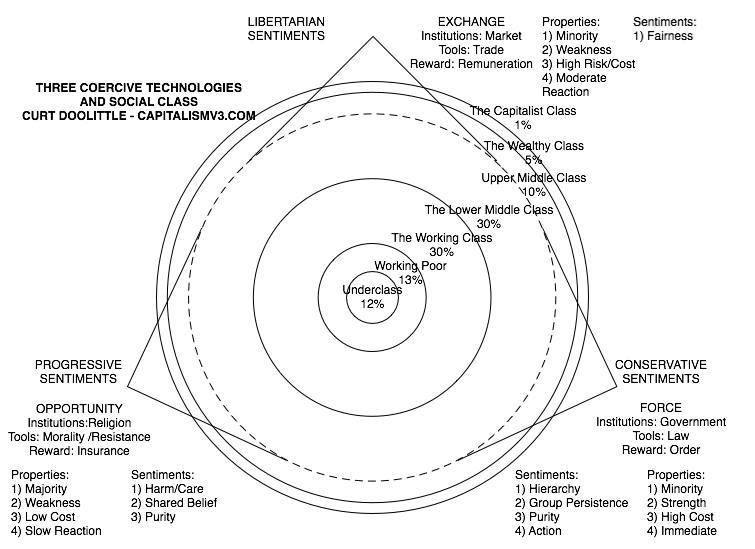
  • Original Diagram of Ternary Logic of Social Organization

    Original Diagram of Ternary Logic of Social Organization

    Original Diagram of Ternary Logic of Social Organization https://t.co/8dREjlb8v8


    Source date (UTC): 2024-01-08 16:31:20 UTC

    Original post: https://twitter.com/i/web/status/1744396379760230462

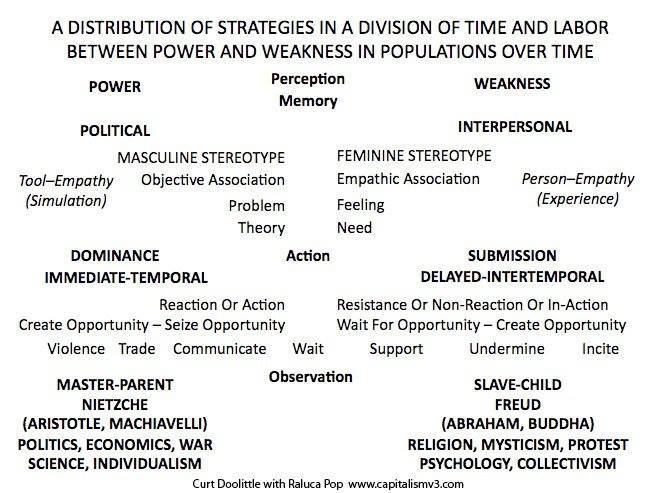
  • Original Diagram of Sex Differences in Cognition and Valence

    Original Diagram of Sex Differences in Cognition and Valence

    Original Diagram of Sex Differences in Cognition and Valence. https://t.co/63yC0JO83g


    Source date (UTC): 2024-01-08 16:29:11 UTC

    Original post: https://twitter.com/i/web/status/1744395836220477913

  • I suppose I should help clarify the subject by disambiguating terms. Calculation

    I suppose I should help clarify the subject by disambiguating terms.

    Calculation in the broadest sense consists of the transformation of inputs into outputs. This is a process of deduction. (top down) Mathematics is Calculation.

    Computation in the broadest sense is the performance of operations. (bottom up) in the absence of deduction, induction, or inference. Arithimetic is computation.

    Probability, in now-popular AI, this difference is now re-conflated and restored to ambiguity because our computers, perform computations, using human-derived calculations, to produce bayesian accounting probabilities, as if they were inferences, because the number of dimensions of measurement and number paramaters exceed the human ability to calculate, in the category we call artificial intelligence. And since all langauge is reducible to measurements, where the measurement consists of a dimension that is subjectively testable by human experience, while still retaining it’s reducability to mathematical expression by substitution of arbitrary numbers as names and values as weights instead of natural naming (vs cardinal or ordinal).

    Machines cannot perform mathematics however, they may perform computations, and therefore may perform arithmetic. Even though, as painful as it is, division is still a matter of tabular trial and error. Just as so much of mathematics is a matter of ‘fitting’.

    I find math boring but I find the foundations of math, logic, and all the grammars (rules of continuous recursive disambiguation) fascinating. πŸ˜‰

    Reply addressees: @Zamicol @cryptogeni


    Source date (UTC): 2024-01-08 13:40:22 UTC

    Original post: https://twitter.com/i/web/status/1744353353725816832

    Replying to: https://twitter.com/i/web/status/1744169409831145592


    IN REPLY TO:

    Unknown author

    THE GODEL NONSENSE IS AN INTERGENERATIONAL INFECTION. πŸ˜‰
    –“There’s no proof that everything is computable. Information theory is in agreement with GΓΆdel.”– Replying to @Zamicol and @cryptogeni

    That is a naive statement. You are confusing the limits of mathematics with the limits of computation and not grasping computation as a sequence of possible operations. The fact is if the universe can construct anything at all – if ANYTHING can exist, then it is computable because there is no difference between computation and construction by permutation.

    The difference is that mathematics is universally statistical (categorical) so that we can predict what is mathematically reducible, and that is only a subset of what is computable. The problem with computability is that there is no means of prediction – there is only a means of trial and error.

    You also misunderstand Godel. The point is that not everything is provable because there is no closure to computability, and provability is a statement about logic given a set of fixed premises and not about existential possibility. Furthermore, the proof appears to be limited to arithmetical operations and nothing more complicated.

    It appears you also misunderstand information theory given that the purpose of the theory is to explain the problem of entropy and noice precisely because of the information loss in mathematical (verbal, ideal) reduction vs computational (operational,real) procedures is due precisely to the fact that mathematics loses information and computation doesn’t (at least down to -35 decimal places).

    I did not realize until the early nineties that this false understanding of Godel was spreading like a virus with each new generation of students learning programming – but who have no basic comprehension of its narrowness. However, there are authors who have written books, one in particular that I can’t recall off the top of my head, that I felt was largely accessible to the STEM degree-educated population.

    I hope this helps you at least head in the right direction.
    Let me know if you require further explanation.

    Cheers

    Original post: https://x.com/i/web/status/1744169409831145592

  • (Definitions) –Q: Curt: Please explain the difference between ‘Western’ Europea

    (Definitions)
    –Q: Curt: Please explain the difference between ‘Western’ European, ‘European’, ‘Western European’ and ‘Northern European’ (etc.)?–

    TLDR; European narrow continental civ vs western broad including americas, australia, new zealand civ.

    In academic discourse, the terms are often used in relation to civilization, but have slightly distinct meanings:

    1) Western – Broader(broadest) ethnic, cultural, and philosophical designation not defined strictly by ethnicity or geography.
    – Encompasses political ideas, cultural norms, and intellectual traditions that emerged in Europe but are not limited to Europe geographically.
    – Includes Europe itself but also societies strongly influenced by European colonialism and migration, such as the Americas and Australia.
    – Emphasizes shared heritage of Greco-Roman, Christian, liberal democratic and Enlightenment values rather than a specific ethnic subset of the european identity.

    2) European – Refers specifically to the nations and peoples of the European continent. May also include offshoot societies founded principally by European colonization, such as the Americas.
    – Principally an ethnic and geographic term referring to European heritage and place of origin.

    3) Western European – Refers to the countries in the western part of Europe, often including:
    – The UK, France, Germany, Switzerland, Austria, Netherlands, Belgium, etc.
    – Characterized by Romance and Germanic language groups.
    – Heavily influenced by both Protestant and Catholic branches of Christianity.
    – Represents the Latin/Romanized areas of Western Christendom.

    4) Northern European – Refers to countries in the northern part of Europe, including:
    – The Nordic nations – Denmark, Norway, Sweden, Finland, Iceland, amd may include Germany, Netherlands, UK, Ireland.
    – Historically shaped by Norse and Germanic cultures.
    – Protestant Christianity and Lutheranism had significant influence.

    Latin (Southern) Europe – Refers to the southern region influenced by ancient Rome and the Catholic church.
    – Defined as including: Portugal, Spain, France, Italy, Romania, with influence extending into Wallonia, Switzerland, and other regions.
    – It represents the Latinate branch of Western Christianity and European culture, as contrasted with Germanic, Slavic, and Nordic Europe. The term emphasizes the shared Romance language and religious heritage of the region.

    Eastern European – Refers to the broad region east of Germany/Austria, including the countries of the eastern region of Europe:
    – It contains distinct sub-cultures defined by religion, empires, and Slavic vs Baltic languages. But overall represents a coherent historical/geographic Eastern European civilization.
    – The Slavic language group: Russia, Poland, Czechia, Slovakia, Slovenia, Croatia, Serbia, Bulgaria, Ukraine, Belarus.
    – The Baltic states: Lithuania, Latvia, Estonia.
    Hungary, Romania, Moldova.
    – Albania and Greece are sometimes included though distinct linguistically.
    Key subgroups within Eastern Europe:
    – Central Europe – Czechia, Slovakia, Hungary, Poland, Slovenia. Catholic Christian and Germanic/Austrian influenced.
    – The Balkans – Croatia, Serbia, Bulgaria, Greece, Albania. Historically part of the Ottoman Empire.
    – Slavic East – Russia, Belarus, Ukraine. Orthodox Christian. Heavily influenced by Russian culture and Soviet communism.
    – Baltics – Lithuania, Latvia, Estonia. Protestant historically but spent time under Soviet control.
    (Note that while eastern europe consist of baltic and slavic branches of europeans and their languages, and traditionally we have included the baltics in the slavic branch, the culture has almost entirely converted to the western european model.)
    Source date (UTC): 2024-01-06 14:51:53 UTC

    Original post: https://twitter.com/i/web/status/1743646576545841152

  • DEFINE SUBLIME? The concept of the sublime is addressed in aesthetics, philosoph

    DEFINE SUBLIME?
    The concept of the sublime is addressed in aesthetics, philosophy, and art, referring to a quality of greatness or grandeur that transcends the ordinary and evokes a sense of awe, wonder, and sometimes even fear. It’s an experience that surpasses mere beauty and encompasses the overwhelming, vast, and awe-inspiring.

    If I ‘science’ the experience of sublime, it will depress you with it’s simplicity. Like many experiences it’s origin is in human aquisitiveness when discovering opportunity resources and scale with.ut risk. – So let’s stick to the definition of it before we science it/ πŸ˜‰

    Definition of the Sublime

    The Sublime: Traditionally, the sublime refers to aspects of nature or art that are great beyond all measure and incomprehensible in terms of ordinary human experience. It is often associated with feelings of awe, reverence, and even fear in the face of something much larger or more powerful than oneself.

    Experience of the Sublime: The experience of the sublime is a complex emotional response that combines awe, wonder, and sometimes terror or a sense of insignificance in the face of something vast and beyond human comprehension. It is often described as a profound and transformative experience.

    Means by Which People Experience the Sublime

    Nature:Vast and powerful natural phenomena such as mountains, oceans, thunderstorms, or the starry night sky are common triggers for the experience of the sublime. These natural elements evoke a sense of awe due to their immense scale, power, or beauty.

    Art and Music: Certain works of art and music can evoke the sublime. This could be through grand and dramatic compositions, artworks of immense scale or profound depth, or music that evokes a deep emotional response.

    Literature and Poetry: Literature, especially poetry, can convey the sublime through language that evokes vastness, deep emotion, or speaks to the universal human condition.

    Architecture: Grand architectural structures, like cathedrals or skyscrapers, especially those that dwarf human scale or represent human ingenuity, can elicit feelings of the sublime.

    Space and Astronomy:The contemplation of the universe, its vastness, and the mystery of celestial bodies can lead to experiences of the sublime.

    Philosophical and Religious Contemplation: Engaging with profound philosophical ideas or religious experiences can also evoke the sublime, particularly when they involve contemplation of the infinite, the divine, or existential questions.

    Extreme or Limit Experiences: Activities that push human limits, such as extreme sports or exploratory ventures into unknown territories, can also lead to experiences of the sublime.

    Conclusion
    The sublime is thus a multifaceted concept that is experienced through various means, often involving encounters with vastness, power, beauty, or the profound. It is an experience that transcends the everyday and has the power to deeply move and affect individuals.

    Cheers


    Source date (UTC): 2024-01-02 03:31:22 UTC

    Original post: https://twitter.com/i/web/status/1742025765334462464

  • (NLI Micro Lesson) Article I.IV: The Natural Law Section: Terms of Cooperation T

    (NLI Micro Lesson)
    Article I.IV: The Natural Law
    Section: Terms of Cooperation
    There exists only one Natural Law of Cooperation and that is Reciprocity; where reciprocity preserves sovereignty, and sovereignty preserves self determination, and self determination preserves individual and group evolutionary computation, and evolutionary computation defeats the dark forces of time, ignorance, and the risks of flora, fauna, mankind, geology, climate, sun, solar system, galactic, and universal disgregard for our condition, survival, persistence or existence.

    ANALYSIS
    The paragraph you provided presents a series of philosophical and metaphysical assertions that connect several broad concepts. Let’s break it down for clarity and examine its components:

    “There exists only one Natural Law of Cooperation and that is Reciprocity”:This statement posits that reciprocity (mutual exchange for mutual benefit) is the foundational principle or ‘natural law’ governing cooperative behavior. In various philosophical and ethical frameworks, reciprocity is indeed considered a key element in fostering cooperation among individuals and groups.

    “…where reciprocity preserves sovereignty, and sovereignty preserves self determination”:Here, the claim is made that reciprocity leads to the preservation of sovereignty (the authority of a state to govern itself or another state), and in turn, sovereignty ensures self-determination (the process by which a group of people, usually possessing a certain degree of national consciousness, form their own state and choose their own government).
    This linkage suggests a flow from interpersonal or organizational ethics (reciprocity) to political theory (sovereignty and self-determination).

    “…and self determination preserves individual and group evolutionary computation”:The term “evolutionary computation” is generally used in the context of algorithms and artificial intelligence and refers to problem-solving systems based on the principles of biological evolution.
    In this statement, it seems to metaphorically suggest that self-determination contributes to the development or progress (evolution) of individuals and groups, possibly in a cultural or societal sense.

    “…and evolutionary computation defeats the dark forces of time, ignorance, and the risks of flora, fauna, mankind, geology, climate, sun, solar system, galactic, and universal disregard for our condition, survival, persistence or existence.”:This part of the sentence appears to be a broad, metaphorical assertion that the evolutionary progress of humanity (in knowledge, culture, technology, etc.) combats various existential risks and challenges.
    These challenges are described in a sweeping range, from ecological and geological to cosmic, suggesting a philosophical view of human progress as a defense against the indifferent nature of the universe.

    Overall Interpretation:
    The paragraph is a philosophical statement linking ethical principles (reciprocity) with political concepts (sovereignty and self-determination) and extending this link to a broader metaphysical claim about human progress and survival in the face of various existential threats.
    It employs a mixture of concrete terms from social and political theory with more metaphorical language related to evolution and cosmology.
    The narrative is grand and sweeping, encompassing a wide range of ideas from different fields of thought.


    Source date (UTC): 2023-12-31 14:15:15 UTC

    Original post: https://twitter.com/i/web/status/1741463028694941696

  • DEFINITION: Imposition of Costs |Severity|: Aggress <- Impose <- Infringe The wo

    DEFINITION: Imposition of Costs
    |Severity|: Aggress <- Impose <- Infringe

    The words “aggress,” “impose,” and “infringe” have distinct meanings but can sometimes be related in the context of actions that overstep boundaries.

    – “aggress” focuses on initiating conflict,
    – “impose” on causing unwelcome burdens (costs), and
    – “infringe” on violating rules or rights (opportunities).

    Here’s a comparison and contrast of these terms:

    Aggress
    Meaning: To “aggress” means to make a first attack or take the initiative in a conflict. It implies initiating hostility or confrontation.

    Usage: This term is often used in contexts of physical or military conflict, but it can also apply to social or verbal confrontations.

    Connotation: “Aggress” generally has a negative connotation, suggesting unwarranted or unprovoked offensive actions.

    Focus: The focus is on the initiation of an action that is hostile or confrontational.

    Impose
    Meaning: To “impose” means to forcibly put a burden, duty, rule, or penalty on someone or something. It can also mean to force one’s ideas or beliefs on others.

    Usage: This term is commonly used in social, legal, and personal contexts, such as imposing a tax, a penalty, or one’s views.

    Connotation: “Impose” often carries a negative connotation, implying a lack of consent or agreement from those affected.

    Focus: The focus is on the act of placing a burden or requirement on others, often without their consent.

    Infringe
    Meaning: To “infringe” means to actively break the terms of a law or agreement or to violate someone’s rights or property.

    Usage: This term is frequently used in legal contexts, such as infringing on copyrights, patents, or personal freedoms.

    Connotation: “Infringe” has a negative connotation, as it involves the violation of laws, rights, or agreements.

    Focus: The focus is on the act of violating boundaries, rules, or rights that are legally or morally established.

    Comparison and Contrast
    Aggression vs. Imposition: While “aggress” involves initiating a conflict or attack, “impose” is more about putting something unwelcome onto others. Aggression is about starting a hostile action, whereas imposition is about burdening others with something.

    Imposition vs. Infringement: Both “impose” and “infringe” can involve overstepping boundaries, but imposition is more about enforcing something unwanted, while infringement is about violating established rules or rights.

    Aggression vs. Infringement: “Aggress” is about initiating conflict, often actively and overtly, while “infringe” is specifically about breaking rules or encroaching on rights, which can be a more subtle form of overstepping.

    Summary
    In summary, while all three terms involve actions that overstep boundaries or norms, “aggress” focuses on initiating conflict, “impose” on enforcing unwelcome burdens, and “infringe” on violating rules or rights.


    Source date (UTC): 2023-12-31 12:02:51 UTC

    Original post: https://twitter.com/i/web/status/1741429708489732096

  • The Creative Commons license prohibits making money from other’s work without li

    The Creative Commons license prohibits making money from other’s work without licensing it for a fee, but does not prevent personal dupulication and use of it.


    Source date (UTC): 2023-12-31 00:38:45 UTC

    Original post: https://twitter.com/i/web/status/1741257550287229094

    Reply addressees: @FuryForth

    Replying to: https://twitter.com/i/web/status/1741254614647738833

  • RE: “Disingenuous” The difference between a crime(you should know not to do this

    RE: “Disingenuous”
    The difference between a crime(you should know not to do this) and a tort (you failed sufficient due diligence to defend against this) is intent.

    You are still guilty of stating a falsehood (lying) if you state a falsehood because you failed to perform the due diligence sufficiently to ensure you could testify to what you are saying.

    This is the ‘hole’ in free speech. Free truthful, testifiable, reciprocal(moral) speech must be free. There is no need to licence lying whether by positive assertion or negative due diligence.

    Reply addressees: @datepsych


    Source date (UTC): 2023-12-29 18:32:48 UTC

    Original post: https://twitter.com/i/web/status/1740803065416921088

    Replying to: https://twitter.com/i/web/status/1740800160861401398