He won’t use his audience to help us prevent a civil war, So I think it’s time to extend my falsification of useful-idiot libertarians from Mises, Rothbard, Hoppe, Friedman, and go to war against Stefan, if only to keep Ov-Window and Market aligned. “Sacrifice or be Sacrificed”.
@h0b0spic3s @StefanMolyneux He hasn’t got the chops. He’s already under economic pressure. He doesn’t feel able to move off his ‘soft’ position any faster than he does. And he has no reason to transfer attention to me that he wants to keep for himself. I understand. BUT WE NEED TO MOVE FAST NOW.
@h0b0spic3s @StefanMolyneux He hasn’t got the chops. He’s already under economic pressure. He doesn’t feel able to move off his ‘soft’ position any faster than he does. And he has no reason to transfer attention to me that he wants to keep for himself. I understand. BUT WE NEED TO MOVE FAST NOW.
—“Curt Doolittle You wrote <<The only thing entropy depends upon is a difference in charge>> As soon as you admit entropy depends on anything, you have already disproven the statement you are trying unsuccessfully to defend – viz. “Entropy is the prime mover.” Game over.”—Prem Prayojan
That’s false right?
Entropy is the name we give to the equilibration of differences in charges. Ergo it is a tautology (same by different words).
Differences in charges exist. which tells us nothing about change. entropy tells us the consequence of change.
Or we could say “the process in time we observe as entropy describes the state within time of a difference in charges, where all differences in charges are caused by a competition with other differences in charges that are organized differently.
At present we deduce that a difference in fundamental charges is producing a consequent difference in fundamental charges that we call quantum fields, and a temporary density of that quantum field we call a particle. And by repeating this process of a difference in the pattern of charges, particles form combinations we call atoms or elements, elements form chemicals ,chemicals form molecules, molecules that include carbon produce biochemical molecules, biochemical molecules form proteins, proteins produce molecules necessary for cells, cells produce other cells, cells produce organs, organs produce organisms, organisms produce nervous systems, nervous systems produce memories, memories produce predictions, predictions product choices, and there we go. The entirety of the ‘grammar’ of the universe is – similar to binary or ternary logic – a difference in charges, whose change we call entropy: the tendency of all charges to equilibrate from order caused by differences in charges, to the disorder – the minimum difference in charges possible.
So. As usual, I have just demonstrated the difference between verbal-linguistic sophisms made possible by imprecision by loose association permitting false deduction, induction, and abduction, versus verbal-linguistic testimony made possible by precision using operationalism, limiting false deduction, induction, and abduction.
You are desperate. I understand. You have malinvested in a falsehood. You take pride (self image) in the explanatory power of your malinvestment, and you obtain undoubtably some social status by using such explanatory power of your malinvestment with other weak or dishonest minded people.
But to anyone reading this it’s rather obvious that you just engaged in not only an error, not only a fallacy, but in a fraud, and a fraud perpetrated by sophism. Like the owner of a boat you have invested in a hole in the water into which you must throw further investment to maintain the prior malinvestment.
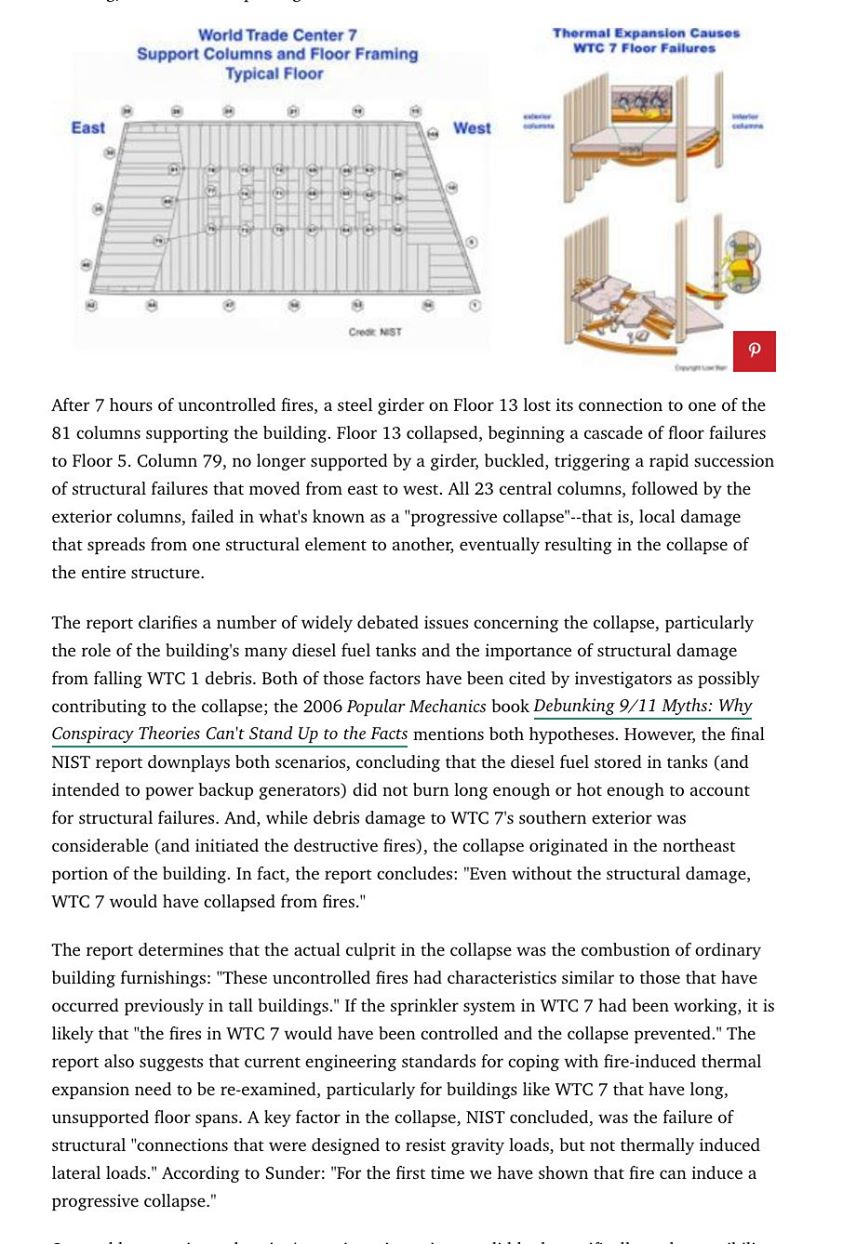
photos_and_videos/TimelinePhotos_dJ9jhts2Ng/75010622_491870861409809_742597895563247616_o_491870858076476.jpg PLS DON’T WASTE MY TIME OR OTHERS WITH BLDG7 CONSPIRACY THEORY
(Yes I know more that you do – as usual )
The primary lessons are:
(a) as usual, only one structural member failed, leading to the cascade, and the structural failure was due to accumulation of heat over many hours. The external damage had no effect on the collapse. It was just the fire.
(b) engineering standards and calculations for steel structures were too loose given the possible duration of fires.
(c) ordinary office combustibles provide long term sources of heat at slow burn necessary to accumulate heat in structural members.
(d) if the sprinklers had been active it’s unlikely the combustibles would have been able to produce accumulated heat, and therefore sprinklers must not be dependent upon external sources of pressure and power in the event of a catastrophe. ie: external infrastructure is a weak link not a discount, and structures must meet closer to greek standards (10x max expected load) than the max load calculations at present, and harmonics make the matter far worse. Make buildings more expensive and there will be fewer of them, and better. Require resident ownership in urban centers and end rental income. Expand underground transport, police the cars aggressively, and if necessary create class -based cars requiring escalating positive behavior.
(PS: Why do you think I know that a civil war punishing urban areas is so easy to win? Anyone overloading emergency services in any urban area will succeed. Multiple urban areas cannot provide mutual support under adverse conditions. Without communication and data, organization of response is all but impossible -bottlenecked.)PLS DON’T WASTE MY TIME OR OTHERS WITH BLDG7 CONSPIRACY THEORY
(Yes I know more that you do – as usual )
The primary lessons are:
(a) as usual, only one structural member failed, leading to the cascade, and the structural failure was due to accumulation of heat over many hours. The external damage had no effect on the collapse. It was just the fire.
(b) engineering standards and calculations for steel structures were too loose given the possible duration of fires.
(c) ordinary office combustibles provide long term sources of heat at slow burn necessary to accumulate heat in structural members.
(d) if the sprinklers had been active it’s unlikely the combustibles would have been able to produce accumulated heat, and therefore sprinklers must not be dependent upon external sources of pressure and power in the event of a catastrophe. ie: external infrastructure is a weak link not a discount, and structures must meet closer to greek standards (10x max expected load) than the max load calculations at present, and harmonics make the matter far worse. Make buildings more expensive and there will be fewer of them, and better. Require resident ownership in urban centers and end rental income. Expand underground transport, police the cars aggressively, and if necessary create class -based cars requiring escalating positive behavior.
(PS: Why do you think I know that a civil war punishing urban areas is so easy to win? Anyone overloading emergency services in any urban area will succeed. Multiple urban areas cannot provide mutual support under adverse conditions. Without communication and data, organization of response is all but impossible -bottlenecked.)
—“Darwin doesn’t even agree with macro evolution. DNA, the eye, Cambrian explosion all disprove any macro evolution not to mention that species actually show just as much entropy as positive gains over time just look at how many useless dogs exist today. To pretend things get better and more organized over time is simply false.”—Charles Schiavo
Did you just try to make sense? Because you didn’t. I’m perfectly able to narrate, almost without checking first, the history of the development of the eye, in at least the two times it evolved. I don’t know how many times blood evolved but I know of two. Darwin didn’t know about DNA, but we do, that’s no argument. DNA merely explains why Darwin was right (massive parallelization, niche exploitation, favoring nothing but increased complexity. The Cambrian explosion is the result of bottlenecking, creating opportunity, increase in oxygen levels increasing available energy – particularly by increasing surface area, and the cliff effect of a new generation of genetic grammars making possible more rapid evolution. So, Energy Density > Entropy > fundamental structure(Tetrahedron?) > fundamental forces > quantum fields > particles > atoms > chemistry > biochemistry > biology > neurons > memory > sentience > consciousness > language > calculation. The same applies for the complexity of biochemical constructions, especially proteins, which function as mechanical devices at the molecular level whose changes in state are powered by changing of charges produced by attachment and detachment of molecules. So there was a Cambrian explosion just as there was a bronze age, steel age, science age, and technological age, and now computational age revolution. Just as the first generations of stars contained little, but made the higher elements, and distributed them through explosion, and laying the seeds for the development of future permutations upon those elements. In evolutionary biology this is called ‘punctuated equilibrium’ where there are periods of explosive growth due to some particular innovation. For example the Indo europeans conquered much of Eurasia in no small part because they developed the ability to drink milk, giving them 40% more calories for the same effort of production. The same for business, economic, state, and civilizational cycles. The entire universe follows the same simple rules from it’s most basic foundations through our most complex inventions.
And what on earth would make you think you’re smart enough, knowledgeable enough, intellectually honest enough to make such an argument when the greatest minds of our age make the opposite.
https://grist.org/…/how-food-forests-and-people-are…/UM. I THINK YOU’RE CONFUSED ABOUT PROPERTY AND COMMONS AND THE EVOLUTION OF EACH
—“Commons are for high-input, savage hunter-gatherers.
Deconstruction of the commons via recognition of private property is the first step to civilisation.”— Jonathan Besler
Um. Well, not quite the argument you’re making. European Hunter gatherers either did not produce fixed commons (hunting grounds, grazing grounds, farms) before they competed with settled peoples, only after they competed with herding peoples, or settled peoples. All people hae always produced normative institutional commons: Norms, traditions, myths, manners, customs, and even property respect itself are commons.
The central problem for settled people has been the gradual conversion from familial property to individual property, that followed the increase in the division of labor, and the development of inheritance, and the devotion of surplus to the incremental production of commons (defense, granaries(ex:africa), buildings(south america), walls(mesopotamia), grazing lands(caucuses, steppe), farming lands(anatolia), walkways(britain), bridges(asia), water transport (mesopotamia) ).
The excess productivity of the flood river valleys when irrigated made possible the conquest of, taxation of, and centralization of proceeds of production in administrative(clerical) and martial (military) classes, in exchange for suppression of local rent seeking, corruption, and exposure to brigandry.
Europe was unable to centralize as such until the conquest of other peoples under agrarianism, and the expansion of mediterranean trade. Europe lacks the flood river valleys and warm climate and so production was distributed, power, distributed, and evolved only in parallel with trade.
Even the english, the most corporate of european peoples still maintained intergenerational familial property (land, animals, house) until the early modern period.
The jews maintained serial marriage until the late middle ages, and the irish until the 1800’s, and slavery, polygamy, and child marriage, and paternal ownership of property are still practiced in developing countries.
The distribution of decidability upon the scope and interest in property evolves with the division of labor, just as it did with women in this century.
The distribution of decidability in conflict over demonstrated interests determines property.
As property increases in atomization, free riding of all kinds is incrementally eradicated. This pushes people into all four directions: decrease in consumption, increases in productivity, innovation in production, or innovation in parasitism.
The population always seeks means of externalization of loss, privatization of commons, free riding, parasitism, and predation, so the law must keep pace with innovations in
The individual is the most rapid means of adapting to constriction of consumption. The market for goods services and information is the most rapid means of adapting to the expansion of production. The market for suppression of free riding, parasitism and predation is the most rapid means of adapting to the expansion of parasitism.
The common law is the most rapid means of suppressing innovations in the parasitism by the immediate expansion of the suppression of innovations in parasitism, by the first case adjudicated. It requires no further institutional support other than communication between judges.
The principle difference P-adds is that ALL demonstrated interests of all kinds and require strict construction of judgements (findings), contracts (agreements), regulations (insurance against non-resitutability), legislation (contracts of the commons) and command (military dictate in cases of duress). And it prevents ir-reciprocal and untruthful (untestimonial) speech in matter of the commons to the commons.
This means sovereignty, rule of law of reciprocity, and truthful speech, and no more marxism, socialism, libertarianism, feminism, postmodernism, denialism, as well as no more judaism and islam or any other religion contrary to the natural law of reciprocity and testimonial truth.
—“What is meant by the contrast between “description within experience” and “analogy beyond”?— Imperius
1. Within the limits of sense perception
2. Within the limits of physical instrumentation.
3. Within the limits of reason( deduction, induction, abduction, guessing.)
4. Within the limits of logic (constant relations).
5. Within the limits of calculation (logical instrumentation).
Ergo: (a) – within sense, perception, reason, calculation = Experience. (b) – Within instrumental evidence testable by sense, perception, reason, calculation = Analogy to experience.(c) “Reduction of the imperceptible to analogy to experience sufficient for comparison within the limits of sense, perception, reason, experience.
Operational means of stating what others have said by previous means — preventing idealism and subsequent conflation and inflation by reduction to operational terms.
—” morality is processed in the declarative, “— Imperius
DEFINITIONS:
RECIPROCITY: productive, fully informed, warrantied voluntary transfer of demonstrated interests free of imposition upon the demonstrated interests of other group members, sufficient to cause retaliation (demand for restitution).
MORALITY
Good <- Moral <- Ethical <- amoral -> unethical -> immoral -> Evil. (I’ve defined this in detail elsewhere, search the site rather than repeat here.)
1) Objectively Moral: Reciprocal (mutually beneficial) within the limits of proportionality (defection). No cooperative species can survive otherwise.
2) Personal Moral Intuition: Minimum Reciprocity within the Limits of proportionality that I prefer given my gender and sexual, social, economic, and political market value.
3) Interpersonal Personal Moral Intuition: Minimum Reciprocity within the limits of proportionality I can get away with given my sexual social economic and political market value.
4) Normative Morality: standards of reciprocity given the group evolutionary strategy, and the portfolio of conditions necessary to preserve sufficient reciprocity that sufficient proportionality is maintained that the polity survives.
DECLARATIVE, OSTENSIVE, IMPERATIVE
1) STATEMENT
Declarative (Subjective): of the nature of or making a declaration; a statement; (irresponsibility)
ie: Objective: Promissory. (responsibility)
2) DESCRIPTION
Ostensive: (Subjective) directly or clearly demonstrative. (irresponsibility)
ie: Objective: Operational. (Responsibility)
CLAIM(PROMISE), VALUE
Imperative: (Subjective) an essential or urgent thing; (irresponsibility)
ie: Objective Necessary: (responsibility)
Grammatical difference between:
a) Command free of responsibility (ir-reciprocity: immorality)
And;
b) Argument inclusive of responsibility. (reciprocity: morality)
So while you claim I don’t understand language as far as I know I understand all grammars known to man, the common (geometric) constitution of those grammars; the point of view each of them is uttered from; and the incentive to use each one of them for the purpose of NOT speaking truthfully.
And as usual you’re claiming that I don’t understand when no, I understand, I don’t value, because I am seeking a means of deciding conflict, and suppressing lying of all kinds, thus prohibiting the abrahamic means of deceit (which is the only one we westerners are vulnerable to given our high trust), and this is counter to your interests because of reasons I’ve explained before.
I don’t really disambiguate your claims often, and I emphasize the only known incentives to avoid reciprocal (testimonial) speech, and all are either to justify authoritarianism or justify deceit.
But if I can ‘correct’ Kantian sophism I’m equally comfortable disambiguating postmodern (social construction) sophism whether left appeal to authority to avoid darwin, or right appeal to authority to advance darwin.
Fact remains is that if you can’t state it truthfully the question is why?
I mean, authoritarianism especially martial and political does nto require obscuring the demand for authority. The reason being that one already has the power to exercise.
Supernatural authority or sophomoric authority or pseudoscientific authority are simply means by which those lacking the power to exercise try to construct it by inspirational means. There is no other reason to use it. But the total failure of continental civilization to produce anything without trying to rescue a country under external pressure and conquest (interwar germany), when people have an incentive to follow a message of rallying for material reasons.
If you can on the other hand construct some promise whether true (economic, political) or false ( supernatural salvation, economic power, political power), and a pseudoscientific, sophomoric, or occult means of advancing it (an ideology) then you at least have an excuse. TO OBSCURE a strategy for the obtaining of power. And then a strategy for preserving power, and operation that polity or faithful.
Now if you had that to offer then I could come back with ‘this will work, that won’t work’ or something or other.
BUt if you’re just talking the theory of lying that in that context I don’t see any value in promoting various new means of lying among our people when it is precisely this kind of lying that has made them vulnerable to marxism, socialism, libertarianism, feminism, and postmodernism.
I mean, is start with ‘here is a constitution that will solve the problem of current modernity; here is a recipe for restoring our historically successful group strategy; here is a recipe for creating a new mythology but not what it is; here is a recipe for creating a new religion, but not what it is. so others please have at it.
So we have had this same conversation for something between four and five years now: I analyze, architect, engineer, and render into law. (Science) the means of operating a polity that cannot be defeated by abrahamic means (or military, or economic, or immigration). The rest is up to “storytellers”. If you want to write a story do so. As long as it doesn’t try to undermine our strategy, which is our group’s competitive advantage, then I don’t care what it is.
But if it does try to perpetuate abrahamic deciets then I’m going to do my duty and falsify, undermine, and eradicate it.
Doolittle’s Comments On Silver’s Quotes from his Book:
1. The story data tells us is often the one we’d like to hear, and we usually make sure it has a happy ending.
3. There are entire disciplines in which predictions have been failing, often at a great cost to society.
4. Some stone-age strengths have become information-age weaknesses.
5. We can never make perfectly objective predictions. They will always be tainted by our subjective point of view.
(CD: They will always be tainted by our wants for the world rather than untainted by a description of the world. we live in paradigms of utility.)
6. A belief in the objective truth -and a commitment to pursuing it- is the first prerequisite of making better predictions.
(CD: very few of us seek truth. We all seek utility not truth. For some of us truth and utility are identical. for others it forces them into competition with darwin – and truth is the enemy of false genes as much as false ideas.)
7. Prediction is important because it connects subjective and objective reality.
(CD: prediction is important because it falsifies many subjective realities training us to predict objective realities.)
8. We are undoubtedly living with many delusions that we do not even realize.
(CD: psychology must be the study of cognitive error, bias, wishful thinking and deceit – and the sciences efforts at compensating for them.)
9. We must become more comfortable with probability and uncertainty.
10. We must think more carefully about the assumptions and beliefs that we bring to a problem.
11. A certain amount of immersion in a topic will provide disproportionally more insight that an executive summary.
12. The signal is the truth. The noise is what distracts us from the truth.
13. Precise forecasts masquerade as accurate ones.
14. If you have reason to think that yesterday’s forecast was wrong, there is no glory in sticking to it.
15. New ideas are sometimes found in the most granular details of a problem where few others bother to look.
16. Extrapolation is a very basic method of prediction -usually, much too basic.
(CD: One must never extrapolate a trend – everything in nature equilibrates.)
17. In many cases involving predictions about human activity, the very act of prediction can alter the way that people behave.
18. The most effective flu prediction might be the one that fails to come to fruition because it motivates people toward more healthful choices.
19. While simplicity can be a virtue for a model, a model should at least be sophisticatedly simple.
(CD: the quality of a prediction is dependent upon the quality and quantity of information, not the complexity of the model.)
20. We can never achieve perfect objectivity, rationality, or accuracy in our beliefs. Instead, we can strive to be less subjective, less irrational, and less wrong.
(CD: we have spent, because of theology, far too much of our history in via-positiva justification, and are still escaping it. Instead we must focus on via positiva reduction of ignorance, error, bias, wishful thinking, and deceit.)
21. Recently, […] some well-respected statisticians have begun to argue that frequentist statistics should no longer be taught to undergraduates. […] In fact, if what you read what’s been written in the past ten years, it’s hard to find anything that doesn’t advocate a Bayesian approach.
(CD: Bayseian accounting is superior to mathematical averages. when stated in this manner the difference in quality of prediction is rather obvious.)
22. There is strong empirical evidence that there is a benefit in aggregating different forecasts.
(CD: competition between theories produces information not only about one theory but about the minds of man making those theories.)
21. This is another of those Information-age risks: we share so much information that our independence is reduced. (CD: information that is not true (parsimonious)
22. Perhaps the central finding of behavioral economics is that most of us are overconfident when we make predictions.
(CD: we evolved overconfidence because action for gain is necessary. We confuse the necessity of action for gain with applying it beyond its evolutionary purpose.)
23. In science, progress is possible. In fact, if one believes in Bayes’ theorem, scientific progress is inevitable as predictions are made and as beliefs are tested and refined.
(CD: Whether mathematical Bayes or Philosophical Popper, or Cognitive science’s lesson that our brains operate by massively parallel similarly bayesian means, learning through trial and error no matter how error prone, will produce either progress in knowledge or failure to survive.)
24. The March toward scientific progress is not always straightforward, and some well-regarded (even “consensus”) theories are later proved wrong- but either way science tends to move toward the truth.
(CD: The difference between the fundamental sciences and entrepreneurship, and daily action is that fundamental science is a luxury good, the findings of which may propagate through the polity over time – but daily action in life has no such luxury of time and cost – we must produce returns. This conflict illustrates the problem of our evolutionary demand for action influencing our overconfidence in science, and conversely, our science ignoring time and cost. )
25. Under Bayes’ theorem, no theory is perfect. Rather, it is a work in progress, always subject to further refinement and testing.
(CD: I knew bayes first, Godel second, hayek third, popper fourt, and kuhn fifth. Bayes provides accounting on one end, then popper, then kuhn, and then hayek on the other end. Only during the past twenty years have we understood the brain’s mixture of elementary composition and spatial attribution. Same process, different scales. It’s not just bayesian – it’s the only possible epistemological method and everything else is a legacy failure we call ‘justificationism’.)
EMPTY CRITICISMS TO OBSCURE UNSATISFIED DEMAND I NEVER SET OUT TO SUPPLY
—“I think Curt is working with an oversimplified, inaccurate theory of language, which leads to many liberal problems (Propertarianism as merely an intensification of liberalism), but I’ve always enjoyed some of his encyclopedic observations (because those are all necessarily written scientifically anyways, so there can be some compatibility).”—Imperius
I am not working on an oversimplified and inaccurate theory of language, I am working on disambiguating language into causal axis (which I have done – as far as I know it’s complete). You are, as many right-wing-postmoderists are, correctly stating that language can via positiva be used to construct paradigms by narrative expression that are useful for various purposes in pseudoscientific, rational(continental sophomoric), literary (analogistic), mythological(heroic analogistic), supernatural prose.
But that’ isn’t my objective (which you know). My objective is to write law that is decidable regardless of the USEFUL paradigms employed, by anyone whenever they are in CONFLICT. So the answer is, yes, P is so far flawless for purpose intended: decidability in matters of conflict. And since you and yours seek secular theology, the christians and muslims supernatural theology, and those like me seek scientific(Testimonial) decidability. So I’m writing a constitution serving all in the only language commensurable across all. I am not (as you wish I would) create a literary, philosophical, or theological religion dependent upon appeal to empathy(emotion) or sympathy(intuition), only reason.
P provides no via positiva for any of the empathic, intuitionistic, or sympathetic market demands. It however does provide via negativa for juridical, political, and military, demands. So the best anyone can do (that I know of) is precisely what we have seen: rebel against science and reason without offering an alternative solution other than return to christian theology – which is impossible for all but those evolved to demand it.
You want a continental secular theology, or perhaps occult theology, or perhaps supernatural theology that appeals to empathy and intuition. And if you want something like abrahamic religions or buddhism that is intentionally designed to circumvent criticism by science and reason, then go ahead and try to create one. But criticizing P while not producing an alternative, is simply unearned attention seeking on one hand and critique without competing alternative on the other. P is actionable. When I see some other centrist, libertarian, or conservative put out a work product that is other than pretense of knowledge and pretense of solution we can talk. Until then, there is no other new game in town.
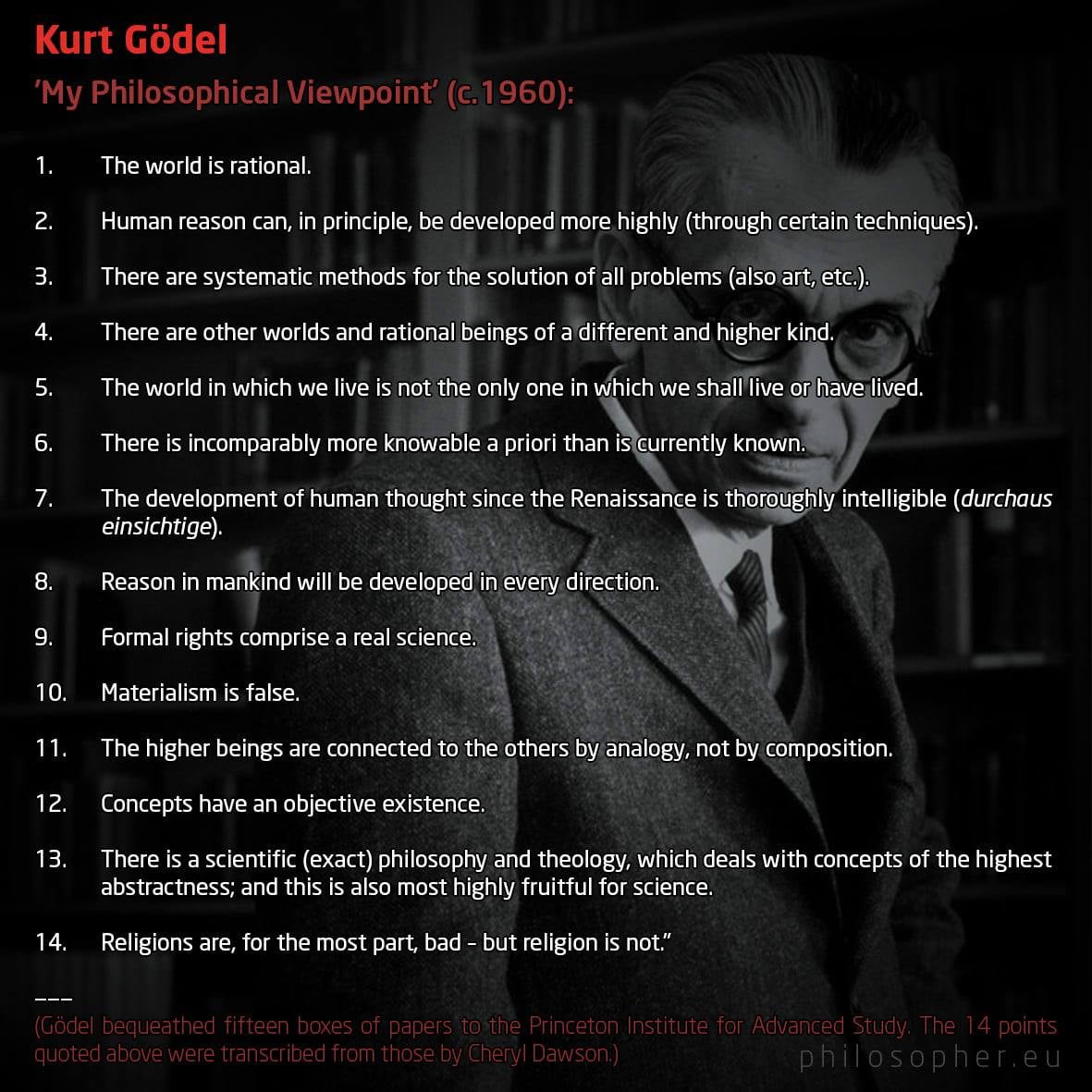
photos_and_videos/TimelinePhotos_kg5QueHwVw/72355004_137347730996722_5914367204375134208_o_137347727663389.jpg CONTRAST WITH P – REQUEST FROM KASH VIKAS
(Godel is a Platonist and I’m an Operationalist. This contrast is rather helpful in illustrating the operational vs platonist vs empirical.)
1. Man acts rationally, and by rationally amorally. But given the disproportionate value of cooperation, and the disproportionate risk of retaliation, it’s just in his interest to act morally much more often than immorally.
1a. We can incrementally reduce observations of the universe, using our senses, reason, and instrumentation to descriptions of invariant constant relations (paradigms)
1b + 3. We can describe (explain) all of experience as constant relations (a single paradigm)
2. While our ability to reason is constant, every increase convergence of our instruments and paradigms increases the explanatory power available to our reason.
4. The capacity to reason is a deterministic product of entropy at convenient temperatures in convenient conditions, for sufficient periods of time. It is likely that given the vastness of the universe, other creatures have evolved reason, and that while the logic of constant relations will exist, and mathematics as a logic of constant positional relations will exist in some form, that the composition of experience that results from different body structures will result in different techniques for employing reason. (think octopi). And that the ability of these creatures may vastly outperform ours.
5. Because we are able to use our powers of prediction using free association to construct a model of the world we exist in, and the worlds we might exist in, and the worlds we cannot exist in, we can experience, many candidate worlds.
5b. The set of demands we evolved and express daily is largely invariant. The set of paradigms we use to imagine opportunities for fulfilling those demands evolves (and devolves) constantly. So while we largely increase the coherence of paradigms, and approach a single paradigm for describing the universe, we have experienced the world differently in the past than in the present, and will so again experience it differently in the future.
6. If we can construct an operational grammar and paradigm for a given set of constant relations, we can produce an operational logic of that set of constant relations, and conduct experiments logically by trial and error as we do in mathematics. To do so we require convergence of paradigms to the point of marginal indifference of those logical constructions. But the Analytic program failed, and Godel and Frege et all were wrong – closure does not exist.
7. Yes the development of thought since Aristotle expanded on Democritus, has been consistent and rational with the exception of the semitic abrahamic dark ages of supernatural ignorance.
8. Reason is reason is reasoning and there is nothing to it. There are however endless permutations of reason especially as knowledge increases.
9. The via-negativa of Natural Law can be restated in the via-positiva as Natural rights, and this logic and empirical combination produces a science of cooperation, and law the institutional enforcement of cooperation under that law, and economics the measure of it’s success, and economics the language of analysis and measurement within that science.
10.The material(noun) and the Operational(verb) are true (exist, and are testifiable). The platonic (ideal) is false. All sets of constant relations are identified, retained, applied, reinforced, and revised by merging physical stimuli with physical organization of information in the brain, producing a hierarchy of changes in state over time we call ‘experience’. So while it is correct to say that the universe is deterministic (composed of constant relations), it is only correct to say that we can observe sets of constant relations, identify them (category), compare them, name them, and predict future states of of them, and in relation to them. These memories and predications like running consist of physical potential, that produce results in time. In other words, al of reality is constructed physically, from a hierarchy of changes in state over time we call experience.
12. Concepts do not exist. the potential for Concepts exists. Running only exists when one is running. We have the potential to run. We have the potential to identify sets of constant relations (concepts), but experience of contexts only exist when we are acting to recall them in time.
13. It appears we can know the most parsimonious paradigm, and host of parsimonious sub-paradigms of increasing complexity (permutations) allowing us to speak the truth using evidence – science; that we can know the same for choices using arguments – philosophy; and we can know the same for collective organization using stories – theology.
14. Existing religions are bad to terrible to suicidal – but human psychological, social, political, and strategic demand for the products of ‘religion’ (order) are endless. So we need to educate one another in mindfulness, ethics(interpersonal), morality (extrapersonal), political, and strategic (competitive), by means gracefully increasing and decreasing in accessibility: parable, story, history, reason and general rules, science and outcomes.CONTRAST WITH P – REQUEST FROM KASH VIKAS
(Godel is a Platonist and I’m an Operationalist. This contrast is rather helpful in illustrating the operational vs platonist vs empirical.)
1. Man acts rationally, and by rationally amorally. But given the disproportionate value of cooperation, and the disproportionate risk of retaliation, it’s just in his interest to act morally much more often than immorally.
1a. We can incrementally reduce observations of the universe, using our senses, reason, and instrumentation to descriptions of invariant constant relations (paradigms)
1b + 3. We can describe (explain) all of experience as constant relations (a single paradigm)
2. While our ability to reason is constant, every increase convergence of our instruments and paradigms increases the explanatory power available to our reason.
4. The capacity to reason is a deterministic product of entropy at convenient temperatures in convenient conditions, for sufficient periods of time. It is likely that given the vastness of the universe, other creatures have evolved reason, and that while the logic of constant relations will exist, and mathematics as a logic of constant positional relations will exist in some form, that the composition of experience that results from different body structures will result in different techniques for employing reason. (think octopi). And that the ability of these creatures may vastly outperform ours.
5. Because we are able to use our powers of prediction using free association to construct a model of the world we exist in, and the worlds we might exist in, and the worlds we cannot exist in, we can experience, many candidate worlds.
5b. The set of demands we evolved and express daily is largely invariant. The set of paradigms we use to imagine opportunities for fulfilling those demands evolves (and devolves) constantly. So while we largely increase the coherence of paradigms, and approach a single paradigm for describing the universe, we have experienced the world differently in the past than in the present, and will so again experience it differently in the future.
6. If we can construct an operational grammar and paradigm for a given set of constant relations, we can produce an operational logic of that set of constant relations, and conduct experiments logically by trial and error as we do in mathematics. To do so we require convergence of paradigms to the point of marginal indifference of those logical constructions. But the Analytic program failed, and Godel and Frege et all were wrong – closure does not exist.
7. Yes the development of thought since Aristotle expanded on Democritus, has been consistent and rational with the exception of the semitic abrahamic dark ages of supernatural ignorance.
8. Reason is reason is reasoning and there is nothing to it. There are however endless permutations of reason especially as knowledge increases.
9. The via-negativa of Natural Law can be restated in the via-positiva as Natural rights, and this logic and empirical combination produces a science of cooperation, and law the institutional enforcement of cooperation under that law, and economics the measure of it’s success, and economics the language of analysis and measurement within that science.
10.The material(noun) and the Operational(verb) are true (exist, and are testifiable). The platonic (ideal) is false. All sets of constant relations are identified, retained, applied, reinforced, and revised by merging physical stimuli with physical organization of information in the brain, producing a hierarchy of changes in state over time we call ‘experience’. So while it is correct to say that the universe is deterministic (composed of constant relations), it is only correct to say that we can observe sets of constant relations, identify them (category), compare them, name them, and predict future states of of them, and in relation to them. These memories and predications like running consist of physical potential, that produce results in time. In other words, al of reality is constructed physically, from a hierarchy of changes in state over time we call experience.
12. Concepts do not exist. the potential for Concepts exists. Running only exists when one is running. We have the potential to run. We have the potential to identify sets of constant relations (concepts), but experience of contexts only exist when we are acting to recall them in time.
13. It appears we can know the most parsimonious paradigm, and host of parsimonious sub-paradigms of increasing complexity (permutations) allowing us to speak the truth using evidence – science; that we can know the same for choices using arguments – philosophy; and we can know the same for collective organization using stories – theology.
14. Existing religions are bad to terrible to suicidal – but human psychological, social, political, and strategic demand for the products of ‘religion’ (order) are endless. So we need to educate one another in mindfulness, ethics(interpersonal), morality (extrapersonal), political, and strategic (competitive), by means gracefully increasing and decreasing in accessibility: parable, story, history, reason and general rules, science and outcomes.