Category: Science, Physics, and Philosophy of Science

  • photos_and_videos/TimelinePhotos_dJ9jhts2Ng/84391809_566699850593576_50368984279

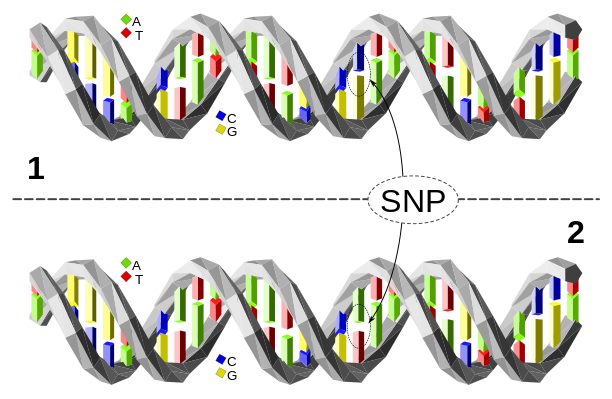
    photos_and_videos/TimelinePhotos_dJ9jhts2Ng/84391809_566699850593576_5036898427955314688_n_566699843926910.jpg SNP’S (SNIPS) THE ‘BITS’ OF THE GENOME

    (basic genetic terms)

    A single-nucleotide polymorphism (SNP, or ‘snip’) is a substitution of a single nucleotide that occurs at a specific position in the genome, where each variation is present at a level of more than 1% in the population

    More than 335 million SNPs have been found across humans from multiple populations. A typical genome differs from the reference human genome at 4 to 5 million sites, most of which (more than 99.9%) consist of SNPs and short indels

    Single-nucleotide polymorphisms may fall within coding sequences of genes, non-coding regions of genes, or in the intergenic regions (regions between genes). SNPs within a coding sequence do not necessarily change the amino acid sequence of the protein that is produced, due to degeneracy of the genetic code.

    The genomic distribution of SNPs is not homogenous; SNPs occur in non-coding regions more frequently than in coding regions or, in general, where natural selection is acting and “fixing” the allele (eliminating other variants) of the SNP that constitutes the most favorable genetic adaptation.

    A large part of DNA (more than 98% for humans) is non-coding, meaning that these sections do not serve as patterns for protein sequences.

    SNPs in the coding region are of two types: synonymous and nonsynonymous SNPs. Synonymous SNPs do not affect the protein sequence, while nonsynonymous SNPs change the amino acid sequence of protein.

    SNPs that are not in protein-coding regions may still affect gene splicing, transcription factor binding, messenger RNA degradation, or the sequence of noncoding RNA.SNP’S (SNIPS) THE ‘BITS’ OF THE GENOME

    (basic genetic terms)

    A single-nucleotide polymorphism (SNP, or ‘snip’) is a substitution of a single nucleotide that occurs at a specific position in the genome, where each variation is present at a level of more than 1% in the population

    More than 335 million SNPs have been found across humans from multiple populations. A typical genome differs from the reference human genome at 4 to 5 million sites, most of which (more than 99.9%) consist of SNPs and short indels

    Single-nucleotide polymorphisms may fall within coding sequences of genes, non-coding regions of genes, or in the intergenic regions (regions between genes). SNPs within a coding sequence do not necessarily change the amino acid sequence of the protein that is produced, due to degeneracy of the genetic code.

    The genomic distribution of SNPs is not homogenous; SNPs occur in non-coding regions more frequently than in coding regions or, in general, where natural selection is acting and “fixing” the allele (eliminating other variants) of the SNP that constitutes the most favorable genetic adaptation.

    A large part of DNA (more than 98% for humans) is non-coding, meaning that these sections do not serve as patterns for protein sequences.

    SNPs in the coding region are of two types: synonymous and nonsynonymous SNPs. Synonymous SNPs do not affect the protein sequence, while nonsynonymous SNPs change the amino acid sequence of protein.

    SNPs that are not in protein-coding regions may still affect gene splicing, transcription factor binding, messenger RNA degradation, or the sequence of noncoding RNA.

    Source date (UTC): 2020-02-03 08:10:00 UTC
  • I do not see numbers and rates of propagation that reflect anywhere near the sev

    I do not see numbers and rates of propagation that reflect anywhere near the severity that I would expect from a serious pandemic that would alter the course of china’s history. It’s early yet. But so far unless it mutates (and it can) that doesn’t seem likely.


    Source date (UTC): 2020-02-03 03:49:43 UTC

    Original post: https://twitter.com/i/web/status/1224178124889513985

    Reply addressees: @QuestionMThings

    Replying to: https://twitter.com/i/web/status/1224175748652634113


    IN REPLY TO:

    Original post on X

    Original tweet unavailable — we could not load the text of the post this reply is addressing on X. That usually means the tweet was deleted, the account is protected, or X does not expose it to the account used for archiving. The Original post link below may still open if you view it in X while signed in.

    Original post: https://twitter.com/i/web/status/1224175748652634113

  • photos_and_videos/TimelinePhotos_kg5QueHwVw/83991359_197810238283804_31468553086

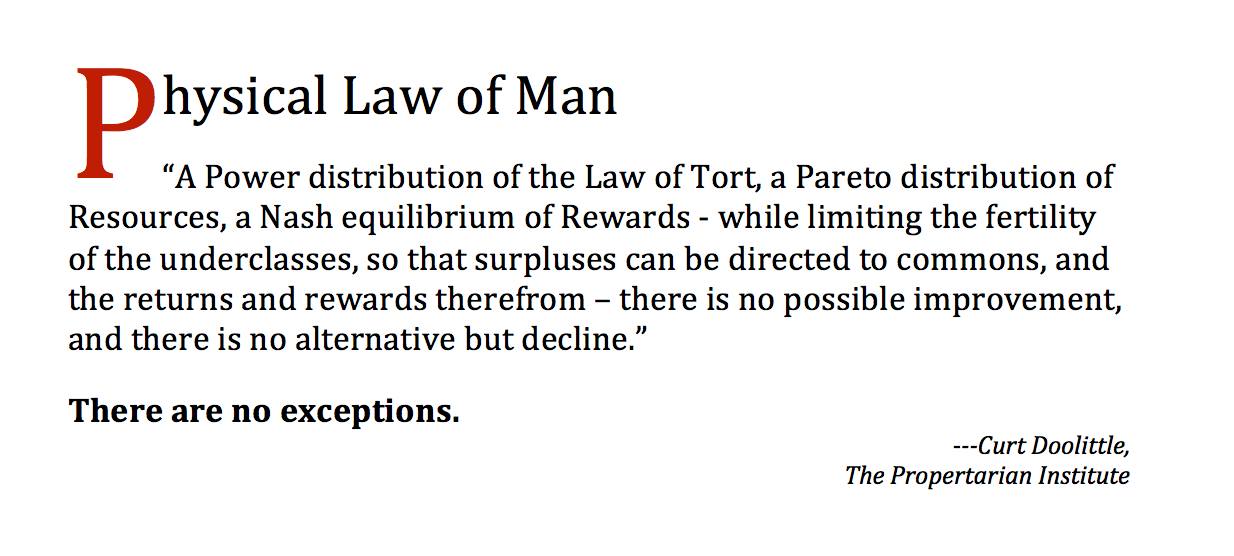
    photos_and_videos/TimelinePhotos_kg5QueHwVw/83991359_197810238283804_3146855308656115712_o_197810228283805.jpg PHYSICAL LAWS THAT LIMIT ALL SOCIAL ORDERSPHYSICAL LAWS THAT LIMIT ALL SOCIAL ORDERS


    Source date (UTC): 2020-02-02 19:15:00 UTC

  • @VDARE: AFAIK, eas asians have a much higher vulnerability to RNA viruses for ge

    @VDARE: AFAIK, eas asians have a much higher vulnerability to RNA viruses for genetic reasons including the accessibility to the cell. (Paper released last night)


    Source date (UTC): 2020-02-02 14:51:14 UTC

    Original post: https://twitter.com/i/web/status/1223982210589564934

    Reply addressees: @vdare

    Replying to: https://twitter.com/i/web/status/1223962866178568193


    IN REPLY TO:

    @vdare

    “In fact, as far as I can tell, all of the confirmed cases have been of Chinese people. According to Sri Lankan radio, the case in Sri Lanka was a “Chinese tourist” …

    #CoronaOutbreak #Coronarivus

    https://t.co/mDJaFdp3AO

    Original post: https://twitter.com/i/web/status/1223962866178568193

  • ORDINARY FLU DEATHS EACH YEAR ARE LIMITED (compiled) According to the World Heal

    ORDINARY FLU DEATHS EACH YEAR ARE LIMITED

    (compiled)

    According to the World Health Organization (WHO), flu globally attacks 5%–10% adults and 20%–30% children annually.

    According to the CDC, during the year when the influenza A (H3N2) viruses are prominent, death rates are typically more than double as compared to seasons when the influenza A (H1N1) or influenza B viruses dominate. This is because the influenza A (H3N2) virus is far more potent and contagious than the H1N1 influenza virus.

    Hospitalizations and flu season deaths occur mainly among the high-risk groups such as young children below the age of 5 years, the elderly above the age of 65 years, and those with chronic medical illnesses.

    Centers for Disease Control and Prevention (CDC), experts say the flu season is in full swing with an estimated 4.6 million flu illnesses, 39,000 hospitalizations and 2,100 deaths from flu so far this season.

    The rate of outpatient visits for influenza-like illnesses (ILI) spiked in the week ending on Dec 21, from 3.9% to 5.1% — a trend typically seen during winter holidays. Rates of ILI have been above the national baseline of 2.4% for 7 weeks.

    Twenty-five states and the District of Columbia, Puerto Rico, and New York City reported high levels of ILI. Flu activity was described as widespread in 39 states.

    The CDC said hospitalization rates rose to 6.6 per 100,000 population, up from 5.5 per 100,000 population during the second week of December. The highest rate of hospitalization was among adults aged older than 65 (14.4 per 100,000 population), followed by children ages 0 to 4 (12.5 per 100,000 population) and adults ages 50 to 64 (7.0 per 100,000 population). All age groups have seen a significant increase in the last week.

    The CDC said hospitalization rates mirror previous seasons.

    Influenza A has been detected in 52.9% of hospitalized cases, and 46.4% were associated with influenza B.

    In testing at public health labs, influenza B accounts for 58.8% of positive flu samples collected from across the country, 98.7% of which are Victoria lineage. Influenza A was detected in 41.2% of specimens, with most of those (94.8%) subtyped as the H1N1 strain first seen in 2009.

    “Activity is being caused mostly by influenza B/Victoria viruses, which is unusual for this time of year. A(H1N1) viruses are the next most common and are increasing in proportion relative to other influenza viruses in some regions,” the CDC said.

    Three pediatric deaths were also recorded in the last week, raising the season’s total to 22. All three recent deaths were associated with influenza B viruses; only six deaths in total this season have been associated with influenza A.

    In the 2018-2019 flu season, the CDC confirmed 143 pediatric deaths.

    The CDC encouraged all who have not yet done so to receive a seasonal influenza vaccine, as the season is set to last for several more weeks.

    DEATHS DUE DO EPIDEMICS

    The world has seen five pandemics during the last century, which took a large number of lives. Here are the figures of deaths that occurred in the United States and Worldwide during those years.

    1. 1889 Russian Flu Pandemic – about 1 million flu deaths

    2. “Spanish flu” A of 1918-19 caused the highest number of influenza-related deaths: approximately 500,000 deaths occurred in the U.S. and 20 million worldwide. That figure is more than the total number of deaths caused by the World War one — 16 million. As a matter of fact, during that year, the flu had killed more people than any other illness in recorded history.

    3. “Asian flu” A of 1957-58 caused 70,000 deaths in the United States and about one million to two million deaths worldwide

    4. “Hong-Kong flu” A of 1968-69 resulted in 34,000 deaths in the United States and an estimated one million to three million people died worldwide.

    5. 2009 H1N1 Flu Pandemic – about 18,300 deaths in the United States and up to 203,000 deaths worldwide


    Source date (UTC): 2020-02-01 11:35:00 UTC

  • whomever asked me about “Integrated Information Theory”: it’s an attempt at math

    whomever asked me about “Integrated Information Theory”: it’s an attempt at mathematical description of the requirements. I don’t find it useful. That said the only objection I have to the theory as I undestand it is ‘integration’ because I’m not sure what the author means and I don’t want to spend time investigating a mathematical rather than causal model. That objection is reducible to whether we can access components of a memory – and we can and do. I’m pretty certain of how memories are stored in the brain, and we certainly can access episodes, and features of episodes, and we do store the fragments of each as pure relations even if we can’t introspect upon them. If that’s what he means then fine. I’m not sure. This is why I emphasize operational langauge not descriptive language.


    Source date (UTC): 2020-02-01 11:02:00 UTC

  • So, yes science can explain spirituality, but that explanation differs from the

    So, yes science can explain spirituality, but that explanation differs from the experience just as the science of colors differs from the experience of colors. We evolved a biological demand for ‘mindfulness’ across a spectrum of conditions. The question is how we satisfy demand.


    Source date (UTC): 2020-01-31 11:23:15 UTC

    Original post: https://twitter.com/i/web/status/1223205096202350592

    Reply addressees: @Sov3r3ignSoul

    Replying to: https://twitter.com/i/web/status/1223204280808673280


    IN REPLY TO:

    Unknown author

    @Sov3r3ignSoul Hmm. Spirituality isn’t magic. Nor is love, nor Consciousness. These are biological processes that serve biological functions, for evolutionary reasons. The “Church” Fireside feast experience is necessary in post-tribal world but false religion is a drug that isn’t good for you.

    Original post: https://x.com/i/web/status/1223204280808673280


    IN REPLY TO:

    @curtdoolittle

    @Sov3r3ignSoul Hmm. Spirituality isn’t magic. Nor is love, nor Consciousness. These are biological processes that serve biological functions, for evolutionary reasons. The “Church” Fireside feast experience is necessary in post-tribal world but false religion is a drug that isn’t good for you.

    Original post: https://x.com/i/web/status/1223204280808673280

  • CHANCE OF FINDING A HABITABLE PLANET This list appears to omit what is possibly

    CHANCE OF FINDING A HABITABLE PLANET

    This list appears to omit what is possibly the most important criteria:

    “Fraction of those planets with a molten iron core, and a moon large enough to keep it molten, so that an electromagnetic shield can protect the atmosphere.”

    Rate of star formation, R” = 1 solar masses

    Fraction of stars with planets, fp = 1

    Number of habitable planets per star, ne = 4

    Fraction of those planets that develop life, fl = 0.25

    Fraction of the above that develop intelligent life, fi = 1

    Fraction of planets with intelligent life that send signals into

    space, to = 1

    Lifetime of a civilisation that sends signals into space, L = 100


    Source date (UTC): 2020-01-26 07:53:00 UTC

  • (And BTW: Nothing in that set of articles or any other, undermines the hypothesi

    (And BTW: Nothing in that set of articles or any other, undermines the hypothesis that (like cervical cancer by viral transmission) that there isn’t some other immune trigger either heritable or environmental that produces the defect in development. )


    Source date (UTC): 2020-01-25 01:21:03 UTC

    Original post: https://twitter.com/i/web/status/1220879219523301376

    Reply addressees: @JayMan471

    Replying to: https://twitter.com/i/web/status/1220871916350853121


    IN REPLY TO:

    Unknown author

    @JayMan471 Agreed. That doesn’t nullify the (a) runs in families (b) second son, (c) testosterone and immune system theories. As for the viral is merely that I can’t falsify the hypothesis, so I’m not willing to take it off the shelf.

    Original post: https://x.com/i/web/status/1220871916350853121


    IN REPLY TO:

    @curtdoolittle

    @JayMan471 Agreed. That doesn’t nullify the (a) runs in families (b) second son, (c) testosterone and immune system theories. As for the viral is merely that I can’t falsify the hypothesis, so I’m not willing to take it off the shelf.

    Original post: https://x.com/i/web/status/1220871916350853121

  • Not enough data yet, although the rate of transmission is a bit alarming, and I

    Not enough data yet, although the rate of transmission is a bit alarming, and I can’t judge the death rate from so small a sample, but it sure is ‘interesting’.


    Source date (UTC): 2020-01-25 01:08:02 UTC

    Original post: https://twitter.com/i/web/status/1220875942677139456

    Reply addressees: @EvaB57423389

    Replying to: https://twitter.com/i/web/status/1220795732254285824


    IN REPLY TO:

    Original post on X

    Original tweet unavailable — we could not load the text of the post this reply is addressing on X. That usually means the tweet was deleted, the account is protected, or X does not expose it to the account used for archiving. The Original post link below may still open if you view it in X while signed in.

    Original post: https://twitter.com/i/web/status/1220795732254285824