Category: Science, Physics, and Philosophy of Science

  • Yes P Is a Formal Algorithmic, Operational, Science – It Is the Most Complete S Ci Ence: Law – by Which All Others Are Judged

    Mar 27, 2020, 9:56 AM

    —“You are not a scientist. You are a story teller. Arranging information, data, statistics, iqs into a self-deceptive, bias confirming narrative. As are the majority of scientists generally. Empirical science is inferior. Lacking holism and art. I renounce it.”—Learned Dr. Kantbot, PhD

    SCIENCES:

    1. Formal(Logics: logic, mathematics, algorithmic, operational). 2. Physical (the laws of nature). 3. Psychological (cognitive science), and; 4. Social (Social science: economics, law, politics, group strategy). P-law is a formal, operational, and algorithmic logic using a universally commensurable grammar (paradigm, vocabulary, logic grammar syntax), that tests (falsifies) every possible dimension of thought: coherent (consistent, correspondent, existentially and operationally possible). Now, you might arbitrarily define ‘science’, but by any present definition P-law is scientific. It is logical, empirical, operational, and under realism, naturalism, rational choice, and reciprocity. Human Faculties (physical process) > Epistemology > Grammar > Vocabulary > Speech > Due Diligence > including Ethics. Faculties:

    1. Sense, Integration by prediction 2. Space-Time Modeling prediction, 3. Auto Association prediction (intuition), Auto Evaluation (emotion), 4. Attention-Recursion, 5. Reason, Planning, Calculation, Computation, 6. Action-Release > Repeat.Epistemology: Observation > Free Association > Hypothesis (reason tested) > Theory (operationally tested), > Surviving Theory (market tested) > Limitation > Falsification > Repeat. In P we use a ‘grammar’ to refer to the Paradigm and Vocabulary, grammar, logic, and syntax of a paradigm. And when we use the term “the Grammars’ we mean the spectrum of those grammars. A Grammar: refers to the Paradigm (permissible dimensions of perception, cognition, and action), the Names, Operations, and Rules of Continuous Recursive Disambiguation (morpheme, word, phrase, sentence, story organization) and the LOGIC (constant relations) that limit consistency, correspondence, coherence, and completeness. Vocabulary: Deflation and disambiguation by competition, operationalization, and serialization, ex: Moral: Evil < Bad < Immoral < Unethical < Amoral > Ethical > Moral > Good > Righteous. or Truth: Tautological < Analytic < Idea < Testifiable < Honest < Untested. Speech: Deflation (constraint upon) ordinary language grammar, limited to a single point of view, absent the verb to be, using complete promissory sentences, describing a series of operations (human actions), resulting in testable transactions (sentence),and sets of transactions. Due Diligence: realism, naturalism, sensory, identity (categorical), internal (logical), operational (actions in time), external (empirical), rational (bounded rationality), reciprocal (moral – reciprocal rationality), limited, fully accounted, warranteed, restitutable. Ethics (Morality): Productive, Fully informed, Voluntary Transfer of Demonstrated Interests, free of imposition of costs upon the demonstrated interests of others by externality, and warrantied, by due diligence against error bias and deceit, within the limits of restitution. No more sophistry. Philosophy is closed. Science has fully replaced it. P-law is complete. Including Metaphysics, Epistemology, Psychology, Ethics, Sociology, Economics, Politics, Law, Group Strategy, and Aesthetics.
  • Categories of The Sciences

    Mar 27, 2020, 10:45 AM BTW: In “SCIENCES: 1. Formal(Logics: logic, mathematics, algorithmic, operational). 2. Physical (the laws of nature). 3. Psychological (cognitive science), and 4. Social (Social science: economics, law, politics, group strategy).” Psychology is either ignored (as a pseudoscience) or included as cognitive science in physical science. I separate formal, physical, individual, and social sciences.

  • Categories of The Sciences

    Mar 27, 2020, 10:45 AM BTW: In “SCIENCES: 1. Formal(Logics: logic, mathematics, algorithmic, operational). 2. Physical (the laws of nature). 3. Psychological (cognitive science), and 4. Social (Social science: economics, law, politics, group strategy).” Psychology is either ignored (as a pseudoscience) or included as cognitive science in physical science. I separate formal, physical, individual, and social sciences.

  • Flattening the curve saves the medical system from overloading. It means margina

    Flattening the curve saves the medical system from overloading. It means marginal cases might not die due to equipment shortages. It doesn’t mean that the frail and elderly won’t die soon. Nor does it mean the coming pain from shutting down the world won’t be a greater suffering.


    Source date (UTC): 2020-05-23 11:40:23 UTC

    Original post: https://twitter.com/i/web/status/1264159237267226625

    Reply addressees: @Quillette

    Replying to: https://twitter.com/i/web/status/1264157376980148225

  • Notes on Eric Weinstein’s Theory

    He demonstrates why geometry must remain the basis for mathematics, else it becomes ordinary language with all it’s faults – long standing complaint – and primary pre-war concern of mathematicians who were concerned by the restoration of mysticism in mathematics by empty verbalisms like ‘multiple infinities’ vs ‘pairing off at different rates’. This restoration of mysticism (Cantor, Bohr, and to some degree Keynes) reversed the restoration of mathematics to geometry by Descartes. He does a great job of demonstrating anchoring in any academic endeavor. And that some scientific half-solutions are sources of ignorance. And that generations of malinvested academics have to die off before their sources of ignorance can be overcome. His interjection with illustrations are a romantic cultural indulgence that distracts from his argument. He missed the point on Hilbert – that Einstein created an obstacle by half-finishing the theory and hilbert wouldn’t have. His logic is elegant, interesting, and thorough. And easier to follow than I expected. He does not make the transition from point-geometry to shape geometry. He does not make the connection between the problem of protein folding and the problem of particles producing waves. He identifies an avenue for investigation but he does not get to the point where he grasps that the reason his theory is correct but limited is that the information is insufficient to deduce from the top down or competition between formulae because we cannot measure. And so he doesn’t get to the point of working with primitives (operations) to produce wave forms (aggregates). So he doesn’t get to the point where math might be the wrong tool per se, and that simulations are necessary – by trial and error – to produce the underlying geometry. It’s not obvious that the sub-quantum (statistical) would logically operate by the same rules as chemistry and bio chemistry, molecular biology, and genetics etc – by an operational grammar. So, my suspicion is that “You can’t get there from here”. There is no means of anticipating the grammar (referent, logic, operations, transformations). All we are left with is trial and error. (My sympathies since I had to work outside the academy as well – there is no way to put a dissertation committee together for my work either.) — Curt Doolittle

  • Notes on Eric Weinstein’s Theory

    He demonstrates why geometry must remain the basis for mathematics, else it becomes ordinary language with all it’s faults – long standing complaint – and primary pre-war concern of mathematicians who were concerned by the restoration of mysticism in mathematics by empty verbalisms like ‘multiple infinities’ vs ‘pairing off at different rates’. This restoration of mysticism (Cantor, Bohr, and to some degree Keynes) reversed the restoration of mathematics to geometry by Descartes. He does a great job of demonstrating anchoring in any academic endeavor. And that some scientific half-solutions are sources of ignorance. And that generations of malinvested academics have to die off before their sources of ignorance can be overcome. His interjection with illustrations are a romantic cultural indulgence that distracts from his argument. He missed the point on Hilbert – that Einstein created an obstacle by half-finishing the theory and hilbert wouldn’t have. His logic is elegant, interesting, and thorough. And easier to follow than I expected. He does not make the transition from point-geometry to shape geometry. He does not make the connection between the problem of protein folding and the problem of particles producing waves. He identifies an avenue for investigation but he does not get to the point where he grasps that the reason his theory is correct but limited is that the information is insufficient to deduce from the top down or competition between formulae because we cannot measure. And so he doesn’t get to the point of working with primitives (operations) to produce wave forms (aggregates). So he doesn’t get to the point where math might be the wrong tool per se, and that simulations are necessary – by trial and error – to produce the underlying geometry. It’s not obvious that the sub-quantum (statistical) would logically operate by the same rules as chemistry and bio chemistry, molecular biology, and genetics etc – by an operational grammar. So, my suspicion is that “You can’t get there from here”. There is no means of anticipating the grammar (referent, logic, operations, transformations). All we are left with is trial and error. (My sympathies since I had to work outside the academy as well – there is no way to put a dissertation committee together for my work either.) — Curt Doolittle

  • Patterns

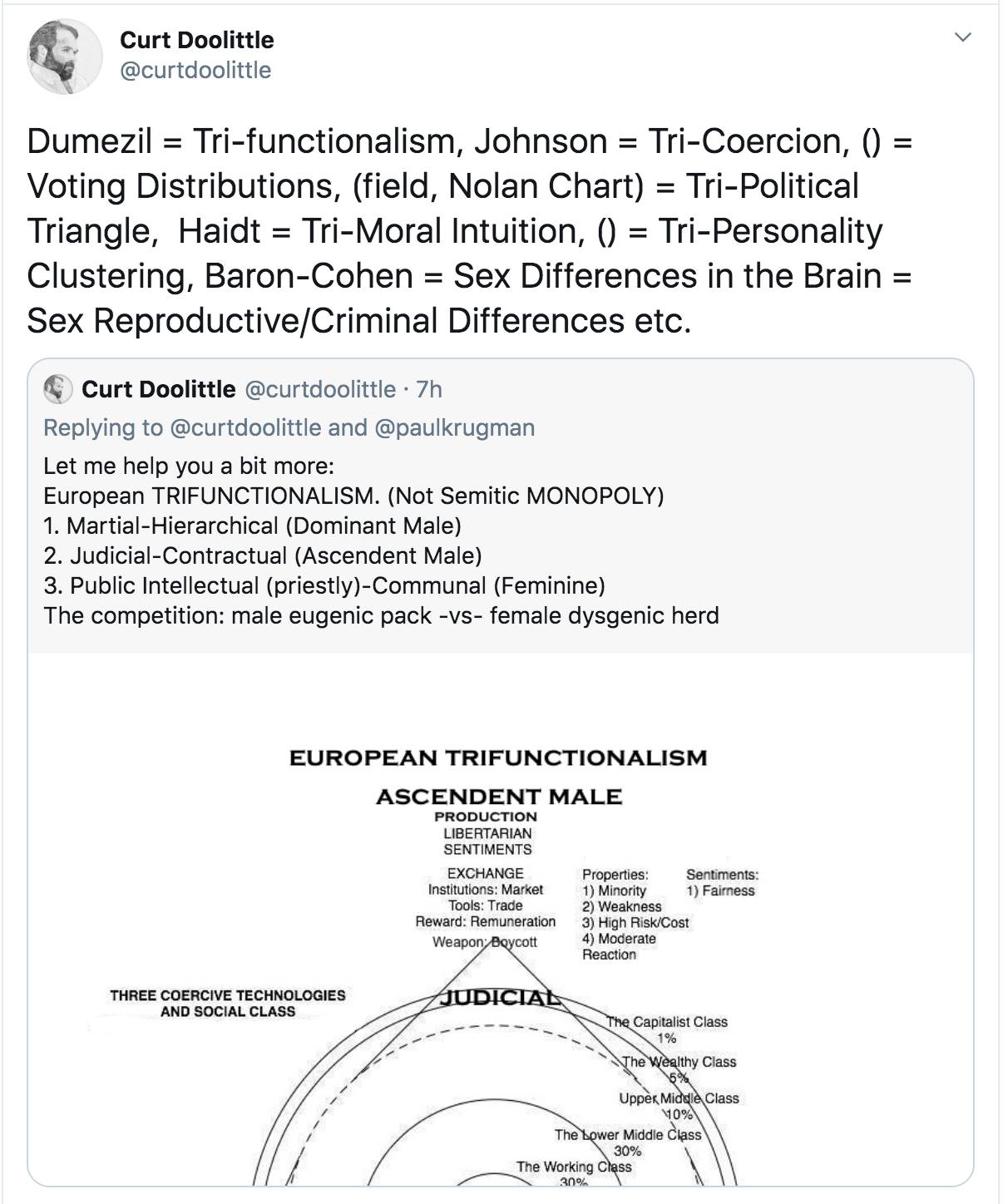
    This is just SOME of the patterns I found. And that’s before I get into math, physics, and economics

  • Dark Forces

    The eternal war of men of mind against the dark forces of time, ignorance, folly, scarcity, and the red queen. 

  • Dark Forces

    The eternal war of men of mind against the dark forces of time, ignorance, folly, scarcity, and the red queen. 

  • Knowledge is simple.That’s what science has done: reduced apparent complexity to

    Knowledge is simple.That’s what science has done: reduced apparent complexity to a single, most parsimonious, internally consistent, operationally possible, externally correspondent, paradigm. My work reduces the metaphysical, linguistic, psychological and social to one paradigm.


    Source date (UTC): 2020-05-20 16:02:49 UTC

    Original post: https://twitter.com/i/web/status/1263138116036165632

    Reply addressees: @DSchrooner

    Replying to: https://twitter.com/i/web/status/1263133474417975299