Having created, by accident, the empire, and having done so for the purpose of exporting our market system, and its trade routes, we are stuck with the very real consequences of creating power vacuums if we withdraw our military power, and create opportunity for the greater cost of NOT acting as we are acting.
We have, after all, made a nice profit out of bringing the Hindu and Sinic cultures into the modern era. We have, and continue, to make a profit bringing the Islamic cultures into the modern era – by exporting debt (that we may questionably have to pay for) rather than by collecting tariffs or taxes for having done so. These efforts have been made under the rubric of political democracy for the purpose of popular opinion, but are actually for the institutional purpose of creating an economically incentivized and politically enfranchised middle class that is invested in perpetuating the world market system.
I do not think that there is disagreement among political economists that we would be better off without having to support the empire. But when faced with the very real, and very negative impact that a withdrawal would have on the average (pampered) american, and on the average (schumpeterian) public intellectual, practical heads prevail.
[callout] Property rights are indeed the basis for prosperity. However, property rights are an institution that is created by the application of organized institutional violence. This fact is usually lost of ideological libertarians. [/callout]
As I understand it, the general thinking among the strategic thinkers (those who study military, political, and economic relationships, rather than just political, financial and social relationships) is that if we bear the burden long enough, the world will evolve into a sufficiently middle class economy (a synonym for democratic) that the purpose of the empire will decline at a rate equal to the relative importance of the american economy, allowing us to withdraw without creating shocks to the international system.
A failure to understand military history is what separates ideological political economy from practicable political economy. Property rights are indeed the basis for prosperity. However, property rights are an institution that is created by the application of organized institutional violence.
This fact is usually lost of ideological libertarians.
http://politicalticker.blogs.cnn.com/2011/03/21/trump-i-screwed-gaddafi/The point he’s making is that we are getting ‘screwed’ around the world all the time, and that we need to stop giving away our future.
I argue that anarchic propertarianism is a brilliant and fruitful research program. But it is, as currently envisioned, another luddite fantasy rather than an institutional solution to modernity that can compete with democratic secular humanism and irrational financial probabilism. Until we unite Austrianism with New Institutional Economics with modern technology we will not have a rational pragmatic alternative that preserves freedom.
Don’t get me wrong. I’m all in favor of NPR. I’m a listener, albiet not a frequent one. On the other hand, using taxpayer money for purposes that are political in nature, content, or value judgements which other taxpayers find patently offensive is simply intolerable.
We will not have a government that we can all support unless it does very little, and what little it does, is acceptable to everyone.
NPR appeals to people who are educated but who largely do not participate in the market, or are wealthy enough not to need to participate in the market. It is an 11% demographic, and that 11% is decidedly left of center, because our universities are decidedly left of center. And for that reason, the use of public funds to promote the religion of secular humanism is simply offensive to other people.
NPR is The 700 Club for Democratic Secular Humanism.
It belongs in the private sector.
NPR Board Member Admits It Serves ‘Liberal, Highly Educated Elite,’ Wonders How to Justify Public Funding
http://www.newsbusters.org/blogs/lachlan-markay/2011/03/11/npr-board-member-admits-it-serves-liberal-highly-educated-elite-wond
An Ideology: Any reasonably coherent set of social, cultural, moral and political ideas that can be used to obtain and hold political power on the behalf of a part of a population that perceives it has similar interests.
THE POLITICAL IDEOLOGIES
There are three basic western philosophical traditions:
1) Aristocratic and Conservative with the longest time preference. 2) Middle Class and Classical Liberal with medium time preference 3) Proletarian and Socialist with short time preference.
These three philosophies loosely correspond to social class sentiments and perceptions of social order. They also loosely correspond to the Monarchy, the Senate, and House of Commons. The insight of the british model was to give each social class it’s house, and to force the houses to collaborate in order to enact laws.
BREAKING THE CLASS BASED MODEL OF GOVERNMENT
This class-based model was successful in adapting to changing currents until the thought leaders of the American and French revolutions attempted to break the class model and transfer full power to either the middle (american) or lower (french) classes. And was further exacerbated by the Russian and Chinese revolutions which (regrettably) succeeded in transferring political power to the proletariat – in the greatest destruction of human life in history after the Black Plague. After the world wars, Europe was broken economically and socially and the citizenry rejected the aristocratic model entirely. (( And did so wrongly. Germany’s intellectuals were right: the anglo social order was socially destructive without the empire to support it – as the experience of both Spain and Portugal had demonstrated. German social order is the most economically productive yet discovered because it mobilizes the working class to produce quality exports. Exactly as it’s 300 princes had done during the medieval era prior to unification. )) Instead of the fraternal aristocratic model, which was the unique feature of western culture, governments sought solace in socialist doctrine and universal enfranchisement. Meanwhile western authoritarian and military leadership was absorbed by the Americans along with the British navy and port system. The parliamentary method of government has been moderately successful given the …….
Americans used this period of postwar economic prosperity to assert their inherited global military power to undermine global communism – successfully. But the cost was high, and the US is now largely bankrupt and unable to fund it’s existing military structure as well as it’s redistributionist benefit system. And the west must now combat the primitivism of Islam, which has taken on the proletarian strategy communists at a time when european postwar economies have recovered, but the developing economies are competing with western lower classes for jobs.
To fund this military empire to protect the west against proletariat primitivism, Americans export debt, and effectively charge the world an indirect tax, instead of taxing other countries directly and creating a political problem for them. Then americans use that debt to finance the cost of running the world trade and monetary system.
Unfortunately, in the process of running the empire, Americans have now become a fractured society, with race, culture and class divisions, as well as somewhere between four and ten different geographic ‘nations’ within the USA, each with different cultures, but operating under the administration of an international imperial government. Many of which, within these sub-countries feel the government is as oppressive to their cultures as do foreign nations. Under this trade empire, the US economy is now so dependent upon the value of the dollar, and the use of military force to determine the means by which trade is administered, that the citizenry will suffer if these obligations are reduced.
This series of events shows the danger of empire building to national cohesion — whether it is done on purpose as in the case of Britain defending herself from Spain and France, or by accident, in the case of the USA, trying to maintain stability, and defense from communism during and after the war period.
GOVERNMENT’S STRUCTURE MUST REFLECT SOCIETY OR SOCIETY WILL FRACTURE BECAUSE IT DOES NOT
The government must reflect the class structure of society in one way or another, so that the classes that do exist can use the government to cooperate rather than regress into class warfare. And if government does not reflect society, then society will either change to reflect the government’s class structure, by the massess aspiring or attempting to become upper middle class, which has some value, or in the opposite case, the aristocracy will abandon the nation as it has in the USA and in Ireland, which is entirely destructive to culture and economy alike. Or the upper and upper middle classes will become a predatory diasporic class like it has with the Jews in the west, and the Chinese in Oceania.
While both the aristocratic (natural law) and proletariat (socialist) political philosophies specifically state that society consists of classes, our classical liberal and democratic socialist philosophies promote the false philosophy of egalitarianism: the factual equality of ability, and the couter factual equality of outcomes – rather than the equality of opportunity despite our differences in ability to produce beneficial outcomes. The socialists, in their effort to undermine the aristocratic political system so that their elites may sieze power, supposedly on behalf of the proletariat classes, have taken control of our educational system to reinforce the justification for their seizure of power in the popular consensus, and created enough of a popular mythos to affect voting patterns, reinforcing their political power, while at the same time, reducing the competitiveness of our lower classes against foreign groups, by a process of intentional “Harrison Bergeron-ing” – dumbing down.
This is not to say that giving people property rights is necessary a bad thing. In fact, it’s an exceptional thing for everyone in the society. THe question is not whether people should have individual property rights. Its whether people need poliitcal rights if they have property rights. And logic would dicate that no. NOt only do they not need political rights, but that by giving people the opportunity for political power, we distract them from developing more useful activities in the market.
We are argue over the absurdity of choosing the best single form of government, when what we mean is ‘which class should rule?’, and “if any class should rule it should be the lower, which is the majority.” When the question itself posits a false dichotomy: the question is, since society consists of different social classes, what institutions should we create to help them cooperate such than none harms the other, and only by mutual benefit can they reach their desired ends. And so we have chosen ‘winner takes all’ government, and because of that choice, we have also, of necessity, chosen perpetual class warfare, and the destruction of the cultural cohesion necessary for the perpetuation of our nations.
So, we should reframe the question, from “which class should rule, using their class’ philosophy”, to “which form of government best facilitates the cooperation of the social classes for achieving shared ends?”
That answer, logically, is that we can, with some effort, accomodate all three class philosophies into one form of government. In fact, we had that form of government. We foolishly have abandoned it, because of the rapid shift in economic power during the industrial revolution.
THE OTHER MISTAKES WE HAVE MADE – AND NEED TO CORRECT
The first mistake we made was the transfer of political power from the landed aristocracy to the middle class, rather than replacing landed and inherited aristocracy with a new layer of aristocracy whose position was earned by merit. This allowed a new aristocracy to form, that is excluded from, and invisible to the politcal economy of society. American upper classes have abandoned participation in politics. The second mistake we made was egalitarianism, and structuring our government for rule by a single class. But we have made a series of other mistakes, partly because we lacked the knowledge of other options, lacked technologies, ideas, philosophical frameworks and processes to provide an alternative to the Hellenic and British models.
-The Errors Of The Political Process:
Scalability of the Debate form of government.
Rational Debate rather than Empirical Pragmatism: The problem of Calculation.
Taxes rather than loans.
Devolution of the defense provided by the senate / House of lords / Upper house
Descent From Utilitarianism Into Moralism
Failure to Keep Pace WIth Technology – debit cards and direct democracy.
-The Errors Of Abstract Ideas:
The Corporeal State, and the Corporeal Business
The Error Of Free Trade
The Error Of Intellectual Property
Probabilism From The Physical Sciences Applied To The Social Sciences
-The Errors Of Human Nature:
The Blank Slate vs Natural Law
The Prohibition of Political Wealth
Ignoring the Status Economy
Devaluing Aristocracy
Devaluing Voluntary Charity
The Universal Utility of Freedom, Democracy and Capitalism
The Impossibility of Agreement upon means, even if possible to agree upon ends.
-The Errors Of Credit and Money
The Relationship Between Time And Money
Breaking The Relationship Between Knowledge And Valuation Among Bankers and Lenders
Erroneous Priorities: The Financialization Of The Economy vs The Productivity Of The Economy
The Creation of Ponzi Benefits Packages Rather Than Saving and Insured Investments.
The Errors Of Incentives
The Transformation of Incentives from Negative Punishments, to Positive Rewards.
The Inability of governments to ostracize individuals and groups.
The Inability of popular government to punish real crime
The criminalization of political speech and action.
GOVERNMENT IS A SET OF INSTITUTIONS
Governments consist of organizations of human beings who follow processes, rituals and rules. These processes and rules may be historical and habitual, or formal and written. The purpose of these rules is to allow people to PLAN: to make plans and to cooperate with one another. So that they may take the risks needed to increase productivity and trade. Even dictators need a bureaucracy: an organization that will execute their will. Democracies more so, because without the hierarchy they must rely upon the established rules to give them authority by which to persuade others to cooperate with them to achieve their goals. And people who wish to cooperate, and combine their capital to produce ends, need some assurance that their risk will allow them to take the profits from that risk.
We call these organizations, rituals, processes and rules ‘institutions’. Institutions are the means by which we cooperate and compete politically.
REPAIRING THE INSTITUTIONSInstitutions:
Managed Corporate Institutions
Managed Private Institutions:
Each institution operates as do the medical, legal and accounting industries, which are largely self regulating, and self-educating. They report to senate committees.
ALSO:THE FEDERAL GOVERNMENT
THE REGIONAL GOVERNMENTS
Money, Insurance, War are global but all trade and culture is local.
NATIONALISM
Monarchs have been superior to elected leaders because they have a longer time preference. And with a longer time preference they can more wisely veto those fashionable changes which will, in the long term, harm the society, or transfer power between social classes.
CONSTITUTIONAL MONARCHY IS A CLASS BASED SYSTEM OF GOVERNMENT
(undone)
MONARCHY HAS ALWAYS BEEN A CLASS BASED SYSTEM OF GOVERNMENT
(undone)
ALL SYSTEMS OF GOVERNMENT NEED IDEOLOGIES
Monarchy needs a sufficient ideological base. The people have abandoned the church. The church has abandoned christendom. Economics has replaced cultural nationalism, and empirical tools have replaced the moral sentiments. For monarchy to prevail in the post-mystical age, we must remake it’s foundations so that they rely upon economic and cultural superiorities, not desire to return to the past.
Monarchs have been superior to elected leaders because they have a longer time preference. And with a longer time preference they can more wisely veto those fashionable changes which will, in the long term, harm the society, or transfer power between social classes.
Monarchy has a high correlation with Nationalism.
Under monarchy multiculturalism is not a problem, because cultures can form communities of interest in as many monarchies as they wish. And there is no threat from them, because they are denied access to political power, and must compete in the market, rather than politics. IN fact, this is the primary virtue of aristocratic society: people compete in the market to serve one another, rather than in politics to enslave one another. And the monarch profits from the fact that this competition, which he or she presides over, serves better to serve the people, than politics ever shall. Politics cannot create wealth. It an only create an an environment where wealth can be created.
So, under monarchies, and nationalism, people form nations, or states, which must compete against other states. These competitions then inform their value judgements – benefitting or punishing them for their decisions.
MONARCHY AND NATIONALISM
Now, why is that circumstance of nationalism a “good”? Because cultures consist of a series of hypothesis and value judgements. Each value judgement in the cultural catalogue asks each member of the community to suffer the cost to himself of forgoing opportunities to fulfill his self interest in order to ‘fund’ the social order. Social orders consist of these rules, and the associated costs in forgone opportunities. In nearly all societies these rules consist of forgoing opportunity to lie, cheat, steal, hurt, and murder. And in most advanced societies, we convert these social words into market language, and call them Fraud, Theft and Violence. But they are effectively synonyms. People can then use this market for behavior to form the society that they wish to. In other words, nationalism, or monarchies, allow people to form and join communities where they have shared values. And to enjoy the benefits of those values, and to bear the costs of those values. People are happiest when they know the rules, when they agree with them, when they can choose which community to belong to, and when it is possible to judge a set of values by their visible outcomes. Furthermore, diversity of communities does not require that we oppress one another. Diversity today is a mask for one group, largely the proletarian, for empowering the state to equally oppress everyone, and to transfer power from the meritocratic-ally endowed classes to those who are not using a false language of morality, that is framed in religious tribal language, but under analytical scrutiny simply is nothing more than exploitation. It is anything other than diversity. It is using the mask of diversity to institute their version of homogeneity.
http://www.navytimes.com/news/2011/03/ap-military-report-too-many-whites-men-leading-military-030711/?sms_ss=facebook&at_xt=4d76711665f3457e%2C0Ah.. Yes. “The Final Solution” for eliminating white male Christendom. The White Males are indeed the worst sort of villans. (Well, except for every other group of elites.) The final solution is killing off 2500 years of the Great Fraternity, it’s history, it’s mythos, it’s civilization, it’s economy, and now the source of it’s culture: The west, like all other civilizations, is the product of it’s military cultur
Whence comes Property?
The answer is a strong army and navy, a strong diplomatic corps, a strong currency free of debasement
Trade rests on trade routes. Trade routes rest on the military.
THe purpose of militarily established order is to create teh institution of property, and the market for trading it.
It’s purpose iis to deny corruption of the market to others.
The purpose of government is to determine which form of corruption wins.
the puprpose of an ancient repubic, which means, property holders, is to disallow corrutpion of trade and trade routes.
a republic of shareholders was the first and remains the only means of preserving trade.
It is a private government.
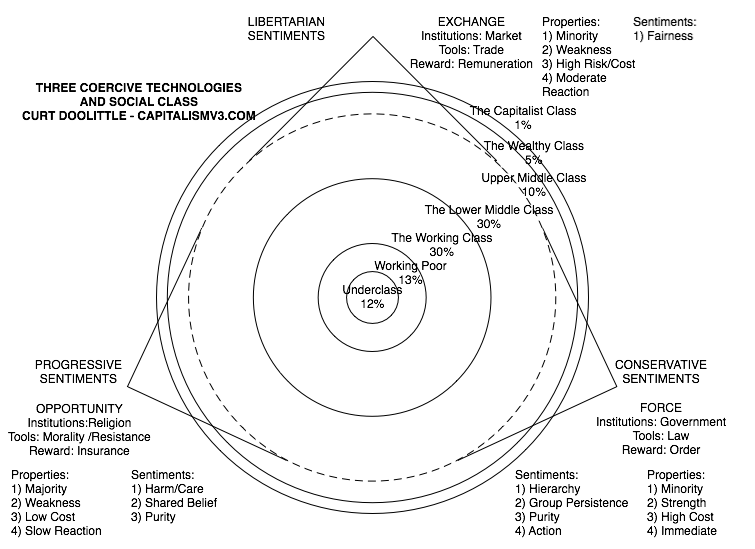
There are three means of coercing groups of people with institutions
1) Force, or the threat of force
A person has a VIOLENCE INCENTIVE to behave in a particular way when it has been made known to him that failure to do so will result in some form of physical aggression being directed at him by other members of the collectivity in the form of inflicting pain or physical harm on him or his loved ones, depriving him of his freedom of movement, or perhaps confiscating or destroying his treasured possessions.
2) Remuneration or payment
A person has a REMUNERATIVE INCENTIVE to behave in a particular way if it has been made known to him that doing so will result in some form of material reward he will not otherwise receive. If he behaves as desired, he will receive some specified amount of a valuable good or service (or money with which he can purchase whatever he wishes) in exchange.
3) Moral claims (collective goods)
A person has a MORAL INCENTIVE to behave in a particular way when he has been taught to believe that it is the “right” or “proper” or “admirable” thing to do. If he behaves as others expect him to, he may expect the approval or even the admiration of the other members of the collectivity and enjoy an enhanced sense of acceptance or self-esteem. If he behaves improperly, he may expect verbal expressions of condemnation, scorn, ridicule or even ostracism from the collectivity, and he may experience unpleasant feelings of guilt, shame or self-condemnation.
And a persuasive argument can consist of one or more of these strategies, often in great complexity.
People give priority one or more different weighted combinations, or perhaps ‘chordic’ representations of these strategies. They do so out of habit, and class inclination, just as they follow religious and class sentiments due to their upbringing.
People who belong to institutions have different capacities for adopting these strategies. Force requires discipline and long Time Bias. Remuneration requires cunning and invention. Moral claims require loyalty to consensus, and absorption of, and therefore payment of, opportunity costs. Different social classes have different time biases and consist of people with different time preferences, requiring different types of discipline under different social and economic conditions. ie: it is easier to have a long time preference if one is genetically disposed to better impulse control, and lives in greater security. It is easier to have a short time preference if one is more persuaded by impulses, less disciplined, and in an environment of scarcity.
The social classes are organized by intelligence. Intelligence is the ability to absorb content in real time, to learn abstractions in time, and to permute those abstractions in application to problems in real time. Intelligence regresses toward the mean over generations. THerefore class membership is an indicator of the likelihood of class mobility, and upper class position is difficult to maintain. While we use the word ‘middle class’, and most people in the west live middle class lifestyles, the middle class means possessing disposable income and participating in the market. Therefore the majority of citizens are in the upper proletariat and lower middle classes, which we call the working, white collar working and craftsman classes.
There are different costs to these institutions: Force is extremely expensive. Creating non-corruption, and order (some network of property definitions and their means of transfer). Property is a term for a scarce good that must used, consumed or transformed in the process of production, even if that process is human sustenance. Remunerative institutions require the complex task of concentrating capital then maintaining it in a constantly changing kaleidic and competitive environment. Moral claims require constant advocacy, verbal skill, maintenance of numerous relationships, and constant payment of opportunity costs.
The Social classes have different access to each of these forms of coercion. Those in the institutional class, or upper class, have access to force in the form of policy and law. Those in the capitalist class, or middle, have access to capital : money, and market institutions.
In each strategy people form elites, and organizations for utilizing those strategies. The elites create philosophical frameworks. Each of these frameworks consists of moral claims, and institutional means of perpetuating those claims, and the social benefits of adopting those claims.
Each of these institutions is open to corruption, which is the privatization of opportunity and reward, for personal consumption at group expense. Corruption is fraud.
Each of these strategies, their organizations, institutionas and elites compete against other strategies, organizations and elites, and each attempts to use it’s organization for discounts against other organizations.
This competition is analogous to the game of Rock, Paper, Scissors, if more complicated: each group can sucessfully compete against one another under most circumstances, but can defeat and be defeated by some other combination of forces.
The human mind is comfortable with identity and causality. It can with practice, understand a one dimensional causal spectrum. It can, with effort, understand two dimensions of cuasality. It can with more effort understand three dimensions of a causal spectrum.
Human emotions for example, consist of probably no more than three stimuli: dominance, pleasure and activiation. And that all human emotions, in their seemingly infinite varieity can be described as using these three axis of stimuli. Likewise, human social behavior consists of three different forms of coercion, in some combination, and this leads set of axis leads to seemingly infinite variety.
But it only seems infinite. At it’s base, there are only three forms of social organization.These three forms can be combined, as they are in the majority of the population in some manner or another. Or they can be used as one of three specializtions, each of which attempts to play rock, paper, scissors, with the other two.
In a nation with no institutions other than tribal alliances, only members of the existing hierarchy can replace a leader, because the only institution that the society relies upon is loyalty to individuals, and religion, not to principles.
In fact, this is the entire problem with the primitive civilization we call Islam. There is loyalty to family and tribe, loyalty to religion, but no loyalty to principles of government.
We forget in the west, how miraculous and uncommon is our transfer or power between regimes. The anglo world is unique in it’s stability. Western culture is unique, and it’s method of government is unique. It is, since antiquity, based upon the balance of powers.
The rest of the world lives under precisely the opposite postion: the concentration of power.
We cannot hold others up to our standards.
We can only help them understand that if they wish our economic prosperity, them must adopt our forms of loyalty.
Loyalty first, to principles.
Leading an organization of human beings of any size, is a complex and difficult task.
Human events are kaleidic. The common people have complex and conflicting motivations and incentives.
Leaders must convey near omniscience because their followers are moved at the lowest cost in the shortest time under the assumption of near omniscience.
Power is obtained by a mixture of discipline, cunning, compromise, threats, perseverance, demographics and luck.
Power is held by a mixture of habituation and limited, tacit consent – almost entirely because the alternatives are uncertain and therefore more risky, costly and frightening.
THE UPPER CLASSES, HISTORY, INSTITUTIONS AND LAW
Those who are the victors, and those who create the rules rules, do not write philosophy — they take actions, make decisions, speeches, art, and policy.
They create institutions: The administrative tools of human cooperation.
Their followers write history.
History is the only form of philosophy with any substantive truth content.
There are very few books of Aristocratic philosophy: Aristotle, Machiavelli, Pareto, Weber. Perhaps some of the scholastics.
In the west, administrative philosophy of the church is divided from the military and commercial philosophy of the Manor-Kings.
The writers of the church are members of the middle class or the aristocracy.
But history and the record of history is the writing of the nobility.
THE MIDDLE CLASSES AND PHILOSOPHY
The vast number of works of political philosophy have been written by the upper middle and middle classes.
Nearly all political philosophy is by definition revolutionary – there is no need to use verbal coercion when one has the means by which to enact ones will without verbal coercion.
Western philosophy is an advisory program. It counsels. It suggests. It persuades.
Western philosophy is utilitarian. It is moral and most importantly it is both technical and commercial.
Western philosophy establishes the contract terms of the middle class, by which they are willing to be administered by the aristocracy.
THE LOWER CLASSES AND RELIGION
All religion is political philosophy. It is the philosophy of resistance.
Religion establishes the contract with the peasantry. It sets the terms by which they are willing to be administered by the aristocracy.
The power to resist. To refuse to act. Is a power. It is the power of the weak. But in vast numbers. It is a vast power.
Religious symbols are resistance movement symbols. Whether dress, or icon, mythical figure or scripture. Religious movements are resistance movements. Resistance through unity.
VIOLENCE RULES
But we must be cautious when consuming philosophical writing. It is largely acts of justification. To defend ourselves against it, we must ensure that we study our history as well, because philosophy influences and justifies —- but violence and law rules.
All legal products, all philosophical products, all religious products – all political products of all kinds, are an effort to rotate elites for the purpose of class benefit.
Marx was right that there exists a class struggle. He was wrong that it will end.
He was wrong that the proletariat would ever win.
The fact is, that there are vast differences in ability between individuals. That these differences are genetic. That our classes are a genetic hierarchy. And that genes regress toward the mean.
For these reasons, we will always have class rotation.
And law, philosophy and religion will be the means by which each group seeks to hold or obtain power.