I got a lot of heat for this so I pulled it and sat on it for a week. And this morning I’ve added some notes to it for clarity. And sorry if it pisses people off, but it’s right. It is what it is.
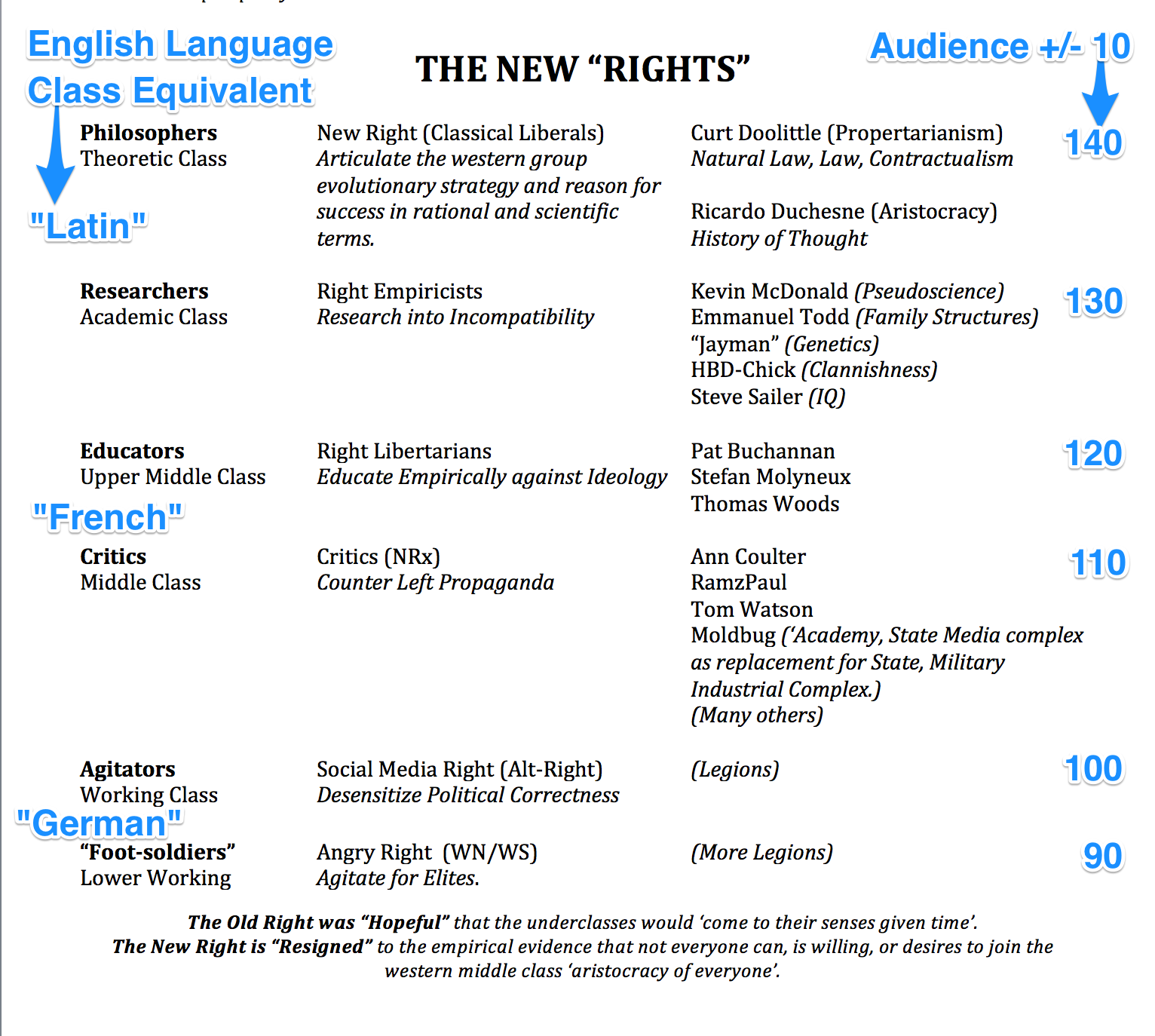
I got a lot of heat for this so I pulled it and sat on it for a week. And this morning I’ve added some notes to it for clarity. And sorry if it pisses people off, but it’s right. It is what it is.
–“I wonder if in one hundred years we just need a roomful of geniuses and the internet to run the whole world.”–Adam Voight
Yeah. That’s what I’m thinking. Except that word ‘run’ is an experiential analogy, and not an operational or descriptive statement.
So, what I worry about is whether it is analogy for “serve”, “farm”, or “enslave”.
…(!!!!)
Source date (UTC): 2016-09-23 05:05:00 UTC
I want every people to compete for dominance.
I just want our people to never be defeated.
What are you, cowards? Women?
Source date (UTC): 2016-09-23 03:23:00 UTC
https://propertarianism.wordpress.com/2016/09/23/the-new-right-class-structures/THE NEW “RIGHTS” BY CLASS STRUCTURE
Source date (UTC): 2016-09-23 03:03:00 UTC
Q&A: —“What are your thoughts on universal public education being provided by the state.”— GREAT QUESTION WHEREAS (1) Education provides both offensive and defensive benefits. So (a) Offensively, it increases the possibility of productivity (a commons). And (b) Defensively it reduces crime(loss), insurance(restitution) and welfare (prevention) costs. (Humans are really expensive things.) While we probably teach largely the wrong things today, and that we teach them poorly, (not enough repetition of basic operations), that does not mean that we cannot teach the right things. After Defense (external), and Law and order(internal), education is probably the most important offensive and defensive capability a group can add to the commons. So I am pretty sure education needs to be mandatory in order to avoid externalizing costs of failing to educate (prevention) on fellow shareholders (citizens), due to loss, restitution. ( Same with driving a vehicle without insurance. Or driving aggressively. You’re exporting risk onto others. ) Failing to educate is just like failing to respect property. It’s just more indirect. Now, if you have the right of exit, and your offspring have the right of exit, and you leave the market (territory), that’s not the case. But then you lose the benefits of being a member of the market (territory). So it’s your choice. It’s pretty hard to find a market that will allow entry of an uneducated person. It’s just going to force costs on shareholders (citizens) (2) So if education is both a necessary good, and a moral obligation, then the question is only (a)whether universal provision by the state is a necessary or preferable, and (b) whether the monopoly provision of it by the state is necessary or preferable. Well first we have to answer the externality question. Does universal provision by the state solve the problem of the costs of loss, restitution, and prevention? Well yes. It does. Does the scale of that provisioning convey any price benefits? Actually no. Because the bureaucracy consumes a disproportionate amount of the funds, without any measurable positive impact, and arguably negative. Does universal education using the same curriculum have positive or negative consequences. Well the answer is that any education must provide some minimum: reading, writing, basic math, basic personal accounting, basic principles of contract, basic principles of the economy. Basic principles of natural law, basic principles of physical laws. Note that I’ve included no mythology in that list. No justificationism. Does universal education need mythology? Well I think that teaching anything antithetical to natural and physical law, antithetical to contract, accounting, mathematics, and reading (the common tongue), is something that exports costs onto others through the propagation of falsehoods. Can I teach my own children mythology at home, or in religious school? Of course you can. If it is taught as spiritual, as faith, as psychology, but not in conflict with physical, natural, contactual, mathematical, literacy, or rhetorical, grammatical, and logical truth. There are no ancient texts that cannot be translated into ratio-scientific language as necessary and possible traditions of the time. There are no normative family and cultural traditions that cannot likewise be explained. There is no harm in prayer, ritual, and faith, even if there is harm in conflating spiritual(experiential) and truthful(testimonial). It’s very hard to argue with the sermon on the mount. And it’s not hard to state that them miracles are fairy tales meant to educated us on how we should aspire to behave toward one another. CLOSING So like anything, when we want to produce a private good (education) for common goods (costs of loss, restitution, and prevention), then the market will succeed at providing some goods (private education, church education, public education) just as it will succeed at providing other goods (private health care, church health care, state health care), and many other goods (private investor banking, commercial banking, credit unions, and state treasury support). So the problem we have had in the past, is not the failure to understand this problem, but the failure to require truth, while preserving faith. Because man does not live by truth alone unless he lives in a large primitive tribe where he is saturated by information supplied by peers and there is no meaningful information available to him that is not shared by those peers. Even in those circumstances we require faith in order to ease the various sufferings, and to cause the community to unite in celebration of the service of the common good. Ergo, we must warranty all speech, products and services against error, bias, wishful, thinking, suggestion, pseudoscience, and deceit. And we must warranty the minimum (not ultimate) services that an individual must possess in order not to be a burden on others such that he invokes moral hazard, and by invoking moral hazard, creates the incentive in the commons to abandon perfect-care of the commons. This is a profoundly important issue: preservation of the incentive to preserve and expand the commons. And as long as one warranties minimum provision, no falsehood, and treats myths as necessary goods as long as they do not violate the natural and physical and contractual and logical law, then there is no reason we cannot provide public (insured education), private education(market provided education), and community education (church, etc), My suggestion, as always with regard to the professions, is (a) that I don’t believe anyone that is not a grandmother or grandfather should teach anything to anyone. Otherwise we have a person without life experience conveying the necessities of surviving life’s experiences. (b) that it’s the teachers who are paid, not organizations, and that the teachers contribute some part of their fees to the maintenance of the organization. And that organizations that desire capital investment can lend against future earnings. And that we can only lend against future earnings if the citizenry is to insure the loan. These are the terms by which teachers can teach, schools can form. Not in the interests of the school owners, but in the interest of the teachers and the students. I think all education should be paid for as deductions from future earnings (payroll fees). And current costs covered from the treasury. Why? Because it’s an investment that produces guaranteed returns, if we keep honest statistics on the performance of different degree programs and their classes. (Early childhood ed is a very bad investment, right behind Sociology). Then universities and schools will not charge money for the modern equivalent of “indulgences” which they give people paper in exchange for participating in nonsense for years, all at the public expense. In university, paying teachers directly and separating teaching and researching staff, and paying them accordingly. (the way oxford and Cambridge were started) We can let the market regulate education by using the courts to punish people who teach untruths contrary to natural, physical, contractual, and logical laws. If we did this in just one generation we would change the world for the better nearly as much as we changed the world with greek reason, British science, and enlightenment literacy. Truth is as important an innovation as were literacy, reason, and science. It’s just unfortunate that it took us this long to discover what it means. So that’s my position: Private(wealthy), civic(middle), and public(lower) institutions for the purpose of education, paid for out of future earnings, teaching the minimums, requiring warranty, and separating spirituality and myth from action and truth. What will rapidly occur is that government schools will rapidly improve else the stigma close them, and as usual the wealthy will innovate and the rest benefit. Curt Doolittle The Propertarian Institute Kiev, Ukraine
Q&A: —“What are your thoughts on universal public education being provided by the state.”— GREAT QUESTION WHEREAS (1) Education provides both offensive and defensive benefits. So (a) Offensively, it increases the possibility of productivity (a commons). And (b) Defensively it reduces crime(loss), insurance(restitution) and welfare (prevention) costs. (Humans are really expensive things.) While we probably teach largely the wrong things today, and that we teach them poorly, (not enough repetition of basic operations), that does not mean that we cannot teach the right things. After Defense (external), and Law and order(internal), education is probably the most important offensive and defensive capability a group can add to the commons. So I am pretty sure education needs to be mandatory in order to avoid externalizing costs of failing to educate (prevention) on fellow shareholders (citizens), due to loss, restitution. ( Same with driving a vehicle without insurance. Or driving aggressively. You’re exporting risk onto others. ) Failing to educate is just like failing to respect property. It’s just more indirect. Now, if you have the right of exit, and your offspring have the right of exit, and you leave the market (territory), that’s not the case. But then you lose the benefits of being a member of the market (territory). So it’s your choice. It’s pretty hard to find a market that will allow entry of an uneducated person. It’s just going to force costs on shareholders (citizens) (2) So if education is both a necessary good, and a moral obligation, then the question is only (a)whether universal provision by the state is a necessary or preferable, and (b) whether the monopoly provision of it by the state is necessary or preferable. Well first we have to answer the externality question. Does universal provision by the state solve the problem of the costs of loss, restitution, and prevention? Well yes. It does. Does the scale of that provisioning convey any price benefits? Actually no. Because the bureaucracy consumes a disproportionate amount of the funds, without any measurable positive impact, and arguably negative. Does universal education using the same curriculum have positive or negative consequences. Well the answer is that any education must provide some minimum: reading, writing, basic math, basic personal accounting, basic principles of contract, basic principles of the economy. Basic principles of natural law, basic principles of physical laws. Note that I’ve included no mythology in that list. No justificationism. Does universal education need mythology? Well I think that teaching anything antithetical to natural and physical law, antithetical to contract, accounting, mathematics, and reading (the common tongue), is something that exports costs onto others through the propagation of falsehoods. Can I teach my own children mythology at home, or in religious school? Of course you can. If it is taught as spiritual, as faith, as psychology, but not in conflict with physical, natural, contactual, mathematical, literacy, or rhetorical, grammatical, and logical truth. There are no ancient texts that cannot be translated into ratio-scientific language as necessary and possible traditions of the time. There are no normative family and cultural traditions that cannot likewise be explained. There is no harm in prayer, ritual, and faith, even if there is harm in conflating spiritual(experiential) and truthful(testimonial). It’s very hard to argue with the sermon on the mount. And it’s not hard to state that them miracles are fairy tales meant to educated us on how we should aspire to behave toward one another. CLOSING So like anything, when we want to produce a private good (education) for common goods (costs of loss, restitution, and prevention), then the market will succeed at providing some goods (private education, church education, public education) just as it will succeed at providing other goods (private health care, church health care, state health care), and many other goods (private investor banking, commercial banking, credit unions, and state treasury support). So the problem we have had in the past, is not the failure to understand this problem, but the failure to require truth, while preserving faith. Because man does not live by truth alone unless he lives in a large primitive tribe where he is saturated by information supplied by peers and there is no meaningful information available to him that is not shared by those peers. Even in those circumstances we require faith in order to ease the various sufferings, and to cause the community to unite in celebration of the service of the common good. Ergo, we must warranty all speech, products and services against error, bias, wishful, thinking, suggestion, pseudoscience, and deceit. And we must warranty the minimum (not ultimate) services that an individual must possess in order not to be a burden on others such that he invokes moral hazard, and by invoking moral hazard, creates the incentive in the commons to abandon perfect-care of the commons. This is a profoundly important issue: preservation of the incentive to preserve and expand the commons. And as long as one warranties minimum provision, no falsehood, and treats myths as necessary goods as long as they do not violate the natural and physical and contractual and logical law, then there is no reason we cannot provide public (insured education), private education(market provided education), and community education (church, etc), My suggestion, as always with regard to the professions, is (a) that I don’t believe anyone that is not a grandmother or grandfather should teach anything to anyone. Otherwise we have a person without life experience conveying the necessities of surviving life’s experiences. (b) that it’s the teachers who are paid, not organizations, and that the teachers contribute some part of their fees to the maintenance of the organization. And that organizations that desire capital investment can lend against future earnings. And that we can only lend against future earnings if the citizenry is to insure the loan. These are the terms by which teachers can teach, schools can form. Not in the interests of the school owners, but in the interest of the teachers and the students. I think all education should be paid for as deductions from future earnings (payroll fees). And current costs covered from the treasury. Why? Because it’s an investment that produces guaranteed returns, if we keep honest statistics on the performance of different degree programs and their classes. (Early childhood ed is a very bad investment, right behind Sociology). Then universities and schools will not charge money for the modern equivalent of “indulgences” which they give people paper in exchange for participating in nonsense for years, all at the public expense. In university, paying teachers directly and separating teaching and researching staff, and paying them accordingly. (the way oxford and Cambridge were started) We can let the market regulate education by using the courts to punish people who teach untruths contrary to natural, physical, contractual, and logical laws. If we did this in just one generation we would change the world for the better nearly as much as we changed the world with greek reason, British science, and enlightenment literacy. Truth is as important an innovation as were literacy, reason, and science. It’s just unfortunate that it took us this long to discover what it means. So that’s my position: Private(wealthy), civic(middle), and public(lower) institutions for the purpose of education, paid for out of future earnings, teaching the minimums, requiring warranty, and separating spirituality and myth from action and truth. What will rapidly occur is that government schools will rapidly improve else the stigma close them, and as usual the wealthy will innovate and the rest benefit. Curt Doolittle The Propertarian Institute Kiev, Ukraine
Aug 13, 2016 12:18pm Everyone knows how to fix Ukraine. But no one in the country has the power to do it. And the only external group willing to use power to do it, will just make it worse (Russians). Even though the optimum people to do it are their genetic siblings right next door (Poland). And other peoples (the Americans, Canadians, and Germans) have demonstrated a willingness to pay for it. (yes really). Ukraine’s problem is a Jewish-libertarian’s dream: about 40 oligarchs (rich people) who range from men of commercial achievement and character, to Russian ex-gangsters, to families that control judicial corruption, to jews looking to restore Ukraine to their undeclared homeland. Very few people know how to fix the United States of America. But because of our arms, our traditions of legal revolt, and culture of aristocratic martial tradition, we have the ability and power to enact that change. We just need to have the will to do it. But because of that same culture we need a moral license, a set of demands, a plan of transition, and a means of revolt, in order to execute our will. Now, every major revolution in the anglo world (anglo-saxon-contractualism) has occurred in no small part, because of expansion of the methods of communication and innovations in technology. We have the ability to communicate and coordinate vast numbers of people that no prior era has ever imagined. Washington had nothing at all but pocket change, character, and some helpful propagandists who used the printing press. Stalin did what he did and had nothing on par with the tools we have at our disposal. Mao did what he did, and he nad nothing on part with the tools we have at our disposal. Napoleon had a lot more going for him than we do. Cromwell had more at his disposal than we do. But whether one is inside the government or outside the government, it does not matter if one has a set of demands, a plan of transition, a means of raising the cost of the status quo through insurrection, a small minority of males willing to risk life and limb, and a communication system capable of distributing information, tactics, and strategy to participants. The world has never been so fragile and in such great transition as it is today – or at least, it has not since the Marxist (Jewish) enlightenment inspired the lower classes to seek power as much as the empirical (anglo) enlightenment inspired the middle classes to seek power. But the difference today is that we cannot, under duress, return to the farm. THere are but a few days of food water and energy in the pipline, and in a momentum economy, like a momentum stock market, the system is increasingly vulnerable to shocks. (Thank your Keynesians for their efforts at ‘balanced equilibrium, rather than your Classical Liberals, for their “changes in capital”). We can more easily fix america than any group ever chose to fix any nation in history. Curt Doolittle The Philosophy of Aristocracy The Propertarian Institute (I have no idea where I am at the moment)
Aug 13, 2016 12:18pm Everyone knows how to fix Ukraine. But no one in the country has the power to do it. And the only external group willing to use power to do it, will just make it worse (Russians). Even though the optimum people to do it are their genetic siblings right next door (Poland). And other peoples (the Americans, Canadians, and Germans) have demonstrated a willingness to pay for it. (yes really). Ukraine’s problem is a Jewish-libertarian’s dream: about 40 oligarchs (rich people) who range from men of commercial achievement and character, to Russian ex-gangsters, to families that control judicial corruption, to jews looking to restore Ukraine to their undeclared homeland. Very few people know how to fix the United States of America. But because of our arms, our traditions of legal revolt, and culture of aristocratic martial tradition, we have the ability and power to enact that change. We just need to have the will to do it. But because of that same culture we need a moral license, a set of demands, a plan of transition, and a means of revolt, in order to execute our will. Now, every major revolution in the anglo world (anglo-saxon-contractualism) has occurred in no small part, because of expansion of the methods of communication and innovations in technology. We have the ability to communicate and coordinate vast numbers of people that no prior era has ever imagined. Washington had nothing at all but pocket change, character, and some helpful propagandists who used the printing press. Stalin did what he did and had nothing on par with the tools we have at our disposal. Mao did what he did, and he nad nothing on part with the tools we have at our disposal. Napoleon had a lot more going for him than we do. Cromwell had more at his disposal than we do. But whether one is inside the government or outside the government, it does not matter if one has a set of demands, a plan of transition, a means of raising the cost of the status quo through insurrection, a small minority of males willing to risk life and limb, and a communication system capable of distributing information, tactics, and strategy to participants. The world has never been so fragile and in such great transition as it is today – or at least, it has not since the Marxist (Jewish) enlightenment inspired the lower classes to seek power as much as the empirical (anglo) enlightenment inspired the middle classes to seek power. But the difference today is that we cannot, under duress, return to the farm. THere are but a few days of food water and energy in the pipline, and in a momentum economy, like a momentum stock market, the system is increasingly vulnerable to shocks. (Thank your Keynesians for their efforts at ‘balanced equilibrium, rather than your Classical Liberals, for their “changes in capital”). We can more easily fix america than any group ever chose to fix any nation in history. Curt Doolittle The Philosophy of Aristocracy The Propertarian Institute (I have no idea where I am at the moment)
https://propertarianforum.wordpress.com/2016/09/19/propertarian-podcast-006-malincentives-of-democracy/WHAT’S WRONG WITH DEMOCRACY (AND HOW TO FIX IT)
Source date (UTC): 2016-09-20 01:09:00 UTC
—“Hi Mr. Doolittle, From my (very limited) knowledge of your work, you seem very concerned with legal rights and economic questions (based upon a moral framework), which is a definite departure from many on the Alt-Right who focus primarily on socio-political issues.Do you think it’s a weakness of our movement to avoid discussion of economic & legal rights? From what I’ve seen, most of us favor an overall capitalistic economic structure with the caveat that economic activity should support the nation, both financially and morally (spiritually?), such as through the limiting of pornography and the banning of usury (actual usury, such as predatory lending terms, not merely interest on capital), and limiting the activity of foreign interests in domestic issues. I ask whether you think it’s a weakness that we don’t discuss this because even though there is a general consensus, I dislike having blind spots in my worldview.Lastly, have you read James Burnham’s Managerial Revolution and/or Sam Francis’ follow-up Leviathan and its enemies? If so, what were your thoughts on the theory presented re: the transformation of capitalist society to a managerial society?”— Great questions. I”m going to reframe the first one: –“You seem very concerned with legal rights and economic questions (based upon a moral framework), which is a definite departure from many on the Alt-Right who focus primarily on socio-political issues.”–I’ll restate this as I try to unify science, morality, law, and philosophy into a single discipline that merely requires we speak truthfully in matters of the commons, and I advocate the forcible restructuring of our institutions using the language of institutions: law. What you see in the alt right, despite the alt right’s embrace of science, is the perpetuation of moral language. The question is, if we evolved from supernatural to reason, to rationalism, to science, and in my work “complete scientific realism”, then why would people continue to argue in reasonable and rational terms, and partly scientific terms, when scientific and completely scientific are available? Well, there are four reasons: (a) moral language helps us rally and shame. (b) moral language helps us with catharsis, (c) moral language is intuitionistic even if unscientific, and (d) scientific l language is none of the above. So to simplify that, I’ll say that I use the language of natural law to construct institutions of natural law: exchange, rather than trying to argue that one position is superior to another in order to enforce a monopoly decision that I prefer over the monopoly decisions that others prefer. —“Do you think it’s a weakness of our movement to avoid discussion of economic & legal rights?”— All rights are contractually exchanged, that’s the only way they can exist. Natural rights are those we generally require if we are to avoid conflict with one another, and foster cooperation and competition with one another. Otherwise they’re not contract rights or natural rights, but legislative rights enforced by an insurer of last resort. We do not contract for our rights. In our case the government is an insurer. And the government works to construct LEGISLATIVE rights, not NATURAL RIGHTS. SO in answer to your question, it’s not useful to discuss rights other than those we require. Instead, I’ve stated it differently: that our position can, and must be, that the only reason we do not use our wealth of personal violence, group violence, and organized violence, to construct legal rights in our interests alone at the expense of other’s desired natural rights, is if we all possess natural rights and natural rights alone. So I’ve tried to restore the reality of political philosophy to the state prior to the set of lies we created in order to justify adding women to the franchise, in an equivalent house, rather than in their own separate house of government: that the only reason to forgo our desire to rule in our own self interest, is if we rule by rule of law in one another’s equal interest. And if that is not the case, then we simply license parasitism and our own destruction. The first question of ethics and politics is ‘why don’t I just kill you and take your stuff’. It’s only after we’ve decided that we will cooperate that we enter the question of ethics (how not to disincentivize cooperation), or politics (how not to disincentivize the production of commons.) We value a MERITOCRATIC commons (political), economy (ethics), reproductive (family), structure that is against the interests of those who lack competitive reproductive desirability, competitive productive ability, and productive ability to contribute to the commons. That you phrase the question as moral, and I phrase it as economic is the problem with the alt-right that I am trying to solve by providing a rational and scientific language for the discussion, comparison, and contrast of all epistemic, ethical, political, and group evolutionary strategies. The weakness is that we will not come to terms with the fact that meritocracy and eugenics and our ability to produce wealth and commons are antithetical to democracy, and that without the restoration of the market for commons and a judicial monarchy (inherited), we cannot possess the liberty and meritocracy we desire. Eugenics is incompatible with democracy. The original settlers (my ancestors included) used different language but the American colonies were an experiment in eugenics. The disaster was the Louisiana purchase that requires vast immigration to populate the new territory so that it would not be seized (yet again) by the European powers. The new territory would have extended slavery, and this would have firmly put both taxation (on export goods) and the power of the federal government, in the hands of the agrarians and their international market, at the expense of the new industrialists and the domestic market. Had we retained the original colonies it is possible that we could have retained the eugenic experiment – even with the handicap of the Scotts-Irish in the south. Of course, I have read Burnham and I consider him one of my greater influences – he gave me the moral courage so to speak to abandon my cultural allegiances as a member of the puritan families, the anti-monarchy forces in the English civil wars, and the anti-monarchy movement in the American revolution. I consider all of these to be failures. You can see my entire reading list onPropertarianism.com/reading-list, and you can contact Ramsey because he maintains our library, and we have most of the work in digital format available for readers. Burnham’s observation is not unique, but he was trying to warn us about it. There are a couple of human tendencies that we should be aware of: 1) the models we use like analogies to animals, hydraulic, mechanical, electrical, and now computational (information) change with every era, and we misapply properties of those models to man. Man is an organism that grows and is changed by his growth from conception to old age. We tend to try to hang on to a model and extend the use of that model in our minds to ever greater scope. But they’re just analogies, with information in both physics and social science the current state of our ability to represent the world. 2) tendency to thing obvious trends are special and novel. But if we look at all human organizations they go through the same cycles and Burnham was trying to tell us that. Like Hayek and popper, or perhaps even Simmel, he was trying to describe the problem of political order as an information and decidability problem. So just as monarchies fell because their families lacked sufficient population to produce sufficient technocrats to run things, and just as private companies had to give way to corporations with professional managers, the size and scale of the modern state requires institutions. Whether those institutions could have been provided by market services is a question of maturity. At first, no, but over time yes. He was critical because he did not have a solution. We have all be correct in criticizing socialism. What we haven’t been correct about is in criticizing capitalism and democracy. Yes, we can have a star trek society with an average IQ of 125 or higher. But the Arabs cannot with an average IQ of 85-90 at the best. Neither can the Brazilians with such an enormous underclass in relation to the productivity and quality of their institutions. I hope this gave you some ideas to work with. Curt Doolittle The Philosophy of Aristocracy The Propertarian Institute