—“I’m trying to understand. … Law is then a summary of natural (proper and just) consequences for action/inaction.
As far as it can be enforced depends on the affordability…this would also determine the willingness of men to administer and enforce the law via Incentives.
It’s an immovable object, or very nearly.
Government (governance deferred from the individual to a collective specialising in law and violence, held in common somewhat and funded by citizens) is the flexible part, the expression of that described above but adjusted to each population with their endemic characteristics, abilities etc.
Holy shit.”—Benjamin Baker
You just graduated my friend. Welcome to the judiciary. 😉
Propertarianism is a system of law designed to prevent lying in politics.
…
…
WHAT IS PROPERTARIANISM? (Medium)
Propertarianism is a methodology that completes the scientific method; the application of that method to the law; a set of amendments to restore rule of law; including the prevention of lying about commerce, finance, economics, law, and politics in public speech.
…
…
WHAT IS PROPERTARIANISM? (Long)
Propertarianism refers to a body of work. That body of work consists of:
… 1. HISTORY: An explanation for the disproportionate success of western civilization in the ancient and modern worlds.
… 2. METHOD: The completion of the scientific method and and its embodiment in law.
… 3. APPLICATION: Application of that method to all fields and common moral and legal questions.
… 4. LAW: A formal, algorithmic, operational, logic of law.
… 5. CONSTITUTION: A set of Recommended Amendments to the Constitution for the United States – preserving the current legal entity, while altering the current means of government.
… 6. POLICIES: a set of policies to reform our military, political, economic, financial, and social orders.
… 7. RECOMMENDATION: The recommendation that insurrection be used to demand implementation of these amendments to the constitution, given the scale of the parasitic classes in and out of government.
—“Is it ancap? I searched it it looked like some minarchy stuff.”–Mick Seppala
It’s strictly constructed rule of law by test of reciprocity – major difference is you can’t ‘lie’ in political speech – which is the hard problem of converting from free speech to free truthful speech. And … You ‘roll your own’ government with it. I recommend various forms of government for various people. but only one rule of law. P is not ideology, philosophy, or religion. It is LAW.
(Not going to repeat every single refutation here. If you encounter one where you think you ‘got me’ it won’t happen. sorry. Just ask how we handle it.)
;
DEMAND FOR POSSESSION, PROPERTY, PROPERTY RIGHTS.
1) Cooperation provides disproportionate returns necessary for survival
2) Division of labor multiplies disproportionate returns on cooperation.
4) Humans engage in both retaliation, and altruistic (costly) punishment of cheaters in order to preserve the disproportionate returns on cooperation and cooperation at scale.
5) Morality consists of reciprocity within the local limits of proportionality. Man is amoral and acts in hist interests it is just nearly always in his better long term interests to act morally.
6) Law evolved to prevent retaliation cycles, to standardize means of conflict resolution, to maintain maximum returns for the majority of the polity, and to increase the revenues of taxing authorities.
7) Law uses a single measure: demonstrated investment which we call interests or ‘property’ to resolve conflicts and preserve the peace (returns on cooperation), and a single test: reciprocity. Ths law is called ‘tort’ or ‘natural law’.
8) Law evolves through the continuous evolutionary suppression of violations of reciprocity, through the continuous discovery of findings of law. It is a purely empirical process.
9) All social science can be expressed in terms of identification, acquisition, transformation, transfer, consumption, and loss of interests in property.
10) All human cognition can be expressed as reward system responses to that same identification, acquisition, transformation, transfer, consumption, and loss of interests in property.
THEREFORE;
Ergo PROPERTARIANISM consist of a universal language of linguistic, psychological, and social sciences that makes use of a standard of measure we commonly call property.
WHEREAS;
“Property” refers to:
1) MEASUREMENT: A category of measurements, within that category we call weights and measures, that provides commensurability and therefore decidability, over the use of all possible human interests, in matters of conflict over those interests, where those interests satisfy any demonstrated human demand.
AND WHERE;
Property consists in that series:
1) POSSESSION(IN FACT): That which I have acted to prevent others from consumption or use.
2) PROPERTY(NORMATIVE: That which you and I agree not to use or consume from one another.
3) PROPERTY RIGHTS(INSURED): that which a third party will insure we do not use or consume from one another.
AND WHERE;
Rights include no less than:
1) Constituo – Homesteading: Convert into property through bearing a cost of transformation.
… 5) Such action is free of violation of the same by externality. (unharmful)
AND WHERE;
Man demonstrates interest and defends the following categories of his means of production:
1) MEANS OF PRODUCTION OF EXISTENCE
Personal property: “Things an individual has a Monopoly Of Control over the use of.”
– Physical Body
– Actions and Time
– Memories, Concepts and Identities: tools that enable us to plan and act. In the consumer economy this includes brands.
– Knowledge ties (skills, crafts)
– Several Property: Those things we claim a monopoly of control over.
AND;
2) MEANS OF PRODUCTION OF REPRODUCTION
Means of Reproduction: “relationships with others and tools of relationships upon which we reciprocally depend.”
– Mates (access to sex/reproduction)
– Children (genetic reproduction)
– Familial Relations (security)
– Consanguineous Relations (tribal and family ties)
– Racial property (racial ties)
– Status and Class (reputation)
AND;
3). MEANS OF PRIVATE PRODUCTION
Relational Property
– Non-Familial Relations (utility)
– Organizational ties (work)
Cooperative Property
– Shares in property: Recorded And Quantified Shareholder Property (claims for partial ownership)
Artificial Property
– Monopoly Property such as intellectual property. (grants of limited monopoly within a geography)
– Trademarks and Brands (prohibitions on fraudulent transfers within a geography).
AND;
4). MEANS OF COMMONS PRODUCTION
(Community) Property
– Institutional Property: “Those objects into which we have invested our forgone opportunities, our efforts, or our material assets, in order to aggregate capital from multiple individuals for mutual gain.”
– Informal (Normative) Institutions: Our norms: manners, ethics and morals. Informal institutional property is nearly impossible to quantify and price. The costs are subjective and consists of forgone opportunities.
– Formal (Procedural) Institutions: Our institutions: Religion (including the secular religion), Government, Laws. Formal institutional property is easy to price. costs are visible. And the productivity of the social order is at least marginally measurable.
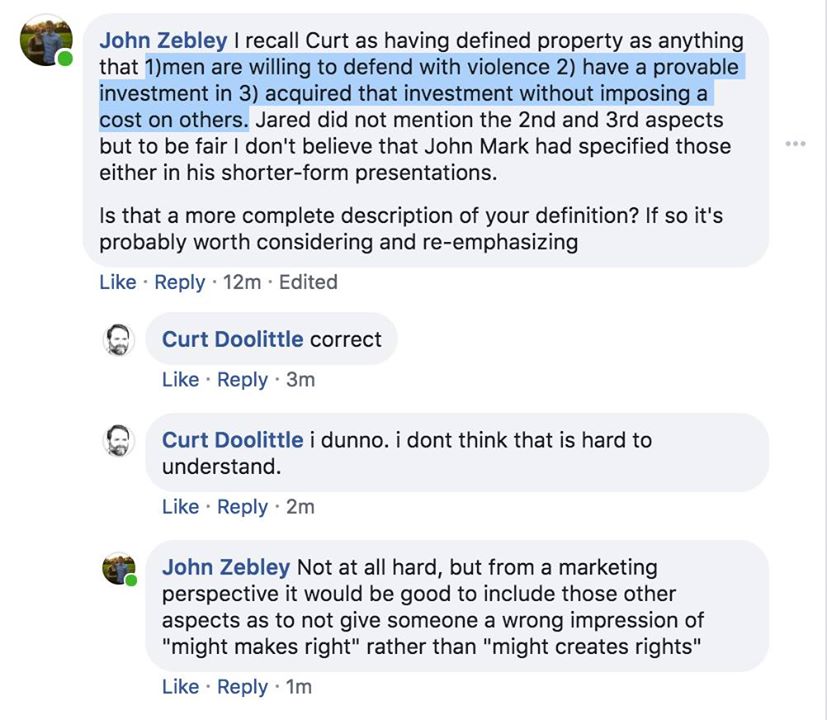
photos_and_videos/TimelinePhotos_SxeO6JU-xg/52491576_10157003298252264_6424530364756131840_o_10157003298247264.jpg PROPERTY IN TOTO IS DEAD SIMPLEMartin ŠtěpánThe way I was trying to explain this to people asking if leftists can have properties such multiculti, equality etc. is that just because we recognize something as property doesn’t automatically mean we also recognize your right to having it. But I guess that might just cause more confusion.Feb 21, 2019, 3:49 PMSimon Ström2) is merely justification for 1) and 3) describes a situation of mutually assured warranty, ultimately rooted in 1) applied to institutions of legal practiceFeb 21, 2019, 4:06 PMCurt DoolittleGod i love it when you are around. …. thank youFeb 21, 2019, 4:17 PMJosh King4) something that a government may not seize or search without a proper warrant, because it was not earned by the state.Feb 21, 2019, 5:26 PMEthan TriceMight pretty much does make right. We may not like it, but that’s a far more valid theory than social contractsFeb 21, 2019, 5:45 PMJimmy KnowlesWhen you consider it as a nation it makes sense as well. Willing to defend, invest tax money for infrastructure mutual defense and retirement, without imposing cost on others as a parasite, you can have a clear definition of citizen via that route.Feb 21, 2019, 5:50 PMStephen ThomasInvestment (accountable resources)
Honest Acquisition (without impositions or fraud)
Defense (forceful/violent protection)
Will you invest in it? Have you honestly acquired it? Will you fight or die to secure it?
If so, how can anyone rightfully claim it is not yours?Feb 21, 2019, 6:11 PMJim CatreHalf of this conflates defense of property with the acquisition of property.Feb 21, 2019, 7:18 PMJim CatreAre there any economists in this group other than myself?Feb 21, 2019, 7:20 PMCurt Doolittle—“Jim Catre Half of this conflates defense of property with the acquisition of property.”—
Explain???Feb 21, 2019, 7:25 PMJim Catre>Men are willing to defend with violence.
Suggests that someone who is unable to defend said property doesn’t actually own it. Furthermore, it doesn’t address whether the defense of said property has to be performed by the owner of the property. In either case, it does not describe a method by which one acquires authority over said property.
>Have a provable investment.
This can be open to interpretation. For example, if I purchase a large plot of real-estate and have the contract to prove as much, it doesn’t mean that the person who sold the real estate had the authority to sell to begin with.
The other interpretation, and the one that 99% of ideologies seem to follow, implies something akin to Lockean methods of property acquisition.
>Acquired property without imposing costs on other parties.
Absolutely asinine statement. Due to scarcity and opportunity costs, virtually any kind of transaction can impose an external cost on others.Feb 22, 2019, 12:47 PMCurt DoolittleLearn something.
—“Suggests that someone who is unable to defend said property doesn’t actually own it.”–
He may in fact possess it. He may have invested in it. Under reciprocal conditions others may choose not to use it. But in physical reality ‘ownership’ is determined by an insurer who decides disputes (in most cases, the court, the police, the military, etc).
You can demonstrate investment. you can hold possession. you can agree with others that you will respect possessions (property), and you can construct an insurer that insures your possessions are not involuntarily transferred.
End the insurer and you don’t ‘own’ anything.
End the normative agreement and you don’t have ‘property’ only possession.
End your sufficiency of self defense against an aggressor and you don’t have possession.
Ergo. no. absent sufficient defense you don’t ‘own’ anything.Feb 22, 2019, 1:35 PMJim Catre>But in physical reality ‘ownership’ is determined by an insurer who decides disputes (in most cases, the court, the police, the military, etc).
Again, you’re not answering the question of acquisition. How did the court, police, etc. gain ownership over the real estate or natural resources?
>absent sufficient defense you don’t ‘own’ anything.
But you completely contradict this statement when you bring up property norms and the individual and social benefit gained from having property rights. Market failure occurs when property rights cannot be defined.Feb 22, 2019, 1:40 PMCurt Doolittle—“>Have a provable investment. “…. This can be open to interpretation. For example, if I purchase a large plot of real-estate and have the contract to prove as much, it doesn’t mean that the person who sold the real estate had the authority to sell to begin with. The other interpretation, and the one that 99% of ideologies seem to follow, implies something akin to Lockean methods of property acquisition.”—
Which claim are you making?
1. you failed due diligence and must appeal to the court despite having done so in order obtain restitution or title.
2. the other party engaged in fraud or error, and you must appeal to the court for his having done so, in order to obtain restitution or title.
3. you have demonstrated investment (performed) some investment even if you cannot demonstrate (provide evidence) that you have done so, and therefore have some moral right to either restitution or the property regardless of the court if you can find someone who can enforce it, or if you are able to physically enforce it yourself.Feb 22, 2019, 1:41 PMJim CatreSee? That’s my point. It definitely seems as though your entire argument is “might makes right” and, if that’s the case, you need to stop beating around the bush and fucking own it.Feb 22, 2019, 1:41 PMJim Catre4. None of the above. I’m looking for what gives someone the right to initially claim authority and ownership over capital.Feb 22, 2019, 1:42 PMCurt DoolittleJim Catre
—“might makes right”—
No, we are correcting you’re use of moralisms, idealism, and special pleading. Might MAKES EVERYTHING, PERIOD. The question of whether it makes reciprocity (right), parasitism (wrong), or predation (very wrong).
—“4. None of the above. I’m looking for what gives someone the right to initially claim authority and ownership over capital.”—
Claim to whom?, How can one have ‘authority’ or ‘ownership?
—“claim”—
Under test of reciprocity: demonstrated interests (cost in time, effort, resources) in acting to obtain that interest, or forgoing opportunity to take interest, by limiting one’s actions to productive, fully informed, warrantied, voluntary exchange, free of imposition of the same by externality upon others.”
(In case the deduction is not obvious, that includes homesteading.)
But again… claim before whom?
HERE (“property for the 1000’th time”)
https://www.facebook.com/curt.doolittle/posts/10157003524812264Feb 22, 2019, 1:48 PMCurt Doolittle(I am not beating around the bush. I am falsifying your priors in order to disambiguate your language such that it is no longer pop philosophy sophism. It’s not like you’re alone man. we do this every day.)Feb 22, 2019, 1:52 PMJim Catre> How can one have ‘authority’ or ‘ownership?
It’s axiomatic, and is a natural result of self-ownership and the social and economic need for organization. Ownership, after all, is just a derivative of authority. No one can exert higher authority over my mind and body than myself. If I own my body, I own and am responsible for it and its actions. Since I own my actions, I own and am responsible for the result of said actions.Feb 22, 2019, 1:52 PMJim CatreI think we’re coming from the same place, with the same conclusions. Violence is the supreme authority from which all authority derives. However, you can’t ignore the fact that, individually and socially, we get more utility through peace and non-violence.Feb 22, 2019, 1:54 PMJim CatreThat’s WHY we’ve developed property norms.Feb 22, 2019, 1:54 PMCurt DoolittleJim Catre there we go. that’s right.Feb 22, 2019, 1:54 PMOliver CrokeMichael WitcoffFeb 22, 2019, 2:09 PMSteve PenderProperty is that which has such benefit that people are willing to bear the cost of defending it to continue deriving that benefit.Feb 22, 2019, 2:32 PMPROPERTY IN TOTO IS DEAD SIMPLE
I know I frustrate y’all but I’m just trying to find a way to make things work. So yes. Because P allows us to make any social order as long as we say it truthfully and transparently. So it just means ‘a constitutional right’ to teach as ‘true’ exclusive to christians.
Original tweet unavailable — we could not load the text of the post this reply is addressing on X. That usually means the tweet was deleted, the account is protected, or X does not expose it to the account used for archiving. The Original post link below may still open if you view it in X while signed in.
Rothbard (Jewish Pale) and Hoppe (German Free Cities) via positiva, via rationalism. Doolittle(Rights of Englishmen) via negativa, via empiricism. Construct a value system by appeal(RH), or prohibit an anti-value system with violence (D). Inspiration and indoctrination (RH) vs prohibition and market for prosecution(D). Unlimited suppression of parasitic behavior that generates retaliation (D), suppression limited to intersubjectively verifiable property (RH). Suppression of blackmail, defamation, public sophism, supernaturalism pseudoscience( marxism, postmodernism, feminism, denialism). Doolittle: existential survivable without imperial protection, vs Rothbard and Hoppe: dependent, non existential without imperial protection. Doolittle: demonstrated, vs Rothbard and Hoppe: not demonstrated, not modelable, not survivable under competition. RH not possible due to praxeological incentives, and D possible because of praxeological testable incentives. No RH community can form or survive market for polities without parasitic dependence upon an empire because of insufficient incentives for defense and production of commons and their resulting multipliers in competition with free riders. vs Any D community can survive in the market for polities because it does not depend upon an external empire because of sufficient incentives for defense and production of commons and their resulting multipliers in competition with free riders. Crusoe’s island depends upon the ‘free’ protection of a vast ocean. The ghetto depends upon the host city or state. And the Free Cities, The Pale (european wildlands), The American/Australian wildlands, and Iceland/Greenland – all depend upon the host empire, and are economically subsidized by lack of political competition, and the availability of cheap and settleable land. The ghetto ethics of the jews and being exterminated for it on a regular basis versus the high trust ethics of the people who dragged humanity kicking and screaming out of ignorance superstition poverty starvation disease hard labor early death…. and the quality of life that people seek despite the costs of commons required to do so. ie: RH consists of pretense that ‘children’ polities, subsidized by parents, can compete against adult polities on their own merits in competition by military, political, economic, religious, demographic, warfare that never ends.
Every group with every grammar of cognition can use Propertarianism: religious, ideological philosophical, scientific, or practical. We can all use this law to unite behind policy rather than religion, philosophy, or ideology. So don’t make me a ‘cult’ leader. Don’t ask me to be one. I’m not special. I’m just a guy working on one of the great problems of our age – and because of the great minds before me, and the shoulders I can stand upon, I did. So I’m not special. Propertarianism is like having a superpower, just like aristotelian reason, empiricism, and the scientific method were like a superpower in ages past. So understand, it’s not me it’s the methodology. I’m only special because this superpower is rare at present. With some work you can learn this ‘superpower’. And then for you too, the world will ‘fit together in very nice clean obvious puzzle pieces’. But I’m not important. I’m not special, and I expect to generate leaders who will use this superpower. I prefer to wear my metaphorical Odin robes and pointy hat, and advise leaders – not be one. Aristotle changed the world of mind but it is Alexander who conquered the world of men.