Category: Epistemology and Method
-
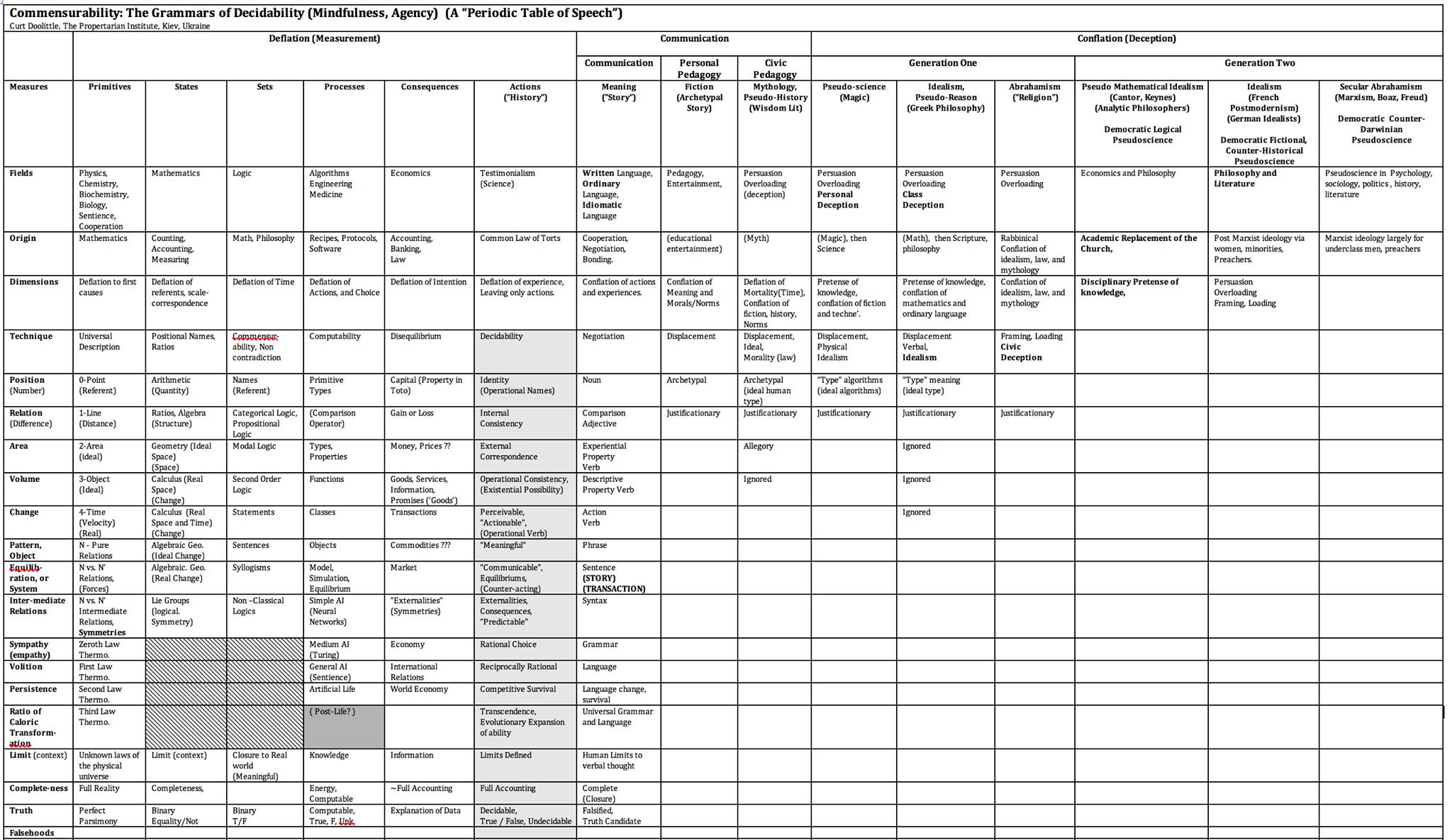
Mind Blowing Version Two
It’s really that simple. And yes, we can produce a periodic table of speech. I swear I could spend a whole year just documenting what this whole thing means, and adding variations to it. -
Mind Blowing Version Two
It’s really that simple. And yes, we can produce a periodic table of speech. I swear I could spend a whole year just documenting what this whole thing means, and adding variations to it. -

photos_and_videos/TimelinePhotos_43196237263/21768570_10155750234557264_37181375
photos_and_videos/TimelinePhotos_43196237263/21768570_10155750234557264_3718137554012735853_o_10155750234557264.jpg MIND BLOWING VERSION TWO
It’s really that simple. And yes, we can produce a periodic table of speech.
I swear I could spend a whole year just documenting what this whole thing means, and adding variations to it.Mea CulbaI can’t read it!Sep 25, 2017 3:32pmCurt DoolittleNonsense. Do I need to educate you on basics? click to open the theater view. download the image. Open it your browser and zoom it. The image is fine.Sep 25, 2017 4:11pmMea CulbaIt’s just my cellphone then! SorrySep 25, 2017 4:16pmGünther Shroomacherwould be great to have higher resolutionSep 26, 2017 9:47amMIND BLOWING VERSION TWO
It’s really that simple. And yes, we can produce a periodic table of speech.
I swear I could spend a whole year just documenting what this whole thing means, and adding variations to it.
Source date (UTC): 2017-09-25 14:36:00 UTC
-
gram·mar /ˈɡramər/ noun The whole system and structure of a language or of langu
gram·mar /ˈɡramər/ noun The whole system and structure of a language or of languages in general, usually taken as consisting of syntax and morphology (including inflections) and sometimes also phonology and semantics. synonyms: syntax, sentence structure, rules of language, morphology; linguistics -
gram·mar /ˈɡramər/ noun The whole system and structure of a language or of langu
gram·mar /ˈɡramər/ noun The whole system and structure of a language or of languages in general, usually taken as consisting of syntax and morphology (including inflections) and sometimes also phonology and semantics. synonyms: syntax, sentence structure, rules of language, morphology; linguistics -
gram·mar /ˈɡramər/ noun The whole system and structure of a language or of langu
gram·mar
/ˈɡramər/
noun
The whole system and structure of a language or of languages in general, usually taken as consisting of syntax and morphology (including inflections) and sometimes also phonology and semantics.
synonyms: syntax, sentence structure, rules of language, morphology; linguistics
Source date (UTC): 2017-09-23 16:48:00 UTC
-
So it’s correct to call apriorism an ideal grammar, but not a formal grammar. Th
So it’s correct to call apriorism an ideal grammar, but not a formal grammar. Thankfully I finally know how to talk about the grammars of each incremental dimension… sigh. Mathematical grammars are not contingent because of constant relations. That’s their beauty. The problem is they’re non causal. Linguistic (Philosophical) grammars are contingent. That’s their weakness. Operational grammars are not contingent. And they’re causal. That’s their beauty. -
So it’s correct to call apriorism an ideal grammar, but not a formal grammar. Th
So it’s correct to call apriorism an ideal grammar, but not a formal grammar. Thankfully I finally know how to talk about the grammars of each incremental dimension… sigh. Mathematical grammars are not contingent because of constant relations. That’s their beauty. The problem is they’re non causal. Linguistic (Philosophical) grammars are contingent. That’s their weakness. Operational grammars are not contingent. And they’re causal. That’s their beauty. -
So it’s correct to call apriorism an ideal grammar, but not a formal grammar. Th
So it’s correct to call apriorism an ideal grammar, but not a formal grammar.
Thankfully I finally know how to talk about the grammars of each incremental dimension… sigh.
Mathematical grammars are not contingent because of constant relations. That’s their beauty. The problem is they’re non causal.
Linguistic (Philosophical) grammars are contingent. That’s their weakness.
Operational grammars are not contingent. And they’re causal. That’s their beauty.
Source date (UTC): 2017-09-23 10:03:00 UTC
-
Grammar A grammar defining formal language L is a quadruple (N,T,R,S), where N i
Grammar A grammar defining formal language L is a quadruple (N,T,R,S), where N is a finite set of nonterminals, T is a finite set of terminal symbols, R is a finite set of productions, and S is an element of N. The set T of terminal symbols is L’s alphabet. Nonterminals are symbols representing language constructs. The sets N and T should not intersect. S is called the start symbol. Productions are rules of the form: alpha->beta, where both alpha and beta are strings of terminals and nonterminals, alpha contains at least one nonterminal. Sentential forms for grammar G=(N,T,R,S) are defined by the following rules: S is a sentential form and if alphabetagamma is a sentential form and production beta->delta belongs to R, then alphadeltagamma is a sentential form as well. L is the set of all strings which are sentential forms consisting entirely of terminal symbols. For a language defined by a grammar, recognition whether a given string (expression) belongs to that language is, in general, a non-trivial task. All languages defined by grammars are recursively enumerable sets. 1. A grammar G is called right linear if all its productions have the form A->alphaB or A->alpha, where A,B in N and alpha is a string of terminal symbols. 2. A grammar G is called context-free if all its productions have the form A->alpha, where A in N and alpha is a string of terminal and nonterminal symbols. 3. A grammar G is called context-sensitive if all its productions have the form alpha->beta, where both alpha and beta are strings of terminal and nonterminal symbols and the length of alpha is not more than the length of beta. 4. A grammar G is called unrestricted if it does not belong to categories 1 through 3. This hierarchy of grammars was introduced by N. Chomsky. The set of languages defined by grammars of every category is a proper superset of that for the previous category. The languages defined by grammars of categories 1 through 3 are recursive sets. A language can be defined by a grammar of category 1 iff it is defined by a regular expression.