(and thus be comprehensible?) Um. I don’t think they’ll be different, for reasons I hope to publish this year. Although there is a substantial difference… Chomsky can take 40 minutes to communicate an idea, and if you look at his sentence structure and vocabulary it’s extraordinary. I cannot match Chomsky’s context-retention during his discourses. This is how I know he’s smarter than I am. His ability to ‘maintain state’ while communicating complex relations and stories is exceptional. Despite working at it terribly hard, I find ‘simplification’ extremely difficult, and I find I use a variation on latin grammar, more 19th century sentence structure, and overwhelm the audience very easily with content. If you listen to young adults they often have trouble forming complete sentences, paragraphs, and narratives with any degree of precision (they require shared context). Some people (me when I was younger) and many people in the tech field for example, speak very very fast with very high word counts. Some people cannot manage that at all. Some people use large vocabularies to concentrate more content in fewer words while preserving or increasing precision. Some groups use terms (english, german) and some tones (chinese). Where terms are more precise because they are less demanding of deduction. Some groups use (awful) high context grammar, and some low context grammar. It appears that once you develop the ability to communicate in language all that matters is the increasing content and precision of that communication method. So we evolved from simple vocal sounds serialized. Others might evolved from parallel tones. Maybe others from some other form of display. Language must at least originate with analogy to experience, so its possible that creatures with different senses or processing (octopods) might use analogies that took us time to decode. So if you look across just that set of dimensions you can imagine that some very smart species would speak very quickly, in very precise very dense grammar, with a very large vocabulary, with long sentences (transactions), and long narratives, in serial (informationally limited) or more parallel (informationally dense) means. And thisso their context retention ability and processing ability would be higher than ours. That said, for reasons that chomsky defends his universal grammar (and for the same reasons that while base number would change and the vocabulary will change, all mathematical systems would be the same) Once you grasp that the term ‘grammar’ means ‘continuous disambiguation’, but that actions in the real world cause languages to eventually converge on the descriptive through nothing other than competition, then This continuous disambiguation is important because it corresponds to falsification (eliminative), just as continuous construction correspondes to justificationism (cumulative). And as such it turns out that since falsehood has a higher truth content than truth claims, the via negativa of continuous disambiguation is the counter intuitive but descriptive and necessary means of communication of truth content. (Apologies if this is too dense an argument.)
Category: Epistemology and Method
-
Will Aliens Use the Same Grammar?
(and thus be comprehensible?) Um. I don’t think they’ll be different, for reasons I hope to publish this year. Although there is a substantial difference… Chomsky can take 40 minutes to communicate an idea, and if you look at his sentence structure and vocabulary it’s extraordinary. I cannot match Chomsky’s context-retention during his discourses. This is how I know he’s smarter than I am. His ability to ‘maintain state’ while communicating complex relations and stories is exceptional. Despite working at it terribly hard, I find ‘simplification’ extremely difficult, and I find I use a variation on latin grammar, more 19th century sentence structure, and overwhelm the audience very easily with content. If you listen to young adults they often have trouble forming complete sentences, paragraphs, and narratives with any degree of precision (they require shared context). Some people (me when I was younger) and many people in the tech field for example, speak very very fast with very high word counts. Some people cannot manage that at all. Some people use large vocabularies to concentrate more content in fewer words while preserving or increasing precision. Some groups use terms (english, german) and some tones (chinese). Where terms are more precise because they are less demanding of deduction. Some groups use (awful) high context grammar, and some low context grammar. It appears that once you develop the ability to communicate in language all that matters is the increasing content and precision of that communication method. So we evolved from simple vocal sounds serialized. Others might evolved from parallel tones. Maybe others from some other form of display. Language must at least originate with analogy to experience, so its possible that creatures with different senses or processing (octopods) might use analogies that took us time to decode. So if you look across just that set of dimensions you can imagine that some very smart species would speak very quickly, in very precise very dense grammar, with a very large vocabulary, with long sentences (transactions), and long narratives, in serial (informationally limited) or more parallel (informationally dense) means. And thisso their context retention ability and processing ability would be higher than ours. That said, for reasons that chomsky defends his universal grammar (and for the same reasons that while base number would change and the vocabulary will change, all mathematical systems would be the same) Once you grasp that the term ‘grammar’ means ‘continuous disambiguation’, but that actions in the real world cause languages to eventually converge on the descriptive through nothing other than competition, then This continuous disambiguation is important because it corresponds to falsification (eliminative), just as continuous construction correspondes to justificationism (cumulative). And as such it turns out that since falsehood has a higher truth content than truth claims, the via negativa of continuous disambiguation is the counter intuitive but descriptive and necessary means of communication of truth content. (Apologies if this is too dense an argument.)
-
WILL ALIENS USE THE SAME GRAMMAR? (and thus be comprehensible?) Um. I don’t thin
WILL ALIENS USE THE SAME GRAMMAR?
(and thus be comprehensible?)
Um. I don’t think they’ll be different, for reasons I hope to publish this year. Although there is a substantial difference…
Chomsky can take 40 minutes to communicate an idea, and if you look at his sentence structure and vocabulary it’s extraordinary. I cannot match Chomsky’s context-retention during his discourses. This is how I know he’s smarter than I am. His ability to ‘maintain state’ while communicating complex relations and stories is exceptional.
Despite working at it terribly hard, I find ‘simplification’ extremely difficult, and I find I use a variation on latin grammar, more 19th century sentence structure, and overwhelm the audience very easily with content.
If you listen to young adults they often have trouble forming complete sentences, paragraphs, and narratives with any degree of precision (they require shared context).
Some people (me when I was younger) and many people in the tech field for example, speak very very fast with very high word counts. Some people cannot manage that at all.
Some people use large vocabularies to concentrate more content in fewer words while preserving or increasing precision.
Some groups use terms (english, german) and some tones (chinese). Where terms are more precise because they are less demanding of deduction.
Some groups use (awful) high context grammar, and some low context grammar.
It appears that once you develop the ability to communicate in language all that matters is the increasing content and precision of that communication method. So we evolved from simple vocal sounds serialized. Others might evolved from parallel tones. Maybe others from some other form of display.
Language must at least originate with analogy to experience, so its possible that creatures with different senses or processing (octopods) might use analogies that took us time to decode.
So if you look across just that set of dimensions you can imagine that some very smart species would speak very quickly, in very precise very dense grammar, with a very large vocabulary, with long sentences (transactions), and long narratives, in serial (informationally limited) or more parallel (informationally dense) means.
And thisso their context retention ability and processing ability would be higher than ours.
That said, for reasons that chomsky defends his universal grammar (and for the same reasons that while base number would change and the vocabulary will change, all mathematical systems would be the same)
Once you grasp that the term ‘grammar’ means ‘continuous disambiguation’, but that actions in the real world cause languages to eventually converge on the descriptive through nothing other than competition, then
This continuous disambiguation is important because it corresponds to falsification (eliminative), just as continuous construction correspondes to justificationism (cumulative). And as such it turns out that since falsehood has a higher truth content than truth claims, the via negativa of continuous disambiguation is the counter intuitive but descriptive and necessary means of communication of truth content.
(Apologies if this is too dense an argument.)
Source date (UTC): 2018-05-28 10:31:00 UTC
-
I can debate anyone who’s intellectually honest, defines his terms, and doesn’t
I can debate anyone who’s intellectually honest, defines his terms, and doesn’t engage in selection bias.Economic argument requires some set of decidabilities. I use capital (property in toto). b/c that’s full accounting. (Science). That’s unheard of in the discipline.
Source date (UTC): 2018-05-28 01:16:45 UTC
Original post: https://twitter.com/i/web/status/1000908704382902279
Reply addressees: @Voltaire1778__8 @Slysneak @Septeus7 @Lord_Keynes2 @LambsRegret @GeolibGeorge @jappleby123 @Noahpinion
Replying to: https://twitter.com/i/web/status/1000822008601546758
IN REPLY TO:
Original post on X
Original tweet unavailable — we could not load the text of the post this reply is addressing on X. That usually means the tweet was deleted, the account is protected, or X does not expose it to the account used for archiving. The Original post link below may still open if you view it in X while signed in.
Original post: https://twitter.com/i/web/status/1000822008601546758
-
“Truth suppresses parasites and liars. It’s a prosecutorial tool. The damage it
—“Truth suppresses parasites and liars. It’s a prosecutorial tool. The damage it inflicts is part of its value.”—Steve Pender
(genius)
Source date (UTC): 2018-05-26 22:01:08 UTC
Original post: https://twitter.com/i/web/status/1000497087035961344
-
True Enough
TRUE ENOUGH FOR ACTION —“At what point do you know you have enough data and experience to act?”— Jeff Urizen When you (a) must act, (b) can pay for the full consequences of failure of your actions (c) can warranty your actions. In other words… when your knowledge is ‘true enough for the consequences’: TRUE ENOUGH A hierarchy of Truths: – True enough to imagine a conceptual relationship – True enough for me to feel good about myself. – True enough for me to take actions that produce positive results. – True enough for me to not cause others to react negatively to me. – True enough to resolve a conflict without subjective opinion among my fellow people with similar values. – True enough to resolve a conflict without subjective opinion across different peoples with different values. – True regardless of all opinions or perspectives. – Tautologically true: in that the two things are equal TRUE ENOUGH FOR THE CONSEQUENCES OF ERRORMay 26, 2018 12:51pm -
True Enough
TRUE ENOUGH FOR ACTION —“At what point do you know you have enough data and experience to act?”— Jeff Urizen When you (a) must act, (b) can pay for the full consequences of failure of your actions (c) can warranty your actions. In other words… when your knowledge is ‘true enough for the consequences’: TRUE ENOUGH A hierarchy of Truths: – True enough to imagine a conceptual relationship – True enough for me to feel good about myself. – True enough for me to take actions that produce positive results. – True enough for me to not cause others to react negatively to me. – True enough to resolve a conflict without subjective opinion among my fellow people with similar values. – True enough to resolve a conflict without subjective opinion across different peoples with different values. – True regardless of all opinions or perspectives. – Tautologically true: in that the two things are equal TRUE ENOUGH FOR THE CONSEQUENCES OF ERRORMay 26, 2018 12:51pm -
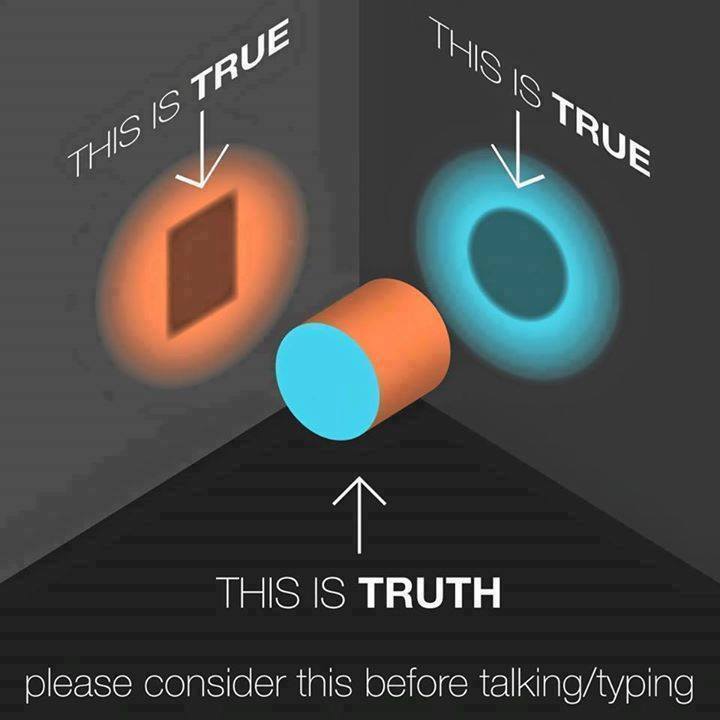
Um. No. Truthful vs True. Shadow or Object?
THIS ILLUSTRATION IS IMPRECISE (a) a “square” describes the shadow truthfully. (b) a “circle” describes the shadow truthfully. The question is whether one is testifying to the shadow or to the three dimensional object that casts it. One CANNOT testify to the shape of the three dimensional object that casts the shadow, one can only testify to the shape of the shadow. THAT IS THE WHOLE POINT OF TESTIMONY (Truth). “DO NOT MAKE SHIT UP by INFERENCE.”
-
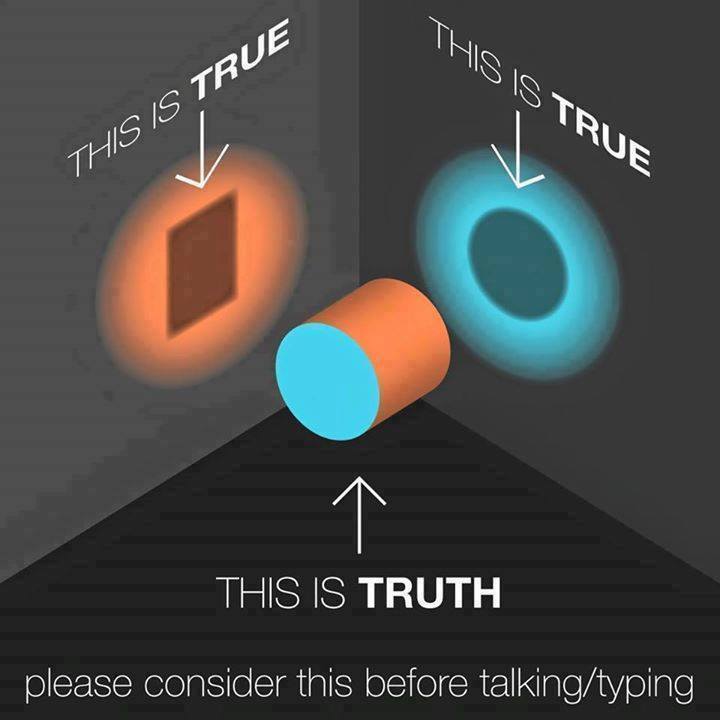
Um. No. Truthful vs True. Shadow or Object?
THIS ILLUSTRATION IS IMPRECISE (a) a “square” describes the shadow truthfully. (b) a “circle” describes the shadow truthfully. The question is whether one is testifying to the shadow or to the three dimensional object that casts it. One CANNOT testify to the shape of the three dimensional object that casts the shadow, one can only testify to the shape of the shadow. THAT IS THE WHOLE POINT OF TESTIMONY (Truth). “DO NOT MAKE SHIT UP by INFERENCE.”
-
“Truth suppresses parasites and liars. It’s a prosecutorial tool. The damage it
—“Truth suppresses parasites and liars. It’s a prosecutorial tool. The damage it inflicts is part of its value.”—Steve Pender
(genius)
Source date (UTC): 2018-05-26 18:00:00 UTC