Category: Epistemology and Method

  • photos_and_videos/TimelinePhotos_kg5QueHwVw/81924791_179763870088441_39946342045

    photos_and_videos/TimelinePhotos_kg5QueHwVw/81924791_179763870088441_3994634204519333888_o_179763866755108.jpg WHAT IS GSRRM, RRGSM, ETC?

    See our section on Deceits.WHAT IS GSRRM, RRGSM, ETC?

    See our section on Deceits.


    Source date (UTC): 2020-01-07 08:17:00 UTC

  • WHAT DOES TRUTH MEAN? Existence refers to persistence. The universe exists, and

    WHAT DOES TRUTH MEAN?

    Existence refers to persistence.

    The universe exists, and the matter in it exists, because it persists – we can identify that it exists because we posses memory.

    We can identify patterns of constant relations in that persist in that universe – that universe is deterministic at any scale at which we can identify patterns of constant relations.

    We can generalize those patterns of constant relations.

    We can identify unique instances of those patterns of constant relations.

    We can name them.

    We name states(nouns), substitutes for states (pronouns), and properties of states (adjectives), operations (verbs), and properties of operations (adverbs) and we can agree or disagree (yes/no, agree disagree, approve reject)

    We can form and speak(display word and deed) transactions(phrases) and transaction sets (sentences), and sets of transaction sets (stories)

    We can agree with those transactions, transaction sets, and sets of transaction sets (true/false)

    We can speak in promise, suggestion, question, agreement, opposition, or silence.

    When we claim we speak truthfully we speak promissorily.

    One can speak truthfully or untruthfully.

    When we speak truthfully we speak coherently with categorically, internally (logically), externally (empirically), operationally(sequence of actions) consistency, and use due diligence to disambiguate any possibility of misinterpretation.

    We can speak untruthfully because of ignorance, error, bias, wishful thinking, suggestion, obscurantism, fictionalism, deceit, and denial.

    We are forever ignorant so while we have discovered how to gradually iterate to the most parsimonious hierarchy of consistent and commensurable paradigms (networks of continuous relations at given scales, and in given contexts), in that set of Grammars we call “science”.

    Truth can and only can consist of language in some grammar or other, reducible to analogy to experience, testable by human logical facility.

    So while patterns of cosntant relations exist in the universe, and we can name those patterns, that thing we call truth consists of langauge humans discover, organize and iteratively refine through a process of continuous recursive disambiguation as information increases.

    The human mind works by using sequences of stimuli (patterns) to produce predictions of fragments, object, models, spaces(places), borders, locations, and episodes.

    The mind then recursively predicts possibilities from those predictions using auto association.

    We then use attention to choose which auto associations to permute upon.

    This is how we imagine, and control what we imagine.

    Because we can imagine, we imagine that truth exists, when only phenomenon exists ,and truth consists of the formula by which we describe it.

    Man discovers constant relations and creates truthful descriptions of those constant relations.

    Truthful statements are made by man because only man (so far) speaks.

    When we say honest we say the speaker promises his words are free of suggestion, obscurantism, fictionalism, deceit and denial.

    When we say truthful, we mean, that operational name (description) which is not false, and satisfies market demand for decidability in the given context, given the present knowledge, and free of bias, wishful thinking, suggestion, obscurantism, fictionalism, and deceit, where the individual uttering it has performed due diligence against ignorance and error.

    When we claim a statement is true we promise that it satisfies market demand for decidability given the context. When we agree that a statement ‘is true’ that means that we AGREE that it satisfies market demand for decidability given the context.

    When we say ‘the truth’ we mean either a parsimonious operational name for the constant relations we refer to, or the MOST parsimonious name for the constant relations we refer to.

    Of the various civilizations which has produced the only method of due diligence with which to speak the most parsimonious categorically consistent, internally consistent, externally correspondent, operational, complete, and fully accounted operational names?

    Of the various civilizations which has paid the high cost of normalizing truth before face regardless of cost to self, competence, dominance hierarchy?

    Only man speaks, only man describes, only man describes in operational names, only operational names are complete and commensurable, only complete and commensurable operational names are parsimonious, only parsimony provides minimum difference between the most parsimonious possible and the current state of knowledge.

    I could work on this further but you get the point.

    That truth must be discovered, named, and uttered (in some form).

    Truth is made. Truth is uttered, Truth is promised, Truth satisfies the market demand for decidability. We consent to that decidability by equal means -or we do not.

    The universe merely exists.


    Source date (UTC): 2020-01-05 19:31:00 UTC

  • ON THE LIMITS OF MATHEMATICS Mathematics is the measurement of averages with lim

    ON THE LIMITS OF MATHEMATICS

    Mathematics is the measurement of averages with limited variance in category, and economics is the measurement of averages in wide variance in category.

    The universe changes state by operations.

    We use mathematics to describe point changes.

    Calculus breaks down at the subatomic level.

    Calculus breaks down at the economic level.

    The problem is we don’t have a calculus of geometries (yet) and we may not have one until we solve either the subatomic problem, or the protein folding problem or the economic problem. I’m betting on the second mostly because both math and physics are lost in nonsense land.


    Source date (UTC): 2020-01-05 15:52:00 UTC

  • Mathematics is the measurement of averages with limited variance in category, an

    Mathematics is the measurement of averages with limited variance in category, and economics is the measurement of averages in wide variance in category.

    The universe changes state by operations.

    We use mathematics to describe point changes.

    Calculus breaks down at the subatomic level.

    Calculus breaks down at the economic level.

    The problem is we don’t have a calculus of geometries (yet) and we may not have one until we solve either the subatomic problem, or the protein folding problem or the economic problem. I’m betting on the second mostly because both math and physics are lost in nonsense land.


    Source date (UTC): 2020-01-05 13:57:00 UTC

  • THE UNREASONABLE EFFECTIVENESS OF P-LOGIC(LAW) IN HUMAN SCIENCES: PARADIGMS(META

    THE UNREASONABLE EFFECTIVENESS OF P-LOGIC(LAW) IN HUMAN SCIENCES: PARADIGMS(METAPHYSICS), PSYCHOLOGY, SOCIOLOGY, ECON, LAW, AND POLITICS

    P-Logic (Law) is (a) universally commensurable (b) value neutral, ( c) operational logic, of (d) decidability.

    Read that a few times and make sure you undrestand it. Universally commensurable, value neutral, operational logic, of decidability.

    The profound depth of that set of properties isn’t at all obvious, but just as saying math has extraordinary explanatory power in the physical sciences of constant temporal relations: P-logic (law) has equally extraordinary explanatory power in the cognitive sciences: paradigms(metaphysics), psychology, sociology, politics, group competitive strategy, ethics, and law.

    Physical sciences are mathematically predictive because categories and relations at a given resolution are constant both in and across time. The physical world can’t choose.

    Economic sciences are mathematically un-predictive, and only mathematically descriptive, and only operationally explanatory because relations (categories, weights(values), and operations) are inconstant across time – the consequence of Humans scheming and choosing with fragmentary and asymmetric information.

    Social Sciences are only operationally explanatory, not mathematically descriptive, nor mathematically predictive because while operations and incentives are constant, subject categories and values are inconstant, and unpredictable because humans scheme and choose using fragmentary and asymmetric information.

    P-Logic(law) provides universal explanatory power across the disciplines. Predictive power decreases with the inconstancy of relations over time. Many can create arbitrary relations within the limits of his perception, cognition, incentives, negotiation, and action, to plot and scheme against the course of events such that by some action or inaction he captures more caloric gains or opportunity for those gains, or prevents losses of opportunity or gains, than he would by not acting or acting.


    Source date (UTC): 2020-01-04 12:01:00 UTC

  • EXPLAINING (DEFINING) PROPERTARIANISM – FOR NEWBS: 1 – The completion of the sci

    EXPLAINING (DEFINING) PROPERTARIANISM – FOR NEWBS:

    1 – The completion of the scientific method and all that it entails – which is a lot and why P is such a big program: it touches everything and it converts almost all psychological, social, and political speech to economic expressions – which is counter-intuitive because it’s scientific where our current psychological social, moral, and political speech is only normative or in the case of psychology sociology and politics, both pseudoscientific and sophomoric.

    2 – The explanation for western success in ancient and modern worlds (adaptive velocity because of our individual sovereignty and resulting traditional law of property/tort.)

    3 – The explanation of the different systems of argument used in the different civilizations, and in particular the abrahamic means of deceit used in the ancient world (judaism, Christianity, islam) and in the modern world (marxism, feminism, postmodernism, denialism/political correctness).

    EXPLANATION

    Do you know what a formal logic is? It’s grammar of the logic of inference using sets and binary truth or falsehood.

    Do you know what programming is? It’s a grammar of operational logic using binary truth or falsehood.

    Do you know what law is? It’s a formal operational rational grammar of conflict resolution, using ternary falsehood, truth candidacy, and undecidability.

    Do you know what tort law is? it’s a formal rational operational grammar of conflict resolution over demonstrated interests that we enumerate as property, using ternary logic of falsehood, truth candidacy, undecidability.

    Propertarianism is a formal (strict), operational(sequential action), grammar (vocabulary, grammar, syntax, logic), of Tort (demonstrated interests), and as a consequence a value neutral universal language (vocabulary, grammar, syntax, logic) across all disciplines (physical science, language-metaphysics, psychology, sociology, politics, ethics, law, group strategy), that allows us to falsify (test) every possible dimension of human action, intuition, cognition, and speech, for both testimonial possibility (truth) and reciprocity(ethics, morality, trespass, tort), and as a consequence allows us to create uninterpretable constitutions, and their enumerated rights and responsibilities, the most influential of which is the conversion of free speech to free truthful and reciprocal speech, in public, to the public, on matters public (commerce, economics, commons, politics, group strategy) by extending the involuntary warranty of due diligence and involuntary liability for the truthfulness and reciprocity of commercial speech to that of political speech. As such it allows us to outlaw hostile religions, and pseudo-religions especially the pseudoscientific and sophomoric restatements of supernatural judaism , christianity, and islam, in pseudoscientific and sophomoric and ir-reciprocal marxism, socialism, feminism, and postmodernism.

    Propertarianism is equivalent in scope to the revolutions of Aristotelian reason (Realism, Naturalism, Reason), the Empirical Revolution(Realism, Naturalism, Empiricism), in that it completes the scientific method by extending it from the physical to the psychological and social sciences, including that of law, politics, and group strategy.

    In other words, “Propertarianism consists of the completion of the Scientific Method; its application to the totality of human knowledge; producing a universally commensurable language of all thought; its embodiment in the common law of tort; resulting in a logical and scientific constitution; permitting the criminalization of ir-reciprocal and un-testifiable speech, and as a consequence the eradication of superstition, pseudoscience, sophism, fraud, and deceit from the commercial, financial, economic, political, and informational commons.”

    When we explain the reason for western success we discover:

    “Heroism and Excellence; Truth and Duty; Oath and Warranty; Sovereignty and Reciprocity; Law and Jury; And Voluntary Markets in Every Aspect of Life: Association, Cooperation, Production, Reproduction, Commons, Polities and War; The direction of surpluses to the production of commons and the returns therefrom; at the cost of suppression of the reproduction of the unproductive underclasses; and the Direction of Dominance Expression to the Production of Commons by a Distributed Dictatorship of Individually Sovereign People and the Reciprocal Warranty of Denial of Power To Any and All.”

    Propertarianism is (a) the completion of the Aristotelian program (b) the completion of the scientific method (c ) the logic and science of the social sciences, and (d) the Natural Law of Reciprocity under which all display word and deed is expressible and commensurable. (e) and the means of institutionalizing in a “Market for the Suppression of Fraud” the suppression of the greatest crime against humanity: the big lies that are responsible for the last dark age and the new one that the enemy has sought to bring about.


    Source date (UTC): 2020-01-02 18:35:00 UTC
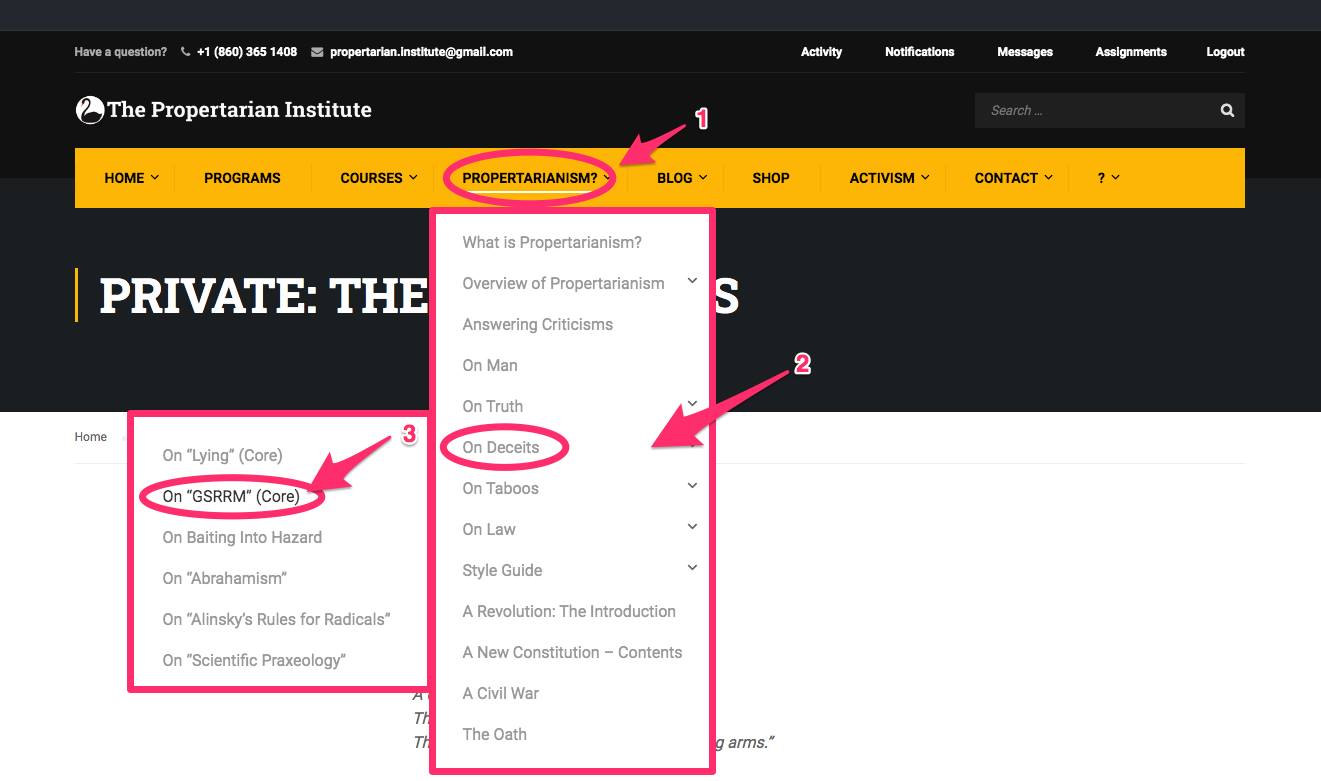
  • “What’s a Grammar in Propertarianism?”

    “CURT, WHAT’S A GRAMMAR IN PROPERTARIANISM?” (important)(core) [A] grammar has traditionally referred to a book containing the rules of a language. But I had to put quite a bit of work into ‘disambiguating’ the terms we use in language. The human cognitive facility consists of identification of constant relations between stimuli in time resulting in categorization (identity). The human auto association facility consists of discovering relations between categories (identities). The human memory facility consists of repetition of stimuli or rehearsal from short term memory, to create, reinforce, change, and eliminate constant relation within and between categories (locations, places, barriers, models, identities) The human logical facility consist of tests of constant, inconstant, and unrecognized relations between states (categories, identities). The human grammar facility refers to our physical ability to perform continuous recursive disambiguation using a stream of signals, most commonly in the form of sounds. The human language facility refers to the use of patterns of symbols or sounds in sequence of continuously recursive attempts at disambiguation. A language consists of Phonemes (sounds), Morphemes(meaningful combination of sounds – roots), Vocabulary (words), Phrases (state), Sentences (changes in state – transactions), Stories (collections of transactions), Grammar (rules of organization making possible disambiguation by inference), and Syntax (further disambiguation – specifically when writing). A vocabulary consists of Names (Nouns, references to referents), Name Substitutes (pronouns), Properties (Adjective, state), Operations (verbs, actions, state of acting), Properties of Operations (Adverb). and Approval or Rejection (yes no true false agree disagree etc). Note that I’ve clarified some terms here a little differently than we traditionally do. However (this is the issue) the collections of permissible dimensions (paradigms) limit the rules of continuous recursive disambiguation: The logic of the paradigm. This is why…. Let’s use math because it’s the most simple language we have that all of us share. Mathematics consists of names of positions (numbers), variables (pronouns), names of operations ( mathematical operations, verbs), phrases (expressions), statements (functions), sentences (transactions), proofs (stories), and Approval or Rejection (true false). There are no adverbs or adjectives. What differs between ordinary language and mathematical language is that mathematics (the language of positional names) and ordinary language (the language of human experience) differ in ‘dimensions of permissible references’ to both Names (nouns) and Operations (verbs). And we can do the same analysis for every Grammar (system of rules) in the spectrum of: math, accounting, logics, programming, physics, chemistry, biochemistry, recipes, protocols, laws, testimony, descriptions, ordinary language, narration, storytelling, fictions, fictionalisms, and deceits – and everything in between. And we use the term “Deflationary grammar” for the narrowest grammars (math, logics), “ordinary grammar” for ordinary language, and “Inflationary grammar” for the widest grammars (story, fiction, fictionalism, deceits). Deflationary < —- Ordinary —-> Inflationary. So instead of the traditional hierarchy: Human Facilities -> language -> phoneme -> morpheme -> paradigms (metaphysics) -> vocabulary -> grammar -> syntax. Instead we have: Human Facilities (see above) -> vocabulary -> paradigms(dimensions) -> grammar of paradigm(rules of story, transaction, function, expression, operation, names: the LOGIC of the paradigm) -> permissible vocabulary -> necessary syntax. So a Grammar refers to the Paradigm (permissible dimensions of perception, cognition, and action), the Names, Operations, and Rules of Continuous Recursive Disambiguation (morpheme, word, phrase, sentence, story organization) and the LOGIC (constant relations) that limit consistency, correspondence, coherence, and completeness. So in P we use a ‘grammar’ to refer to the Vocabulary, logic, syntax of a paradigm. And when we use the term “the Grammars’ we mean the spectrum And Operational Grammar or Testimony is a Deflationary Grammar: a Deflation (constraint upon) ordinary language grammar, limiting it to a single point of view, absent the verb to be, using complete promissory sentences, describing a series of operations (human actions), resulting in testable transactions (sentence), and sets of transactions (testimony). The paradigm of human actions.

  • “What’s a Grammar in Propertarianism?”

    “CURT, WHAT’S A GRAMMAR IN PROPERTARIANISM?” (important)(core) [A] grammar has traditionally referred to a book containing the rules of a language. But I had to put quite a bit of work into ‘disambiguating’ the terms we use in language. The human cognitive facility consists of identification of constant relations between stimuli in time resulting in categorization (identity). The human auto association facility consists of discovering relations between categories (identities). The human memory facility consists of repetition of stimuli or rehearsal from short term memory, to create, reinforce, change, and eliminate constant relation within and between categories (locations, places, barriers, models, identities) The human logical facility consist of tests of constant, inconstant, and unrecognized relations between states (categories, identities). The human grammar facility refers to our physical ability to perform continuous recursive disambiguation using a stream of signals, most commonly in the form of sounds. The human language facility refers to the use of patterns of symbols or sounds in sequence of continuously recursive attempts at disambiguation. A language consists of Phonemes (sounds), Morphemes(meaningful combination of sounds – roots), Vocabulary (words), Phrases (state), Sentences (changes in state – transactions), Stories (collections of transactions), Grammar (rules of organization making possible disambiguation by inference), and Syntax (further disambiguation – specifically when writing). A vocabulary consists of Names (Nouns, references to referents), Name Substitutes (pronouns), Properties (Adjective, state), Operations (verbs, actions, state of acting), Properties of Operations (Adverb). and Approval or Rejection (yes no true false agree disagree etc). Note that I’ve clarified some terms here a little differently than we traditionally do. However (this is the issue) the collections of permissible dimensions (paradigms) limit the rules of continuous recursive disambiguation: The logic of the paradigm. This is why…. Let’s use math because it’s the most simple language we have that all of us share. Mathematics consists of names of positions (numbers), variables (pronouns), names of operations ( mathematical operations, verbs), phrases (expressions), statements (functions), sentences (transactions), proofs (stories), and Approval or Rejection (true false). There are no adverbs or adjectives. What differs between ordinary language and mathematical language is that mathematics (the language of positional names) and ordinary language (the language of human experience) differ in ‘dimensions of permissible references’ to both Names (nouns) and Operations (verbs). And we can do the same analysis for every Grammar (system of rules) in the spectrum of: math, accounting, logics, programming, physics, chemistry, biochemistry, recipes, protocols, laws, testimony, descriptions, ordinary language, narration, storytelling, fictions, fictionalisms, and deceits – and everything in between. And we use the term “Deflationary grammar” for the narrowest grammars (math, logics), “ordinary grammar” for ordinary language, and “Inflationary grammar” for the widest grammars (story, fiction, fictionalism, deceits). Deflationary < —- Ordinary —-> Inflationary. So instead of the traditional hierarchy: Human Facilities -> language -> phoneme -> morpheme -> paradigms (metaphysics) -> vocabulary -> grammar -> syntax. Instead we have: Human Facilities (see above) -> vocabulary -> paradigms(dimensions) -> grammar of paradigm(rules of story, transaction, function, expression, operation, names: the LOGIC of the paradigm) -> permissible vocabulary -> necessary syntax. So a Grammar refers to the Paradigm (permissible dimensions of perception, cognition, and action), the Names, Operations, and Rules of Continuous Recursive Disambiguation (morpheme, word, phrase, sentence, story organization) and the LOGIC (constant relations) that limit consistency, correspondence, coherence, and completeness. So in P we use a ‘grammar’ to refer to the Vocabulary, logic, syntax of a paradigm. And when we use the term “the Grammars’ we mean the spectrum And Operational Grammar or Testimony is a Deflationary Grammar: a Deflation (constraint upon) ordinary language grammar, limiting it to a single point of view, absent the verb to be, using complete promissory sentences, describing a series of operations (human actions), resulting in testable transactions (sentence), and sets of transactions (testimony). The paradigm of human actions.

  • “CURT, WHAT’S A GRAMMAR IN PROPERTARIANISM?” (important)(core) A grammar has tra

    “CURT, WHAT’S A GRAMMAR IN PROPERTARIANISM?”

    (important)(core)

    A grammar has traditionally referred to a book containing the rules of a language. But I had to but quite a bit of work into ‘disambiguating’ the terms we use in language.

    The human cognitive facility consists of identification of constant relations between stimuli in time resulting in categorization (identity).

    The human auto association facility consists of discovering relations between categories (identities).

    The human memory facility consists of repetition of stimuli or rehearsal from short term memory, to create, reinforce, change, and eliminate constant relation within and between categories (locations, places, barriers, models, identities)

    The human logical facility consist of tests of constant, inconstant, and unrecognized relations between states (categories, identities).

    The human grammar facility refers to our physical ability to perform continuous recursive disambiguation using a stream of signals, most commonly in the form of sounds.

    The human language facility refers to the use of patterns of symbols or sounds in sequence of continuously recursive attempts at disambiguation.

    A language consists of Phonemes (sounds), Morphemes(meaningful combination of sounds – roots), Vocabulary (words), Phrases (state), Sentences (changes in state – transactions), Stories (collections of transactions), Grammar (rules of organization making possible disambiguation by inference), and Syntax (further disambiguation – specifically when writing).

    A vocabulary consists of Names (Nouns, references to referents), Name Substitutes (pronouns), Properties (Adjective, state), Operations (verbs, actions, state of acting), Properties of Operations (Adverb). and Approval or Rejection (yes no true false agree disagree etc). Note that I’ve clarified some terms here a little differently than we traditionally do.

    However (this is the issue) the collections of permissible dimensions (paradigms) limit the rules of continuous recursive disambiguation: The logic of the paradigm.

    This is why…. Let’s use math because it’s the most simple language we have that all of us share.

    Mathematics consists of names of positions (numbers), variables (pronouns), names of operations ( mathematical operations, verbs), phrases (expressions), statements (functions), sentences (transactions), proofs (stories), and Approval or Rejection (true false). There are no adverbs or adjectives.

    What differs between ordinary language and mathematical language is that mathematics (the language of positional names) and ordinary language (the language of human experience) differ in ‘dimensions of permissible references’ to both Names (nouns) and Operations (verbs).

    And we can do the same analysis for every Grammar (system of rules) in the spectrum of: math, accounting, logics, programming, physics, chemistry, biochemistry, recipes, protocols, laws, testimony, descriptions, ordinary language, narration, storytelling, fictions, fictionalisms, and deceits – and everything in between.

    And we use the term “Deflationary grammar” for the narrowest grammars (math, logics), “ordinary grammar” for ordinary language, and “Inflationary grammar” for the widest grammars (story, fiction, fictionalism, deceits).

    Deflationary < —- Ordinary —-> Inflationary.

    So instead of the traditional hierarchy:

    Human Facilities -> language -> phoneme -> morpheme -> paradigms (metaphysics and resulting semantics) -> vocabulary -> grammar -> syntax.

    Instead we have:

    Human Facilities (see above) -> vocabulary -> paradigms(dimensions) -> grammar of paradigm(rules of story, transaction, function, expression, operation, names: the LOGIC of the paradigm) -> permissible vocabulary -> necessary syntax.

    So a Grammar refers to the Paradigm (permissible dimensions of perception, cognition, and action), the Names, Operations, and Rules of Continuous Recursive Disambiguation (morpheme, word, phrase, sentence, story organization) and the LOGIC (constant relations) that limit consistency, correspondence, coherence, and completeness.

    So in P we use a ‘grammar’ to refer to the Vocabulary, logic, syntax of a paradigm. And when we use the term “the Grammars’ we mean the spectrum

    And Operational Grammar or Testimony is a Deflationary Grammar: a Deflation (constraint upon) ordinary language grammar, limiting it to a single point of view, absent the verb to be, using complete promissory sentences, describing a series of operations (human actions), resulting in testable transactions (sentence), and sets of transactions (testimony).


    Source date (UTC): 2019-12-31 12:54:00 UTC

  • “CURT, WHAT’S A GRAMMAR IN PROPERTARIANISM?” (important)(core) A grammar has tra

    “CURT, WHAT’S A GRAMMAR IN PROPERTARIANISM?”

    (important)(core)

    A grammar has traditionally referred to a book containing the rules of a language. But I had to put quite a bit of work into ‘disambiguating’ the terms we use in language.

    The human cognitive facility consists of identification of constant relations between stimuli in time resulting in categorization (identity).

    The human auto association facility consists of discovering relations between categories (identities).

    The human memory facility consists of repetition of stimuli or rehearsal from short term memory, to create, reinforce, change, and eliminate constant relation within and between categories (locations, places, barriers, models, identities)

    The human logical facility consist of tests of constant, inconstant, and unrecognized relations between states (categories, identities).

    The human grammar facility refers to our physical ability to perform continuous recursive disambiguation using a stream of signals, most commonly in the form of sounds.

    The human language facility refers to the use of patterns of symbols or sounds in sequence of continuously recursive attempts at disambiguation.

    A language consists of Phonemes (sounds), Morphemes(meaningful combination of sounds – roots), Vocabulary (words), Phrases (state), Sentences (changes in state – transactions), Stories (collections of transactions), Grammar (rules of organization making possible disambiguation by inference), and Syntax (further disambiguation – specifically when writing).

    A vocabulary consists of Names (Nouns, references to referents), Name Substitutes (pronouns), Properties (Adjective, state), Operations (verbs, actions, state of acting), Properties of Operations (Adverb). and Approval or Rejection (yes no true false agree disagree etc). Note that I’ve clarified some terms here a little differently than we traditionally do.

    However (this is the issue) the collections of permissible dimensions (paradigms) limit the rules of continuous recursive disambiguation: The logic of the paradigm.

    This is why…. Let’s use math because it’s the most simple language we have that all of us share.

    Mathematics consists of names of positions (numbers), variables (pronouns), names of operations ( mathematical operations, verbs), phrases (expressions), statements (functions), sentences (transactions), proofs (stories), and Approval or Rejection (true false). There are no adverbs or adjectives.

    What differs between ordinary language and mathematical language is that mathematics (the language of positional names) and ordinary language (the language of human experience) differ in ‘dimensions of permissible references’ to both Names (nouns) and Operations (verbs).

    And we can do the same analysis for every Grammar (system of rules) in the spectrum of: math, accounting, logics, programming, physics, chemistry, biochemistry, recipes, protocols, laws, testimony, descriptions, ordinary language, narration, storytelling, fictions, fictionalisms, and deceits – and everything in between.

    And we use the term “Deflationary grammar” for the narrowest grammars (math, logics), “ordinary grammar” for ordinary language, and “Inflationary grammar” for the widest grammars (story, fiction, fictionalism, deceits).

    Deflationary < —- Ordinary —-> Inflationary.

    So instead of the traditional hierarchy:

    Human Facilities -> language -> phoneme -> morpheme -> paradigms (metaphysics) -> vocabulary -> grammar -> syntax.

    Instead we have:

    Human Facilities (see above) -> vocabulary -> paradigms(dimensions) -> grammar of paradigm(rules of story, transaction, function, expression, operation, names: the LOGIC of the paradigm) -> permissible vocabulary -> necessary syntax.

    So a Grammar refers to the Paradigm (permissible dimensions of perception, cognition, and action), the Names, Operations, and Rules of Continuous Recursive Disambiguation (morpheme, word, phrase, sentence, story organization) and the LOGIC (constant relations) that limit consistency, correspondence, coherence, and completeness.

    So in P we use a ‘grammar’ to refer to the Vocabulary, logic, syntax of a paradigm. And when we use the term “the Grammars’ we mean the spectrum

    And Operational Grammar or Testimony is a Deflationary Grammar: a Deflation (constraint upon) ordinary language grammar, limiting it to a single point of view, absent the verb to be, using complete promissory sentences, describing a series of operations (human actions), resulting in testable transactions (sentence), and sets of transactions (testimony).


    Source date (UTC): 2019-12-31 12:54:00 UTC