Category: Economics, Finance, and Political Economy

  • “Talk won’t be so cheap if we make it expensive — I get that. However, are there

    —“Talk won’t be so cheap if we make it expensive — I get that. However, are there opportunity costs with the restriction on supply? In other words, Is there profit in falsification and is it empirically verifiable? If these are opportunities to build collective equity in discourse “falsification” — opportunity throughput becomes relevant. Is resistance the price that must be paid for the extraction of “gains” in our quest to build collective knowledge? “— Rob Ellerman

    Um. I am not sure exactly what you’re getting at…. More?


    Source date (UTC): 2018-11-04 13:04:00 UTC

  • (Economics describes human behavior by DEMONSTRATION not survey or projection. I

    (Economics describes human behavior by DEMONSTRATION not survey or projection. If you don’t understand economics (behavioral) then whatever you do, your judgement is always the victim of cherry picking.)


    Source date (UTC): 2018-11-04 12:36:09 UTC

    Original post: https://twitter.com/i/web/status/1059061737654272000

    Reply addressees: @JeffreyASachs

    Replying to: https://twitter.com/i/web/status/1058412303727685632


    IN REPLY TO:

    @JeffreyASachs

    Here’s a puzzle I think about a lot. If any academic field is associated with the contemporary debate surrounding free speech, it’s psychology. Haidt, Pinker, Peterson, Saad, Jussim, even Lehmann. All specialize or have backgrounds in academic psych.

    So what’s the puzzle?

    Original post: https://twitter.com/i/web/status/1058412303727685632

  • Defending Hayek

    [T]here is so much “shyte” written about Hayek that it’s impossible to defend him against the cabbages of sophism. Look, Hayek in the sensory order, in the Knowledge Problem, in the Pricing System’s solution to the Knowledge Problem, can only be understood as he finally understood it, as a question of the Law, and the LAW as the institutional means of preserving the exceptionalism of western civilization. We do not submit to the market, we submit to the law, and we do so because it is, as in all cases, the means by which we provide no incentive to others to fail to submit to the law. The fact that we finally had power of the purse sufficient to interfere in the economy merely required hayek to expand it. Fortunately for me, and unfortunately for hayek, I was born after Turing (and chomsky) and Hayek before. So Hayek’s work can be completed in a method he could sense in the Sensory Order but not develop into the Science of Law he finally understood was the NEGATIVE means by which we produce positive ends. Popper got partway there. Hayek got partway there. Turing got partway there. Chomsky took turing and added a little bit more. But it was too late to prevent the 20th century’s consumption of the accumulated capital of western civilization.

  • photos_and_videos/TimelinePhotos_SxeO6JU-xg/45281106_10156751548612264_898375524

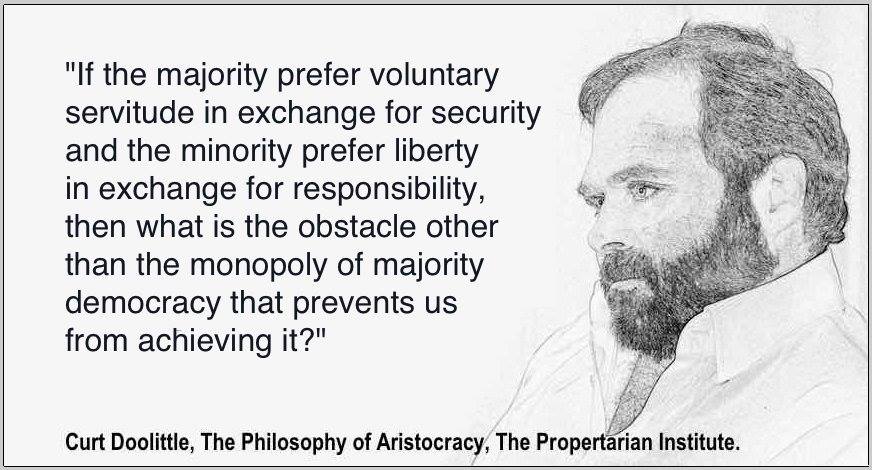
    photos_and_videos/TimelinePhotos_SxeO6JU-xg/45281106_10156751548612264_8983755248770220032_n_10156751548607264.jpg Paul FranklinFederal funding.Nov 2, 2018, 10:00 PMJennifer DeanThe only obstacle I see is upsetting the security of the vulnerable and innocent who can’t fend for themselves.Nov 2, 2018, 11:57 PMDarren HowellSo… do we migrate to where liberty exists?Nov 3, 2018, 8:24 AMSteven GantLast I heard Somalia 🇸🇴 was as free a state, as free can get.Nov 3, 2018, 12:36 PMJustin Allredno where left to migrate. It’s time to fightNov 3, 2018, 1:01 PMDaniel Roland AndersonJustin Allred

    Damned right.Nov 4, 2018, 2:45 AMVincenzo LaSalaThe illusion that we can’t win.Nov 4, 2018, 8:34 PM


    Source date (UTC): 2018-11-02 20:06:00 UTC

  • How Germany Made Use of Second Mover Advantage:

    BRITAIN VS GERMANY (how germany made use of second mover advantage: england betamax, germany vhs) By Aaron Kahland [I]’ll start by addressing education. Let’s take the metric of universities. Germany had more than ten before 16th century concluded whilst England’s third university was first founded in 1824 and Oxbridge were largely confined to theology and law. The protestant reformation led to compulsory education in Germany well before it was commonplace in England. The pietist movement in Germany led to the concept of ‘Bildung’ or a general education in the humanities which led to a revival of the study of the Classics. By the 19th century, whilst the Britons were busying themselves with superficial comparisons between Victorian and Roman periods, Germans were discovering places like Troy. By 1933, Germany had more Nobel Prize winners than all English speakers on the planet combined. But that is actually a poor metric considering that Germany invented the modern university and it became the model for the rest of the world and, importantly, the United States. I want to emphasize that i am not entirely convinced that the general education of the average German was better than that of the average Briton. Perhaps it was, perhaps it was not – I really don’t know. A good indicator might be book sales and what books were being sold in the 19th century. However, I would argue that by the 19th century, the upper 5% of Germans were better educated than Britons – and this is reflected in the fact that the Second Industrial Revolution occurred not in Britain but Germany. Whilst Britain was the origin of the Scientific Revolution – the Germans scholars absolutely embraced it and built their deucational institutions using the scientific method as a foundation. In fact I might argue that German philosophy was a response / reaction to that tremendous pace of scientific advance. By the 19th century in both France and Britain – Germany became synonymous with science and France had entirely given up hope of ever competing. It came to be understood, in Europe, that there was something peculiar about German civilization that provided it a technological advantage over others. It was this second Industrial Revolution – the fact that Germany now completely dominated electrics, machine tools, chemicals, pharmaceuticals that, in my view, was the cause of this civilizational conflict. By the late 19th Century the British ruling classes were determined to build a global Empire that would be run by a global English-speaking elite – the Rhodes Scholarship was established precisely for the purpose of selecting this elite on merit. Germany however, was the obstacle to achieving this because of her scientific advancement. (I baited Aaron Kahland into this post. He didn’t bite. So I just outright asked him. This is the result. lol -hugs )
  • How Germany Made Use of Second Mover Advantage:

    BRITAIN VS GERMANY (how germany made use of second mover advantage: england betamax, germany vhs) By Aaron Kahland [I]’ll start by addressing education. Let’s take the metric of universities. Germany had more than ten before 16th century concluded whilst England’s third university was first founded in 1824 and Oxbridge were largely confined to theology and law. The protestant reformation led to compulsory education in Germany well before it was commonplace in England. The pietist movement in Germany led to the concept of ‘Bildung’ or a general education in the humanities which led to a revival of the study of the Classics. By the 19th century, whilst the Britons were busying themselves with superficial comparisons between Victorian and Roman periods, Germans were discovering places like Troy. By 1933, Germany had more Nobel Prize winners than all English speakers on the planet combined. But that is actually a poor metric considering that Germany invented the modern university and it became the model for the rest of the world and, importantly, the United States. I want to emphasize that i am not entirely convinced that the general education of the average German was better than that of the average Briton. Perhaps it was, perhaps it was not – I really don’t know. A good indicator might be book sales and what books were being sold in the 19th century. However, I would argue that by the 19th century, the upper 5% of Germans were better educated than Britons – and this is reflected in the fact that the Second Industrial Revolution occurred not in Britain but Germany. Whilst Britain was the origin of the Scientific Revolution – the Germans scholars absolutely embraced it and built their deucational institutions using the scientific method as a foundation. In fact I might argue that German philosophy was a response / reaction to that tremendous pace of scientific advance. By the 19th century in both France and Britain – Germany became synonymous with science and France had entirely given up hope of ever competing. It came to be understood, in Europe, that there was something peculiar about German civilization that provided it a technological advantage over others. It was this second Industrial Revolution – the fact that Germany now completely dominated electrics, machine tools, chemicals, pharmaceuticals that, in my view, was the cause of this civilizational conflict. By the late 19th Century the British ruling classes were determined to build a global Empire that would be run by a global English-speaking elite – the Rhodes Scholarship was established precisely for the purpose of selecting this elite on merit. Germany however, was the obstacle to achieving this because of her scientific advancement. (I baited Aaron Kahland into this post. He didn’t bite. So I just outright asked him. This is the result. lol -hugs )

  • Rahim Makes Tells the Story so That I Don’t Have To:

    October 31st, 2018 2:10 PM RAHIM MAKES TELLS THE STORY SO THAT I DON’T HAVE TO: The Weaponization of the Commons as means of FUNDING the KNIGHTS. Rahim Taghizadegan, Why Are Western Europens So Naive (PFS 2018) http://propertyandfreedom.org/2018/10/rahim-taghizadegan-why-are-western-europens-so-naive-pfs-2018/

  • The Market for Halloween Celebration

    October 30th, 2018 7:22 PM [H]alloween Celebration: Driven by (a) children per household, (b) relative wealth (c) the dominance of the workplace as means of trick-or-treating, because (d) the dissolution of the stable, territorial, intergenerational family, because of the growth of cities – and (e) as Haidt’s recent book suggests: the ‘infantilization’ of the generation, and it’s ‘paranoia’ due to the inverse relation between crime and criminal trends. Where I am in a rural area of the USA at the moment, its as insane as christmas decorations in suburbia. Don’t underestimate the impact of the current political stress over white-replacement on civic participation. It’s huge.

  • Aristocratic (propertarian) Markets

    October 30th, 2018 3:33 PM ARISTOCRATIC (PROPERTARIAN) MARKETS 5 – Established Males (industry/politics): Curt’s View 4 – Lightly Established Males (family/smb): Bill’s View 3 – Warrior Males (individuals/craftsmen): Eli Harman’s View. 2 – Occultists (outcasts/literary) … so far we don’t market there. Someone undoubtably will…. 1 – Traditionalists … (Religion/Tradition) … interested largely in the outputs not the history. (from bill and I discussing what’s going on … )

  • The Market for Halloween Celebration

    October 30th, 2018 7:22 PM [H]alloween Celebration: Driven by (a) children per household, (b) relative wealth (c) the dominance of the workplace as means of trick-or-treating, because (d) the dissolution of the stable, territorial, intergenerational family, because of the growth of cities – and (e) as Haidt’s recent book suggests: the ‘infantilization’ of the generation, and it’s ‘paranoia’ due to the inverse relation between crime and criminal trends. Where I am in a rural area of the USA at the moment, its as insane as christmas decorations in suburbia. Don’t underestimate the impact of the current political stress over white-replacement on civic participation. It’s huge.