Category: Commentary, Critique, and Response

  • Good Example (Godel, Chomsky)

    —“Not quite, as Godel presented a mathematical model of this phenomenon. You cannot reduce this to mere positivistic linguistics. On which point, are you not assuming Chomsky’s universal grammar with your definition of grammar? If so, this has been shown to be unempirical.”—

    I didn’t say anything like that. I’m saying that he’s correct. I haven’t met anyone other than the author of the best book on the subject that understands the limit of Godel’s argument: (a) we identify new constant relations (experiences) (b) we invent new references (c) we invent new paradigms (d) we require grammars to talk about them (e) we can make ungrammatical statements. Godel said it. Turing said it. Kripke said it. So there is no closure to logic without appeal to the operational, empirical, limits and completeness, and even then there is only closure on falsification not justification. THE FUNDAMENTAL PROBLEM FOR PEOPLE IN PHILOSOPHY AND THEOLOGY: There is nothing positivistic in P. It’s purely falsificationary. Either it survives adversarial competition by the terms stated in testimonialism or it doesn’t. If more than one does, then we just don’t know and nothing else can be said. In general, i have found that the first and most significant hurdle that people have trouble with – at least those not educated in the sciences – is that all propositions are contingent and all truth propositions are achieved by falsification. And P articulates the METHOD for universal falsification. ==== Afterward: Chomsky was trying to bring Turing to language. His original paper is simply pulling Turing into language. Chomsky’s contribution – from my understanding – is correctly stating that: (a) the brain produces experience by continuous recursive disambiguation. (b) linguistic thought consists of rules of continuous recursive disambiguation. (c) grammar regardless of language consists of rules of continuous recursive disambiguation. (d) language serves as a system of measurement for thought – albeit we use many different paradigms (metaphysics) within each human language, and these paradigms vary according to the correspondent vs the three non-correspondent (fictionalisms). (e) there appear to be higher demands on cognition for higher levels of thought. And we should expect aliens if there are any to use simpler or more complex grammatical structures given their abilities.
  • Good Example (Godel, Chomsky)

    —“Not quite, as Godel presented a mathematical model of this phenomenon. You cannot reduce this to mere positivistic linguistics. On which point, are you not assuming Chomsky’s universal grammar with your definition of grammar? If so, this has been shown to be unempirical.”—

    I didn’t say anything like that. I’m saying that he’s correct. I haven’t met anyone other than the author of the best book on the subject that understands the limit of Godel’s argument: (a) we identify new constant relations (experiences) (b) we invent new references (c) we invent new paradigms (d) we require grammars to talk about them (e) we can make ungrammatical statements. Godel said it. Turing said it. Kripke said it. So there is no closure to logic without appeal to the operational, empirical, limits and completeness, and even then there is only closure on falsification not justification. THE FUNDAMENTAL PROBLEM FOR PEOPLE IN PHILOSOPHY AND THEOLOGY: There is nothing positivistic in P. It’s purely falsificationary. Either it survives adversarial competition by the terms stated in testimonialism or it doesn’t. If more than one does, then we just don’t know and nothing else can be said. In general, i have found that the first and most significant hurdle that people have trouble with – at least those not educated in the sciences – is that all propositions are contingent and all truth propositions are achieved by falsification. And P articulates the METHOD for universal falsification. ==== Afterward: Chomsky was trying to bring Turing to language. His original paper is simply pulling Turing into language. Chomsky’s contribution – from my understanding – is correctly stating that: (a) the brain produces experience by continuous recursive disambiguation. (b) linguistic thought consists of rules of continuous recursive disambiguation. (c) grammar regardless of language consists of rules of continuous recursive disambiguation. (d) language serves as a system of measurement for thought – albeit we use many different paradigms (metaphysics) within each human language, and these paradigms vary according to the correspondent vs the three non-correspondent (fictionalisms). (e) there appear to be higher demands on cognition for higher levels of thought. And we should expect aliens if there are any to use simpler or more complex grammatical structures given their abilities.

  • Upcoming Book on Human Intelligence

    Upcoming Book on Human Intelligence

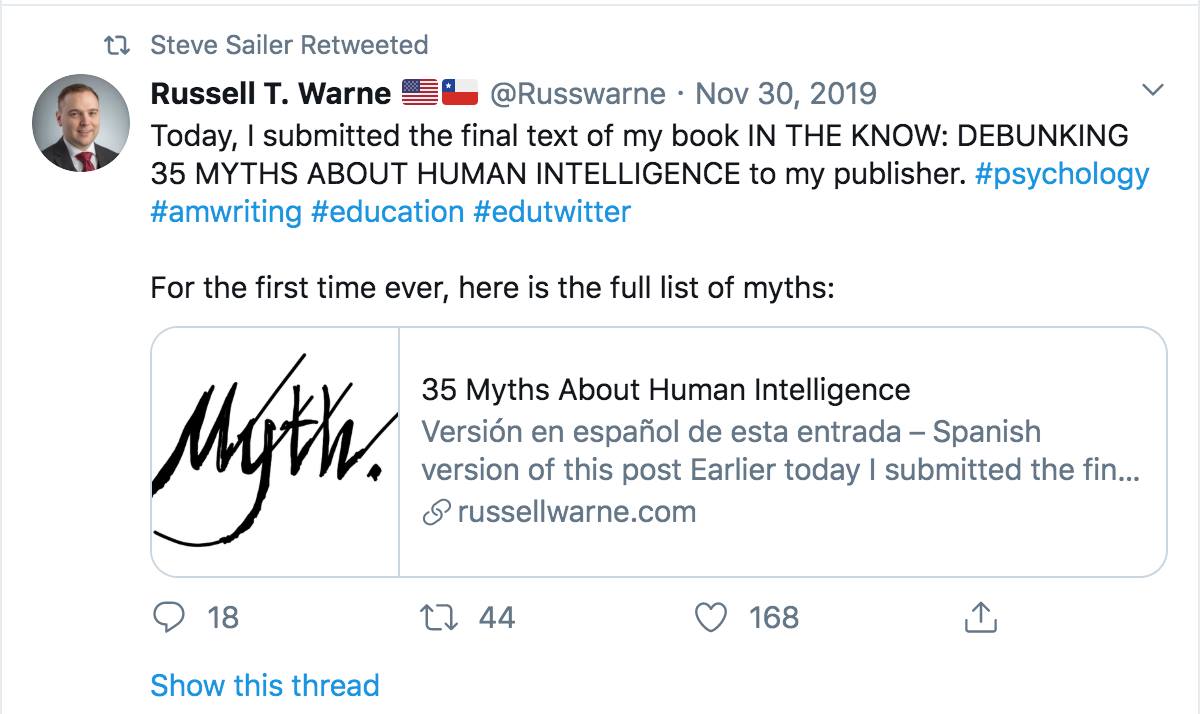
    Russell T. WarnePsychologist – Data Analyst – Educator(a book answering the science-denialists) [“E]arlier today I submitted the final text for my upcoming book In the Know: Debunking 35 Myths About Human Intelligence. It feels good to have it in the hands of my publisher. There is still some work to do, but most of it is work that my publisher has to do–not me. The book has 35 chapters (one per myth), plus an introduction and a conclusion. The chapters are each short enough that they can be read in one sitting, and the language is as non-technical as possible. My goal was to have the book serve as a convenient reference that people could use to combat common incorrect ideas about intelligence. The book will be published in fall 2020. In the meantime, here are the myths that the book addresses:

    Section 1: The Nature of Intelligence Intelligence is whatever collection of tasks a psychologist puts on a test. Intelligence is too complex to summarize with one number. IQ does not correspond to brain anatomy or functioning. Intelligence is a Western concept that does not apply to non-Western cultures. There are multiple intelligences in the human mind. Practical intelligence is a real ability, separate from general intelligence. Fact: there are aspects of brain anatomy and functioning that correlate with IQ scores. Section 2: Measuring Intelligence Measuring intelligence is difficult. Content on intelligence tests is trivial and cannot measure intelligence. Intelligence tests are imperfect and cannot be used or trusted. Intelligence tests are biased against diverse populations. Section 3: Influences on Intelligence IQ only reflects a person’s socioeconomic status. High heritability for intelligence means that raising IQ is impossible. Genes are not important for determining intelligence. Environmentally driven changes in IQ mean that intelligence is malleable. Social interventions can drastically raise IQ. Brain training programs can raise IQ. Improvability of IQ means intelligence can be equalized. The reality is that geneticists have identified hundreds of DNA segments that are associated with intelligence. In fact, in some samples, genes have a larger impact than environment on IQ. Section 4: Intelligence and Education Every child is gifted. Effective schools can make every child academically proficient. Non-cognitive variables have powerful effects on academic achievement. Admissions tests are a barrier to college for underrepresented students. Section 5: Life Consequences of Intelligence IQ scores only measure how good someone is at taking intelligence tests. Intelligence is not important in the workplace. Intelligence tests are designed to create or perpetuate a false meritocracy. Very high intelligence is not more beneficial than moderately high intelligence. Emotional intelligence is a real ability that is helpful in life. It is a myth that schools can equalize children in their knowledge, academic skills, or intelligence. Section 6: Demographic Group Differences Males and females have the same distribution of IQ scores. Racial/Ethnic group IQ differences are completely environmental in origin. Unique influences operate on one group’s intelligence test scores. Stereotype threat explains score gaps among demographic groups. Section 7: Societal and Ethical Issues Controversial or unpopular ideas should be held to a higher standard of evidence. Past controversies taint modern research on intelligence. Intelligence research leads to negative social policies. Intelligence research undermines the fight against inequality. Everyone is about as smart as I am.

    86790915_210269200371241_8064657175416406016_o.jpg
  • Upcoming Book on Human Intelligence

    Upcoming Book on Human Intelligence

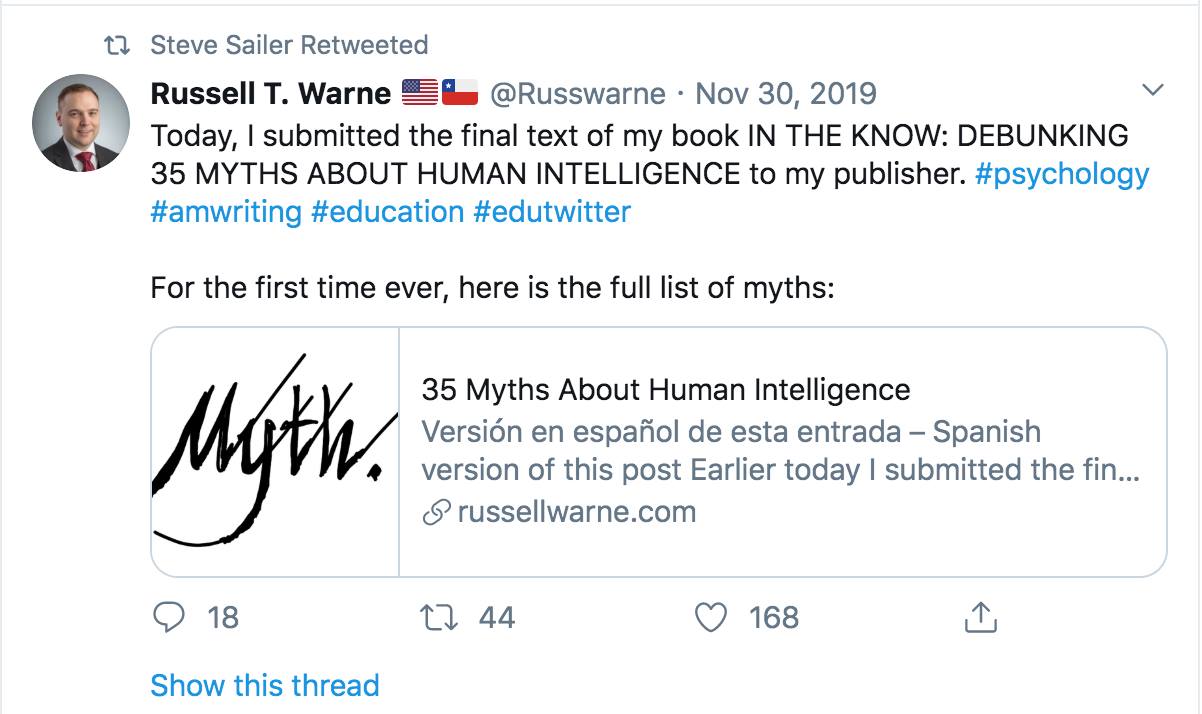
    Russell T. WarnePsychologist – Data Analyst – Educator(a book answering the science-denialists) [“E]arlier today I submitted the final text for my upcoming book In the Know: Debunking 35 Myths About Human Intelligence. It feels good to have it in the hands of my publisher. There is still some work to do, but most of it is work that my publisher has to do–not me. The book has 35 chapters (one per myth), plus an introduction and a conclusion. The chapters are each short enough that they can be read in one sitting, and the language is as non-technical as possible. My goal was to have the book serve as a convenient reference that people could use to combat common incorrect ideas about intelligence. The book will be published in fall 2020. In the meantime, here are the myths that the book addresses:

    Section 1: The Nature of Intelligence Intelligence is whatever collection of tasks a psychologist puts on a test. Intelligence is too complex to summarize with one number. IQ does not correspond to brain anatomy or functioning. Intelligence is a Western concept that does not apply to non-Western cultures. There are multiple intelligences in the human mind. Practical intelligence is a real ability, separate from general intelligence. Fact: there are aspects of brain anatomy and functioning that correlate with IQ scores. Section 2: Measuring Intelligence Measuring intelligence is difficult. Content on intelligence tests is trivial and cannot measure intelligence. Intelligence tests are imperfect and cannot be used or trusted. Intelligence tests are biased against diverse populations. Section 3: Influences on Intelligence IQ only reflects a person’s socioeconomic status. High heritability for intelligence means that raising IQ is impossible. Genes are not important for determining intelligence. Environmentally driven changes in IQ mean that intelligence is malleable. Social interventions can drastically raise IQ. Brain training programs can raise IQ. Improvability of IQ means intelligence can be equalized. The reality is that geneticists have identified hundreds of DNA segments that are associated with intelligence. In fact, in some samples, genes have a larger impact than environment on IQ. Section 4: Intelligence and Education Every child is gifted. Effective schools can make every child academically proficient. Non-cognitive variables have powerful effects on academic achievement. Admissions tests are a barrier to college for underrepresented students. Section 5: Life Consequences of Intelligence IQ scores only measure how good someone is at taking intelligence tests. Intelligence is not important in the workplace. Intelligence tests are designed to create or perpetuate a false meritocracy. Very high intelligence is not more beneficial than moderately high intelligence. Emotional intelligence is a real ability that is helpful in life. It is a myth that schools can equalize children in their knowledge, academic skills, or intelligence. Section 6: Demographic Group Differences Males and females have the same distribution of IQ scores. Racial/Ethnic group IQ differences are completely environmental in origin. Unique influences operate on one group’s intelligence test scores. Stereotype threat explains score gaps among demographic groups. Section 7: Societal and Ethical Issues Controversial or unpopular ideas should be held to a higher standard of evidence. Past controversies taint modern research on intelligence. Intelligence research leads to negative social policies. Intelligence research undermines the fight against inequality. Everyone is about as smart as I am.

    86790915_210269200371241_8064657175416406016_o.jpg
  • There we go. 😉

    There we go. 😉


    Source date (UTC): 2020-02-26 19:25:52 UTC

    Original post: https://twitter.com/i/web/status/1232748635122737152

    Reply addressees: @StanGalerius

    Replying to: https://twitter.com/i/web/status/1232747455474806786

  • Untitled

    https://propertarianism.com/2020/02/26/88950/

    Source date (UTC): 2020-02-26 19:22:52 UTC

    Original post: https://twitter.com/i/web/status/1232747880865288192

  • Book. From Blog. “Whistleblower”

    Book. From Blog. “Whistleblower” https://propertarianism.com/2020/02/26/book-from-blog-whistleblower/


    Source date (UTC): 2020-02-26 19:22:01 UTC

    Original post: https://twitter.com/i/web/status/1232747664678281216

  • Criticizing and Reforming “logos”

    Criticizing and Reforming “logos” https://propertarianism.com/2020/02/26/criticizing-and-reforming-logos/


    Source date (UTC): 2020-02-26 19:21:04 UTC

    Original post: https://twitter.com/i/web/status/1232747426613792770

  • Objective Measures of Good and Evil?

    Objective Measures of Good and Evil? https://propertarianism.com/2020/02/26/objective-measures-of-good-and-evil/


    Source date (UTC): 2020-02-26 19:03:48 UTC

    Original post: https://twitter.com/i/web/status/1232743082409390080

  • Interesting Choices of Gods

    Interesting Choices of Gods https://propertarianism.com/2020/02/26/interesting-choices-of-gods/


    Source date (UTC): 2020-02-26 19:02:23 UTC

    Original post: https://twitter.com/i/web/status/1232742724979261440