Category: Civilization, History, and Anthropology

  • Conflict 4: Conquest of the World

    Generation Six: Expansion and Exploitation: The Second Great Leap Forward

    ( … )

    Origins: Persian Gulf and Indus River Urhiemat
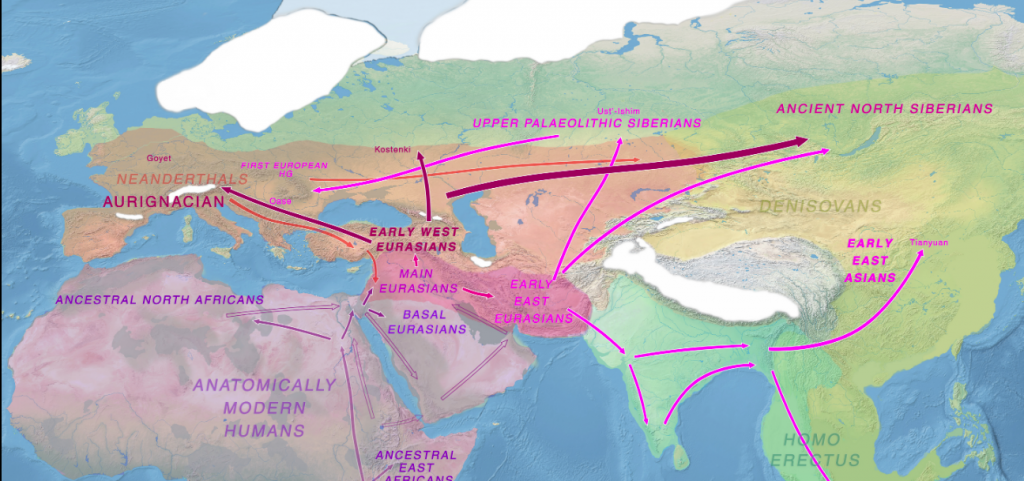
    The South Eurasian Urheimat


    The North Eurasian Urheimat


    Cultures of the Upper Paleolithic

    Generation Six: Regional Adaptation

    We won’t cover each of these cultures here, instead limit our discussion to those cultures that represent changes in technology in response to environmental demands. 

    SW Asia (Fertile Crescent)
    +Emiran (50–40 ka)
    Ahmarian (46–42 ka)
    Baradostian (36–18 ka)
    Aurignacian (35–29 ka)
    Zarzian (20–10 ka)
    Kebaran (18–12.5 ka)
    Trialetian (16–8 ka)
    +Natufian (14.5–11.5 ka)
    Khiamian (12.2–10.8 ka)
    Europe
    Bohunician (48–40 ka)
    +Châtelperronian (44.5–36 ka)
    Lincombian-Ranisian-Jerzmanowician (43–32 ka)
    +Aurignacian (43–26 ka)
    +Szeletian (41,000-37,000)
    Périgordian (35–20 ka)
    +Gravettian (33–24 ka)
    +Pavlovian (29–25 ka)
    +Solutrean (22–17 ka)
    +Epigravettian (20–10 ka)
    +Magdalenian (17–12 ka)
    Hamburg (15.5–13.1 ka)
    Federmesser (14–12.8 ka)
    +Azilian (14–10 ka)
    +Ahrensburg (13–12 ka)
    +Swiderian (11–8 ka)
    Africa
    Khormusan (42–18 ka)
    Iberomaurusian (25–11 ka)
    Mushabian
    Halfan (22–14 ka)
    Qadan (15—11 ka)
    Sebilian (15–11 ka)
    Eburran (15–5 ka)
    Magosian (10–8 ka)

    Siberia
    Mal’ta–Buret’ (24–15 ka)
    Afontova Gora (21–12 ka)

    SW Asia

    (Human)
    Paleolithic >
    Middle Paleolithic to Upper Paleolithic >
    The Emiran, Bohunician, and Ahmarian Complex (??? BC to 40,000 BC) Anatomically Modern Humans spread in Eurasia. These are also the first people that appear to successfully compete with the Neanderthals.

    SW Asia (Levant) >
    Emiran Culture (First Anatomically Modern Eurasians) (50,000 BC to 40000 BC) existed in the Levant (Syria, Lebanon, Israel, Palestine), and Arabia between the Middle Paleolithic and the Upper Paleolithic periods. It is the oldest known of the Upper Paleolithic cultures and remains an enigma as it transitionally has no African progenitor this culture is indigenous to the Levant, and the possible Uriheimat of West Eurasians. The tools of this culture are noticably primitive compared to later work products.

    SW Asia (Levant) >
    Ahmarian(Elongated, Curved Blades) (
    44,000 BC to 40,000 BC): The Ahmarian period together with the Emiran period, both from the Levant, are among the very first periods of the Upper Paleolithic, corresponding to the first stages of the expansion of Homo sapiens out of Africa. From this stage, the first modern humans migrated to Europe to form the beginning of the European Upper Paleolithic, including the Aurignacian culture, where they become known as the Cro-Magnons

    Ahmarian blades are usually elongated with some curves. The technical knowledge of the Ahmarian culture, along with the other lithic industries, is considered the likely source of the abrupt and rapid takeover of the world in all directions as evidenced by the crossing of the Bering Strait towards America. Ahmarian technology, which included the complex of blade/bladelet-knapping techniques is also linked to the tools used by the hunter-gatherers of southwestern Asia. 

    SW Asia (Iran-Iraq: Zagros Mountains) >
    Baradostian (34,000 BC – 16,000 BC)

    (Human)
    Paleolithic >
    Upper Paleolithic >
    Europe >
    Basal West Europeans (46,000 BC to 13,000 BC) – West Hunter Gatherer
    (WHG),  European Early (Anatomically) Modern Humans (EEMH), or “Cro-Magnon” and their conquest of Europe.  The founder population of all later EEMH was established by 35,000 BC, and Europe would remain in genetic isolation from the rest of the world until 12,000 BC.

    The Invasion and Transition

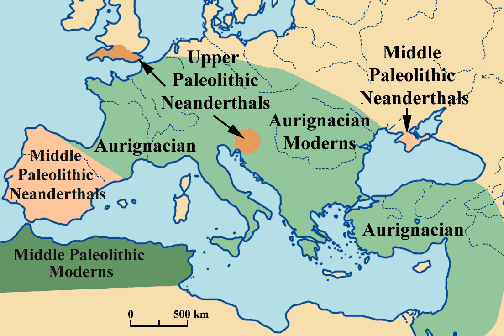
    Mousterian, Châtelperronian, Perigordian (Neanderthal) (44,500–36,000)Mousterian industry, and lasted from c. 45,000 to c. 40,000 BP, and Catelperronian Neanderthal cultures and the earliest Upper Palaeolithic industry in Central and Southwestern France, as well as in Northern Spain. Châtelperronian culture may represent a community of Neanderthals who had to some extent adopted the culture of the modern Homo sapiens that had established themselves in the surrounding area, which would account for the signs of a hybrid culture found. These hypothetical Neanderthal hold-outs would be analogous to more recent Native Americans in North and South America who adopted European technologies such as firearms or domestication of horses in order to survive in an environment dominated by more technologically advanced competitors
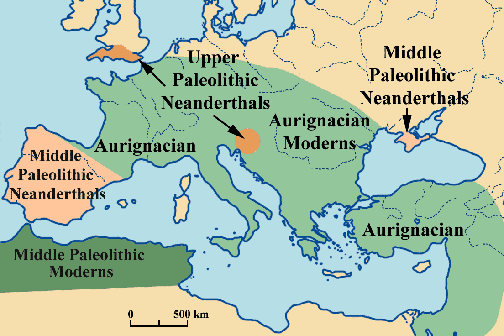
    Neanderthals In Refuge (by 35,000 BC) Evidence for continued Neanderthal presence in the Iberian Peninsula.

    The Completion of the Conquest of Europe
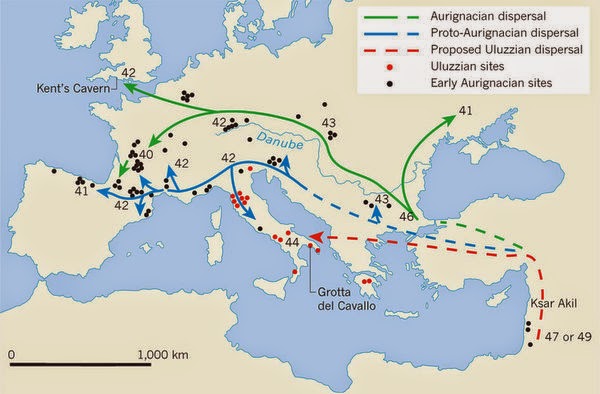
    (Europe: Central and SE Europe) >
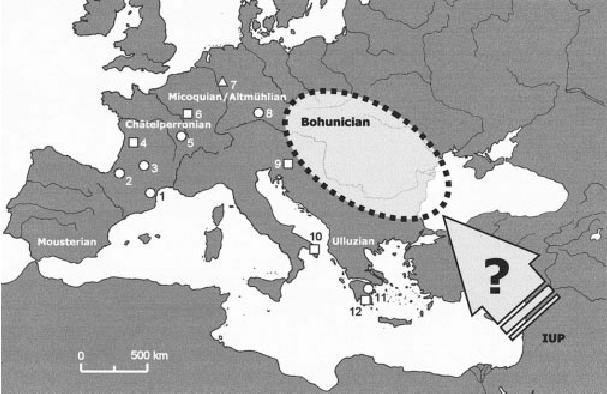
    Bohunician Industry
    (48,000 BC to 40,000 BC) (First Anotomicaly Modern Europeans) is the candidate for representing the first wave of anatomically modern humans in Europe.

    Bohunician technology resembles the Mousterian, as do the contemporary assemblages of the Szeletian, Emiran and Ahmarian all these cultures apper to be related.
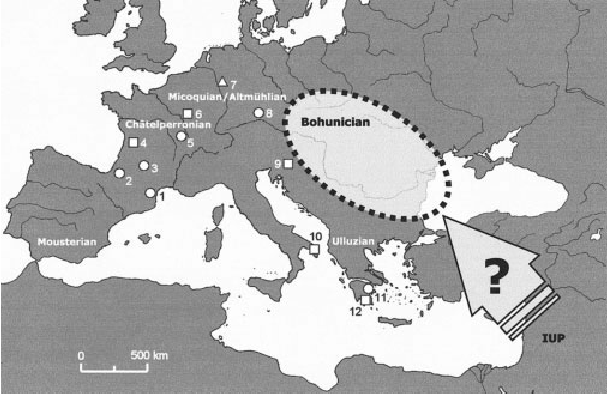
     

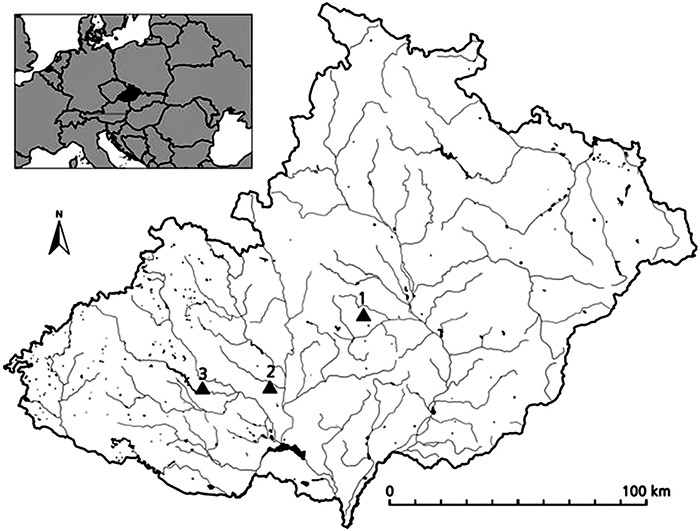
    Szeletian Culture  (39,000 BC to 35,000 BC)  Austria, Moravia, northern Hungary, and southern Poland. It is dated years before the present (BP), most original and also the most aboriginal Upper Palaeolithic culture in Central Europe.
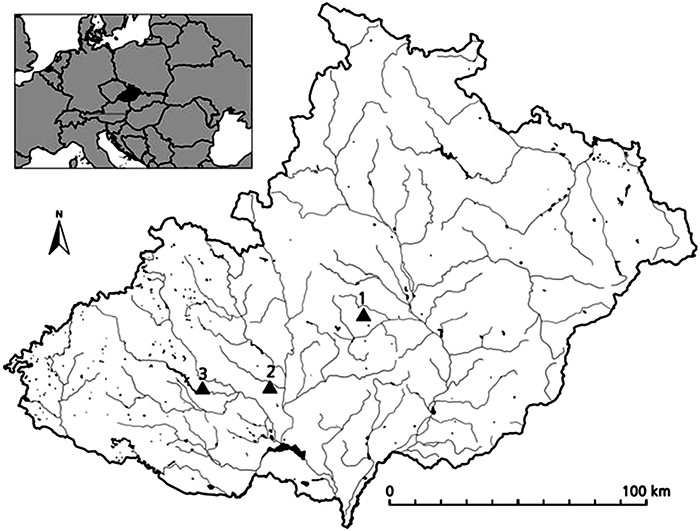
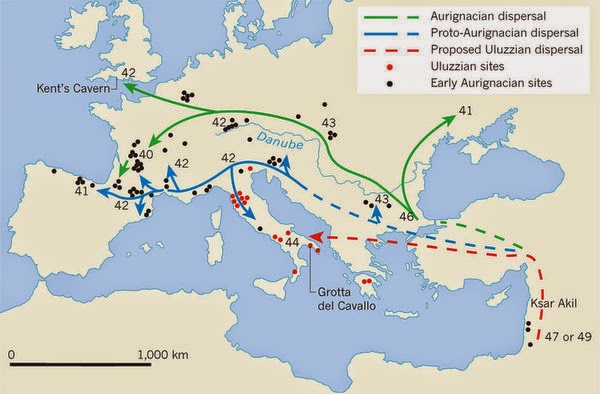
    Uluzzian Culture (45,000–39,500) of Italy and Greece


    The Formation of a Wholly European Culture

    Europe to SW Asia
    Aurignacian
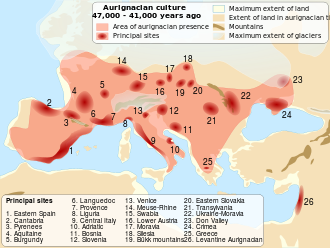
    (41,000 BC to 24,000 BC): The Upper Paleolithic developed in Europe some time after the Levant, where the Emiran period and the Ahmarian period form the first periods of the Upper Paleolithic, corresponding to the first stages of the expansion of Homo sapiens out of Africa. They then migrated to Europe and created the first European culture of modern humans, the Aurignacian.
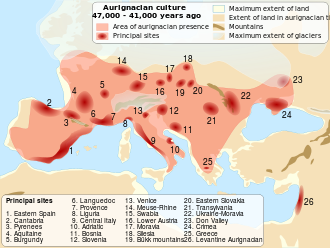
    An Early Aurignacian or Proto-Aurignacian stage is dated between about 43,000 and 37,000 years ago. The Aurignacian proper lasts from about 37,000 to 33,000 years ago. A Late Aurignacian phase transitional with the Gravettian dates to about 33,000 to 26,000 years ago.

    One of the oldest examples of figurative art, the Venus of Hohle Fels, comes from the Aurignacian and is dated to between 40,000 and 35,000 years ago. The German Lion-man figure is given a similar date range. The Bacho Kiro site in Bulgaria is one of the earliest known Aurignacian burials.

    A “Levantine Aurignacian” culture is known from the Levant, with a type of blade technology very similar to the European Aurignacian, following chronologically the Emiran and Early Ahmarian in the same area of the Near East, and also closely related to them. The Levantine Aurignacian may have preceded European Aurignacian, but there is a possibility that the Levantine Aurignacian was rather the result of reverse influence from the European Aurignacian: this remains unsettled.

    The Last Wholly European Culture

    Central and Eastern Europe 
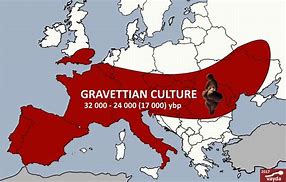
    Gravettian
    (33,000 BC to 22,000 BC) The Gravettian succeeds the Aurignacian, and is the last wholly unified European culture. West and Central Europe were extremely cold during this period. The Gravettians were hunter-gatherers who lived in this bitterly cold period of European prehistory, and Gravettian lifestyle was shaped by the climate as glacial and environmental changes forced them to adapt. They lived in caves or semi-subterranean or rounded dwellings which were typically arranged in small “villages”.
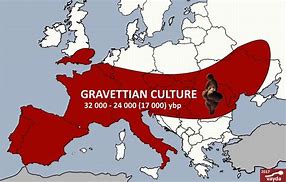
    Archaeologists usually divide the culture into two regional variants: the western Gravettian, known mainly from cave sites in France, Spain and Britain, and the eastern Gravettian in Central Europe and Russia. The eastern Gravettians, which include the Pavlovian culture, were specialized mammoth hunters, whose remains are usually found not in caves but in open air sites.

    The Gravettians are known for their Venus figurines, which were typically made as either ivory or limestone carvings.  And they were technologically innovative, producing new arts and artifacts.

    During the post glacial period, evidence of the culture begins to disappear from northern Europe but was continued in areas around the Mediterranean
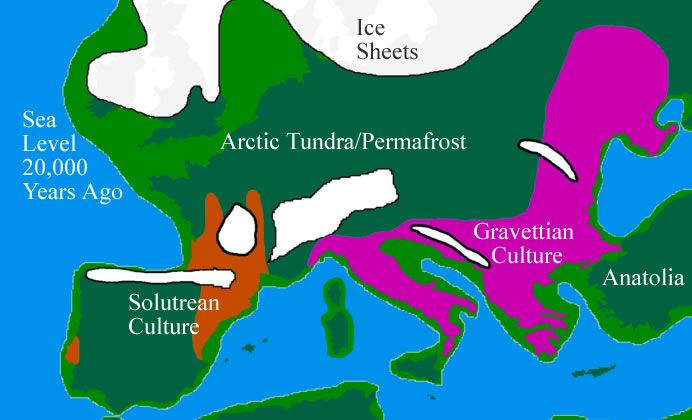
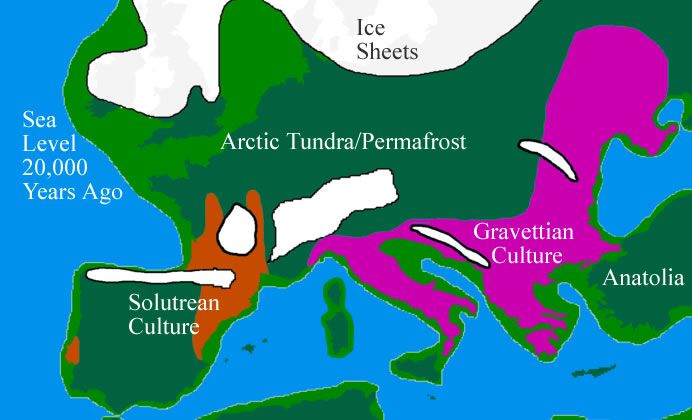
    Afterward, the Soultrean abrubtly replaces it in Fance, and it continues as the Epigravettian in Italy, Balkans, Ukraine, and Russia. 


    Crisis: The Last Glacial Maximum

    The second ice age, or Würm glaciation, of 28,000 to 10,000 years ago.
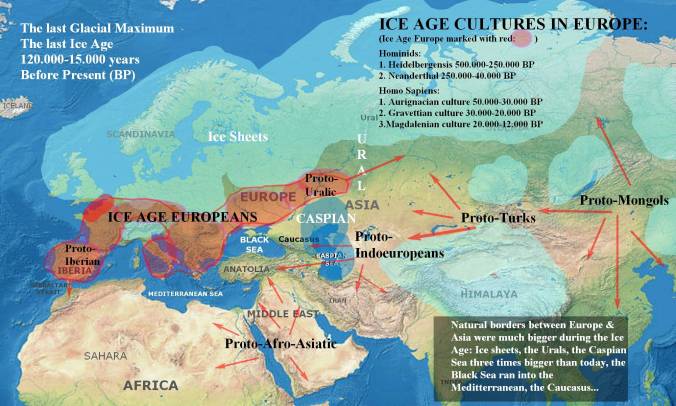
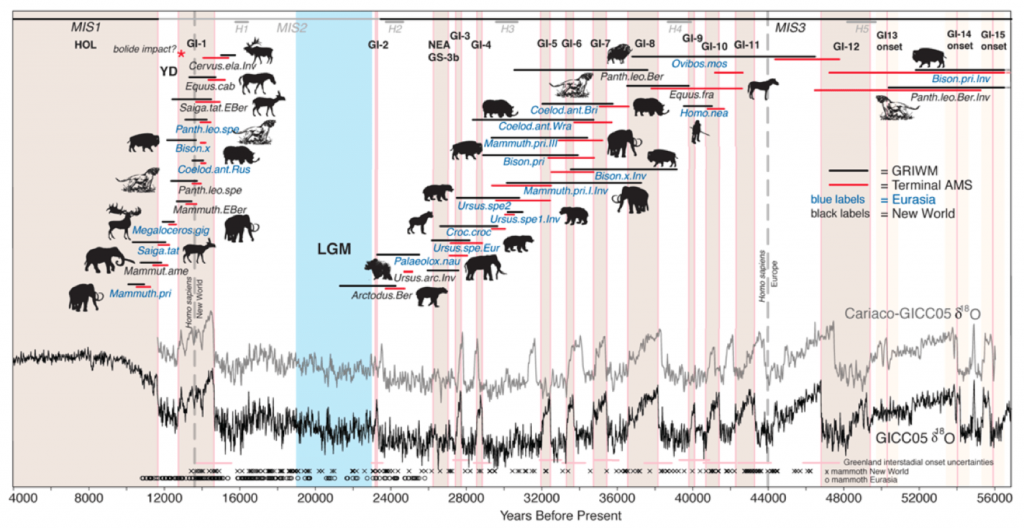
    Last Glacial Maximum (LGM) (~10,000 years from ~23,000 BC to 13,000 BC)

    There have been five major ice ages in earth’s history lasting from tens to a hundred million years. The last ice age started about 2.58 million years ago beginning with the spread of ice sheets in the Northern Hemisphere. Since then, the world has experienced cycles of glaciation with ice sheets advancing (glacial periods, glacials) and retreating (interglacial periods, interglacials) on 40,000- and 100,000-year time scales.

    So the paleolithic revolution is interrupted the most recent glacial cycle (LGM) The peopling of the Americas occurred during this time, with East and Central Asia populations reaching the Bering land bridge after about 35 ka, and expanding into the Americas by about 15 ka. The Holocene glacial retreat begins 11.7 ka (10th millennium BC), marking the beginning of the earliest forms of farming in the Fertile Crescent.

    (Human)
    Paleolithic >
    Upper Paleolithic >
    Northern Austria and Southern Poland

    Pavlovian (Ice Shelf Mammot Hunters, Weaving) (27,000 BC – 23,000 BC) Pavolvians are related to the Gravettians, and they  lived in the region of Moravia, northern Austria and southern Poland. They used sophisticated stone age technology to survive in the tundra on the fringe of the ice sheets around the Last Glacial Maximum. Its economy was principally based on the hunting of mammoth herds for meat, fat fuel, hides for tents and large bones and tusks for building winter shelters.

    Archaeologists have excavated flint implements, polished and drilled stone artifacts, bone spearheads, needles, digging tools, flutes, bone ornaments, drilled animal teeth, and seashells. Art or religious finds include bone carvings and figurines of humans and animals made of mammoth tusk, stone, and fired clay. Textile impressions made into wet clay give the oldest proof of the existence of weaving by humans.

    Basal North Eurasians

    (Human)
    Paleolithic >
    Upper Paleolithic >
    The Basal North Eurasian Dispersal

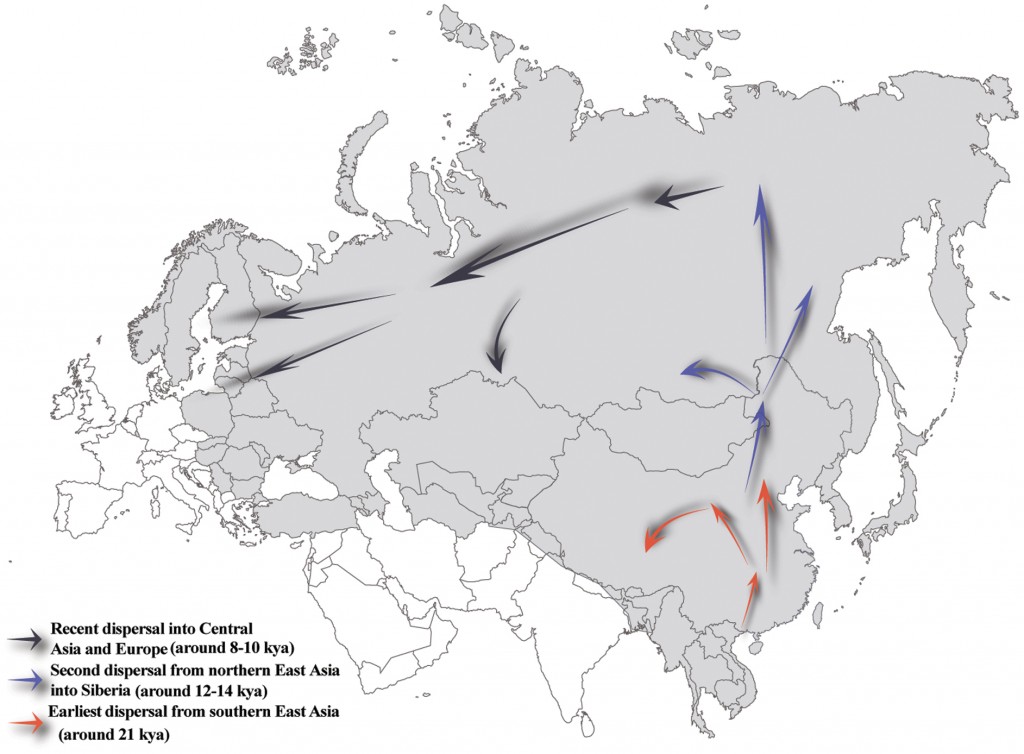
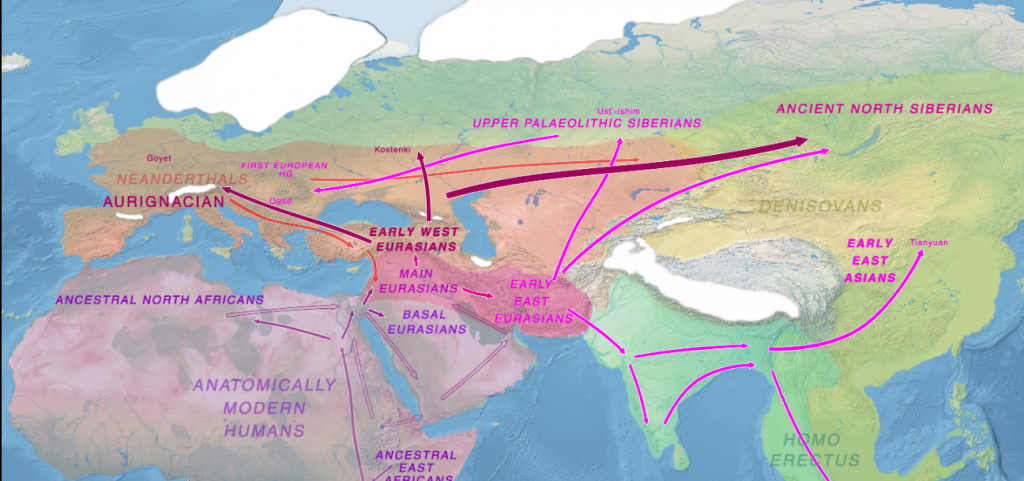
    Around 24,000 years ago, around the last glacial maximum,  a group of people in Siberia, evolve into Ancient North Eurasians (ANE). This group was extraordinarily successful. The mutation and subsecquent evolution of blond hair evolved in the ANE population. And their evolution contributed to a cline (in order influence) of Native Americans, Europeans, Central Asians, South Asians, and some East Asians. Later dilution of Native american ANE ancestry is the result of a second migration into the Americas 5000 years ago, that all but eradicated earlier groups.
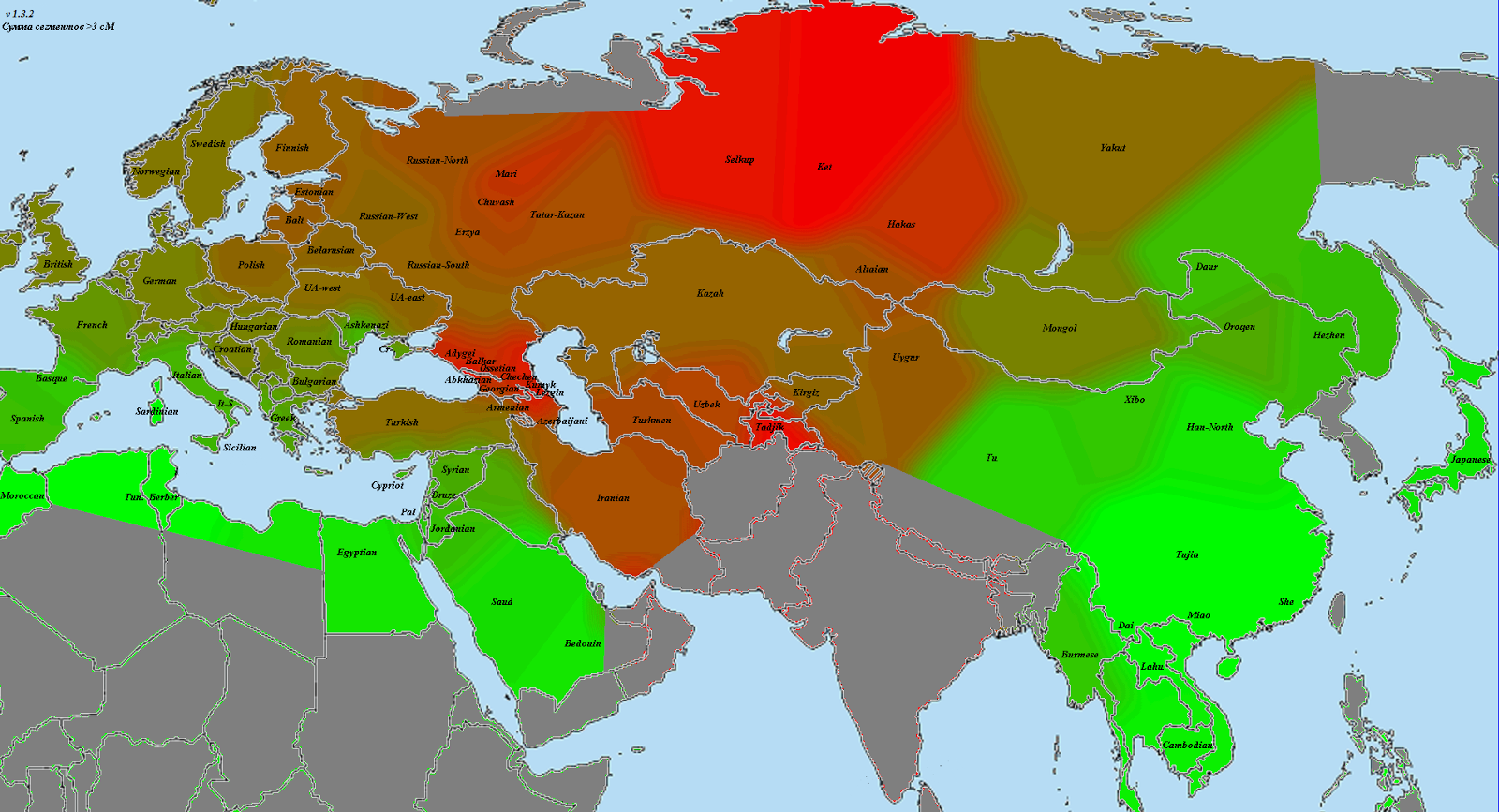
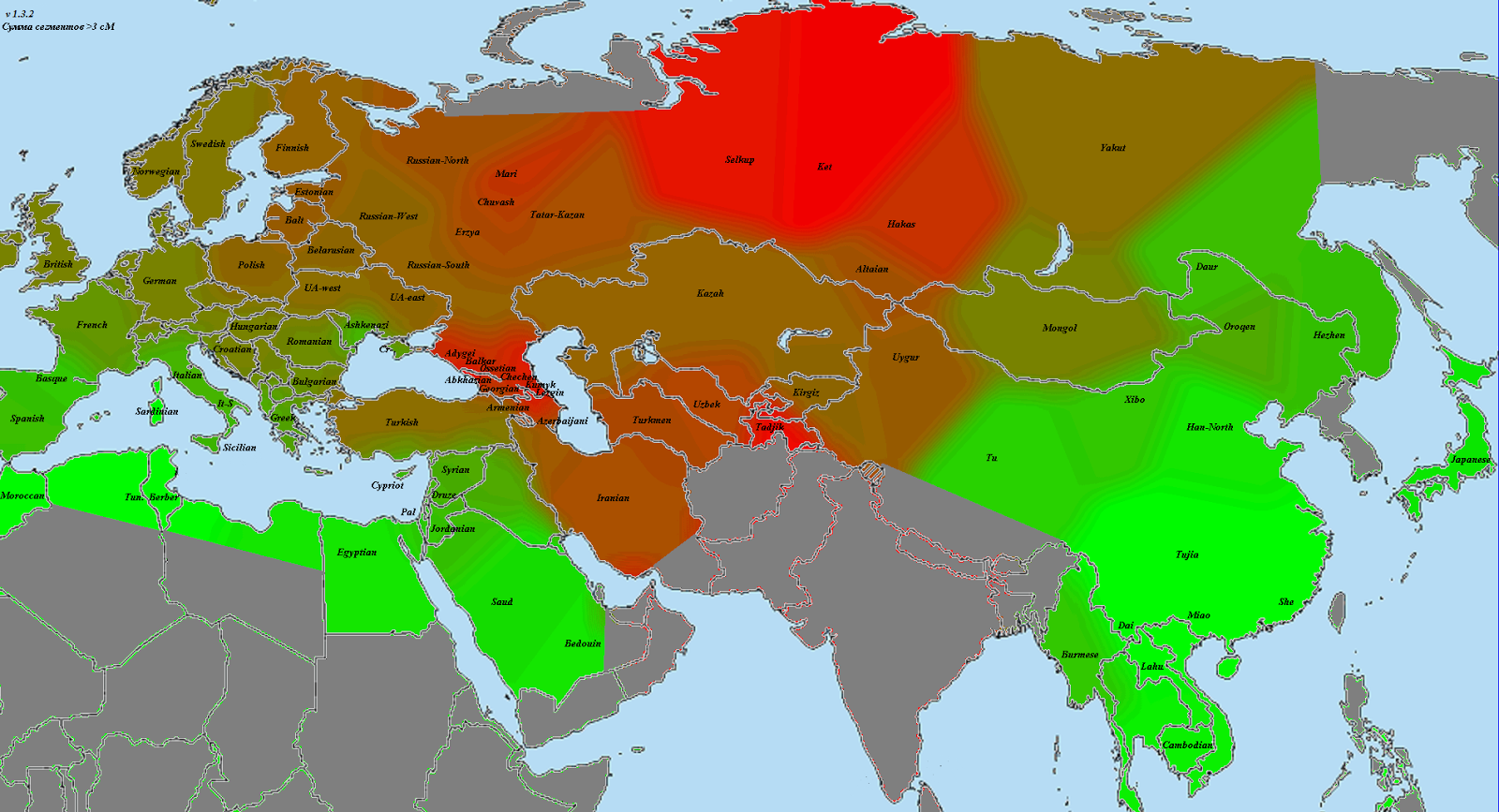
    Distribution of Ancient North Eurasian Genetics


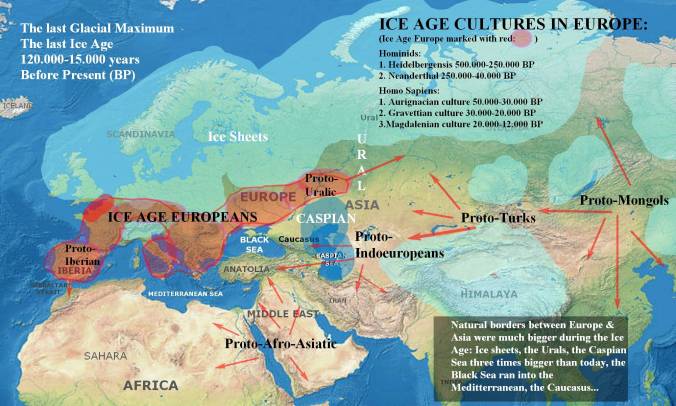
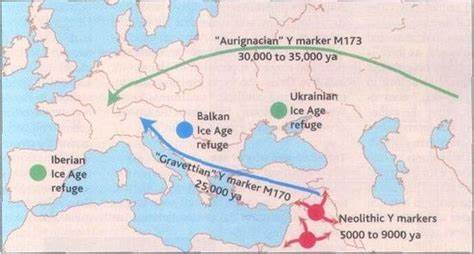
    The Ice Age Migrations

    The Resulting Cline West Eurasians After The ANE Expansion:

    • West Siberian Hunter-Gatherer (WSG)  had about 30% EHG ancestry, 50% ANE ancestry, and 20% East Asian ancestry.
    • Eastern European Hunter-Gatherer (EHG) is dominated by the Ancient North Euraasian (ANE) contribution (75%).
    • Scandinavian Hunter-Gatherer (SHG) were descended from Western Hunter-Gatherers who initially settled Scandinavia from the south, and later populations of EHG who entered Scandinavia from the north through the coast of Norway.
    • Western Hunter-Gatherers (WHG) and EHG lineages merged in Eastern Europe, after the end of the Last Glacial Maximum, accounting for early presence of ANE ancestry in Mesolithic Europe. Evidence suggests that as Ancient North Eurasians migrated West from Eastern Siberia, they absorbed Western Hunter-Gatherers and other West Eurasian populations as well.
    • Caucasian Hunter-Gatherer (CHG) dated ~26 kya, lacked ANE-admixture, by ~13 kya carried 36% ANE-derived admixture.
    • Iran Neolithic (Iran_N) individuals dated ~8.5 kya carried 50% ANE-derived admixture and 50% Caucuses-related admixture,marking them as different from other Near-Eastern and Anatolian Neolithics who didn’t have ANE admixture. Iran Neolithics were later replaced by Iran Chalcolithics, who were a mixture of Iran Neolithic and Near Eastern Levant Neolithic.

    This neolithic Iranian and Eastern European composition of 50% ANE will provide an interesting pattern in the milennia to come.

    Basal Siberian American Dispersals: 

    [ ADD IMAGE OF NORTH AMERICAN DISPERSAL ]

    ( … )


    Cultures of Post Glacial Maxium Europe

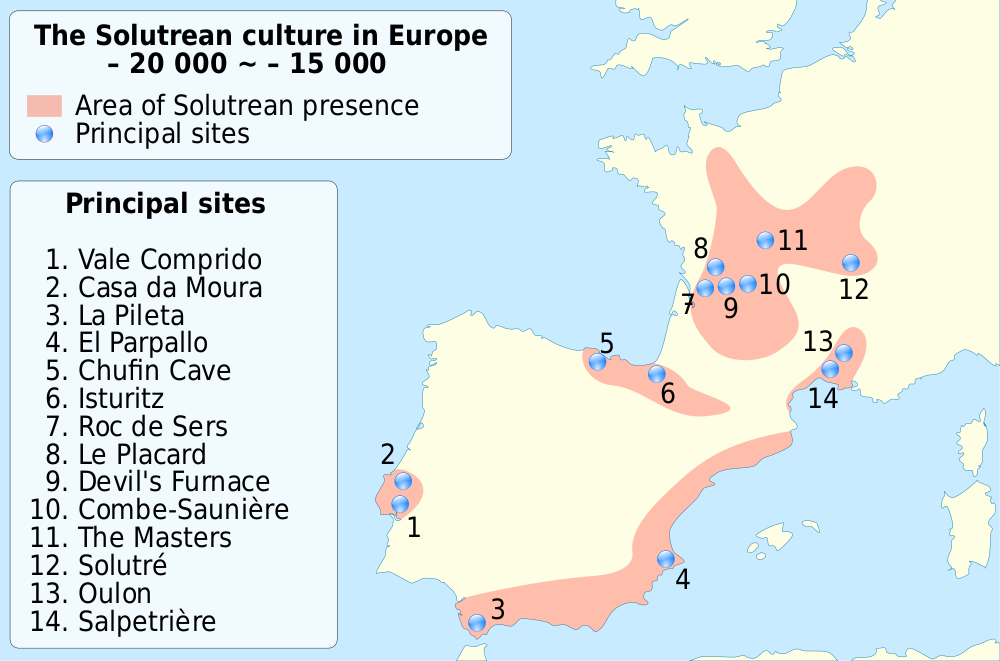
    Soultrean Culture (Advanced Flint) (19,000 BC to 15,000 BC) The Soultrean period in western europe (France, spain portugal) was a transitional stage between the flint implements of the Mousterian (Neanderthal) and the bone implements of the Magdalenian epochs. The period refers to the development of highly advanced flintmaking techniques that hadn’t been seen before and weren’t rediscovered for millennia. It includes relatively finely worked, bifacial points made with lithic reduction percussion and pressure flaking rather than cruder flintknapping. Knapping was done using antler batons, hardwood batons and soft stone hammers. This method permitted the working of delicate slivers of flint to make light projectiles and even elaborate barbed and tanged arrowheads. Large thin spearheads; scrapers with edge not on the side but on the end; flint knives and saws, but all still chipped, not ground or polished; long spear-points, with tang and shoulder on one side only, are also characteristic implements of this industry. Bone and antler were used as well. They used these tools to hunt horse, reindeer, mammoth, cave lion, rhinoceros, bear and aurochs.
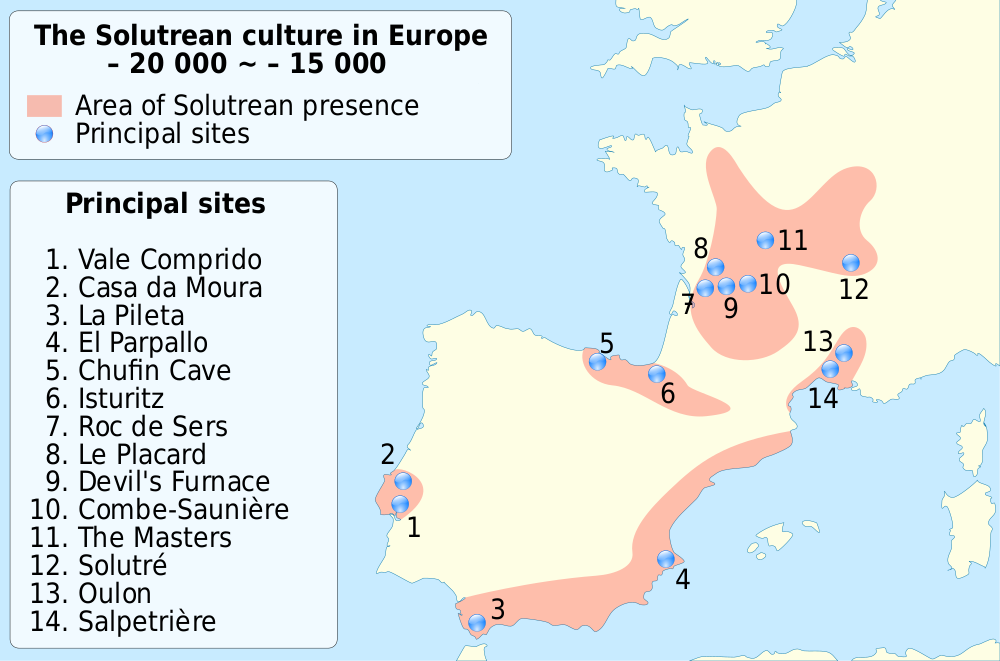
    The Oldest Dryas stadial (15,000 BC)

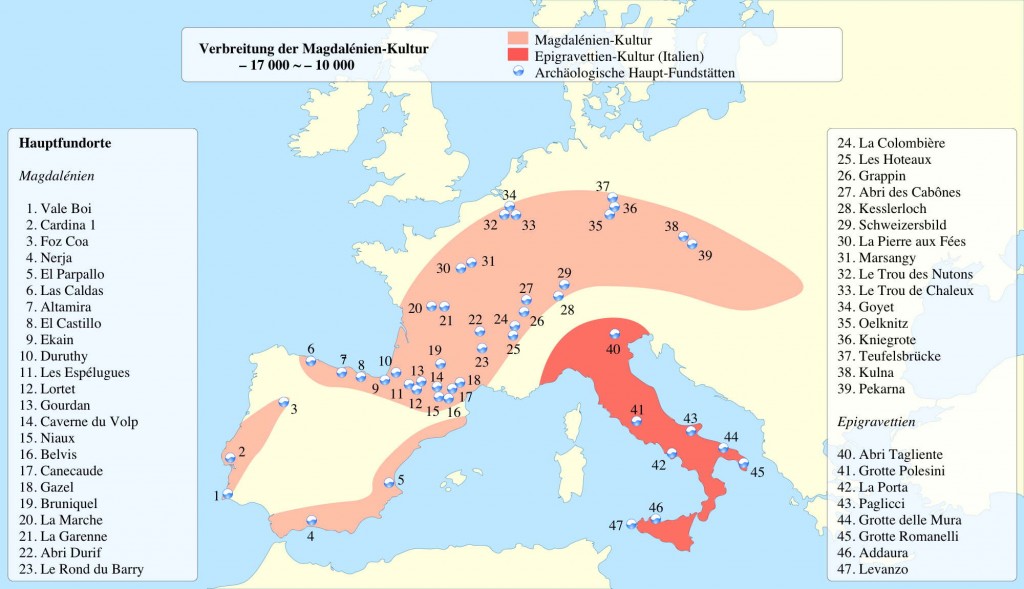
    Magdalenian Culture (Bone) (15,000 BC to 12,000 BC) cultures above the Alps were primarily reindeer hunters, although Magdalenian sites also contain extensive evidence for the hunting of red deer, horses, and other large mammals present in Europe toward the end of the last glacial period including blue foxes, Arctic hares, and other polar creatures, but included tigers and other typically tropical species. The culture was geographically widespread, stretched from Portugal in the west to Poland in the east, and as far north as France, the Channel Islands, England, and Wales. Archaology shows progress in arts and culture. It was characterized by a cold and dry climate, and the extinction of the mammoth. The use of bone and ivory as implements, begun in the preceding Solutrean epoch, increased, making the period essentially a bone period. Bone instruments are quite varied: spear-points, harpoon-heads, borers, hooks and needles. Cave sites such as Lascaux contain the best known examples of Magdalenian cave art. but most archeological remains consist of bone related artwork.

    Magdalenian humans appear to have been of short stature, dolichocephalic (long skuled), with a low retreating forehead and prominent brow ridges.  Human bones show cut marks and breakage, consistent with cannibalism with both flesh and bone marrow being consumed. Some skulls were cleaned of soft tissues, then had the facial regions removed, with the remaining brain case retouched, possibly to make the broken edges more regular. This manipulation suggests the shaping of skulls to produce skull cups.

    The analyses suggested that 70-80% of their ancestry evolved from the Aurignacian culture of about 35,000 BP, from the Goyet Caves in modern Belgium. And that these people didn’t settle in europe but followed herds.
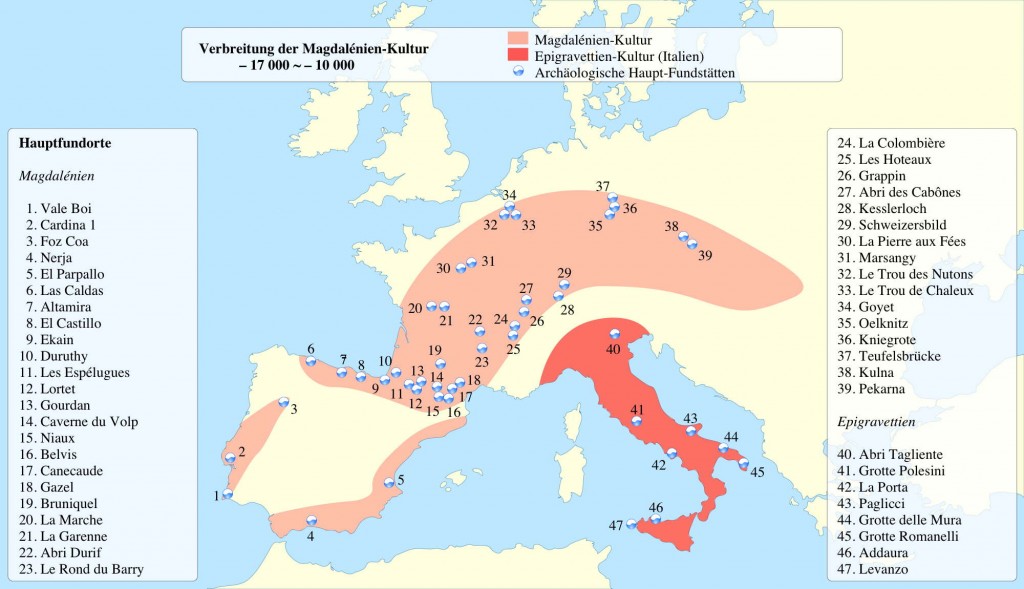
    Epigravettian cultures below the alps the Italian Peninsula, is a similar culture appearing at the same time. Its known range extends from southeast France to the western shores of the Volga river in Russia.


    Azilian culture (Decline) (14,000 BC to 12,000 BC) emerges when the climate begins to warm. The effects of melting ice sheets would have diminished the food supply and probably impoverished the previously well-fed Magdalenian manufacturers, or at least those who had not followed the herds of horse and reindeer out of the glacial refugium to new territory. As a result, Azilian tools and art were cruder and less expansive than their Ice Age predecessors – or simply different. They occupied a region similar to the Magdalenian, and in most cases the same sites. The remains are fewer and comparatively simple – indicating a smaller group of people. As the glaciers retreated, sites increasingly reach into the slopes of the Cantabrian Mountains as high as 1,000 metres above sea level, though presumably the higher ones were only occupied in the summers.  the Azilian represents the tail end of the Magdalenian as the warming climate brought about changes in human behaviour in the area.

    The Bølling interstadial. (13,000 BC)

    Arhensburg Culture (12,900 BC to 11700 BC) 
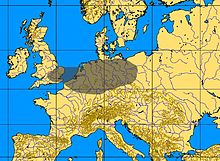
    The Older Dryas stadial, Allerød interstadial. (12,000 BC)

     ( … )

    Post Glacial Great Migrations

    (Human)
    Genetics >
    West Eurasians >
    Europeans >
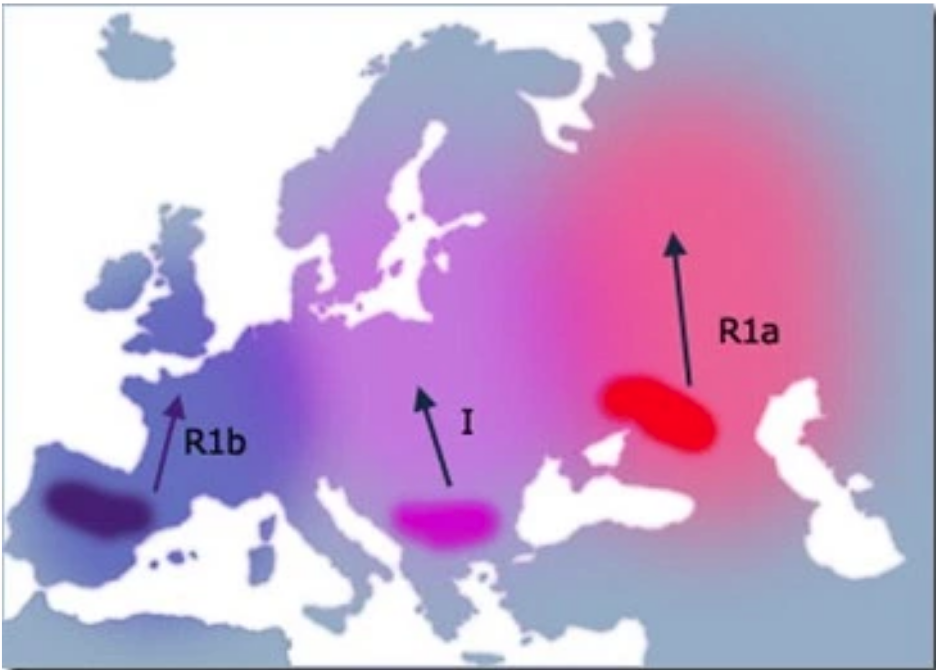
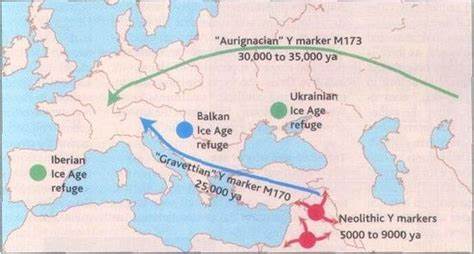
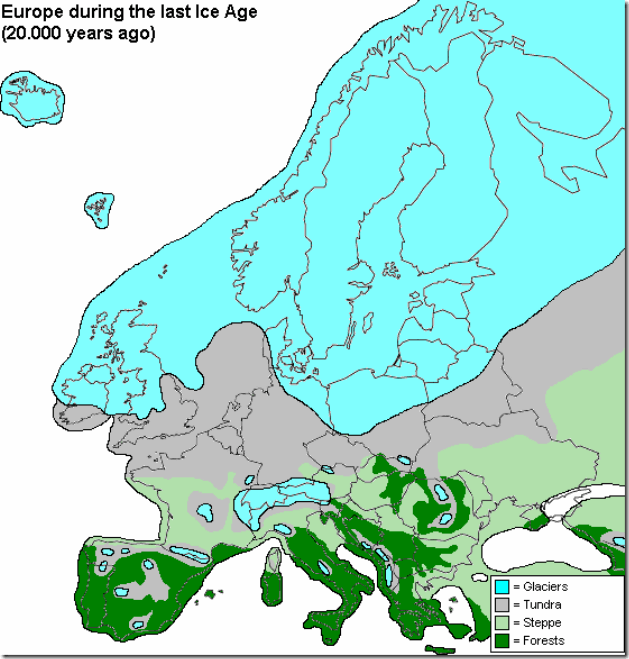
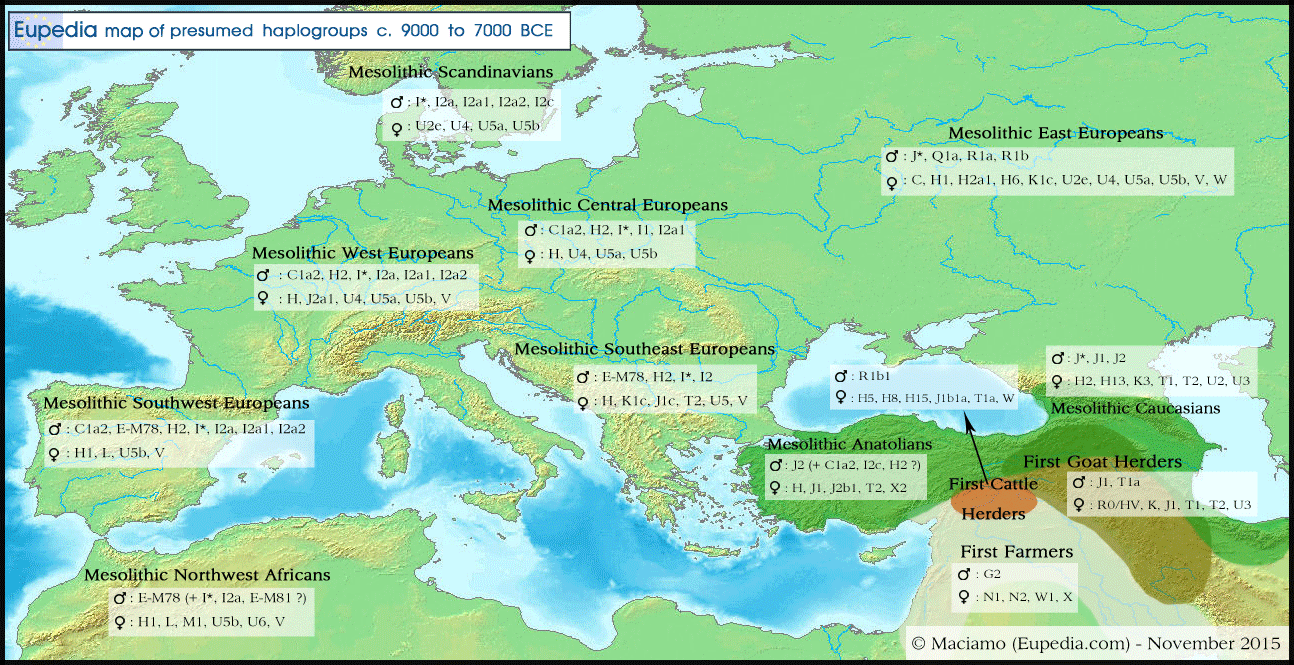
    European Hunter Gatherers Repopulate Europe: European hunter-gatherers (EHG) survived the Ice Age in pockets of the warmer Mediterranean climate, in today’s Spain, Italy, and either the Balkans or Greece. As the climate warmed, they followed the retreating ice north, and recolonized Europe, resulting in three groups distinct groups: Western (WHG), Scandinavia(SHG), and Eastern (EHG) european hunter-gatherers. WHGs inhabited an area stretching from the British Isles in the west to the Carpathians in the east
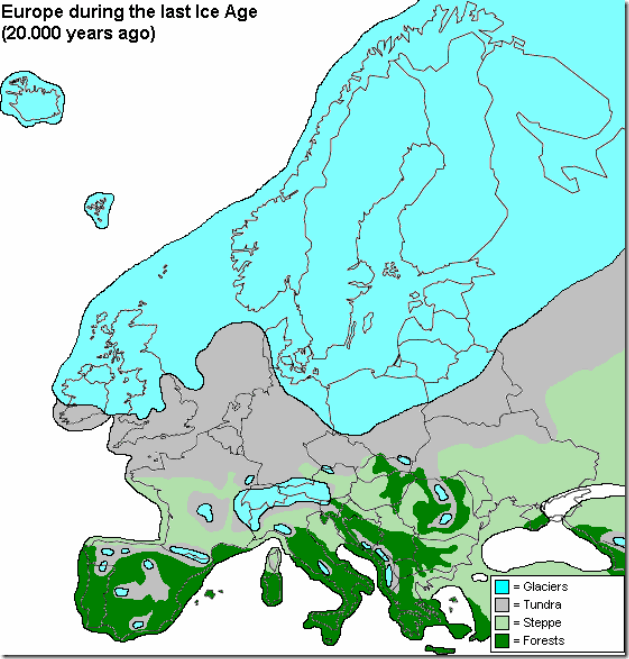
    The Glacial Maximum The repopulation of europe by three primary groups as the glaciers receded. The resulting hunter-gatherer repopulation of europe at the end of the Ice age.


    European Hunter-Gatherer (EHG), or Western Hunter Gatherer(WHG) refers to the group of descendents of hunter-gatherers of Western, Northern, Southern, and Central Europe. During the Mesolithic, the WHGs inhabited an area stretching from the British Isles in the west to the Carpathians in the east.

    Eastern European Hunter-Gatherers ( EEHG, or EHG) inhabited an area stretching from the Baltic Sea to the Urals and downwards to the Pontic-Caspian steppe. The border between WHGs and EHGs ran roughly from the lower Danube, northward along the western forests of the Dnieper towards the western Baltic Sea.

    Scandianvian Hunter Gathereers (SHG)s were an equal mix of Western Hunter-Gatherers (WHGs) initially populating Scandinavia from the south during the Holocene, and Eastern Hunter-Gatherers (EHGs), who later entered Scandinavia from the north along the Norwegian coast.

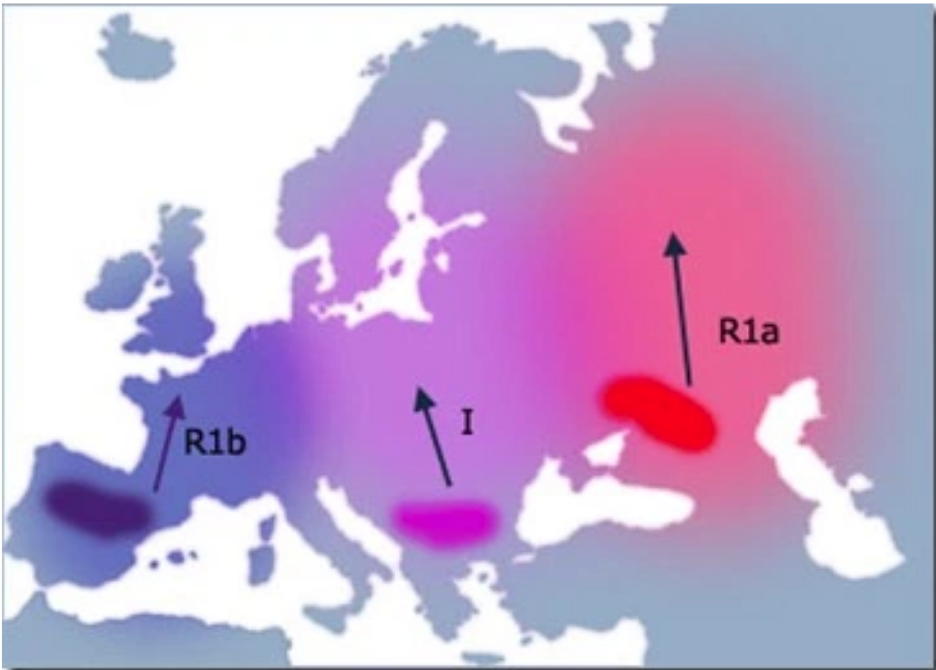
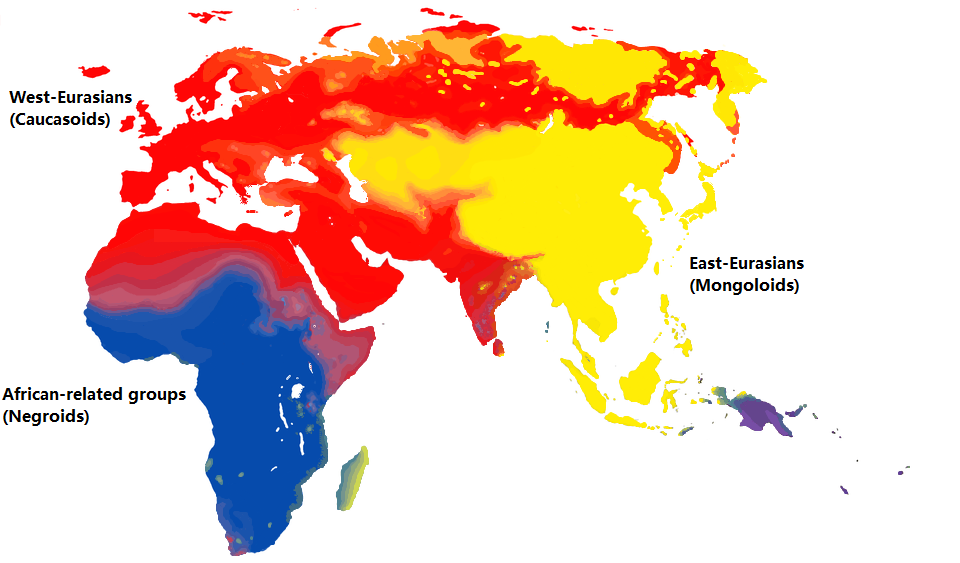
    West Eurasians: Together these peoples, living in somewhat vertical bands across the Eurasian continent enter the ‘human era’ we call the Holocene, as the “West Eurasians“.
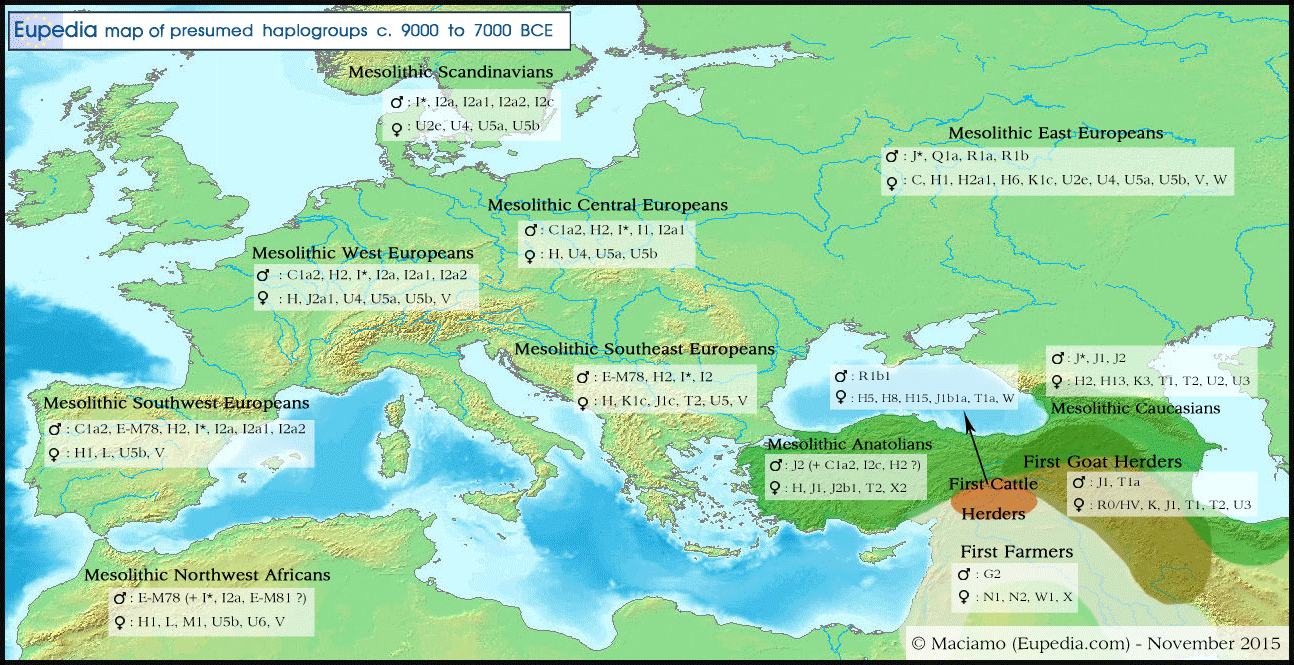
     

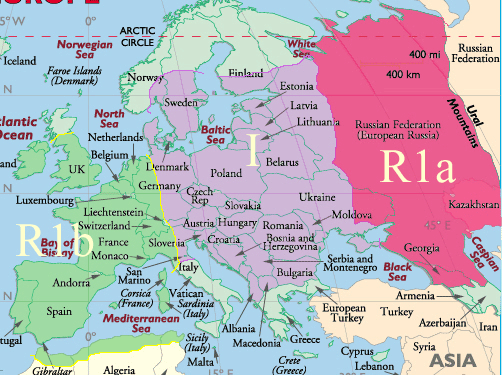
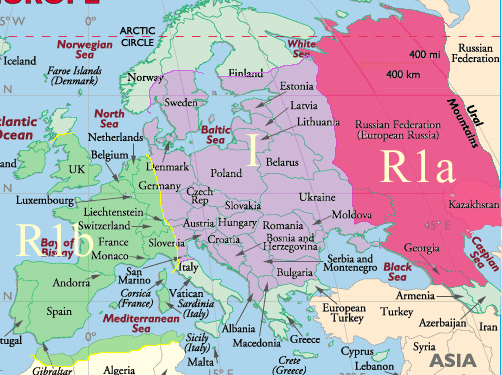
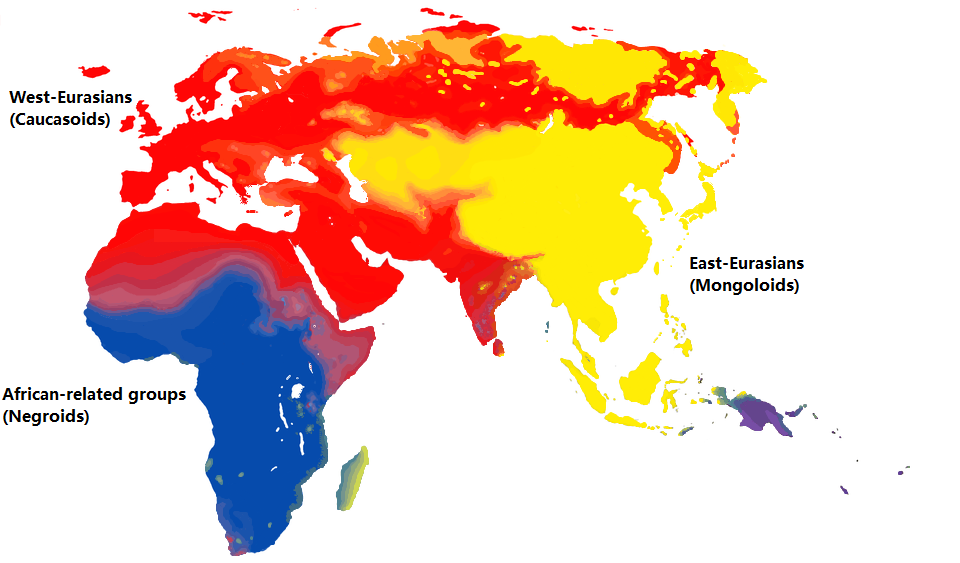
    Approximate distribution of the human groups at the end of the hunter gatherer age, and just prior to the agrarian expansion.

    This list should demonstrate – perphas obviously – that the reason these traits evolve by latitude (female, vitamin d, calcium): female dimorphism, and neoteny ( youth, fertility) – are the reasons for reproductive success of these traits where these traits are both reproductively beneficial and not biologically harmful.

    The Proto Populations – Subraces (Subspecies) and Languages

    So far we have been discussing genetic groups of hunter gatherers. But at the end of the paleolithic we find the proto-peoples that represent the primary subraces, their languages, and their subcultures that still exist today.
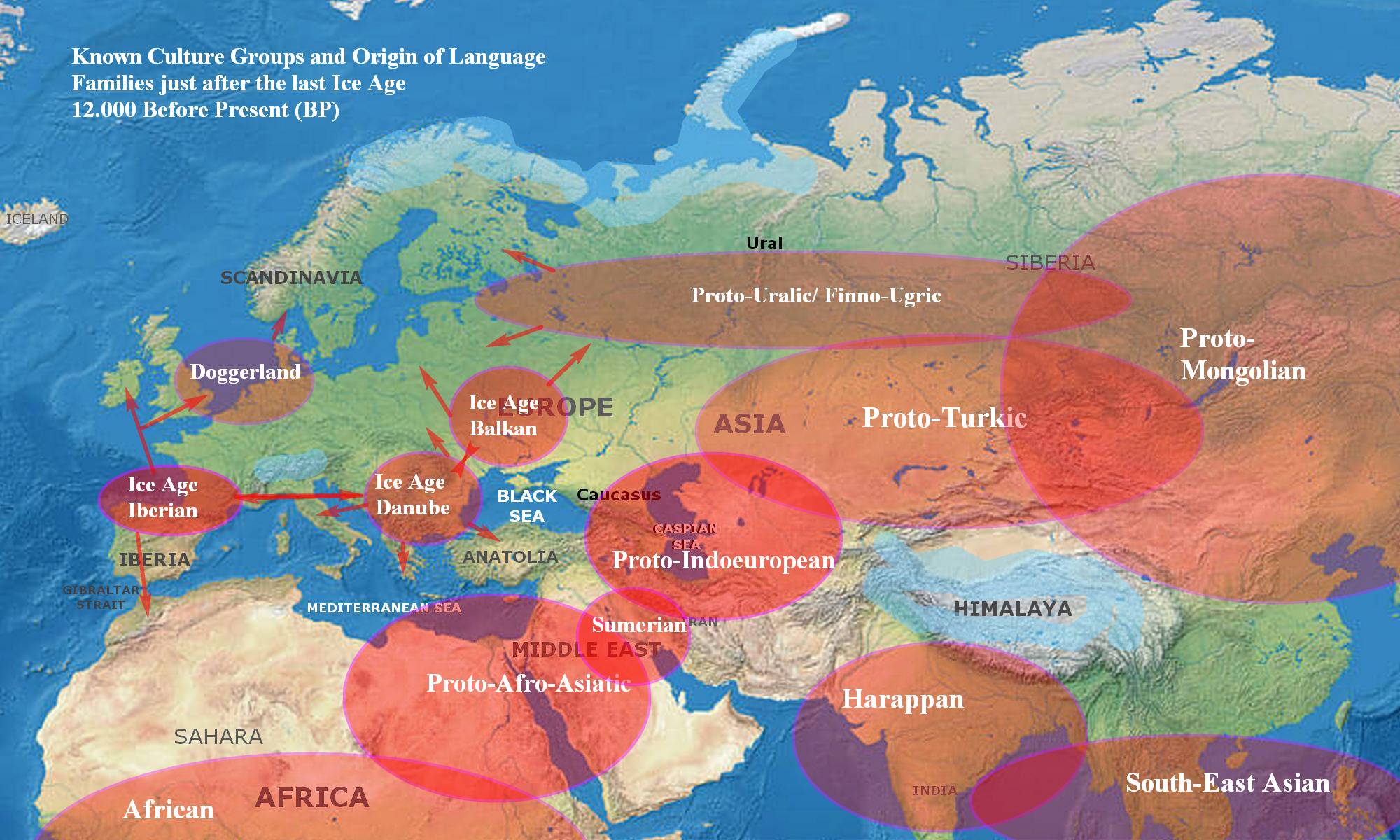
    See the source image

    Proto-Indo European = Proto Iranic


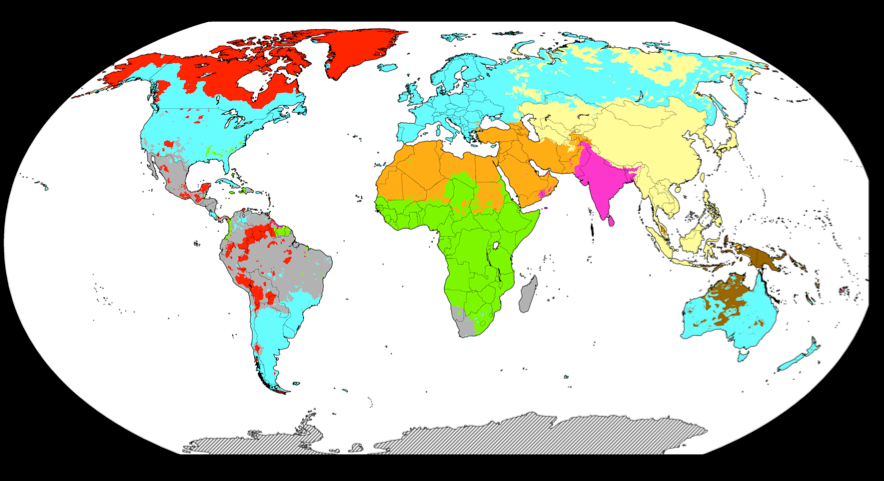
    Major Populations – The Distribution of the Races (Species)


    Crisis Repeated: The Younger Dryas Period: Humans Seek Refuge

    (Climate)
    Quaternary > Pleistocene > Upper Pleistocene >
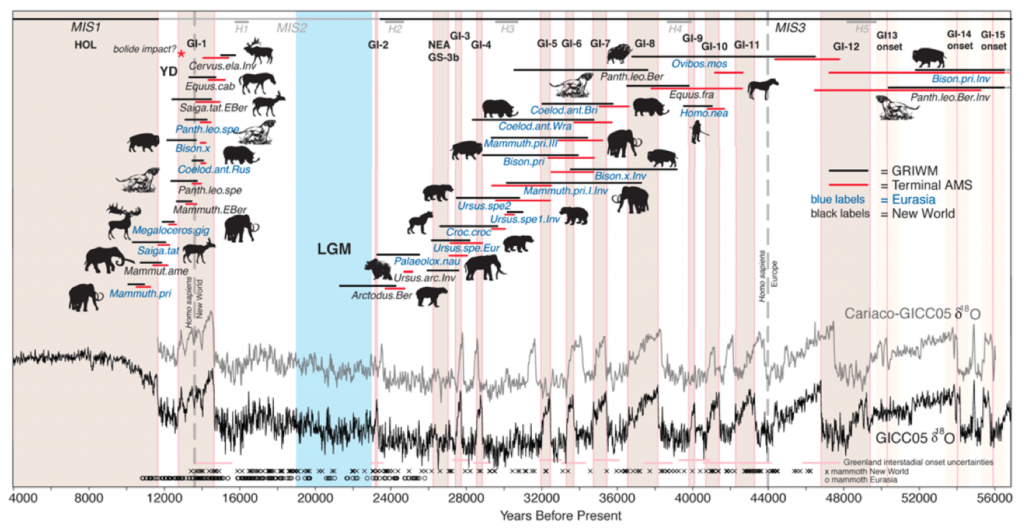
    The Younger Dryas Stadial (~1,300 years, from ~10,900 BC to around 9,700 BC)
    Just after the end of that ice age, the Younger Dryas Period was a major and abrupt reversal that changed the world climate from roughly 10,900BC to around 9,700 BC – lasting for ~1,300 years. The temperatures dropped substantially creating a near-glacial period.  There are two competing theories of the cause, with the flooding of the north atlantic by lake Agaziz in north america, or an impact in Greenland or both.

    Crises: The Anthropocene Extinction

    (Ecology)
    Quaternary > Pleistocene > Anthropocene
    Anthropocen Extinction

    Also known as the “sixth extinction”, as it is possibly the sixth mass extinction event. Mass extinctions are characterized by the loss of at least 75% of species within a geologically short period of time. There is no general agreement on where the Holocene, or anthropogenic, extinction begins, and the Quaternary extinction event, which includes climate change resulting in the end of the last ice age, ends, or if they should be considered separate events at all. The literature conflates Quaternary(climate), Holocene(Climate) with Anthropocene(Ecology), so we disambiguate the terms. 

    The more important question is whether the Anthropocene Extinction begins as soon as modern humans leave africa, because whether island, island-continent, subcontinent, or continent, mankind kills all megafauna as fast as they migrate – about 1km per year. 

    Crisis: The Persian Gulf Deluge (Flood)

    ( … )


  • Conflict 4: Conquest of the World

    Generation Six: Expansion and Exploitation: The Second Great Leap Forward

    ( … )

    Origins: Persian Gulf and Indus River Urhiemat

    The South Eurasian Urheimat


    The North Eurasian Urheimat


    Cultures of the Upper Paleolithic

    Generation Six: Regional Adaptation

    We won’t cover each of these cultures here, instead limit our discussion to those cultures that represent changes in technology in response to environmental demands. 

    SW Asia (Fertile Crescent)
    +Emiran (50–40 ka)
    Ahmarian (46–42 ka)
    Baradostian (36–18 ka)
    Aurignacian (35–29 ka)
    Zarzian (20–10 ka)
    Kebaran (18–12.5 ka)
    Trialetian (16–8 ka)
    +Natufian (14.5–11.5 ka)
    Khiamian (12.2–10.8 ka)
    Europe
    Bohunician (48–40 ka)
    +Châtelperronian (44.5–36 ka)
    Lincombian-Ranisian-Jerzmanowician (43–32 ka)
    +Aurignacian (43–26 ka)
    +Szeletian (41,000-37,000)
    Périgordian (35–20 ka)
    +Gravettian (33–24 ka)
    +Pavlovian (29–25 ka)
    +Solutrean (22–17 ka)
    +Epigravettian (20–10 ka)
    +Magdalenian (17–12 ka)
    Hamburg (15.5–13.1 ka)
    Federmesser (14–12.8 ka)
    +Azilian (14–10 ka)
    +Ahrensburg (13–12 ka)
    +Swiderian (11–8 ka)
    Africa
    Khormusan (42–18 ka)
    Iberomaurusian (25–11 ka)
    Mushabian
    Halfan (22–14 ka)
    Qadan (15—11 ka)
    Sebilian (15–11 ka)
    Eburran (15–5 ka)
    Magosian (10–8 ka)

    Siberia
    Mal’ta–Buret’ (24–15 ka)
    Afontova Gora (21–12 ka)

    SW Asia

    (Human)
    Paleolithic >
    Middle Paleolithic to Upper Paleolithic >
    The Emiran, Bohunician, and Ahmarian Complex (??? BC to 40,000 BC) Anatomically Modern Humans spread in Eurasia. These are also the first people that appear to successfully compete with the Neanderthals.

    SW Asia (Levant) >
    Emiran Culture (First Anatomically Modern Eurasians) (50,000 BC to 40000 BC) existed in the Levant (Syria, Lebanon, Israel, Palestine), and Arabia between the Middle Paleolithic and the Upper Paleolithic periods. It is the oldest known of the Upper Paleolithic cultures and remains an enigma as it transitionally has no African progenitor this culture is indigenous to the Levant, and the possible Uriheimat of West Eurasians. The tools of this culture are noticably primitive compared to later work products.

    SW Asia (Levant) >
    Ahmarian(Elongated, Curved Blades) (
    44,000 BC to 40,000 BC): The Ahmarian period together with the Emiran period, both from the Levant, are among the very first periods of the Upper Paleolithic, corresponding to the first stages of the expansion of Homo sapiens out of Africa. From this stage, the first modern humans migrated to Europe to form the beginning of the European Upper Paleolithic, including the Aurignacian culture, where they become known as the Cro-Magnons

    Ahmarian blades are usually elongated with some curves. The technical knowledge of the Ahmarian culture, along with the other lithic industries, is considered the likely source of the abrupt and rapid takeover of the world in all directions as evidenced by the crossing of the Bering Strait towards America. Ahmarian technology, which included the complex of blade/bladelet-knapping techniques is also linked to the tools used by the hunter-gatherers of southwestern Asia. 

    SW Asia (Iran-Iraq: Zagros Mountains) >
    Baradostian (34,000 BC – 16,000 BC)

    (Human)
    Paleolithic >
    Upper Paleolithic >
    Europe >
    Basal West Europeans (46,000 BC to 13,000 BC) – West Hunter Gatherer
    (WHG),  European Early (Anatomically) Modern Humans (EEMH), or “Cro-Magnon” and their conquest of Europe.  The founder population of all later EEMH was established by 35,000 BC, and Europe would remain in genetic isolation from the rest of the world until 12,000 BC.

    The Invasion and Transition

    Mousterian, Châtelperronian, Perigordian (Neanderthal) (44,500–36,000)Mousterian industry, and lasted from c. 45,000 to c. 40,000 BP, and Catelperronian Neanderthal cultures and the earliest Upper Palaeolithic industry in Central and Southwestern France, as well as in Northern Spain. Châtelperronian culture may represent a community of Neanderthals who had to some extent adopted the culture of the modern Homo sapiens that had established themselves in the surrounding area, which would account for the signs of a hybrid culture found. These hypothetical Neanderthal hold-outs would be analogous to more recent Native Americans in North and South America who adopted European technologies such as firearms or domestication of horses in order to survive in an environment dominated by more technologically advanced competitors

    Neanderthals In Refuge (by 35,000 BC) Evidence for continued Neanderthal presence in the Iberian Peninsula.

    The Completion of the Conquest of Europe

    (Europe: Central and SE Europe) >
    Bohunician Industry
    (48,000 BC to 40,000 BC) (First Anotomicaly Modern Europeans) is the candidate for representing the first wave of anatomically modern humans in Europe.

    Bohunician technology resembles the Mousterian, as do the contemporary assemblages of the Szeletian, Emiran and Ahmarian all these cultures apper to be related.


    Szeletian Culture  (39,000 BC to 35,000 BC)  Austria, Moravia, northern Hungary, and southern Poland. It is dated years before the present (BP), most original and also the most aboriginal Upper Palaeolithic culture in Central Europe.

    Uluzzian Culture (45,000–39,500) of Italy and Greece


    The Formation of a Wholly European Culture

    Europe to SW Asia
    Aurignacian
    (41,000 BC to 24,000 BC): The Upper Paleolithic developed in Europe some time after the Levant, where the Emiran period and the Ahmarian period form the first periods of the Upper Paleolithic, corresponding to the first stages of the expansion of Homo sapiens out of Africa. They then migrated to Europe and created the first European culture of modern humans, the Aurignacian.

    An Early Aurignacian or Proto-Aurignacian stage is dated between about 43,000 and 37,000 years ago. The Aurignacian proper lasts from about 37,000 to 33,000 years ago. A Late Aurignacian phase transitional with the Gravettian dates to about 33,000 to 26,000 years ago.

    One of the oldest examples of figurative art, the Venus of Hohle Fels, comes from the Aurignacian and is dated to between 40,000 and 35,000 years ago. The German Lion-man figure is given a similar date range. The Bacho Kiro site in Bulgaria is one of the earliest known Aurignacian burials.

    A “Levantine Aurignacian” culture is known from the Levant, with a type of blade technology very similar to the European Aurignacian, following chronologically the Emiran and Early Ahmarian in the same area of the Near East, and also closely related to them. The Levantine Aurignacian may have preceded European Aurignacian, but there is a possibility that the Levantine Aurignacian was rather the result of reverse influence from the European Aurignacian: this remains unsettled.

    The Last Wholly European Culture

    Central and Eastern Europe 
    Gravettian
    (33,000 BC to 22,000 BC) The Gravettian succeeds the Aurignacian, and is the last wholly unified European culture. West and Central Europe were extremely cold during this period. The Gravettians were hunter-gatherers who lived in this bitterly cold period of European prehistory, and Gravettian lifestyle was shaped by the climate as glacial and environmental changes forced them to adapt. They lived in caves or semi-subterranean or rounded dwellings which were typically arranged in small “villages”.

    Archaeologists usually divide the culture into two regional variants: the western Gravettian, known mainly from cave sites in France, Spain and Britain, and the eastern Gravettian in Central Europe and Russia. The eastern Gravettians, which include the Pavlovian culture, were specialized mammoth hunters, whose remains are usually found not in caves but in open air sites.

    The Gravettians are known for their Venus figurines, which were typically made as either ivory or limestone carvings.  And they were technologically innovative, producing new arts and artifacts.

    During the post glacial period, evidence of the culture begins to disappear from northern Europe but was continued in areas around the Mediterranean

    Afterward, the Soultrean abrubtly replaces it in Fance, and it continues as the Epigravettian in Italy, Balkans, Ukraine, and Russia. 


    Crisis: The Last Glacial Maximum

    The second ice age, or Würm glaciation, of 28,000 to 10,000 years ago.

    Last Glacial Maximum (LGM) (~10,000 years from ~23,000 BC to 13,000 BC)

    There have been five major ice ages in earth’s history lasting from tens to a hundred million years. The last ice age started about 2.58 million years ago beginning with the spread of ice sheets in the Northern Hemisphere. Since then, the world has experienced cycles of glaciation with ice sheets advancing (glacial periods, glacials) and retreating (interglacial periods, interglacials) on 40,000- and 100,000-year time scales.

    So the paleolithic revolution is interrupted the most recent glacial cycle (LGM) The peopling of the Americas occurred during this time, with East and Central Asia populations reaching the Bering land bridge after about 35 ka, and expanding into the Americas by about 15 ka. The Holocene glacial retreat begins 11.7 ka (10th millennium BC), marking the beginning of the earliest forms of farming in the Fertile Crescent.

    (Human)
    Paleolithic >
    Upper Paleolithic >
    Northern Austria and Southern Poland

    Pavlovian (Ice Shelf Mammot Hunters, Weaving) (27,000 BC – 23,000 BC) Pavolvians are related to the Gravettians, and they  lived in the region of Moravia, northern Austria and southern Poland. They used sophisticated stone age technology to survive in the tundra on the fringe of the ice sheets around the Last Glacial Maximum. Its economy was principally based on the hunting of mammoth herds for meat, fat fuel, hides for tents and large bones and tusks for building winter shelters.

    Archaeologists have excavated flint implements, polished and drilled stone artifacts, bone spearheads, needles, digging tools, flutes, bone ornaments, drilled animal teeth, and seashells. Art or religious finds include bone carvings and figurines of humans and animals made of mammoth tusk, stone, and fired clay. Textile impressions made into wet clay give the oldest proof of the existence of weaving by humans.

    Basal North Eurasians

    (Human)
    Paleolithic >
    Upper Paleolithic >
    The Basal North Eurasian Dispersal

    Around 24,000 years ago, around the last glacial maximum,  a group of people in Siberia, evolve into Ancient North Eurasians (ANE). This group was extraordinarily successful. The mutation and subsecquent evolution of blond hair evolved in the ANE population. And their evolution contributed to a cline (in order influence) of Native Americans, Europeans, Central Asians, South Asians, and some East Asians. Later dilution of Native american ANE ancestry is the result of a second migration into the Americas 5000 years ago, that all but eradicated earlier groups.

    Distribution of Ancient North Eurasian Genetics


    The Ice Age Migrations

    The Resulting Cline West Eurasians After The ANE Expansion:

    • West Siberian Hunter-Gatherer (WSG)  had about 30% EHG ancestry, 50% ANE ancestry, and 20% East Asian ancestry.
    • Eastern European Hunter-Gatherer (EHG) is dominated by the Ancient North Euraasian (ANE) contribution (75%).
    • Scandinavian Hunter-Gatherer (SHG) were descended from Western Hunter-Gatherers who initially settled Scandinavia from the south, and later populations of EHG who entered Scandinavia from the north through the coast of Norway.
    • Western Hunter-Gatherers (WHG) and EHG lineages merged in Eastern Europe, after the end of the Last Glacial Maximum, accounting for early presence of ANE ancestry in Mesolithic Europe. Evidence suggests that as Ancient North Eurasians migrated West from Eastern Siberia, they absorbed Western Hunter-Gatherers and other West Eurasian populations as well.
    • Caucasian Hunter-Gatherer (CHG) dated ~26 kya, lacked ANE-admixture, by ~13 kya carried 36% ANE-derived admixture.
    • Iran Neolithic (Iran_N) individuals dated ~8.5 kya carried 50% ANE-derived admixture and 50% Caucuses-related admixture,marking them as different from other Near-Eastern and Anatolian Neolithics who didn’t have ANE admixture. Iran Neolithics were later replaced by Iran Chalcolithics, who were a mixture of Iran Neolithic and Near Eastern Levant Neolithic.

    This neolithic Iranian and Eastern European composition of 50% ANE will provide an interesting pattern in the milennia to come.

    Basal Siberian American Dispersals: 

    [ ADD IMAGE OF NORTH AMERICAN DISPERSAL ]

    ( … )


    Cultures of Post Glacial Maxium Europe

    Soultrean Culture (Advanced Flint) (19,000 BC to 15,000 BC) The Soultrean period in western europe (France, spain portugal) was a transitional stage between the flint implements of the Mousterian (Neanderthal) and the bone implements of the Magdalenian epochs. The period refers to the development of highly advanced flintmaking techniques that hadn’t been seen before and weren’t rediscovered for millennia. It includes relatively finely worked, bifacial points made with lithic reduction percussion and pressure flaking rather than cruder flintknapping. Knapping was done using antler batons, hardwood batons and soft stone hammers. This method permitted the working of delicate slivers of flint to make light projectiles and even elaborate barbed and tanged arrowheads. Large thin spearheads; scrapers with edge not on the side but on the end; flint knives and saws, but all still chipped, not ground or polished; long spear-points, with tang and shoulder on one side only, are also characteristic implements of this industry. Bone and antler were used as well. They used these tools to hunt horse, reindeer, mammoth, cave lion, rhinoceros, bear and aurochs.

    The Oldest Dryas stadial (15,000 BC)

    Magdalenian Culture (Bone) (15,000 BC to 12,000 BC) cultures above the Alps were primarily reindeer hunters, although Magdalenian sites also contain extensive evidence for the hunting of red deer, horses, and other large mammals present in Europe toward the end of the last glacial period including blue foxes, Arctic hares, and other polar creatures, but included tigers and other typically tropical species. The culture was geographically widespread, stretched from Portugal in the west to Poland in the east, and as far north as France, the Channel Islands, England, and Wales. Archaology shows progress in arts and culture. It was characterized by a cold and dry climate, and the extinction of the mammoth. The use of bone and ivory as implements, begun in the preceding Solutrean epoch, increased, making the period essentially a bone period. Bone instruments are quite varied: spear-points, harpoon-heads, borers, hooks and needles. Cave sites such as Lascaux contain the best known examples of Magdalenian cave art. but most archeological remains consist of bone related artwork.

    Magdalenian humans appear to have been of short stature, dolichocephalic (long skuled), with a low retreating forehead and prominent brow ridges.  Human bones show cut marks and breakage, consistent with cannibalism with both flesh and bone marrow being consumed. Some skulls were cleaned of soft tissues, then had the facial regions removed, with the remaining brain case retouched, possibly to make the broken edges more regular. This manipulation suggests the shaping of skulls to produce skull cups.

    The analyses suggested that 70-80% of their ancestry evolved from the Aurignacian culture of about 35,000 BP, from the Goyet Caves in modern Belgium. And that these people didn’t settle in europe but followed herds.

    Epigravettian cultures below the alps the Italian Peninsula, is a similar culture appearing at the same time. Its known range extends from southeast France to the western shores of the Volga river in Russia.


    Azilian culture (Decline) (14,000 BC to 12,000 BC) emerges when the climate begins to warm. The effects of melting ice sheets would have diminished the food supply and probably impoverished the previously well-fed Magdalenian manufacturers, or at least those who had not followed the herds of horse and reindeer out of the glacial refugium to new territory. As a result, Azilian tools and art were cruder and less expansive than their Ice Age predecessors – or simply different. They occupied a region similar to the Magdalenian, and in most cases the same sites. The remains are fewer and comparatively simple – indicating a smaller group of people. As the glaciers retreated, sites increasingly reach into the slopes of the Cantabrian Mountains as high as 1,000 metres above sea level, though presumably the higher ones were only occupied in the summers.  the Azilian represents the tail end of the Magdalenian as the warming climate brought about changes in human behaviour in the area.

    The Bølling interstadial. (13,000 BC)

    Arhensburg Culture (12,900 BC to 11700 BC) 

    The Older Dryas stadial, Allerød interstadial. (12,000 BC)

     ( … )

    Post Glacial Great Migrations

    (Human)
    Genetics >
    West Eurasians >
    Europeans >
    European Hunter Gatherers Repopulate Europe: European hunter-gatherers (EHG) survived the Ice Age in pockets of the warmer Mediterranean climate, in today’s Spain, Italy, and either the Balkans or Greece. As the climate warmed, they followed the retreating ice north, and recolonized Europe, resulting in three groups distinct groups: Western (WHG), Scandinavia(SHG), and Eastern (EHG) european hunter-gatherers. WHGs inhabited an area stretching from the British Isles in the west to the Carpathians in the east

    The Glacial Maximum The repopulation of europe by three primary groups as the glaciers receded. The resulting hunter-gatherer repopulation of europe at the end of the Ice age.


    European Hunter-Gatherer (EHG), or Western Hunter Gatherer(WHG) refers to the group of descendents of hunter-gatherers of Western, Northern, Southern, and Central Europe. During the Mesolithic, the WHGs inhabited an area stretching from the British Isles in the west to the Carpathians in the east.

    Eastern European Hunter-Gatherers ( EEHG, or EHG) inhabited an area stretching from the Baltic Sea to the Urals and downwards to the Pontic-Caspian steppe. The border between WHGs and EHGs ran roughly from the lower Danube, northward along the western forests of the Dnieper towards the western Baltic Sea.

    Scandianvian Hunter Gathereers (SHG)s were an equal mix of Western Hunter-Gatherers (WHGs) initially populating Scandinavia from the south during the Holocene, and Eastern Hunter-Gatherers (EHGs), who later entered Scandinavia from the north along the Norwegian coast.

    West Eurasians: Together these peoples, living in somewhat vertical bands across the Eurasian continent enter the ‘human era’ we call the Holocene, as the “West Eurasians“.


    Approximate distribution of the human groups at the end of the hunter gatherer age, and just prior to the agrarian expansion.

    This list should demonstrate – perphas obviously – that the reason these traits evolve by latitude (female, vitamin d, calcium): female dimorphism, and neoteny ( youth, fertility) – are the reasons for reproductive success of these traits where these traits are both reproductively beneficial and not biologically harmful.

    The Proto Populations – Subraces (Subspecies) and Languages

    So far we have been discussing genetic groups of hunter gatherers. But at the end of the paleolithic we find the proto-peoples that represent the primary subraces, their languages, and their subcultures that still exist today.

    See the source image

    Proto-Indo European = Proto Iranic


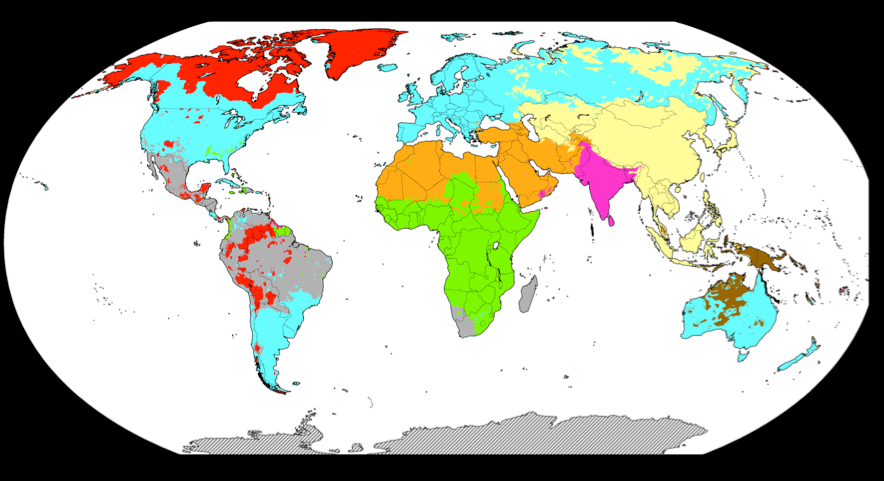
    Major Populations – The Distribution of the Races (Species)


    Crisis Repeated: The Younger Dryas Period: Humans Seek Refuge

    (Climate)
    Quaternary > Pleistocene > Upper Pleistocene >
    The Younger Dryas Stadial (~1,300 years, from ~10,900 BC to around 9,700 BC)
    Just after the end of that ice age, the Younger Dryas Period was a major and abrupt reversal that changed the world climate from roughly 10,900BC to around 9,700 BC – lasting for ~1,300 years. The temperatures dropped substantially creating a near-glacial period.  There are two competing theories of the cause, with the flooding of the north atlantic by lake Agaziz in north america, or an impact in Greenland or both.

    Crises: The Anthropocene Extinction

    (Ecology)
    Quaternary > Pleistocene > Anthropocene
    Anthropocen Extinction

    Also known as the “sixth extinction”, as it is possibly the sixth mass extinction event. Mass extinctions are characterized by the loss of at least 75% of species within a geologically short period of time. There is no general agreement on where the Holocene, or anthropogenic, extinction begins, and the Quaternary extinction event, which includes climate change resulting in the end of the last ice age, ends, or if they should be considered separate events at all. The literature conflates Quaternary(climate), Holocene(Climate) with Anthropocene(Ecology), so we disambiguate the terms. 

    The more important question is whether the Anthropocene Extinction begins as soon as modern humans leave africa, because whether island, island-continent, subcontinent, or continent, mankind kills all megafauna as fast as they migrate – about 1km per year. 
    Crisis: The Persian Gulf Deluge (Flood)

    ( … )


  • Conflict 7: The Culture of Indo Europeans

    The Culture of the West Indo Europeans

    Incentives: The Democratic Governance of Seafarers, Pirates, Vikings, and Raiders

    “You British are pirates. You were founded by pirates. You grew rich on piracy. You invent new forms of piracy. Your culture is still full of piracy.” That insight casts a light on so much of what passes for our economic culture. Get rich quick without thought of the consequences and run off with the loot. Tomorrow there will be another prize to plunder. This goes for the hedge-fund pirates who plunder the wealth created by other businesses, and for the corporate robber barons who empty out business assets while imposing Victorian conditions on their workers. But it also goes for ordinary lottery players. Grab the prize and get out. Business, not Kinship Interests: Pirates were a diverse group. A sample of 700 pirates active in the Caribbean between 1715 and 1725, for example, reveals that 35 percent were English, 25 percent were American, 20 percent were West Indian, 10 percent were Scottish, 8 percent were Welsh, and 2 percent were Swedish, Dutch, French, and Spanish. Others came from Portugal, Scandinavia, Greece, and East India. Pirate crews were also racially diverse. Based on data available from 23 pirate crews active between 1682 and 1726, the racial composition of ships varied between 13 and 98 percent black. If this sample is representative, 25–30 percent of the average pirate crew was of African descent. Contrary to most people’s images of pirate crews, they were quite large. On the basis of figures from 37 pirate ships between 1716 and 1726, it appears that the average crew had about 80 members. A number of pirate crews were closer to 120, and crews of 150–200 were not uncommon.  Several pirate crews were bigger than this. For example, Blackbeard’s crew aboard the Queen Anne’s Revenge was 300 men strong. Even a sixth-rate Royal Navy ship in the early eighteenth century carried more crew members than the average pirate vessel (about 150). But compared to the average 200-ton merchant ship, which carried only 13–17 men, pirate ships were much larger. Some pirate crews were too large to fit in one ship, and so they formed pirate squadrons. Captain Bartholomew Roberts, for example, commanded a squadron of four ships that carried 508 men. However, the absence of the owner-crew principal-agent problem on pirate ships does not mean that pirates did not need captains. They certainly did. Many important piratical decisions, such as how to engage a potential target, how to pursue when “chasing” a target or being chased by authorities, and how to react if attacked, required snap decision making. There was no time for disagreement or debate in such cases, and conflicting voices would have made it impossible to undertake the most essential tasks. Furthermore, pirate ships, like all ships, needed some method of maintaining order, distributing victuals and payments, and administering discipline to unruly crew members. The office of captain overcame such difficulties by vesting autocratic control over these matters in the hands of an authority. In this sense, although pirate ships differed from merchant ships in requiring captains to solve an owner-sailor principal-agent problem, pirate ships were similar to merchant ships in requiring some kind of authority for their undertaking’s success. Although a pirate ship’s activity—violent plunder—was wholly different from a merchant ship’s, both kinds of vessels shared the need to create internal order to achieve their ends. The need for captains posed a dilemma for pirates. On the one hand, a captain who wielded unquestioned authority in certain decisions was critical for success. On the other hand, what was to prevent a captain with this power from behaving predatorily toward his crew? Since pirates did not have absentee owners but instead jointly owned the stolen ships they sailed on, although they required captains, unlike merchant ships, they did not require autocratic captains. Pirate democracy ensured that pirates got precisely the kind of captain they desired. Because pirates could popularly depose any captain who did not suit them and elect another in his place, pirate captains’ ability to prey on crew members was greatly constrained compared to that of merchant ship captains. Similarly, because pirates were both principals and agents of their ships, they could divide authority on their vessels to further check captains’ ability to abuse crew members without loss. Unlike merchant ships, which could not afford a separation of power since this would have diminished the ability of the absentee owners’ acting agent (the captain) to make the crew act in the owners’ interests, pirate ships could and did adopt a system of democratic checks and balances. The men (Army, Militia) elected captains (Kings, Generals) and quartermasters (Judges, Sergeants) and reserved for themselves voting (senate, jury), and drew up an agreement (constitution), and swore an oath to abide by it (citizenship) – by universal consent. And if any rejected it, disbanded him, and welcomed him to look for other opportunities instead. Piratical Checks and Balances: The Separation of Powers The institutional separation of powers aboard pirate ships predated its adoption by seventeenth- and eighteenth-century governments – fr that matter, it predated writing. The threat of captain predation meant pirates “were adamant in wanting to limit the captain’s power to abuse and cheat them”. To do this they instituted a democratic system of divided power, or piratical checks and balances, aboard their ships. As the pirate Walter Kennedy testified at his trial,

    “Most of them having suffered formerly from the ill-treatment of Officers, provided thus carefully against any such Evil now they had the choice in themselves . . . for the due Execution thereof they constituted other Officers besides the Captain; so very industrious were they to avoid putting too much Power into the hands of one Man”.Democratic Election of Captains They democratically elected Captains, “the Rank of Captain being obtained by the Suffrage of the Majority”. The combination of separated powers and democratic elections for captains ensured that:

    —“[pirates] only permit him to be Captain, on Condition, that they may be Captain over him”.— Crews could vote captains out of office for any number of reasons. Predation was one, but so was cowardice, poor judgment, and any other behavior a crew did not feel was in its best interest. In this way pirates could be sure that captainship “falls on one superior for Knowledge and Boldness, Pistol Proof, (as they call it)”. Crews sometimes elected quartermasters who displayed particular valor or keen decision making to replace less capable or honorable captains. For example, when one pirate crew “went to Voting for a new Captain . . . the Quarter-Master, who had behaved so well in the last Affair . . . was chosen”. This helped create competition among pirate officers that tended to check their abuses and encouraged them to serve the interests of their crews. Democratice Election of The Quartermaster (Judge) The Quartermaster was the primary “other officer” pirates “constituted” for this purpose.  Captains retained absolute authority in times of battle, enabling pirates to realize the benefits of autocratic control required for success in conflict. However, pirate crews transferred power to allocate provisions, select and distribute loot (there was rarely room aboard pirate ships to take all they seized from a prize), and adjudicate crew member conflicts/administer discipline to the quartermaster, whom they democratically elected:

    —“For the Punishment of small Offences . . . there is a principal Officer among the Pyrates, called the Quarter-Master, of the Men’s own choosing, who claims all Authority this Way, (excepting in Time of Battle:) If they disobey his Command, are quarrelsome and mutinous with one another, misuse Prisoners, plunder beyond his Order, and in particular, if they be negligent of their Arms, which he musters at Discretion, he punishes at his own dare without incurring the Lash from all the Ship’s Company”— This Officer is Trustee for the whole, is the first on board any Prize, separating for the Company’s Use, what he pleases, and returning what he thinks fit to the Owners, excepting Gold and Silver, which they have voted not returnable.

    —-“the Captain of a Pirate Ship, is chiefly chosen to fight the Vessels they may meet with. Besides him, they chuse another principle Officer, whom they call Quarter-master, who has the general Inspection of all Affairs, and often controuls the Captain’s Orders”.— William Snelgrave This separation of power removed captains’ control over activities they traditionally used to prey on crew members, while empowering them sufficiently to direct plundering expeditions.

    —“the Captain can undertake nothing which the Quarter-Master does not approve. We may say, the Quarter-Master is an humble Imitation of the Roman Tribune of the People; he speaks for, and looks after the Interest of the Crew”.— The only exception to this was “in Chase, or in Battle” when crews desired autocratic authority and thus, “by their own Laws,” “the Captain’s Power is uncontrollable” Democratic Decision Making: The Jury (Senate) For minor infractions, crews typically delegated punishment power to the ship’s democratically elected quartermaster. The quartermaster “acts as a Sort of civil Magistrate on board a Pyrate Ship”. In the case of more severe infractions, crew members voted on punishments. In both cases pirate crews tended to follow the punishments for various infractions identified in their articles. By specifying punishments in their articles, crews were able to limit the scope of quartermasters’ discretion in administering discipline, checking quartermasters’ power for abuse. Punishments for article violations varied from physical torture, such as “slitting the Ears and Nose of him that was Guilty,” to marooning— a practice Captain Johnson described as the “barbarous Custom of putting the Offender on Shore, on some desolate or uninhabited Cape or Island, with a Gun, a few Shot, a Bottle of Water, and a Bottle of Powder, to subsist with or starve” Since pirate articles tended to be short and simple, they could not cover all possible contingencies that might affect a crew. In this sense they were always incomplete. To deal with this, when a significant issue emerged, the crew gathered to act as a kind of judiciary to interpret or apply the ship’s articles to situations not clearly stipulated in the articles themselves: “In Case any Doubt should arise concerning the Construction of these Laws, and it should remain a Dispute whether the Party had infringed them or no, a Jury was appointed to explain them, and bring in a Verdict upon the Case in Doubt”. Through this “judicial review” process, pirate crews were able to further limit quartermasters’ discretionary authority, restraining the potential for quartermaster abuse. Equality Under The Law Captains were unable to secure special privileges for themselves at their crews’ expense. Their lodging, provisions, and even pay were nearly the same as that of ordinary crew members. As Johnson described it, aboard pirate ships “every Man, as the Humour takes him . . . [may] intrude [the captain’s] Apartment, swear at him, seize a part of his Victuals and Drink, if they like it, without his offering to find Fault or contest it”. In other cases, “the Captain himself not being allowed a Bed” had to sleep with the rest of the crew in far less comfortable conditions. Or, as one pirate fellow-traveler marveled, “even their Captain, or any other Officer, is allowed no more than another Man; nay, the Captain cannot [even] keep his own Cabin to himself”. Altruistic Punishment Pirates exercised greater cruelty in maintaining discipline among themselves than in their treatment of prisoners”. Pirates considered theft aboard their ships especially heinous (a moral or common crime against all). Their articles reflected this and frequently punished theft with torture, marooning, or death. To help keep themselves honest, some crews used random searches to hunt for anyone who might be holding back loot. To ensure that the quartermaster did not hide booty from the crew, some pirates prohibited their valuable plunder from being kept under lock and key. As pirate Peter Hooff described the situation on Captain Sam Bellamy’s Whydah, for instance, the “money was kept in Chests between Decks without any Guard, but none was to take any without the Quarter Masters leave” Terms of the Exercise of Power: Contracts (Constitutions) This system of checks and balances prevented captains from preying on their crews. But by granting many of the powers captains in quartermasters instead, they had opportunity to prey on crews. As with captains, pirate crews elected quartermasters and could depose them if they overstepped their authority. And that limit of authority was established by contract (constitution). Shareholders: The Commons Before Self They determined by common vote where they would cruise; what fee the captain shall have for himself and for the use of his vessel; the wage for skilled roles like carpenters and surgeons – who were paid sligthly more than other men. The wounded were paid bonuses next. Then the remainder of the ‘booty’ was divided equally among the men. The captain received four or five men’s portions for the use of the ship, perhaps even more, and two portions for himself. The rest of the men share uniformly, and the boys get half a man’s share. No one must plunder and keep his loot to himself. Everything taken—money, jewels, precious stones and goods—must be shared among them all. To prevent deceit, before the booty is distributed everyone has to swear an oath that he has not kept for himself so much as the value of a sixpence, whether in silk, linen, wool, gold, silver, jewels, clothes or shot, from all the capture. And should any man be found to have made a false oath, he would be banished from the rovers, never more be allowed in their company. Individual Sovereignty and Self Determination Articles of agreement required unanimous consent. Consequently, pirates democratically formed them in advance of launching pirating expeditions. ”  The crew forged its articles alongside the election of a captain, quartermaster, and occasionally other smaller officers. Pirates sought agreement on their articles ex ante “to prevent Disputes and Ranglings afterwards”. In the event a pirate disagreed with their conditions, he was free to search elsewhere for more satisfactory terms. Norms: The Market Calculated And Settled The Optimum Constitution Over time, they institutionalized their articles of agreement and social organization. The basic elements of pirate constitutions displayed remarkable similarity across crews. The result was a system of customary law and metarules called the “Custom of the Coast,” or the “Jamaica Discipline.” Eighteenth-century pirates built on this institutional framework in developing their own constitutions. Pirates created them “for the better Conservation of their Society, and doing Justice to one another”.  In describing the articles on Captain Roberts’ ship, for instance, Johnson refers to “the Laws of this Company . . . principle Customs, and Government, of this roguish Commonwealth; which are pretty near the same with all Pyrates” High Trust: The Social and Political Consequences The evidence also suggests that piratical articles were successful in preventing internal conflict and creating order aboard pirate ships. Pirates, it appears, strictly adhered to their articles. According to one historian, pirates were more orderly, peaceful, and well organized among themselves than many of the colonies, merchant ships, or vessels of the Royal Navy (Pringle 1953; Rogozinski 2000). As an astonished pirate observer put it, “At sea, they perform their duties with a great deal of order, better even than on the Ships of the Dutch East India Company; the pirates take a great deal of pride in doing things right” Though it is strange to think about such order prevailing among pirates, the peculiarity fades when one recognizes that their organized criminal enterprise’s success depended on it. The remark of one perceptive eighteenth-century observer indicates precisely this. As he put it, “great robbers as they are to all besides, [pirates] are precisely just among themselves; without which they could no more Subsist than a Structure without a Foundation”. The fact that pirate crews unanimously consented to the articles that governed them, ex ante, also plays an important role in explaining their success. Pirates recognized that “it was every one’s Interest to observe them, if they were minded to keep up so abominable a Combination”. Since pirates agreed to these rules before sailing, rules were largely self-enforcing once in place Merit Attracted Merit This success helps explain why, counterintuitively, “the People [pirates overtook] were generally glad of an opportunity of entring with them”. Pirates frequently “strengthen’d themselves with a great many fresh Hands, who most of them enter’d voluntarily”. A Via Negativa System of Government (Contractualism, Constitutionalism) As we shall see throughout the course of western history, this group strategy of entrepreneurial raiders continues with us to the present day – and for good reason. It’s the set of incentives that served as the source of european exceptionalism. The Officers and the Sargeants. A General and the Officers. A King and The Judges.

    The West Indo European (Aryan) Europeans

    Hierarchical and egalitarian only among the elite. From Pirates to Privateers and Bucaneers to Marines

    ( conquerers, and holders, rulers not just pirates and raiders)
  • Conflict 7: The Culture of Indo Europeans

    The Culture of the West Indo Europeans

    Incentives: The Democratic Governance of Seafarers, Pirates, Vikings, and Raiders

    “You British are pirates. You were founded by pirates. You grew rich on piracy. You invent new forms of piracy. Your culture is still full of piracy.” That insight casts a light on so much of what passes for our economic culture. Get rich quick without thought of the consequences and run off with the loot. Tomorrow there will be another prize to plunder. This goes for the hedge-fund pirates who plunder the wealth created by other businesses, and for the corporate robber barons who empty out business assets while imposing Victorian conditions on their workers. But it also goes for ordinary lottery players. Grab the prize and get out. Business, not Kinship Interests: Pirates were a diverse group. A sample of 700 pirates active in the Caribbean between 1715 and 1725, for example, reveals that 35 percent were English, 25 percent were American, 20 percent were West Indian, 10 percent were Scottish, 8 percent were Welsh, and 2 percent were Swedish, Dutch, French, and Spanish. Others came from Portugal, Scandinavia, Greece, and East India. Pirate crews were also racially diverse. Based on data available from 23 pirate crews active between 1682 and 1726, the racial composition of ships varied between 13 and 98 percent black. If this sample is representative, 25–30 percent of the average pirate crew was of African descent. Contrary to most people’s images of pirate crews, they were quite large. On the basis of figures from 37 pirate ships between 1716 and 1726, it appears that the average crew had about 80 members. A number of pirate crews were closer to 120, and crews of 150–200 were not uncommon.  Several pirate crews were bigger than this. For example, Blackbeard’s crew aboard the Queen Anne’s Revenge was 300 men strong. Even a sixth-rate Royal Navy ship in the early eighteenth century carried more crew members than the average pirate vessel (about 150). But compared to the average 200-ton merchant ship, which carried only 13–17 men, pirate ships were much larger. Some pirate crews were too large to fit in one ship, and so they formed pirate squadrons. Captain Bartholomew Roberts, for example, commanded a squadron of four ships that carried 508 men. However, the absence of the owner-crew principal-agent problem on pirate ships does not mean that pirates did not need captains. They certainly did. Many important piratical decisions, such as how to engage a potential target, how to pursue when “chasing” a target or being chased by authorities, and how to react if attacked, required snap decision making. There was no time for disagreement or debate in such cases, and conflicting voices would have made it impossible to undertake the most essential tasks. Furthermore, pirate ships, like all ships, needed some method of maintaining order, distributing victuals and payments, and administering discipline to unruly crew members. The office of captain overcame such difficulties by vesting autocratic control over these matters in the hands of an authority. In this sense, although pirate ships differed from merchant ships in requiring captains to solve an owner-sailor principal-agent problem, pirate ships were similar to merchant ships in requiring some kind of authority for their undertaking’s success. Although a pirate ship’s activity—violent plunder—was wholly different from a merchant ship’s, both kinds of vessels shared the need to create internal order to achieve their ends. The need for captains posed a dilemma for pirates. On the one hand, a captain who wielded unquestioned authority in certain decisions was critical for success. On the other hand, what was to prevent a captain with this power from behaving predatorily toward his crew? Since pirates did not have absentee owners but instead jointly owned the stolen ships they sailed on, although they required captains, unlike merchant ships, they did not require autocratic captains. Pirate democracy ensured that pirates got precisely the kind of captain they desired. Because pirates could popularly depose any captain who did not suit them and elect another in his place, pirate captains’ ability to prey on crew members was greatly constrained compared to that of merchant ship captains. Similarly, because pirates were both principals and agents of their ships, they could divide authority on their vessels to further check captains’ ability to abuse crew members without loss. Unlike merchant ships, which could not afford a separation of power since this would have diminished the ability of the absentee owners’ acting agent (the captain) to make the crew act in the owners’ interests, pirate ships could and did adopt a system of democratic checks and balances. The men (Army, Militia) elected captains (Kings, Generals) and quartermasters (Judges, Sergeants) and reserved for themselves voting (senate, jury), and drew up an agreement (constitution), and swore an oath to abide by it (citizenship) – by universal consent. And if any rejected it, disbanded him, and welcomed him to look for other opportunities instead. Piratical Checks and Balances: The Separation of Powers The institutional separation of powers aboard pirate ships predated its adoption by seventeenth- and eighteenth-century governments – fr that matter, it predated writing. The threat of captain predation meant pirates “were adamant in wanting to limit the captain’s power to abuse and cheat them”. To do this they instituted a democratic system of divided power, or piratical checks and balances, aboard their ships. As the pirate Walter Kennedy testified at his trial,

    “Most of them having suffered formerly from the ill-treatment of Officers, provided thus carefully against any such Evil now they had the choice in themselves . . . for the due Execution thereof they constituted other Officers besides the Captain; so very industrious were they to avoid putting too much Power into the hands of one Man”.Democratic Election of Captains They democratically elected Captains, “the Rank of Captain being obtained by the Suffrage of the Majority”. The combination of separated powers and democratic elections for captains ensured that:

    —“[pirates] only permit him to be Captain, on Condition, that they may be Captain over him”.— Crews could vote captains out of office for any number of reasons. Predation was one, but so was cowardice, poor judgment, and any other behavior a crew did not feel was in its best interest. In this way pirates could be sure that captainship “falls on one superior for Knowledge and Boldness, Pistol Proof, (as they call it)”. Crews sometimes elected quartermasters who displayed particular valor or keen decision making to replace less capable or honorable captains. For example, when one pirate crew “went to Voting for a new Captain . . . the Quarter-Master, who had behaved so well in the last Affair . . . was chosen”. This helped create competition among pirate officers that tended to check their abuses and encouraged them to serve the interests of their crews. Democratice Election of The Quartermaster (Judge) The Quartermaster was the primary “other officer” pirates “constituted” for this purpose.  Captains retained absolute authority in times of battle, enabling pirates to realize the benefits of autocratic control required for success in conflict. However, pirate crews transferred power to allocate provisions, select and distribute loot (there was rarely room aboard pirate ships to take all they seized from a prize), and adjudicate crew member conflicts/administer discipline to the quartermaster, whom they democratically elected:

    —“For the Punishment of small Offences . . . there is a principal Officer among the Pyrates, called the Quarter-Master, of the Men’s own choosing, who claims all Authority this Way, (excepting in Time of Battle:) If they disobey his Command, are quarrelsome and mutinous with one another, misuse Prisoners, plunder beyond his Order, and in particular, if they be negligent of their Arms, which he musters at Discretion, he punishes at his own dare without incurring the Lash from all the Ship’s Company”— This Officer is Trustee for the whole, is the first on board any Prize, separating for the Company’s Use, what he pleases, and returning what he thinks fit to the Owners, excepting Gold and Silver, which they have voted not returnable.

    —-“the Captain of a Pirate Ship, is chiefly chosen to fight the Vessels they may meet with. Besides him, they chuse another principle Officer, whom they call Quarter-master, who has the general Inspection of all Affairs, and often controuls the Captain’s Orders”.— William Snelgrave This separation of power removed captains’ control over activities they traditionally used to prey on crew members, while empowering them sufficiently to direct plundering expeditions.

    —“the Captain can undertake nothing which the Quarter-Master does not approve. We may say, the Quarter-Master is an humble Imitation of the Roman Tribune of the People; he speaks for, and looks after the Interest of the Crew”.— The only exception to this was “in Chase, or in Battle” when crews desired autocratic authority and thus, “by their own Laws,” “the Captain’s Power is uncontrollable” Democratic Decision Making: The Jury (Senate) For minor infractions, crews typically delegated punishment power to the ship’s democratically elected quartermaster. The quartermaster “acts as a Sort of civil Magistrate on board a Pyrate Ship”. In the case of more severe infractions, crew members voted on punishments. In both cases pirate crews tended to follow the punishments for various infractions identified in their articles. By specifying punishments in their articles, crews were able to limit the scope of quartermasters’ discretion in administering discipline, checking quartermasters’ power for abuse. Punishments for article violations varied from physical torture, such as “slitting the Ears and Nose of him that was Guilty,” to marooning— a practice Captain Johnson described as the “barbarous Custom of putting the Offender on Shore, on some desolate or uninhabited Cape or Island, with a Gun, a few Shot, a Bottle of Water, and a Bottle of Powder, to subsist with or starve” Since pirate articles tended to be short and simple, they could not cover all possible contingencies that might affect a crew. In this sense they were always incomplete. To deal with this, when a significant issue emerged, the crew gathered to act as a kind of judiciary to interpret or apply the ship’s articles to situations not clearly stipulated in the articles themselves: “In Case any Doubt should arise concerning the Construction of these Laws, and it should remain a Dispute whether the Party had infringed them or no, a Jury was appointed to explain them, and bring in a Verdict upon the Case in Doubt”. Through this “judicial review” process, pirate crews were able to further limit quartermasters’ discretionary authority, restraining the potential for quartermaster abuse. Equality Under The Law Captains were unable to secure special privileges for themselves at their crews’ expense. Their lodging, provisions, and even pay were nearly the same as that of ordinary crew members. As Johnson described it, aboard pirate ships “every Man, as the Humour takes him . . . [may] intrude [the captain’s] Apartment, swear at him, seize a part of his Victuals and Drink, if they like it, without his offering to find Fault or contest it”. In other cases, “the Captain himself not being allowed a Bed” had to sleep with the rest of the crew in far less comfortable conditions. Or, as one pirate fellow-traveler marveled, “even their Captain, or any other Officer, is allowed no more than another Man; nay, the Captain cannot [even] keep his own Cabin to himself”. Altruistic Punishment Pirates exercised greater cruelty in maintaining discipline among themselves than in their treatment of prisoners”. Pirates considered theft aboard their ships especially heinous (a moral or common crime against all). Their articles reflected this and frequently punished theft with torture, marooning, or death. To help keep themselves honest, some crews used random searches to hunt for anyone who might be holding back loot. To ensure that the quartermaster did not hide booty from the crew, some pirates prohibited their valuable plunder from being kept under lock and key. As pirate Peter Hooff described the situation on Captain Sam Bellamy’s Whydah, for instance, the “money was kept in Chests between Decks without any Guard, but none was to take any without the Quarter Masters leave” Terms of the Exercise of Power: Contracts (Constitutions) This system of checks and balances prevented captains from preying on their crews. But by granting many of the powers captains in quartermasters instead, they had opportunity to prey on crews. As with captains, pirate crews elected quartermasters and could depose them if they overstepped their authority. And that limit of authority was established by contract (constitution). Shareholders: The Commons Before Self They determined by common vote where they would cruise; what fee the captain shall have for himself and for the use of his vessel; the wage for skilled roles like carpenters and surgeons – who were paid sligthly more than other men. The wounded were paid bonuses next. Then the remainder of the ‘booty’ was divided equally among the men. The captain received four or five men’s portions for the use of the ship, perhaps even more, and two portions for himself. The rest of the men share uniformly, and the boys get half a man’s share. No one must plunder and keep his loot to himself. Everything taken—money, jewels, precious stones and goods—must be shared among them all. To prevent deceit, before the booty is distributed everyone has to swear an oath that he has not kept for himself so much as the value of a sixpence, whether in silk, linen, wool, gold, silver, jewels, clothes or shot, from all the capture. And should any man be found to have made a false oath, he would be banished from the rovers, never more be allowed in their company. Individual Sovereignty and Self Determination Articles of agreement required unanimous consent. Consequently, pirates democratically formed them in advance of launching pirating expeditions. ”  The crew forged its articles alongside the election of a captain, quartermaster, and occasionally other smaller officers. Pirates sought agreement on their articles ex ante “to prevent Disputes and Ranglings afterwards”. In the event a pirate disagreed with their conditions, he was free to search elsewhere for more satisfactory terms. Norms: The Market Calculated And Settled The Optimum Constitution Over time, they institutionalized their articles of agreement and social organization. The basic elements of pirate constitutions displayed remarkable similarity across crews. The result was a system of customary law and metarules called the “Custom of the Coast,” or the “Jamaica Discipline.” Eighteenth-century pirates built on this institutional framework in developing their own constitutions. Pirates created them “for the better Conservation of their Society, and doing Justice to one another”.  In describing the articles on Captain Roberts’ ship, for instance, Johnson refers to “the Laws of this Company . . . principle Customs, and Government, of this roguish Commonwealth; which are pretty near the same with all Pyrates” High Trust: The Social and Political Consequences The evidence also suggests that piratical articles were successful in preventing internal conflict and creating order aboard pirate ships. Pirates, it appears, strictly adhered to their articles. According to one historian, pirates were more orderly, peaceful, and well organized among themselves than many of the colonies, merchant ships, or vessels of the Royal Navy (Pringle 1953; Rogozinski 2000). As an astonished pirate observer put it, “At sea, they perform their duties with a great deal of order, better even than on the Ships of the Dutch East India Company; the pirates take a great deal of pride in doing things right” Though it is strange to think about such order prevailing among pirates, the peculiarity fades when one recognizes that their organized criminal enterprise’s success depended on it. The remark of one perceptive eighteenth-century observer indicates precisely this. As he put it, “great robbers as they are to all besides, [pirates] are precisely just among themselves; without which they could no more Subsist than a Structure without a Foundation”. The fact that pirate crews unanimously consented to the articles that governed them, ex ante, also plays an important role in explaining their success. Pirates recognized that “it was every one’s Interest to observe them, if they were minded to keep up so abominable a Combination”. Since pirates agreed to these rules before sailing, rules were largely self-enforcing once in place Merit Attracted Merit This success helps explain why, counterintuitively, “the People [pirates overtook] were generally glad of an opportunity of entring with them”. Pirates frequently “strengthen’d themselves with a great many fresh Hands, who most of them enter’d voluntarily”. A Via Negativa System of Government (Contractualism, Constitutionalism) As we shall see throughout the course of western history, this group strategy of entrepreneurial raiders continues with us to the present day – and for good reason. It’s the set of incentives that served as the source of european exceptionalism. The Officers and the Sargeants. A General and the Officers. A King and The Judges.

    The West Indo European (Aryan) Europeans

    Hierarchical and egalitarian only among the elite. From Pirates to Privateers and Bucaneers to Marines

    ( conquerers, and holders, rulers not just pirates and raiders)
  • RT @NoahRevoy: #1 pursues TRUTH #2 pursues HONOR #3 pursues WEALTH We need it al

    RT @NoahRevoy: #1 pursues TRUTH
    #2 pursues HONOR
    #3 pursues WEALTH

    We need it all, but it starts with #1

    Understanding trifunctionalism a…


    Source date (UTC): 2021-05-20 14:42:33 UTC

    Original post: https://twitter.com/i/web/status/1395389487098875907

  • Dumézil: PIE society had three main groups, corresponding to three distinct func

    Dumézil: PIE society had three main groups, corresponding to three distinct functions:
    1.Sovereignty,
    … worldly formal, juridical and priestly (Law)
    … supernatural, unpredictable and priestly
    2.Military: force, military and war
    3.Productivity: herding, farming and crafts


    Source date (UTC): 2021-05-20 14:00:23 UTC

    Original post: https://twitter.com/i/web/status/1395378877434847232

  • Or you could say it’s a war against the institutions of cultural production beca

    Or you could say it’s a war against the institutions of cultural production because of the rate of evolution and adaptation of the european discovery, adaptation to, and application of those laws of the universe – and that the leftist are simply genetically unfit for those laws.


    Source date (UTC): 2021-05-20 13:36:57 UTC

    Original post: https://twitter.com/i/web/status/1395372976988688387

    Reply addressees: @AlexEReynolds @JulieBorowski

    Replying to: https://twitter.com/i/web/status/1395139517867171840

  • Or you could say that it’s a repetition of the bolshevik revolution in Russia, a

    Or you could say that it’s a repetition of the bolshevik revolution in Russia, and the Marxist undermining of Germany. Or you could say it’s a repetition of the Christian destruction of the ancient European world. Or the Islamic destruction of the five great civs of oriental.


    Source date (UTC): 2021-05-20 13:34:19 UTC

    Original post: https://twitter.com/i/web/status/1395372317623132162

    Reply addressees: @AlexEReynolds @JulieBorowski

    Replying to: https://twitter.com/i/web/status/1395139517867171840

  • Human Capital consists in: – Homogeneity of the population – Demo. Age Distribut

    Human Capital consists in:
    – Homogeneity of the population
    – Demo. Age Distribution
    – Demo. IEC: IQ, Executive Function, and Conscientiousness
    – Manners, Norms, Ethics, Morals, Traditions, Myths, Metaphysics
    – Fitness, Mindfulness, Norms, Education, Training, Experience, Science


    Source date (UTC): 2021-05-19 20:27:43 UTC

    Original post: https://twitter.com/i/web/status/1395113963621425154

  • We don’t classify any region of africa as steppe as far as I know because there

    We don’t classify any region of africa as steppe as far as I know because there are no winters.

    It is possible that I am misusing nilotic in the broader sense rather than the narrower sense, and that this is a mistake of miscasting a hybrid.


    Source date (UTC): 2021-05-18 16:19:11 UTC

    Original post: https://twitter.com/i/web/status/1394689030617456642

    Reply addressees: @jonathanmizero @MaMo_ @kenationalist__

    Replying to: https://twitter.com/i/web/status/1394684363393183745