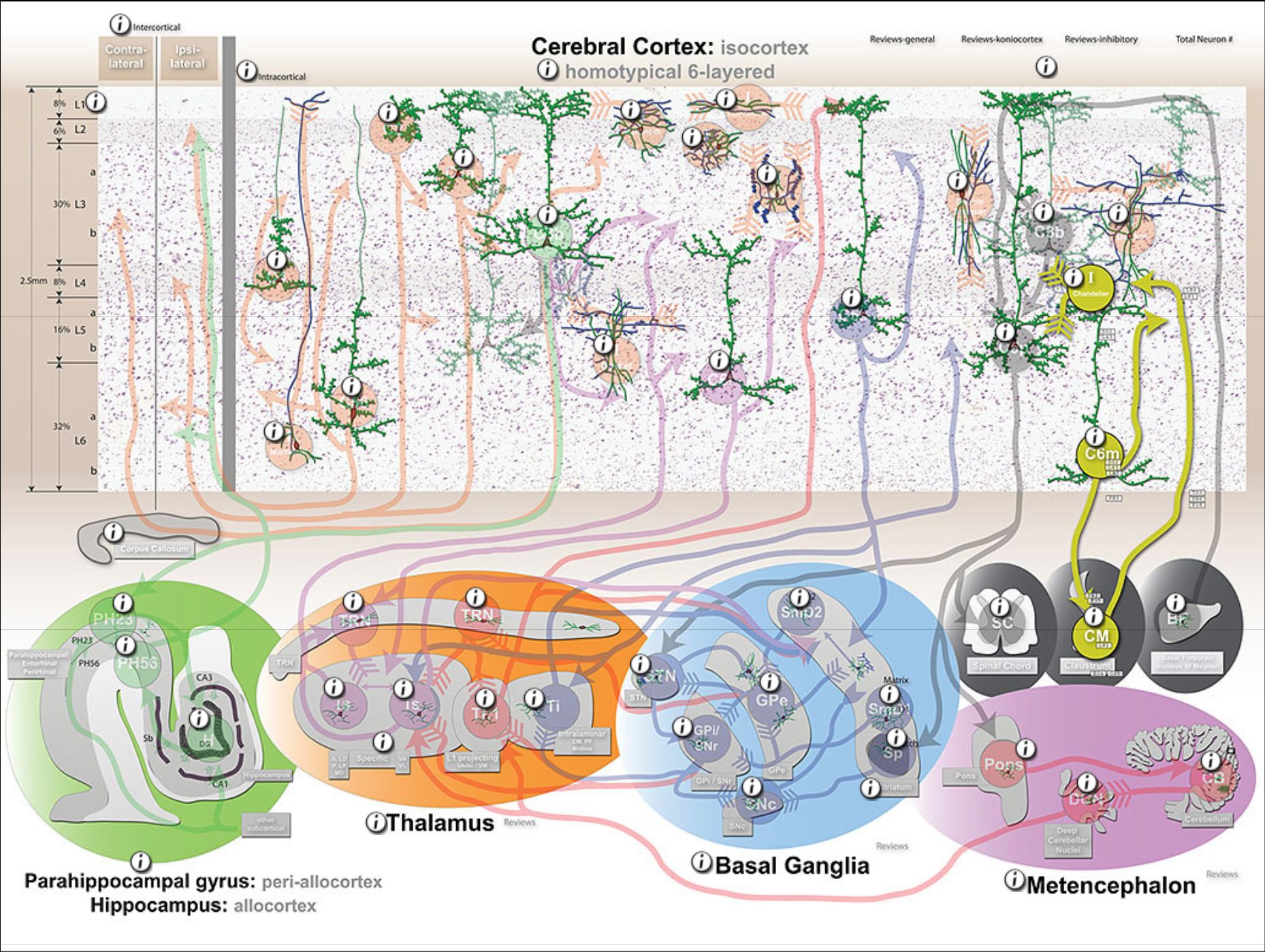
photos_and_videos/TimelinePhotos_kg5QueHwVw/84468244_194138885317606_6638667096148410368_o_194138878650940.jpg THE CIRCUITS OF THE BRAIN
The brain makes use of a number of ‘circuits’. A circuit provides a feedback loop that competes for, creates, maintains, or loses attention, producing information. Just like an electrical (unidirectional) or hydraulic(non-directional) circuit. What you ‘experience’ is whatever has enough current to win the competition among the predictions produced by stimulation.
When you want to theorize how something in your brain is working, think thru:
1) Nerves and neurons are the same thing – just longer or shorter.
2) Nerves and neurons are dumb things: they turn on and off, and they increase or decrease in rate – and that’s it.
3) Groups of Neurons are not so dumb things, they take a sequence of on and off and predict what’s coming next, and forward that prediction to the rest of the neurons in it’s ‘field’ (range).
4) Columns of neurons predict objects (models) and where they are in physical space in relation to you.
5) All active columns compete with each other for ‘coherence’ in time and space. Although there are as much information coming from your eyes as the rest of your body combined.
6) This information is ‘distilled’ into a three dimensional roughly hexagonal spherical grid that accounts for your body size, your body, head, eye direction, your direction of movement and speed of movement, to create what you perceive of as objects, spaces, and boundaries. This is your ‘sixth sense’: the world model. And its done in less than half a second in massive parallel by those very simple nerves, neurons, mini-columns, columns, modules of columns, and 50+ regions of the brain.
7) Anything that is existential is reinforced, and anything tat novel is indexed by auto association to whatever network of neurons just ‘won the competition’, and whatever novelty you experience during the day is repeatedly ‘rehearsed’ (echoed, repeated) very quickly, in a sort of time-sharing with the rest of your brain, and then during sleep.
8) All of this information recursively passes from the back to the front of your brain, iteratively producing competing predictions vying for sufficient ‘amplitude’ to grasp your attention.
9) What ever maintains your attention stays stimulated by the circuit and contributes to the next cycle of information processing. So you control what you think by controlling what you pay attention to. This is what creates cognitive agency. It’s also why its usually easier for men than for women.
10) For the most part the thalamus determines what holds your attention – although our brain includes interruption circuits (dorsal and brainstem) that can seize attention in the case of opportunity, pain, or duress.
11) Your brain evolved to identify routes to resources that can be acquired for consumption, on one hand, and to be cautious of predators on the other – and pretty much, whatever gets your attention will be that – unless you train it to do something else. The hierarchy from the back to the front is from the sensory to the physical to the imagined.
12) Mindfulness – or any other state – is merely the ritualized (habit) of controlling and building networks using the attention circuit. Really. It’s that f—-king simple. Keeping the section of Christmas lights on that you want to keep lit.THE CIRCUITS OF THE BRAIN
The brain makes use of a number of ‘circuits’. A circuit provides a feedback loop that competes for, creates, maintains, or loses attention, producing information. Just like an electrical (unidirectional) or hydraulic(non-directional) circuit. What you ‘experience’ is whatever has enough current to win the competition among the predictions produced by stimulation.
When you want to theorize how something in your brain is working, think thru:
1) Nerves and neurons are the same thing – just longer or shorter.
2) Nerves and neurons are dumb things: they turn on and off, and they increase or decrease in rate – and that’s it.
3) Groups of Neurons are not so dumb things, they take a sequence of on and off and predict what’s coming next, and forward that prediction to the rest of the neurons in it’s ‘field’ (range).
4) Columns of neurons predict objects (models) and where they are in physical space in relation to you.
5) All active columns compete with each other for ‘coherence’ in time and space. Although there are as much information coming from your eyes as the rest of your body combined.
6) This information is ‘distilled’ into a three dimensional roughly hexagonal spherical grid that accounts for your body size, your body, head, eye direction, your direction of movement and speed of movement, to create what you perceive of as objects, spaces, and boundaries. This is your ‘sixth sense’: the world model. And its done in less than half a second in massive parallel by those very simple nerves, neurons, mini-columns, columns, modules of columns, and 50+ regions of the brain.
7) Anything that is existential is reinforced, and anything tat novel is indexed by auto association to whatever network of neurons just ‘won the competition’, and whatever novelty you experience during the day is repeatedly ‘rehearsed’ (echoed, repeated) very quickly, in a sort of time-sharing with the rest of your brain, and then during sleep.
8) All of this information recursively passes from the back to the front of your brain, iteratively producing competing predictions vying for sufficient ‘amplitude’ to grasp your attention.
9) What ever maintains your attention stays stimulated by the circuit and contributes to the next cycle of information processing. So you control what you think by controlling what you pay attention to. This is what creates cognitive agency. It’s also why its usually easier for men than for women.
10) For the most part the thalamus determines what holds your attention – although our brain includes interruption circuits (dorsal and brainstem) that can seize attention in the case of opportunity, pain, or duress.
11) Your brain evolved to identify routes to resources that can be acquired for consumption, on one hand, and to be cautious of predators on the other – and pretty much, whatever gets your attention will be that – unless you train it to do something else. The hierarchy from the back to the front is from the sensory to the physical to the imagined.
12) Mindfulness – or any other state – is merely the ritualized (habit) of controlling and building networks using the attention circuit. Really. It’s that f—-king simple. Keeping the section of Christmas lights on that you want to keep lit.
Source date (UTC): 2020-01-29 12:14:00 UTC
Leave a Reply