photos_and_videos/TimelinePhotos_SxeO6JU-xg/46288046_10156778867667264_6105518357425946624_o_10156778867662264.jpg photos_and_videos/TimelinePhotos_SxeO6JU-xg/46333688_10156778859132264_1543714114944106496_n_10156778859127264.jpg WESTERNERS ARE DIFFERENT – SCIENCE ERODES EQUALITARIAN MYTHS
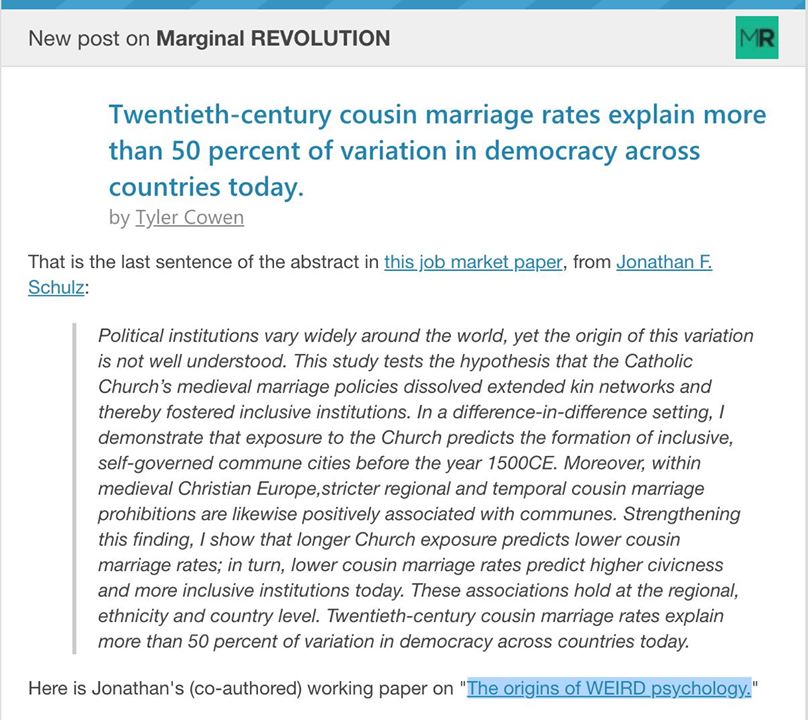
Twentieth-century cousin marriage rates explain more than 50 percent of variation in democracy across countries today.
Political institutions vary widely around the world, yet the origin of this variation is not well understood. This study tests the hypothesis that the Catholic Church’s medieval marriage policies dissolved extended kin networks and thereby fostered inclusive institutions. In a difference-in-difference setting, I demonstrate that exposure to the Church predicts the formation of inclusive, self-governed commune cities before the year 1500CE. Moreover, within medieval Christian Europe,stricter regional and temporal cousin marriage prohibitions are likewise positively associated with communes. Strengthening this finding, I show that longer Church exposure predicts lower cousin marriage rates; in turn, lower cousin marriage rates predict higher civicness and more inclusive institutions today. These associations hold at the regional, ethnicity and country level. Twentieth-century cousin marriage rates explain more than 50 percent of variation in democracy across countries today.
https://marginalrevolution.com/marginalrevolution/2018/11/twentieth-century-cousin-marriage-rates-explain-50-percent-variation-democracy-across-countries-today.html
—-
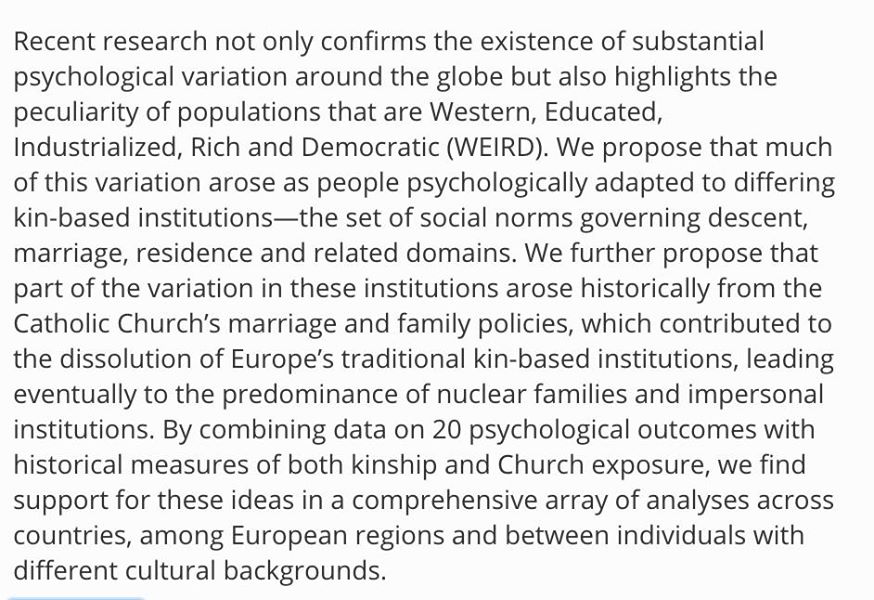
“The origins of WEIRD psychology.“
https://psyarxiv.com/d6qhu/
Source date (UTC): 2018-11-15 00:37:00 UTC
Leave a Reply